
Showing 12 items matching "spencer> miles"
-
 Box Hill Historical Society
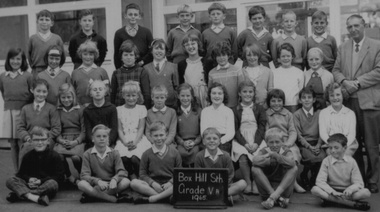
Photograph - Schools - Box Hill South Primary, 1965
... ...Spencer> Miles...Box Hill South State School class photo of Grade 5A, taken 1965 with their teacher Mr Paul Box Hill South State School Donehue> Chris Bolton> Andrew Spencer> Miles Mathews> Paul Shultz> Rodney Kazwara> Steven Morgan> Garth Ritchie> Ian Dalton> Gail Greenwood> Carla Friekie> Dawn Talbett> Anne Thiesson> Jeanette Mortimer> Anne Godfrey> Cheryl Clermon> Gail Barson> Robyn Hinton> Judith Mernson> Susan Ebbs> Lynette Meehen> Ann Hubie> Janeene Roebuck> Kerry Aston> Gail Natiwell> Robyn Paterson> Pam Black> Jennifer Taylor> Lesley Wakem> Mark Bingham> Neil Mackay> Peter Hudson> Peter Vickery> Alan Tyson> Ian Teachers Paul> - (Mr) Primary schools B&w photo Photograph Schools - Box Hill South Primary ...Box Hill South State School class photo of Grade 5A, taken 1965 with their teacher Mr PaulB&w photobox hill south state school, donehue> chris, bolton> andrew, spencer> miles, mathews> paul, shultz> rodney, kazwara> steven, morgan> garth, ritchie> ian, dalton> gail, greenwood> carla, friekie> dawn, talbett> anne, thiesson> jeanette, mortimer> anne, godfrey> cheryl, clermon> gail, barson> robyn, hinton> judith, mernson> susan, ebbs> lynette, meehen> ann, hubie> janeene, roebuck> kerry, aston> gail, natiwell> robyn, paterson> pam, black> jennifer, taylor> lesley, wakem> mark, bingham> neil, mackay> peter, hudson> peter, vickery> alan, tyson> ian, teachers, paul> - (mr), primary schools -
 Ringwood and District Historical Society
Pictures, Spencer Shier Studio, Framed picture of members of the Ringwood Borough Council 1924-1925 in 9 sepia photographs, 1925
... Spencer Shier Studio. Hung in council chambers Presented by Councillor A. Temple Miles JP to the council Framed picture of members of the Ringwood Borough Council 1924-1925 in 9 sepia photographs. ...Prepared by Spencer Shier Studio. Hung in council chambersFramed picture of members of the Ringwood Borough Council 1924-1925 in 9 sepia photographs. +Additional Keywords: Councillor R.G Wilkins / Councillor A. Blood / Councillor J.K. McCaskill / Councillor W. Mackinlay / Councillor A. Temple Miles, JP/Mayor / Councillor J.P. McAlpin, JP / Mr. A.F.B. Long, Town Clerk / Mr. F.R Lucas, C.E./Engineer / Dr. A.T. Langley MB BS/Health OfficerPresented by Councillor A. Temple Miles JP to the council -
 Ringwood and District Historical Society
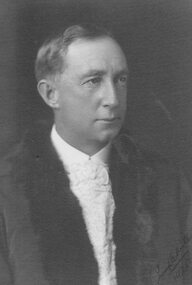
Photograph, Cr A. Temple Miles, Ringwood Council 1925
... Miles, 1925". Photographer listed as, "Spencer Sitier, Howey House, 216 Collins St., Melbourne"....Miles, 1925". Photographer listed as, "Spencer Sitier, Howey House, 216 Collins St., Melbourne". ...Black and white photographWritten under photograph: "Cr A.T. Miles, 1925". Photographer listed as, "Spencer Sitier, Howey House, 216 Collins St., Melbourne". -
 Eltham District Historical Society Inc
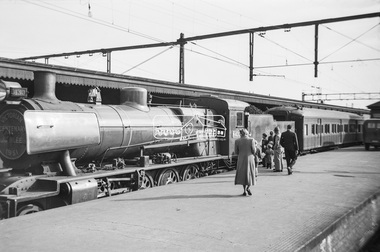
Photograph, George Coop, Steam locomotive N-430 and the Victorian Centenary Jubilee train at Spencer Street Railway Station, Feb. 1951
... miles tour, from 1st February to 30th June, the train visited 168 stations and was inspected by 547,978 people. An entertainment unit accompanied the train and gave 100 performances which were attended by 96,400 people. Source: Report of The Victorian Railways Commissioners for the Year Ended 30th June 1951 George Coop Collection N-430 N-class steam locomotive Victorian Centenary Jubilee 1951 Digital TIFF file Scan of Kopdak 620 black and white negative transparency Steam locomotive N-430 and the Victorian Centenary Jubilee train at Spencer Street Railway Station Photograph Photograph George Coop ...The Centenary-Jubilee Train. The Centenary-Jubilee train was one of the outstanding successes of the Centenary and Jubilee celebrations in Victoria. The train, attractively painted green and gold, consisted of eleven cars, and toured Victoria to take to people in the country exhibits of interest associated with the celebrations. National Art Gallery paintings, rare manuscripts and pictures were displayed, as well as models showing the history of gold production, and models and illustrations of national projects controlled by the various departments of this State. The Commonwealth section included displays by the Army, Navy, Air Force and Post Office; a war materials exhibit from the Supply Department; and diagrams and maps of the Snowy Mountains Hydro-Electric scheme. The Railways exhibit portrayed the century's growth and development of railways in Victoria and their influence on the prosperity of the State. During its 6,000 miles tour, from 1st February to 30th June, the train visited 168 stations and was inspected by 547,978 people. An entertainment unit accompanied the train and gave 100 performances which were attended by 96,400 people. Source: Report of The Victorian Railways Commissioners for the Year Ended 30th June 1951Digital TIFF file Scan of Kopdak 620 black and white negative transparencygeorge coop collection, n-430, n-class steam locomotive, victorian centenary jubilee 1951 -
 Eltham District Historical Society Inc
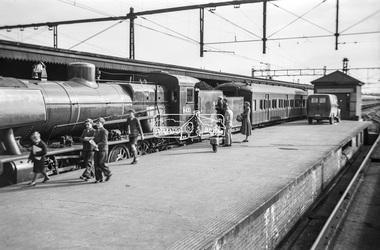
Photograph, George Coop, Steam locomotive N-430 and the Victorian Centenary Jubilee train at Spencer Street Railway Station, Feb. 1951
... miles tour, from 1st February to 30th June, the train visited 168 stations and was inspected by 547,978 people. An entertainment unit accompanied the train and gave 100 performances which were attended by 96,400 people. Source: Report of The Victorian Railways Commissioners for the Year Ended 30th June 1951 George Coop Collection N-430 N-class steam locomotive Victorian Centenary Jubilee 1951 Digital TIFF file Scan of Kopdak 620 black and white negative transparency Steam locomotive N-430 and the Victorian Centenary Jubilee train at Spencer Street Railway Station Photograph Photograph George Coop ...The Centenary-Jubilee Train. The Centenary-Jubilee train was one of the outstanding successes of the Centenary and Jubilee celebrations in Victoria. The train, attractively painted green and gold, consisted of eleven cars, and toured Victoria to take to people in the country exhibits of interest associated with the celebrations. National Art Gallery paintings, rare manuscripts and pictures were displayed, as well as models showing the history of gold production, and models and illustrations of national projects controlled by the various departments of this State. The Commonwealth section included displays by the Army, Navy, Air Force and Post Office; a war materials exhibit from the Supply Department; and diagrams and maps of the Snowy Mountains Hydro-Electric scheme. The Railways exhibit portrayed the century's growth and development of railways in Victoria and their influence on the prosperity of the State. During its 6,000 miles tour, from 1st February to 30th June, the train visited 168 stations and was inspected by 547,978 people. An entertainment unit accompanied the train and gave 100 performances which were attended by 96,400 people. Source: Report of The Victorian Railways Commissioners for the Year Ended 30th June 1951Digital TIFF file Scan of Kopdak 620 black and white negative transparencygeorge coop collection, n-430, n-class steam locomotive, victorian centenary jubilee 1951 -
 Bendigo Historical Society Inc.
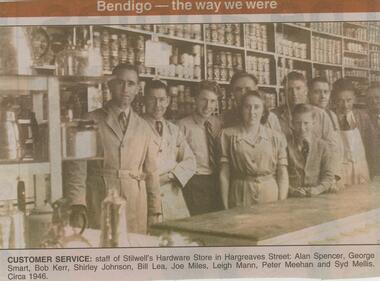
Newspaper - JENNY FOLEY COLLECTION: CUSTOMER SERVICE
... Customer service: staff of Stilwell's Hardware store in Hargreaves Street: Alan Spencer, George Smart, Bob Kerr, Shirley Johnson, Bill Lea, Joe Miles, Leigh Mann, Peter Meehan and Syd Mellis. ...Customer service: staff of Stilwell's Hardware store in Hargreaves Street: Alan Spencer, George Smart, Bob Kerr, Shirley Johnson, Bill Lea, Joe Miles, Leigh Mann, Peter Meehan and Syd Mellis. ...Bendigo Advertiser ''The way we were'' from 2001. Customer service: staff of Stilwell's Hardware store in Hargreaves Street: Alan Spencer, George Smart, Bob Kerr, Shirley Johnson, Bill Lea, Joe Miles, Leigh Mann, Peter Meehan and Syd Mellis. Circa 1946. The clip is in a folder.newspaper, bendigo advertiser, the way we were -
 Bendigo Historical Society Inc.
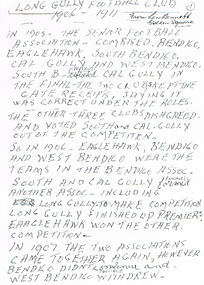
Document - LONG GULLY HISTORY GROUP COLLECTION: SHORT HISTORY OF THE LONG GULLY FOOTBALL CLUB 1906 - 1911
... Names are: Jan Jewel, Ben Thompson, Jack Dunstan, Elisaa Donstan, Fred Jenkins, Tommy Allen, Paddy Rohan, W White, Hum Scott, Buller Webster, Billy Cook, Sapper Newcombe, Spreader Ennor, Syd Jenkins, Buller Canavan, Tommy Baxter, Len Bowe, Joe Scadden, Brit Pattinson, Bruiser Williams, Cap Muir, D Mahoney, Tassy Trahair, P Hughes, Taffy Vercoe, G Ogilvie, Tom Smith, Nels Keating, A Blackmore, J Benstead, Bony Daykin, Mottle, Tamus, Hilby Jenkins, Les Sinclair, Dave Mahoney, Perl Mahoney, Errol Hargreaves, Ant Theodore, Les Theodore, W Donaldson, Henry Boldt, Peter Hughes, J White, P Walker, Jack Roberts, Jim Turner, Cap Muir, Brit Pattinson, W Byrne, Trahair, Bendigo District Football Association, Lol, Cook, Sunny, Jim Spencer, Teddy Mills, W Cravino, Snowy Bolger, Henner Wright, R Moran, Miles O'Neill, W Hill, M Craven, T Webb, A pattinson, F Pattinson, A Upstett, W Hewitt, J Foster, Big Seawood, Tas Andrew, Malachi Trewartha, Pompey Scaddon, Mottle Daykin, Barney Fagan, Tax Edwards, J Bornford, P Bauer, Olly Heath, G Graham, Geordie Ogilvie sen, Bill Ewing, Barkley Bailes, Harry Glen, Punter Sells, Les Oliver, A Muerer, V Proffit, A Hands, A Cambridge, A Trajair, Frank Mueller, H Hunter, W Luke, H Barlow, Bertie Pierce, F Fielding, Bendigo City, Harry Morgan,...BENDIGO History long gully history group Jan Jewel Bendigo Advertiser Ben thompson Jack Dunstan Elisaa Donstan Fred jenkins Tommy Allen Paddy Rohan W White Hum Scott Buller Webster Billy Cook Sapper Newcombe Spreader Ennor Syd Jenkins Buller Canavan Tommy Baxter Len Bowe Joe Scadden Brit Pattinson Bruiser Williams Cap Muir D Mahoney Tassy Trahair P Hughes Taffy Vercoe G Ogilvie Tom Smith Nels Keating A Blackmore J Benstead Bony Daykin Mottle Tamus Hilby Jenkins Les Sinclair Dave Mahoney Perl Mahoney Errol Hargreaves Ant Theodore Les Theodore W Donaldson Henry Boldt Peter Hughes J White P Walker Jack Roberts Jim Turner Cap Muir Brit Pattinson W Byrne Trahair William Bidwell J E Fauckner J Smith Bendigo District Football Association Lol Cook Sunny Jim Spencer Teddy Mills W Cravino Snowy Bolger Henner Wright R Moran Miles O'Neill W Hill M Craven T Webb A pattinson F Pattinson A Upstett W Hewitt J Foster Big Seawood Tas Andrew Malachi Trewartha Pompey Scaddon Mottle Daykin Barney Fagan Tax Edwards J Bornford P Bauer Olly Heath G Graham Geordie Ogilvie sen Bill Ewing Barkley Bailes Harry Glen Punter Sells Les Oliver A Muerer V Proffit A Hands A Cambridge A Trajair Frank Mueller H Hunter W Luke H Barlow Bertie Pierce F Fielding Bendigo City Harry Morgan Short History of the Long Gully Football Club 1906 - 1911 Len Bennett Long Gully Bridge Long Gully Alberts Team Jan Jewel Bendigo Advertiser Ben thompson Jack Dunstan Elisaa Donstan Fred jenkins Tommy Allen Paddy Rohan W White Hum Scott Buller Webster Billy Cook Sapper Newcombe Spreader Ennor Syd Jenkins Buller Canavan Tommy Baxter Len Bowe Joe Scadden Brit Pattinson Bruiser Williams Cap Muir D Mahoney Tassy Trahair P Hughes Taffy Vercoe G Ogilvie Tom Smith Nels Keating A Blackmore J Benstead Bony Daykin Mottle Tamus Hilby Jenkins Les Sinclair Dave Mahoney Perl Mahoney Errol Hargreaves Ant Theodore Les Theodore W Donaldson Henry Boldt Peter Hughes J White P Walker Jack Roberts Jim Turner Cap Muir Brit Pattinson W Byrne Trahair William Bidwell J E Fauckner J Smith Bendigo District Football Association Lol Cook Sunny Jim Spencer Teddy Mills W Cravino Snowy Bolger Henner Wright R Moran Miles O'Neill W Hill M Craven T Webb A pattinson F Pattinson A Upstett W Hewitt J Foster Big Seawood Tas Andrew Malachi Trewartha Pompey Scaddon Mottle Daykin Barney Fagan Tax Edwards J Bornford P Bauer Olly Heath G Graham Geordie Ogilvie sen Bill Ewing Barkley Bailes Harry Glen Punter Sells Les Oliver A Muerer V Proffit A Hands A Cambridge A Trajair Frank Mueller H Hunter W Luke H Barlow Bertie Pierce F Fielding Bendigo City Harry Morgan Copy of a handwritten Short History, (6 pages) of the Long Gully Football Club 1906 - 1911. ...Copy of a handwritten Short History, (6 pages) of the Long Gully Football Club 1906 - 1911. Includes some history, grounds, advertisements and names of players. Names are: Jan Jewel, Ben Thompson, Jack Dunstan, Elisaa Donstan, Fred Jenkins, Tommy Allen, Paddy Rohan, W White, Hum Scott, Buller Webster, Billy Cook, Sapper Newcombe, Spreader Ennor, Syd Jenkins, Buller Canavan, Tommy Baxter, Len Bowe, Joe Scadden, Brit Pattinson, Bruiser Williams, Cap Muir, D Mahoney, Tassy Trahair, P Hughes, Taffy Vercoe, G Ogilvie, Tom Smith, Nels Keating, A Blackmore, J Benstead, Bony Daykin, Mottle, Tamus, Hilby Jenkins, Les Sinclair, Dave Mahoney, Perl Mahoney, Errol Hargreaves, Ant Theodore, Les Theodore, W Donaldson, Henry Boldt, Peter Hughes, J White, P Walker, Jack Roberts, Jim Turner, Cap Muir, Brit Pattinson, W Byrne, Trahair, Bendigo District Football Association, Lol, Cook, Sunny, Jim Spencer, Teddy Mills, W Cravino, Snowy Bolger, Henner Wright, R Moran, Miles O'Neill, W Hill, M Craven, T Webb, A pattinson, F Pattinson, A Upstett, W Hewitt, J Foster, Big Seawood, Tas Andrew, Malachi Trewartha, Pompey Scaddon, Mottle Daykin, Barney Fagan, Tax Edwards, J Bornford, P Bauer, Olly Heath, G Graham, Geordie Ogilvie sen, Bill Ewing, Barkley Bailes, Harry Glen, Punter Sells, Les Oliver, A Muerer, V Proffit, A Hands, A Cambridge, A Trajair, Frank Mueller, H Hunter, W Luke, H Barlow, Bertie Pierce, F Fielding, Bendigo City, Harry Morgan,bendigo, history, long gully history group, jan jewel, bendigo advertiser, ben thompson, jack dunstan, elisaa donstan, fred jenkins, tommy allen, paddy rohan, w white, hum scott, buller webster, billy cook, sapper newcombe, spreader ennor, syd jenkins, buller canavan, tommy baxter, len bowe, joe scadden, brit pattinson, bruiser williams, cap muir, d mahoney, tassy trahair, p hughes, taffy vercoe, g ogilvie, tom smith, nels keating, a blackmore, j benstead, bony daykin, mottle, tamus, hilby jenkins, les sinclair, dave mahoney, perl mahoney, errol hargreaves, ant theodore, les theodore, w donaldson, henry boldt, peter hughes, j white, p walker, jack roberts, jim turner, cap muir, brit pattinson, w byrne, trahair, william bidwell, j e fauckner, j smith, bendigo district football association, lol, cook, sunny, jim spencer, teddy mills, w cravino, snowy bolger, henner wright, r moran, miles o'neill, w hill, m craven, t webb, a pattinson, f pattinson, a upstett, w hewitt, j foster, big seawood, tas andrew, malachi trewartha, pompey scaddon, mottle daykin, barney fagan, tax edwards, j bornford, p bauer, olly heath, g graham, geordie ogilvie sen, bill ewing, barkley bailes, harry glen, punter sells, les oliver, a muerer, v proffit, a hands, a cambridge, a trajair, frank mueller, h hunter, w luke, h barlow, bertie pierce, f fielding, bendigo city, harry morgan, short history of the long gully football club 1906 - 1911, len bennett, long gully bridge, long gully alberts team, jan jewel, bendigo advertiser, ben thompson, jack dunstan, elisaa donstan, fred jenkins, tommy allen, paddy rohan, w white, hum scott, buller webster, billy cook, sapper newcombe, spreader ennor, syd jenkins, buller canavan, tommy baxter, len bowe, joe scadden, brit pattinson, bruiser williams, cap muir, d mahoney, tassy trahair, p hughes, taffy vercoe, g ogilvie, tom smith, nels keating, a blackmore, j benstead, bony daykin, mottle, tamus, hilby jenkins, les sinclair, dave mahoney, perl mahoney, errol hargreaves, ant theodore, les theodore, w donaldson, henry boldt, peter hughes, j white, p walker, jack roberts, jim turner, cap muir, brit pattinson, w byrne, trahair, william bidwell, j e fauckner, j smith, bendigo district football association, lol, cook, sunny, jim spencer, teddy mills, w cravino, snowy bolger, henner wright, r moran, miles o'neill, w hill, m craven, t webb, a pattinson, f pattinson, a upstett, w hewitt, j foster, big seawood, tas andrew, malachi trewartha, pompey scaddon, mottle daykin, barney fagan, tax edwards, j bornford, p bauer, olly heath, g graham, geordie ogilvie sen, bill ewing, barkley bailes, harry glen, punter sells, les oliver, a muerer, v proffit, a hands, a cambridge, a trajair, frank mueller, h hunter, w luke, h barlow, bertie pierce, f fielding, bendigo city, harry morgan -
 Bendigo Historical Society Inc.
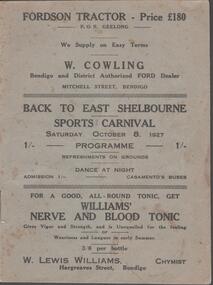
Document - BACK TO EAST SHELBOURNE SPORTS CARNIVAL, 8 October, 1927
... Next 8 pages contain information on the history of East Shelbourne beginning with; This district is situated about ten miles west of south-west of Bendigo on Back Creek or Spring Creek, which received its names from the early diggers of Bendigo who, through shortage of water, were compelled to puddle at Bullock Creek or further 'back,' hence Back Creek; and because of the number of springs it contained - Spring Creek. Among the first to settle, in 1860, were Messrs. John Jenkinson, J Kilgour, T Connelly, G Nichols, R Fox, (who married Mrs James Jenkinson), Kenny, J Roberts, J Genders, J Curry, G Nevinson, Bartram, J Geary, A Nicholl, H Spencer...Next 8 pages contain information on the history of East Shelbourne beginning with; This district is situated about ten miles west of south-west of Bendigo on Back Creek or Spring Creek, which received its names from the early diggers of Bendigo who, through shortage of water, were compelled to puddle at Bullock Creek or further 'back,' hence Back Creek; and because of the number of springs it contained - Spring Creek. Among the first to settle, in 1860, were Messrs. John Jenkinson, J Kilgour, T Connelly, G Nichols, R Fox, (who married Mrs James Jenkinson), Kenny, J Roberts, J Genders, J Curry, G Nevinson, Bartram, J Geary, A Nicholl, H Spencer ...Back To East Shelbourne Sports Carnival, Saturday, October 8, 1927. Programme. Refreshments on grounds, dance at night. 1/- Casamento's Buses. Executive Committee: President; W Harris. Vice-President; M De Araugo. Messrs. E Wright, A D Holden, W Hamilton, J Bartels, J Hinck, and H Hinck. Hon. Sec.; H M Burke. Asst. Hon. Sec.; G H Marshall. Ladies; Mesdames J Bartels, H Burke, G H Marshall, E Pocock, R Vines, and E Wright. General Committee; In addition to the above, Messrs. E Pocock, J De Araugo, F J Roberts, and W Marshall, Mesdames W Harris, A Holden, J De Araugo, F J Roberts, and Miss Pocock. Officials Judges: Messrs. T D Cairns, J Craven, and Geo. Hogben. Handicappers: Mr P Davidson (Northern District Walker's Assn.) Starter: Mr W Harris, M De Araugo, J Hinck, H Hovenden, E Pocock, W Hamilton, F J Roberts, A D Holden. Timekeeper: Mr H Hinck. Patrons: Cr, J Bartels, Nuttall & Clarke, Mrs D Punton, R S V Cocking, J Murray, and A Wells. Next 8 pages contain information on the history of East Shelbourne beginning with; This district is situated about ten miles west of south-west of Bendigo on Back Creek or Spring Creek, which received its names from the early diggers of Bendigo who, through shortage of water, were compelled to puddle at Bullock Creek or further 'back,' hence Back Creek; and because of the number of springs it contained - Spring Creek. Among the first to settle, in 1860, were Messrs. John Jenkinson, J Kilgour, T Connelly, G Nichols, R Fox, (who married Mrs James Jenkinson), Kenny, J Roberts, J Genders, J Curry, G Nevinson, Bartram, J Geary, A Nicholl, H Spencer, W Saunders, Mrs Prichard, and J Stansfield. History of East Shelbourne continues . . . Events held were Boy's (State School) Bicycle Race, Stepping the Distance (Gents), Stepping the Distance (Ladies), Bowling at the Stump, Kicking Football Through Hoop, Sheaf Toss, Bucket Ball, Sheffield, Children's Relay Race, Men's Potato Race, Tilting Rings, on Bikes, Walking Contest 1 mile, Car Race through pegs, Slow Bicycle Race 50 yards, Handicap Bicycle Race 2 miles, Tilting Rings in Cars, High Jump, Ladies' and Gent's Cigarette Race, Weight Guessing. Prizes were awarded for first and second placing of these events.In 1923, a Sports Carnival was held in the precincts of what was then a water reserve, situated south of the State School. The area was reserved for watering purposes on 1st May, 1894; and on July 15th, 1912, a small portion was excised. By 1923 its usefulness for water storage had disappeared, and being ideal for recreation purposes, it was decided, at the final meeting of the above sorts carnival, to apply for the area appointed, Mr W Harris (chairman), Messrs. G H Marshall, J Roberts, D Gill, M Connolly, R Vines, E Pocock, and H M Burke (secretary). The matter terminated in a Land Board, presided over by Mr McPherson, being held in Bendigo. The application was granted, but was not gazetted, until Messrs. W Harris and F J Roberts, with Messrs. A E Cook, MLA and Hon. H Keck, MLC interviewed the Minister for Lands. Soon afterwards, at a public meeting, the following members were elected to constitute the first Board of management, Messrs. W Harris (chairman), G H Marshall, A D Holden, F J Roberts (tres.), M D'Araugo, E Wright, and H M Burke (sec.). Since then the arena has been cleared and levelled by residents, and labor and material to the value of 150 pounds have been put into the reserve. At least 2/3rds of the program contain ads from business in Bendigo. Fordson Tractor - W Cowling, W Lewis William's Chymist, Collier footwear, William Wallace Land and Clearing Sales, Bain & Daws Groceries, Farmers & Citizens Trustees Company Bendigo Limited, Northern Seed Supply Co., Marong Bakery, Bennetts' Arcade Store, Marong Hotel, Warren's Drapery & Clothing, Jas. Friswell Butcher, Webster's Wireless, Baker & Woods Tennis Supplies, Hartleys Wireless, Cycle Hartleys, Bendigo Book & Stationery Centre Frank J Every's, T R Jones Chemist, Wool Skins & Hides F Ferguson, Furniture Carpets Linoleums Morley Johnsons, Jewellery & Silverware Prescott & Dawe, Drapers Honan & O'Toole, Stilwell's of Bendigo, Gents' & Ladies' Tailoring Hatters & Mercers Messrs. Denton Bros., Groceries Ales Wines & Spirits W Jeffrey, Ashman's Tailors Hatters Mercers, Myer's, Farmers' Grocery D Whyte & Co., Drapers & Furniture Stores The Beehive, Butcher les. Friswell, Tobacconist & Hairdresser W J Lenten, Timber Merchants & Ironmongers Hume & Iser, Stock E M Vains & Co., Ladies' & Gents' Tailors Clifford & Fulton, Printers & Stationers Bolton Bros. Pty Ltd, Bendigo Leather Shop, Everything Musical Suttons, Andrew's Auction Rooms Butter Eggs Poultry etc, Meats A C Petherick's, Albert Bush's Produce Stores & Chaff Mills, T D Cairns & Co., Jeweller C J Kirby, Casamento's Garage & Ballarat Motor Bus Service, Webster Bros. Sporting House Cycle Builders Motor Cycle & Car Agents, British Motors Bendigo, Webb's Bacon Depot. 20 pages plus coverBoltons Print, Bendigoevent, social, east shelbourne sports carnival -
 Eltham District Historical Society Inc
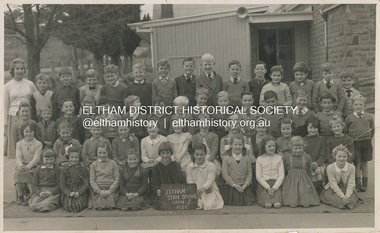
Photograph - Digital Copy, George Murray, Eltham State School, Grade 2, 1958
... Spencer Third Row (L-R): Bruce Martin, Neville Myers, Nelson (Smart?), George Sutherland, Robert Dowdell, David Campbell, Ken Dickerson, Kit Hill, Wayne Brodford, Martin Fowler, Michael Kilpatrick, Colin Graham, Ken Brown, David Boss, Greg Lewis Second Row (L-R): Bora Meredith, Heather Dyke, Linda Morris, Janne Miles, Biddy Quinlan, Cheryl Croft, Terry Croft, Margaret Box, Shelley Barker, Wendy Bradley, Sandra Black, Lynette Pitcher Front Row (L-R): Sally Lewis, Faye Harris, Elizabeth Jolley, Wendy Rainsbury, Helen Corrie, Bronwen Cavistock, June Skippington, Gloria Oldfield, Anna Jacka, Ruth Gangell...Spencer Third Row (L-R): Bruce Martin, Neville Myers, Nelson (Smart?), George Sutherland, Robert Dowdell, David Campbell, Ken Dickerson, Kit Hill, Wayne Brodford, Martin Fowler, Michael Kilpatrick, Colin Graham, Ken Brown, David Boss, Greg Lewis Second Row (L-R): Bora Meredith, Heather Dyke, Linda Morris, Janne Miles, Biddy Quinlan, Cheryl Croft, Terry Croft, Margaret Box, Shelley Barker, Wendy Bradley, Sandra Black, Lynette Pitcher Front Row (L-R): Sally Lewis, Faye Harris, Elizabeth Jolley, Wendy Rainsbury, Helen Corrie, Bronwen Cavistock, June Skippington, Gloria Oldfield, Anna Jacka, Ruth Gangell 1958 Anna Jacka Biddy Quinlan Bora Meredith Bronwen Cavistock Bruce Martin Cheryl Croft Class Photo Colin Graham David Boss David Campbell Don Muir Elizabeth Jolley Eltham State School No. 209 Faye Harris Faye Walker (nee Harris) Collection Geoffrey Thorpe George Sutherland Gilbert McGloughlin Gloria Oldfield Grade 2 Greg Lewis Heather Dyke Helen Corrie Ian Murray Janne Miles Jeff Steele John Mead June Skippington Ken Brown Ken Dickerson Kim Hunter Kit Hill Linda Morris Lynette Pitcher Marcus Skipper Margaret Box Martin Fowler Michael Kilpatrick Nelson Smart Neville Myers Peter Norman Richard Lynch Robert Dowdell Robert Spencer Russell Smart Ruth Gangell Sally Lewis Sandra Black Shelley Barker Stephen Short Terry Croft Wayne Brodford Wendy Bradley Wendy Rainsbury Names written on reverse and photographer's stamp Photo scanned March 18, 2024 from print (13 x 20.5 cm) on loan Eltham State School, Grade 2 Photograph Digital Copy George Murray ...Back Row (L-R): Russell Smart, John Mead, Peter Norman, Kim Hunter, Richard Lynch, Stephen Short, Gilbert McGloughlin, Don Muir, Jeff Steele, Geoffrey Thorpe, Ian Murray, Marcus Skipper, Ray ( ? ), Robert Spencer Third Row (L-R): Bruce Martin, Neville Myers, Nelson (Smart?), George Sutherland, Robert Dowdell, David Campbell, Ken Dickerson, Kit Hill, Wayne Brodford, Martin Fowler, Michael Kilpatrick, Colin Graham, Ken Brown, David Boss, Greg Lewis Second Row (L-R): Bora Meredith, Heather Dyke, Linda Morris, Janne Miles, Biddy Quinlan, Cheryl Croft, Terry Croft, Margaret Box, Shelley Barker, Wendy Bradley, Sandra Black, Lynette Pitcher Front Row (L-R): Sally Lewis, Faye Harris, Elizabeth Jolley, Wendy Rainsbury, Helen Corrie, Bronwen Cavistock, June Skippington, Gloria Oldfield, Anna Jacka, Ruth GangellNames written on reverse and photographer's stamp1958, anna jacka, biddy quinlan, bora meredith, bronwen cavistock, bruce martin, cheryl croft, class photo, colin graham, david boss, david campbell, don muir, elizabeth jolley, eltham state school no. 209, faye harris, faye walker (nee harris) collection, geoffrey thorpe, george sutherland, gilbert mcgloughlin, gloria oldfield, grade 2, greg lewis, heather dyke, helen corrie, ian murray, janne miles, jeff steele, john mead, june skippington, ken brown, ken dickerson, kim hunter, kit hill, linda morris, lynette pitcher, marcus skipper, margaret box, martin fowler, michael kilpatrick, nelson smart, neville myers, peter norman, richard lynch, robert dowdell, robert spencer, russell smart, ruth gangell, sally lewis, sandra black, shelley barker, stephen short, terry croft, wayne brodford, wendy bradley, wendy rainsbury -
 Melbourne Tram Museum
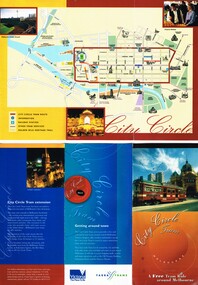
Pamphlet, Yarra Trams, "City Circle Tram Melbourne", 2003
... Trams tramways City Circle Yarra Trams Docklands Spencer St Pamphlet - DL 6 fold from A3 sheet, full colour titled "City Circle Tram Melbourne", detailing the City Circle tram, c2003 - has route via Harbour Esplanade - map shows various points, the Golden Mile heritage walk. ...Pamphlet - DL 6 fold from A3 sheet, full colour titled "City Circle Tram Melbourne", detailing the City Circle tram, c2003 - has route via Harbour Esplanade - map shows various points, the Golden Mile heritage walk. Notes that the route had recently been extended to run through Docklands. Has contact details but no web site. Has the Victoria government and Yarra Trams logos. Tram was extended early 2003. See Reg Item 866, 2703 and 2993 for other versions. Set of five additional pamphlets, all DL when folded about the Circle Tram - variants on a theme. All with a map. .1 - 6 fold - PTC - 1994 - could be the first pamphlet - has logos of State Govt, Agenda 21, Better Cities and PTC. .2 - 8 fold - Yarra Trams and Vic Govt - details the points of interest and general tram travel. .3 - 8 fold - 2009 - Yarra Trams, Vic tourism, city of Melbourne - as above. Running via Spencer St .4 - single DL sheet - 2009 update - extended service - to Docklands, with map .5 - single DL sheet - 2/2012 - simple details.trams, tramways, city circle, yarra trams, docklands, spencer st -
 Melbourne Tram Museum
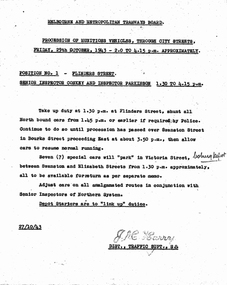
Document - Memorandum, Melbourne & Metropolitan Tramways Board (MMTB), "Procession of Munitions Vehicles, through city streets", Oct. 1943
... Spencer St Collins St "Mr Harry" written in pencil on one letter. "Coburg depot" written on 2 memos. Several comments written in pencil regarding tram scheduling. 2 copies of letter from HS Wootton, Town Clerk, City of Melbourne, titled "Arrangements in connection with "Miles of Munitions 1943" procession through city streets on Friday 29th October, 1943, in connection with Fourth Liberty War Loan". ...2 copies of letter from HS Wootton, Town Clerk, City of Melbourne, titled "Arrangements in connection with "Miles of Munitions 1943" procession through city streets on Friday 29th October, 1943, in connection with Fourth Liberty War Loan". Provides details of route and assembly points with tram requirements. Dated 21 Oct 1943 8 memos from JM Harry, Dist Traffic Supt SS regarding tram arrangements to various inspectors. Memos dated 27/10/1943."Mr Harry" written in pencil on one letter. "Coburg depot" written on 2 memos. Several comments written in pencil regarding tram scheduling.trams, tramways, events, parades, world war 2, coburg depot, hanna st depot, malvern depot, hawthorn depot, camberwell depot, glenhuntly depot, victoria st, swanston st, elizabeth st, spencer st, collins st -
 City of Melbourne Libraries
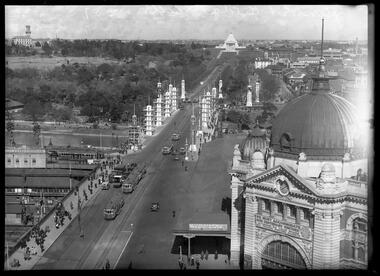
Photograph, Bull, Hugh Jones, 1897-1993, Princes Bridge Centenary pylons under construction
... Spencer Streets. Together with the Princes Bridge pylons, approximately 28 miles of wire was required to supply power to the more than 20,000 lights. ...Spencer Streets. Together with the Princes Bridge pylons, approximately 28 miles of wire was required to supply power to the more than 20,000 lights. ...Princes Bridge Centenary pylons under construction Possibly taken from Young and Jacksons Hotel (formerly Princes Bridge Hotel) on the corner of Flinders and Swanston streets, Flinders Street Station’s clocks and main entrance dominate, along with its distinctive copper dome and decorative façade. The time on the main clock is 1.40pm, and the sign underneath, reflecting Melbourne’s upcoming Centenary reads, “We must accommodate our Centenary visitors! Citizens! Do your share by taking paying guests.” At left is the original Princes Bridge Station, today the site of Federation Square. The riverside tram terminus advertises a Café/Tobacconist/Refreshment Room selling cigars & cigarettes, fountain drinks & confectionery, and in smaller text: “Leave your boot repairs here”. Nearly everyone is dressed in dark suits, coats and hats. The footpaths are wide and there are no traffic lights. The roadway stretches towards the Shrine of Remembrance, not yet dedicated but very dominant on the skyline. Government House is clearly visible across the wide parkland that would come to be known as Kings Domain and that is an area of deep importance to the people of the Eastern Kulin. Originally, Birrarung was part of a network of swamps and lagoons linked to the course of the river. From 1896, Public Works Department engineer Carlo Catani, oversaw a new channel to straighten the river and the swamps and lagoons were filled with spoil from the channel works. From the same vantage point today, only the top of the tower of Government House would be visible. The photo captures the pylons along Princes Bridge, mid-construction and being installed to mark Melbourne’s Centenary. The pylons were not without controversy. Both The Argus and The Age bemoaned them for being “made almost entirely of imported softwood timber”, denying work to native hardwood timber workers and sawmillers, and leading visitors to think Australia did not have its own exceptional native hardwoods. The pylons were also variously described in their incomplete state, as unimaginative and resembling an oilfield. Published: The Age 5 September 1934 Featured in "Newsworthy: Melbourne in photographs 1933-1936" exhibition at East Melbourne Library, October to December 2023. Exhibition caption by project volunteer, Louise McKenzie Photographer notations on slide: "Pylons + St Kilda Rd C57" Published: Age (Melbourne, Vic. : 1854 - 1954), Wednesday 5 September 1934, page 11 Published title: DECORATIONS -- THEN AND NOW. Published caption: "Although not completed yet, some impression of the effect of the decorations on Princes-bridge may be obtained from the first picture which shows the majestic sweep of St Kilda road with the Shrine of Remembrance and Government House dominating the horizon. The area to the left of St. Kilda-road and in front of Government House is portion of the area which it is proposed to call the King's Domain, which extends to Domain-road and Anderson-street..." Description: East-facing, elevated view of Flinders Street Station and Princes Bridge, featuring partially completed pylons erected for Melbourne's Centenary celebrations. The Shrine of Remembrance and Government House can be seen in the distance. In the foreground are trams, cars and trucks, pedestrians, Batman Avenue tram terminus and refreshment rooms. Signage on Flinders Street Station encourages citizens to accommodate Centenary visitors. The Melbourne Centenary was held 1934-35 in celebration John Batman's proclamation that Melbourne "the place for a village". Centenary events included a visit by Prince Henry, Duke of Gloucester. A Centenary Cake measuring 50 feet in height and ten tons in weight was cut into 250,000 pieces and sold at 1 shilling per piece for charity. Spectacular floodlighting of city landmarks, the creation of the Pioneer Women's Memorial Garden, and the MacRobertson Air Race from London, were other notable activities. Research by project volunteer, Louise McKenzie: The photo in The Age collage of 5 September 1934 has a slightly cropped foreground. The original photo has been taken from an elevated vantage point, most probably the roof of the Nicholas Building on the corner of Flinders and Swanston streets. The right foreground is dominated by the main “clocks” entrance to Flinders Street Station, showing its distinctive copper dome and decorative façade. The time on the main clock is 1.40 pm. The main sign on the front of the Station reads, "We Must Accommodate our Centenary Visitors! Citizens! Do your share by taking paying guests. Write to The Official Centenary Accommodation Bureau, 436 Collins St. City. Tel M 4671”. Another sign at eye level at the main entrance says: “Cheap Trips on Sundays”. The sign on the end of the roof along the eastern side of the station reads, “The Babies Need Your Help! Support Broadmeadows Foundling Hospital Appeal. July and August”. Run by the Sisters of St Joseph of the Sacred Heart, St Joseph’s Foundling Hospital was a purpose built infants’ home for up to 300 babies, plus accommodation for expectant mothers, mainly single women. In the early 1930s, the department (Victorian Children’s Welfare Department) contracted St Joseph’s Foundling Hospital to care for an additional 60 infant state wards, and up to 175 non wards at any given time. In 1931 it also operated a mothercraft training school. The centre foreground shows the commencement of Princes Bridge. Beneath the left side of the bridge was the site of the original Princes Bridge Station, by this time incorporated into Flinders Street Station, and today the area is the site of Federation Square. It was linked to Flinders Street station by the railway tracks that ran underneath the northern approach to the bridge. This photo shows a tram terminus which has a Café/Tobacconist/Refreshment Room, selling cigars & cigarettes, fountain drinks & confectionary, and a sign: Leave your boot repairs here. In the foreground is a wide roadway running south/north, comprising two vehicle lanes each heading north/south, and a central section containing two sets of tram tracks. There are cars, buses and delivery vans on the roadway. The trams visible are Glen Iris (Route No. 6; tram no. 448), Toorak (Route No. 8, tram no. 333), ? (No. 7), ? (No. 1), and ? (No. 2A). The footpaths are extremely wide. There is a square newspaper/magazine stand on the eastern side footpath. And also a “Ferry” sign. There are no traffic lights, but a policeman is visible on the roadway. There are pedestrians – men, women, children, a porter with trolley, women with prams. Clothing comprises dark suits, coats and hats for nearly everyone. There are double headed “Collins Street” lights along the side of the roadway, and along the northern riverbank. The roadway in the foreground is an extension of Swanston Street, which becomes Princes Bridge, then St Kilda Road, stretching towards the Shrine of Remembrance, and diverting past it. The Shrine had not yet been officially dedicated, and looks very white and dominant on the skyline. On the LHS of St Kilda Road, Government House is clearly visible across the wide parkland to be known as Kings Domain. The Kings Domain area is important to the people of the Eastern Kulin nation, and also has historical importance for its association with the early settlement of Melbourne and the foundation of British colonial administration in Victoria. On the southern side of the Yarra River (Birrarung) an historic rowing boathouse is visible, located adjacent to the Alexandra Gardens. Originally Birrarung was part of a network of swamps and lagoons linked to the course of the river. From 1896, under the guidance of engineer Carlo Catani* a new channel to straighten the river was created and the swamps and lagoons were filled with spoil from the channel works. The gardens were then created and completed in time for a Royal visit by the Duke of York in May 1901. The gardens are named after Alexandra of Denmark, the wife of King Edward VII. Both these areas, plus the Royal Botanic Gardens Victoria, Shrine of Remembrance Reserve, Sidney Myer Music Bowl, Government House, and the Queen Victoria Gardens together form the Domain Parklands. The extent of the subsequent plantings is evident today, where from the same vantage point only the top of the tower of Government House would be visible. *Catani was born in Florence in 1852, but after arriving in Melbourne worked as a civil engineer for the Victorian Government. His last major project was the reclamation of the foreshore of St Kilda, envisaged in the style of a European resort, complete with a split level esplanade, bathing pavilions, dance halls, amusements and a French-Italian style of landscape complete with palms. The gardens at the end of Fitzroy Street, St Kilda, now bear his name. The historic boathouse visible across the Yarra is another glimpse into Melbourne’s past. “Boathouse Row” comprises 7 amateur rowing clubs, the first established in 1859 (Melbourne University Boat Club). Other Clubs were Richmond, Melbourne, Banks, Melbourne Grammar School, Yarra Yarra and Mercantile. South of the river and west of the bridge is an area today developed into the Melbourne arts precinct of Hamer Hall and the Arts Centre. But at this time it was the home of Wirths Olympia Circus, which comprised Wirths Pleasure Park (an amusement park), a 5,000 seat auditorium – Hippodrome, a roller skating rink, a glaciarium, a cinema, and the Green Mill Dance Hall. Dog shows were also held at Olympia. The Green Mill Dance Hall closed in 1950, and the remainder of the Wirth buildings on site were destroyed by fire in December 1953. The feature of the photo is the pylons erected along Princes Bridge to mark Melbourne’s Centenary in 1934. The sixteen plastered pylons were designed by Roy Prentice, the second person to qualify as an architect at The University of Melbourne’s Bachelor of Architecture degree, in 1933, aged 27. Simon Reeves in his article marking the 100th birthday of Roy Prentice on 20 June 2006 reports that the State Electricity Commission sponsored this work, and the Argus reported that “… the pylons were “illuminated from within to give the effect of soft radiance”. Australia Home Beautiful 1 Oct 1934 reports in a very detailed and comprehensive article: The 10 taller pylons, including flagpole, were 48 ft, with a base of 8 ft. Timber-framed and faced with fibrous plaster and galvanised sheet iron, each structure was securely bolted to a concrete foundation three feet in depth. Panels of glass let into the shaft of each pylon were indirectly lit by 40, 100 watt lamps, and the upper bank of internal lamps were dyed so as to flood the panels with a deep red light. The decorative painted shields and flagpoles/pennants were illuminated by three 200 watt projectors concealed in the roof of each pylon, and were part of an electric night light decoration scheme involving 28 miles of wire to supply more than 20,000 lights. An article in the Argus on 18 October 1934 provided minute detail of the lighting erected in Melbourne for the Centenary, converting it “… into a coloured fairyland by night.” The estimated cost of 10 pounds per hour the lights were on. The display included 800 standard light poles 30 feet high which were tiered with electric bulbs concealed in inverted cones, 138 specially designed “Venetian poles” draped in flags trophies and streamers. The streets included in the electric night light decoration scheme were Bourke Street from Spring to William, the entire length of Collins Street, Flinders Street from Elizabeth to Spring, Lonsdale Street from Elizabeth to Swanston, Swanston and Elizabeth Streets from Flinders to Lonsdale, and parts of Springs and Spencer Streets. Together with the Princes Bridge pylons, approximately 28 miles of wire was required to supply power to the more than 20,000 lights. And that is just in the city of Melbourne. It was estimated the same amount of lighting was duplicated among other local councils. The pylons were not without controversy. The Argus on 28 August 1934 in an article headed “Imported Timber in Pylons” reported that the Princes Bridge pylons are “made almost entirely of imported softwood timber”, and have therefore denied work to native hardwood timber workers and sawmillers. The same day the Melbourne Age ran a similar story, bemoaning the fact that foreign oregon had been used which may lead tourists to think Australia did not have its own exceptional native hardwoods. A Camberwell City Councillor described the pylons as unimaginative, and the Herald reported that skeletons of pylons for the Centenary decorations in their present form led the area to resemble an oilfield! The Yarra River and Princes Bridge have long been a focal point of Melbourne life. In the early days of European settlement in Melbourne a rope-hauled punt carried people across the Yarra River. A surge in population and increased shipping traffic created a need for a bridge. There was difficulty in agreeing on a suitable site for the bridge (options were crossing at Elizabeth, Swanston, Queen or Market Streets), but the NSW Government favoured Swanston Street and the Melbourne Town Council decided on a temporary bridge across the Yarra spanning from the foot of Swanston Street. This first bridge was a single span timber toll bridge designed by Scottish born bridge designer David Lennox, and completed in 1845. It was 120 feet long, had a roadway of 17 feet wide, and a footpath on one side of 4 feet. It was leased to the Melbourne Bridge Company in the name of Robert A Balbirnie. The tollhouse was on the north side of the river and the toll keeper, Patrick Doherty, was credited with saving nine lives during the four years he was in charge of the toll station. The second bridge was stone (completed 1850), and named Prince’s Bridge after the HRH Prince of Wales, later Edward VII. It was designed with an elliptical single arc and an exceedingly small rise in proportion to the span. However, this design created an obstacle for flood waters, and together with Melbourne’s increasing population it was quickly apparent that a new bridge was required. At its opening on 15 November 1850 coincided with the imminent declaration of Victoria as a separate colony, it provided a moment of great celebration for Melbournians and “The opening ceremony was described as the grandest processional display witnessed in the colony.” (ToMelbourne.com.au) Princes Bridge in its present form, as depicted in this photograph, was designed by Jenkins, D’Ebro and Grainger, and constructed in 1886-88 by David Munro. John Grainger (father of Australian composer Percy Grainger) did the majority of the design work for the bridge. The structure was to have three arches each 96 feet wide measured across the river, and the banks on both sides were raised to allow more space for floodwater to flow. St Kilda Road was originally many feet below the current level. The bridge is of architectural significance for its substantial size, giant half columns, extensive use of wrought and cast iron, decorative elements (cast-iron lamps) and the skilled stonemasonry in the construction of the abutments and piers. Its main design features are similar to those of Blackfriars Bridge in London (1870). The bluestones were quarried from Footscray, the Malmsbury stones were from quarries at Kyneton, and the granite from Harcourt. The cost was met by the State of Victoria, City of Melbourne, and six out of seven of its municipalities, and their coats of arms feature on the bridge. The building of the bridge reflected the boom period of Melbourne, including the Victorian gold rush 1851- late 1860s, and its contractor, David Munro, was also responsible for the construction of Queens Bridge and Sandridge Railway Bridge. The Centenary pylons are no longer in place, but today this intersection still plays a major part in Melbourne’s daily life: people still meet “under the clocks” at Flinders Street station, and the route in and out of the city along St Kilda Road is often a feature of parades such as Moomba, the Grand Final Parade, and of course the Anzac Day Parade which commences at the Princes Bridge intersection and finishes at the Shrine of Remembrance. There are many tram routes, which cross the Bridge, and it directs pedestrians towards the Arts Precinct, the various components of Domain Park, plus the Southbank restaurant and rowing precincts. Even though this is a street scene, it feels very intimate; the viewer is instantly immersed in the activity of a Melbourne afternoon, looking down St Kilda Road from a viewpoint near today’s Federation Square. References: DECORATIONS -- THEN AND NOW. (1934, September 5). The Age (Melbourne, Vic. : 1854 - 1954), p. 11. Retrieved September 21, 2023, from http://nla.gov.au/nla.news-article205880269 'Flinders Street railway station', Wikipedia, https://en.wikipedia.org/wiki/Flinders_Street_railway_station 'St Joseph’s Foundling Hospital (1901-75)', Finding Records, Department of Health and Human Services, State of Victoria, https://www.findingrecords.dhhs.vic.gov.au/collectionresultspage/St-JosephsFoundling-Hospital-Babies-Home#departmental-administration 'Alexandra Gardens', City of Melbourne, https://www.melbourne.vic.gov.au/community/parks-open-spaces/major-parks-gardens/Pages/alexandra-gardens.aspx 'Wirths Circus', Wikipedia, https://en.wikipedia.org/wiki/Wirth's_Circus 'Roy Prentice: Centenary Architect', Built Heritage Pty Ltd, Simon Reeves, https://www.builtheritage.com.au/downloads/prentice.pdf 'Princes Bridge', Heritage Council Victoria, https://vhd.heritagecouncil.vic.gov.au/places/817 PORT PHILLIP. (1846, April 1). The Sydney Morning Herald (NSW : 1842 - 1954), p. 3. Retrieved September 21, 2023, from http://nla.gov.au/nla.news-article12886251 'Edward VII', Wikipedia, https://en.wikipedia.org/wiki/Edward_VII 'Princes Bridge', ToMelbourne.com, https://tomelbourne.com.au/princes-bridge/ 'Princes Bridge', eMelbourne, https://www.emelbourne.net.au/biogs/EM01189b.htm 'Princes Bridge', Australia for everyone, http://australiaforeveryone.com.au/files/melbourne/princes-bridge.html 'Victorian gold rush', Wikipedia, https://en.wikipedia.org/wiki/Victorian_gold_rush IMPORTED TIMBER IN PYLONS (1934, August 28). The Argus (Melbourne, Vic. : 1848 - 1957), p. 9. Retrieved September 21, 2023, from http://nla.gov.au/nla.news-article10952507 Princes-Bridge Pylons. (1934, August 28). The Age (Melbourne, Vic. : 1854 - 1954), p. 7. Retrieved September 21, 2023, from http://nla.gov.au/nla.news-article205532235 Pylons Appear Near Princes Bridge (1934, August 18). The Herald (Melbourne, Vic. : 1861 - 1954), p. 1. Retrieved September 21, 2023, from http://nla.gov.au/nla.news-article243104375 PRINCES-BRIDGE PYLONS. (1934, September 20). The Age (Melbourne, Vic. : 1854 - 1954), p. 10. Retrieved September 21, 2023, from http://nla.gov.au/nla.news-article205873535 28 Miles of Wire (1934, October 18). The Argus (Melbourne, Vic. : 1848 - 1957), p. 1 (The Junior Argus). Retrieved September 21, 2023, from http://nla.gov.au/nla.news-article10977836 'Historical references for Boathouse Row, Melbourne', http://boathouserowmelbourne.com.au/history/ 'ITALIAN DELEGATION TO HONOUR CARLO CATANI, DESIGNER OF THE ST KILDA FORESHORE, St Kilda Historical Society, 2001, https://web.archive.org/web/20070928061938/http://www.skhs.org.au/~SKHSarticles/articles/Carlo_Catani.html# HISTORY IN LIGHTS (1934, July 12). The Herald (Melbourne, Vic. : 1861 - 1954), p. 16. Retrieved September 21, 2023, from http://nla.gov.au/nla.news-article243172436 'Dressing Melbourne for the Duke', The Australian home beautiful: a journal for the home builder. Vol 12 No. 10 (1 October 1934), page 21, 58. Retrieved September 14, 2023, from http://nla.gov.au/nla.obj-2950922209Photographer notations on slide: "Pylons + St Kilda Rd C57".centenaries, bridges, lighting, flinders street railway station
