
Showing 6 items matching "sri lankan-australian art"
-
 Wyndham Art Gallery (Wyndham City Council)
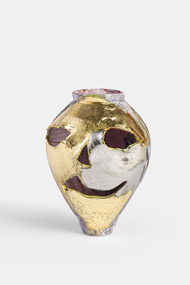
Sculpture - Vessel Mask II, Ramesh Mario Nithiyendran, 2025
... ...Sri Lankan-Australian art...Ceramics Ceramic sculpture Contemporary sculpture Mythology Religion Spirituality Ritual Sri Lankan-Australian art South Asian influences Contemporary mythology Postcolonialism Decolonisation Vessel Mask II Sculpture Vessel Mask II Ramesh Mario Nithiyendran ...Ramesh Mario Nithiyendran is a contemporary artist of Sri Lankan, Tamil heritage. His practice traverses global histories and languages of figuration with a particular focus on South Asian traditions. He sees the imaginative exploration of ancient pasts as a way to speculate on parallel futures and to expand ways of perceiving the present. While he works across ceramics, bronze casting, painting, drawing, and immersive installation, he is best known for his hybrid ceramic sculptures that fuse references to ancient forms with various tropes and imagery from popular culture, zoology and other discourses. Through these works he explores themes of secular and non-secular idolatry, co-existent belief systems, queer aesthetics, disciplinary and regional histories of ceramics and sculpture, monumentality, as well as self-portraiture and autobiography.ceramics, ceramic sculpture, contemporary sculpture, mythology, religion, spirituality, ritual, sri lankan-australian art, south asian influences, contemporary mythology, postcolonialism, decolonisation -
 Nillumbik Shire Council
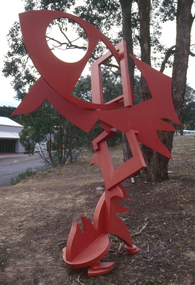
Public Art: Edward GINGER (b.1951 Kegalle, Sri Lanka - arrived 1975 Aus), Edward Ginger, The Breeze, Location: Main Road, Research - opposite Eltham Little Theatre, 1990
... The circular cut-out in the eye mimics the sun, symbolising the intense heat of the Australian climate, while the colour red alludes to the history of bushfire within the urban and rural fringe. The Breeze, Location: Main Road, Research - opposite Eltham Little Theatre Public Art: Edward GINGER (b.1951 Kegalle, Sri Lanka - arrived 1975 Aus) Edward Ginger ...The first sculpture awarded the Shire of Eltham 'Art in Public Places' Award/Commission. The Judges were Inge King, Jenny Zimmer and Daryl Jackson. The work deals with the juxtaposition of suburban and rural surroundings. This scupture is a typical example of the artist's oevre of the period. This sculptre is site specific and refers to the nature of the environment. The colour - bushfire red / sienna - alludes to the history of fire in the urban/rural fringe and the title, as well as the sculpture's shapes, forms and material refer to the natural and local elements. Judges report noted: "The most vital and expressive work for the site...with a great sense of dynamic movement and vibrant colour. Its' abstract forms will enliven the surroundings and the urban and natural environment. This work is the most appropriate for the site and expressive of the dynamics of an evolving community in which artistic discourse and debate has always thrived." The work has acquired the status of a major landmark from the National Trust. The Breeze is an abstract work made out of welded steel and painted in enamel in bush fire red / sienna. It comprises a series of flat, cut-out shapes, interlocking at different angles, giving the impression of being hinged together rather than fixed. The work references nature and the built environment. Its geometric shapes suggest man-made structures within industry and suburban life, while rural areas can be identified by the organic flame-like shapes fanned by the wind. The circular cut-out in the eye mimics the sun, symbolising the intense heat of the Australian climate, while the colour red alludes to the history of bushfire within the urban and rural fringe. N/Apublic art, ginger, red, sienna, elements, steel, abstract, breeze, fire, sculpture -
 Ararat Gallery TAMA
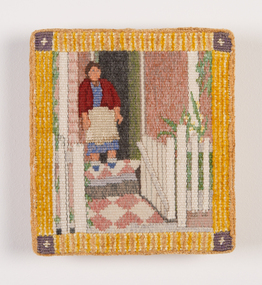
Sara Lindsay, Rosa, 1978
... Art Gallery, then the position of Production Manager at the Australian Tapestry Workshop. Since 2013 she has mentored three Karen refugee women from Myanmar, assisting in their professional development and furthering their tapestry skills. In 2023 Lindsay began the Ararat New Settlement Weaving Program, teaching and mentoring culturally diverse settlers from refugee and migrant backgrounds in the Ararat region. The artwork exhibited here is part of body of work exploring Lindsay’s family’s historical ties to Sri Lanka...Art Gallery, then the position of Production Manager at the Australian Tapestry Workshop. Since 2013 she has mentored three Karen refugee women from Myanmar, assisting in their professional development and furthering their tapestry skills. In 2023 Lindsay began the Ararat New Settlement Weaving Program, teaching and mentoring culturally diverse settlers from refugee and migrant backgrounds in the Ararat region. The artwork exhibited here is part of body of work exploring Lindsay’s family’s historical ties to Sri Lanka ...Sara Lindsay is a Melbourne-based artist, curator and educator. She worked as a weaver at the Victorian Tapestry Workshop (now the Australian Tapestry Workshop) from its foundation in 1976 until 1990. Alongside her art practice, Lindsay has lectured at the Tasmanian School of Art, held the role of Curator of Textiles at the Tasmanian Museum and Art Gallery, then the position of Production Manager at the Australian Tapestry Workshop. Since 2013 she has mentored three Karen refugee women from Myanmar, assisting in their professional development and furthering their tapestry skills. In 2023 Lindsay began the Ararat New Settlement Weaving Program, teaching and mentoring culturally diverse settlers from refugee and migrant backgrounds in the Ararat region. The artwork exhibited here is part of body of work exploring Lindsay’s family’s historical ties to Sri Lanka. Her British grandfather managed a tea plantation in Ceylon’s hill country during the 1920s and 30s, where her mother was born before returning to England after his early death in 1937. After her first visit to Sri Lanka in 2005, Lindsay developed works that responded to this journey. She chose a quiet, contemplative approach to reflect on the complexity of colonial histories. Research into her family history led her to delve deeper into Sri Lanka’s complex history as a trading nation and to expand her materials to speak to this layered past. The use of cinnamon in this work connects to the story of 17th-century weavers from Southern India who were displaced from the Kingdom of Kandy and sent to the southwest coast to become cinnamon peelers under Portuguese and later Dutch rule. The finely woven ticking strips seen here reference the thick cotton fabric once used to cover mattresses and pillows aboard cargo ships transporting spices from Sri Lanka - a subtle reminder of the human stories woven into trade routes and colonial histories. -
 Ararat Gallery TAMA
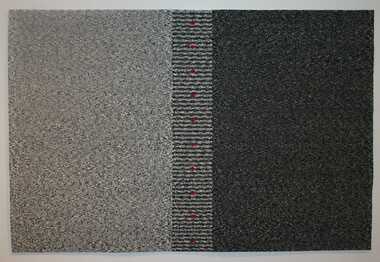
Sara Lindsay, In-Between #2, 1999
... Art Gallery, then the position of Production Manager at the Australian Tapestry Workshop. Since 2013 she has mentored three Karen refugee women from Myanmar, assisting in their professional development and furthering their tapestry skills. In 2023 Lindsay began the Ararat New Settlement Weaving Program, teaching and mentoring culturally diverse settlers from refugee and migrant backgrounds in the Ararat region. The artwork exhibited here is part of body of work exploring Lindsay’s family’s historical ties to Sri Lanka...Art Gallery, then the position of Production Manager at the Australian Tapestry Workshop. Since 2013 she has mentored three Karen refugee women from Myanmar, assisting in their professional development and furthering their tapestry skills. In 2023 Lindsay began the Ararat New Settlement Weaving Program, teaching and mentoring culturally diverse settlers from refugee and migrant backgrounds in the Ararat region. The artwork exhibited here is part of body of work exploring Lindsay’s family’s historical ties to Sri Lanka ...Sara Lindsay is a Melbourne-based artist, curator and educator. She worked as a weaver at the Victorian Tapestry Workshop (now the Australian Tapestry Workshop) from its foundation in 1976 until 1990. Alongside her art practice, Lindsay has lectured at the Tasmanian School of Art, held the role of Curator of Textiles at the Tasmanian Museum and Art Gallery, then the position of Production Manager at the Australian Tapestry Workshop. Since 2013 she has mentored three Karen refugee women from Myanmar, assisting in their professional development and furthering their tapestry skills. In 2023 Lindsay began the Ararat New Settlement Weaving Program, teaching and mentoring culturally diverse settlers from refugee and migrant backgrounds in the Ararat region. The artwork exhibited here is part of body of work exploring Lindsay’s family’s historical ties to Sri Lanka. Her British grandfather managed a tea plantation in Ceylon’s hill country during the 1920s and 30s, where her mother was born before returning to England after his early death in 1937. After her first visit to Sri Lanka in 2005, Lindsay developed works that responded to this journey. She chose a quiet, contemplative approach to reflect on the complexity of colonial histories. Research into her family history led her to delve deeper into Sri Lanka’s complex history as a trading nation and to expand her materials to speak to this layered past. The use of cinnamon in this work connects to the story of 17th-century weavers from Southern India who were displaced from the Kingdom of Kandy and sent to the southwest coast to become cinnamon peelers under Portuguese and later Dutch rule. The finely woven ticking strips seen here reference the thick cotton fabric once used to cover mattresses and pillows aboard cargo ships transporting spices from Sri Lanka - a subtle reminder of the human stories woven into trade routes and colonial histories. -
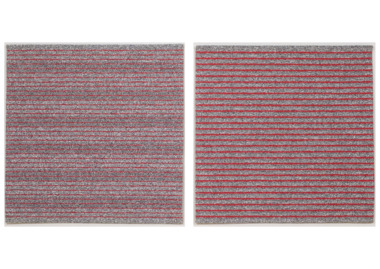 Ararat Gallery TAMA
Sara Lindsay, Pulse (diptych), 2001-2002
... Art Gallery, then the position of Production Manager at the Australian Tapestry Workshop. Since 2013 she has mentored three Karen refugee women from Myanmar, assisting in their professional development and furthering their tapestry skills. In 2023 Lindsay began the Ararat New Settlement Weaving Program, teaching and mentoring culturally diverse settlers from refugee and migrant backgrounds in the Ararat region. The artwork exhibited here is part of body of work exploring Lindsay’s family’s historical ties to Sri Lanka...Art Gallery, then the position of Production Manager at the Australian Tapestry Workshop. Since 2013 she has mentored three Karen refugee women from Myanmar, assisting in their professional development and furthering their tapestry skills. In 2023 Lindsay began the Ararat New Settlement Weaving Program, teaching and mentoring culturally diverse settlers from refugee and migrant backgrounds in the Ararat region. The artwork exhibited here is part of body of work exploring Lindsay’s family’s historical ties to Sri Lanka ...Sara Lindsay is a Melbourne-based artist, curator and educator. She worked as a weaver at the Victorian Tapestry Workshop (now the Australian Tapestry Workshop) from its foundation in 1976 until 1990. Alongside her art practice, Lindsay has lectured at the Tasmanian School of Art, held the role of Curator of Textiles at the Tasmanian Museum and Art Gallery, then the position of Production Manager at the Australian Tapestry Workshop. Since 2013 she has mentored three Karen refugee women from Myanmar, assisting in their professional development and furthering their tapestry skills. In 2023 Lindsay began the Ararat New Settlement Weaving Program, teaching and mentoring culturally diverse settlers from refugee and migrant backgrounds in the Ararat region. The artwork exhibited here is part of body of work exploring Lindsay’s family’s historical ties to Sri Lanka. Her British grandfather managed a tea plantation in Ceylon’s hill country during the 1920s and 30s, where her mother was born before returning to England after his early death in 1937. After her first visit to Sri Lanka in 2005, Lindsay developed works that responded to this journey. She chose a quiet, contemplative approach to reflect on the complexity of colonial histories. Research into her family history led her to delve deeper into Sri Lanka’s complex history as a trading nation and to expand her materials to speak to this layered past. The use of cinnamon in this work connects to the story of 17th-century weavers from Southern India who were displaced from the Kingdom of Kandy and sent to the southwest coast to become cinnamon peelers under Portuguese and later Dutch rule. The finely woven ticking strips seen here reference the thick cotton fabric once used to cover mattresses and pillows aboard cargo ships transporting spices from Sri Lanka - a subtle reminder of the human stories woven into trade routes and colonial histories. -
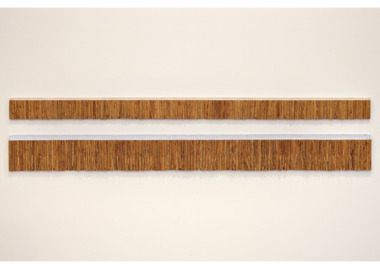 Ararat Gallery TAMA
Sara Lindsay, Cinnamon and Ticking #9, 2008
... Art Gallery, then the position of Production Manager at the Australian Tapestry Workshop. Since 2013 she has mentored three Karen refugee women from Myanmar, assisting in their professional development and furthering their tapestry skills. In 2023 Lindsay began the Ararat New Settlement Weaving Program, teaching and mentoring culturally diverse settlers from refugee and migrant backgrounds in the Ararat region. The artwork exhibited here is part of body of work exploring Lindsay’s family’s historical ties to Sri Lanka...Art Gallery, then the position of Production Manager at the Australian Tapestry Workshop. Since 2013 she has mentored three Karen refugee women from Myanmar, assisting in their professional development and furthering their tapestry skills. In 2023 Lindsay began the Ararat New Settlement Weaving Program, teaching and mentoring culturally diverse settlers from refugee and migrant backgrounds in the Ararat region. The artwork exhibited here is part of body of work exploring Lindsay’s family’s historical ties to Sri Lanka ...Sara Lindsay is a Melbourne-based artist, curator and educator. She worked as a weaver at the Victorian Tapestry Workshop (now the Australian Tapestry Workshop) from its foundation in 1976 until 1990. Alongside her art practice, Lindsay has lectured at the Tasmanian School of Art, held the role of Curator of Textiles at the Tasmanian Museum and Art Gallery, then the position of Production Manager at the Australian Tapestry Workshop. Since 2013 she has mentored three Karen refugee women from Myanmar, assisting in their professional development and furthering their tapestry skills. In 2023 Lindsay began the Ararat New Settlement Weaving Program, teaching and mentoring culturally diverse settlers from refugee and migrant backgrounds in the Ararat region. The artwork exhibited here is part of body of work exploring Lindsay’s family’s historical ties to Sri Lanka. Her British grandfather managed a tea plantation in Ceylon’s hill country during the 1920s and 30s, where her mother was born before returning to England after his early death in 1937. After her first visit to Sri Lanka in 2005, Lindsay developed works that responded to this journey. She chose a quiet, contemplative approach to reflect on the complexity of colonial histories. Research into her family history led her to delve deeper into Sri Lanka’s complex history as a trading nation and to expand her materials to speak to this layered past. The use of cinnamon in this work connects to the story of 17th-century weavers from Southern India who were displaced from the Kingdom of Kandy and sent to the southwest coast to become cinnamon peelers under Portuguese and later Dutch rule. The finely woven ticking strips seen here reference the thick cotton fabric once used to cover mattresses and pillows aboard cargo ships transporting spices from Sri Lanka - a subtle reminder of the human stories woven into trade routes and colonial histories.
