
Showing 3 items matching "st augustine's church wodonga"
-
 Wodonga & District Historical Society Inc
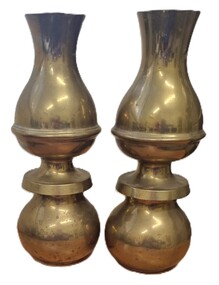
Decorative object - Brassware - St Augustines Church, Wodonga, T. Gaunt & Co, c1900
... ...St Augustine's Church Wodonga...St Augustine’s Church, Wodonga The Roman Catholic religion first came to the Wodonga area with travelling clergymen in about 1843. ...Brassware - St Augustines Church, Wodonga Decorative object Brassware - St Augustines Church, Wodonga T. ...St Augustine’s Church, Wodonga The Roman Catholic religion first came to the Wodonga area with travelling clergymen in about 1843. It was not until 4th October that 1860 Bishop Goold of the Chiltern parish visited Wodonga and consecrated St. Francis Chapel, a small weatherboard building which was erected on the site of the present St Augustine’s Church. Wodonga was officially separated from the Chiltern parish in 1899. Father James Ryan became the first Parish Priest of St Augustine's and oversaw the construction of the new church. The present St. Augustine’s was blessed and opened on 27 April 1902. Between 1918–1919 under Father Francis Flynn, the church was extended, and significant features such as the marble altar and stained-glass windows were added. Major refurbishments were completed in 1927, including further extension of the primary school. T. Gaunt & Co. Thomas Gaunt arrived in Melbourne in about 1856. He was a trained clockmaker and opened a business in Bourke Street, later moving to The Royal Arcade. Although he also made and sold wrist watches, jewellery, silver and brassware, Thomas was possibly most well-known for a chronometer he donated to the Victorian Racing Club for whom he was official timekeeper. It displayed the time of a race to an accuracy of .25 of a second. Gaunt had strong beliefs and connection to the Catholic Church of supplied much of its ecclesiastical silver and brassware such as this item. After Thomas Gaunt died in 1890, his executors continued the business, which was renamed T. Gaunt & Co. in 1893. The company operated for almost a century before closing in 1960. These items are significant because they were used in an important Wodonga church.A set of four brass vases manufactured by T Gaunt & Co.Beneath each vase T. GAUNT & Co.church brassware, st augustine's church wodonga, t gaunt & co -
 Wodonga & District Historical Society Inc
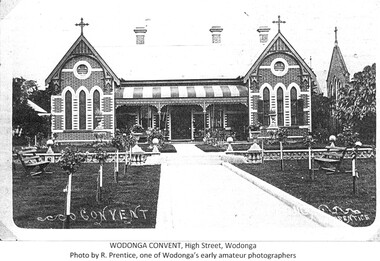
Photograph - St Joseph's Convent, Wodonga, Various dates
... ...St Augustine's Church Wodonga...St Augustine’s school in 2001. These images are significant because they capture the history of an important religious building in Wodonga, Victoria. Sisters of Mercy Wodonga St Joseph's Convent Wodonga St Augustine's Church Wodonga Three black and white photographs of St Joseph's Convent in Wodonga in the early 1900s. ...Until 1892 the first Catholic School in Wodonga, a simple wooden skillion which was erected behind the sanctuary of St. Francis’ Chapel, was overseen by Dean William Tierney of Beechworth, Father Michael O’Connor P.P. of Chiltern and his successor Father Charles Van Der Hayden. The lay teachers, Miss Fagan and Miss O’Leary. In 1892 four Sisters of Mercy from Albury were invited to make a foundation at Wodonga. On the 6th February 1892, Mother M. Aloysius Tierney (1864-1948), Sr. M. Gabriel Comins (1868-1945), Sr. M. Celestine Coyle (1871-1857) and a postulant Miss Mary Jane Conlan (1874-1939) (Sr. Mary Joseph) travelled by horse drawn cab from the Albury convent to a rented house in Hume Street. The parishioners of Wodonga were anxious for the nuns to have their own residence, and on the 19th March 1893, the foundation stone for St. Joseph’s Convent was laid and consecrated by Bishop Stephen Reville on behalf of Bishop Crane of Sandhurst. The convent was designed by architects Gordon and Gordon and built by Fraser and Wilson of Melbourne at a cost of £1000. Construction was expected to take three months. The Wodonga and Towong Sentinel of Friday 24 March 1893 included the following description of the Convent. “In the front is a handsome verandah, with an oratory on the right and a community room on the left. Entering the door, the reception and music rooms are met with on opposite sides, and there are five cells in succession at the back of the reception room, whilst on the other side of the passage the reverend mother's cell, the refectory, pantry, and kitchen are found. At the extreme rear of the building there is a linen room, a bathroom, and a servant's room, There is also a verandah on either side of the convent. The height of the walls is to be 12 feet and 13 feet”. The Convent was officially opened on Sunday 13 August 1893 St Joseph’s Convent became part of St Augustine’s school in 2001.These images are significant because they capture the history of an important religious building in Wodonga, Victoria.Three black and white photographs of St Joseph's Convent in Wodonga in the early 1900s.sisters of mercy wodonga, st joseph's convent wodonga, st augustine's church wodonga -
 Wodonga & District Historical Society Inc
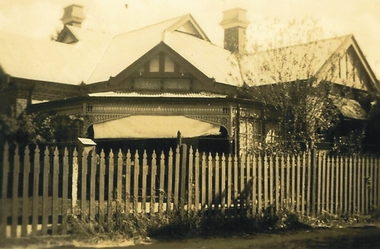
Photograph - Sister Hughes' Private Hospital in Wodonga
... St Augustine’s Church. The Private Hospital in High Street possibly closed in 1954 with the opening of the Wodonga Hospital in Vermont Street....St Augustine’s Church. The Private Hospital in High Street possibly closed in 1954 with the opening of the Wodonga Hospital in Vermont Street. ...Sister Hughes’ Private Hospital on the corner of High and Stanley Streets, Wodonga operated between 1922 and 1938. The building was constructed as a family home for Albert Schlink, a storekeeper in 1909. The building was first used as a private hospital in 1919 starting with Nurse Eliza Browne. It had six or seven rooms, one of which was an operating theatre. There was a walkway, then three bedrooms and a bathroom that belonged to the hospital all in the one area. A small building at the back served as a self-contained flat. Catherine Josephine Hughes' sister Mabel earlier married into the Schlink family and came from Bendigo to take over the Lease on the hospital in 1922. Apart from Sister Hughes, there were Nurses Poyntz and Costello. Three domestic staff were also employed – a cleaner Elsie Enever, the cook Mrs Baker and Mrs Kimball who did the laundry. Nurses Poyntz and Costello took charge of the hospital in 1938 and Catherine Hughes continued to be listed as a nurse on the electoral roll until 1954. In the early 1940s she conducted a business in the “lolly shop” in High Street, south of St Augustine’s Church. The Private Hospital in High Street possibly closed in 1954 with the opening of the Wodonga Hospital in Vermont Street. The images are significant because they represent a building and nurses who served an important role in the Wodonga community in the early 20th century.A set of black and white photos of Sister Hughes Hospital in Wodonga and some of the staff. The architect's plans of the original house, designed for Albert Schlink are included.sister hughes wodonga, hospitals wodonga
