Showing 19 items matching "st john's fire warrnambool"
-
Warrnambool and District Historical Society Inc.Print, Relic from St John’s Fire, Pre 1920
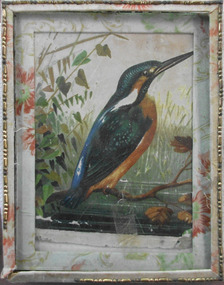
... ...st john's fire warrnambool...The event of this fire remains one of the most significant in the history of Warrnambool. warrnambool st.john's presbyterian church st john's fire warrnambool st john's fire relic On back of picture, ‘ From Grandmother to Nancy on her 5th Birthday, Aug 20th 1920. ...A small card at the back of the picture reads,’ This Picture was a teaching aid used in St. John’s Kinderg S.S and was found in the Church Ruins after the fire in July 1920 by Nancy McC(Absalom). Later framed by Grandma. St. John’s Presbyterian Church was built in 1875 and was burned down July 21st 1920. A volunteer fireman Mr T Spicer discovered the fire and despite the prompt arrival of the fire brigade, after an hour only the walls and tower remained. Some items were salvaged including vestry furnishings and church register. A bible which had been given to the Church in 1895 was rescued by an unknown young man whose identity remained a mystery until1976 when a Mr Stan Williams of Ballarat told his story. The Church was rebuilt in 1922. The event of this fire remains one of the most significant in the history of Warrnambool. Framed print of kookaburra on branch in natural setting. The bird is coloured blue, green and tan. Background is in muted greens. The light wooden frame is covered in fabric in pinks and green. A patterned metal edge sits atop the fabric. On back of picture, ‘ From Grandmother to Nancy on her 5th Birthday, Aug 20th 1920. This is a relic of the burning of St John’s Church July 21st 1920. Picked up by Nancy and framed by E Black.” warrnambool, st.john's presbyterian church, st john's fire warrnambool, st john's fire relic -
Warrnambool and District Historical Society Inc.Box, Bouquet of Roses Toilet Soap, Mid 20th century
... Warrnambool and District Historical Society Inc. 2 Gilles Street (south of Merri St) Warrnambool great-ocean-road The business of Kitchen and Sons began in 1856 when John Kitchen began to make tallow candles in their backyard in Emerald Hill but had to move two years later due to it being an offensive trade. Bad luck plagued them again after two years when fire ...The business of Kitchen and Sons began in 1856 when John Kitchen began to make tallow candles in their backyard in Emerald Hill but had to move two years later due to it being an offensive trade. Bad luck plagued them again after two years when fire destroyed their premises. However after rebuilding , the expanded and moved to Footscray ten years later. Over the next 30years the business expanded further employing upwards of 300 people and became one of the leading manufacturers of soaps, candles and associated products in Australia and New Zealand. They were makers of long standing brands such as Velvet soap and Solvol and by the mid 1920's were employing about 1400 people. It was around this time that they merged with the Lever Co of Sydney and after absorption of other soap companies over the next 40 years , the company became known as Lever & Kitchen in 1962. This box contained gift soaps and probably belongs to the period prior to 1924. Miss C M Trigg of Wangoom was the owner. A common item with links to a district family.White card box with overlapping lid which is covered in white paper with green and red text. A red banner across right bottom corner. Light grey floral pattern as background.Miss C M Trigg Wangoom written in black ink on left corner. Made by J Kitchen & Sons Pty Ltd.warrnambool, warrnambool history, wangoom, c m trigg wangoom -
Warrnambool and District Historical Society Inc.Clothing, Warrnambool Urban Fire Brigade, Mid 20th century
... Warrnambool and District Historical Society Inc. 2 Gilles Street (south of Merri St) Warrnambool great-ocean-road This jacket was part of the working uniform of the Warrnambool Urban Fire Brigade in the mid 20th century. It belonged to John ...This jacket was part of the working uniform of the Warrnambool Urban Fire Brigade in the mid 20th century. It belonged to John (Jack) Sizeland, a member of the Fire Brigade for over 37 years. He retired in 1977. Prompted by a fire at the Flying Buck Hotel in Liebig Street the Warrnambool Fire Brigade was established in the mid 1860s. It has been successful in Victorian Fire Brigade Championships over the years, especially in the 19th century. It is currently situated in Mortlake Road. This jacket is of interest as an example of the clothing worn by firefighters in Victoria in the mid 20th century. It is also of interest because it was worn by Jack Sizeland, a local firefighter for over 37 years. This is a black double-breasted cloth jacket with six brass buttons down the front and two brass buttons on the lapels. The buttons are impressed with a shield and the words ‘Country Fire Authority Victoria’. There are two brass clips on the side to hold a belt. There are two black and red cloth attachments at the top of each sleeve (‘Warrnambool Urban Fire Brigade’). There is some black cloth lining inside the garment across the shoulders. The maker’s label, ‘David Lack Pty Ltd, Melbourne’ is on the inside collar. ‘David Lack Pty Ltd Melbourne’ ‘Warrnambool Urban Fire Brigade’ warrnambool fire brigade, jack sizeland, history of warrnambool -
Warrnambool and District Historical Society Inc.Uniform, Warrnambool Fire Brigade, Mid 20th century
... St) Warrnambool great-ocean-road This is a complete uniform of the Warrnambool Urban Fire Brigade in the mid 20th century. The Warrnambool Fire Brigade, located today in Mortlake Road, Warrnambool, was established in 1863. The formation was prompted by a fire at the Flying Buck Hotel in Liebig Street. The Warrnambool Fire Brigade has a long proud history of service to the people of Warrnambool and district for over 150 years. The uniform belonged to John ...This is a complete uniform of the Warrnambool Urban Fire Brigade in the mid 20th century. The Warrnambool Fire Brigade, located today in Mortlake Road, Warrnambool, was established in 1863. The formation was prompted by a fire at the Flying Buck Hotel in Liebig Street. The Warrnambool Fire Brigade has a long proud history of service to the people of Warrnambool and district for over 150 years. The uniform belonged to John (Jack) Sizeland, a firefighter for over 37 years. He retired in 1977. This uniform is of some significance as it shows the type of uniform worn by Warrnambool firefighters in the mid 20th century. It is also of importance because it belonged to a local firefighter, Jack Sizeland. This is a Warrnambool Fire Brigade uniform consisting of:- .1 A black cloth single-breasted jacket lined with black and white material. It has four silver metal buttons down the front and two on the top pocket lapels. The buttons have the inscription ‘Country Fire Authority Victoria’. There are two red and black cloth tabs stitched on the top of the sleeves (‘Warrnambool Urban Fire Brigade’). The belt is stitched at the back and loose at the front. .2 Black cloth trousers with a red braid stripe down each leg. .3 Black leather belt with a silver-coloured buckle. .4 Black officer-type hat with red plastic lining, a plastic peaked front with a green backing, a red and black braid around the rim with two metal buttons and a silver-coloured metal badge of the Country Fire Authority. .5 Black cloth (polyester) tie with orange lining. Trousers: ‘C.F.A., I. L. Wise’ Tie: ‘Mark Andrew Made in Australia’ Hat: ‘Emerco, Melbourne, Registered Trademark, This is Your Guarantee for Quality, Made in Australia’ warrnambool fire brigade, jack sizeland, history of warrnambool -
Warrnambool and District Historical Society Inc.Certificate, Country Fire Authority J T Sizeland, 1977
... Warrnambool and District Historical Society Inc. 2 Gilles Street (south of Merri St) Warrnambool great-ocean-road This is a certificate awarded to John "Jack" Sizeland of Banyan Street Warrnambool for membership of the Warrnambool Urban Fire Brigade. ...This is a certificate awarded to John "Jack" Sizeland of Banyan Street Warrnambool for membership of the Warrnambool Urban Fire Brigade. Mr. Sizeland joined the C.F.A. in 1945 and retired at the compulsory age of 65 in 1977 after over 37 years membership. In our collection we have Jack Sizeland’s Fire Brigade uniform and accessories. The Warrnambool Fire Brigade was established in 1863.This certificate is of interest as it records the years of service of a prominent fireman in Warrnambool in the 20th century.A sheet of white card featuring a black printing, photocopied hand signatures and a title in an ornamental scroll, a title and a logo of the Country Fire Authority. The white card has a blue tinge around the edges. It has the emblem of the Country Fire Authority, the name of the Authority in a cream, yellow and black ornate setting and printing in black and yellow. There are three signatures (blue ink) on the certificate.Country Fire Authority John T. Sizeland john t sizeland, warrnambool fire brigade, country fire authority -
Warrnambool and District Historical Society Inc.Artefact, China Plate, 1922 (painting)
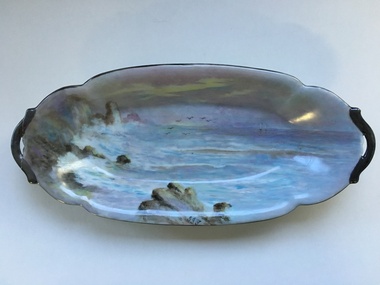
... John Lamb Forrester and Maria Hexter, was an architect in Warrnambool in the early 20th century. He had an office in Kepler Street (1910) and in Koroit Street (1916). He lived in the house in Liebig Street that was formerly the first Savings Bank and was erected in 1860 (7A Liebig Street today). Forrester was a staunch member of the Presbyterian Church and was the co-architect for the re-building of the interior of St. John’s Presbyterian Church in Warrnambool after it was destroyed by fire...John Lamb Forrester and Maria Hexter, was an architect in Warrnambool in the early 20th century. He had an office in Kepler Street (1910) and in Koroit Street (1916). He lived in the house in Liebig Street that was formerly the first Savings Bank and was erected in 1860 (7A Liebig Street today). Forrester was a staunch member of the Presbyterian Church and was the co-architect for the re-building of the interior of St. John’s Presbyterian Church in Warrnambool after it was destroyed by fire ...This plate was painted by J.J. Forrester in 1922. John James Forrester, the son of John Lamb Forrester and Maria Hexter, was an architect in Warrnambool in the early 20th century. He had an office in Kepler Street (1910) and in Koroit Street (1916). He lived in the house in Liebig Street that was formerly the first Savings Bank and was erected in 1860 (7A Liebig Street today). Forrester was a staunch member of the Presbyterian Church and was the co-architect for the re-building of the interior of St. John’s Presbyterian Church in Warrnambool after it was destroyed by fire in 1920. John Forrester was also a noted artist of his time and several of his works of art have survived. A landscape by him is in the possession of the Warrnambool and District Historical Society. This plate is one of two painted by Forrester that survive today.This plate, although damaged, is of interest because it was painted by John James Forrester, a Warrnambool artist from the early 20th century. This is a china plate showing a seascape painted by John James Forrester in 1922. It depicts a coastal scene of rocks, birds and sailing boats. The colours are in mauve/brown/ white tonings and are slightly opalescent. The plate has brown/grey handles with one broken and repaired. The plate is oval-shaped with a slight dip and a stand at the base. Front of plate: ‘J.J.F.’ On base: ‘J.J. Forrester 1922’ john james forrester, history of art in warrnamool, history of architecture in warrnambool, history of warrnambool, china painting -
Warrnambool and District Historical Society Inc.Household, Button Cleaning Shield, C 1960
... Warrnambool and District Historical Society Inc. 2 Gilles Street (south of Merri St) Warrnambool great-ocean-road This object was used a shield to slide brass button through to enable them to be polished.They were a common object for those who wore military type uniforms with metal buttons The item belonged to John T Sizeland who was a member of the Warrnambool Urban Fire Brigade from 1940 through to 1977. ...This object was used a shield to slide brass button through to enable them to be polished.They were a common object for those who wore military type uniforms with metal buttons The item belonged to John T Sizeland who was a member of the Warrnambool Urban Fire Brigade from 1940 through to 1977.This is an object which was commonly used by those in the military and those who wore uniforms with brass buttons. This item has strong provenance having belonged to John Sizeland who was a member of the Warrnambool Fire Brigade for over 30 years and was donated along with a number of associated fire brigade items. Long horse shoeshaped piece of copper with narrow slice three quarters through with rounded notch at the end.J Sizeland hammered into one end.warrnambool, button cleaner/protector, button cleaning shield, brass button, john t sizeland, brass button cleaning -
Warrnambool and District Historical Society Inc.Booklet - Sunday School library catalogue and card, Smith's Printing Works, Warrnambool, early 20th century
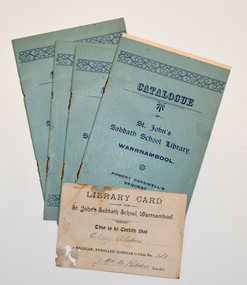
... Warrnambool Presbyterian St. John's Sabbath School Library (Robert Carswell's Bequest) early in the 20th century. The books for boys and girls are listed separately and are mostly fiction, many with some religious content. St John's Presbyterian Church was opened in 1875. The building was destroyed by fire...St) Warrnambool great-ocean-road The booklet is a catalogue of the books in the Warrnambool Presbyterian St. John's Sabbath School Library (Robert Carswell's Bequest) early in the 20th century. The books for boys and girls are listed separately and are mostly fiction, many with some religious content. St John's Presbyterian Church was opened in 1875. The building was destroyed by fire ...The booklet is a catalogue of the books in the Warrnambool Presbyterian St. John's Sabbath School Library (Robert Carswell's Bequest) early in the 20th century. The books for boys and girls are listed separately and are mostly fiction, many with some religious content. St John's Presbyterian Church was opened in 1875. The building was destroyed by fire in 1920 and rebuilt in a similar style to the original one. Robert Carswell was a Warrnambool resident who died in 1900 at the age of 77 and it is presumed that the bequest from his will enabled the Sunday (Sabbath) School library to be established. The card is a membership certificate indicating that Elsie Alston was enrolled as a Sunday School member in Class 14 and thus entitled to borrow books from the library. No details have been found on Elsie Alston but there were several Alston families in Warrnambool at the time.These items are of some interest as church Sunday Schools in the past, particularly in the 19th century, were important as they were widely attended and provided a range of educational and recreational activities, often not otherwise available to the children at that time'.1 A booklet of ten pages with a blue cover with blue printing and a decorative border on the front. The pages contain printed material. The booklet was once stapled but the staples have been removed. .2 A white card with black printing and handwritten names.Elsie Alston Mr M. Ritchieelsie alston, robert carswell, st. john's sabbath school warrnambool, sunday schools in warrnambool -
Warrnambool and District Historical Society Inc.Booklet, The Caravan of Dreams and Other verses of the Grampians Road, 1923
... St) Warrnambool great-ocean-road This book contains poems written by Lindsay Russell. This was the pen name of Ethel Stonehouse (1883-1964) who was born in Nhill, Victoria and published verse, short stories and novels. She gained a national reputation for her novels, many of which were controversial at the time, dealing with rebellious women and they were often critical of some aspects of the Catholic Church. Her first novel, ‘Smouldering Fires’ sold 100,000 copies in Australia alone. In 1914 Ethel Stonehouse married Dr John ...This book contains poems written by Lindsay Russell. This was the pen name of Ethel Stonehouse (1883-1964) who was born in Nhill, Victoria and published verse, short stories and novels. She gained a national reputation for her novels, many of which were controversial at the time, dealing with rebellious women and they were often critical of some aspects of the Catholic Church. Her first novel, ‘Smouldering Fires’ sold 100,000 copies in Australia alone. In 1914 Ethel Stonehouse married Dr John Scott and came to live in Mortlake, Victoria. ‘The Caravan of Dreams’ was her last publication. This book is of considerable significance as a book of original poems by Lindsay Russell, an Australian author who lived in the local area (Mortlake). The book was printed at the Terang Express newspaper office in 1923. This is a soft cover book of 32 pages. It has a dark blue cover with a border at the top and bottom of the front cover and black printing. The ornate borders are repeated throughout the pages. The book contains 28 poems. The cover is a little stained. Daisy Quick Allanbee Teranglindsay russell (ethel stonehouse), history of mortlake, australian literature, warrnambool history -
Warrnambool and District Historical Society Inc.Artefact, Model of Church, C1900
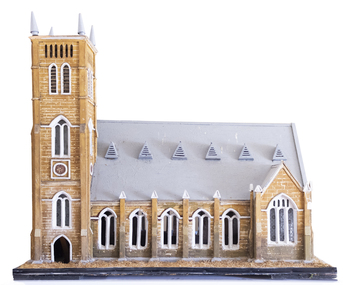
... Warrnambool Art Gallery today). St. John’s Presbyterian Church, designed by Andrew Kerr, was built in the English Gothic style and opened in 1875. It was destroyed by fire...It is the only known model of the Warrnambool St. John’s Presbyterian Church which was destroyed by fire in 1920. ...This model of St. John’s Presbyterian Church in Warrnambool was made by Johan Carl August Landmann (1826-1920). August Landmann and his wife, Christina came from Silesia to Australia in 1854. They settled in Warrnambool where August made a living as a carpenter and joiner. At first he rented shops in Timor Street and then built a two-storeyed shop and residence in Henna Street. Landmann built many of the early commercial buildings and residences in Warrnambool and he and his family were associated with the management of the Warrnambool Western Brewery. When he retired in 1900 he built another residence in Mickle Street and it was at that time that it is believed he made the model of the Presbyterian Church and the model of the Ozone Hotel (which is in the Warrnambool Art Gallery today). St. John’s Presbyterian Church, designed by Andrew Kerr, was built in the English Gothic style and opened in 1875. It was destroyed by fire in 1920 but was rebuilt to a similar style. This model is of great significance for two reasons: 1. It was made by a prominent early Warrnambool carpenter and joiner, Johan Carl August Landmann. 2. It is the only known model of the Warrnambool St. John’s Presbyterian Church which was destroyed by fire in 1920.This model is on a wooden stand or base which is painted black with metal screws. The edging of the stand contains straw which is now brown but was originally green to resemble grass or lawn. The church is a wooden structure (hollow inside) with some sections painted to resemble sandstone. The roof is slanted and painted grey and has six dormer windows or ventilation pieces on each side. The main body of the church has a nave with dual arched windows, the west end has dual arched windows and a door with louvre ventilation and the east end has a door and dual arched windows and two conical-shaped finials. The windows, some of which are triangular, have frosted decorated glass. Some of the glass in the windows is missing. The main tower is square-shaped with four conical-shaped finials. The upper part has four sets of louvres and two arched windows. The centre and lower sections have rosette patterns and several sets of dual arched windows with frosted decorated glass panels. The north east corner has a smaller tower.johan carl august landmann, st. john’s presbyterian church, warrnambool, warrnambool history -
Warrnambool and District Historical Society Inc.Book, Advertising book cover, Mid 20th century
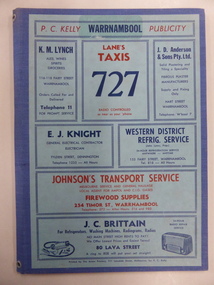
... St. John’s Presbyterian Church in Warrnambool. The folder would have been funded by the businesses advertising in the folder. St. John’s Presbyterian Church was designed by Andrew Kerr and opened for service in 1875. It was destroyed by fire...St) Warrnambool great-ocean-road This folder has been used to hold music sheets at St. John’s Presbyterian Church in Warrnambool. The folder would have been funded by the businesses advertising in the folder. St. John’s Presbyterian Church was designed by Andrew Kerr and opened for service in 1875. It was destroyed by fire ...This folder has been used to hold music sheets at St. John’s Presbyterian Church in Warrnambool. The folder would have been funded by the businesses advertising in the folder. St. John’s Presbyterian Church was designed by Andrew Kerr and opened for service in 1875. It was destroyed by fire in 1920 and rebuilt to a similar style. This folder is of interest as a memento of St. John’s Presbyterian Church in the mid 20th century. It also gives us information on some Warrnambool businesses at the time. This is a cardboard folder of four pages to hold music. It has space on the third page to write notes. The other three pages contain 21 advertisements for local Warrnambool businesses pasted on to the folder. The folder is blue and the printed material is in red and dark blue print on a light blue background. There are red and blue borders around each advertisement and some advertisements have illustrated material. The folder has two eyelets with metal edging for attaching the sheet music. st. john’s presbyterian church, warrnambool, history of warrnambool -
Warrnambool and District Historical Society Inc.Criterion Hotel Glass, Glass, Mid 20th century
... St) Warrnambool great-ocean-road This small glass has been kept as a souvenir of the Warrnambool Criterion Hotel by a local resident, James Godfrey. The Criterion Hotel opened in Kepler Street, Warrnambool in April 1872. The first licensee was John Tate and the Humm family members of Woodford and the McGennan family of Warrnambool were prominent licensees and owners in the late 19th and 20th centuries. In the second half of the 20th century the hotel was an important centre in Warrnambool for live pop music. The hotel closed in 2008. The building was partially destroyed by fire ...This small glass has been kept as a souvenir of the Warrnambool Criterion Hotel by a local resident, James Godfrey. The Criterion Hotel opened in Kepler Street, Warrnambool in April 1872. The first licensee was John Tate and the Humm family members of Woodford and the McGennan family of Warrnambool were prominent licensees and owners in the late 19th and 20th centuries. In the second half of the 20th century the hotel was an important centre in Warrnambool for live pop music. The hotel closed in 2008. The building was partially destroyed by fire in 2010 and the remaining structure was demolished in 2013. This glass is significant because it has local provenance as a memento of a hotel in Warrnambool prominent in the local business world for 136 years and as an example of the souvenirs kept of this hotel by Warrnambool residents.This is a small clear glass tumbler with a heavy base and a slightly tapered neck and a circular open top. The name ‘Criterion Hotel’ has been etched on to the side of the glass.Criterion Hotelcriterion hotel warrnambool, history of warrnambool, glass -
Warrnambool and District Historical Society Inc.Documents, Atlas Automatic Fire Services Pty Ltd, Woollen Mill, late 20th century
... Warrnambool and District Historical Society Inc. 2 Gilles Street (south of Merri St) Warrnambool great-ocean-road These items are from the Warrnambool Woollen Mill and relate to the fire protection services operating at the factory in the late 20th century. The Warrnambool Woollen Mill was commenced as a local public company and opened in 1910 in South Warrnambool with the first manager, John Bennett. ...These items are from the Warrnambool Woollen Mill and relate to the fire protection services operating at the factory in the late 20th century. The Warrnambool Woollen Mill was commenced as a local public company and opened in 1910 in South Warrnambool with the first manager, John Bennett. During World War Two there were 700 employees at the mill due to wartime demand. In 1958 the factory became the first in Australia to manufacture electric blankets. In 1968 the mill was purchased by the Dunlop company and in 1982 Dunlop sold out to Onkaparinga Woollen Company which was taken over by Macquarie Worsteds and became known as Warrnambool Textiles. When Macquarie Worsteds ceased operations in Warrnambool the Smith Family managed the factory on behalf of the owners, the Warrnambool City Council. In 2000 the Woollen Mill closed and the site has been sold and developed as a housing estate.These items are of minor interest as mementoes of the Warrnambool Woollen Mill and will be added to the Woollen Mill collection in the Historical Society archives. .1 A sheet of white paper showing a sketch plan in black of the Warrnambool Woollen Mill with three areas coloured pink, yellow and blue .2 the same as .1 except that there are no shaded areas. .3 A sheet of lightweight card with black and yellow printing and a diagram of a machine Fire Plan For Insurance Purposes Atlas Automatic Fire Services Pty Ltd warrnambool woollen mill, history of warrnambool, onkaparinga woollen company, dunlop company -
Warrnambool and District Historical Society Inc.Plate, Humms Criterion Hotel Warrnambool, Early 20th century
... St) Warrnambool great-ocean-road This plate has been produced by the English firm of W.H.Grindley for use at the Criterion Hotel in Warrnambool. The Criterion Hotel was on the western side of Kepler street near Lava Street and was established in 1872 with the first licensee being John Tate. The hotel closed in 2008, was partially destroyed by fire ...This plate has been produced by the English firm of W.H.Grindley for use at the Criterion Hotel in Warrnambool. The Criterion Hotel was on the western side of Kepler street near Lava Street and was established in 1872 with the first licensee being John Tate. The hotel closed in 2008, was partially destroyed by fire in 2010 and was demolished in 2013. The Humm family had a long association with the Criterion Hotel, with George Humm of Woodford taking over as the licensee in 1882 and buying the hotel in 1887 and remaining there until his death in 1894. George Humm’s widow, Elizabeth, was the licensee from 1894 to 1907, her son, John was the licensee from 1907 to 1916 and his widow, Bridget, was the licensee from 1916 to 1919. The plate could have been in use for all or part of these years but is most likely to have been bought early in the 20th century. This plate is of considerable interest because it came from the Criterion Hotel, a prominent hotel in Warrnambool for over 130 years.This is a white china plate which has a red embedded stamp in the shape of a belt (the maker’s trademark) on the front and on the back it has the blue markings of the maker with an image of a crown. The bowl has a shallow base and was perhaps a soup plate. The edges of the plate are somewhat worn and scuffed. ‘Humms Criterion Hotel Warrnambool’ ‘Grindley Hotel Ware England Vitrified’ criterion hotel, humm family of woodford, history of warrnambool -
Warrnambool and District Historical Society Inc.Plate, Criterion Hotel Warrnambool, Early 20th century
... St) Warrnambool great-ocean-road This plate has been made by the Globe Pottery Company in England and supplied by the china merchant firm of John Dynon and Sons of Lonsdale Street, Melbourne. As it has the mark ‘Cobridge’ on the back of the plate, it was made before 1934. It was used at the Warrnambool Criterion Hotel which was on the western side of Kepler Street near Lava Street. This hotel was established in 1872 with the first licensee being John Tate. It closed in 2008, was partially destroyed by fire ...This plate has been made by the Globe Pottery Company in England and supplied by the china merchant firm of John Dynon and Sons of Lonsdale Street, Melbourne. As it has the mark ‘Cobridge’ on the back of the plate, it was made before 1934. It was used at the Warrnambool Criterion Hotel which was on the western side of Kepler Street near Lava Street. This hotel was established in 1872 with the first licensee being John Tate. It closed in 2008, was partially destroyed by fire in 2010 and was demolished in 2013. During the first 30 years of the 20th century licensees at the Criterion Hotel included members of the Humm family, Theresa Lynch and Henry and Margaret McGennan. The plate could have been used for all or part of these times and even at a later date. This plate is of considerable interest because it came from the Cruterion Hotel, a prominent hotel in Warrnambool for over 130 years.This is a circular white china plate with a shallow base probably used as a soup plate. It has a red embedded stamp in the shape of a belt on the front edge and on the back it has the grey markings of the maker.‘Criterion Hotel Warrnambool’ ‘Globe Pottery Co. Ltd. Cobridge, England, Vitrified, John Dynon &Sons, Melbourne’ criterion hotel, history of warrnambool, humm family, woodford, theresa lynch, mcgennan family -
Warrnambool and District Historical Society Inc.Plate, Criterion Hotel Warrnambool, Early 20th Century
... St) Warrnambool great-ocean-road This plate has been made by the Globe Pottery Company of England and supplied by the china merchant firm of John Dynon and Sons of Lonsdale Street, Melbourne. It was used at the Criterion Hotel in Warrnambool. The Criterion Hotel, situated on the western side of Kepler Street near Lava Street, was established in 1872 with the first licensee being John Tate. The hotel closed in 2008, was partially destroyed by fire ...This plate has been made by the Globe Pottery Company of England and supplied by the china merchant firm of John Dynon and Sons of Lonsdale Street, Melbourne. It was used at the Criterion Hotel in Warrnambool. The Criterion Hotel, situated on the western side of Kepler Street near Lava Street, was established in 1872 with the first licensee being John Tate. The hotel closed in 2008, was partially destroyed by fire in 2010 and was demolished in 2010. This plate, being marked with the name ‘Cobridge’, was made before 1934. In the first three decades of the 20th century the licensees at the Criterion Hotel were members of the Humm family, Theresa Lynch, Henry McGennan and Margaret McGennan. The dinner plate could have been used for all or part of these years and could have been used later as well. This plate is of considerable interest as it was used at the Criterion Hotel, a prominent hotel in Warrnambool for over 130 years. This is a circular white china plate with a rim and a slight indentation at the base. There is a red embedded stamp in the shape of a belt on the top edge and the grey stamp of the maker on the bottom of the plate. This plate was probably used as a small dinner plate. There are a few small imperfections and stains on this plate.‘Criterion Hotel Warrnambool’ ‘Globe Pottery Co. Ltd. Cobridge England Vitrified, John Dynon & Sons, Melbourne’ humm family, mcgennan family, theresa lynch, criterion hotel, history of warrnambool -
Warrnambool and District Historical Society Inc.Plate, Humms Criterion Hotel, Early 20th century
... St) Warrnambool great-ocean-road This plate has been produced by the English firm of W.H.Grindley for use at the Criterion Hotel in Warrnambool. The Criterion Hotel was on the western side of Kepler Street near Lava Street and was established in 1872 with the first licensee being John Tate. The hotel closed in 2008, was partially destroyed by fire ...This plate has been produced by the English firm of W.H.Grindley for use at the Criterion Hotel in Warrnambool. The Criterion Hotel was on the western side of Kepler Street near Lava Street and was established in 1872 with the first licensee being John Tate. The hotel closed in 2008, was partially destroyed by fire in 2010 and was demolished in 2013. The Humm family had a long association with the Criterion Hotel with George Humm of Woodford taking over as licensee in 1882, buying the hotel in 1887 and remaining there until his death in 1894. George Humm’s widow, Elizabeth, was the licensee from 1894 to 1907, her son, John, was the licensee from 1907 to 1916 and his widow, Bridget, was the licensee from 1916 to 1919. The plate could have been in use for all or part of these years but is most likely to have been bought early in the 20th century. This plate is of considerable interest because it came from the Criterion Hotel, a prominent hotel in Warrnambool for over 130 years. This is a white china plate which has been broken into three pieces and inexpertly mended. The plate is much stained. It has a red embedded stamp in the shape of a belt (the maker’s trademark) on the front and on the back it has the blue markings of the maker with an image of a crown. The bowl has a shallow curved base and was perhaps used for soup. ‘Humms Criterion Hotel Warrnambool’ ‘Grindley Hotel Ware England Vitrified’ criterion hotel, humm family of woodford, history of warrnambool -
Warrnambool and District Historical Society Inc.Book, The History of Warrnambool by Richard Osburne, 1980
... St) Warrnambool great-ocean-road Richard Osburne (1825-1895) came to Warrnambool in 1847, a pioneer resident in the new settlement. In 1851, with John Wilkinson, he founded Warrnambool’s first newspaper, the Warrnambool Examiner, and issued it weekly for some months until he left the town for the goldfields. Returning in 1853 he resumed publication of the Examiner and continued it, intermittently in its last few years, until 1880. He was acknowledged in his day as the Father of the Warrnambool Press and was a dominant figure in Warrnambool’s early history. He was associated with the establishment of the Aboriginal Reserves, Fire ...Richard Osburne (1825-1895) came to Warrnambool in 1847, a pioneer resident in the new settlement. In 1851, with John Wilkinson, he founded Warrnambool’s first newspaper, the Warrnambool Examiner, and issued it weekly for some months until he left the town for the goldfields. Returning in 1853 he resumed publication of the Examiner and continued it, intermittently in its last few years, until 1880. He was acknowledged in his day as the Father of the Warrnambool Press and was a dominant figure in Warrnambool’s early history. He was associated with the establishment of the Aboriginal Reserves, Fire Brigade, Mechanics’ Institute, Warrnambool Council, National School, Presbyterian Church, Public Wants Committee, Villiers Building Society, Fish Protection Society, Dramatic Club, Cricket Club, Otway Gold Exploration Syndicate and other institutions. In 1882 he went to live in Melbourne, returning to publish his ‘History of Warrnambool’ in 1887, a Queen’s Jubilee publication. Richard Osburne’s book is a seminal work of the 19th century history of Warrnambool and its importance cannot be over-emphasized. The original copies of this book are now hard to get and are very valuable. This facsimile is kept because the facsimiles are also now becoming rare and they are good examples of the way a facsimile is reproduced and the reason for the existence of this particular reprint– the importance and usefulness of Osburne’s history and the need to make it accessible to researchers today.This is a facsimile edition (1980) of Richard Osburne's book on the history of Warrnambool from 1847 to 1886. It is a hard cover buff-coloured book with gold lettering on the spine. The dust cover is cream-coloured paper with black writing. Inside the cover is a map of southwest Victoria (1880). There are five fold-up inserts (sketches, diagrams etc), a number of business advertisements, sepia photographs and sketches and an index. The dust cover includes information on the author. There are 25 chapters, a foreword by the Prime Minister of Australia, Malcolm Fraser and a Preface The proceeds of the book reprint went to Flagstaff Hill Maritime Village.This is a facsimile edition (1980) of Richard Osburne’s book on the history of Warrnambool from 1847 to 1886. It is a hard cover buff-coloured book with gold lettering on the spine. The dust cover is cream–coloured paper with black writing. Inside the cover is a map of southwest Victoria (1880). There are five fold-up inserts (sketches, diagrams etc), a number of business advertisements, sepia photographs and sketches and an index. The dust cover includes information on the author. There are 25 chapters, a foreword by the Prime Minister of Australia, Malcolm Fraser and a Preface The proceeds of the book reprint went to Flagstaff Hill Maritime Village.richard osburne, the history of warrnambool, warrnambool examiner -
Flagstaff Hill Maritime Museum and VillageClock, 1890s
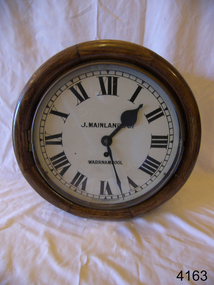
... After John Gall Mainland Jnr. had trained as a jeweller and watchmaker he also developed itchy feet and left New Zealand for Australia in the late 1880s eventually settling in Walhalla Victoria where he became chief of the fire brigade for ten years before moving to Warrnambool. Gertrude Emily born 1872 met and married John G Mainland after he had increased his skills to become an optician. In Jan 1892 opened a business in Liebig St...After John Gall Mainland Jnr. had trained as a jeweller and watchmaker he also developed itchy feet and left New Zealand for Australia in the late 1880s eventually settling in Walhalla Victoria where he became chief of the fire brigade for ten years before moving to Warrnambool. Gertrude Emily born 1872 met and married John G Mainland after he had increased his skills to become an optician. In Jan 1892 opened a business in Liebig St ...John Gall Mainlands father John Mainland Snr. was born in 1835 in the town of Lerwick in the Shetland Isles off the coast of Scotland. At the age of fifteen, he migrated to the South Island of New Zealand where he trained as a carpenter/builder after settling in Oamaru where he soon became a prominent citizen. He was for many years the Chairman of the Hospital Board and Captain of the fire brigade (which he founded). Mary Gall, Johns wife had also migrated with her family from Glasgow Scotland in 1837 at the age of thirteen to New Zealand where she had met and married John Mainland and in 1866 John Gall Mainland the second eldest of their six children was born. After John Gall Mainland Jnr. had trained as a jeweller and watchmaker he also developed itchy feet and left New Zealand for Australia in the late 1880s eventually settling in Walhalla Victoria where he became chief of the fire brigade for ten years before moving to Warrnambool. Gertrude Emily born 1872 met and married John G Mainland after he had increased his skills to become an optician. In Jan 1892 opened a business in Liebig St Warrnambool the sign outside his premises read, (J Mainland Watchmaker Jeweler and Optician). While he was establishing his business and profession John had set about contributing to the cultural and business life of the Warrnambool community. One of his many community commitments was with the scouting movement where he became a King Scout and an original charter member of the Warrnambool Rotary Club.The clock was made by an early Warrnambool business identity who had also made an important contribution to the local community over the years through his involvement with Rotary as a founding member the fire brigade. Having an item that was made by John Mainland during the early development of Warrnambool and in such good condition is in itself significant, it's provenance is well established and it is another piece of local history that further tells a story of Warrnambool's cultural life and early development in the 1890s. Wall Clock, circular in a wooden case Roman numerals on a twelve hour dialName of maker to dial face "J Mainland & Co Warrnambool"flagstaff hill, warrnambool, shipwrecked-coast, flagstaff-hill, flagstaff-hill-maritime-museum, maritime-museum, shipwreck-coast, flagstaff-hill-maritime-village, warrnambool clock maker, john mainland, john gall mainland, mary gall, clock maker, optician, jeweller