
Showing 4 items matching "stan goodall"
-
 Phillip Island and District Historical Society Inc.
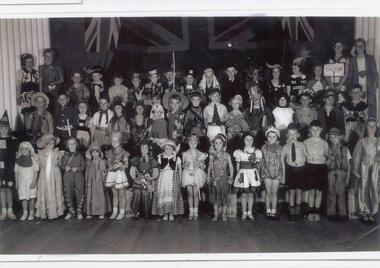
Photograph, Fancy Dress group, c. 1940s
... ...Stan Goodall..., ??, ??, ??, Stan Goodall, George Goodall, ??, ??, ??, ??, Pat Barton, ??..., ??, ??, ??, Stan Goodall, George Goodall, ??, ??, ??, ??, Pat Barton, ??..., ??, ??, ??, Stan Goodall, George Goodall, ??, ??, ??, ??, Pat Barton, ?? ...Following are some of the names of the children. Back Row: Ruth? Humphries, Joy Odlund, ??, ??, ??, ??, ??, Stan Goodall, George Goodall, ??, ??, ??, ??, Pat Barton, ??, ??, ??. Middle Row: ??, Lesley ?, Fay Shrieber, Alan Cleeland, Ruth? Humphries, ??, Coral McLardy, ??, Wally Goodall, ??, Eris Gawith, ??, ??, ??, ??, ??. Front Row: Heather McLardy, Diedre Cleeland, Charlotte Cleeland, Shirley Matthews?, Marie Regod, Verna Gawith, ??, Clarie Loton?, Betty Bradley, Vivian Cleeland, Enid Nelson, Lois Barton, Neville Cleeland, ??, George Regos, ??, Betty Bradley hopes someone can fill in the gaps and says she is not sure which one is Ruth Humphries (put in two places) but thinks it is the one in the top row. Black & White copy of a photograph of a children's fancy dress group in the early 1940's. Following are some of the names of the children. Back Row: Ruth? Humphries, Joy Odlund, ??, ??, ??, ??, ??, Stan Goodall, George Goodall, ??, ??, ??, ??, Pat Barton, ??, ??, ??. Middle Row: ??, Lesley ?, Fay Shrieber, Alan Cleeland, Ruth? Humphries, ??, Coral McLardy, ??, Wally Goodall, ??, Eris Gawith, ??, ??, ??, ??, ??. Front Row: Heather McLardy, Diedre Cleeland, Charlotte Cleeland, Shirley Matthews?, Marie Regod, Verna Gawith, ??, Clarie Loton?, Betty Bradley, Vivian Cleeland, Enid Nelson, Lois Barton, Neville Cleeland, ??, George Regos, ??, Betty Bradley hopes someone can fill in the gaps and says she is not sure which one is Ruth Humphries (put in two places) but thinks it is the one in the top row. celebration, ball, festivities, fancy dress, children, stan goodall -
 Phillip Island and District Historical Society Inc.
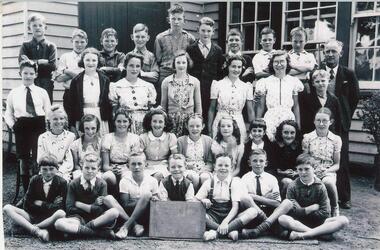
Photograph, Cowes State School Children & Headmaster 1941, 1941
... Back row from left: Bob Nelson, Tom Walton, George Goodall, Stan Goodall, Jim McKenzie, Kevin Findlay, Arthur Woodley, Wally Goodall, Doug Morrison. ...Back row from left: Bob Nelson, Tom Walton, George Goodall, Stan Goodall, Jim McKenzie, Kevin Findlay, Arthur Woodley, Wally Goodall, Doug Morrison. ...School photograph taken 1941. Back row from left: Bob Nelson, Tom Walton, George Goodall, Stan Goodall, Jim McKenzie, Kevin Findlay, Arthur Woodley, Wally Goodall, Doug Morrison. Second back row: Harvey Dixon, Elvie Matthews, Pat Anderson, Carmel Bilson, Pat Barton, Shirley Barton, Arthur Murdoch and Head Master Kevin Gerraty. Second row: Joy Odlund, Ruth Humphries, May McLardy, Enid Nelson, possibly Betty Mitchell, Lois Cleeland, Lorna Thompson, Daphne Smith, possibly Lois Barton. Front row: Bob Grayden, Kelvin Matthews, Kevin Gerraty, ? Gerraty, Ted Roberts, Roy Anderson, Ern Walton. Names checked by Elly Berryman and her mother, Charlotte Berryman nee Cleeland. 2/6/2020Black & White school photograph at Cowes State School 1941. cowes state school phillip island, ern walton -
 Flagstaff Hill Maritime Museum and Village
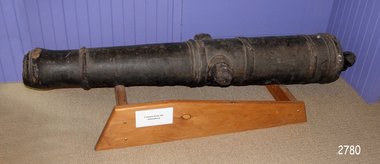
Weapon - Cannon, Alexander Hall and Son, c. 1855
... The Schomberg Cannon was recovered from the 1855 wreck of the SCHOMBERG in 1974 by Flagstaff Hill divers Peter Ronald, Colin Goodall and Gary Hayden. The wreck site was discovered in August 1973 by Stan McPhee and John Laidlaw. ...The Schomberg Cannon was recovered from the 1855 wreck of the SCHOMBERG in 1974 by Flagstaff Hill divers Peter Ronald, Colin Goodall and Gary Hayden. The wreck site was discovered in August 1973 by Stan McPhee and John Laidlaw. ...The Schomberg Cannon was recovered from the 1855 wreck of the SCHOMBERG in 1974 by Flagstaff Hill divers Peter Ronald, Colin Goodall and Gary Hayden. The wreck site was discovered in August 1973 by Stan McPhee and John Laidlaw. ABOUT THE SCHOMBERG When SCHOMBERG was launched in 1855, she was considered the “Noblest ship that ever floated on water.” SCHOMBERG’s owners, the Black Ball Line, commissioned the ship for their fleet of passenger liners. The ship was built by Alexander Hall of Aberdeen at a cost of £43,103. It was constructed with three skins: one planked fore and aft and two diagonally planked, fastened together with screw-threaded trunnels (wooden rails). Its first-class accommodation was simply luxurious; velvet pile carpets, large mirrors, rosewood, birds-eye maple, mahogany, soft furnishings of satin damask; an oak-lined library and a piano. Overall she had accommodation for 1000 passengers. At the launch, the SCHOMBERG’s 34-year-old master, Captain ‘Bully’ Forbes, had promised Melbourne in 60 days, "with or without the help of God." James Nicol Forbes was born in Aberdeen in 1821 and rose to fame with his record-breaking voyages on the famous Black Ball Line ships; MARCO POLO and LIGHTNING. In 1852 in the MARCO POLO he made the record passage from London to Melbourne in 68 days. There were 53 deaths on the voyage but the great news was of the record passage by the master. In 1954 Captain Forbes took the clipper LIGHTNING to Melbourne in 76 days and back in 63 days, this was never beaten by a sailing ship. He often drove his crew and ship to breaking point to beat his own records. He cared little for the comfort of the passengers. On this, the SCHOMBERG’s maiden voyage, he was going to break records. SCHOMBERG departed Liverpool on her maiden voyage on 6 October 1855 flying the sign “Sixty Days to Melbourne”. The ship departed with 430 passengers and 3000 tons of cargo including iron rails and equipment intended to build the Melbourne to Geelong Railway and a bridge over the Yarra from Melbourne to Hawthorn. She also carried a cow for fresh milk, pens for fowls and pigs, and 90,000 gallons of water for washing and drinking. It also carried 17,000 letters and 31,800 newspapers. The ship and the cargo was insured for $300,000, a fortune in those times. The winds were poor as she sailed across the equator, slowing SCHOMBERG’s journey considerably. Land was first sighted on Christmas Day, at Cape Bridgewater near Portland, and Captain Forbes followed the coastline towards Melbourne. Forbes was said to be playing cards when called by the Third Mate Henry Keen, who reported land about 3 miles off, Due in large part to the captain's regarding a card game as more important than his ship, it eventually ran aground on a sand spit near Curdie's Inlet (about 56 km west of Cape Otway) on 26 December 1855, 78 days after leaving Liverpool. The sand spit and the currents were not marked on Forbes’s map. Overnight, the crew launched a lifeboat to find a safe place to land the ship’s passengers. The scouting party returned to SCHOMBERG and advised Forbes that it was best to wait until morning because the rough seas could easily overturn the small lifeboats. The ship’s Chief Officer spotted SS QUEEN at dawn and signalled the steamer. The master of the SS QUEEN approached the stranded vessel and all of SCHOMBERG’s passengers and crew were able to disembark safely. The SCHOMBERG was lost and with her, Forbes’ reputation. The Black Ball Line’s Melbourne agent sent a steamer to retrieve the passengers’ baggage from the SCHOMBERG. Other steamers helped unload her cargo until the weather changed and prevented the salvage teams from accessing the ship. Later one plunderer found a case of Wellington boots, but alas, all were for the left foot! Local merchants Manifold & Bostock bought the wreck and cargo, but did not attempt to salvage the cargo still on board the ship. They eventually sold it on to a Melbourne businessman and two seafarers. In 1864 after two of the men drowned when they tried to reach SCHOMBERG, salvage efforts were abandoned. Parts of the SCHOMBERG were washed ashore on the south island of New Zealand in 1870, nearly 15 years after the wreck. The wreck now lies in almost 9 metres of water. Although the woodwork is mostly disintegrated the shape of the ship can still be seen due to the remaining railway irons, girders and the ship’s frame. A variety of goods and materials can be seen scattered about nearby. Flagstaff Hill holds many items salvaged from the SCHOMBERG including a ciborium (in which a diamond ring was concealed), communion set, ship fittings and equipment, personal effects, a lithograph, tickets and a photograph from the SCHOMBERG. One of the SCHOMBERG bells was in the old Warrnambool Library. The Schomberg cannon is currently on loan to the Port Campbell Visitor Information Centre.The SCHOMBERG collection is of historical and archaeological significance at a State level, listed on the Victorian Heritage Register VHR S612. Flagstaff Hill’s collection of artefacts from the SCHOMBERG is significant for its association with the Victorian Heritage Registered shipwreck. The collection is primarily significant because of the relationship between the objects, as together they have a high potential to interpret the story of the SCHOMBERG. The SCHOMBERG collection is archaeologically significant as the remains of an international passenger ship. The shipwreck collection is historically significant for representing aspects of Victoria’s shipping history and its potential to interpret sub-theme 1.5 of Victoria’s Framework of Historical Themes (living with natural processes). The collection is also historically significant for its association with the shipwreck and the ship, which was designed to be the fastest and most luxurious of its day. The SCHOMBERG collection meets the following criteria for assessment: Criterion A: Importance to the course, or pattern, of Victoria’s cultural history. Criterion B: Possession of uncommon, rare or endangered aspects of Victoria’s cultural history. Criterion C: Potential to yield information that will contribute to an understanding of Victoria’s cultural history.Cannon; 6-POUNDER (6pdr) smooth bore cannon, mounted on a wooden frame. The cannon has a metal lug on each side. It is commonly known as the Schomberg cannon. It was recovered from the wreck of the Schomberg in 1974.warrnambool, flagstaff-hill, flagstaff-hill-maritime-museum, maritime-museum, shipwreck-coast, flagstaff-hill-maritime-village, schomberg, shipwrecked-artefact, clipper ship, black ball line, 1855 shipwreck, aberdeen clipper ship, captain forbes, peterborough shipwreck, ss queen, cannon, the schomberg cannon, schomberg cannon, peterborough, 1855, sailing ship -
 Phillip Island and District Historical Society Inc.
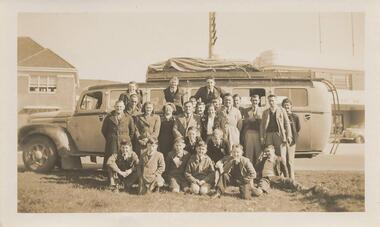
Photographs, Phillip Island Band's visit to Tasmania, 1947
... Centre row: Tom Westley (bandmaster), Jim Broadbent, Joan Westley, Nan Hislop, Tom Cartwright, Wally Goodall, Des Cartwright, Wally?, Jessie Cartwright, Ken Clark (Tasmanian Bus Driver), Les Bain, Stan Walton, Doug Morrison, Mary Broadbent. ...Centre row: Tom Westley (bandmaster), Jim Broadbent, Joan Westley, Nan Hislop, Tom Cartwright, Wally Goodall, Des Cartwright, Wally?, Jessie Cartwright, Ken Clark (Tasmanian Bus Driver), Les Bain, Stan Walton, Doug Morrison, Mary Broadbent. ...Five photographs of the Phillip Island Band going on a social visit to Tasmania in 1947. Boys and parents. Names of people in photograph 333-01 and 333-02: Back row: Charlotte Cleeland, Arthur Murdoch, Alan Cleeland. Centre row: Tom Westley (bandmaster), Jim Broadbent, Joan Westley, Nan Hislop, Tom Cartwright, Wally Goodall, Des Cartwright, Wally?, Jessie Cartwright, Ken Clark (Tasmanian Bus Driver), Les Bain, Stan Walton, Doug Morrison, Mary Broadbent. Front row: Arbie Broadbent, W McNair, John Bennett, Kevin Wagner, Bill Broadbent, Ian Matthews, Robert Cleeland, Bob Cartwright.Five photographs of the Phillip Island Band going on a social visit to Tasmania in 1947. Boys and parents. 333-01 - Black & White photograph of the Band in front of the Bern Denham bus in Cowes. 333-02 is an enlargement of 333-01. 333-03 - Black & White photograph of the Band in the bus ready for departure to Tasmania. 333-04 - Black & White photograph of the Band in front of a Monument possibly in Tasmania. 333-05 - Black & White enlargement of 333-04. phillip island band, kevin findlay
