
Showing 7 items matching "standard common names"
-
 Wheen Bee Foundation
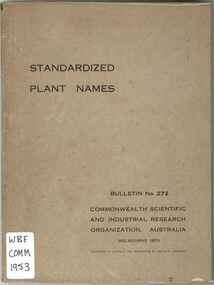
Publication, CSIRO, Standardized plant names: a revised list of standard common names... (CSIRO), Melbourne, 1953, 1953
... Standardized plant names: a revised list of standard common names... (CSIRO), Melbourne, 1953...Standardized plant names: a revised list of standard common names... (CSIRO), Melbourne, 1953 Publication CSIRO ... -
 University of Melbourne, Burnley Campus Archives
Book, CSIRO, Standardized Plant Names, CSIRO 1967, 1953
... ...Standard common names...Common Names Index: Common Name, Standard Common Name, Scientific Name. ...Botanical Names Index: Botanical Name, Approved Botanical name, Standard Common Name. Common Names Index: Common Name, Standard Common Name, Scientific Name. ...CSIRO periodical with light cardboard cover - 132 Pages in two parts beginning with a section on how to use the index - an index of Botanical names and an index of Common names. Botanical Names Index: Botanical Name, Approved Botanical name, Standard Common Name. Common Names Index: Common Name, Standard Common Name, Scientific Name. Bulletin No. 272 Commonwealth Scientific and Industrial Research Organization, Australia Melbourne 1953. "A Revised List of Standard Common Names for the More Important Australian Grasses, Other Pasture Plants, and Weeds. (Superseded Bulletin No. 156). On back cover RECENT BULLETINS list 245-271Insert paper marker - a torn exam paper used to note ARCOTHECA CALENDULA and ECHIUM LYCOPSIS from an unknown user (in blue ink handwriting)plant names, scientific names, csiro, australian plants, bulletin, standard common names, 1967, standardized plant names, australian grasses, pasture plants, weeds -
 Greensborough Historical Society
Jars, Kraft Foods, Vegemite Jars, 2008-2016
... A variety of Vegemite jars: 115g jar with yellow plastic lid (manufactured 2008), standard labelling; 145g jar with red metal lid (manufactured 2010), special labelling 'New, Name Me', possibly first edition of 'Cheesymite'; 235g jar with orange plastic lid (manufactured 2016), labelled as 'Reduced Salt', part of the 'Beat the Drum Campaign' to support Australian Olympians in Rio de Janeiro. Shows the variety of this common ...A variety of Vegemite jars: 115g jar with yellow plastic lid (manufactured 2008), standard labelling; 145g jar with red metal lid (manufactured 2010), special labelling 'New, Name Me', possibly first edition of 'Cheesymite'; 235g jar with orange plastic lid (manufactured 2016), labelled as 'Reduced Salt', part of the 'Beat the Drum Campaign' to support Australian Olympians in Rio de Janeiro.Shows the variety of this common spread.3 Vegemite glass jars, different labels and sizes. Plastic or metal lid, paper or plastic labels.vegemite jars, kraft foods -
 City of Moorabbin Historical Society (Operating the Box Cottage Museum)
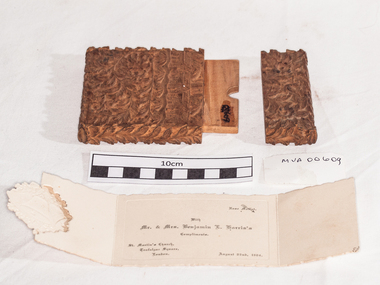
Craftwork, heavily carved calling card case, c1900
... common amongst the aristocracy of Europe, and also in the United States. The whole procedure depended upon there being servants to open the door and receive the cards and it was, therefore, confined to the social classes which employed servants. Some visiting cards included refined engraved ornaments, embossed lettering, and fantastic coats of arms. However, the standard form visiting card in the 19th century in the United Kingdom was a plain card with nothing more than the bearer's name...common amongst the aristocracy of Europe, and also in the United States. The whole procedure depended upon there being servants to open the door and receive the cards and it was, therefore, confined to the social classes which employed servants. Some visiting cards included refined engraved ornaments, embossed lettering, and fantastic coats of arms. However, the standard form visiting card in the 19th century in the United Kingdom was a plain card with nothing more than the bearer's name ...A visiting card, also known as a calling card, is a small paper card with one's name printed on it, and often bearing an artistic design. Visiting cards became an indispensable tool of etiquette, with sophisticated rules governing their use. The essential convention was that one person would not expect to see another person in his own home (unless invited or introduced) without first leaving his visiting card for the person at his home. Upon leaving the card, he would not expect to be admitted at first, but might receive a card at his own home in response. This would serve as a signal that a personal visit and meeting at home would be welcome. On the other hand, if no card were forthcoming, or if a card were sent in an envelope, a personal visit was thereby discouraged. As an adoption from French and English etiquette, visiting cards became common amongst the aristocracy of Europe, and also in the United States. The whole procedure depended upon there being servants to open the door and receive the cards and it was, therefore, confined to the social classes which employed servants. Some visiting cards included refined engraved ornaments, embossed lettering, and fantastic coats of arms. However, the standard form visiting card in the 19th century in the United Kingdom was a plain card with nothing more than the bearer's name on it. Sometimes the name of a gentlemen's club might be added, but addresses were not otherwise included. If a card was left with a turned corner it indicated that the card had been left in person rather than by a servant. Visiting cards were kept in highly decorated card cases.A timber calling card case, heavily carved with flowers, leaves and huts.craftwork, woodwork, visiting cards, early settlers, moorabbin, bentleigh, cheltenham, market gardeners -
 Eltham District Historical Society Inc
Document - Register, Common/State School at Eltham No. 209, 1864-1917
... Common School at Eltham No. 209, it lists child's name, years of attendance and classes attended, age when first admitted, date of admsission, date of leaving and occupation of parents. The register was revised to the Register of the State School at Eltham No. 209 capturing students from 1873. Some overlap between the two variants exists. The latter register includes additional information of date of passing the Standard...Common School at Eltham No. 209, it lists child's name, years of attendance and classes attended, age when first admitted, date of admsission, date of leaving and occupation of parents. The register was revised to the Register of the State School at Eltham No. 209 capturing students from 1873. Some overlap between the two variants exists. The latter register includes additional information of date of passing the Standard ...Copies made from original register held by Eltham Primary School as part of the school's sesquicentennial recognition 1856-2006. Lists students by registration number commencing with William John Taylor (No. 1) in 1864. Initially recorded as the Register of the Common School at Eltham No. 209, it lists child's name, years of attendance and classes attended, age when first admitted, date of admsission, date of leaving and occupation of parents. The register was revised to the Register of the State School at Eltham No. 209 capturing students from 1873. Some overlap between the two variants exists. The latter register includes additional information of date of passing the Standard of Education, names of parent or guardian and residence of parent or guardian. The register was discontinued in 1917. Later pages of the original register are very damaged with large sections illegible.eltham state school no. 209, register of students, dalton street, eltham primary school -
 Warrnambool and District Historical Society Inc.
Booklet - Lettering Book, Halstead Press Pty Ltd, The Australian Lettering Book, 1945
... common errors, compass points. Especially designed for use in Australian Schools, offices of Lawyers, Architects, Surveyors, Engineers, Engravers, and Draughtsmen. Table of contents The author is a teacher of show card and ticket writing at Sydney Technical College. Book used by many students and offices. Note by the publishers provides standards for the correct form of the characters. warrnambool lettering book angus & robertson limited s.r. coleston herbert newell Hand written name ...Author Herbert Newell. Alphabets of varied fonts, headings, flourishes, plans, numerals, sketch maps, scrolls, shading, common errors, compass points. Especially designed for use in Australian Schools, offices of Lawyers, Architects, Surveyors, Engineers, Engravers, and Draughtsmen. Table of contentsThe author is a teacher of show card and ticket writing at Sydney Technical College. Book used by many students and offices. Note by the publishers provides standards for the correct form of the characters. Light brown light card cover with black ink font and border patterns. 32 Cream pages with black ink. Two staples. Hand written name on top of outline black border S. R Coleston. Price 3/9warrnambool, lettering book, angus & robertson limited, s.r. coleston, herbert newell -
 Emerald Museum & Nobelius Heritage Park
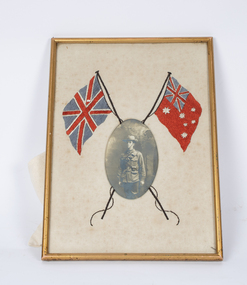
Photograph - Framed photographic postcard of soldier, Kodak, 1914-1918
... common for newly enlisted servicemen to organise a photograph of themselves in their enlistment uniform to give to their family/loved ones before embarking. Two names have been suggested regarding the identity of this soldier: Victor George Thompson and Tommy Dalzeil - both presumably local young men. However, the actual name has not been confirmed. World War I On back of frame handwritten probably by Museum staff: 'Unknown soldier / maybe Victor George Thompson' On back of photographic postcard handwritten: 'To go in Corticilli / with 2 flags / Black flag poles / 3/8 Gold / Standard ...This photo was taken during World War 1 (1914-1918). It was very common for newly enlisted servicemen to organise a photograph of themselves in their enlistment uniform to give to their family/loved ones before embarking. Two names have been suggested regarding the identity of this soldier: Victor George Thompson and Tommy Dalzeil - both presumably local young men. However, the actual name has not been confirmed.Plain wooden frame with gilt coating. Picture consists of black and white, oval shaped photographic postcard of a soldier in the centre surrounded by two silk embroidered flags on black embroidered flag poles. The flag on the left is the British flag and the flag on the right is the Australian Red Ensign. The background is a cream-coloured calico-type material. This appears to be an enlistment photo, but the soldier is wearing a curiously ill-fitting uniform - perhaps borrowed from the studio for the occasion.On back of frame handwritten probably by Museum staff: 'Unknown soldier / maybe Victor George Thompson' On back of photographic postcard handwritten: 'To go in Corticilli / with 2 flags / Black flag poles / 3/8 Gold / Standard / Wed / for / certain'world war i
