
Showing 7 items matching "stanthorpe"
-
 Wheen Bee Foundation
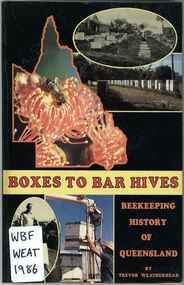
Publication, Weatherhead, T, Boxes to bar hives: beekeeping history of Queensland (Weatherhead, T.) Stanthorpe, 1986, 1986
... Boxes to bar hives: beekeeping history of Queensland (Weatherhead, T.) Stanthorpe, 1986...Stanthorpe, International Colour Productions...Boxes to bar hives: beekeeping history of Queensland (Weatherhead, T.) Stanthorpe, 1986 Publication Weatherhead, T. ... -
 Beechworth Honey Archive
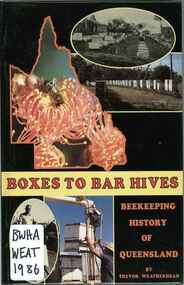
Publication, Boxes to bar hives: beekeeping history of Queensland (Weatherhead, T.), Stanthorpe, 1986, 1986
... Boxes to bar hives: beekeeping history of Queensland (Weatherhead, T.), Stanthorpe, 1986...Stanthorpe, International Colour Productions...Boxes to bar hives: beekeeping history of Queensland (Weatherhead, T.), Stanthorpe, 1986 Publication ... -
 St Kilda Historical Society
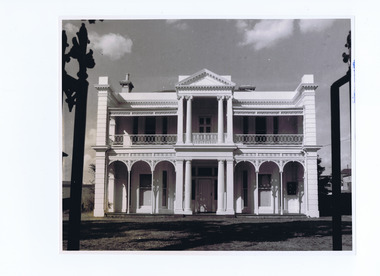
Photograph - Building, The Age newspaper, Stanthorpe, 1971
... Stanthorpe......Stanthorpe...Built 1875 for Alexander Sutherland, later Presbyterian Manse Mansions Stanthorpe Given to historical society by Mis E Service 12.10.1982 Stamped the Age 23.4.1971 black and white photograph Stanthorpe Photograph Building The Age newspaper ...Built 1875 for Alexander Sutherland, later Presbyterian Manseblack and white photographGiven to historical society by Mis E Service 12.10.1982 Stamped the Age 23.4.1971mansions, stanthorpe -
 Beechworth Honey Archive
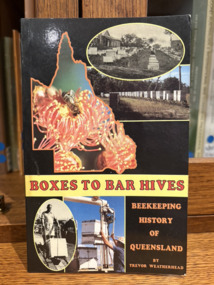
Book - Boxes to Bar Hives, Boxes to Bar Hives: beekeeping history of Queensland (Weatherhead, T.), Stanthorpe, 1986
... Boxes to Bar Hives: beekeeping history of Queensland (Weatherhead, T.), Stanthorpe, 1986...Boxes to Bar Hives: beekeeping history of Queensland (Weatherhead, T.), Stanthorpe, 1986 Book Boxes to Bar Hives ... -
 Orbost & District Historical Society
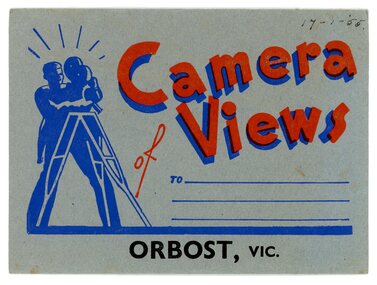
Souvenir - Camera Views of Orbost of the 1950's, Murray Views, c 1950's
... Samuel Lee & Co., Printers, Stanthorpe, Q. Serial No. CCV...Samuel Lee & Co., Printers, Stanthorpe, Q. Serial No. CCV Grey envelope with red and black printing with blue drawing with a person behind a tripod holding a camera. ...This souvenir is a promotion of the Orbost district dated from the 1950'sThis item is significant because it showing images of Orbost attractions used as tourist interest in the 1950's.Grey envelope with red and black printing with blue drawing with a person behind a tripod holding a camera. Eight fold out photographs that drop down when opened. Front inscriptions - Camera Views of -------- Orbost, Vic 17.1. 55. Back inscriptions - Copyright. Produced by Murray Views, Gympie, Q. Samuel Lee & Co., Printers, Stanthorpe, Q. Serial No. CCVorbost, souvenir, photos -
 Bendigo Historical Society Inc.
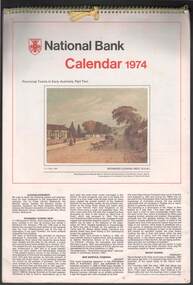
Document - NATIONAL BANK CALENDAR 1974
... Daylesford [Victoria] 12. Stanthorpe, 1888 [QLD]...Daylesford [Victoria] 12. Stanthorpe, 1888 [QLD] Document NATIONAL BANK CALENDAR 1974 ...National Bank calendar 1974 featuring thirteen coloured views of provincial towns in early Australia. Part two in series. 1. Richmond looking West. 2. New Norfolk [Tasmania] 3. Mount Barker [SA] 4. West Maitland [NSW] 5. Gympie in 1887 [Qld] 6. Sandhurst [Vic] 7. Kiama [NSW] 8. View of Fremantle [WA], 1832. 9. Goulburn [NSW] 10. Yorkton, Port Dalrymple, Van Diemen's Land 1808. 11. Daylesford [Victoria] 12. Stanthorpe, 1888 [QLD]australia, history, colonies, establishing -
 National Wool Museum
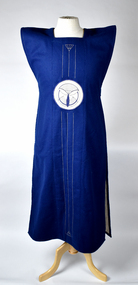
Clothing - Tabard, Jun Tomita, 1970s
... Tomita was at the Jam factory from 1976-78 and he has works in numerous public collections, including: - Stanthorpe Art Museum, Art Gallery of South Australia / Australia - Oslo National Gallery / Norway - National Museum of Israel / Israel - Stedelik Museum, Museum of Rotterdam / The Netherlands - Denver Art Museum, St. ...Tomita was at the Jam factory from 1976-78 and he has works in numerous public collections, including: - Stanthorpe Art Museum, Art Gallery of South Australia / Australia - Oslo National Gallery / Norway - National Museum of Israel / Israel - Stedelik Museum, Museum of Rotterdam / The Netherlands - Denver Art Museum, St. ...This tabard is one of a small number that were produced/woven by Japanese master weaver Jun Tomita during the period that he was resident artisan at the Jam Factory in Adelaide. The tabard incorporates Ikat/Kasuri woven central panels. Tomita was born in 1951 in Toyama prefecture, and is based in Kyoto, the textile centre of Japan. The technique he uses kasuri (the Japanese term for ikat) is selectively pre-dying yarns before weaving to create pattern. The other decorative features of this garment are based on Japanese family crest designs (kamon). The pointed shoulders of this garment are reminiscent of the stiffened shoulders of kataginu, the upper part of the kamishimo ensemble that was formal wear for samurai men. Tomita was at the Jam factory from 1976-78 and he has works in numerous public collections, including: - Stanthorpe Art Museum, Art Gallery of South Australia / Australia - Oslo National Gallery / Norway - National Museum of Israel / Israel - Stedelik Museum, Museum of Rotterdam / The Netherlands - Denver Art Museum, St. Louis Art Museum, Long House Foundation - Cooper-Hewitt Museum of Art/USA - Victoria and Albert Museum, UK - Toyama Prefectural Museum of Art, Japan The donor purchased this tabard from an exhibition held at Wool House in Parkville Victoria, which was sponsored by the Australian Wool Board to promote the use of Australian Wool in textiles and fashion at that time, around April/May in 1977. At that time (1976-1977) the donor owned and run a retail/display shop for craft products such as ceramics, artworks and jewellery. The donor subsequently retained this in storage with some other items since the business closed.Double sided reversible tabard featuring woven centrals panels. One side is navy blue with white and blue detail panels, one side is grey with green, brown and cream central panel detail.textile, tabard, japan, art, clothing, weaving, fashion, design, ikat, kasuri
