
Showing 13 items matching "starboard lamp"
-
 Flagstaff Hill Maritime Museum and Village
Equipment - Navigation Lamp, Starboard
... Navigation Lamp, Starboard......Starboard lamp...Navigation lamp; Starboard side. Metal kerosene lamp with two flat sides and a curved front with a rippled, green glass window. ...Equipment Navigation Lamp, Starboard ...This item appears to be a 20th-century lamp, modelled after an earlier version of a wall-mounted kerosene lamp. Authentic kerosene lamps were typically crafted from copper or brass, renowned for their durability and traditional aesthetic. In contrast, contemporary reproductions are often manufactured using alternative materials and processes, reflecting changes in production methods and cost considerations.The lamp is modelled after marine kerosene navigation lamps that were widely used throughout the 19th and early 20th centuries. These lamps played a significant role in maritime history, providing essential lighting for navigation on vessels during this era. As a representation of this period’s maritime lighting technology, the lamp serves as an example of the type of equipment that would have been commonplace aboard ships of the time.Navigation lamp; Starboard side. Metal kerosene lamp with two flat sides and a curved front with a rippled, green glass window. The chimney on top has a catch and an opening lid. and the name "Starboard" is inscribed on a fixed brass plaque. The fuel tank and wick can be removed through the base. Engraved on plaque: “STARBOARD“flagstaff hill, flagstaff hill maritime museum and village, warrnambool, maritime museum, maritime village, great ocean road, shipwreck coast, ship's lamp, kerosene lamp, navigation lamp, starboard lamp, ship's equipment, safety equipment -
 Glenelg Shire Council Cultural Collection
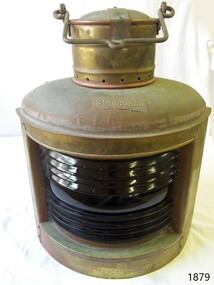
Functional object - Navigational Lamp - Starboard
... Navigational Lamp - Starboard...lamp. Two flat sides at the back joining at a point. Front is curved in a semi circle. Stamped lettering - Starboard and Patent No 546575 AND OTHERS PENDING...lamp. Two flat sides at the back joining at a point. Front is curved in a semi circle. Stamped lettering - Starboard and Patent No 546575 AND OTHERS PENDING Functional object Navigational Lamp - Starboard ...Copper navigational lamp. Two flat sides at the back joining at a point. Front is curved in a semi circle. Stamped lettering - Starboard and Patent No 546575 AND OTHERS PENDING -
 Flagstaff Hill Maritime Museum and Village
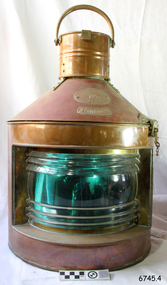
Lamp
... lamp...Starboard side light...flagstaff hill warrnambool shipwrecked-coast flagstaff-hill flagstaff-hill-maritime-museum maritime-museum shipwreck-coast flagstaff-hill-maritime-village flagstaff hill warrnambool shipwrecked-coast flagstaff-hill flagstaff-hill-maritime-museum maritime-museum shipwreck-coast flagstaff-hill-maritime-village lamp Starboard side light Starboard side light with fresnal glass lens with removable blue/green filter, oil/kero burner with reflector inside. ...Starboard side light with fresnal glass lens with removable blue/green filter, oil/kero burner with reflector inside. Made by "Tung Woo Hong Kong No. S1477", rounded front and 2 flat sides, bracket on one side for hanging. H 57.5cm x D 35cm.flagstaff hill, warrnambool, shipwrecked-coast, flagstaff-hill, flagstaff-hill-maritime-museum, maritime-museum, shipwreck-coast, flagstaff-hill-maritime-village, flagstaff hill, warrnambool, shipwrecked-coast, flagstaff-hill, flagstaff-hill-maritime-museum, maritime-museum, shipwreck-coast, flagstaff-hill-maritime-village, lamp, starboard side light -
 Flagstaff Hill Maritime Museum and Village
Functional object - Navigation Side Lamp, early 20th century
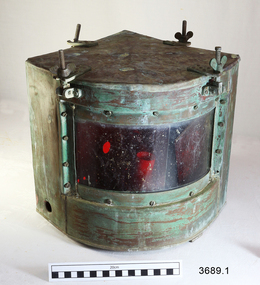
... lamp...navigation light...navigation equipment...starboard...This system of coloured lamps is standardised throughout the world for all marine vessels, red is for port and green for starboard, (red is for the boats right hand side). ...The starboard lamp also has a hole in each straight side (one with a threaded fitting). ...The starboard lamp also has a hole in each straight side (one with a threaded fitting). ...This pair of navigational lamps or lights was fitted to the vessel S.S. Rowitta when it was renovated to become a display passenger ferry at Flagstaff Hill Maritime Village from 1976-2015. Navigation lamps are used to indicate a vessel’s position and direction of travel to other vessels nearby. This system of coloured lamps is standardised throughout the world for all marine vessels, red is for port and green for starboard, (red is for the boats right hand side). These navigation lamps were not the original fittings for this vessel but had come from a similar vessel of the same era of the early 1900’s. The history of the lamp fittings at this time is unknown. SS ROWITTA: - The 1909 steam ferry, SS Rowitta, was installed as an exhibit at Flagstaff Hill in 1975 and was enjoyed by many visitors for 40 years. Rowitta was a timber steam ferry built in Hobart in 1909 using planks of Huon and Karri wood. She was a favourite of sightseeing passengers along Tasmania’s Tamar and Derwent rivers for 30 years. Rowitta was also known as Tarkarri and Sorrento and had worked as a coastal trading vessel between Devonport and Melbourne, and Melbourne Queenscliff and Sorrento. In 1974 Rowitta was purchased by Flagstaff Hilt to convert into a representation of the Speculant, a historic and locally significant sailing ship listed on the Victorian Heritage Database. (The Speculant was built in Scotland in 1895 and traded timber between the United Kingdom and Russia. Warrnambool’s P J McGennan & Co. then bought the vessel to trade pine timber from New Zealand to Victorian ports and cargo to Melbourne. She was the largest ship registered with Warrnambool as her home port, playing a key role in the early 1900s in the Port of Warrnambool. In 1911, on her way to Melbourne, she was wrecked near Cape Otway. None of the nine crew lost their lives.) The promised funds for converting Rowitta into the Speculant were no longer available, so she was restored back to her original configuration. She represented the importance of coastal traders to transport, trade and communication in Australia times before rail and motor vehicles. Sadly, in 2015 the time had come to demolish the Rowitta due to her excessive deterioration and the high cost of on-going repairs. She had given over 100 years of service and pleasure to those who knew her. These lamps are an historical example of navigational equipment used in the early 20th century, adhering to a navigational standard that is worldwide, and a design similar to what is still being used today. They were used on the display vessel at Flagstaff Hill Maritime Village as an aid to maritime education. The Rowitta represents the importance of coastal traders to transport, trade and communication along the coast of Victoria, between states, and in Australia before rail and motor vehicles. The vessel was an example of a ferry built in the early 20th century that served many different roles over its lifetime of over 100 years. Two side navigation ship's lamps, quarter circle shaped metal boxes with glass window and removable lid. The lid attaches to the box using four brackets, wingnuts and screws that swing down out of the way. The window of double-thickness glass is inserted on the curved side of the box and attached by screws around the frame. The inner glass panel is coloured according to the lamp’s use; port is red and starboard green. The port lamp has a round hole cut into each of the two straight sides and an electrical fitting inside. The starboard lamp also has a hole in each straight side (one with a threaded fitting). Its lid has an additional cross bar on top that has a circular space in the centre, nuts and screws fit through holes in the ends and a folding handle is attached across the centre space. The lamps were once fitted onto the vessel Rowitta. The starboard lamp has an inscription stamped into the metal. Impressed on 3689.2; “STARBOARD PATT 8025” flagstaff hill, warrnambool, flagstaff hill maritime museum, maritime museum, flagstaff hill maritime village, navigation lamp, navigation light, navigation equipment, starboard patt 8025, ship’s fitting, rowitta, tarkarri, speculant, purdon & featherstone of hobart, passenger ferry 1909, vessel, display rowitta, display passenger ferry, sorrento -
 Flagstaff Hill Maritime Museum and Village
Binnacle, Early to mid 20th Century
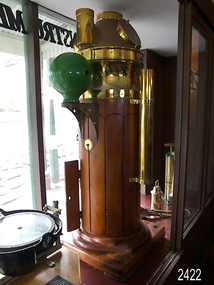
... Ships binnacle, wood with brass fittings, consists of 2 brass lamp holders, place for compass, Also has an inclinometer with a scale 40 to 0 to 40, one red and one green iron Kelvin compensation balls, one on each side of binnacle denoting port and starboard, a brass cylinder attached perpendicular at the rear for storing a Flinders Bar, 2 hinged cupboards containing adjustable wooden racks with drilled holes in them to hold iron Heeling error magnets....Ships binnacle, wood with brass fittings, consists of 2 brass lamp holders, place for compass, Also has an inclinometer with a scale 40 to 0 to 40, one red and one green iron Kelvin compensation balls, one on each side of binnacle denoting port and starboard, a brass cylinder attached perpendicular at the rear for storing a Flinders Bar, 2 hinged cupboards containing adjustable wooden racks with drilled holes in them to hold iron Heeling error magnets. ...Mr John Wilson Gillie was born on the 31st of March 1864. On the 31st of July 1880 he was apprenticed for four years to J.J. Wilson and Sons, Nautical Instrument Makers of Sunderland. Following the apprenticeship he spent six months to a year as an ‘improver’ in Glasgow, and then started a new company ‘Wilson and Gillie’ in North Shields. At this time sail had just given way to steam and wooden ships to steel, and the railways were competing with colliers for the carrying of coal from the North East of England to London and the South. In 1858 only seven out of 44 shipyards on the Tyne were using iron, but by 1862 there were ten, employing around 4,000 men. These changes had a significant effect on nautical instrument manufacturers, as the magnetic compass for a wooden sailing vessel was very simple and required little in the way of compensation. For steel vessels much more was required and this was a period of great development, both in the compass bowl and the binnacle in which it was housed. In 1870 Sir William Thomson (later Lord Kelvin) designed his dry card standard compass, which completely replaced all previous designs. Wilson and Gillie started as agents for the Thomson compass, but later J.W. Gillie, using similar principles, redesigned the compass suspension and patented the ‘UNIT’ standard compass. It became popular with local shipowners and shipbuilders. In 1910 the firm of John Lilley and Son (which had been established in London in 1812), found themselves in financial difficulties and were saved with the help of John Wilson Gillie, who established, on the 8th of August 1911, a new firm of John Lilley and Son Limited. John Lilley and Son had been the sole London agents for Sir William Thomson, a very enviable position during this period, when the Thomson compass led the field. Unfortunately, Mr. Lilley had quarreled with the Glasgow company, who withdrew the agency and established their own branch in London (later to become Kelvin White and Hutton). On November 7th 1913, the firm of John Lilley and Son Limited of London amalgamated with Wilson and Gillie of North Shields, and after this date instruments manufactured by the two companies bore the name John Lilley and Son Limited of London and North Shields. During the 1930s many of the London nautical instrument makers were in difficulties, including John Lilley and Son Limited and Reynolds and Son, Dobbie and Clyde Limited, and Mr. J.W. Gillie arranged an amalgamation between these two companies. The new firm became Lilley and Reynolds Limited. In 1943, with estate duties in mind, the North Shields company was reconstituted and took the name of John Lilley and Gillie Limited, although the shareholders, directors and personnel remained unchanged In the early 1970s Lilley and Gillie developed close links with Observator in Rotterdam, who manufactured one of the first fully reliable transmitting magnetic compass systems. The Observator shareholders, Holland America Line, bought the share capital of John Lilley and Gillie Limited., but retained all the personnel and the directors. (See Links for more information)A significant item of early 20th century marine navigational equipment made by a leading manufacturer in the field from a company that is still producing marine navigational instruments today. John Lilleys company began in 1812 growing at a time when the transition of compasses from timber ships, to steel vessels. Compasses at this time required a method of compensation to allow their inclusion in steel vessels without magnetic deviation. This therefore was a period of great development, both in the compass bowl and the binnacle in which it was housed and the Lilley company were leaders in the field. Ships binnacle, wood with brass fittings, consists of 2 brass lamp holders, place for compass, Also has an inclinometer with a scale 40 to 0 to 40, one red and one green iron Kelvin compensation balls, one on each side of binnacle denoting port and starboard, a brass cylinder attached perpendicular at the rear for storing a Flinders Bar, 2 hinged cupboards containing adjustable wooden racks with drilled holes in them to hold iron Heeling error magnets.Textured brass plate attached to front stating "JOHN LILLEY & SON LTD (WILSON & GILLIE), NAUTICAL INSTRUMENT MAKERS, NORTH SHIELDS" . Inclinometer has "JOHN LILLEY & SON LTD (Wilson & Gillie) LONDON & NORTH SHIELDS" engraved. flagstaff hill, warrnambool, shipwrecked-coast, flagstaff-hill, flagstaff-hill-maritime-museum, maritime-museum, shipwreck-coast, flagstaff-hill-maritime-village, binnacle, john lillie & son ltd, compass -
 Flagstaff Hill Maritime Museum and Village
Lamp
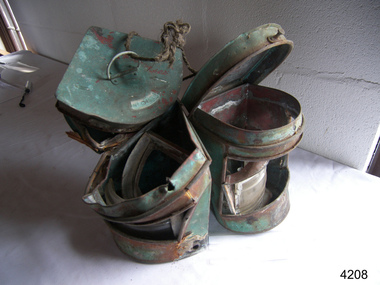
... Lamps (3), green & crushed. Port, Starboard & Stern imprinted & joined with rope....flagstaff hill warrnambool shipwrecked-coast flagstaff-hill flagstaff-hill-maritime-museum maritime-museum shipwreck-coast flagstaff-hill-maritime-village Lamps (3), green & crushed. Port, Starboard & Stern imprinted & joined with rope. ...Lamps (3), green & crushed. Port, Starboard & Stern imprinted & joined with rope.flagstaff hill, warrnambool, shipwrecked-coast, flagstaff-hill, flagstaff-hill-maritime-museum, maritime-museum, shipwreck-coast, flagstaff-hill-maritime-village -
 Flagstaff Hill Maritime Museum and Village
Equipment - Navigation Lamp, W. T George and Co. Ltd, ca 1941
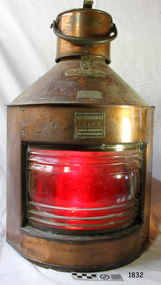
... lamp is important as an example of the evolution of marine safety technology. Countries began passing laws and regulations in the 1830s that required ships to show navigation lights at night or in poor weather. From the late 1840s colours were standardised; red for portside of the vessel and green for starboard ...William Thomas George was born in Birmingham in 1884 and was a tin plate worker. He and his wife Ellene had a son Leslie Thomas George. The firm W T George & Co was formed sometime later. In 1939 his firm produced ship lamps. The Patent Number GB546575 on the lamp's plate was assigned to Leslie Thomas George in 1941 for improvements in, or relating to, ships' lanterns. From that time the patent number was affixed to their namufactured Meteorite lights. The ship navigation lamp is important as an example of the evolution of marine safety technology. Countries began passing laws and regulations in the 1830s that required ships to show navigation lights at night or in poor weather. From the late 1840s colours were standardised; red for portside of the vessel and green for starboard, a white masthead light, and a white light at anchor. By 1914 the International Convention for the Safety of Life at Sea was formed and continues, with decisions and notifications on improvements and changes.. Lamp; Portside ship's lamp is rounded in the front with two flat sides coming to a point at the rear. Glass has circular ridging. Metal handle with lid and clasp. The reflector has red colouring. Inscribed on fixed plates on the front, with maker's details and Patent number. This Meteorite lantern was made by W T George and Co Ltd, of Birmingham. "Port" "W T George and Co Ltd" "Sherlock Street Birmingham" "Meteorite 68990 Patented No 546575 and others pending"warrnambool, shipwreck coast, flagstaff hill, flagstaff hill maritime museum, flagstaff hill maritime village, portside ships lamp, portside, port lamp, ship's lamp, marine lamp, navigation lamp, w t george & co, coloured lens, red lens, ship fitting, marine technology, navigation light, signal lamp, leslie thomas george, gb546575, patent gb546575, meteorite, lantern, lamp, light -
Glenelg Shire Council Cultural Collection
Equipment - Lamp - navigational, c. 1983
... Starboard navigation light. Green painted copper case with hinged lid. Fastened with hinged latch. 90(?) percent dioptric lens fitted with incandescent lamp. ...Starboard navigation light. Green painted copper case with hinged lid. Fastened with hinged latch. 90(?) percent dioptric lens fitted with incandescent lamp. ...ex-'Tarragal', tug boat, Port of Portland|Port of Portland Authority CollectionFront: Seahorse/ G. B./ 59679 (on lid) PORT Back: (no inscriptions)port of portland archives -
Glenelg Shire Council Cultural Collection
Photograph - Photograph - Ships Cabin, n.d
... Colour photo of starboard crew's cabin, double bunks with curtains on right, mirror with wall lamp above, glass shelf beneath on far wall....Port of Portland Authority Archives Port of Portland Archives Back: 'S/BOARD CREWS CABIN' ' blue biro Colour photo of starboard crew's cabin, double bunks with curtains on right, mirror with wall lamp above, glass shelf beneath on far wall. ...Port of Portland Authority ArchivesBack: 'S/BOARD CREWS CABIN' ' blue biroport of portland archives -
Glenelg Shire Council Cultural Collection
Photograph - Photograph - Ship Fittings, n.d
... Colour photo, starboard officer's cabin, showing a wall with a bed lamp and curtains on a rail....Port of Portland Authority Archives Port of Portland Archives Back: 'S/B OFFICERRS' -blue biro Colour photo, starboard officer's cabin, showing a wall with a bed lamp and curtains on a rail. ...Port of Portland Authority ArchivesBack: 'S/B OFFICERRS' -blue biroport of portland archives -
Glenelg Shire Council Cultural Collection
Photograph - Photograph - Ships Cabin, n.d
... Starboard officer's cabin. Bunks with ladder and curtains at rear, mirror with lamp above, orange jacket on hook, mugs on shelf below mirror...Starboard officer's cabin. Bunks with ladder and curtains at rear, mirror with lamp above, orange jacket on hook, mugs on shelf below mirror Photograph Photograph - Ships Cabin ...Port of Portland Authority ArchivesBack: 'S/BOARD OFFICERS CABIN' - blue biroport of portland archives -
![A bras, kerosene fueled lantern with two interchangeable port [red] and starboard [green] glass filters.](/media/collectors/4f729f7e97f83e03086018d1/items/61ad49eac16083c84177fe16/item-media/61aef20e6464cc35c0927766/item-fit-380x285.jpg?cb=6) Queenscliffe Maritime Museum
Queenscliffe Maritime MuseumEquipment - Brass Lantern
... A brass lamp which was part of the safety equipment on board the Third Queenscliff Lifeboat Light Navigational Safety Brandt Bros Melbourne Manufacturers 422 Elizabeth Street Brass Lantern with interchangeable port and starboard glass filters run of kerosene. ...Prior to the launch of the motor powered Queenscliffe, three row boats were in service as lifeboats. This lantern was part of the equipment of the third lifeboat up to 1926.A brass lamp which was part of the safety equipment on board the Third Queenscliff LifeboatBrass Lantern with interchangeable port and starboard glass filters run of kerosene.Brandt Bros Melbourne Manufacturers 422 Elizabeth Streetlight, navigational safety -
 Flagstaff Hill Maritime Museum and Village
Equipment - Navigation Lamp, Port, George Bocock & Co. Ltd, Trading As Seahorse Lamps, 1930s
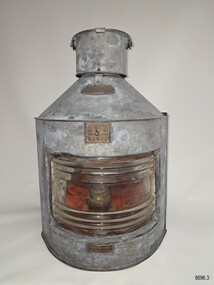
... lamp is intentional. It allows the light to be visible horizontally from up to a 112.5-degree angle, and to be invisible past that angle. The light's colour and position are part of the code of signals that inform viewers of the vessel’s position, direction of travel and status. The red lights indicate the port side of a vessel, green lights indicate the starboard...lamp is intentional. It allows the light to be visible horizontally from up to a 112.5-degree angle, and to be invisible past that angle. The light's colour and position are part of the code of signals that inform viewers of the vessel’s position, direction of travel and status. The red lights indicate the port side of a vessel, green lights indicate the starboard ...The donor recovered this navigation lamp before the 1980s from an old storage area in a South Melbourne factory where he worked. He asked about the lamp, but nobody there knew anything about its origin, and he was told that he could have it. This is a complete ship navigation lamp with its original oil burner. The internal red colour and shape indicate that the lamp was used for the port side of a vessel. The burner assembly is fixed to a removable tray, and the burner disconnects from the tank to allow fuel to be added. Light showing from the lamp is magnified by the polished brass reflector behind it, and the painted internal surfaces give the light its red colour. The lid on the chimney unclips for inspection purposes. The wedge shape of the lamp is intentional. It allows the light to be visible horizontally from up to a 112.5-degree angle, and to be invisible past that angle. The light's colour and position are part of the code of signals that inform viewers of the vessel’s position, direction of travel and status. The red lights indicate the port side of a vessel, green lights indicate the starboard side, and white lights are used on the masthead. From 1972, lights and signals on marine vessels are required to be fitted according to the International Regulations for Preventing Collisions at Sea. SEAHORSE lamp, made in Britain: The firm Bocock & Wilkinson was established in Birmingham in 1890 as an electroplate manufacturer. In 1900, Kelly’s Directory lists the firm as a ship lamp manufacturer. In 1910, the firm was listed Trading As “Seahorse” at 17 & 18 Mott Street, Birmingham. The firm later became Bocock & Son, and in 1932 was listed as George Bocock & Co. Ltd, and in 1973, it was still at that address. Ship’s navigation lamp: an original, galvanised metal, Port bow-side lamp. The wedge-shaped case has an arc front and two flat side panels that meet at the back, with a metal chimney and a swinging ‘C’ shaped handle on top. The curved, clear glass Fresnel has moulded ribs, top and bottom. The chimney has a hinged cap with a clip closure. One flat panel has a firmly attached, hollow rectangular channel for mounting onto a post or bracket. The other flat panel has a ‘D’ shaped, swinging handle, and slides upwards to access the burner assembly with its original brass burner. Concentric rings of ventilation holes are in the base. A removable tray, with ventilation holes on two edges, holds the round fuel tank and burner and the short post with the curved brass reflector. All internal metal surfaces, apart from the brass burner and reflector, were painted red sometime after the lamp’s manufacture. Inscriptions are embossed on the three brass plaques on the front; one has a rope design border and a seahorse emblem. Branded Seahorse, made in Great Britain, Ca. 1930s. Plaque on top, crescent shape: “PORT” Plaque in centre, square logo: “[rope design border] [Seahorse logo] “SEAHORSE / G B / TRADE / MARK / P55933” Plaque on base, rectangular: “PATENT NO. 546575 / AND OTHERS PENDING” flagstaff hill maritime museum and village, great ocean road, shipwreck coast, ship lamp, navigation lamp, masthead light, masthead lamp, port lamp, port light, bow side lamp, lighting device, navigation, marine light, marine lamp, marine equipment, marine technology, marine safety, running light, position light, code of lights, international regulations for preventing collisions at sea, antique, galvanised, seahorse, great britain, gb, patent 546575, seahorse logo, trade mark p55933, oil burner, bocock & wilkinson, bocock & sons, george bocock & co. ltd
