
Showing 10 items matching "starting troubles "
-
 Moorabbin Air Museum
Book - Aeronautics, Aeronautics Volume III
... ...Starting troubles & remedies...Aeronautics Everyday precautions Daily pre flight inspections Fuel & oil systems Magnetic compasses Air photography Annual overhaul Air navigation Launching & hauling in large flying boats Acceptance tests Navigation on long flights over sea Tracing internal combustion engine troubles Astronomical navigation Testing flying boats Safety measures in the air Air photography interpretation Directional radio systems Boost pressure & mixture strengths The controllable pitch airscrew Aerobatics effect on carburation Overhauls Anti corrosive measures Fabric coverings Starting troubles & remedies Maps & charts Aircraft design The rating & performance testing of engines Aero engine accessories Overview on navigation, inspection & tests. ...Overview on navigation, inspection & tests. No publication date stated, but looks to be around late 1930s/early 1940snon-fictionOverview on navigation, inspection & tests. No publication date stated, but looks to be around late 1930s/early 1940severyday precautions, daily pre flight inspections, fuel & oil systems, magnetic compasses, air photography, annual overhaul, air navigation, launching & hauling in large flying boats, acceptance tests, navigation on long flights over sea, tracing internal combustion engine troubles, astronomical navigation, testing flying boats, safety measures in the air, air photography interpretation, directional radio systems, boost pressure & mixture strengths, the controllable pitch airscrew, aerobatics effect on carburation, overhauls, anti corrosive measures, fabric coverings, starting troubles & remedies, maps & charts, aircraft design, the rating & performance testing of engines, aero engine accessories -
 Federation University Historical Collection
Document, Report on Requirements to get started at old LRG Shaft
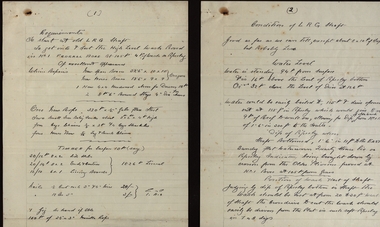
... "[4] He was successful in combating and remedying the gas and ventilation troubles of the Deep Mines of Creswick and Allendale Districts after all had failed Richard Squires old LRG Shaft Requirements Federal Bore Handwritten document of 10 pages on the requirements to start at the old LRG Shaft Report on Requirements to get started at old LRG Shaft Document ...In 1905 Richard Squire was manager of the West Berry Consols at Allendale, and developed an improved system of mine ventilation, which was supported in "The Age."[4] He was successful in combating and remedying the gas and ventilation troubles of the Deep Mines of Creswick and Allendale Districts after all had failedHandwritten document of 10 pages on the requirements to start at the old LRG Shaftrichard squires, old lrg shaft, requirements, federal bore -
 National Wool Museum
Textile - Rug, Returned Soldiers and Sailors Mill, 1963
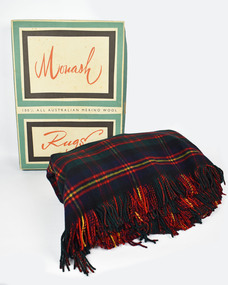
... The mill first began to run into financial troubles with the ‘Credit Squeeze’ or the ‘Holt Jolt’ of the early 1960s. This saw import restrictions lifted which triggered the start of a minor recession and a rise in unemployment. ...The mill first began to run into financial troubles with the ‘Credit Squeeze’ or the ‘Holt Jolt’ of the early 1960s. This saw import restrictions lifted which triggered the start of a minor recession and a rise in unemployment. ...The Returned Soldiers and Sailors Mills was located near the Barwon river on Pakington Street, Geelong, where its building still stands. The mill was established in October 1922 with capital acquired from War Gratuity Bonds. The mill produced fine grade woollen products with its speciality being ‘Retsol’ travelling rugs. The mill first began to run into financial troubles with the ‘Credit Squeeze’ or the ‘Holt Jolt’ of the early 1960s. This saw import restrictions lifted which triggered the start of a minor recession and a rise in unemployment. Included in these troubles was the RS&S Mill which saw the number of employees gradually decrease and business declining with cheaper imports beginning to grab an expanding part of the market share. The mill was eventually purchased by Godfrey Hirst in 1973 who tried to continue operations without success and in June 1975 textile production at the site ceased. Outside of financial considerations contributing to the closure of Woollen Mills in this period was the declining need for heavier fabrics as in-home heating and insulation improved. This need had been replaced for a demand for ever softer, finer and lighter worsted fabrics for more casual clothing. Modern day textile production requires fewer steps in the processing of materials for this use. This meant large factory complexes such as early woollen mills like the RS&S mills were no longer required. Compared to modern textile production which can spin a fine yarn out of synthetic fibre or imported cotton easily, spinning fine yarn from medium quality wool at a textile factory was cumbersome and no longer financially viable to suit new consumer demands. This rug provides context to this statement. It was gifted to Shirley and Gordon Green as a wedding present in November 1963 by one of Gordon's colleagues in the wool industry. Living in areas such as Neutral Bay, the Hornsby area and later in life retiring to the Central Coast, the blanket was too heavy for use in these weather conditions and hence it stayed in its original box for nearly 60 years. Top and bottom of rug has frilled edges. Pattern is titled the 'Clan Cameron' and is repeated in a 7x7 grid. Front of rug has a red background with 4 vertical and horizontal lines. All is surrounded by a yellow boarder. Label is stitched into the bottom right corner. Reverse of rug also has a repeating 7x7 grid. Blue background with thick green horizontal stripe. Yellow and red boarder to the grid with 4 red vertical and horizontal lines making up the interior. Rug measure 1550 x 2040mm, approximately the same size as a queen size mattress.Wording, Bottom right corner. THE GEELONG R.S&S. WOOLEN MILLS/ PURE/ WOOL/ AUSTRALIA/ The John Monash Rug (cursive)/ The Clan Cameron (cursive)rs&s mills, textile manufacture, rug, clan cameron, sydney greasy wool exchange -
 Brighton Historical Society
Bodice, circa 1900
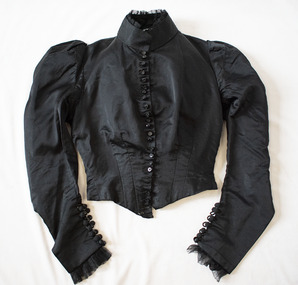
... start a dental practice in Gippsland. For some locals, this took a little getting used to: “Many were amazed, and had some misgivings, when they found that the local dentist was a woman,” she said. “I always remember a huge farmer (he was about 6 ft. 4 in.), who had fortified himself at the local hotel to face the ordeal of visiting the dentist. He almost turned and ran when he saw me. … He was still more amazed when I pulled out his tooth without undue trouble...start a dental practice in Gippsland. For some locals, this took a little getting used to: “Many were amazed, and had some misgivings, when they found that the local dentist was a woman,” she said. “I always remember a huge farmer (he was about 6 ft. 4 in.), who had fortified himself at the local hotel to face the ordeal of visiting the dentist. He almost turned and ran when he saw me. … He was still more amazed when I pulled out his tooth without undue trouble ...This bodice belonged to Mary Crombie, an early Victorian dentist, who lived in Brighton while she was studying at the Australian College of Dentistry in the mid-1900s, and later returned to the area in her retirement from 1949-1971. Mary Margaret Crombie (1884-1971) was born at Coan Downs Station near Walgett, northern New South Wales, where her father Henry was station manager. After Henry’s untimely death in 1895, Mary and her mother loved for a few years with family members in St Kilda, before moving into a cottage of their own, ‘Rosewood’, at 42 Asling Street, Brighton around 1899. From here, Mary attended Oberwyl Ladies College in St Kilda and later the Australian College of Dentistry, one of only a few women to study dental surgery at the time. She was apprenticed to Ada Tovell (1865-1932), one of Victoria’s first female dentists, who had her own practice in Collins Street. Mary graduated in 1907 and the following year moved with he mother to Yarram in South Gippsland, where she took over the running of a practice owned by Sale dentist Charles Trood, eventually purchasing it from him in 1915. Speaking to a Brighton newspaper in 1961, Mary said she believed that she was the first woman to start a dental practice in Gippsland. For some locals, this took a little getting used to: “Many were amazed, and had some misgivings, when they found that the local dentist was a woman,” she said. “I always remember a huge farmer (he was about 6 ft. 4 in.), who had fortified himself at the local hotel to face the ordeal of visiting the dentist. He almost turned and ran when he saw me. … He was still more amazed when I pulled out his tooth without undue trouble.” The farmer was the best advertisement she could have asked for, telling everybody about the diminutive lady dentist who had calmly extracted his tooth. Mary practiced in Yarram until her retirement in 1949. After selling her practice she returned to Brighton, where she spent the last two decades of her life residing at 25 Oak Grove. Following her death in 1971, her relatives in Brighton donated a number of items from her home to BHS.Black satin bodice, boned, with black faceted glass buttons down the front. High collar. Both collar and cuffs are edged with a black net ruffle. Two rows of seven black crochet-covered buttons at each cuff, fastening with loops. Stray brown threads poking through fabric around the collar, shoulders and back indicate that these areas may originally have featured lace embellishments.mary crombie, 1900s -
 Melbourne Legacy
Letter - Document, letter, 10/03/1943
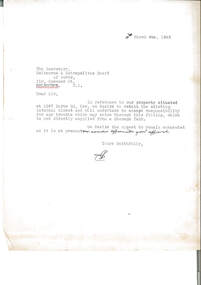
... Legacy accepted responsibility for any trouble which may arise through this fitting which was not directly supplied from a Storage Tank. Holmbush was the first hostel for children that Legacy started and operated from April 1943. ...Legacy accepted responsibility for any trouble which may arise through this fitting which was not directly supplied from a Storage Tank. Holmbush was the first hostel for children that Legacy started and operated from April 1943. ...Letter dated 10 March 1943 to the Melbourne and Metropolitan Board of Works about the retention of an internal water closet at 1267 Burke Road, Kew (Holmbush). Legacy accepted responsibility for any trouble which may arise through this fitting which was not directly supplied from a Storage Tank. Holmbush was the first hostel for children that Legacy started and operated from April 1943. It was later renamed Blamey House after another hostel called Blamey House was closed. Melbourne Legacy ran three residences: Blamey House (purchased 1947) , Stanhope (purchased 1945) and Harelands (purchased 1950), to take care of children whose fathers were servicemen, and who may have been left orphans, or whose mother may have been unable to care for them herself. Harelands accommodated boys and girls under the age of 14, Blamey House looked after boys over 14, and Stanhope looked after girls over 14. The children were cared for until they were old enough to become independent.A record of written correspondence in 1943 especially concerning consulting the MMBW about sewer connections.File copy of a letter to MMBW about a WC at Holmbush on white quarto copy paper, with black type, two hole punched.Initialled in ink, possibly EB.residences, holmbush, holmbush administration -
 City of Greater Geelong
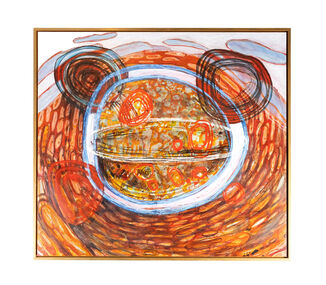
Acrylic on Canvas, Big Day Out, 2010-2011
... trouble painting, but had been doing some brilliant work with Posca markers. It was with a certain reluctance that Robinson agreed, as he felt this to be a “political hot potato in some quarters” but also respected a relationship between artists beyond the cultural divide. Mr Robertson demanded that they start...trouble painting, but had been doing some brilliant work with Posca markers. It was with a certain reluctance that Robinson agreed, as he felt this to be a “political hot potato in some quarters” but also respected a relationship between artists beyond the cultural divide. Mr Robertson demanded that they start ...Rohan Robinson is an artist born in Geelong, and attended “the Mill” part of Deakin University in 1980-82, studying Fine Art. In 2010-11, he was the manager of Kayili Artists Aboriginal Corporation, at Patjarr in the Gibson Desert W.A., where he oversaw the development and marketing of artworks of the corporation’s members. The community is the remotest in Australia and averaged 25 people, mostly consisting of elderly people and part of the Ngaanyatjarra region, with some members not having any consistent contact with white fellas up to the mid 1960’s. During his time it was common for all the community members to go out hunting and having a visit to important areas, where members would get some tucker of rabbits and lizards and honey ants and perhaps some “meow meow” and have a nice sleep in the shade on the warm sand. Robinson would often take his painting gear along and do some work on unstretched linen on the desert ground, he would paint for a while and then perhaps lie around with the elders or follow one of the expert hunters and observe from a distance [several meters] the skills of elderly women casually walking through some recently burned spinifex knocking cowering bunnies on the head with a steel rod. It was on one of these occasions, when this particular painting was being conceived, that after returning from the hunting mission, he was informed by some of the mob, that an elder had been spending time looking at this work in it’s infantile stage...”You know the old fella over there, he been looking at that painting of yours” It was later in the day, when returning to Patjarr, that the elder Arthur Robertson approached Robinson, and demanded/asked that Robinson paint his stories for him. Mr Robertson was suffering from Parkinson’s disease, and was having trouble painting, but had been doing some brilliant work with Posca markers. It was with a certain reluctance that Robinson agreed, as he felt this to be a “political hot potato in some quarters” but also respected a relationship between artists beyond the cultural divide. Mr Robertson demanded that they start immediately and armed with pencil and paper they created the notes for several paintings under Mr Robertson’s direction. The painting that you are viewing is signifcant in that it was the catalyst for this relationship between the two artists. Mr Arthur Robertson died later that year 2011.Gold framed blue and earth tone painting. Painting depicting four circles with mountain and sky in the background. -
 Carlton Football Club
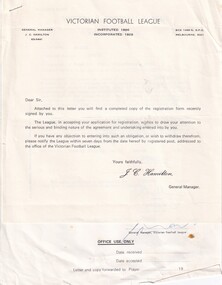
Letter from Victorian Football League 1981, VFL Registration Form 5A, 1981
... trouble early against his taller, equally athletic opponent Len Thompson, but rallied after half time to get right on top as the Blues came from 44 points down to shatter Collingwood in the greatest of all Grand Final comebacks. Swan took nine telling marks and collected 18 possessions to be hailed as Best on Ground, before collecting the first of his four Premiership medals. One of the hallmarks of the Carlton teams coached by Barassi was their versatility, so as his career progressed, McKay started ...A now defunct Form 5A registration of playerA now defunct Form 5A registration of player of four time premiership player David McKay Career : 1969 - 1981 Debut : Round 3, 1969 vs Footscray, aged 19 years, 165 days Carlton Player No. 809 Games : 263 Goals : 277 Last Game : Grand Final, 1981 vs Collingwood, aged 31 years, 325 days Guernsey No. 43 Height : 191 cm (6 ft. 3 in.) Weight : 92 kg (15 stone, 0 lbs.) DOB : November 5, 1949 Premiership Player 1970, 1972, 1979, 1981 Carlton Hall of Fame (1996) One of the most spectacular high marks of his era, David Robert James “Swan” McKay was a Carlton star for twelve seasons, and a key member of four Premiership teams. Recruited from Newlyn, near Ballarat in central Victoria, McKay arrived at Princes Park in 1968 as a raw-boned 19 year-old. Coach Ron Barassi liked what he saw, and quickly realised that the laconic, easy-going country kid had the makings of something special after only a handful of games in the Blues’ number 43 guernsey. At 191cm and 95 kg he was robust enough to play in the ruck, while his exceptional aerial skills allowed him to hold down a key position. The problem was that he had joined the reigning premiers, so he wasn’t able to claim a regular place in the side until after the Blues were beaten by Richmond in the ’69 Grand Final. Early in the following season, McKay was given a chance at centre half-back, and took to it “like a swan to water.” Quick for his size and blessed with wonderful judgement, “Swan” soon became a crowd favourite. From that season on and throughout his career, it was only on rare occasions when the weekly televised football highlights package did not include footage of him drifting across the front of the pack to pluck the ball from the hands of an opponent, or leaping high over three or four sets of shoulders to take another soaring high mark. By 1970, McKay was embedded in the Carlton defence and hadn’t missed a game all season. After the Blues wound up second on the ladder, David experienced the thrill of a VFL final for the first time in his 29th senior match, when almost 113,000 fans packed into the MCG to see Collingwood beat Carlton by 10 points in a high-scoring Semi Final. Swan took 10 marks amid his 16 possessions that afternoon, and although his side was beaten, he revelled in the occasion. A fortnight later, after destroying St Kilda in a one-sided Preliminary Final, Carlton met Collingwood again in the Grand Final in front of an even bigger crowd. McKay was in trouble early against his taller, equally athletic opponent Len Thompson, but rallied after half time to get right on top as the Blues came from 44 points down to shatter Collingwood in the greatest of all Grand Final comebacks. Swan took nine telling marks and collected 18 possessions to be hailed as Best on Ground, before collecting the first of his four Premiership medals. One of the hallmarks of the Carlton teams coached by Barassi was their versatility, so as his career progressed, McKay started spending time up forward or in the ruck. From then on, when a game was in the balance and a goal or two was sorely needed, he was the man the Blues often looked for. He worked hard on his shooting for goal and became a reliable forward option. The 1972 final series must rank as one of Carlton’s finest hours, as the Blues fought their way through three hard, cut-throat games to meet the raging favourites Richmond in the Grand Final. In that remarkable encounter on a fine, cool day at the MCG, Swan lined up in a back pocket to cover the Tigers’ resting ruckmen and for once, lowered his colours to Richmond’s Neil Balme, who kicked 5 goals – but the Blues still won by 27 points and McKay picked up his second medal. In August 1973, Swan brought up game number 100 against Footscray at the Western Oval. Carlton won by nine points – thanks to McKay’s 13 marks in great game at centre half-back. A month later, the Blues and the Tigers met again on Grand Final day, and – still smarting from their surprise defeat the previous year – Richmond went head-hunting in a spiteful match. Swan was shifted forward early and kicked two majors, but neither he nor his team could match Richmond’s ferocity and the Tigers won the flag by 30 points. Midway through the following season, in round 14, 1975 - McKay was embroiled in another infamous encounter at Essendon’s Windy Hill – a game that saw eight players (himself included) reported. On a wet and miserable day dominated by a howling wind, Swan’s 22 disposals, 14 marks and eight goals won the game for Carlton, and making that victory even sweeter, he later escaped suspension for striking. By the time Carlton was knocked out of the finals in 1976 by straight-sets defeats at the hands of Hawthorn and North Melbourne, McKay was 27 and had racked up 172 games. But he felt he needed relief from the pressure-cooker life of a VFL footballer, so he agreed in principle to join WAFL club Subiaco. When he requested a clearance from Carlton however, the Blues steadfastly refused. Both sides dug in their heels, and some unfortunate headlines resulted before Swan relented and resumed training some weeks into 1977. In round 13 of that season, on a freezing cold and wet Saturday afternoon at the Junction Oval, bottom side Fitzroy caused a huge upset by beating Carlton by 7 points. In his 181st game, McKay took 9 marks, and his second goal of the game was the 200th of his career. McKay’s fourth Grand Final came in 1979 against Collingwood. By then one of only five survivors from the ’73 team, Swan was approaching his 30th birthday. yet still playing valuable, consistent football. In a close, absorbing match on a wet and slippery MCG that day, Carlton again won a nail-biter by just 5 points, thanks to Wayne Harmes’ famous swipe at the ball from a forward pocket in the last minutes of the game. The ball ended at the feet of Ken Sheldon, whose goal clinched Carlton’s twelfth Premiership, and McKay’s third. Throughout the majority of his career, Swan was a durable type who rarely suffered serious injury. That all changed in 1980 however, when he rolled an ankle, played on, and compounded the injury which hampered him for the rest of his career. Carlton made the finals again, but dropped out after successive losses. That was a bitter blow for the Blues, who promptly sacked coach Peter Jones and reinstated David Parkin. Because of his ankle, Swan missed a number of games early in 1981, but was back to near his best for the finals. Carlton destroyed Geelong by 40 points in the second Semi Final and marched into the Grand Final as hot favourites against Collingwood. In a typically fierce and physical decider, Collingwood led by 21 points late in the third quarter, before the confident Blues overwhelmed them in the last term - winning Premiership number four for Swan McKay, and flag number thirteen for Carlton. One of the goals in that vital last quarter came from the big number 43. It was his second major of the game, and his last kick in league football. Amid the jubilation of victory in the rooms after the game, Swan announced his retirement after 263 games and 277 career goals. He was a few weeks short of his thirty-second birthday and it was an appropriate way to end the playing career of one of the club’s favourite sons. Following his retirement, McKay stayed involved at Princes Park in a number of off-field roles. He was inducted into the Carlton Hall of Fame in 1996, and later became a high-profile critic of Carlton’s President John Elliott. When Elliott was voted out of office in 2002, McKay was appointed a director of the club under new President Ian Collins. During 1999 and 2000, David's son James McKay played eight Reserves games and kicked two goals for Carlton. Milestones 100 Games : Round 21, 1973 vs Footscray 150 Games : Round 2, 1976 vs Essendon 200 Games : Round 10, 1978 vs Footscray 250 Games : Round 9, 1981 vs South Melbourne 100 Goals : Round 13, 1974 vs Geelong 200 Goals : Round 13, 1977 vs FitzroyLetters & copy of form from VFL -
 The Beechworth Burke Museum
Photograph - Photograph - Reproduction, c. 1900
... trouble when the tail-race (a channel for removing water) fell. After the land changed hands a few times (see Beechworth: A Titan's Field, p. 99), the newly-launched Rocky Mountain Extended Gold Sluicing Company resumed the tunnelling works in June 1876, starting beneath Newtown bridge. ...trouble when the tail-race (a channel for removing water) fell. After the land changed hands a few times (see Beechworth: A Titan's Field, p. 99), the newly-launched Rocky Mountain Extended Gold Sluicing Company resumed the tunnelling works in June 1876, starting beneath Newtown bridge. ...This photograph shows an operator for the Rocky Mountain Mining Company holding a mining drill. The drill is likely a Ford's patent rock drill, used by the Rocky Mountain Extended Mining Company to dig the Rocky Mountain Tunnel that still exists beneath Beechworth as part of gold mining efforts. Work on the tunnel began in 1856 under Robert Dryburgh, but was met with trouble when the tail-race (a channel for removing water) fell. After the land changed hands a few times (see Beechworth: A Titan's Field, p. 99), the newly-launched Rocky Mountain Extended Gold Sluicing Company resumed the tunnelling works in June 1876, starting beneath Newtown bridge. Completed in December 1879, the tunnel was almost 800m long and cost a total of £13,500. The mine was closed in 1921 "after yielding 47,926 ozs of gold and paying £63,639 in dividends". The photograph appears to have been taken against a solid backdrop, rather than at a mine, possibly as a way to demonstrate the equipment the miners were using.The search for gold is ingrained into the history of Victoria and therefore, images like this one which portray the machinery and workers involved can reveal important information for society and technology for the date when the photograph was taken. This image is of important historical significance for its ability to convey information about the specific types of machines and the methods used to find gold in the late 1800s and early 1900s. The photograph also appears to have been taken out of the drill's standard operating context of a mine, which might convey information about how mining, drills, and mine workers were portrayed in a more presentation-like context. The Burke Museum is home to a substantial collection of Australian mining photographs which can be used to gain a deeper understanding into life on the gold fields, technology used in mining, the miners themselves and the impact of the gold digging on the environment.Black and white rectangular reproduced photograph printed on card.7815 / Copy 1/3 /beechworth, beechworth museum, burke museum, australian museum, mining, gold, rocky mountain mining co., rocky mountain mining company, mining machinery, drill, mining drill, mining company -
Linton Mechanics Institute and Free Library Collection
Book - Novel, Austin, Brett, Troubled grass, 1954
... starts a range war against the farmers, dealing out death and destruction without compunction. Into this turmoil rides Buck McKee and his old partner Tortilla Joe and thrills and excitement abound. stamp "Property of Ararat Mechanics Institute and Free Library" stamp "Tresrove Library Apollo Bay" stamp "Moore's Lending Library 219 Glenhuntly Rd., Elsternwick" stamp "The Roundabout Book 55B Kooyong Road North Caulfield" 160p. ; blue cover ; original dust jacket featuring drawing of several cowboys riding horses has been cut and pasted to the front cover; blurb from original just jacker has been cut and pasted to front end paper; Troubled grass Book Novel Austin, Brett Ward, Lock, and Tyler Northumberland Press ...When Big Bob Williams dies, his hot headed and arrogant son Matt quickly starts a range war against the farmers, dealing out death and destruction without compunction. Into this turmoil rides Buck McKee and his old partner Tortilla Joe and thrills and excitement abound.160p. ; blue cover ; original dust jacket featuring drawing of several cowboys riding horses has been cut and pasted to the front cover; blurb from original just jacker has been cut and pasted to front end paper;fictionWhen Big Bob Williams dies, his hot headed and arrogant son Matt quickly starts a range war against the farmers, dealing out death and destruction without compunction. Into this turmoil rides Buck McKee and his old partner Tortilla Joe and thrills and excitement abound.fiction, western, brett austin -
Linton Mechanics Institute and Free Library Collection
Book - Novel, Reilly, William K, The secret of the range, [1946?]
... A killer-wolf had started the trouble by attacking calves - and had then attacked and killed a man, a stranger to the district. ...Ridge City and the cattle country surrounding it was in a ferment. A killer-wolf had started the trouble by attacking calves - and had then attacked and killed a man, a stranger to the district.188p. ; dark blue cover with front of original dust jacket depicting drawing of cowboys with guns, pasted onto front coverfictionRidge City and the cattle country surrounding it was in a ferment. A killer-wolf had started the trouble by attacking calves - and had then attacked and killed a man, a stranger to the district. fiction, western, william k. reilly
