
Showing 8 items matching "steam operated machine"
-
 Cheese World Museum
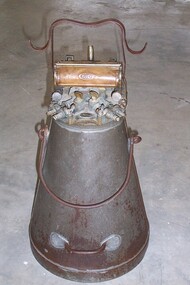
Milking Machine, Bartram & Son, LKG Steam Operated Machine, 1906 (estimated)
... LKG Steam Operated Machine...Brass cover plate LKG Steam Operated Machine Milking Machine Bartram & Son ...This machine was the first double action (suction and pulsator) milking machine. This method is still in use today. Invented by Alexander Gillies,of Terang. The LKG milking machine is of State significance because it represents a high degree of technical achievement. It demonstrates the innovation developed by a Western District farmer, Alexander Gillies, that enabled dairy farms throughout Victoria to move successfully from hand milking to machine milking, thus contributing to the mechanisation of one of Victoria's major rural industries. Source: Cheese World Museum Significance Assessment, Lesley Alves, December 2009Cone shaped metal pail with a carry handle attached near the top and a tipping handle near the base. Removable top has pulsator mechanism which sealed the pail. Brass cover plateBrass cover plate inscribed Trade Mark LKG. Metal disc inscribed K136.dairy industry, machinery, milking machines, alexander gillies, terang -
 Flagstaff Hill Maritime Museum and Village
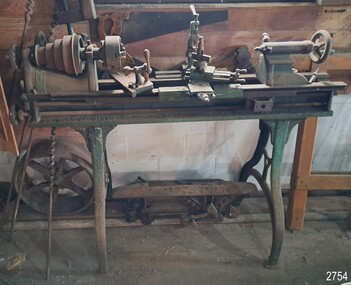
Machine - Lathe, W F & John Barnes, early 1900s
... steam engine...machine...steam operated...Such a configuration reflects manufacturing practices from the late 1800s and early 1900s, when steam power was the predominant source for driving workshop and factory machinery. Large machine shops often utilised a single power source, distributing power via roof-mounted belts and pulleys to operate several machines simultaneously. ...steam-powered woodworking machine. Its bench is supported by decorative posts at each end, with each post dividing into arched legs. The lathe is mechanically connected to both a pulley and a flywheel, designed to be operated in conjunction with a steam engine. ...Flagstaff Hill Flagstaff Hill Maritime Museum and Village Warrnambool Maritime Museum Maritime Village Great Ocean Road Shipwreck Coast Lathe steam-operated lathe steam-operated pulley steam power steam engine machine steam operated machine metal work foundry work metal working trade tool pulley driven metalworking woodworking Barnes lathe Briggs Marine belt driven wordworking lathe free standing lathe bench lathe steam powered vintage lathe woodturning lathe W. ...This woodworking lathe, connected to both a pulley and a flywheel, demonstrates its historical operation with a steam engine. Such a configuration reflects manufacturing practices from the late 1800s and early 1900s, when steam power was the predominant source for driving workshop and factory machinery. Large machine shops often utilised a single power source, distributing power via roof-mounted belts and pulleys to operate several machines simultaneously. Over time, petrol-driven motors were introduced, and eventually, electricity became the standard power source. Conversion kits were made available in the late 19th and early 20th centuries to adapt older lathes to these newer, cleaner fuels. Manufacturer's History: W.F. & J. Barnes was a renowned maker of hand- and foot-powered treadle woodworking and metalworking machinery, established in 1869. The partnership between William F. Barnes and John Barnes was formalised in 1872, and the firm was incorporated in 1884. Their machines were used for both ‘farm’ applications and professional engineering. By 1881, the company began producing electrically powered machinery. By 1937, W.F. & J. Barnes expanded into manufacturing machinery for automotive assembly. The business closed in 1983, and in 1998, LeBlond Ltd. of Ohio acquired the firm. The lathe was donated by Briggs Marine, Melbourne: In Flagstaff Hill’s formative years, 1972-1975, Briggs Marine, Melbourne (Briggs Brass Foundry), donated equipment and objects used or made at their premises. The foundry was established in 1912 by Herbert Harrison Briggs. In 1965, the firm was owned by partners Cyril Briggs and Frank Lee: Cyril died in 1967, and Frank died in 1971, so the foundry was then run by his son and daughter-in-law, Les and Eva Lee. Briggs Marine’s Warrnambool Branch closed in 1972 after the death of Frank Lee in 1971. Flagstaff Hill’s founding director, John Lindsay, recalled that Briggs Marine’s family members gave personal assistance in setting up the displays in the original village shops, particularly the ‘Brass Foundry’ building, around the time the Maritime Museum opened in 1975. Briggs Marine still exists today, but the Briggs family is no longer involved. This early 1900s lathe marks a significant stage in the evolution of machinery, positioned between the era of hand-operated machines and the advent of electrically powered equipment. Its presence exemplifies the progression of industrial technology and craftsmanship during this period. The lathe is particularly notable for its association with the Briggs Brass Foundry. The foundry was known for developing a specialised brass alloy composed of non-ferrous metals, a formulation that resulted in durable products built to withstand the demanding conditions of marine environments. This focus on resilience and longevity made Briggs Brass Foundry’s goods highly sought after within the maritime sector. Briggs Maine, a long-established business, utilised the foundry’s capabilities to create cast goods tailored to the needs of the marine industry. The facility was equipped to deliver both custom-designed and mass-produced items, ensuring versatility in meeting various requirements. Many of Briggs Foundry’s products found their place on sailing and steam vessels throughout Victoria’s coastline, including in the port town of Warrnambool, where there was once a brancy of Briggs Marine. In addition to general marine fittings, Briggs Marine earned recognition for its expertise in bell-founding. The foundry’s reputation is closely linked to the restoration of the Schomberg Bell at Flagstaff Hill, a small but historically significant bell from a luxury migrant vessel dating back to the mid-19th century. The successful restoration of the Schomberg Bell demonstrates Briggs Brass Foundry’s commitment to preserving craftsmanship and maritime heritage.The lathe is a green, bench-type, steam-powered woodworking machine. Its bench is supported by decorative posts at each end, with each post dividing into arched legs. The lathe is mechanically connected to both a pulley and a flywheel, designed to be operated in conjunction with a steam engine. Included with the lathe is a range of accessories. Across the front of the machine, an inscription is cast, and a stamped, metal lathe pulley guide is attached to the drive mechanism. The lathe was manufactured by W. F. and J. Barnes, Rockford, Illinois, USA, during the 1900s.“W F and J Barnes, Rockford, USA” "1820" "1887"flagstaff hill, flagstaff hill maritime museum and village, warrnambool, maritime museum, maritime village, great ocean road, shipwreck coast, lathe, steam-operated lathe, steam-operated pulley, steam power, steam engine, machine, steam operated machine, metal work, foundry work, metal working trade, tool, pulley driven, metalworking, woodworking, barnes lathe, briggs marine, belt driven, wordworking lathe, free standing lathe, bench lathe, steam powered, vintage lathe, woodturning lathe, w. f. and j. barnes, illanois, early 20th century, briggs, briggs brass foundry, briggs marine foundry, briggs marine products, herbert harrison briggs, george edward briggs, cyril falkiner mckinnon briggs, collingwood, moorabbin, frank lee, les lee, eva lee, briggs marine warrnambool, non-ferrous founders, bell specialists, ship bell specialists, sand cast, marine equipment, marine fittings, foundry, brass foundry, founders -
 Flagstaff Hill Maritime Museum and Village
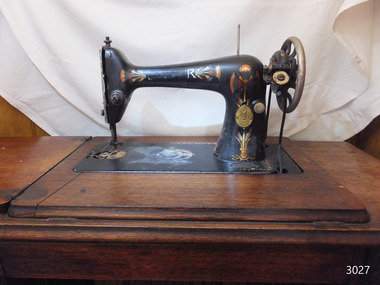
Domestic object - Sewing Machine, Singer Sewing Machine Company, 1922
... Industrial sewing machines, in combination with the cotton gin, the spinning jenny, and the steam engine, made clothing production much easier and much cheaper. flagstaff hill warrnambool shipwrecked-coast flagstaff-hill-maritime-museum maritime-museum shipwreck-coast flagstaff-hill-maritime-village sewing machine hand operated dressmaking textile machinery portable premier sewing machine premier Singer Treadle Sewing Machine "Branded Premier" 5-7-9-2-0-0-" Serial Number Y6243048 (denotes 1922 year of manufacture) Sewing machine, treadle operated, Domestic object Sewing Machine Singer Sewing Machine Company ...In 1867 the Singer Company decided that the demand for their sewing machines in the UK was sufficiently high to open a local factory. Glasgow was selected for its iron-making industries, cheap labour, and possibly because at the time the General Manager of the US Singer Sewing Machine Company was George McKenzie, who was of Scottish descent. The company obtained a lease on land near Queen Street Station and machinery and machine parts were shipped over from the US. Demand for sewing machines outstripped production at the new plant and by 1873 a new larger factory was completed near Bridgeton Cross. By now Singer employed over 2,000 people in Scotland but still, they could not produce enough machines. In 1882 George McKenzie, the soon to become President of the Singer Sewing Machine Company undertook the ground breaking ceremony on 46 acres of farmland at Kilbowie, Clydebank and the largest Singer factory in the world started to be built. Originally two main buildings were constructed. Built above the middle wing of the factory was a huge clock tower with the 'Singer' name displayed for all to see from miles around. Many miles of railway lines were laid throughout the factory to connect the different departments and to aid in the shipping of their goods. Railway lines from the factory connected Glasgow, Dumbarton, and Helensburgh stations. The factory was regarded as the most modern facility in Europe at that time. As different departments in the factory were completed, the workers moved from the old sites to the new one at Kilbowie and the factory was finally finished in 1885. With nearly a million square feet of space and almost 7,000 employees producing on average 13,000 machines a week, making it the largest sewing machine factory in the world. The Clydebank factory was so productive that in 1905 the US Singer Company set up the Singer Manufacturing Company Ltd. as a UK registered company. The invention of the sewing machine had several very significant impacts on the lives of many people. It changed the domestic life of many women as more households began to own sewing machines, women as the ones who traditionally stayed home to do chores including making and repairing clothing, found themselves with more free time. Previously several days a week would be dedicated to sewing clothing for herself and her family, a housewife could now complete her sewing in merely several hours, allowing for more free time to pursue hobbies and attain new skills. Sewing and clothing production, in general, became more industrialized activities, taking place less in the home and more in large factories. Industrial sewing machines, in combination with the cotton gin, the spinning jenny, and the steam engine, made clothing production much easier and much cheaper. Sewing machine, treadle operated, "Branded Premier" 5-7-9-2-0-0-" Serial Number Y6243048 (denotes 1922 year of manufacture) flagstaff hill, warrnambool, shipwrecked-coast, flagstaff-hill-maritime-museum, maritime-museum, shipwreck-coast, flagstaff-hill-maritime-village, sewing machine, hand operated, dressmaking, textile machinery, portable, premier sewing machine, premier, singer treadle sewing machine -
 Flagstaff Hill Maritime Museum and Village
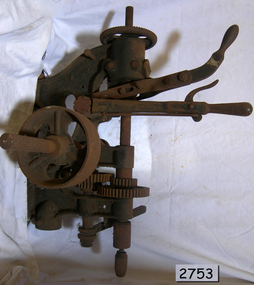
Drill Press, early to mid-20th century
... operated manually or by a pulley driven flywheel, with the aid of an engine connected to a power supply. In the late 1800s early 1900s a drill press like this would have been driven by steam from a boiler, the main power source for manufacturer’s power at that time. Dawn’s Golden Anniversary 1917-1967 Catalogue describes this model 611 drill as … “Ruggedly constructed with accurately reamed bearings. The coupling between the main spindle and feed screw engages the full circumference of the spindle, and embraces a ball-bearing thrust race. The pillar, as in all “Dawn Drilling Machines...machine drill with gear driven flywheel forging tool metal working tool post drill steam powered drill trade tool warrnambool district 1900s "DAWN MFG COY”, “MELB. AUSTRALIA", " 611" Post type drill press machine with gear driven flywheel. Drill press is attached to a post and is fitted with a pulley belt and will run at a speed of maxim 200 r.p.m. The machine can also be manually operated ...This post drill press has been made by Melbourne business, Dawn Manufacturing Company. It can be operated manually or by a pulley driven flywheel, with the aid of an engine connected to a power supply. In the late 1800s early 1900s a drill press like this would have been driven by steam from a boiler, the main power source for manufacturer’s power at that time. Dawn’s Golden Anniversary 1917-1967 Catalogue describes this model 611 drill as … “Ruggedly constructed with accurately reamed bearings. The coupling between the main spindle and feed screw engages the full circumference of the spindle, and embraces a ball-bearing thrust race. The pillar, as in all “Dawn Drilling Machines” is a solid bright steel bar, in place of the usual light tubing. Adjustable automatic feed.” And “F. & l. Pulleys extra, if required”. DAWN MANUFACTURING CO. The Dawn Manufacturing Co. was founded in Coburg, Melbourne, in 1917 by the four Blake brothers, who were all engineers. After World War I Dawn was supplying drills Australia wide and the company was growing at a healthy rate. During the depression they remained busy, with employees working 60-80 hour weeks. Dawn was contracted to supply vices and clamps to the Australian Defence Department and munitions factory during the World War II. - 1959 the company was taken over by G.N. Raymond Group. - 1967 the Dawn Manufacturing Co. had distributors in Australia and overseas, including USA, Canada, New Zealand, Asia and the Middle East. - 1973 the Siddons Ramset Limited acquired Dawn. - December 1991, Dawn became a unit of the United States owned Stanley Works Pty. Ltd. - November 1998 Dawn became 100 per cent Australian owned. The drill is a typical tool of a blacksmith, cart wright, wheelwright and garage business. It is an example of the tools of the blacksmiths’ trade in Victoria in the early to mid-20th century.Post type drill press machine with gear driven flywheel. Drill press is attached to a post and is fitted with a pulley belt and will run at a speed of maxim 200 r.p.m. The machine can also be manually operated. It has an aperture in the centre, a chuck, for the drill bit and has two metal handles at the centre, on the right hand side. Gear ratio 2:1 main drive, 6" diam, 3:1 reduction gear. Made by Dawn of Melbourne, Australia. Model No. 611, Code No. 9157"DAWN MFG COY”, “MELB. AUSTRALIA", " 611"flagstaff hill, warrnambool, shipwrecked-coast, flagstaff-hill, flagstaff-hill-maritime-museum, maritime-museum, shipwreck-coast, flagstaff-hill-maritime-village, blacksmiths, blacksmith’s drill, blacksmith tools, dawn drill model no. 611, dawn drill code no. 9157, dawn manufacturing coy melbourne, dawn manufacturing coy coburg, dawn post drill, drilling machine, drill with gear driven flywheel, forging tool, metal working tool, post drill, steam powered drill, trade tool, warrnambool district 1900s -
 Warrnambool and District Historical Society Inc.
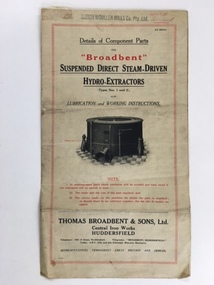
Document - Instruction manual, Details of component parts for Broadbent suspended steam driven Hydro Extractors, C 1926
... By 1893 Broadbent had progressed to steam powered engines for the textile industry. Some of these machines operated for upwards of 50 years Today Broadbent is a leading world designer in the manufacture and maintenance of advanced centrifuges. ...By 1893 Broadbent had progressed to steam powered engines for the textile industry. Some of these machines operated for upwards of 50 years Today Broadbent is a leading world designer in the manufacture and maintenance of advanced centrifuges. ...Thomas Broadbent $ sons Ltd was established in 1864 in Huddersfield England. They are an engineering firm , specialists in heavy duty engineering products. By 1893 Broadbent had progressed to steam powered engines for the textile industry. Some of these machines operated for upwards of 50 years Today Broadbent is a leading world designer in the manufacture and maintenance of advanced centrifuges. This document is a manual for a suspended direct steam driven hydro extractor. It shows the various parts , maintenance instructions and erection and working instructions. While it is stamped as Albion Woollen mills which were situated at Geelong, it is likely to have connections to the Warrnambool Woollen Mills.This document is a good example of machinery manual. It is possibly linked to the Warrnambool Woollen Mill. The fact that the company which manufactured these items is still in existence today after 150 years is testament to the quality of the items produced.Cream coloured document with mainly black text with some red text for headings contained in the document. It is printed front and back and is folded in three sections.Stamp at top "Albion Woollen mills Pty Ltd" .4H x 4 in red pencil in top RHC. Printed on front page. Thomas Broadbent & Sons Ltd Central Iron Works Huddersfield. warrnambool, warrnambool woollen mill, broadbent direct steam driven hydo extractors,, broadbent centrifuge -
 Bendigo Historical Society Inc.
Photograph - MINING EQUIPMENT
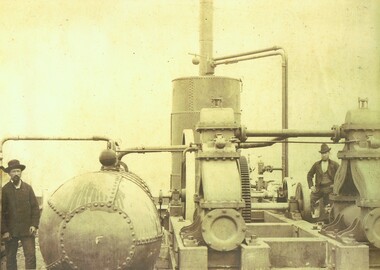
... machine. Written on a sheet attached to photo reads. R.G. Ford's Steam Winch, cylinders 150mm. In diameter and 255mm. Stroke. The winch has wrought iron cheeks, is fitted with reversing gear and manufactured to operate on both steam and air....Steam Winch. Mining Equipment. R.G.Ford. Photograph - black and white. A photo of 2 men standing next to a machine. Written on a sheet attached to photo reads. R.G. Ford's Steam Winch, cylinders 150mm. In diameter and 255mm. Stroke. The winch has wrought iron cheeks, is fitted with reversing gear and manufactured to operate ...Photograph - black and white. A photo of 2 men standing next to a machine. Written on a sheet attached to photo reads. R.G. Ford's Steam Winch, cylinders 150mm. In diameter and 255mm. Stroke. The winch has wrought iron cheeks, is fitted with reversing gear and manufactured to operate on both steam and air.organization, business, mining equipment, steam winch. mining equipment. r.g.ford. -
 Sunshine and District Historical Society Incorporated
Photograph - Mario Cachias collection of agricultural machinery on 21 July 1996
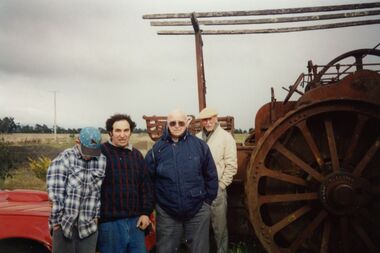
... Photographs depicting the collection of machinery Mr Cachia has collected and holds on his property at Clarks Lane Rockbank Victoria Photograph 1 has Marios son Mano Cachia with David Templeton and Eric Wegener Photograph 2 Has Eric Wegener with Mario Cachia and Frank Ford and David Templeton in front of traction steam engine Photograph 3 Traction Steam Engine Photograph 4 Traction Steam Engine Photograph 5 M Cachia Eric Wegener David Templeton alongside heavy haulage wagon Photograph 6 Heavy haulage wagon Photograph 7 Heavy haulage wagon Photograph 8 Harvester and oddments Photograph 9 Harvester and oddments Photograph 10 Early Stripper Photograph 11 2 Seed drills and oddments Photograph 12 Binder Photograph 13 Centre is a Stationary Engine and Left is Sunshine Gates Photograph 14 Mario Eric and David Header with steering wheel used when tractor drawn and steered and operated by one man on header Photograph 15 Oddments of machines Photograph 16 Eric and David at header Cover on a machine not discernible Photograph 17 Mario photographing David and Eric while looking at a variety of machines Photograph 18 Rear end of a Buggy Photograph 19 Portion of a very large Winnown English Origin Photograph 20 Mario photographing David and Eric in Front of a mould board Plough...Farm Machinery Cachias Photographs depicting the collection of machinery Mr Cachia has collected and holds on his property at Clarks Lane Rockbank Victoria Photograph 1 has Marios son Mano Cachia with David Templeton and Eric Wegener Photograph 2 Has Eric Wegener with Mario Cachia and Frank Ford and David Templeton in front of traction steam engine Photograph 3 Traction Steam Engine Photograph 4 Traction Steam Engine Photograph 5 M Cachia Eric Wegener David Templeton alongside heavy haulage wagon Photograph 6 Heavy haulage wagon Photograph 7 Heavy haulage wagon Photograph 8 Harvester and oddments Photograph 9 Harvester and oddments Photograph 10 Early Stripper Photograph 11 2 Seed drills and oddments Photograph 12 Binder Photograph 13 Centre is a Stationary Engine and Left is Sunshine Gates Photograph 14 Mario Eric and David Header with steering wheel used when tractor drawn and steered and operated by one man on header Photograph 15 Oddments of machines Photograph 16 Eric and David at header Cover on a machine not discernible Photograph 17 Mario photographing David and Eric while looking at a variety of machines Photograph 18 Rear end of a Buggy Photograph 19 Portion of a very large Winnown English Origin Photograph 20 Mario photographing David and Eric in Front of a mould board Plough Mario Cachias collection of agricultural machinery on 21 July 1996 Photograph Mario Cachias collection of agricultural machinery on 21 July 1996 ...Photographs depicting the collection of machinery Mr Cachia has collected and holds on his property at Clarks Lane Rockbank Victoria Photograph 1 has Marios son Mano Cachia with David Templeton and Eric Wegener Photograph 2 Has Eric Wegener with Mario Cachia and Frank Ford and David Templeton in front of traction steam engine Photograph 3 Traction Steam Engine Photograph 4 Traction Steam Engine Photograph 5 M Cachia Eric Wegener David Templeton alongside heavy haulage wagon Photograph 6 Heavy haulage wagon Photograph 7 Heavy haulage wagon Photograph 8 Harvester and oddments Photograph 9 Harvester and oddments Photograph 10 Early Stripper Photograph 11 2 Seed drills and oddments Photograph 12 Binder Photograph 13 Centre is a Stationary Engine and Left is Sunshine Gates Photograph 14 Mario Eric and David Header with steering wheel used when tractor drawn and steered and operated by one man on header Photograph 15 Oddments of machines Photograph 16 Eric and David at header Cover on a machine not discernible Photograph 17 Mario photographing David and Eric while looking at a variety of machines Photograph 18 Rear end of a Buggy Photograph 19 Portion of a very large Winnown English Origin Photograph 20 Mario photographing David and Eric in Front of a mould board Ploughfarm machinery, cachias -
 Department of Energy, Environment and Climate Action
Washington Winch - identification Plate
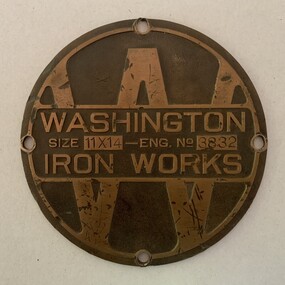
... machine was later sold to Jack Ezard from Swifts Creek in 1959 where it operated on its current site until about 1961. The fate of the second machine is unknown. It was possibly cannibalised for parts. The Ezards were innovative sawmillers who introduced high lead logging into Victoria. They had owned and operated sawmills in the Warburton area from 1907, before shifting to Erica in Gippsland in 1932. Bulldozers and powerful logging trucks eventually made steam...machine was later sold to Jack Ezard from Swifts Creek in 1959 where it operated on its current site until about 1961. The fate of the second machine is unknown. It was possibly cannibalised for parts. The Ezards were innovative sawmillers who introduced high lead logging into Victoria. They had owned and operated sawmills in the Warburton area from 1907, before shifting to Erica in Gippsland in 1932. Bulldozers and powerful logging trucks eventually made steam ...The Washington Winch sits deep in the forest east of Swifts Creek and is the last one of its particular type left in Australia. It was made by the Washington Iron Works company in Seattle. This unique winch was one of two machines imported in 1920 to operate in the Karri forests of WA. Both machines were later purchased by the Forests Commission after the 1939 bushfires for salvage logging at Toorongo to drive elaborate "high lead" cable systems. This particular machine was later sold to Jack Ezard from Swifts Creek in 1959 where it operated on its current site until about 1961. The fate of the second machine is unknown. It was possibly cannibalised for parts. The Ezards were innovative sawmillers who introduced high lead logging into Victoria. They had owned and operated sawmills in the Warburton area from 1907, before shifting to Erica in Gippsland in 1932. Bulldozers and powerful logging trucks eventually made steam and the Washington Winch redundant. The winch is listed on the State Heritage Register. Only one of its kindBrass identification plate recovered from the Washington Winch near Swifts Creek 21 cm in diameter11 x 14 refers to the double drums The serial number is assumed to be 3832forest harvesting
