
Showing 67 items matching "stereoscopic photograph"
-
 The Beechworth Burke Museum
Photograph - Stereoscopic Photograph
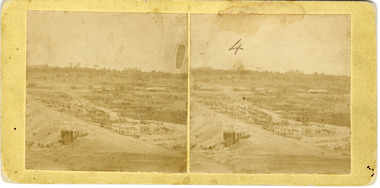
... Stereoscopic Photograph......Stereoscopic photograph...This is an original stereoscopic photograph of a bridge over Spring Creek in Beechworth, taken on 22nd February, 1864. ...This is an original stereoscopic photograph of a bridge over Spring Creek in Beechworth, taken on 22nd February, 1864. ...This is an original stereoscopic photograph of a bridge over Spring Creek in Beechworth, taken on 22nd February, 1864. In early 1853, newly arrived English architect, 22 year old Francis Nixon was appointed Government Architect. Nixon was sent to Beechworth as the towns first architect, where his first duties included the erection of a wooden post office and the first bridge over Spring Creek (Reference 1). The Beechworth Benevolent Asylum (built c1862) can be seen in the background. It is not completely clear if this is the bridge that Nixon designed, however 'A Beechworth Companion, volume 1' indicates a bridge built over Spring Creek at the foot of Camp St was built in 1856 which accords with the article cited above. This stereoscopic photograph is historically significant as it captures Beechworth in it's early form, with the newly built Benevolent Asylum visible in the background.Two sepia toned square steroscopic photographs mounted on card depicting a bridge made of an unsealed gravel road in the foreground, with some trees, small buildings, roads and fences in the background.Obverse: Number 4 handwritten on right hand side photo. Reverse: Card turned to a vertical position and written from top down: '7806'/'3 Bridge over Spring Creek Beechworth 22nd Feb 1864'/'Benevolent asylum in the distance'/'59' in large lettering the middle of the card/'9'/'9' in small lettering at the bottom right of the card.spring creek, bridge, beechworth benevolent asylum, stereoscopic photograph, 1800s beechworth -
 The Beechworth Burke Museum
Photograph - Stereoscopic Photograph
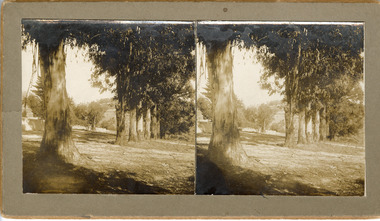
... Stereoscopic Photograph...This stereoscopic photograph depicts the grounds and mature trees of the Former Ovens District Hospital. ...Sepia square stereoscopic photograph printed on matte photographic paper mounted on card....This stereoscopic photograph depicts the grounds and mature trees of the Former Ovens District Hospital. ...This stereoscopic photograph depicts the grounds and mature trees of the Former Ovens District Hospital. Started in 1857, it was Beechworth's first hospital and the only hospital between Melbourne and New South Wales. It was a philanthropic institution catering to the poor. In 1874, the sweeping gardens were laid out by Dr. Jenkyns and featured over 200 species of trees including fruit trees, shrubs and vegetable and flower gardens. Patients could enjoy the view from a rotunda. The section photographed was known as 'Little Canada', and an isolation ward was added there in 1890. Since the hospital's closure in 1940, only the front facade and gardens remain. The gardens are now known as Centennial Park and retain many of the original mature trees.This stereoscopic photograph has aesthetic significance as it beautifully captures the sanitorium-like restorative atmosphere of the hospital gardens. It also has historical significance as it depicts the grounds of the Ovens District Hospital and the nature of hospital gardens in the nineteenth and early twentieth century.Sepia square stereoscopic photograph printed on matte photographic paper mounted on card.Reverse: 1997.2687/A02687/Trees in Hospital Grounds/(Little Canada)/Beechworth Note: Trees in the O+D hospital grounds/(Little Canada)/A02687/1997.2687former ovens district hospital, ovens district hospital, little canada, hospital garden, jenkyns, centennial park -
 The Beechworth Burke Museum
Photograph - Stereoscopic Photograph
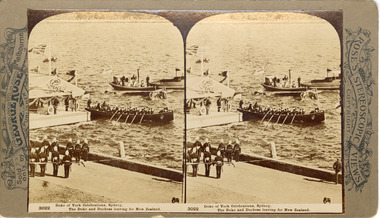
... Stereoscopic Photograph......Stereoscopic photograph...Obverse: Branding printed on the card on left and right sides of photographs: Roses Stereoscopic Views Copyright / Sold only by George Rose Melbourne Publisher. 3022 / Duke of York Celebrations Sydney / The Duke and Duchess leaving for New Zealand. ... Stereoscopic Photograph ...The photo is of three boats on the water next to a floating dock/pontoon with land in the foreground. Two lines of officials stand on a road in the foreground, one boat in the centre of the image has a flag at each end, four oars visible and 15-17 people seated in it. The pontoon has a roof with official regalia including the British flag. The other boats in the background are smaller with only two people clearly visible. George Rose was a pioneer of photographic art in Australia. Later in his career he became interested in stereoscopic photography (between 1880s and 1920s), establishing a business for the production of such works. George Rose died in 1942. The Duke and Duchess of York visited Australia on two occasions that coincide with George Rose’s stereoscopic photography works: 1901 and 1927. It is not completely clear in which year this image was taken. There was much ceremony and celebration on both occasions, however, in comparison with some other of Rose’s work, it is likely the image was taken in 1901. This stereographic photograph is a significant example of George Rose's stereographs, which captured important moments in history both in Australia and overseas. Two clear sepia toned photos printed on one piece of photographic paper mounted on brown card with ornate ribbon scroll and minimal floral branding on each side of the card with 'Roses Stereoscopic Views Copyright' on the ribbon scroll on the right hand side and 'Sold only by George Rose Melbourne Publisher' on the ribbon scroll on the left hand side. Obverse: Branding printed on the card on left and right sides of photographs: Roses Stereoscopic Views Copyright / Sold only by George Rose Melbourne Publisher. 3022 / Duke of York Celebrations Sydney / The Duke and Duchess leaving for New Zealand. Reverse: '1997.3184' top right corner / unclear text in greylead pencil left side. sydney harbour, duke and duchess of york, george rose, stereoscopic photograph -
 The Beechworth Burke Museum
Photograph - Stereoscopic Photograph
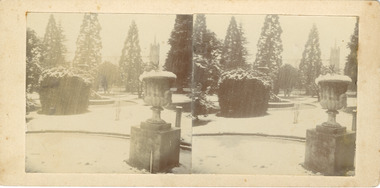
... Stereoscopic Photograph...Black and white stereoscopic photograph mounted on pasteboard....Town Hall Gardens Snow Churches Beechworth Reverse: 97-2282 / 84-159-1 / Town Hall Gardens / BMMA03167 / Note: A03167 / Town Hall Gardens, Beechworth / Black and white stereoscopic photograph mounted on pasteboard. Photograph Stereoscopic Photograph ...Town Hall Gardens in Beechworth were laid out by R H Jenkyn in 1875, however the gardens as a public open space dates back to 1857. The row of Sierra Redwood trees along the historic gardens' Williams Street frontage are presumed to be a gift from Baron Ferdinand von Mueller, Director of the Royal Botanic Gardens. Many trees from the original plantings are on the National Trust Significant Tree Register. The gardens also feature a rotuda, fountain and two urns which are dated to 1876 and remain in their original positions. Today, Town Hall Gardens are adjacent to prominent buildings including Indigo Shire Council, Burke Museum, Beechworth Library, and Beechworth Visitor Information Centre. The church steeple visible in the background belongs to St Andrew's Presbyterian Church which was erected in 1857 by Smith, Bank and Cranston. It is an architectural example of gothic revival churches in Victoria.This photograph documents a snowfall event in August 1899 which covered Beechworth's Town Hall Gardens in a blanket of snow. It also provides a historical view of key landmarks in the gardens and surrounding area, which is adjacent to the Burke Museum.Black and white stereoscopic photograph mounted on pasteboard.Reverse: 97-2282 / 84-159-1 / Town Hall Gardens / BMMA03167 / Note: A03167 / Town Hall Gardens, Beechworth /town hall gardens, snow, churches beechworth -
 The Beechworth Burke Museum
Photograph - Stereoscopic Photograph, c1900
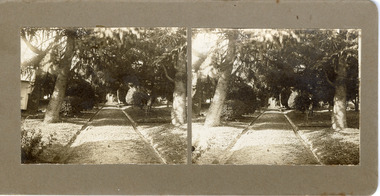
... Stereoscopic Photograph...Black and white stereoscopic photograph mounted on card....Ovens Hospital Hospital garden Gardens and Parks Ovens District Hospital Reverse: 97-2292 / View up centre path of Hospital / A03177 / BMM3177 / Note: A03178 / View of the central path of the Ovens Hospital / (Church St) Beechworth Black and white stereoscopic photograph mounted on card. Photograph Stereoscopic Photograph ...The gardens of Ovens District Hospital were laid out and planted by R H Jenkyns in 1874. Over 200 species of trees and shrubs were planted, including several large Himalayan Cedars (Cedrus deodora), a Coast Redwood (Sequoia sempervirens), rare Scots Pine (Pinus sylvestris), Pencil Cedar (Juniperus virginiana), Bunya Bunya Pines (Araucaria bidwillii), a Purple-leaved Dutch Elm (Ulmus x hollandica 'Purpurascens'), American Ash (Fraxinus americana), Pinus radiata, and numerous Populus alba trees and suckers. The gardens were considered integral to the healing process, also including orchards and kitchen gardens. In the 1880s, tourists flocked to Beechworth as the area became recognised as a health resort and picturesque beauty spot. Although the hospital closed in 1940, and parts were subsequently demolished, the gardens remain and form part of the site's listing on the Victorian Heritage Register. This photograph is part of a collection of items held by the Burke Museum relating to Ovens District Hospital. At the time of being built, the Ovens District Hospital was the only hospital between Melbourne, Victoria, and Goulburn, New South Wales, treating patients from all of north-east Victoria, including Indigo Shire.Black and white stereoscopic photograph mounted on card.Reverse: 97-2292 / View up centre path of Hospital / A03177 / BMM3177 / Note: A03178 / View of the central path of the Ovens Hospital / (Church St) Beechworthovens hospital, hospital garden, gardens and parks, ovens district hospital -
 The Beechworth Burke Museum
Photograph - Stereoscopic Photograph
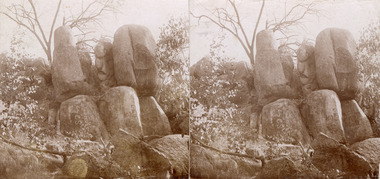
... Stereoscopic Photograph...Sepia square stereoscopic photograph printed on matte photographic paper mounted on card....Photograph Stereoscopic Photograph ...This photograph depicts The Sphinx Rock, named for its resemblance to the Egyptian Sphinx. It is one of many distinct granite rock formations found along the popular Beechworth Gorge walking trail. The Sphinx rock has a hard granite core and was once buried beneath the surface of the earth. Over time, natural weathering eroded the surrounding rock creating the unusual formations we see today. This photograph is of historic significance as an example of the unique granite outcrops located within the Beechworth Historic Park, an area of of historical significance for its relation the Victorian gold rush. The photograph serves as an important reference for the geological history of the Beechworth landscape. Sepia square stereoscopic photograph printed on matte photographic paper mounted on card.Obverse: 16. Reverse: 97.2188 / Sphinx / Beechworth / A0 3075 / 84-129-2. sphinx beechworth, beechworth gorge, beechworth walking trail, beechworth historic park -
 The Beechworth Burke Museum
Photograph - Stereoscopic Photograph
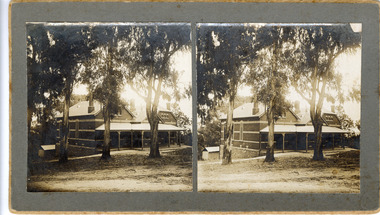
... Stereoscopic Photograph...A rectangular sepia stereoscopic photograph printed on matte photographic paper, mounted on board....Photograph Stereoscopic Photograph ...Believed to have been taken in the late 19th - early 20th century, this photograph depicts the former Ovens District Hospital or now referred to as the Old Hospital Ruins in Beechworth. The photograph highlights the isolation ward, or ward 6 and 7 as it was otherwise known, which was built by D Fiddes in 1890 . The former Ovens and District Hospital was closed and demolished in 1940.This photograph documents the structure of the former Ovens District Hospital before it was demolished in 1940. The Ovens District Hospital is considered a historically significant archaeological site within Victoria, therefore this photograph holds significance in its documentation of a stage of the history of this historic site. A rectangular sepia stereoscopic photograph printed on matte photographic paper, mounted on board.Words 6 & 7 Little Canadaisolation ward, beechworth hospital history, beechworth, ovens district hospital, former ovens district hospital, old hospital ruins -
 4th/19th Prince of Wales's Light Horse Regiment Unit History Room
Stereoscopic Photograph, The Rose Steriographs, Light Horse of the Australian Expeditionary Force, 1914/15
... Stereoscopic Photograph ...A sepia tone stereoscopic photograph of the Light Horse of the Australian Expeditionary Force in Collins Street melbourne...The Rose Steriographs A sepia tone stereoscopic photograph of the Light Horse of the Australian Expeditionary Force in Collins Street melbourne Light Horse of the Australian Expeditionary Force Stereoscopic Photograph The Rose Steriographs ...A sepia tone stereoscopic photograph of the Light Horse of the Australian Expeditionary Force in Collins Street melbourne12,923 "STURDY SONS OF THE EMPIRE" The Light Horse of the Australian Expeditionary Force, Collins St Melbourne. The Rose Steriographsphoto, light horse, melbourne -
 The Beechworth Burke Museum
Photograph - Stereoscopic Photograph
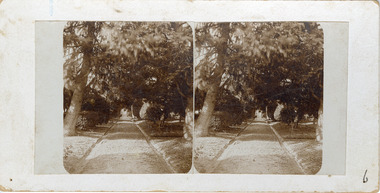
... Stereoscopic Photograph...This is a stereoscopic photograph of the pathway and gardens leading up to the Ovens District Hospital, taken on an unknown date. ...Photograph Stereoscopic Photograph ...This is a stereoscopic photograph of the pathway and gardens leading up to the Ovens District Hospital, taken on an unknown date. However, the photograph was taken some time after 1885 as requests were being made between 1873-1885 for the road up to the hospital to be kerbed and channelled to allow easy transport of patients as the road would become a bog during wet weather. By the 1890s the hospital had "sweeping gardens" with cedars and bunya pines, which are visible on both sides of the pathway the photograph.This photograph is of historical significance as it captures an early image of the kerbed and channelled pathway leading up to the Ovens District Hospital, with gardens on both sides.Two sepia toned photographs of a pathway (up the centre of the image) through gardens to a building in the distance.Obverse: '6' at lower right hand corner. Reverse: '1997.2668' top right corner/'A02668' top right corner below previous text.ovens district hospital, medicine, hospital, beechworth hospital, photography -
 The Beechworth Burke Museum
Photograph - Stereoscopic Photograph, Unknown c1875
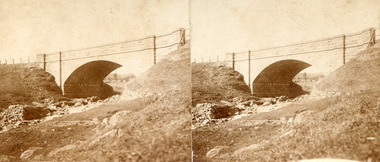
... Stereoscopic Photograph...Photograph Stereoscopic Photograph ...Depicted in the photograph is Newtown Bridge or the Newtown Falls Bridge, in Beechworth, Victoria. Noted for its location, detailed craftsmanship and stonemasonry by Scottish stonemasons the Newtown Bridge was built in the 19th century provincial town of Beechworth (completed in 1875). The bridge was built over Spring Creek, spanning 6.3 meters wide and 24.8 meters tall. Beechworth held a distinct role in the administrative and commercial management of Victoria's north-eastern goldfields, with many objects and structures still well preserved from the towns establishment. The bridge indicates the growth of the town, replacing a previous timber structure as well as its association to the mining activity in the area and the rapid increase in Australia's economy that led to investment and development of roads and railways. The local granite used in the construction of the single arch Newtown Bridge makes the bridge and other buildings made with the granite unique to the area, the honey-toned material distinct to Beechworth. This photograph is historically significant as it provides insight into the industrial development of Beechworth and the surrounding area, contributed to by the goldfields. The photograph further captures the representation of vernacular engineering traditions and Scottish stonemasonry.Two sepia-toned rectangular photographs featuring a bridge in the background printed on matte photographic paper mounted on card.Reverse: 97.2324/ Newtown Bridge/ Beechworthbridge, newtown beechworth, newtown bridge, newtown, beechworth, beechworth falls bridge, beechworth mining district, spring creek, -
 The Beechworth Burke Museum
Photograph - Stereoscopic Photograph
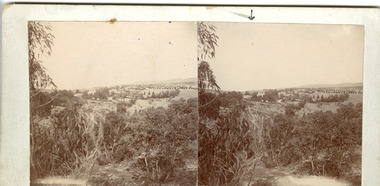
... Stereoscopic Photograph...Photograph Stereoscopic Photograph ...This photograph offers a view of Beechworth, located at the foot of the Victorian Alps. It captures the gorge and native vegetation in the foreground, with the Beechworth township visible in the middle, where the hospital is marked with an arrow. Distant hills form the backdrop. Originally settled c1839, Beechworth was officially proclaimed a town in 1856.This photograph is historically significant as it captures the landscape of Beechworth, providing valuable insight into the town's visual and historical character.Two sepia-toned square photographs showing the view of a town with trees in the foreground and hills in the far distance, mounted.Obervse: Above the right photograph there is an arrow pointing down. Reverse: 97.2195/ View across the Gorge/ looking over Beechworth/ (Hospital under arrow)/ 84-110-1/ A03082beechworth, town, landscape, ovens district, stereoscopic -
 The Beechworth Burke Museum
Photograph - Stereoscopic Photograph, c1900
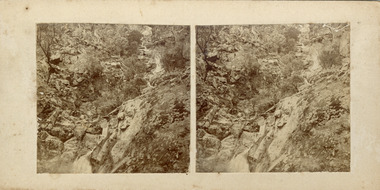
... Stereoscopic Photograph...Photograph Stereoscopic Photograph ...This photograph depicts Indigo Falls, situated 20 km northeast of Beechworth, and highlights the picturesque scenery and surrounding vegetation. Known for its scenic beauty, Indigo Falls has drawn visitors from Albury and Wodonga and was a popular spot for the Beechworth Tourist Club in the early 1900s.This photograph is historically significant for showcasing the natural beauty of Indigo Falls and surrounding vegetation.Two sepia-toned square photographs featuring a rocky waterfall and vegetation, mounted.Reverse: 97.2197/ Indigo Falls/ Beechworth/ 84-116-1./ A03084/ Indigo Falls are near the start of the Indigo Valley - a short distance from the Indigo Valley Rd. turnoff is Ewarts Rd., on the right of the Beechworth Wodonga Rd., waterfall, indigo falls, ovens district, natural history, stereoscopic, district views -
 Lara RSL Sub Branch
Stereoscopic Photos World War 1 Ballarat, The Rose Stereographs, World War 1
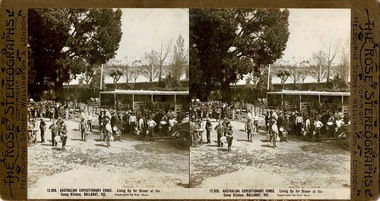
... Sepia Stereoscopic paper photographs mounted on grey cardboard...Stereograph photo of Australian Infantry Force in Training at Camp Kitchen Ballarat Lining for Dinner ballarat stereograph photo australian expeditionary force camp kitchen rose stereographs 12.926 Australian Expeditionary Force Camp Kitchen Ballarat Vic Lining up for dinner The Rose Stereographs Copyright Melbourne Sydney Wellington & London Sepia Stereoscopic paper photographs mounted on grey cardboard Stereoscopic Photos World War 1 Ballarat The Rose Stereographs ...Stereograph photo of Australian Infantry Force in Training at Camp Kitchen Ballarat Lining for DinnerSepia Stereoscopic paper photographs mounted on grey cardboard12.926 Australian Expeditionary Force Camp Kitchen Ballarat Vic Lining up for dinner The Rose Stereographs Copyright Melbourne Sydney Wellington & Londonballarat stereograph photo australian expeditionary force camp kitchen rose stereographs -
 Lara RSL Sub Branch
Stereoscopic Photos World War 1 Ballarat, The Rose Stereographs, World War 1
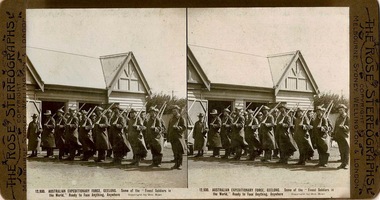
... Sepia Stereoscopic paper photographs mounted on grey cardboard...Stereograph photo of Australian Infantry Force in Training at Geelong Victoria Aust 12.930 Australian Expeditionary Force Geelong Some of the Finest Soldiers in the World Ready for Anything, Anywhere The Rose Stereographs Copyright Melbourne Sydney Wellington & London Sepia Stereoscopic paper photographs mounted on grey cardboard Stereoscopic Photos World War 1 Ballarat The Rose Stereographs ...Stereograph photo of Australian Infantry Force in Training at Geelong Victoria AustSepia Stereoscopic paper photographs mounted on grey cardboard12.930 Australian Expeditionary Force Geelong Some of the Finest Soldiers in the World Ready for Anything, Anywhere The Rose Stereographs Copyright Melbourne Sydney Wellington & London -
 Federation University Historical Collection
Equipment - Object, Stereo-viewer and Solid State Models, c1928
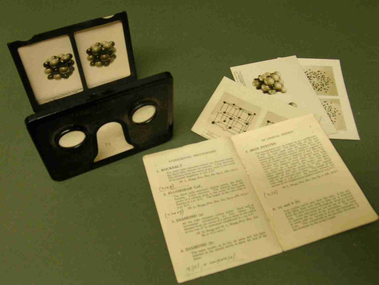
... Metal stereo viewer and many cards including stereoscopic photographs of crystal modals (Bragg's Crystal, Fluorspar, caesieum chloride, zinc-blende, iron pyrites, quartz, Tellurirumetc), and Dr Mullers Universal X-Ray Spectrograph. ...This was at the very end of the daguerreotype era, and originals are quite rare. stereoscope adam hilger sir william bragg w.i. bragg dr muller x-ray crystal spinel bismuth diamond structure tartaric acid naphthalene Metal stereo viewer and many cards including stereoscopic photographs of crystal modals (Bragg's Crystal, Fluorspar, caesieum chloride, zinc-blende, iron pyrites, quartz, Tellurirumetc), and Dr Mullers Universal X-Ray Spectrograph. ...This folding viewer for individual stereoscopic pictures has a cut-out between the lenses to accommodate the nose of the user. The original folding viewer was patented by J. F. Mascher of Philadelphia in March 1853 and was designed to hold stereoscopic portraits using the daguerreotype process. This was at the very end of the daguerreotype era, and originals are quite rare.Metal stereo viewer and many cards including stereoscopic photographs of crystal modals (Bragg's Crystal, Fluorspar, caesieum chloride, zinc-blende, iron pyrites, quartz, Tellurirumetc), and Dr Mullers Universal X-Ray Spectrograph. stereoscope, adam hilger, sir william bragg, w.i. bragg, dr muller, x-ray, crystal, spinel, bismuth, diamond structure, tartaric acid, naphthalene -
 Australian Army Museum of Western Australia
Stereographic Image, 1900
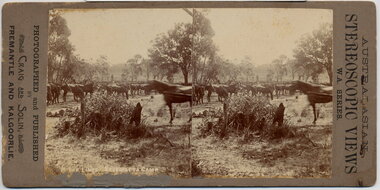
... Published in Australian Stereoscopic Views, WA Series, Photographed and published by Craig and Solin, Fremantle and Kalgoorlie...Published in Australian Stereoscopic Views, WA Series, Photographed and published by Craig and Solin, Fremantle and Kalgoorlie Stereographic Image ...The 1st Contingent departed Fremantle on 7 November 1899 and returned on 29 December 1900. The 2nd Contingent departed 3 February 1900 and returned 8 December 1900. Due to the shortage of khaki material, the 1st Contingent uniforms wore their blue militia tunics, blue puttees and a dark blue puggaree on departure. An Anglo Boer War Service of Reconciliation is held annually on the first Sunday in June at the "Fallen Soldiers" (Boer War) Memorial in Kings Park attended by descendants and representative of all combatant nations. The date selected is the closest Sunday to the date of signing of the Treaty or Peace of Vereeniging (31 May 1902). The culmination of the service is the laying of the Emily Hobhouse wreath.Unique series of stereoscopic images showing both the 1st and 2nd West Australian Mounted Infantry Contingents to the Anglo Boer War. Images contain details of uniforms, accoutrements, camp life, civic honours and departure.Horse Lines in Karrakatta Camp. Published in Australian Stereoscopic Views, WA Series, Photographed and published by Craig and Solin, Fremantle and KalgoorliePhotographed and published by Craig and Solin, Fremantle and Kalgoorliestereoscope, boer war, south africa, capetown -
 Australian Army Museum of Western Australia
Stereographic Image, 1900
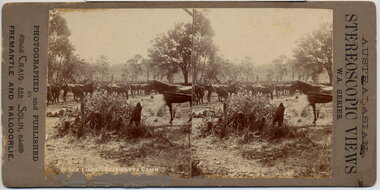
... Published in Australian Stereoscopic Views, WA Series, Photographed and published by Craig and Solin, Fremantle and Kalgoorlie...Published in Australian Stereoscopic Views, WA Series, Photographed and published by Craig and Solin, Fremantle and Kalgoorlie Stereographic Image ...The 1st Contingent departed Fremantle on 7 November 1899 and returned on 29 December 1900. The 2nd Contingent departed 3 February 1900 and returned 8 December 1900. Due to the shortage of khaki material, the 1st Contingent uniforms wore their blue militia tunics, blue puttees and a dark blue puggaree on departure. An Anglo Boer War Service of Reconciliation is held annually on the first Sunday in June at the "Fallen Soldiers" (Boer War) Memorial in Kings Park attended by descendants and representative of all combatant nations. The date selected is the closest Sunday to the date of signing of the Treaty or Peace of Vereeniging (31 May 1902). The culmination of the service is the laying of the Emily Hobhouse wreath.Unique series of stereoscopic images showing both the 1st and 2nd West Australian Mounted Infantry Contingents to the Anglo Boer War. Images contain details of uniforms, accoutrements, camp life, civic honours and departure.Horse Lines Karrakatta Camp. Published in Australian Stereoscopic Views, WA Series, Photographed and published by Craig and Solin, Fremantle and KalgoorliePhotographed and published by Craig and Solin, Fremantle and Kalgoorliestereoscope, boer war, south africa, capetown -
 Australian Army Museum of Western Australia
Stereographic Image, 1900
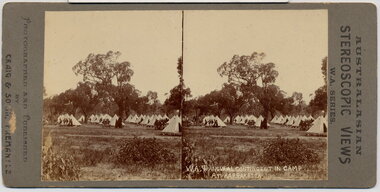
... Published in Australian Stereoscopic Views, WA Series, Photographed and published by Craig and Solin, Fremantle and Kalgoorlie...Published in Australian Stereoscopic Views, WA Series, Photographed and published by Craig and Solin, Fremantle and Kalgoorlie Stereographic Image ...The 1st Contingent departed Fremantle on 7 November 1899 and returned on 29 December 1900. The 2nd Contingent departed 3 February 1900 and returned 8 December 1900. Due to the shortage of khaki material, the 1st Contingent uniforms wore their blue militia tunics, blue puttees and a dark blue puggaree on departure. An Anglo Boer War Service of Reconciliation is held annually on the first Sunday in June at the "Fallen Soldiers" (Boer War) Memorial in Kings Park attended by descendants and representative of all combatant nations. The date selected is the closest Sunday to the date of signing of the Treaty or Peace of Vereeniging (31 May 1902). The culmination of the service is the laying of the Emily Hobhouse wreath.Unique series of stereoscopic images showing both the 1st and 2nd West Australian Mounted Infantry Contingents to the Anglo Boer War. Images contain details of uniforms, accoutrements, camp life, civic honours and departure.WA Transvaal Contingent in Camp at Karrakatta. Published in Australian Stereoscopic Views, WA Series, Photographed and published by Craig and Solin, Fremantle and KalgoorliePhotographed and published by Craig and Solin, Fremantle and Kalgoorliestereoscope, boer war, south africa, capetown -
 Australian Army Museum of Western Australia
Stereographic Image, 1900
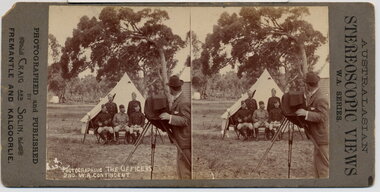
... Photographing the Officers. 2nd WA Contingent. Published in Australian Stereoscopic Views, WA Series, Photographed and published by Craig and Solin, Fremantle and Kalgoorlie...Published in Australian Stereoscopic Views, WA Series, Photographed and published by Craig and Solin, Fremantle and Kalgoorlie Stereographic Image ...The 1st Contingent departed Fremantle on 7 November 1899 and returned on 29 December 1900. The 2nd Contingent departed 3 February 1900 and returned 8 December 1900. Due to the shortage of khaki material, the 1st Contingent uniforms wore their blue militia tunics, blue puttees and a dark blue puggaree on departure. An Anglo Boer War Service of Reconciliation is held annually on the first Sunday in June at the "Fallen Soldiers" (Boer War) Memorial in Kings Park attended by descendants and representative of all combatant nations. The date selected is the closest Sunday to the date of signing of the Treaty or Peace of Vereeniging (31 May 1902). The culmination of the service is the laying of the Emily Hobhouse wreath.Unique series of stereoscopic images showing both the 1st and 2nd West Australian Mounted Infantry Contingents to the Anglo Boer War. Images contain details of uniforms, accoutrements, camp life, civic honours and departure.Photographing the Officers. 2nd WA Contingent. Published in Australian Stereoscopic Views, WA Series, Photographed and published by Craig and Solin, Fremantle and KalgoorliePhotographed and published by Craig and Solin, Fremantle and Kalgoorliestereoscope, boer war, south africa, capetown -
 Australian Army Museum of Western Australia
Stereographic Image, 1900
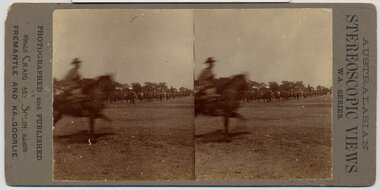
... Published in Australian Stereoscopic Views, WA Series, Photographed and published by Craig and Solin, Fremantle and Kalgoorlie...Published in Australian Stereoscopic Views, WA Series, Photographed and published by Craig and Solin, Fremantle and Kalgoorlie Stereographic Image ...The 1st Contingent departed Fremantle on 7 November 1899 and returned on 29 December 1900. The 2nd Contingent departed 3 February 1900 and returned 8 December 1900. Due to the shortage of khaki material, the 1st Contingent uniforms wore their blue militia tunics, blue puttees and a dark blue puggaree on departure. An Anglo Boer War Service of Reconciliation is held annually on the first Sunday in June at the "Fallen Soldiers" (Boer War) Memorial in Kings Park attended by descendants and representative of all combatant nations. The date selected is the closest Sunday to the date of signing of the Treaty or Peace of Vereeniging (31 May 1902). The culmination of the service is the laying of the Emily Hobhouse wreath.Unique series of stereoscopic images showing both the 1st and 2nd West Australian Mounted Infantry Contingents to the Anglo Boer War. Images contain details of uniforms, accoutrements, camp life, civic honours and departure.Untitled [Mounted Exercises in Karrakatta Camp]. Published in Australian Stereoscopic Views, WA Series, Photographed and published by Craig and Solin, Fremantle and KalgoorliePhotographed and published by Craig and Solin, Fremantle and Kalgoorliestereoscope, boer war, south africa, capetown -
 Australian Army Museum of Western Australia
Stereographic Image, 1900
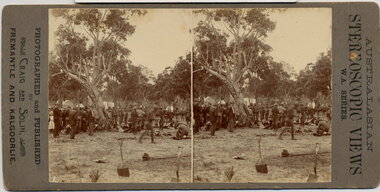
... Published in Australian Stereoscopic Views, WA Series, Photographed and published by Craig and Solin, Fremantle and Kalgoorlie...Published in Australian Stereoscopic Views, WA Series, Photographed and published by Craig and Solin, Fremantle and Kalgoorlie Stereographic Image ...The 1st Contingent departed Fremantle on 7 November 1899 and returned on 29 December 1900. The 2nd Contingent departed 3 February 1900 and returned 8 December 1900. Due to the shortage of khaki material, the 1st Contingent uniforms wore their blue militia tunics, blue puttees and a dark blue puggaree on departure. An Anglo Boer War Service of Reconciliation is held annually on the first Sunday in June at the "Fallen Soldiers" (Boer War) Memorial in Kings Park attended by descendants and representative of all combatant nations. The date selected is the closest Sunday to the date of signing of the Treaty or Peace of Vereeniging (31 May 1902). The culmination of the service is the laying of the Emily Hobhouse wreath.Unique series of stereoscopic images showing both the 1st and 2nd West Australian Mounted Infantry Contingents to the Anglo Boer War. Images contain details of uniforms, accoutrements, camp life, civic honours and departure.Untitled [Issue of Harness at Karrakatta Camp]. Published in Australian Stereoscopic Views, WA Series, Photographed and published by Craig and Solin, Fremantle and KalgoorliePhotographed and published by Craig and Solin, Fremantle and Kalgoorliestereoscope, boer war, south africa, capetown -
 Australian Army Museum of Western Australia
Stereographic Image, 1900
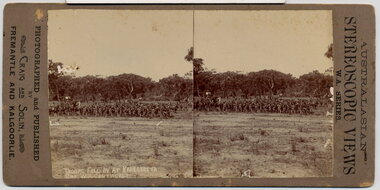
... Published in Australian Stereoscopic Views, WA Series, Photographed and published by Craig and Solin, Fremantle and Kalgoorlie...Published in Australian Stereoscopic Views, WA Series, Photographed and published by Craig and Solin, Fremantle and Kalgoorlie Stereographic Image ...The 1st Contingent departed Fremantle on 7 November 1899 and returned on 29 December 1900. The 2nd Contingent departed 3 February 1900 and returned 8 December 1900. Due to the shortage of khaki material, the 1st Contingent uniforms wore their blue militia tunics, blue puttees and a dark blue puggaree on departure. An Anglo Boer War Service of Reconciliation is held annually on the first Sunday in June at the "Fallen Soldiers" (Boer War) Memorial in Kings Park attended by descendants and representative of all combatant nations. The date selected is the closest Sunday to the date of signing of the Treaty or Peace of Vereeniging (31 May 1902). The culmination of the service is the laying of the Emily Hobhouse wreath.Unique series of stereoscopic images showing both the 1st and 2nd West Australian Mounted Infantry Contingents to the Anglo Boer War. Images contain details of uniforms, accoutrements, camp life, civic honours and departure.Troops Fall In at Karrakatta. 2nd WA Contingent. Published in Australian Stereoscopic Views, WA Series, Photographed and published by Craig and Solin, Fremantle and KalgoorliePhotographed and published by Craig and Solin, Fremantle and Kalgoorliestereoscope, boer war, south africa, capetown -
 Australian Army Museum of Western Australia
Stereographic Image, 1900
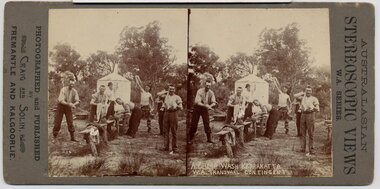
... Published in Australian Stereoscopic Views, WA Series, Photographed and published by Craig and Solin, Fremantle and Kalgoorlie...Published in Australian Stereoscopic Views, WA Series, Photographed and published by Craig and Solin, Fremantle and Kalgoorlie Stereographic Image ...The 1st Contingent departed Fremantle on 7 November 1899 and returned on 29 December 1900. The 2nd Contingent departed 3 February 1900 and returned 8 December 1900. Due to the shortage of khaki material, the 1st Contingent uniforms wore their blue militia tunics, blue puttees and a dark blue puggaree on departure. An Anglo Boer War Service of Reconciliation is held annually on the first Sunday in June at the "Fallen Soldiers" (Boer War) Memorial in Kings Park attended by descendants and representative of all combatant nations. The date selected is the closest Sunday to the date of signing of the Treaty or Peace of Vereeniging (31 May 1902). The culmination of the service is the laying of the Emily Hobhouse wreath.Unique series of stereoscopic images showing both the 1st and 2nd West Australian Mounted Infantry Contingents to the Anglo Boer War. Images contain details of uniforms, accoutrements, camp life, civic honours and departure.A Camp Wash Karrakatta. WA Transvaal Contingent. Published in Australian Stereoscopic Views, WA Series, Photographed and published by Craig and Solin, Fremantle and KalgoorliePhotographed and published by Craig and Solin, Fremantle and Kalgoorliestereoscope, boer war, south africa, capetown -
 Australian Army Museum of Western Australia
Stereographic Image, 1900
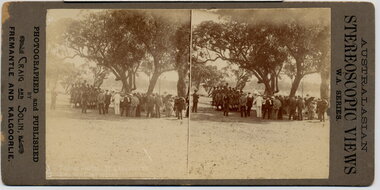
... Published in Australian Stereoscopic Views, WA Series, Photographed and published by Craig and Solin, Fremantle and Kalgoorlie...Published in Australian Stereoscopic Views, WA Series, Photographed and published by Craig and Solin, Fremantle and Kalgoorlie Stereographic Image ...The 1st Contingent departed Fremantle on 7 November 1899 and returned on 29 December 1900. The 2nd Contingent departed 3 February 1900 and returned 8 December 1900. Due to the shortage of khaki material, the 1st Contingent uniforms wore their blue militia tunics, blue puttees and a dark blue puggaree on departure. An Anglo Boer War Service of Reconciliation is held annually on the first Sunday in June at the "Fallen Soldiers" (Boer War) Memorial in Kings Park attended by descendants and representative of all combatant nations. The date selected is the closest Sunday to the date of signing of the Treaty or Peace of Vereeniging (31 May 1902). The culmination of the service is the laying of the Emily Hobhouse wreath.Unique series of stereoscopic images showing both the 1st and 2nd West Australian Mounted Infantry Contingents to the Anglo Boer War. Images contain details of uniforms, accoutrements, camp life, civic honours and departure.Taking Photos at Karrakatta. 2nd WA Contingent. Published in Australian Stereoscopic Views, WA Series, Photographed and published by Craig and Solin, Fremantle and KalgoorliePhotographed and published by Craig and Solin, Fremantle and Kalgoorliestereoscope, boer war, south africa, capetown -
 Bendigo Military Museum
Photograph - Stereoscopic Equipment – Army Survey Regiment, Fortuna, Bendigo
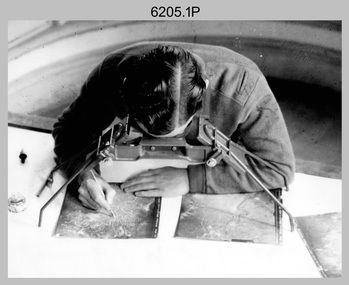
... The stereoscopes shown in photos .1P and .2P were used to stereoscopically view and interpret features in overlapping aerial photographs. ...This is a set of six photographs of stereoscopic equipment and personnel at the Army Survey Regiment, Fortuna, Bendigo, c1950s to c1960s. ...Stereoscopic Equipment – Army Survey Regiment, Fortuna, Bendigo. Photograph Stereoscopic Equipment – Army Survey Regiment, Fortuna, Bendigo. ...This is a set of six photographs of stereoscopic equipment and personnel at the Army Survey Regiment, Fortuna, Bendigo, c1950s to c1960s. The stereoscopes shown in photos .1P and .2P were used to stereoscopically view and interpret features in overlapping aerial photographs. The stereoscopic plotters shown in photos .3P and .4P were used to stereoscopically plot topographic detail from overlapping aerial photographs using a pantograph arm with pencil onto a controlled plotting sheet. The Ryker Model PL-3 Wernstedt-Mahan type stereoscopic plotter shown in photos .5P and .6P was used for precision contouring, planimetry and profiling. It was a comparatively simple stereoscopic mapping instrument designed to use ordinary contact prints of aerial photographs. It provides for plotting on a constant scale and approximate tilt correction but does not provide refinements such as correction for lens distortion. The plotter in Photo .6P does not have its pantograph arm attached. These plotters pre-date the Wild B9 and B8 stereo plotters introduced in the 1960s.This is a set of six photographs of stereoscopic equipment and personnel at the Army Survey Regiment, Fortuna, Bendigo, c1950s to c1960s. Black and white photos are on photographic paper and were scanned at 300 dpi. .1) - Photo, black & white, c1950s to c1960s, Universal Stereoscope, unidentified technician. .2) - Photo, black & white, c1950s to c1960s, Old Delft Scanning Stereoscopes, unidentified technicians. .3) - Photo, black & white, c1950s to c1960s, Unidentified stereoscopic plotters and technicians. .4) - Photo, black & white, c1950s to c1960s, Unidentified stereoscopic plotter, CPL Bill Shapcott. .5) and .6) - Photo, black & white, c1950s to c1960s, Ryker Model PL-3 stereoscopic plotter.Photo .4P is annotated on back - ‘Bill Shapcott (CPL)’royal australian survey corps, army svy regt, rasvy, army survey regiment, fortuna, asr, air survey, photogrammetry -
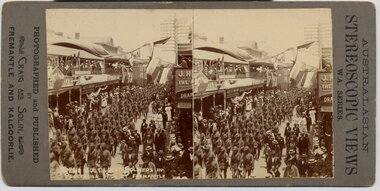 Australian Army Museum of Western Australia
Stereoscopic Image
... Published in Australian Stereoscopic Views, WA Series, Photographed and published by Craig and Solin, Fremantle and Kalgoorlie...Published in Australian Stereoscopic Views, WA Series, Photographed and published by Craig and Solin, Fremantle and Kalgoorlie Stereoscopic Image ...The 1st Contingent departed Fremantle on 7 November 1899 and returned on 29 December 1900. The 2nd Contingent departed 3 February 1900 and returned 8 December 1900. Due to the shortage of khaki material, the 1st Contingent uniforms wore their blue militia tunics, blue puttees and a dark blue puggaree on departure. An Anglo Boer War Service of Reconciliation is held annually on the first Sunday in June at the "Fallen Soldiers" (Boer War) Memorial in Kings Park attended by descendants and representative of all combatant nations. The date selected is the closest Sunday to the date of signing of the Treaty or Peace of Vereeniging (31 May 1902). The culmination of the service is the laying of the Emily Hobhouse wreath.Unique series of stereoscopic images showing both the 1st and 2nd West Australian Mounted Infantry Contingents to the Anglo Boer War. Images contain details of uniforms, accoutrements, camp life, civic honours and departure.2nd Contingent Soldiers in Procession, High Street, Fremantle. Published in Australian Stereoscopic Views, WA Series, Photographed and published by Craig and Solin, Fremantle and KalgoorliePhotographed and published by Craig and Solin, Fremantle and Kalgoorlieanglo boer war, peace of vereenniging, emily hobhouse, 1st contingent wami, 2nd contingent wami -
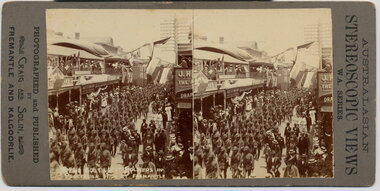 Australian Army Museum of Western Australia
Stereographic Image, 1900
... Published in Australian Stereoscopic Views, WA Series, Photographed and published by Craig and Solin, Fremantle and Kalgoorlie...Published in Australian Stereoscopic Views, WA Series, Photographed and published by Craig and Solin, Fremantle and Kalgoorlie Stereographic Image ...The 1st Contingent departed Fremantle on 7 November 1899 and returned on 29 December 1900. The 2nd Contingent departed 3 February 1900 and returned 8 December 1900. Due to the shortage of khaki material, the 1st Contingent uniforms wore their blue militia tunics, blue puttees and a dark blue puggaree on departure. An Anglo Boer War Service of Reconciliation is held annually on the first Sunday in June at the "Fallen Soldiers" (Boer War) Memorial in Kings Park attended by descendants and representative of all combatant nations. The date selected is the closest Sunday to the date of signing of the Treaty or Peace of Vereeniging (31 May 1902). The culmination of the service is the laying of the Emily Hobhouse wreath.Unique series of stereoscopic images showing both the 1st and 2nd West Australian Mounted Infantry Contingents to the Anglo Boer War. Images contain details of uniforms, accoutrements, camp life, civic honours and departure.2nd Contingent Soldiers in Procession, High Street, Fremantle. Published in Australian Stereoscopic Views, WA Series, Photographed and published by Craig and Solin, Fremantle and KalgoorliePhotographed and published by Craig and Solin, Fremantle and Kalgoorliestereoscope, boer war, south africa, capetown -
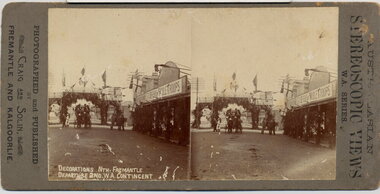 Australian Army Museum of Western Australia
Stereographic Image, 1900
... Published in Australian Stereoscopic Views, WA Series, Photographed and published by Craig and Solin, Fremantle and Kalgoorlie...Published in Australian Stereoscopic Views, WA Series, Photographed and published by Craig and Solin, Fremantle and Kalgoorlie Stereographic Image ...The 1st Contingent departed Fremantle on 7 November 1899 and returned on 29 December 1900. The 2nd Contingent departed 3 February 1900 and returned 8 December 1900. Due to the shortage of khaki material, the 1st Contingent uniforms wore their blue militia tunics, blue puttees and a dark blue puggaree on departure. An Anglo Boer War Service of Reconciliation is held annually on the first Sunday in June at the "Fallen Soldiers" (Boer War) Memorial in Kings Park attended by descendants and representative of all combatant nations. The date selected is the closest Sunday to the date of signing of the Treaty or Peace of Vereeniging (31 May 1902). The culmination of the service is the laying of the Emily Hobhouse wreath.Unique series of stereoscopic images showing both the 1st and 2nd West Australian Mounted Infantry Contingents to the Anglo Boer War. Images contain details of uniforms, accoutrements, camp life, civic honours and departure.Decorations in Nth Fremantle. Departure of 2nd WA Contingent. Published in Australian Stereoscopic Views, WA Series, Photographed and published by Craig and Solin, Fremantle and KalgoorliePhotographed and published by Craig and Solin, Fremantle and Kalgoorliestereoscope, boer war, south africa, capetown -
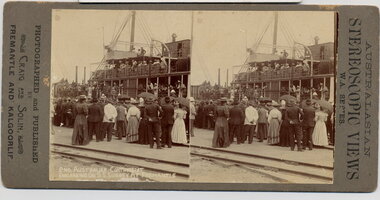 Australian Army Museum of Western Australia
Stereographic Image, 1900
... Published in Australian Stereoscopic Views, WA Series, Photographed and published by Craig and Solin, Fremantle and Kalgoorlie...Published in Australian Stereoscopic Views, WA Series, Photographed and published by Craig and Solin, Fremantle and Kalgoorlie Stereographic Image ...The 1st Contingent departed Fremantle on 7 November 1899 and returned on 29 December 1900. The 2nd Contingent departed 3 February 1900 and returned 8 December 1900. Due to the shortage of khaki material, the 1st Contingent uniforms wore their blue militia tunics, blue puttees and a dark blue puggaree on departure. An Anglo Boer War Service of Reconciliation is held annually on the first Sunday in June at the "Fallen Soldiers" (Boer War) Memorial in Kings Park attended by descendants and representative of all combatant nations. The date selected is the closest Sunday to the date of signing of the Treaty or Peace of Vereeniging (31 May 1902). The culmination of the service is the laying of the Emily Hobhouse wreath.Unique series of stereoscopic images showing both the 1st and 2nd West Australian Mounted Infantry Contingents to the Anglo Boer War. Images contain details of uniforms, accoutrements, camp life, civic honours and departure.2nd WA Contingent Embarking on SS Surrey at Fremantle. Published in Australian Stereoscopic Views, WA Series, Photographed and published by Craig and Solin, Fremantle and KalgoorliePhotographed and published by Craig and Solin, Fremantle and Kalgoorliestereoscope, boer war, south africa, capetown -
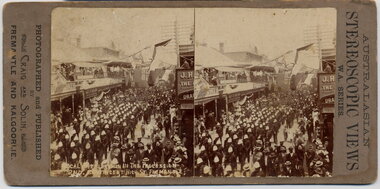 Australian Army Museum of Western Australia
Stereographic Image, 1900
... Published in Australian Stereoscopic Views, WA Series, Photographed and published by Craig and Solin, Fremantle and Kalgoorlie...Published in Australian Stereoscopic Views, WA Series, Photographed and published by Craig and Solin, Fremantle and Kalgoorlie Stereographic Image ...The 1st Contingent departed Fremantle on 7 November 1899 and returned on 29 December 1900. The 2nd Contingent departed 3 February 1900 and returned 8 December 1900. Due to the shortage of khaki material, the 1st Contingent uniforms wore their blue militia tunics, blue puttees and a dark blue puggaree on departure. An Anglo Boer War Service of Reconciliation is held annually on the first Sunday in June at the "Fallen Soldiers" (Boer War) Memorial in Kings Park attended by descendants and representative of all combatant nations. The date selected is the closest Sunday to the date of signing of the Treaty or Peace of Vereeniging (31 May 1902). The culmination of the service is the laying of the Emily Hobhouse wreath.Unique series of stereoscopic images showing both the 1st and 2nd West Australian Mounted Infantry Contingents to the Anglo Boer War. Images contain details of uniforms, accoutrements, camp life, civic honours and departure.Local Artillerymen in the Procession. 2nd Contingent, High Street, Fremantle. Published in Australian Stereoscopic Views, WA Series, Photographed and published by Craig and Solin, Fremantle and KalgoorliePhotographed and published by Craig and Solin, Fremantle and Kalgoorliestereoscope, boer war, south africa, capetown
