
Showing 6 items matching "stick shed"
-
 Victorian Interpretive Projects Inc.
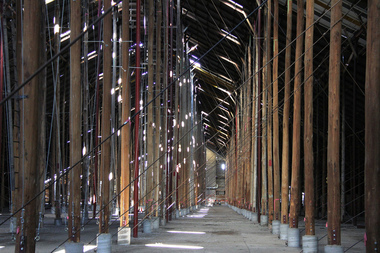
Photograph - digital, LJ Gervasoni, Murtoa Stick Shed 00031, 13/08/2011
... Murtoa Stick Shed 00031......stick shed...These poles are the reason for use of the term "stick shed". With its vast gabled interior and the long rows of poles the space has been likened to the nave of a cathedral. ...Murtoa grain storage facility better known as the Stick Shed. The shed was constructed in World War Two to store grain. ...The supporting columns are trees. Murtoa Stick Shed 00031 Photograph - digital LJ Gervasoni ...From the Victorian Heritage Register statement of significance H0791 The Marmalake/Murtoa Grain Store, originally the No.1 Murtoa Shed, is located within the Murtoa Grain Terminal, adjacent to the grain elevator tower and railway line. The shed is 280m long, 60m wide and 19m high at the ridge with a capacity of 3.4 million bushels. The hipped corrugated iron roof of the shed is supported on approximately 600 unmilled hardwood poles set in a concrete slab floor and braced with iron tie rods. These poles are the reason for use of the term "stick shed". With its vast gabled interior and the long rows of poles the space has been likened to the nave of a cathedral. An elevator at one end took wheat from railway trucks to ridge level where it was distributed by conveyor along the length of the shed, creating a huge single mound of grain. Braced internal timber bulkheads on either side took the lateral thrust of the wheat, and conveyors at ground level outside the bulkheads took wheat back to the elevator for transport elsewhere. Wheat had been handled in jute bags from the start of the Victorian wheat industry in the mid nineteenth century. Bulk storage had been developed in North America from the early 1900s. NSW began building substantial concrete silos from 1920-21. In Western Australia, farmers' co-operatives, who had to supply their own bulk storage from 1934-5, pioneered the use of low-cost horizontal sheds of timber and corrugated iron for bulk storage. Following its establishment in 1935 the Victorian Grain Elevators Board (GEB) planned a network of 160 concrete silos in country locations, connected by rail to the shipping terminal at Geelong. By the outbreak of the Second World War there was a worldwide glut of wheat, and Australia soon had a massive surplus which it was unable to export. Only 48 silos had been established under the Victorian Silo Scheme so far, and wartime material and labour restrictions prevented progress with this scheme. The storage deficit had become an emergency by 1941 as Britain obtained its imports from North America, rather than over the lengthy and difficult shipping route from Australia. In 1941 the GEB, under chairman and general manager Harold Glowrey, proposed large temporary versions of the horizontal bulk storage sheds already in use in Western Australia. The proposal was approved by the Victorian Wheat and Woolgrowers Association, who considered the use of shed storages as a longer term proposition. After initial resistance from the Australian Wheat Board, some of whose members represented wheat bagging interests, the Commonwealth and Victorian governments agreed to split the costs, and Murtoa was chosen as a suitable site for the first emergency storage. The main contractor, Green Bros, commenced work on the No.1 Murtoa Shed in September 1941, deliveries of bulk wheat began in January 1942, and the store was full by June of the same year. In the following years the Council for Scientific and Industrial Research (later CSIRO) conducted valuable research and experiment on the impacts and control of insect pests at the Murtoa No.1 shed. With these discoveries, and the development of more effective pesticides, use of the No.1 shed and the larger No.2 shed, erected in 1942/43, continued for many years. The No.2 shed was demolished in 1975. By the 1990s, pest resistance to pesticides and requirements for both pest free and insecticide free grain rendered open storage of this type unviable. The No. 1 store was also becoming increasingly expensive to maintain, and its use was phased out from 1989.Image of the Marmalake/Murtoa Grain Store which is of historical, architectural, scientific (technical) and social significance to the State of VictoriaDigital colour image of the interior of the Marmaduke . Murtoa grain storage facility better known as the Stick Shed. The shed was constructed in World War Two to store grain. The supporting columns are trees.marmalake, murtoa grain store, wheat store, stick shed, murtoa -
 Bendigo Historical Society Inc.
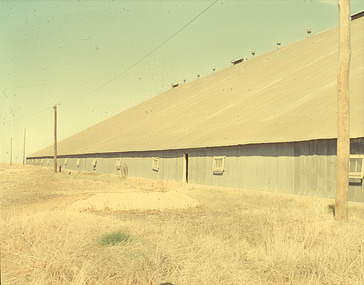
Slide - Mouat Crawford Collection: Farming Life in the Wimmera
... ...stick shed...The Stick Shed. Used as a teaching aid....AGRICULTURE Farm Crop Storage wimmera wheat silo stick shed murtoa mouat crawford collection PERUTZ Wheat terminal at Murtoa, known as the stick shed Markings: Murtoa(SIC) Bulk Wheat Terminal. ...Wheat terminal at Murtoa, known as the stick shed Markings: Murtoa(SIC) Bulk Wheat Terminal. The Stick Shed. Used as a teaching aid.PERUTZagriculture, farm, crop storage, wimmera, wheat silo, stick shed, murtoa, mouat crawford collection -
 Ringwood and District Historical Society
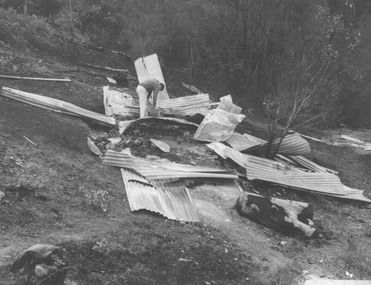
Photograph, Ringwood Rifle Range, Warrandyte after bushfire 1962
... Remains of the target shed near entrance to pit. R. Johnson, Peter Pullin (with stick), R. Pullin, J. ...Remains of the target shed near entrance to pit. R. Johnson, Peter Pullin (with stick), R. Pullin, J. ...Black and white photograph (2 images)Typed note on back of one of the photographs: "Ringwood Rifle Range, Warrandyte after the bushfires of 1962. Remains of the target shed near entrance to pit. R. Johnson, Peter Pullin (with stick), R. Pullin, J. Hinds." -
 Bendigo Historical Society Inc.
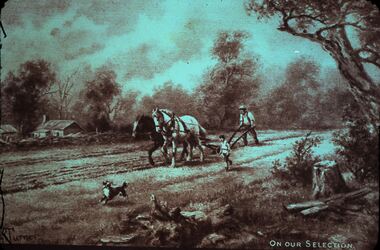
Slide - DIGGERS & MINING. LIFE OF THE SELECTORS, c1860-1890
... A child alongside appears to be playing with the dog as the dog has a stick in its mouth. The home is in the background along with a shed. Markings: Life Of The Selectors Set 432 No. 10. ...A child alongside appears to be playing with the dog as the dog has a stick in its mouth. The home is in the background along with a shed. Markings: Life Of The Selectors Set 432 No. 10. ...BHS CollectionDiggers & mining. Life Of The Selectors. Man ploughing a field with 2 horses. A child alongside appears to be playing with the dog as the dog has a stick in its mouth. The home is in the background along with a shed. Markings: Life Of The Selectors Set 432 No. 10. On Our Selection - a photograph of a painting by J. A. Turner. Used as a teaching aid.Visual Education Centreeducation, tertiary, goldfields -
 Sunshine and District Historical Society Incorporated
Photograph - Demolition of Spalding factory, 1994
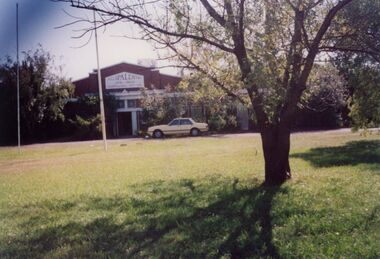
... Series of nine photographs of the AG Spalding and Bros Australia Pty Ltd Factory before and during demolition in March 1994 The factory land was cleared for the building of Bunnings Hardware and Garden Warehouse Photograph 1 Front view of factory office lawns and gardens from Ballarat Road Photograph 2 View through factory yard from adjacent paddock Photograph 3 View from McIntyre Road Photograph 4 View from adjacent paddock to laboratory and factory sheds Demoliton underway Photograph 5 From McIntyre Road Sign hoarding and some trees in garden Photograph 6 From McIntyre Road Laboratory Photograph 7 From Phoenix Street Golf Stick Room and Water Tower Photograph 8 From McIntyre Road Switch Room Tennis Room Golf Stick Room and Water Tower Photograph 9 View across paddock looking south to remains of McKay factory and offices and portion of Sunshine business area...Spaldings Ballarat Road Sunshine North Series of nine photographs of the AG Spalding and Bros Australia Pty Ltd Factory before and during demolition in March 1994 The factory land was cleared for the building of Bunnings Hardware and Garden Warehouse Photograph 1 Front view of factory office lawns and gardens from Ballarat Road Photograph 2 View through factory yard from adjacent paddock Photograph 3 View from McIntyre Road Photograph 4 View from adjacent paddock to laboratory and factory sheds Demoliton underway Photograph 5 From McIntyre Road Sign hoarding and some trees in garden Photograph 6 From McIntyre Road Laboratory Photograph 7 From Phoenix Street Golf Stick Room and Water Tower Photograph 8 From McIntyre Road Switch Room Tennis Room Golf Stick Room and Water Tower Photograph 9 View across paddock looking south to remains of McKay factory and offices and portion of Sunshine business area Demolition of Spalding factory Photograph Demolition of Spalding factory ...Series of nine photographs of the AG Spalding and Bros Australia Pty Ltd Factory before and during demolition in March 1994 The factory land was cleared for the building of Bunnings Hardware and Garden Warehouse Photograph 1 Front view of factory office lawns and gardens from Ballarat Road Photograph 2 View through factory yard from adjacent paddock Photograph 3 View from McIntyre Road Photograph 4 View from adjacent paddock to laboratory and factory sheds Demoliton underway Photograph 5 From McIntyre Road Sign hoarding and some trees in garden Photograph 6 From McIntyre Road Laboratory Photograph 7 From Phoenix Street Golf Stick Room and Water Tower Photograph 8 From McIntyre Road Switch Room Tennis Room Golf Stick Room and Water Tower Photograph 9 View across paddock looking south to remains of McKay factory and offices and portion of Sunshine business areaspaldings, ballarat road, sunshine north -
 Lakes Entrance Historical Society
Photograph - Rosemont House, Lakes Entrance Victoria. c1935 plus 2026
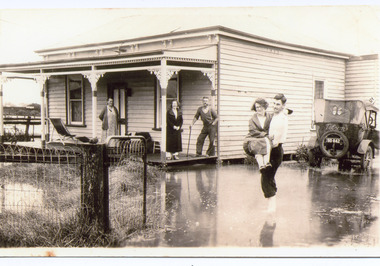
... On the veranda of boarding house are Alice Fraser nee Falk, her daughter Joan and husband George leaning on stick, beside house is a soft topped sedan car with sign Telsons on back, Lakes Entrance Victoria. Plus a recent photo of sheds on the block taken 2026...On the veranda of boarding house are Alice Fraser nee Falk, her daughter Joan and husband George leaning on stick, beside house is a soft topped sedan car with sign Telsons on back, Lakes Entrance Victoria. Plus a recent photo of sheds on the block taken 2026 Photograph Rosemont House, Lakes Entrance Victoria. c1935 plus 2026 ...Sepia toned photograph of a man carrying a woman through flood water surrounding Rosemont House, Cnr. of Lake Street and Barkes Avenue. On the veranda of boarding house are Alice Fraser nee Falk, her daughter Joan and husband George leaning on stick, beside house is a soft topped sedan car with sign Telsons on back, Lakes Entrance Victoria. Plus a recent photo of sheds on the block taken 2026genealogy, guesthouses, floods
