
Showing 406 items matching "story board"
-
 Bendigo Military Museum
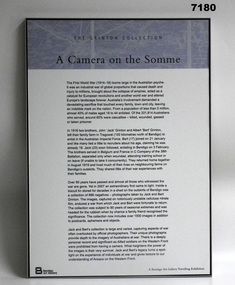
Literary work - STORY BOARD - FRAMED - WW1, Bendigo & District RSL Sub Branch et al, C.2008/09
... STORY BOARD - FRAMED - WW1...Story board - framed. Story Board - black print on white and pale blue background on synthetic paper adhered to backing board. ...Framed Accessories Camera on the Somme WW1 38th Bn Grinton "The Grinton Collection" "A Camera on the Somme". Story board - framed. Story Board - black print on white and pale blue background on synthetic paper adhered to backing board. ...Refer Cat No.1280 for Jack Grintons service history.Story board - framed. Story Board - black print on white and pale blue background on synthetic paper adhered to backing board. Frame - metal with wood backing board."The Grinton Collection" "A Camera on the Somme". framed accessories, camera on the somme, ww1, 38th bn, grinton -
 Bendigo Military Museum
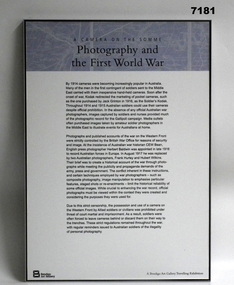
Literary work - STORY BOARD - FRAMED - WW1, Bendigo & District RSL Sub Branch et al, C.2008/09
... STORY BOARD - FRAMED - WW1...Story board - framed. Story Board - black print on white and pale blue background on synthetic paper adhered to backing board. ...Framed Accessories Camera on the Somme WW1 38th Bn Grinton Photography "A CAMERA ON THE SOMME" "Photography and the FIRST WORLD WAR" Story board - framed. Story Board - black print on white and pale blue background on synthetic paper adhered to backing board. ...Refer Cat No. 1280 for Jack Grintons service history.Story board - framed. Story Board - black print on white and pale blue background on synthetic paper adhered to backing board. Frame - metal with wood backing board."A CAMERA ON THE SOMME" "Photography and the FIRST WORLD WAR"framed accessories, camera on the somme, ww1, 38th bn, grinton, photography -
 Bendigo Military Museum
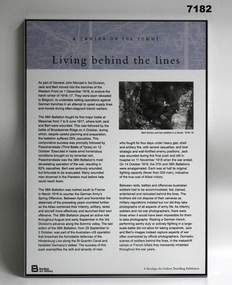
Literary work - STORY BOARD - FRAMED - WW1, Bendigo & District RSL Sub Branch et al, C.2008/09
... STORY BOARD - FRAMED - WW1...Story board - framed. Story Board - black print on white and pale blue background on synthetic paper adhered to backing board. ...Photograph - "Bert Grinton and two soldiers in a trench 1916-1919". Story board - framed. Story Board - black print on white and pale blue background on synthetic paper adhered to backing board. ...Refer Cat No. 1280 for Jack Grintons service history. "BERT GRINTON NO. 5024" 38TH BN - refer cat no 1320P for his service history.Story board - framed. Story Board - black print on white and pale blue background on synthetic paper adhered to backing board. Frame - metal with wood backing board."A CAMERA ON THE SOMME". "Living behind the lines". Photograph - "Bert Grinton and two soldiers in a trench 1916-1919". framed accessories, camera on the somme, ww1, 38th bn, grinton -
 Bendigo Military Museum
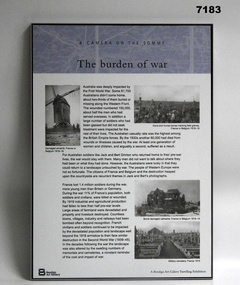
Literary work - STORY BOARD - FRAMED - WW1, Bendigo & District RSL Sub Branch et al, C.2008/09
... STORY BOARD - FRAMED - WW1...Story board - framed. Story Board - black print on white and pale blue background on synthetic paper adhered to backing board. ...Frame - metal with wood backing board. Literary work STORY BOARD - FRAMED - WW1 Bendigo & District RSL Sub Branch Bendigo Art Gallery ...Jack Grinton. Refer Cat No.1280 for his service history.Story board - framed. Story Board - black print on white and pale blue background on synthetic paper adhered to backing board. Frame - metal with wood backing board." A CAMERA ON THE SOMME' "The Burden of War". Photographs top left - "Damaged windmill, France or Belgium 1916-1919" Top right "Guns and human bones marking field graves, France or Belgium 1916-1919" Middle right "Bomb damaged cathedral, France or Belgium 1916-19" Bottom right "Military Cemetery, France 1919" framed accessories, camera on the somme, ww1, 38th bn, grinton -
 Bendigo Military Museum
Literary work - STORY BOARD - FRAMED - WW1, Bendigo District RSL Sub - Branch Inc. et al, c2008/09
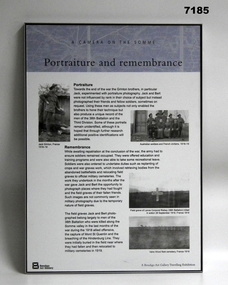
... STORY BOARD - FRAMED - WW1...Story Board - framed. Story board - black print on white and pale blue background on synthetic paper adhered to backing board. ...Bottom right - "Vaire Wood field cemetery, France 1919" Story Board - framed. Story board - black print on white and pale blue background on synthetic paper adhered to backing board. ...Refer Cat No. 1280. "JACK GRINTON No. 1043, 38th Battalion - refer Cat No. 1280 for his service history.Story Board - framed. Story board - black print on white and pale blue background on synthetic paper adhered to backing board. Illustrated - four black and white photographs. Frame - metal with wood backing board."A Camera on the Somme". "Portraiture and Remembrance", Photographs - Top left - "Jack Grinton, France 1918 - 19" Top Right - "Australian soldiers and French civilians 1918-19". Middle Right "Field grave of Lance Corporal Risbey (38th Battalion) killed in action 29 September 1918, France 1919". Bottom right - "Vaire Wood field cemetery, France 1919"framed accessories, camera on the somme, ww1, 38th bn, grinton, risbey -
 Bendigo Military Museum
Literary work - STORY BOARD - FRAMED - WW1, Bendigo & District RSL Sub Branch et al, C.2008/09
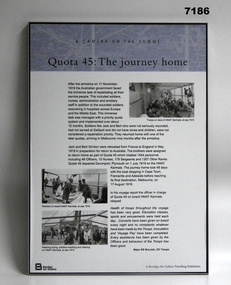
... STORY BOARD - FRAMED - WW1...Story Board - framed. Story board - black print on white and pale blue background on synthetic paper adhered to backing board. ...Bottom "Washing drying, soldiers wrestling and relaxing on HMAT Karmala, at sea 1919." Story Board - framed. Story board - black print on white and pale blue background on synthetic paper adhered to backing board. ...Refer Cat No. 1280, Grinton collection.Story Board - framed. Story board - black print on white and pale blue background on synthetic paper adhered to backing board. Illustrated - three black and white photographs. Frame - metal with wood backing board."A CAMERA ON THE SOMME" "Quota 45: The Journey Home". Photographs - Top - "Troops on deck of HMAT Karmala, at sea 1919". Middle "Workers on board HMAT Karmala, at sea 1919". Bottom "Washing drying, soldiers wrestling and relaxing on HMAT Karmala, at sea 1919."framed accessories, camera on the somme, ww1, 38th bn, grinton, hmat karmala -
 Bendigo Military Museum
Literary work - STORY BOARD - FRAMED - WW1, Bendigo District RSL Sub - Branch Inc. et al, C.2008/09
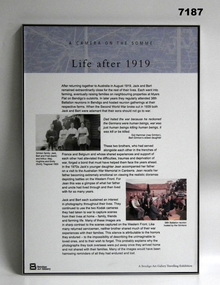
... STORY BOARD - FRAMED - WW1...Story Board - framed. Story board - black print on white and pale blue background on synthetic paper adhered to backing board. ...Frame - metal with wood backing board. Literary work STORY BOARD - FRAMED - WW1 Bendigo District RSL Sub - Branch Inc. ...Refer Cat No. 1280. "JACK GRINTON No. 1043, " 38th Bn - Refer Cat No. 1280 for Service History. "BERT GRINTON No. 5024" 38th Bn - Refer Cat No. 1320P for Service History.Story Board - framed. Story board - black print on white and pale blue background on synthetic paper adhered to backing board. Illustrated - one black and white photograph, one colour photograph. Frame - metal with wood backing board."A CAMERA ON THE SOMME" "Life after 1919" Photographs - black and white - "Grinton family: Jack, Bert and Fred (back), and Arthur, May, Hughina and Emily (front) Tragowel 1920", Colour - "38th Battalion reunion hosted by the Grintons"framed accessories, camera on the somme, ww1, 38th bn, grinton -
 Bendigo Military Museum
Literary work - STORY BOARD - FRAMED - WW1, Bendigo District RSL Sub - Branch Inc. et al, C.2008/09
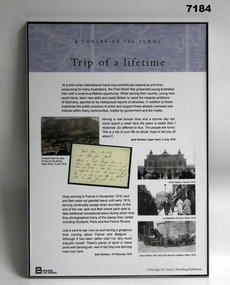
... STORY BOARD - FRAMED - WW1....Story Board - framed. Storyboard - black print on white and pale blue background on synthetic paper adhered to backing board. ...Frame - metal with wood backing board. Literary work STORY BOARD - FRAMED - WW1. Bendigo District RSL Sub - Branch Inc. ...Refer Cat No. 1280 "Jack GRINTON No 1043", 38th Bn - Refer Cat No. 1280 for his service history.Story Board - framed. Storyboard - black print on white and pale blue background on synthetic paper adhered to backing board. Illustrated - three black and white photographs, one colour photograph and copy of - handwritten letter on yellow paper. Frame - metal with wood backing board."A CAMERA ON THE SOMME" "Trip of a Lifetime" Photographs; Top left: in colour "Postcard sent by Jack Grinton to his family, Cape Town, 5 July 1916" Top right: "Paris Opera, France 1919". Middle right: " La Madeline Church, Paris 1919" . Bottom right: " Jack Grinton with captured German Artillery, Paris 1919". Handwritten letter: "From Jack".framed accessories, camera on the somme, ww1, 38th bn, grinton -
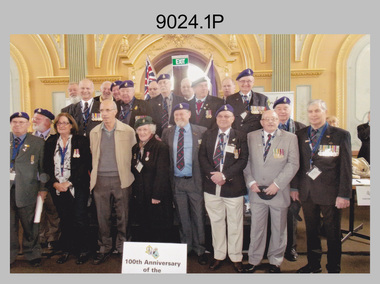 Bendigo Military Museum
Photograph - 100th Anniversary of the Royal Australian Survey Corps Celebrations, Bendigo, Victoria, 2015
... Sunday 5 July 2015 – 1500hrs short Commemorative Service, unveiling of Survey Corps story board at Fortuna Villa. ...Group photo of Ex-Survey personnel at the Commemorative Service to unveil the Survey Corps plaque and story board at Fortuna Villa, Bendigo....The following annotations are written on the back of each photo: .1P - ‘EX-SURVEY PERSONNEL (BRISBANE ASSOCIATION)’. .2P - ‘THE BAD BOYS 04 JUL 15 (LEFT THE CORPS TO WORK IN SAUDI ARABIA) .3P – ‘DEDICATION OF PLAQUE& STORY BOARD AT FORTUNA BENDIGO ON O5 JUL 15’....Sunday 5 July 2015 – 1500hrs short Commemorative Service, unveiling of Survey Corps story board at Fortuna Villa. Royal Australian Survey Corps RASvy Fortuna Army Survey Regiment The following annotations are written on the back of each photo: .1P - ‘EX-SURVEY PERSONNEL (BRISBANE ASSOCIATION)’. .2P - ‘THE BAD BOYS 04 JUL 15 (LEFT THE CORPS TO WORK IN SAUDI ARABIA) .3P – ‘DEDICATION OF PLAQUE& STORY BOARD AT FORTUNA BENDIGO ON O5 JUL 15’. ...These three photographs were taken during the 100th Anniversary of the Royal Australian Survey Corps Celebrations held in BENDIGO from the 3rd of July to the 5th of July 2015. The following events were held during the weekend of celebrations: Friday 3 July 2015 – Informal Meet and Greet at the Bendigo RSL. Saturday 4 July 2015 – 1030hrs Civic Reception Bendigo Town Hall. Saturday 4 July 2015 – 1400 -1600hrs Open House at Turriff (The WRAAC Barracks). Saturday 4 July 2015 – 1900 for 1930hrs Main Dinner Function at the All-Seasons Function Centre. Sunday 5 July 2015 - Catholic & Anglican Church Services. Sunday 5 July 2015 – 1200hrs BBQ Lunch Goldmines Hotel. Sunday 5 July 2015 – 1500hrs short Commemorative Service, unveiling of Survey Corps story board at Fortuna Villa. This is a set of three photographs taken during the 100th Anniversary of the Royal Australian Survey Corps Celebrations held in Bendigo in July 2015. The colour photographs were printed on photographic paper and are part of the Army Survey Regiment’s Collection. The photographs were scanned at 300 dpi. .1) - Photo, colour, 2015. Group photo of Ex-Survey personnel from the Brisbane Association at the Bendigo Town Hall. .2) - Photo, colour, 2015. Group photo of Ex-Survey personnel taken at the All-Seasons Hotel. This group left the Corps in the late 1980s to work in Saudi Arabia. L to R: Wally Chilcott, Brett Treneman, Dave Murphy, Steve Throssel, unidentified, Jim Cook, Dave Wright, Peter Lefel. .3) - Photo, colour, 2015. Group photo of Ex-Survey personnel at the Commemorative Service to unveil the Survey Corps plaque and story board at Fortuna Villa, Bendigo.The following annotations are written on the back of each photo: .1P - ‘EX-SURVEY PERSONNEL (BRISBANE ASSOCIATION)’. .2P - ‘THE BAD BOYS 04 JUL 15 (LEFT THE CORPS TO WORK IN SAUDI ARABIA) .3P – ‘DEDICATION OF PLAQUE& STORY BOARD AT FORTUNA BENDIGO ON O5 JUL 15’.royal australian survey corps, rasvy, fortuna, army survey regiment -
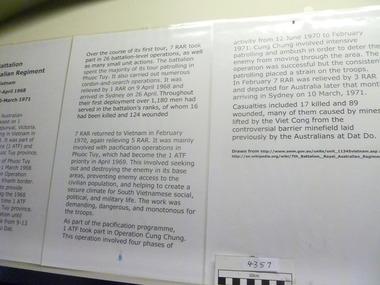 National Vietnam Veterans Museum (NVVM)
Poster - Poster, Information Board, 7RAR History and Operations
... ...Story board...7 RAR Poster Information Board Story board internet address of information Three sections of Poster, Information Board on laminated paper, describing the history and operations of 7RAR April 1967 - April 1968 and February 1970 - March 1971 7RAR History and Operations Poster Poster, Information Board ...Three sections of Poster, Information Board on laminated paper, describing the history and operations of 7RAR April 1967 - April 1968 and February 1970 - March 1971internet address of information7 rar, poster, information board, story board -
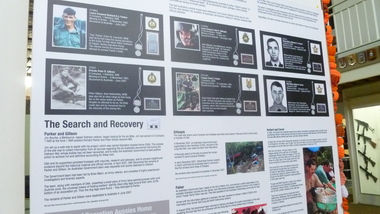 National Vietnam Veterans Museum (NVVM)
Poster - Poster, Information Board, MIAs in Vietnam
... Story board with photos of the Australian MIAs of the Vietnam War...MIAs Australian Vietnam War Photos and stories of the MIAs Story board with photos of the Australian MIAs of the Vietnam War MIAs in Vietnam Poster Poster, Information Board ...Story board with photos of the Australian MIAs of the Vietnam WarPhotos and stories of the MIAsmias, australian, vietnam war -
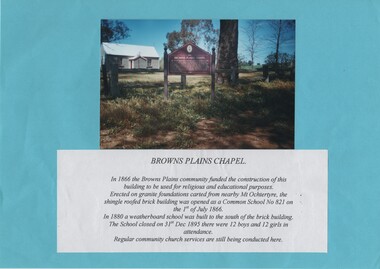 Rutherglen Historical Society
Image, c1985
... Colour photograph of a small painted brick building with a story board in front of it. The photograph is mounted on a bright blue sheet of paper, along with a typed caption of the text from the story board....Colour photograph of a small painted brick building with a story board in front of it. The photograph is mounted on a bright blue sheet of paper, along with a typed caption of the text from the story board. ...Colour photograph of a small painted brick building with a story board in front of it. The photograph is mounted on a bright blue sheet of paper, along with a typed caption of the text from the story board.Caption text: "Browns Plains Chapel. In 1866 the Browns Plains community funded the construction of this building to be used for religious and educational purposes. Erected on granite foundations carted from nearby Mt Ochtertyre, the shingle roofed brick building was opened as a Common School No 821 on the 1st of July 1866. In 1880 a weatherboard school was built to the south of the brick building. The School closed on 31st Dec 1895 there were 12 boys and 12 girls in attendance. Regular community church services are still being conducted here."browns plains, churches, schools, common school no 821 -
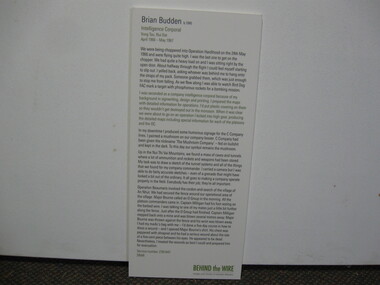 National Vietnam Veterans Museum (NVVM)
Poster - Poster, Information Board, Behind the Wire
... Story Board about Brian Budden, Intelligence Corporal. ...5 RAR Vung Tau Nui Dat Behind the Wire Story Board about Brian Budden, Intelligence Corporal. ...Story Board about Brian Budden, Intelligence Corporal. Service No. 2781441.5 rar, vung tau, nui dat, behind the wire -
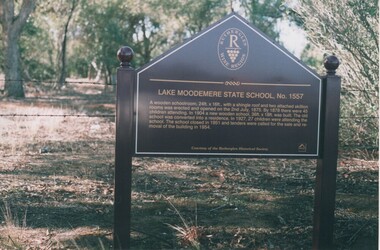 Rutherglen Historical Society
Image, 2004
... Colour photograph of a story board marking former site of a school, mounted on an album page....lake moodemere school storyboards Colour photograph of a story board marking former site of a school, mounted on an album page. ...Colour photograph of a story board marking former site of a school, mounted on an album page.lake moodemere school, storyboards -
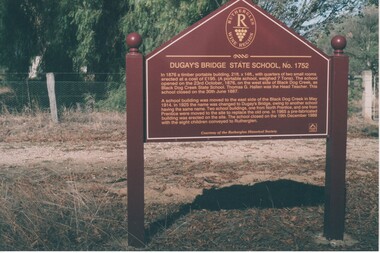 Rutherglen Historical Society
Image, 2004
... Colour photograph of a story board marking former site of a school, mounted on an album page....storyboards dugays bridge state school Colour photograph of a story board marking former site of a school, mounted on an album page. ...Colour photograph of a story board marking former site of a school, mounted on an album page.storyboards, dugays bridge state school -
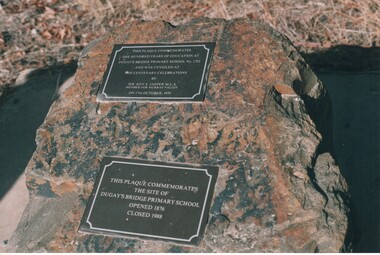 Rutherglen Historical Society
Image, 2004
... Colour photograph of a story board marking former site of a school, mounted on an album page....storyboards dugays bridge primary school Colour photograph of a story board marking former site of a school, mounted on an album page. ...Colour photograph of a story board marking former site of a school, mounted on an album page.storyboards, dugays bridge primary school -
 Rutherglen Historical Society
Image, 2004
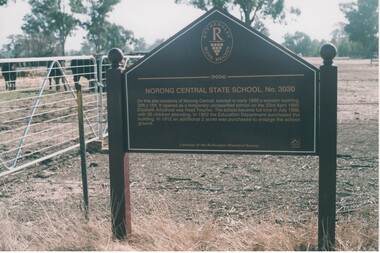
... Colour photograph of a story board marking former site of a school, mounted on an album page....storyboards norong central state school Colour photograph of a story board marking former site of a school, mounted on an album page. ...Colour photograph of a story board marking former site of a school, mounted on an album page.storyboards, norong central state school -
 Rutherglen Historical Society
Image, 2004
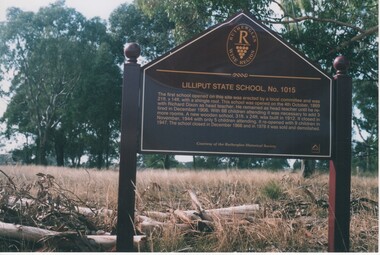
... Colour photograph of a story board marking former site of a school, mounted on an album page....storyboards lilliput state school Colour photograph of a story board marking former site of a school, mounted on an album page. ...Colour photograph of a story board marking former site of a school, mounted on an album page.storyboards, lilliput state school -
 Rutherglen Historical Society
Image, 2004
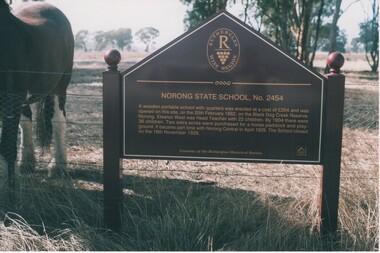
... Colour photograph of a story board marking former site of a school, mounted on an album page....storyboards norong state school Colour photograph of a story board marking former site of a school, mounted on an album page. ...Colour photograph of a story board marking former site of a school, mounted on an album page.storyboards, norong state school -
 Rutherglen Historical Society
Image, 2004
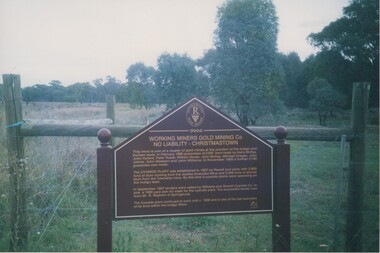
... Colour photograph of a story board marking former site of a gold processing cyanide plant at Christmastown. ...storyboards working miners gold mining co gold mining cyanide plant Colour photograph of a story board marking former site of a gold processing cyanide plant at Christmastown. ...Colour photograph of a story board marking former site of a gold processing cyanide plant at Christmastown. Photo is mounted on an album page.storyboards, working miners gold mining co, gold mining, cyanide plant -
 Whitehorse Historical Society Inc.
Artwork, other - Ink Line Drawing, Margaret Picken, 17 Closter Ave., Nunawading, 1995
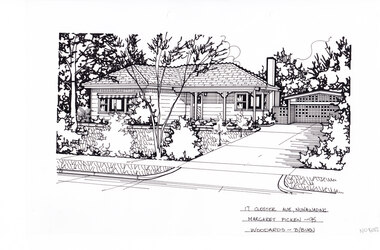
... A black ink line drawing on drafters film by Margaret Picken, of a black and white line drawing of a single story weather board house with a driveway on the right leading to a separate carport. ...Whitehorse Historical Society Schwerkolt Cottage Housing Architecture Margaret Picken House Garden Real Estate Nunawading 17 Closter Ave., Nunawading Margaret Picken - 95 Woodards - B/Burn A black ink line drawing on drafters film by Margaret Picken, of a black and white line drawing of a single story weather board house with a driveway on the right leading to a separate carport. ...A property illustration by Margaret Picken Commissioned by a real estate agency for the purpose of advertising 3 Caversham Crt., Nunawading The property has be listed as having sold for $132,000 in 1996 Made by using Rotring ‘Rapidigraph’ drafting pens with Rotring ink on Rapidigraph polyester drafting film, double matte. Trained as a cartographic draftsman within the mining industry, Margaret Picken is an artist who worked producing property illustrations for real estate agencies in eastern suburbs of Victoria from 1983-2005. Retiring from the industry as technological changes favored coloured photography over illustrations, and commissioning companies over sole contractors.This artwork is of Historical Significance as a record of local domestic architecture.A black ink line drawing on drafters film by Margaret Picken, of a black and white line drawing of a single story weather board house with a driveway on the right leading to a separate carport. In front of the house is a front garden with lawn, trees, and plant beds. There are two holepunch holes centred just under the upper edge.17 Closter Ave., Nunawading Margaret Picken - 95 Woodards - B/Burnwhitehorse historical society, schwerkolt cottage, housing, architecture, margaret picken, house, garden, real estate, nunawading -
 Ballarat Tramway Museum
Postcard - Folder set, "Ballarat Trams A Pictorial History in Four Post Cards", 1971
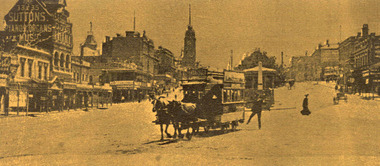
... Cards 3 and 4 have a story board on the side and further information on the back. ...Cards 3 and 4 have a story board on the side and further information on the back. ...Set of four black and white postcards printed onto a one sided colour textured stock and contained within a folded white glossy paper envelope. The white envelope has the title "Ballarat Trams A Pictorial History in Four Post Cards" and a horse tram printed on it - made from heavy one sided paste board. The postcards consist of 1. Horse tram arriving at Grenville St with person stepping off - same image as Reg. Item No. 1539, 3898 2. ESCo tram soon after opening - c1905/1906 - has Gardens destination sign. 3 ESCo Sebastopol tram at the time of construction - with a "Suttons for Gramophones" roof advertisement and lettered "Ballarat Tramways". 4. SEC Tram - appears to be No. 32 in the Gardens area. On the rear of cards 1 and 2 is a text caption story that is relevant to the card picture. Cards 3 and 4 have a story board on the side and further information on the back. On the rear of card 4 are details about the tramway, some track details, rolling stock and mileage covered.trams, tramways, horse trams, esco, sebastopol type -
 Whitehorse Historical Society Inc.
Artwork, other - Ink Line Drawing, Margaret Picken, 4 Pilita St., Forest Hill, 1990
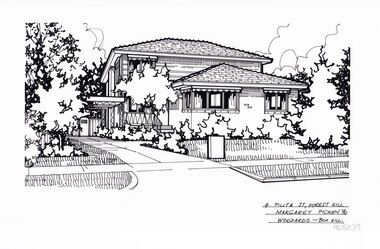
... A black ink line drawing on drafters film by Margaret Picken, of 4 Pilita St., Forest Hill, a two story brick and weather board house set back from a front lawn, with a driveway leading to a connected carport. ...Whitehorse Historical Society Schwerkolt Cottage Housing Architecture Margaret Picken House Garden Forest Hill 4 Pilita St., Forest Hill Margaret Picken '90 Woodards - Box Hill A black ink line drawing on drafters film by Margaret Picken, of 4 Pilita St., Forest Hill, a two story brick and weather board house set back from a front lawn, with a driveway leading to a connected carport. ...A property illustration by Margaret Picken Commissioned by the real estate agency Woodards Box Hill for the purpose of advertising 4 Pilita St., Forest Hill. Made by using Rotring ‘Rapidigraph’ drafting pens with Rotring ink on Rapidigraph polyester drafting film, double matte. Trained as a cartographic draftsman within the mining industry, Margaret Picken is an artist who worked producing property illustrations for real estate agencies in eastern suburbs of Victoria from 1983-2005. Retiring from the industry as technological changes favored coloured photography over illustrations, and commissioning companies over sole contractors.This artwork is of Historical Significance as a record of local domestic architecture.A black ink line drawing on drafters film by Margaret Picken, of 4 Pilita St., Forest Hill, a two story brick and weather board house set back from a front lawn, with a driveway leading to a connected carport. There are two hole punches centre of the upper edge4 Pilita St., Forest Hill Margaret Picken '90 Woodards - Box Hillwhitehorse historical society, schwerkolt cottage, housing, architecture, margaret picken, house, garden, forest hill -
 Glenelg Shire Council Cultural Collection
Photograph - Photograph reprint of a scan of photograph - Bridge Inn Casterton, Victoria, n.d
... Image shows two walls of Bridge Inn, a weather board, single story structure. Several people standing either in one of the two doorways visible, or on the ground either outside. ...Image shows two walls of Bridge Inn, a weather board, single story structure. Several people standing either in one of the two doorways visible, or on the ground either outside. ...Vern McCallum Collectionreprint of a scan of a black and white photograph. Image shows two walls of Bridge Inn, a weather board, single story structure. Several people standing either in one of the two doorways visible, or on the ground either outside. One man standing on top of barrel, a dog standing beside barrel. 'Bridge Inn' printed on top of one wall, 'J. Seymour's Bridge Inn' on the other. Print ounted on white archival mount board frame. -
 Flagstaff Hill Maritime Museum and Village
Ceramic - Ceramic Piece, Minton Potteries, ca 1877
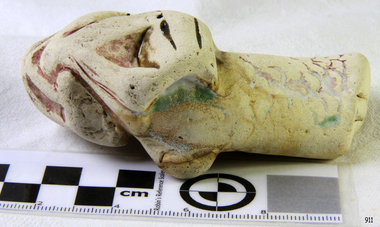
... board, only two survived: the apprentice, Tom Pearce and the young woman passenger, Eva Carmichael, who lost her family in the tragedy. The shipwreck of the Loch Ard is of significance for Victoria and is registered on the Victorian Heritage Register ( S 417). Flagstaff Hill has a varied collection of artefacts from Loch Ard and its collection is significant for being one of the largest accumulation of artefacts from this notable Victorian shipwreck. The collections object is to also give us a snapshot into history so we can interpret the story ...The ceramic piece is one of five porcelain fragments washed up from the Loch Ard wreck near Port Campbell, Victoria. These fragments resemble the foot and leg of a large bird, and legend has it that another bird had drifted ashore at the same time as the Loch Ard peacock. This figurine is on display at Flagstaff Hill Maritime Museum and regarded as the most valuable shipwreck relic. It is believed that all five fragments could belong to another peacock or a Minton porcelain stork that had been photographed in a Home Beautiful magazine in 1928. This stork appeared to be missing a leg and foot, and experts have hypothesised that the five fragments could belong to this stork, the whereabouts of which are currently unknown. A brief history of the Loch Ard (1873-1878): - The sailing ship Loch Ard was one of the famous Loch Line of ships that sailed the long voyage from England to Australia. Barclay, Curdle and Co. built the three-masted iron vessel in Glasgow in 1873. It had sailed three trips to Australia and one trip to Calcutta before its fateful voyage. Loch Ard left England on March 2, 1878, under the command of recently married, 29-year-old Captain Gibbs. It was bound for Melbourne with a crew of 37, plus 17 passengers. The general cargo reflected the affluence of Melbourne at the time. Onboard were straw hats, umbrellas, perfumes, clay pipes, pianos, clocks, confectionery, linen and candles, and a heavier load of railway irons, cement, lead and copper. Other cargo included items intended for display in the Melbourne International Exhibition of 1880. The Loch Ard had been sailing for three months and was close to its destination on June 1, 1878. Captain Gibbs had expected to see land at about 3 am, but the Loch Ard ran into a fog that greatly reduced visibility, and there was no sign of land or the Cape Otway lighthouse. The fog lifted at 4 am, and the sheer cliffs of Victoria's west coast were much closer to them than Captain Gibbs expected. He tried to manage the vessel but failed, and the ship struck a reef at the base of Mutton Bird Island, near Port Campbell. The top deck loosened from the hull, and the masts and rigging crashed down, knocking passengers and crew overboard. The lifeboat was launched by Tom Pearce but crashed into the side of Loch Ard and capsized. He clung onto its overturned hull and sheltered under it. He drifted out to sea, and the tide brought him back to what is now called Loch Ard Gorge. He swam to shore and found a cave for shelter. A passenger, Eva Carmichael, had raced onto the deck to find out what was happening and was confronted by towering cliffs above the ship. She was soon swept off the ship by a huge wave. Eva saw Tom Pearce on a small rocky beach and yelled to attract his attention. He swam out and dragged her to the shelter of the cave. He revived her with a bottle of brandy from a case that had washed up on the beach. Tom scaled a cliff in search of help and followed some horse hoof prints. He came from two men from Glenample Station, three and a half miles away. He told the men of the tragedy and then returned to the gorge while the two men rode back to the station to get help. They reached Loch Ard Gorge and took the two shipwreck survivors to Glenample Station to recover. Eva stayed at the station for six weeks before returning to Ireland by steamship. In Melbourne, Tom Pearce received a hero's welcome and was presented with a medal and some money. Of the 54 crew members and passengers on board, only two survived: the apprentice, Tom Pearce and the young woman passenger, Eva Carmichael, who lost her family in the tragedy. The shipwreck of the Loch Ard is of significance for Victoria and is registered on the Victorian Heritage Register ( S 417). Flagstaff Hill has a varied collection of artefacts from Loch Ard and its collection is significant for being one of the largest accumulation of artefacts from this notable Victorian shipwreck. The collections object is to also give us a snapshot into history so we can interpret the story of this tragic event. The collection is also archaeologically significant as it represents aspects of Victoria's shipping history that allows us to interpret Victoria's social and historical themes of the time. The collections historically significance is that it is associated unfortunately with the worst and best-known shipwreck in Victoria's history.Ceramic piece, broken, with remnants of burgundy, green and yellow glaze. The piece has been shaped. It could be a peacock leg section with green foliage with glaze. Noneflagstaff hill, flagstaff hill maritime museum and village, warrnambool, maritime museum, maritime village, great ocean road, shipwreck coast, ceramic, porcelain, piece, fragment, ceramic bird, loch ard, shipwreck, salvage, recover, 1877, 1878, minton, shard -
 Flagstaff Hill Maritime Museum and Village
Ceramic - Ceramic Piece, Minton Potteries, ca 1877
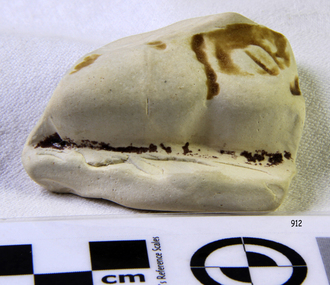
... board, only two survived: the apprentice, Tom Pearce and the young woman passenger, Eva Carmichael, who lost her family in the tragedy. The shipwreck of the Loch Ard is of significance for Victoria and is registered on the Victorian Heritage Register ( S 417). Flagstaff Hill has a varied collection of artefacts from Loch Ard and its collection is significant for being one of the largest accumulation of artefacts from this notable Victorian shipwreck. The collections object is to also give us a snapshot into history so we can interpret the story ...The ceramic piece is one of five porcelain fragments washed up from the Loch Ard wreck near Port Campbell, Victoria. These fragments resemble the foot and leg of a large bird, and legend has it that another bird had drifted ashore at the same time as the Loch Ard peacock. This figurine is on display at Flagstaff Hill Maritime Museum and regarded as the most valuable shipwreck relic. It is believed that all five fragments could belong to another peacock or a Minton porcelain stork that had been photographed in a Home Beautiful magazine in 1928. This stork appeared to be missing a leg and foot, and experts have hypothesised that the five fragments could belong to this stork, the whereabouts of which are currently unknown. A brief history of the Loch Ard (1873-1878): - The sailing ship Loch Ard was one of the famous Loch Line of ships that sailed the long voyage from England to Australia. Barclay, Curdle and Co. built the three-masted iron vessel in Glasgow in 1873. It had sailed three trips to Australia and one trip to Calcutta before its fateful voyage. Loch Ard left England on March 2, 1878, under the command of recently married, 29-year-old Captain Gibbs. It was bound for Melbourne with a crew of 37, plus 17 passengers. The general cargo reflected the affluence of Melbourne at the time. Onboard were straw hats, umbrellas, perfumes, clay pipes, pianos, clocks, confectionery, linen and candles, and a heavier load of railway irons, cement, lead and copper. Other cargo included items intended for display in the Melbourne International Exhibition of 1880. The Loch Ard had been sailing for three months and was close to its destination on June 1, 1878. Captain Gibbs had expected to see land at about 3 am, but the Loch Ard ran into a fog that greatly reduced visibility, and there was no sign of land or the Cape Otway lighthouse. The fog lifted at 4 am, and the sheer cliffs of Victoria's west coast were much closer to them than Captain Gibbs expected. He tried to manage the vessel but failed, and the ship struck a reef at the base of Mutton Bird Island, near Port Campbell. The top deck loosened from the hull, and the masts and rigging crashed down, knocking passengers and crew overboard. The lifeboat was launched by Tom Pearce but crashed into the side of Loch Ard and capsized. He clung onto its overturned hull and sheltered under it. He drifted out to sea, and the tide brought him back to what is now called Loch Ard Gorge. He swam to shore and found a cave for shelter. A passenger, Eva Carmichael, had raced onto the deck to find out what was happening and was confronted by towering cliffs above the ship. She was soon swept off the ship by a huge wave. Eva saw Tom Pearce on a small rocky beach and yelled to attract his attention. He swam out and dragged her to the shelter of the cave. He revived her with a bottle of brandy from a case that had washed up on the beach. Tom scaled a cliff in search of help and followed some horse hoof prints. He came from two men from Glenample Station, three and a half miles away. He told the men of the tragedy and then returned to the gorge while the two men rode back to the station to get help. They reached Loch Ard Gorge and took the two shipwreck survivors to Glenample Station to recover. Eva stayed at the station for six weeks before returning to Ireland by steamship. In Melbourne, Tom Pearce received a hero's welcome and was presented with a medal and some money. Of the 54 crew members and passengers on board, only two survived: the apprentice, Tom Pearce and the young woman passenger, Eva Carmichael, who lost her family in the tragedy. The shipwreck of the Loch Ard is of significance for Victoria and is registered on the Victorian Heritage Register ( S 417). Flagstaff Hill has a varied collection of artefacts from Loch Ard and its collection is significant for being one of the largest accumulation of artefacts from this notable Victorian shipwreck. The collections object is to also give us a snapshot into history so we can interpret the story of this tragic event. The collection is also archaeologically significant as it represents aspects of Victoria's shipping history that allows us to interpret Victoria's social and historical themes of the time. The collections historically significance is that it is associated unfortunately with the worst and best-known shipwreck in Victoria's history.Ceramic piece, broken with remnants of glaze. It has been shaped. It may be from a peacock leg section.Noneflagstaff hill, flagstaff hill maritime museum and village, warrnambool, maritime museum, maritime village, great ocean road, shipwreck coast, ceramic, porcelain, piece, fragment, ceramic bird, loch ard, shipwreck, salvage, recover, 1877, 1878, minton, shard -
 Flagstaff Hill Maritime Museum and Village
Functional object - Porthole Frame, Russell & Co, 1888
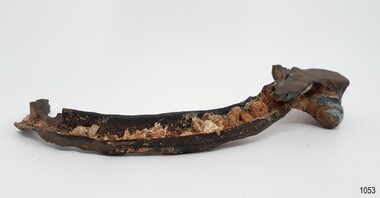
... board with the name "Sutlej" led to the identification of the wreck as Antares, which had been reported missing. According to later reports, the Antares wrecking was overshadowed by war news at the time. A young local boy had remarked that the Germans had arrived off the coast as he had seen them firing off shells and rockets, but his story was passed off as a joke. ...board with the name "Sutlej" led to the identification of the wreck as Antares, which had been reported missing. According to later reports, the Antares wrecking was overshadowed by war news at the time. A young local boy had remarked that the Germans had arrived off the coast as he had seen them firing off shells and rockets, but his story was passed off as a joke. ...This portion of the porthole frame was part of the fittings of the Antares. The Italian barque “Antares” was an iron three-masted sailing ship built in 1888 by Russell & Co of Port Glasgow. The ship was originally named the “Sutlej” but was renamed the “Antares” in 1907 when sold to the Semider Bros of Genoa, Italy, where it was registered. The vessel left Marseilles on the 18th of December 1913 with its master Captain Gazedo destined for Mullaly & Byrne of Melbourne with a cargo of roofing tiles but failed to arrive. The wreckage was found near the Bay of Islands, twenty-two miles east of Warrnambool, after a body had washed ashore. Some of the timbers washed up were charred by fire, and a small boat's stern board with the name "Sutlej" led to the identification of the wreck as Antares, which had been reported missing. According to later reports, the Antares wrecking was overshadowed by war news at the time. A young local boy had remarked that the Germans had arrived off the coast as he had seen them firing off shells and rockets, but his story was passed off as a joke. These rockets were most likely the distress signals from the stricken ship. The Italian barque, clipper, Antares was sometime later reported as overdue. The wreck of the ship was later found at the base of a cliff at the Bay of Islands near Warrnambool in November 1914; there were no survivors.The Antares is significant as it was a sail trader carrying international inbound cargo during the early part of the 20th century. It is part of the Great Ocean Road Historic Shipwreck Trail and as such is registered as a protected wreck in the Victorian Heritage Database VHS S34 .Porthole frame section, brass, large part corroded away. Hing is still visible on the end. The underside is shaped to allow the fitting of the glass. Recovered from the wreck of the Antares. Noneflagstaff hill, warrnambool, shipwrecked-coast, flagstaff-hill, flagstaff-hill-maritime-museum, maritime-museum, shipwreck-coast, flagstaff-hill-maritime-village, antares, tall ship, sailing ship, peterborough, phillip le couteur, peter mathieson, constable stainsbury, sutlej, antares rock., bay of islands, porthole, ship fitting, 1914 shipwreck, porthole frame -
 Flagstaff Hill Maritime Museum and Village
Functional object - Crucible, The Patent Plumbago Crucible Company, circa 1878
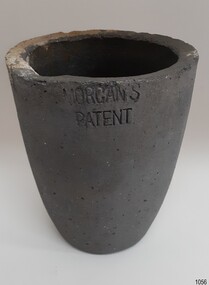
... board, only two survived: the apprentice, Tom Pearce and the young woman passenger, Eva Carmichael, who lost her family in the tragedy. The shipwreck of the LOCH ARD is of State significance ― Victorian Heritage Register S417. Flagstaff Hill’s collection of artefacts from LOCH ARD is significant for being one of the largest collections of artefacts from this shipwreck in Victoria. It is significant for its association with the shipwreck, which is on the Victorian Heritage Register (VHR S417). The collection is significant because of the relationship between the objects, as together they have a high potential to interpret the story ...This crucible was raised from the wreck of the LOCH ARD. It is one of six similar relics, in a range of sizes, now in the Flagstaff Hill collection. All bear markings to indicate their manufacture by the Morgan brothers of Battersea, trading as the Patent Plumbago Crucible Co. A crucible is a container used for purifying and melting metals so that they can be cast in a mould to a predetermined shape and use. They must withstand extremely high temperatures, and abrupt cooling, and shed their contents with minimal adherence. The addition of graphite to the traditional firing clays greatly enhanced the durability of industrial crucibles in mid-Victorian Britain, a significant technological advance at a time of great activity in foundries and expansion of demand for refined metals. The Morgans first noticed the advantages of graphite crucibles at the Great Exhibition held in London in 1851. Initially, they contracted to be sole selling agents for the American-made products of Joseph Dixon and Co. from New Jersey, but in 1856 they obtained that firm’s manufacturing rights and began producing their own graphite crucibles from the South London site. The Morgans imported crystalline graphite in 4-5 cwt casks from the British colony of Ceylon (now Sri Lanka) and mixed it with conventional English (Stourbridge) clays to be fired in kilns. Their products were purchased by the Royal Mints in London and India, and exported to official mints in France and Germany. They were successful exhibitors of their crucibles and furnaces at the London Exhibition held in 1861 (Class 1, Mining, quarrying, metallurgy and mineral products, Exhibit 265, Patent Plumbago Crucible Co). The range of sizes represented by the six crucibles retrieved from the LOCH ARD, suggests they may have been part of a sample shipment intended for similar promotion in the Australian colonies ― at Melbourne’s International Exhibition to be held in 1880. The summary of the LOCH ARD cargo manifest, by Don Charlwood in ‘Wrecks and Reputations’, does not mention any crucibles, implying that they were not a large consignment of uniform items. A newspaper account of an 1864 tour of the Morgan brothers’ ‘Black Potteries’ at Battersea indicates: “All the pots were numbered according to their contents, each number standing for one kilogram, or a little over two pounds; a No. 2 crucible contains two kilogrammes; a No. 3, three kilogrammes, and so on.” These numbers are obscured by marine sediment on three of the crucibles in the Flagstaff Hill collection, but those legible on the remaining three are 5, 6, and 8. None of the six is of the same size from a visual appraisal. A brief history of the Loch Ard (1873-1878): - The sailing ship Loch Ard was one of the famous Loch Line of ships that sailed the long voyage from England to Australia. Barclay, Curdle and Co. built the three-masted iron vessel in Glasgow in 1873. It had sailed three trips to Australia and one trip to Calcutta before its fateful voyage. Loch Ard left England on March 2, 1878, under the command of recently married, 29-year-old Captain Gibbs. It was bound for Melbourne with a crew of 37, plus 17 passengers. The general cargo reflected the affluence of Melbourne at the time. Onboard were straw hats, umbrellas, perfumes, clay pipes, pianos, clocks, confectionery, linen and candles, and a heavier load of railway irons, cement, lead and copper. Other cargo included items intended for display in the Melbourne International Exhibition of 1880. The Loch Ard had been sailing for three months and was close to its destination on June 1, 1878. Captain Gibbs had expected to see land at about 3 am but the Loch Ard ran into a fog that greatly reduced visibility and there was no sign of land or the Cape Otway lighthouse. The fog lifted at 4 am and the sheer cliffs of Victoria's west coast were much closer to them than Captain Gibbs expected. He tried to manage the vessel but failed and the ship struck a reef at the base of Mutton Bird Island, near Port Campbell. The top deck loosened from the hull, and the masts and rigging crashed down, knocking passengers and crew overboard. The lifeboat was launched by Tom Pearce but crashed into the side of Loch Ard and capsized. He clung onto its overturned hull and sheltered under it. He drifted out to sea and the tide brought him back to what is now called Loch Ard Gorge. He swam to shore and found a cave for shelter. A passenger, Eva Carmichael, had raced onto the deck to find out what was happening and was confronted by towering cliffs above the ship. She was soon swept off the ship by a huge wave. Eva saw Tom Pearce on a small rocky beach and yelled to attract his attention. He swam out and dragged her to the shelter of the cave. He revived her with a bottle of brandy from a case that had washed up on the beach. Tom scaled a cliff in search of help and followed some horse hoof prints. He came from two men from Glenample Station, three and a half miles away. He told the men of the tragedy and then returned to the gorge while the two men rode back to the station to get help. They reached Loch Ard Gorge and took the two shipwreck survivors to Glenample Station to recover. Eva stayed at the station for six weeks before returning to Ireland by steamship. In Melbourne, Tom Pearce received a hero's welcome and was presented with a medal and some money. Of the 54 crew members and passengers on board, only two survived: the apprentice, Tom Pearce and the young woman passenger, Eva Carmichael, who lost her family in the tragedy. The shipwreck of the LOCH ARD is of State significance ― Victorian Heritage Register S417. Flagstaff Hill’s collection of artefacts from LOCH ARD is significant for being one of the largest collections of artefacts from this shipwreck in Victoria. It is significant for its association with the shipwreck, which is on the Victorian Heritage Register (VHR S417). The collection is significant because of the relationship between the objects, as together they have a high potential to interpret the story of the LOCH ARD. The LOCH ARD collection is archaeologically significant as the remains of a large international passenger and cargo ship. The LOCH ARD collection is historically significant for representing aspects of Victoria’s shipping history and its potential to interpret sub-theme 1.5 of Victoria’s Framework of Historical Themes (living with natural processes). The collection is also historically significant for its association with the LOCH ARD, which was one of the worst and best-known shipwrecks in Victoria’s history.A Morgan’s Patent graphite crucible No.8 (i.e. 8kgs capacity), one of a set. It was recovered from the wreck of the LOCH ARD. It is in its original grey colouring with minimal sediment accretion on the top rim. It rises in a slight curve from a flat circular base to a wider rim with a pouring lip. Maker’s marks on the side of the container clearly identify the manufacturer. The maker's details are stamped into the base around and within a circle. A white sticker is attached. Made by the Patent Plumbago Crucible Company at the Battersea Works in London. Number “8”. Letters “MORGAN’S PATENT”. Details on the base "MORGAN'S PATENT" "THE PATENT PLUMBAGO CRUCIBLE COMPANY" Symbol [8] above "BATTERSEA WORKS LONDON" Handwritten on a white sticker in black pen "LA/89"flagstaff hill, warrnambool, maritime museum, shipwreck coast, great ocean road, loch line, loch ard, captain gibbs, eva carmichael, tom pearce, glenample station, mutton bird island, loch ard gorge, graphite crucible, plumbago crucible, morgans crucible company, flagstaff hill maritime museum and village, fluxing pots, crucible, morgan’s patent, morgan brothers, patent plumbago crucible co, battersea works, london, port campbell -
 Flagstaff Hill Maritime Museum and Village
Book - Religious Book/Bilble, Oxford University Press, The Holy Bible, 1866
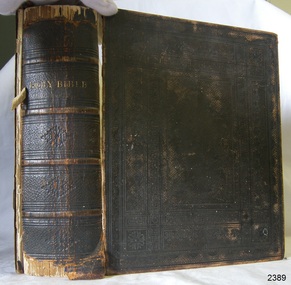
... story of Joseph Bell and Elizabeth Bell (née Mapperley), who was born in Westport St Mary, Malmesbury, England, is a classic 19th-century tale of English emigration, religious transformation, and pioneering life in Australia. Joseph Bell, the son of James and Sarah Bell of Itchington, Gloucestershire, married Elizabeth in September 1854 at St Paul’s, Bristol. Their marriage was swiftly followed by a monumental life change. Less than a month after their wedding, they packed their belongings and boarded...story of Joseph Bell and Elizabeth Bell (née Mapperley), who was born in Westport St Mary, Malmesbury, England, is a classic 19th-century tale of English emigration, religious transformation, and pioneering life in Australia. Joseph Bell, the son of James and Sarah Bell of Itchington, Gloucestershire, married Elizabeth in September 1854 at St Paul’s, Bristol. Their marriage was swiftly followed by a monumental life change. Less than a month after their wedding, they packed their belongings and boarded ...To understand the nature of your 1866 Oxford University Press (OUP) Bible, it helps to look at how Bibles were produced in the 19th century and the massive historical scale of the publisher. The context of the King James Version Bible is indicated by the standard phrase on the flyleaf: "Translated out of the Original Tongues... By His Majesty's Special Command." This work is a historical 1866 reprint of the original version published in 1611. This particular volume served as the family Bible for Joseph and Elizabeth Bell, documenting their family history through the births and deaths noted on its end papers.Book, black hard cover with embossed pattern and gold test, metal locking clasp. King James Version of the Holy Bible, containing the Old and New Testaments. It was published by Oxford University Press in 1866. Inscriptions on the loose endpaper list the marriage of Joseph and Elizabeth Bell in 1854 at St Paul's, Bristol, England, and their ten children born from 1856 to 1878.non-fictionTo understand the nature of your 1866 Oxford University Press (OUP) Bible, it helps to look at how Bibles were produced in the 19th century and the massive historical scale of the publisher. The context of the King James Version Bible is indicated by the standard phrase on the flyleaf: "Translated out of the Original Tongues... By His Majesty's Special Command." This work is a historical 1866 reprint of the original version published in 1611. This particular volume served as the family Bible for Joseph and Elizabeth Bell, documenting their family history through the births and deaths noted on its end papers.flagstaff hill, flagstaff hill maritime museum and village, warrnambool, maritime museum, maritime village, great ocean road, shipwreck coast, holy bible, book, religious book, bell family, bell family bible, elizabeth bell, joseph bell, 1826, 1833, 1854, st paul's bristol -
![Ceramic doll]s leg, cream and beige, with shape of shoe on the end](/media/collectors/4f729f6597f83e03086016ea/items/521602bb19403a17c4b9fa5a/item-media/52a7cc472162ef1d94e8449b/item-fit-380x285.jpg?cb=6) Flagstaff Hill Maritime Museum and Village
Flagstaff Hill Maritime Museum and VillageLeisure object - Doll's Leg, ca 1878/
... board, only two survived: the apprentice, Tom Pearce and the young woman passenger, Eva Carmichael, who lost her family in the tragedy. Flagstaff Hill’s collection of artefacts from LOCH ARD is significant for being one of the largest collections of artefacts from this shipwreck in Victoria. It is significant for its association with the shipwreck, which is on the Victorian Heritage Register (VHR S417). The collection is significant because of the relationship between the objects, as together they have a high potential to interpret the story ...This is part of a child's toy, a doll with ceramic legs. It was recovered from the wreck of the Loch Ard. A brief history of the Loch Ard (1873-1878): - The sailing ship Loch Ard was one of the famous Loch Line ships that sailed from England to Australia. Barclay, Curdle and Co. built the three-masted iron vessel in Glasgow in 1873. It had sailed three trips to Australia and one trip to Calcutta before its fateful voyage. Loch Ard left England on March 2, 1878, under the command of recently married, 29-year-old Captain Gibbs. It was bound for Melbourne with a crew of 37, plus 17 passengers. The general cargo reflected the affluence of Melbourne at the time. Onboard were straw hats, umbrellas, perfumes, clay pipes, pianos, clocks, confectionery, linen and candles, and a heavier load of railway irons, cement, lead and copper. Other cargo included items intended for display in the Melbourne International Exhibition of 1880. The Loch Ard had been sailing for three months and was close to its destination on June 1, 1878. Captain Gibbs had expected to see land at about 3 am but the Loch Ard ran into a fog that greatly reduced visibility and there was no sign of land or the Cape Otway lighthouse. The fog lifted at 4 am and the sheer cliffs of Victoria's west coast were much closer to them than Captain Gibbs expected. He tried to manage the vessel but failed and the ship struck a reef at the base of Mutton Bird Island, near Port Campbell. The top deck loosened from the hull, and the masts and rigging crashed down, knocking passengers and crew overboard. The lifeboat was launched by Tom Pearce but crashed into the side of Loch Ard and capsized. He clung onto its overturned hull and sheltered under it. He drifted out to sea and the tide brought him back to what is now called Loch Ard Gorge. He swam to shore and found a cave for shelter. A passenger, Eva Carmichael, had raced onto the deck to find out what was happening and was confronted by towering cliffs above the ship. She was soon swept off the ship by a huge wave. Eva saw Tom Pearce on a small rocky beach and yelled to attract his attention. He swam out and dragged her to the shelter of the cave. He revived her with a bottle of brandy from a case that had washed up on the beach. Tom scaled a cliff in search of help and followed some horse hoof prints. He came from two men from Glenample Station, three and a half miles away. He told the men of the tragedy and then returned to the gorge while the two men rode back to the station to get help. They reached Loch Ard Gorge and took the two shipwreck survivors to Glenample Station to recover. Eva stayed at the station for six weeks before returning to Ireland by steamship. In Melbourne, Tom Pearce received a hero's welcome and was presented with a medal and some money. Of the 54 crew members and passengers on board, only two survived: the apprentice, Tom Pearce and the young woman passenger, Eva Carmichael, who lost her family in the tragedy. Flagstaff Hill’s collection of artefacts from LOCH ARD is significant for being one of the largest collections of artefacts from this shipwreck in Victoria. It is significant for its association with the shipwreck, which is on the Victorian Heritage Register (VHR S417). The collection is significant because of the relationship between the objects, as together they have a high potential to interpret the story of the LOCH ARD. The LOCH ARD collection is archaeologically significant as the remains of a large international passenger and cargo ship. The LOCH ARD collection is historically significant for representing aspects of Victoria’s shipping history and its potential to interpret sub-theme 1.5 of Victoria’s Framework of Historical Themes (living with natural processes). The collection is also historically significant for its association with the LOCH ARD, which was one of the worst and best known shipwrecks in Victoria’s history. China doll's leg, cream and beige ceramic, foot shaped at the end of the leg. Recovered from the wreck of the Loch Ard. flagstaff hill, warrnambool, shipwrecked coast, flagstaff hill maritime museum, maritime museum, shipwreck coast, flagstaff hill maritime village, great ocean road, loch line, loch ard, captain gibbs, eva carmichael, tom pearce, glenample station, mutton bird island, loch ard gorge, china dolls leg, doll's leg, china doll's leg, doll's limb, ceramic doll
