
Showing 251 items matching "street fair"
-
 Buninyong & District Historical Society
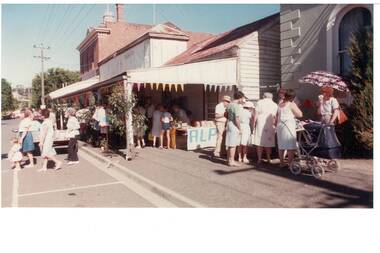
Photograph - Colour photograph of Gold King Festival 1985, de Soza park, street fair, Gold King Festival 1985, de Soza park, street fair
... Colour photograph of Gold King Festival 1985, de Soza park, street fair...Gold King Festival 1985, de Soza park, street fair......street fair...Colour photograph Gold King Festival 1985, de Soza park, street fair, south side Learmonth, National Bank, old Adams Store, butchers shop visible, stands in front of buildings on the right. ...Gold King Festival 1985, de Soza park, street fair Photograph Colour photograph of Gold King Festival 1985, de Soza park, street fair ...One of a series of photographs taken of the Buninyong Gold King Festival 1985Colour photograph Gold King Festival 1985, de Soza park, street fair, south side Learmonth, National Bank, old Adams Store, butchers shop visible, stands in front of buildings on the right. buninyong, gold king festival, festival events, street fair, learmonth st., national bank building, adams store, whykes butcher shop -
 Allan Doney Collection, Bendigo Historical Society Inc.
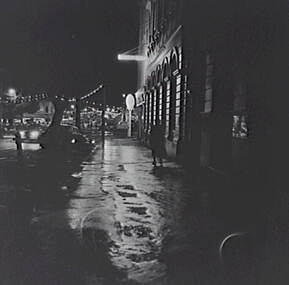
Negative - Bendigo Easter Fair 1956 - Street Bendigo - Night, Allan Doney, 1950 -1970
... Bendigo Easter Fair 1956 - Street Bendigo - Night...Negative Bendigo Easter Fair 1956 - Street Bendigo - Night Allan Doney ...In the years of Allan Doney’s photography, landmark buildings succumbed to fire, neglect and redevelopment. He photographed the grey sand hills from Bendigo’s mining past, the streetscapes, poppet heads, miners’ cottages, gracious homes with ornate verandahs, trams and much more. Above all, his photographs show how much of the city has survived from the 19th century – and how much has not. Through two decades of great change, Allan Doney was there to capture ways people interacted with it. Although he travelled to many other places in Northern Victoria and beyond in search of subjects for his art, he seemed to always return to Bendigo for inspiration. -
 Allan Doney Collection, Bendigo Historical Society Inc.
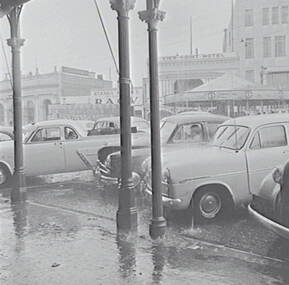
Negative - Bendigo Easter Fair 1956 - Street Bendigo - Rain, Allan Doney, 1950 -1970
... Bendigo Easter Fair 1956 - Street Bendigo - Rain...Negative Bendigo Easter Fair 1956 - Street Bendigo - Rain Allan Doney ...In the years of Allan Doney’s photography, landmark buildings succumbed to fire, neglect and redevelopment. He photographed the grey sand hills from Bendigo’s mining past, the streetscapes, poppet heads, miners’ cottages, gracious homes with ornate verandahs, trams and much more. Above all, his photographs show how much of the city has survived from the 19th century – and how much has not. Through two decades of great change, Allan Doney was there to capture ways people interacted with it. Although he travelled to many other places in Northern Victoria and beyond in search of subjects for his art, he seemed to always return to Bendigo for inspiration. -
 Bendigo Historical Society Inc.
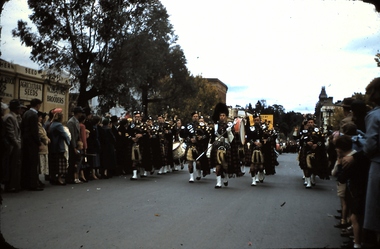
Slide - FLEMING COLLECTION: 1950S BENDIGO SLIDE, 1957
... Bendigo Easter Fair 22/4/1957. Bagpipe Band Myer Street Bendigo Easter Fair Procession...Bendigo Easter Fair 22/4/1957. Bagpipe Band marching along Myer Street, Bendigo, in the Easter Fair Procession....EVENT Easter fair bendigo easter fair Bendigo Easter Fair 22/4/1957. Bagpipe Band Myer Street Bendigo Easter Fair Procession Kodak Bendigo 1950s. ...Bendigo 1950s. Bendigo Easter Fair 22/4/1957. Bagpipe Band marching along Myer Street, Bendigo, in the Easter Fair Procession.Kodakevent, easter fair, bendigo easter fair, bendigo easter fair 22/4/1957. bagpipe band myer street bendigo easter fair procession -
 Wodonga & District Historical Society Inc
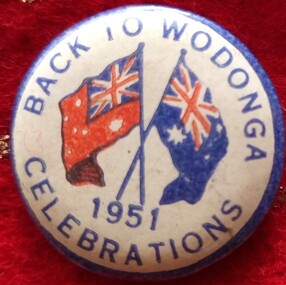
Badge - Back to Wodonga Celebrations 1951
... Thursday: All-day Street Fair and Carnival. Friday: Back to School (Higher Elementary School), Wodonga Hospital Ball. ...Thursday: All-day Street Fair and Carnival. Friday: Back to School (Higher Elementary School), Wodonga Hospital Ball. ...1951 was a year of celebration in Victoria. 9th May 1951 marked the 50th anniversary of the opening of the Australian Federal Parliament in 1901, which at that time met in Melbourne, Victoria. 13th November marked the Centenary of the opening of the first Victorian Parliament. Cities and towns held activities and celebrations to recognise the occasion. A "Back to Wodonga" was held from Friday 9th to Saturday 7th November 1951. Friday: Children’s Sport and Children’s Concert. Saturday: Welcome to Visitors, Official Luncheon, Gymkhana, Official Opening and Barbecue. Sunday: Church services, various denominations. Monday: Ladies’ Day (Bowls, Tennis, Croquet etc.) Afternoon Garden Parties, Boxing Tournament. Tuesday: Procession, Basket Lunch, Apex Sports Carnival, 50-50 Dance. Wednesday: Tour of district and visit to factories. Re-unions of various organisations. Thursday: All-day Street Fair and Carnival. Friday: Back to School (Higher Elementary School), Wodonga Hospital Ball. Saturday: Bonegilla Race Club meeting, Competition Sports, (Cricket, Bowls, Tennis, etc.) Farewell Parties by various organisations.This Badge is significant because it is a memento of an important community celebration in Wodonga.A small enamel badge featuring both the blue and red Australian ensigns in the centre on a white background surrounded by blue text.Around the edge; BACK TO WODONGA CELEBRATIONS 1951back to wodonga 1951, opening victorian parliament, australian federal parliament opening -
 Bendigo Historical Society Inc.
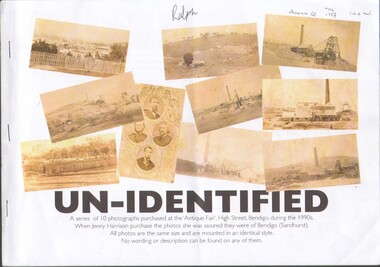
Booklet - Bendigo photographs
... A4 booklet - of a series of ten sepia photographs purchased at the "Antiques Fair" High Street Bendigo during the 1990s. Seven double sided printed pages, stapled on short LH side....Photographs Sandhurst A4 booklet - of a series of ten sepia photographs purchased at the "Antiques Fair" High Street Bendigo during the 1990s. Seven double sided printed pages, stapled on short LH side. ...A4 booklet - of a series of ten sepia photographs purchased at the "Antiques Fair" High Street Bendigo during the 1990s. Seven double sided printed pages, stapled on short LH side.photographs, sandhurst -
 Bendigo Historical Society Inc.
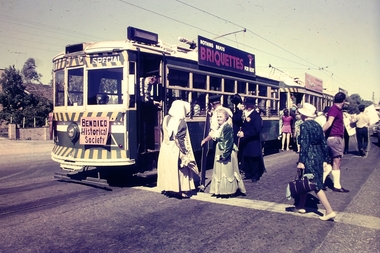
Slide - Eaglehawk Dahlia and Arts Festival, About 1970s
... These include: Street Procession, Gala Fair, Art Exhibition, Flower Show, Folk Art, Literary Competition, Heritage displays, Sunday family Day to name a few....These include: Street Procession, Gala Fair, Art Exhibition, Flower Show, Folk Art, Literary Competition, Heritage displays, Sunday family Day to name a few. history bendigo Eaglehawk Dahlia and Arts Festival processions parades highland bands bendigo historical society eaglehawk gardens eaglehawk Eaglehawk Dahlia and Arts Festival This item contain 21 colour slides: 4403.1a Eaglehawk Dahlia and Arts Procession - Steam Engine 4403.1b Eaglehawk Dahlia and Arts Procession - Mens Highland Band 4403.1c Eaglehawk Dahlia and Arts Procession - Old Cars 4403.1d Eaglehawk Dahlia and Arts Procession - Ladies Highland Band 4403.1e Eaglehawk Dahlia and Arts Procession - Wedderburn Eucalyptus Float 4403.1f Eaglehawk Dahlia and Arts Procession - Tram crossing Victoria Street 4403.1g Eaglehawk Dahlia and Arts Procession - Horse and Donkey Vehicles 4403.1h Eaglehawk Dahlia and Arts Procession - Float 4403.1i Eaglehawk Dahlia and Arts Procession - Brass Band 4403.1j Eaglehawk Dahlia and Arts Procession - VIP's 4403.1k Eaglehawk Dahlia and Arts Procession - Highland Band 4403.1l Eaglehawk Dahlia and Arts Procession - Bendigo Historical Society boarding their tram 4403.1m Eaglehawk Dahlia and Arts Procession - Walkers and Tram 4403.1n Eaglehawk Dahlia and Arts Procession - Public Gardens 4403.1o Eaglehawk Dahlia and Arts Procession - Public Gardens 4403.1p Eaglehawk Dahlia and Arts Procession - Public Gardens 4403.1q Eaglehawk Dahlia and Arts Procession - Public Gardens 4403.1r Eaglehawk Dahlia and Arts Procession - Public Gardens 4403.1s Eaglehawk Dahlia and Arts Procession - Tram on the way 4403.1t Eaglehawk Dahlia and Arts Procession - Eaglehawk Traders' tram 4403.1u Eaglehawk Dahlia and Arts Procession - Tram and assistant getting ready Slide Eaglehawk Dahlia and Arts Festival ...The Eaglehawk community enjoys a successful annual festival comprising of numerous separate activities to enjoy over a 5 day period. These include: Street Procession, Gala Fair, Art Exhibition, Flower Show, Folk Art, Literary Competition, Heritage displays, Sunday family Day to name a few.Eaglehawk Dahlia and Arts Festival This item contain 21 colour slides: 4403.1a Eaglehawk Dahlia and Arts Procession - Steam Engine 4403.1b Eaglehawk Dahlia and Arts Procession - Mens Highland Band 4403.1c Eaglehawk Dahlia and Arts Procession - Old Cars 4403.1d Eaglehawk Dahlia and Arts Procession - Ladies Highland Band 4403.1e Eaglehawk Dahlia and Arts Procession - Wedderburn Eucalyptus Float 4403.1f Eaglehawk Dahlia and Arts Procession - Tram crossing Victoria Street 4403.1g Eaglehawk Dahlia and Arts Procession - Horse and Donkey Vehicles 4403.1h Eaglehawk Dahlia and Arts Procession - Float 4403.1i Eaglehawk Dahlia and Arts Procession - Brass Band 4403.1j Eaglehawk Dahlia and Arts Procession - VIP's 4403.1k Eaglehawk Dahlia and Arts Procession - Highland Band 4403.1l Eaglehawk Dahlia and Arts Procession - Bendigo Historical Society boarding their tram 4403.1m Eaglehawk Dahlia and Arts Procession - Walkers and Tram 4403.1n Eaglehawk Dahlia and Arts Procession - Public Gardens 4403.1o Eaglehawk Dahlia and Arts Procession - Public Gardens 4403.1p Eaglehawk Dahlia and Arts Procession - Public Gardens 4403.1q Eaglehawk Dahlia and Arts Procession - Public Gardens 4403.1r Eaglehawk Dahlia and Arts Procession - Public Gardens 4403.1s Eaglehawk Dahlia and Arts Procession - Tram on the way 4403.1t Eaglehawk Dahlia and Arts Procession - Eaglehawk Traders' tram 4403.1u Eaglehawk Dahlia and Arts Procession - Tram and assistant getting readyhistory, bendigo, eaglehawk dahlia and arts festival, processions, parades, highland bands, bendigo historical society, eaglehawk gardens, eaglehawk -
 Bendigo Historical Society Inc.
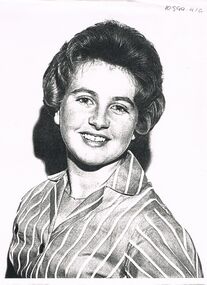
Photograph - BENDIGO EASTER FAIR COLLECTION: MARLENE HAZELDENE 1962
... On rear of sheet, photocopy of photo of Marlene Hazeldene, holding lucky ticket sheets and wearing Bendigo Easter Fair Mitchell Street, Popular girl sash....On rear of sheet, photocopy of photo of Marlene Hazeldene, holding lucky ticket sheets and wearing Bendigo Easter Fair Mitchell Street, Popular girl sash. Photograph BENDIGO EASTER FAIR COLLECTION: MARLENE HAZELDENE 1962 ...Photocopy of photograph: 1962 Marlene Hazeldene ?? written in pencil on bottom of photocopy. On rear of sheet, photocopy of photo of Marlene Hazeldene, holding lucky ticket sheets and wearing Bendigo Easter Fair Mitchell Street, Popular girl sash.bendigo, bendigo easter fair, marlene hazeldene 1962 -
 Bendigo Historical Society Inc.
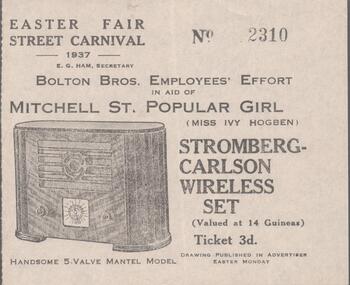
Ephemera - BENDIGO EASTER FAIR COLLECTION: RAFFLE TICKETS FROM 1937
... Five raffle tickets for the Easter Fair Street Carnival 1937. Bolton Bros. Employees' Effort in aid of Mitchell St. popular girl (Miss Ivy Hogben). ...EVENT Easter fair bendigo easter fair Five raffle tickets for the Easter Fair Street Carnival 1937. Bolton Bros. Employees' Effort in aid of Mitchell St. popular girl (Miss Ivy Hogben). ...Five raffle tickets for the Easter Fair Street Carnival 1937. Bolton Bros. Employees' Effort in aid of Mitchell St. popular girl (Miss Ivy Hogben). Stromberg-Carlson wireless set valued at 14 guineas. Ticket 3d. A drawinf of the wirelss set on the ticket. Tickets Numbers: 2310, 2313, 2318, 2324, 2325.event, easter fair, bendigo easter fair -
 City of Moorabbin Historical Society (Operating the Box Cottage Museum)
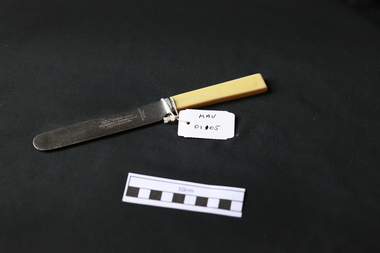
Kitchen Equipment, cutlery butter knife, c1930
... Smith Street Collingwood Summer Fair Bargains Thornhill. Bednal, and Co.' ...Smith Street Collingwood Summer Fair Bargains Thornhill. Bednal, and Co.' ...WALTER THORNHILL SP London The firm established in 1734 by Joseph Gibbs changed its style in early 19th century to Morley & Thornhill. The firm changed to Thornhill & Co (1820), Walter Thornhill (1850), Walter Thornhill & Co (1875) Walter Thornhill & Co Ltd (1895) and Walter Thornhill & Co (1905). Advertisement in The Argus, Saturday January 22 1921 FOY & GIBSON'S Pty Ltd. Smith Street Collingwood Summer Fair Bargains Thornhill. Bednal, and Co.' Ivoride Handle TABLE KNIVES, stainless steel blades, 35/- per ½ dozen. Per TROVE A butter knife with stainless steel blade and bone handle on blade ; TRADE 'ORIS' MARK / THORNHILL, BEDNAL & CO. / SHEFFIELD ENG. / STAINLESS STEELbutter knife, sheffield england, cheltenham, moorabbin, bentleigh, early settlers, pioneers, cutlery, stainless stell, thornhill bednal & co -
 Ballarat Clarendon College
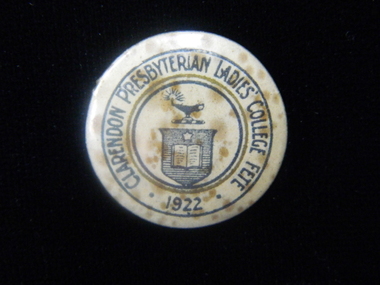
Badge, Clarendon Presbyterian Ladies College Fete 1922 badge
... According to the school history 'The lamp burns brightly' a special committee of the school ouncil were appointed to organise a great fete in August 1922 to raise money towards the purchase of new property in Webster/Mair Streets. "The Oriental Fair transformed the Ballarat City Hall for three consecutive days. ...According to the school history 'The lamp burns brightly' a special committee of the school ouncil were appointed to organise a great fete in August 1922 to raise money towards the purchase of new property in Webster/Mair Streets. "The Oriental Fair transformed the Ballarat City Hall for three consecutive days. ...Badge made to promote fete held at Clarendon Presbyterian Ladies College in 1922. According to the school history 'The lamp burns brightly' a special committee of the school ouncil were appointed to organise a great fete in August 1922 to raise money towards the purchase of new property in Webster/Mair Streets. "The Oriental Fair transformed the Ballarat City Hall for three consecutive days. Stalls of many types were heavily laded, and, as one reveller commented, 'The perpetual motion of the fairty floss machine, producing its quaint confection, was an object of interest and wonderment to many, and the crack of the pea rifle in the adjoining shooting gallery almost dispersed the feathery flakes of fairy floss as they issued from the magic machine'. An arochestra provided continuous music, varied at times by vocal solos, eurythmic displays and other enterainments. the fair raised the remarkable sum of 1,576 pounds." (TLBB p. 20) Unique itemRound plastic coated badge on metal backing and pin across back. School crest stamped on centre front with lettering encircling crestFront: CLARENDON PRESBYTERIAN LADIES COLLEGE FETE 1922clarendon-presbyterian-ladies-college, fete, 1922, fairy floss, mair-street-campus -
 Bendigo Historical Society Inc.
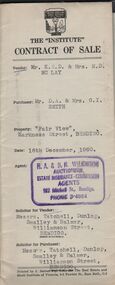
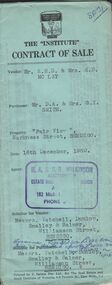
Document - H. A. & S. R. WILKINSON COLLECTION: CONTRACT OF SALE
... Tatchell, Dunlop, Smalley & Balmer, Williamson Street, Bendigo. Property: "Fair View" Harkness Street, Bendigo being part of Crown allotment 15 section 108C being the balance of land now comprised in certificate of title volume 7383 folio 509 together with all floor coverings, blinds, curtains and electric light fittings and shades as inspected. ...Tatchell, Dunlop, Smalley & Balmer, Williamson Street, Bendigo. Property: "Fair View" Harkness Street, Bendigo being part of Crown allotment 15 section 108C being the balance of land now comprised in certificate of title volume 7383 folio 509 together with all floor coverings, blinds, curtains and electric light fittings and shades as inspected. ...Contract of sale dated 16th December, 1960 between Mr. K. E. D. & Mrs. E. D. Mc Lay (vendor) and Mr. D. A. & Mrs. G. I. Smith (purchaser). Solicitor for vendor: Messrs. Tatchell, Dunlop, Smalley & Balmer, Williamson Street, Bendigo. Solicitor for purchaser: Messrs. Tatchell, Dunlop, Smalley & Balmer. Solicitor for purchaser: Messrs. Tatchell, Dunlop, Smalley & Balmer, Williamson Street, Bendigo. Property: "Fair View" Harkness Street, Bendigo being part of Crown allotment 15 section 108C being the balance of land now comprised in certificate of title volume 7383 folio 509 together with all floor coverings, blinds, curtains and electric light fittings and shades as inspected. Price 2,600 pounds.organization, business, h.a. & s.r wilkinson real estate -
 Bendigo Historical Society Inc.
Document - H.A & S. R. WILKINSON COLLECTION: CONTRACT OF SALE
... Tatchell, Dunlop, Smalley & Balmer, Williamson Street, Bendigo. Property: "Fair View" Harkness Street, Bendigo being part of Crown allotment 15 section 108C being the balance of land now comprised in certificate of title volume 7383 folio 509 together with all floor coverings, blinds, curtains and electric light fittings and shades as inspected. ...Tatchell, Dunlop, Smalley & Balmer, Williamson Street, Bendigo. Property: "Fair View" Harkness Street, Bendigo being part of Crown allotment 15 section 108C being the balance of land now comprised in certificate of title volume 7383 folio 509 together with all floor coverings, blinds, curtains and electric light fittings and shades as inspected. ...Contract of sale dated 16th December, 1960 between Mr. K. E. D. & Mrs. E. D. Mc Lay (vendor) and Mr. D. A. & Mrs. G. I. Smith (purchaser). Solicitor for vendor: Messrs. Tatchell, Dunlop, Smalley & Balmer, Williamson Street, Bendigo. Solicitor for purchaser: Messrs. Tatchell, Dunlop, Smalley & Balmer. Solicitor for purchaser: Messrs. Tatchell, Dunlop, Smalley & Balmer, Williamson Street, Bendigo. Property: "Fair View" Harkness Street, Bendigo being part of Crown allotment 15 section 108C being the balance of land now comprised in certificate of title volume 7383 folio 509 together with all floor coverings, blinds, curtains and electric light fittings and shades as inspected. Price 2,600 pounds.organization, business, h.a. & s.r wilkinson real estate -
 Bendigo Historical Society Inc.
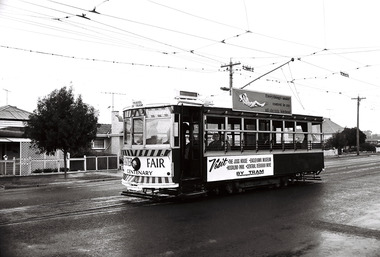
Photograph - Robert Green Collection - Photos of Bendigo Tramways - Sheet 5 of 8, 1960s
... Photos: 11147.5a Birney car decked out in advertising for the Bendigo Easter Fair 11147.5b Birney car decked out in advertising for the Bendigo Easter Fair heading to North Bendigo in Mcrae St 11147.5c Birney car decked out in advertising for the Bendigo Easter Fair heading to North Bendigo in Mcrae St passing No 17 and another tram approaching from the depot 11147.5d Birney car decked out in advertising for the Bendigo Easter Fair heading into the depot in Tramway Avenue 11147.5e No 18 and old shop front 11147.5f Tram Turning into Tramways Avenue from Mcrae St 11147.5g Three trams at the Golden Square Terminus in High Street 11147.5h No 18 tram in Mcrae Street passing by Tramways Avenue to North Bendigo 11147.5i No 21 returning to the Tramways Avenue Depot off Mcrae Street 11147.5j No 21 returning to the Tramways Avenue Depot off Mcrae Street 11147.5k No 21 returning to the Tramways Avenue Depot crossing the Back Creek 11147.5l No 21 returning to the Tramways Avenue Depot 11147.5m No 21 returning to the Tramways Avenue Depot with the scrubber tram on the left 11147.5n No 21 in the Tramways Avenue Depot 11147.5o Nos 18 and 17 pass at the Golden Square Terminus in High St 11147.5p No 17 on its way to the North Bendigo Terminus 11147.5q No 17 turns from the North Bendigo Terminus into Finn Street 11147.5r No 17 heading to the North Bendigo Terminus along Thunder Street 11147.5s No 17 at the North Bendigo Terminus off Finn Street 11147.5t Train heading from the Swan Hill direction to Bendigo off the Finn Street crossing 11147.5u No 25 heading to Golden Square 11147.5v No 25 turns from Weeroona Avenue into Caledonia Street 11147.5w The Easter Fair, intersection of Pall Mall and Williamson St with Myer Stores in the background...Photos: 11147.5a Birney car decked out in advertising for the Bendigo Easter Fair 11147.5b Birney car decked out in advertising for the Bendigo Easter Fair heading to North Bendigo in Mcrae St 11147.5c Birney car decked out in advertising for the Bendigo Easter Fair heading to North Bendigo in Mcrae St passing No 17 and another tram approaching from the depot 11147.5d Birney car decked out in advertising for the Bendigo Easter Fair heading into the depot in Tramway Avenue 11147.5e No 18 and old shop front 11147.5f Tram Turning into Tramways Avenue from Mcrae St 11147.5g Three trams at the Golden Square Terminus in High Street 11147.5h No 18 tram in Mcrae Street passing by Tramways Avenue to North Bendigo 11147.5i No 21 returning to the Tramways Avenue Depot off Mcrae Street 11147.5j No 21 returning to the Tramways Avenue Depot off Mcrae Street 11147.5k No 21 returning to the Tramways Avenue Depot crossing the Back Creek 11147.5l No 21 returning to the Tramways Avenue Depot 11147.5m No 21 returning to the Tramways Avenue Depot with the scrubber tram on the left 11147.5n No 21 in the Tramways Avenue Depot 11147.5o Nos 18 and 17 pass at the Golden Square Terminus in High St 11147.5p No 17 on its way to the North Bendigo Terminus 11147.5q No 17 turns from the North Bendigo Terminus into Finn Street 11147.5r No 17 heading to the North Bendigo Terminus along Thunder Street 11147.5s No 17 at the North Bendigo Terminus off Finn Street 11147.5t Train heading from the Swan Hill direction to Bendigo off the Finn Street crossing 11147.5u No 25 heading to Golden Square 11147.5v No 25 turns from Weeroona Avenue into Caledonia Street 11147.5w The Easter Fair, intersection of Pall Mall and Williamson St with Myer Stores in the background Photograph Robert Green Collection - Photos of Bendigo Tramways - Sheet 5 of 8 ...This collection contains eight archive sheets (Sheet 1 to Sheet 8) of strips of original 35mm black and white negatives of photographs taken during the 1960s and early 1970s by Robert Green, of the Bendigo State Electricty Commission of Victoria Tramways prior to their abandonment The collection also includes two archive quality sheets (Sheet A and Sheet B) of original 35mm colour slides taken by Robert Green during the same period. Sheet B also contains one slide taken by Robert's friend Keigh S King (1928-2019) who was the author of the book 'The Bendigo Tramways an illustrated history, published by the Australian Railway Historical Society Victorian Division Melbourne in February 1972; BHS Item no. 5052. The collection also includes one USB stick which contains images of all photographs described above, except for one colour slide taken by Keith S Kings. Sixteen black and white prints from the images are also included.Robert Green Collection, this item contains 23 Black and White Negatives of the trams at various locations around Bendigo. Photos: 11147.5a Birney car decked out in advertising for the Bendigo Easter Fair 11147.5b Birney car decked out in advertising for the Bendigo Easter Fair heading to North Bendigo in Mcrae St 11147.5c Birney car decked out in advertising for the Bendigo Easter Fair heading to North Bendigo in Mcrae St passing No 17 and another tram approaching from the depot 11147.5d Birney car decked out in advertising for the Bendigo Easter Fair heading into the depot in Tramway Avenue 11147.5e No 18 and old shop front 11147.5f Tram Turning into Tramways Avenue from Mcrae St 11147.5g Three trams at the Golden Square Terminus in High Street 11147.5h No 18 tram in Mcrae Street passing by Tramways Avenue to North Bendigo 11147.5i No 21 returning to the Tramways Avenue Depot off Mcrae Street 11147.5j No 21 returning to the Tramways Avenue Depot off Mcrae Street 11147.5k No 21 returning to the Tramways Avenue Depot crossing the Back Creek 11147.5l No 21 returning to the Tramways Avenue Depot 11147.5m No 21 returning to the Tramways Avenue Depot with the scrubber tram on the left 11147.5n No 21 in the Tramways Avenue Depot 11147.5o Nos 18 and 17 pass at the Golden Square Terminus in High St 11147.5p No 17 on its way to the North Bendigo Terminus 11147.5q No 17 turns from the North Bendigo Terminus into Finn Street 11147.5r No 17 heading to the North Bendigo Terminus along Thunder Street 11147.5s No 17 at the North Bendigo Terminus off Finn Street 11147.5t Train heading from the Swan Hill direction to Bendigo off the Finn Street crossing 11147.5u No 25 heading to Golden Square 11147.5v No 25 turns from Weeroona Avenue into Caledonia Street 11147.5w The Easter Fair, intersection of Pall Mall and Williamson St with Myer Stores in the backgroundkeith s king, bendigo, trams, robert green -
 Flagstaff Hill Maritime Museum and Village
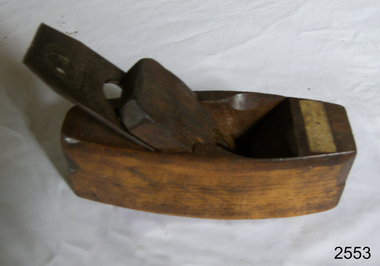
Tool - Wood Working Plane, Mathieson and Son, 1880-1900
... fairs for their goods. At the Great Exhibition, London, 1851. Prize medal for joiners' tools in the class of Cutlery & Edge Tools, Great London Exposition, 1862. Prize medal honoris causa. International Exhibition, Melbourne, 1880. Gold medal International Exhibition of Industry, Science and Art, Edinburgh, 1886. Prize medal James Haworth & Sons History: James Haworth and Sons, of Broomspring Works, Bath-street...fairs for their goods. At the Great Exhibition, London, 1851. Prize medal for joiners' tools in the class of Cutlery & Edge Tools, Great London Exposition, 1862. Prize medal honoris causa. International Exhibition, Melbourne, 1880. Gold medal International Exhibition of Industry, Science and Art, Edinburgh, 1886. Prize medal James Haworth & Sons History: James Haworth and Sons, of Broomspring Works, Bath-street ...A Mathieson & Son History: In 1792 John Manners had set up a workshop making woodworking planes at 14 Saracens Lane Glasgow. He also had employed an apprentice Alexander Mathieson (1773-1851). But in the following year at Saracen's Lane, the 1841 census describes Alexander Mathieson as a master plane-maker now at 38 Saracen Lane with his son Thomas Adam working with him as a journeyman plane-maker. Presumably, Alexander must have taken over the premises and business of John Manners. Now that the business had Thomas Adam Mathieson working with his father it gradually grew and became more diversified, and it is recorded at the time by the Post-Office Glasgow Annual Directory that by 1847-1848 Alexander Mathieson was a “plane, brace, bit, auger & edge tool maker.” In 1849 the firm of James & William Stewart at 65 Nicolson Street, Edinburgh was taken over and Thomas was put in charge of the business, trading under the name Thomas A. Mathieson & Co. as plane and edge-tool makers. Thomas's company went on to acquire the Edinburgh edge-tool makers “Charles & Hugh McPherson” and took over their premises in Gilmore Street. In the Edinburgh directory of 1856/7, the business is recorded as being Alexander Mathieson & Son, plane and edge-tool makers at 48 Nicolson Street and Paul's Work, Gilmore Street Edinburgh. The 1851 census Alexander is recorded as working as a tool and plane-maker employing eight men. Later that year Alexander died and his son Thomas took over the business. Under the heading of an edge-tool maker in the 1852/3 Post-Office Glasgow Annual Directory the firm is now listed as Alexander Mathieson & Son, with further entries as "turning-lathe and vice manufacturers". By the early 1850s, the business had moved to 24 Saracen Lane. The directory for 1857/8 records that the firm had moved again only a few years later to East Campbell Street, off the Gallowgate area, and that through further diversification was also manufacturing coopers' and tinmen's tools. The ten-yearly censuses report the firm's growth in 1861 stating that Thomas was a tool manufacturer employing 95 men and 30 boys; in 1871 he had 200 men working for him and in 1881 300 men. By 1899 the firm had been incorporated as Alexander Mathieson & Sons Ltd, even though only Alexander's son Thomas appears ever to have joined the firm so the company was still in his fathers' name. In September 1868 Thomas Mathieson put a notice in the newspapers of the Sheffield & Rotherham Independent and the Sheffield Daily Telegraph stating that his firm had used the trade-mark of a crescent and star "for some time" and that "using or imitating the Mark would be proceeded against for infringement". The firm had acquired its interest in the crescent-and-star mark from the heirs of Charles Pickslay, the Sheffield cutler who had registered it with the Cutlers' Company in 1833 and had died in 1852. The year 1868 seems also to be the one in which the name Saracen Tool Works was first adopted; not only does it figure at the foot of the notice in the Sheffield press, it also makes its first appearance in the firm's entry in the Post-Office Glasgow Annual Directory in the 1868/9 edition. As Thomas Mathieson's business grew, so too did his involvement in local public life and philanthropy. One of the representatives of the third ward on the town council of Glasgow, he became a river bailie in 1868, a magistrate in 1870 and a preceptor of Hutcheson's Hospital in 1878. He had a passion for books and was an "ardent Ruskinian". He served on the committee handling the bequest for the setting up of the Mitchell Library in Glasgow. When he died at Coulter Maynes near Biggar in 1899, he left an estate worth £142,764. Company's later years: Both Thomas's sons, James Harper and Thomas Ogilvie were involved in the continuing life of the firm. James followed in his father's footsteps in becoming a local public figure. He was appointed Deputy Lieutenant of the County of the City of Glasgow and was made a deacon of the Incorporation of the Hammermen of Glasgow in 1919. His brother Thomas Ogilvie was recorded as tool manufacturer and employer in the 1911 census. Thomas Ogilvie's son Thomas Alastair Sutherland Ogilvie Mathieson was born in 1908 took a rather different approach to engineering, however, by becoming a racing driver. In 1947 he wed the French film actress Mila Parély. The firm had won many awards at world fairs for their goods. At the Great Exhibition, London, 1851. Prize medal for joiners' tools in the class of Cutlery & Edge Tools, Great London Exposition, 1862. Prize medal honoris causa. International Exhibition, Melbourne, 1880. Gold medal International Exhibition of Industry, Science and Art, Edinburgh, 1886. Prize medal James Haworth & Sons History: James Haworth and Sons, of Broomspring Works, Bath-street Sheffield were among leading manufacturers of edge tools and joiners tools. The business was commenced in 1835, by James Haworth who was joined by his sons in 1863. Haworth manufacture light and heavy edge tools of all kinds, including a variety of joiners’ tools, hammers, skates, augers. The firm soon was extended and began exporting their products to the USA, Canada, Australia, China, and many other overseas destinations as well as to the home market. They were exhibitors at the London Exhibitions of 1851 and 1862, and Paris in 1855, receiving awards. Haworth was primarily operating from Sheffield. J Haworth & Sons produce goods of a very high class and were also engaged in the manufacture of steel, file, saw, and similar trades. Upon the death of James Haworth, the firm was managed by his four sons James, Samuel, Edwin, and John Haworth. The firm was discontinued in 1913, and its trademark was acquired by Robert Sorby and Sons in 1922.A significant tool made in the late 19th century by a known makers and sought after by collectors of vintage wood working tools.Smoothing Plane Coffin type. 2" stamped on one end and Tertius Keen & Co (plane maker.) Blade has James Haworth Warranted Cast Steel Sheffield (maker of blade only.)flagstaff hill, warrnambool, shipwrecked-coast, flagstaff-hill, flagstaff-hill-maritime-museum, maritime-museum, shipwreck-coast, flagstaff-hill-maritime-village -
 Flagstaff Hill Maritime Museum and Village
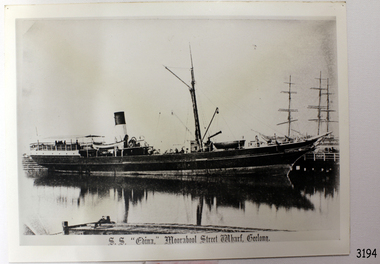
Photograph - Vessel, Steam Ship, S.S. "EDINA," Moorabool Street Wharf, Geelong, c. 1870's - 1930's
... Street. The Port of Geelong had many wool sheds alongside the wharf - wool was a major export product. ABOUT THE SS EDINA The three masted iron screw steamer SS Edina was built in Glasgow, Scotland, in 1854 by Barclay and Curle. She was adorned with the figurehead of ‘fair...Street. The Port of Geelong had many wool sheds alongside the wharf - wool was a major export product. ABOUT THE SS EDINA The three masted iron screw steamer SS Edina was built in Glasgow, Scotland, in 1854 by Barclay and Curle. She was adorned with the figurehead of ‘fair ...This black and white photograph was taken when the SS Edina was as port at the Geelong Wharf in Moorabool Street. The Port of Geelong had many wool sheds alongside the wharf - wool was a major export product. ABOUT THE SS EDINA The three masted iron screw steamer SS Edina was built in Glasgow, Scotland, in 1854 by Barclay and Curle. She was adorned with the figurehead of ‘fair maid of Judea’. The many years of service made SS Edina famous world-wide as the longest serving screw steamer. (The term screw steamer comes from being driven by a single propeller, sometimes called a screw, driven by a steam engine.) SS Edina’s interesting history includes English Chanel runs, serving in the Crimean Ware carrying ammunition, horses and stores to the Black Sea, and further service in the American Civil War and later, serving in the western district of Victoria as well as in Queensland and carried gold, currency and gold prospectors Australia to New Zealand. SS Edina had the privilege of being an escort vessel to H.R.H. the Duke of Edinburgh during his visit to Australia in 1867. In March 1863 SS Edina arrived in Port Phillip Bay, Melbourne and was bought by Stephen Henty, of Portland fame, to work the cargo and passenger run from Melbourne – Warrnambool – Port Fairy - Portland. After a short time of working the run from Australia to New Zealand, with passengers and cargo that included gold and currency, she returned to her Melbourne - Warrnambool – Port Fairy run, with cargo including bales of wool produced in the western district of Victoria. The Warrnambool Steam Packet Company purchased SS Edina in 1867; she was now commanded by Captain John Thompson and Chief Engineer John Davies. She survived several mishaps at sea, had a complete service and overhaul and several changes of commanders. In 1870 SS Edina was in Lady Bay, Warrnambool, when a gale sprung up and caused a collision with the iron screw steamer SS Dandenong. SS Edina’s figurehead was broken into pieces and it was not ever replaced. SS Edina was re-fitted in 1870 then was used as a coastal trader in Queensland for a period. She was then brought to Melbourne to carry cargo and passengers between Melbourne and Geelong and performed this service 1880-1938. During this time (1917) she was again refitted with a new mast, funnel, bridge and promenade deck, altering her appearance. In 1938, after more collisions, SS Edina was taken out of service. However she was later renamed Dinah and used as a ‘lighter’ (a vessel without engine or superstructure) to be towed and carry wool and general cargo between Melbourne and Geelong. In 1957, after 104 years, the SS Edina was broken up at Footscray, Melbourne. Remains of SS Edina’s hull can be found in the Maribyrnong River, Port Phillip Bay. This postcard of the SS Edina is significant for its association with the screw steamer SS Edina and shows her at one of her trading ports on the Melbourne - Warrnambool - Port Fairy - Portland run. The SS Edina is heritage listed on the Victorian Heritage Database VHR S199. She had endeared herself to the people of Port Phillip Bay as a passenger ferry, part of their history and culture. She played a significant role in the Crimean War, the American Civil War and the gold rush in New Zealand. She also served western Victoria for many years in her cargo and passenger runs. The SS Edina is famous for being the longest serving screw steamer in the world. After spending her first nine years overseas she arrived in Melbourne and her work included running the essential service of transporting cargo and passengers between Melbourne and the western Victoria ports of Warrnambool, Port Fairy and Portland. The SS Edina was purchased in the late 1860’s by local Warrnambool business, the Warrnambool Steam Packet Co. and continued trading from there as part of the local business community. The SS Edina’s original ‘fair maid of Judea’ figurehead was broken to pieces in a collision with another vessel (the SS Dandenong) in a gale off Warrnambool, Victoria, in 1870.Black and White photograph of S.S Edina at the Moorabool Street Wharf, Geelong in calm water that shows the reflection of the steamer. Ship has no sails raised. The funnel has a light coloured base with a dark coloured top. There are people on board the steamer. Other ship masts and people are in the background. In the foreground is a jetty with a small boat beside it and a person inside the boat. There is a title printed along the base of the photograph. c. 1870's to 1930'sPrinted at base of photograph "S.S. "EDINA," Moorabool Street Wharf, Geelong"warrnambool, shipwrecked coast, flagstaff hill, flagstaff hill maritime museum, maritime museum, shipwreck coast, flagstaff hill maritime village, shipwrecked artefact, barclay & curle, figurehead 'fair maid of judea', centenary maritime exhibition 1934, a brief review of steam navigation in victoria, pleasure steamer edina, trade and travel late 19th and early 20th century, trade melbourne to geelong, screw steamer edina, coastal trader edina, lighter dinah, cargo carrying for cremean war, cargo carrying for american civil war, passenger and trade in western district of victoria, export gold and currency and gold diggers to new zealand, export vessel to h r h the duke of edinburgh, melbourne - warrnambool - port fairy - portland cargo run, warrnambool steam packet company, stephen henty, captain john thompson, chief engineer john davies, lady bay warrnambool, lighter edina, shipping victoria, port phillip bay steamers, steamship great britain, edina, vhr s199 victorian heritage database, postcard of ss edina 1870's - 1930's -
 Flagstaff Hill Maritime Museum and Village
Wood Samples, 1891
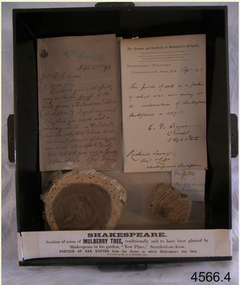
... Street, Stratford on Avon [Hand written] Sept. 22nd / 91. Mr. R. S. Harris, Dear Sir, Enclosed you will find [underlined next 3 words] every authentic proof of the Oak from Shakespeare's House (Birth place). I regret very much Sir, that you made a short-day at S. on A. I should have been delighted to have had the honour, & pleasure, of showing you around our Beautiful Country. You did not give [next 3 words underlined] me or yourself a fair...Street, Stratford on Avon [Hand written] Sept. 22nd / 91. Mr. R. S. Harris, Dear Sir, Enclosed you will find [underlined next 3 words] every authentic proof of the Oak from Shakespeare's House (Birth place). I regret very much Sir, that you made a short-day at S. on A. I should have been delighted to have had the honour, & pleasure, of showing you around our Beautiful Country. You did not give [next 3 words underlined] me or yourself a fair ...The timber display case was presented to Mr Richard Standcombe Harris of Warrnambool (1831-1923). He was a councillor (1875-1891) and predominant businessman. Mr C F Loggin had met Mr Harris while on a trip to Stratford upon Avon in the United Kingdom. Upon his return to Warrnambool, Mr Harris donated the item to the Warrnambool Museum and Art Gallery, (established 1886) where Joseph Archibald was Curator: he catalogued the case in 1894. THE LETTERS IN THE CASE The two letters contained within the display case confirm the authenticity of the oak wood sample. The first letter in the case includes the text; "[Stamped Header on banner] High Street, Stratford on Avon [Hand written] Sept. 22nd / 91. Mr. R. S. Harris, Dear Sir, Enclosed you will find [underlined next 3 words] every authentic proof of the Oak from Shakespeare's House (Birth place). I regret very much Sir, that you made a short-day at S. on A. I should have been delighted to have had the honour, & pleasure, of showing you around our Beautiful Country. You did not give [next 3 words underlined] me or yourself a fair chance. But however I hope that we may again some day have more time to go quietly around. With kind regards, and wishing you, Sir, a pleasant voyage, I remain, Dear Sir, Yours very truly, C.F. Loggin. P.S. A paper will be always acceptable to be as how you Jolly Warrnamboolites are desporting yourselves. “ The second letter includes text; “[Printed Letterhead with stamped impression] The Trustees and Guardians of Shakespeare’s Birthplace Incorporated by Act of 54 and 55, Vict. 1891 Secretary and Librarian - Richard Savage Shakespeare’s Birthplace Stratford-upon-Avon [handwritten] 22 Sept 1891 This piece of oak is a portion of what was cut away at at the restoration of Shakespeare’s Birthplace in 1857-58. C. F. Loggins Chemist 3 High Street Richard Savage Sec. – Shakespeare’s Birthplace Mr C F Loggin was connected with the Shakespeare Trust as the person who had originally donated a scion of Shakespeare's mulberry tree to the "Shakespearean Birthday Committee" in 1842. (The scion that was given to the Shakespearean Birthday Committee, from which the Mulberry sample is derived, still grows today in "New Place" garden.) Mr Richard Savage was the Secretary and Liberian of the then renamed “Trustees and Guardians of Shakespeare’s Birthplace when the display case was given to Mr Harris in 1891 by Mr Loggin. WILLIAM SHAKESPEARE Shakespeare was born in 1564 in Stratford-upon-Avon, where he also grew up. He married at 18 years and he and his wife, Anne Hathaway, had three children: They moved to London where he became successful as an actor, writer, and part-owner of a playing company. He later returned to Stratford and purchased his last home, which he called "New Place" in 1602 where he later died in 1616. For the next 150 years, it was known that there existed a black mulberry tree in the garden. At the time there was a fashion for planting mulberry trees. It was the early 17th century after King James had come to the throne, and he imported tens of thousands of saplings in an attempt to get landowners to start a silk industry in England. Unfortunately for posterity, Shakespeare's mulberry was felled around 1756, by the then owner of “New Place" the Reverend Francis Gastrell, who was apparently tired of continual visits by pilgrims asking to see the tree, so he chopped it down. Gastrell had applied for local permission to extend the garden but the application was rejected and his tax was increased. Gastrell retaliated by demolishing the house in 1759, this greatly outraged the local inhabitants. Gastrell was eventually forced to leave town having provoked the wrath of Stratford residents for committing such an act. Today only the garden remains where “New House" used to stand with a scion from the original mulberry tree still growing there. The wood from the felled mulberry tree at “New House" was purchased by an enterprising local clock-maker Thomas Sharp and he spent the next 40 years or so years making souvenirs from the wood. These became early tourist souvenirs and subsequently developed into a profitable sideline for various other makers, including George Cooper and John Marshall. These objects range from relatively small domestic wooden objects, such as snuff boxes and weight scales to large tea caddies and even tables. C. F. Loggin donated a scion or cutting from Shakespeare's mulberry tree to the Shakespeare Birthplace Trust in 1862, he was a chemist who lived and worked in Stratford. There is a note on the frame of the donation that the mulberry sample is from this scion, research shows that from Richard Savage's diary notes that there must have been a lot of wood taken from that scion over the years which was planted in the garden of “New Place” and is still growing there today. The "Trustees and Guardians of Shakespeare’s Birthplace" (1847 -1964) was formed after the house where Shakespeare is believed to have been born fell into disrepair. Subsequently in 1846 after the death of Thomas Court's widow the last owner. Interest in the house was revived when PT Barnum, the American showman, wanted to buy it and ship the house back to America. In response to this, the Shakespeare Birthday Committee was established (by a private Act of Parliament) with the help of such luminaries as Charles Dickens, the Committee of Trustees raised the necessary £3,000 and purchased the house the following year. Once the Committee had acquired the building, restoration work began. Originally the Birthplace formed part of a terrace with later houses built either side. The first stage in its conservation was their destruction. At the time it was thought necessary to avoid the risk of fire spreading to Shakespeare's birthplace. Reconstruction was carried out by the Shakespeare Trust between 1857 and 1864 that restored the outside of the building to its original 16th-century state. It is from this restoration that the donated piece of oak is derived, originally from a beam that was in the house. Communication from The Shakespeare Birthplace Trust, dated April 11th, 2019, confirms that the pieces displayed in this case have good provenance. The wood samples are significant for their association with the history of William Shakespeare. The display case and its content is significant to Warrnambool local history for its association with the establishment in 1886 of the Warrnambool Museum and Art Gallery. However, it should be noted that the letters of authentication that accompany the wood samples are only applicable to the oak sample. None the less, all the pieces have very good provenance, with Richard Savage's certificate of authenticity for the oak, and the mulberry sample with the letter to Mr Harris from Mr CF Loggin having also been the donor of the scion of mulberry in 1862 to the Shakespeare Birthplace Trust. This scion was then established at Shakespeare's garden at "New Home" that had been demolished by Rev Francis Gastrell in 1759. Two wood samples associated with William Shakespeare, presented in a hanging, timber and glass display case with metal trim around the frame. The case also contains two letters and a label printed on a card that refers to the contents, their origins and the donor. A card label with a printed number and a round adhesive label are attached on the back of the case. The left round section of wood is from a donated scion (or shoot) derived from the original mulberry tree planted by William Shakespeare at his last home "New Place", Stratford-upon-Avon. The outer section is light brown coloured while the centre is dark grain. The right wood sample in the case is a section of oak rafter from the house where Shakespeare was born in 1564. The wood is mid brown with a distinct grain. The included letters, each dated 22/9/1891, refer to only the oak sample. - The letter on the left comprises two handwritten pages from Mr CF Loggin to Mr Richard Standcombe Harris. The paper has the printed letterhead address of High Street, Stratford on Avon. - The letter on the right is a handwritten certificate of authenticity signed by Mr CF Loggin and counter signed by Mr Richard Savage, Secretary and Liberian of the Shakespeare Trust. It is on the printed letterhead of The Trustees and Guardians of Shakespeare’s Birthplace Cardboard label inside the glass case “Shakespeare Section of Mulberry Tree, traditionally said to have been planted by Shakespeare in his garden, “New Place,” Stratford-on-Avon. PORTION OF OAK RAFTER from the house in which Shakespeare was born. (Presented by R S Harris 1891.) Printed label on the back of the case “3 2 “ The handwritten adhesive label “0566” flagstaff hill, warrnambool, shipwrecked coast, flagstaff hill maritime museum, maritime museum, shipwreck coast, flagstaff hill maritime village, great ocean road, shakespeare display case, wood samples, oak from shakespeare's birthplace, mulberry from shakespeare's home "new place", stratford-upon-avon, shakespeare's birthplace, the trustees and guardians of shakespeare's birthplace &c., shakespeare trust, shakespeare birthday committee, r.s. harris, brunswick, victoria, richard s harris, brunswick, victoria, c.f. loggins, chemist, 3 high street stratford-on-avon, richard savage, warrnambool museum and art gallery, thomas court, pt barnum, charles dickins, anne hathaway, black mulberry tree, reverend francis gastrell -
 Federation University Historical Collection
Booklet - Book, Albert Steane, Freemasonic Records Ballarat and District 1854 - 1957, 16/10/1957 (exact)
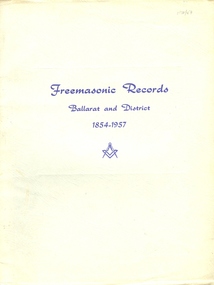
... Street School. Classrooms were so scattered that Steane recalled without his motorbike he would never have covered the ground! By 9 September 1921 the Junior Technical School Building was officially opened on the site of the old Ballarat Gaol. In a confidential report of 1916 Steane was described as one of the best organizers in schools at that time, and he was noted for his strong but fair...Street School. Classrooms were so scattered that Steane recalled without his motorbike he would never have covered the ground! By 9 September 1921 the Junior Technical School Building was officially opened on the site of the old Ballarat Gaol. In a confidential report of 1916 Steane was described as one of the best organizers in schools at that time, and he was noted for his strong but fair ...Born at the Victorian town of Sandhurst (now Bendigo, Albert Steane attended the Gravel Hill State School until the fourth class, then transferred to the Central School 1976 where he gained the Merit Certificate. The monitor system of teacher training had been introduced and he passed as a fourth, third, second and first class pupil teacher. At about 16 years of age Steane was appointed a teacher monitor at £12 per annum. Albert Steane was awarded the Teachers' Certificate of Competency in 1897. He was the first headmaster of the Ballarat Technical School, and opened the Sloyd (woodwork) Centre in 1902 at the Ballarat East Art School (later known as the Ballarat East Free Library). According to the Ballarat Courier of 23 March 1957 Steane established the Ballarat Junior Technical School in February 1913, a part of the School of Mines and Industries Ballarat. The beginning classes with 86 pupils were held at a temporary site at the Dana Street School. Classrooms were so scattered that Steane recalled without his motorbike he would never have covered the ground! By 9 September 1921 the Junior Technical School Building was officially opened on the site of the old Ballarat Gaol. In a confidential report of 1916 Steane was described as one of the best organizers in schools at that time, and he was noted for his strong but fair discipline. In the 1926 school report the Chief Inspector wrote that 'no boy is neglected'. Steane held the position of headmaster at the Ballarat Junior Technical School for 29 years retiring on 16 April 1942. Steane is known for the teaching of Sloyd or woodwork, which was an important point in his career, and for his love of gymnastics. He was made a life member of the Ballarat Y.M.C.A. in 1968 aged 91 years. The teaching of woodwork in Victoria began in 1901 and Steane was chosen, among 18 others for the inaugural training course at Queensberry State School in Melbourne. Because of his lifelong love of gymnastics Steane organized a gymnastic display for the Education Department in 1902 at Bendigo's Golden Jubilee Exhibition. He was one of those instrumental in establishing the Ballarat Y.M.C.A. and directed its physical culture evening classes in 1906. In 1908 Steane toured the world visiting the Swedish Naas Institute and the Gymnastic Festival in Germany. Steane in his reminiscences recalls: "In 1908 I obtained leave of absence and undertook a world trip to further my knowledge of both manual art training and physical training. On this trip I visited U.S.A., Canada, Scotland, England and Europe. Notable events were the attendance at the great 11th Deutche Turnfest at Frankfurt, inspection of the Naas Training School for Sloyd at Naas, Sweden inorgorated [sic] by Otto Solomon, and attendance at Physical Education Demonstrations at London given by the Swedish institution. These P.E. demonstrations were given to assist the organization and introduction of P.E. training in London schools.On returning to Ballarat I resumed my position at the Ballarat East Sloyd Centre and continued my studies at the Ballarat Art School gaining the Drawing Teachers' Certificate." Steane died, aged 93 years, on 13 July 1970, at Sydney, leaving his widow Grace Elliott Steane and children Eric and Violet. Steane is listed on the University of Ballarat Honour Roll at https://www.ballarat.edu.au/curator/honour-roll/honourroll_steane.shtml Printed green book with soft cover. The book lists all masonic bodies, including lodges and chapters, that have worked within 30 miles of Ballarat during the first 100 years of Freemasonry in the district. Includes a Loose, one page addenda et Corrigenda.The image of Albert Steane in the front of the book is inscribed "Yours faithfully A.W. Steane."ballarat, freemason, freemasonic, lodge, albert steane, a a w steane, a j dean, mark lodges, royal ark mariners, royal arch chapters, masonic orders -
 Flagstaff Hill Maritime Museum and Village
Book - Technical Reference, L Oertling (Ludwig Oertling), Tables for Ascertaining The Strength of Spirits with a Sike's Hydrometer, c. 1922
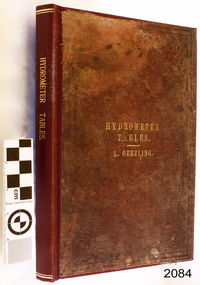
... The firm was situated at Turnmill Street, London, in 1922, when it advertised its products including hydrometers, petroleumeters, saccharometers, balances and weights, and automatic coin weighing machines in the British Industries Fair catalogue. ...The firm was situated at Turnmill Street, London, in 1922, when it advertised its products including hydrometers, petroleumeters, saccharometers, balances and weights, and automatic coin weighing machines in the British Industries Fair catalogue. ...The book was compiled for the proprietor, L Oertling (Ludwig Oertling), who established his firm of precision scientific instruments in 1849 and went on to become well-known in Britain for its manufacture of precision instruments, particularly its balance scales. In 1865 Ludwig Oertling and business partner Edward Wilds Laad at 27 Moorgate Street London were granted Patent 75 for the invention of improvements in hydrometers. The firm was situated at Turnmill Street, London, in 1922, when it advertised its products including hydrometers, petroleumeters, saccharometers, balances and weights, and automatic coin weighing machines in the British Industries Fair catalogue. In 1925 the firm became part of the Avery group of companies, which acquired Stanton Instruments in 1968 and about two years later Stantons merged into L. Oertling Ltd. Joseph Long has been mentioned by some sources as the author of this book, written for the proprietor of L. Oertling Ltd.The book has been recognised as being culturally important as a basis for our current civilization. It was of great importance to the Board of Revenue for the collectors of taxes and duties Customs Offices, and used in the calculation of alcohol levels in wine and spirits.Reference book, hardcover, burgundy with gold text and lines. Cloth cover with embossed design. Title: Tables for Ascertaining The Strength of Spirits for ascertaining the strengths of spirits with Sike's Hydrometer; Compiled for L. Oetlihg, by appointment, sole manufacturer of Hydrometers & Saccharometers to the Board of Inland Revenue. [some sources say the author is Joseph Long] Published in Turnmill Street, London, near Farringdon Street Station Printer: Printed in London, England by George Berridge and Co, Eastcheap Works, ECflagstaff hill, flagstaff hill maritime museum and village, warrnambool, maritime museum, maritime village, great ocean road, shipwreck coast, l. oertling, ludwig oertling., precision balances, edward wilds ladd, patent 75, improvements in hydrometers, hydrometer, automatic balance for weighing sovereigns, hydrometers, petroleometers, saccharometers, balances and weights, automatic coin-weighing machines, avery group, stanton instruments, l. oertling ltd, testing machine, tables for hydrometers, strength of spirits, alcohol content, alcohol measurement, board of revenue, joseph long -
 Federation University Historical Collection
Handwritten document, Ballarat Junior Technical School - Records of raffle results - 1921, 09/09/1921 and 10/10/1921
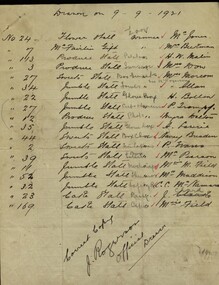
... street primary school...ballarat school of mines...1921...sir alexander...school fair...Street State School. As numbers grew a larger building was needed. Plans were drawn and a school built within the grounds of the School of Mines. Students started at this new school in 1921. It was officially opened on 9 September 1921 by Sir Alexander, resident of Creswick, local member for North Ballarat and the Minister for Education. He also opened the School Fair...Street State School. As numbers grew a larger building was needed. Plans were drawn and a school built within the grounds of the School of Mines. Students started at this new school in 1921. It was officially opened on 9 September 1921 by Sir Alexander, resident of Creswick, local member for North Ballarat and the Minister for Education. He also opened the School Fair ...Ballarat Junior Technical School opened in 1913. It was located at the Dana Street State School. As numbers grew a larger building was needed. Plans were drawn and a school built within the grounds of the School of Mines. Students started at this new school in 1921. It was officially opened on 9 September 1921 by Sir Alexander, resident of Creswick, local member for North Ballarat and the Minister for Education. He also opened the School Fair which coincided with the buildings ceremony. This was a fair on a grand scale and lasted two days and nights. Staff and students worked for weeks making articles for sale. A parent's committee led by Mr J Rogerson, a local police detective, had been organizing for months. Money raised funded the dodge-ball court, purchased a typewriter, a second-hand piano, an inter-room telephone system, an epidiascope and film projector. Four pages of lined paper showing handwritten results for raffles held at Ballarat Junior Technical Schhool in 1921. Pages held together with a dressmaker's pin.J Rogerson, official drawerballarat junior technical school, dana street primary school, ballarat school of mines, 1921, sir alexander, school fair, parent's committee, j rogerson, police detective, dodge-ball court, typewriter, piano, telephone system, epidiascope, film projector -
 Federation University Historical Collection
Hand written document, Ballarat Junior Technical School Correspondence 1921, 1921
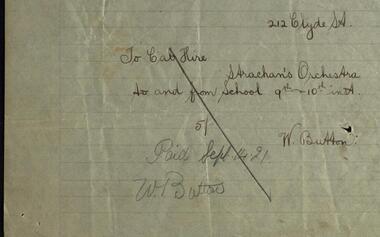
... street...ballarat school of mines...minister for education...member for north ballarat...school fair...Street State School. As numbers grew a larger building was needed. Plans were drawn and a school built within the grounds of the School of Mines. Students started at this new school in 1921. It was officially opened on 9 September 1921 by Sir Alexander, resident of Creswick, local member for North Ballarat and the Minister for Education. He also opened the School Fair...Street State School. As numbers grew a larger building was needed. Plans were drawn and a school built within the grounds of the School of Mines. Students started at this new school in 1921. It was officially opened on 9 September 1921 by Sir Alexander, resident of Creswick, local member for North Ballarat and the Minister for Education. He also opened the School Fair ...Ballarat Junior Technical School opened in 1913. It was located at the Dana Street State School. As numbers grew a larger building was needed. Plans were drawn and a school built within the grounds of the School of Mines. Students started at this new school in 1921. It was officially opened on 9 September 1921 by Sir Alexander, resident of Creswick, local member for North Ballarat and the Minister for Education. He also opened the School Fair which coincided with the buildings ceremony. This was a fair on a grand scale and lasted two days and nights. Staff and students worked for weeks making articles for sale. A parent's committee led by Mr J Rogerson, a local police detective, had been organizing for months. As part of the ceremony for the opening of the school the Strachan Orchestra was engaged to play. .1 Taxi hire provided transport for the Strachan Orchestra for two visits at a total cost of Five Shillings. This hand written slip shows the date of payment and by whom .2 This item is the receipt N A Strachan sent to Mr Steane, Headmaster of the school, for the payment of Two Pounds, cost for engaging the Orchestra. Money raised funded the dodge-ball court, purchased a typewriter, a second-hand piano, an inter-room telephone system, an epidiascope and film projector.Hand written notes on lined paper. .1 Invoice; .2 Receipt.1 Signature of W. Button .2 Signature of N.A. Strachan.ballarat junior technical school, dana street, ballarat school of mines, minister for education, member for north ballarat, school fair, strachan orchestra, receipt, albert steane, ceremony, taxi, typewriter, piano, telephone system, payment notice, sir alexander peacock -
 Federation University Historical Collection
Photograph - Photograph - Black and White, Ballarat Ladies Highland Pipe Band Photographs and Newspaper Article
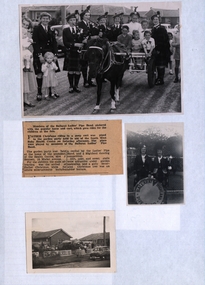
... fair to raise money for new drums. The horse and cart was hired to give children rides around the "island". Trevor in the cart - striped shirt. M. Bennett. Ballarat Courier Press Photograph. A3 - Ballarat - Margaret Smith - Base drummer and Margaret Bennett - Drum Major, outside I & R Morley Doveton Street. ...fair to raise money for new drums. The horse and cart was hired to give children rides around the "island". Trevor in the cart - striped shirt. M. Bennett. Ballarat Courier Press Photograph. A3 - Ballarat - Margaret Smith - Base drummer and Margaret Bennett - Drum Major, outside I & R Morley Doveton Street. ..."After the war Pipe-Major Duncan McLennan, moved to Ballarat and took up a position as cadet instructor and leader of the Ballarat Highland Pipe Band and the Ballarat Ladies Pipe Band. " (Victorian Historical Journal Vol. 85, No. 1, June 2014)A1 - Black and white photograph of band members with children in horse and cart. A2 - Newspaper article relating to the above mentioned photograph. A3 - Black and White photograph of Drum major and member of band. A4 - Black and White photograph of Ballarat Ladies Highland Pipe Band Bazaar B1 - Black and White photograph of piper in uniform B2 - Black and White photograph of Drum Major in uniform B3 - Black and White photograph of Drum Major in uniform on stairs B4 - List of Members. C1 - Black and White photograph of pipe band marching. C2 - Black and white photograph of Ladies Drum Major with Lew Zilles and Mrs Zilles C3 - Black and white photograph of Mr & Mrs Zilles, Mr and Mrs Bennett and Joan Bolden Gift of Margaret Bennett, 2019A1 - Outside 19 Waller Avenue where the ladies pipe band held a fair to raise money for new drums. The horse and cart was hired to give children rides around the "island". Trevor in the cart - striped shirt. M. Bennett. Ballarat Courier Press Photograph. A3 - Ballarat - Margaret Smith - Base drummer and Margaret Bennett - Drum Major, outside I & R Morley Doveton Street. A4 - Ballarat Ladies Highland Pipe Band Bazaar 1959. 19 Waller Ave, Ballarat B1 - 183 B2 - Margaret Bennett the Drum Major of Ballarat Ladies Pipe Band. Taken on front porch of 19 Waller Avenue B3 - Ballarat City Oval. Drum Major Margaret Bennett nee Reynolds. C1 - Copyright The Ballarat Courier Proprietary Limited C2 - Mrs Zilles, Lew Zilles, and Margaret Bennett. Progress Photos, Midway Arcade, 256 Collins St, Melbourne C3 - Mr & Mrs Zilles, Margaret and John Bennett, Joan Bolden (Parker) ladies pipe band, members, members list, ladies highland pipe band, photograph, black and white photograph -
 Federation University Historical Collection
Correspondence, Alfred Lester and Co, to Ballarat School of Mine, 1898
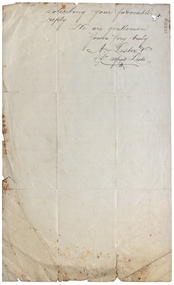
... No 15 Arcade Chambers Hay Street Perth West April 4th 1898 The Chairman and Directors The School of Mines Ballarat Gentlemen We believe that we could do business for you here in the way of arranging for the forwarding of parcels of ore for treatment and various samples for assays. If you are disposed ot offer us a fair...alfred lester perth assay treatment ballarat school of mines No 15 Arcade Chambers Hay Street Perth West April 4th 1898 The Chairman and Directors The School of Mines Ballarat Gentlemen We believe that we could do business for you here in the way of arranging for the forwarding of parcels of ore for treatment and various samples for assays. If you are disposed ot offer us a fair ...Foolscap handwritten document concerning Alfred Lester and Co forwarding parcels of ore for treatment at the Ballarat School of Mines. No 15 Arcade Chambers Hay Street Perth West April 4th 1898 The Chairman and Directors The School of Mines Ballarat Gentlemen We believe that we could do business for you here in the way of arranging for the forwarding of parcels of ore for treatment and various samples for assays. If you are disposed ot offer us a fair commission for such business introduced to you, we should advertise our representation here, and on the fields, we have a good connection with the officers of various companies, in perth and would do our best on your behalf. The writer has been resident here for some six years + is known personally to several of the gentlemen comprising your board. Soliciting your favourable reply We are gentlemen Yours very truly A. Lester and Co. per Alfred Lestoralfred lester, perth, assay, treatment, ballarat school of mines -
 Flagstaff Hill Maritime Museum and Village
Vehicle - Wagon, H.H. Smith & Co. Baker, Circa 1930s - 1940s
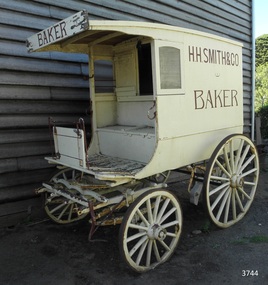
... Streets, Warrnambool. The building retains the original cast iron veranda. Above the veranda, a motif of a wheat sheaf in ornamental plaster can be seen. Inside the building, there are still some of the original fittings. The building was classified by the National Trust in August 1979. After the Second World War, an official system of zoning was introduced as a fair...Streets, Warrnambool. The building retains the original cast iron veranda. Above the veranda, a motif of a wheat sheaf in ornamental plaster can be seen. Inside the building, there are still some of the original fittings. The building was classified by the National Trust in August 1979. After the Second World War, an official system of zoning was introduced as a fair ...This baker’s wagon or cart transported and delivered bread and other baked goods in the Warrnambool area. It currently has advertising for H.H. Smith & Co. Henry Huntington Smith (1857-1941) owned and operated his Warrnambool bakery in the late 19th and early 20th century. However, the design of the wagon is similar to those used by local bakers in the 1930s and 1940s and probably originated from Stephenson’s Bakery in Warrnambool, which operated around that time. The wagon’s original internal shelves were removed in the early days of Flagstaff Hill so that children could have rides around the village in a horse-driven cart. BAKERS’ HISTORY There were many bakeries in Warrnambool in the 19th to mid-20th century. Each bread bakery made horse and cart deliveries in its allocated zone. SMITH’S BAKERY; – as shown on the wagon’s signage. Henry Huntington Smith (1857-1941) was born and educated in Warrnambool. He worked at Davis’ steam biscuit factory in Timor Street before he began his own bakery business in 1885 near the corner of Fairy and Koroit Streets. A few years later Smith built a new bakery on the corner of Fairy and Lava Street where it still stands today (2025) as Monaghan’s Pharmacy. The building was designed by James McLeod in 1892 as a bakehouse, shop and residence for Smith The address was known locally as Smith’s Corner. Next door to the bakery, at 136 Fairy Street, were stables built by Jobbins and McLeod in 1886 for William Cust. A photograph in the archives of the Warrnambool and District Historical Society shows the 1892 building with four fancy horse-drawn wagons on the street with white-clad drivers and a promotional stand erected with 5 bakers in uniform and the signage “H H Smith & Co, Pastry Cooks and Confectioners”. One of the wagons appears to have “H H Smith” painted on the side. H.H. Smith & Co. placed an Advertisement in the Weekly Times in December 1896 promoting its business as bakers, confectioners and pastry cooks, praising their shop as an ‘ornament to the town’ with ‘neat appointments’ and ‘dainty decorations’. It also boasted of supplying a large number of customers within a twelve-mile radius of Warrnambool. In November 1919 The Warrnambool Standard announced the marriage of Henry H Smith, Mayor of Warrnambool, to Jeannie Samson-Goodman in East Adelaide. In the same newspaper was a notice that Frank Crossley was to open as baker and pastry cook in H.H. Smith’s premises. As well as being the proprietor of the H.H. Smith Bakery, Henry Huntington Smith was a Councillor for the Warrnambool Municipality from 1913 to 1937 and Mayer for two terms. In December 1919 during his first term as Mayor, he was honoured for the work he had done with returning soldiers after World War I, receiving a document in recognition of this work, presented by the Mothers, Wives and Sisters of returned soldiers. Smith was very interested and involved in the community in many roles, including being the Vice President of the first Warrnambool and District Historical Society. STEPHENSON’S BAKERY: – believed to be the past owner of the wagon. The last owner of the bakery was Harold Stephenson. Stephenson was enlisted in the A.I.F. and was invalided home in 1943 before the end of the Second World War. He also served as a Councillor from 1958 to 1976, during which time he served six terms as Mayor for the City of Warrnambool (1966-1973) while he had the bakery. He was very involved in many local organisations including the Warrnambool Surf Life Saving Club and the Road Race Committee. He died in 1985, lauded as being one of Warrnambool’s “most distinguished civic leaders”. It has been said that the baker injured in World War II invented a special contraption to enable him to get up into the wagon and that he alerted his customers that he was in their vicinity by blowing a whistle. The customers would come out and choose their bread from the back of his wagon then pay him for it. However, another account is given by a man who once earned pocket money by helping the baker on his rounds. He says that it was Stephenson, the owner and manager of the bakery, and not the delivery baker who received a significant injury during the war, making him unable to climb the stairs of his upstairs accommodation at the bakery, therefore causing him to sleep downstairs. At this time in the early to late 1940 Stephenson’s bakery had three wagons, one for each of the delivery rounds. The wagons were painted black and yellow. Two of the drivers were Stan Lake and Ali (Alec) Dean who both had wagons with the covered cabin design. The third driver was Bill Lake who had a flat wagon. Stan Lake delivered in the area around Lava and Koroit Streets, Ali Dean had another round and Bill Lake had the Dennington area. Bread continued to be delivered into the 1960s but by this time the delivery vehicles were motorised. The goods produced at Stephenson’s bakery included bread baked in different shaped tins such as High Tin, Sandwich and Vienna. Some shapes were easily divided into half by breaking them apart, therefore the baker could make two-quarter loaves from a half loaf, satisfying different needs. There was the option of white or brown bread, sweet buns, fruit buns and Boston buns. The baker’s assistant was known to take great delight in ‘trimming’ the broken halves of excess bread and crust, enjoying his treat. THE BAKERY PREMISES: – Southeast corner of Fairy and Lava Streets, Warrnambool. The building retains the original cast iron veranda. Above the veranda, a motif of a wheat sheaf in ornamental plaster can be seen. Inside the building, there are still some of the original fittings. The building was classified by the National Trust in August 1979. After the Second World War, an official system of zoning was introduced as a fair way for the baking industry to operate. In 1949 different pricing was introduced by the Government for either delivered or retail purchased bread. Many of the small local bakeries went out of business after the Government banned zoning. The way was made open for the larger bread manufacturers to enter the local market with cheaper prices. Some of those companies were Mc Queens, Tip Top, Twisties, and Sunicrust, (Mc Queens ‘new’ bakery building was where the current Toyworld shop now stands, is, in the Ozone carpark.) O’Grady’s Bakery, later changing hands and known as Burkes Bakery, was on Fairy Street near the Timor Street intersection, on the North West side. There was also a bakery named Almay. The baker’s wagon is significant because of its association with H.H. Smith’s Bakery in Warrnambool.. The H.H. Smith’s Bakery building on the corner of Fairy and Lava Streets, built in 1892, is classified by the National Trust, August 1979. Smith Street Warrnambool was named after Henry Huntington Smith, who was a Warrnambool Councillor 1913 – 1937 and Mayor 1919 – 1921. Baker’s wagon, often referred to as a baker’s cart. Four wheeled horse-drawn delivery wagon, front wheels smaller than rear wheels. Wagon is clad with metal sheets and lined with varnished timber panels. Wheels have metal rims, wooden spokes and rear wheels have wooden brake pads. Horse shaft is timber with metal fittings. Front has a metal lamp holder, brake lever, metal hand grips and decorative metal foot plates. The wagon has suspension leaves on back and sides and double suspension leaves on the front. Driver’s area at front has a roof, glass side windows and wooden box seat with hinged compartment accessing wagon storage area. Door above back of seat has buckled leather handgrip strap attached, door slides open for access to wagon area. Back of wagon has a wooden step and a split door; top door has ventilation louvers, both doors have metal latches. Wagon is painted cream with brown trim and signage and green step. Remnants of red and green paint are visible; underside of seat panel is painted grey. Wagon advertises H.H. Smith & Co. Baker, a Warrnambool business established in 1885, but is of a more modern design seen around 1930’s and 1940’s and most likely belonging to Stephenson's bakery. Brown signwriting on sides of wagon “H.R. SMITH & CO. / BAKER” Brown signwriting across front of wagon “BAKER” warrnambool, shipwrecked-coast, flagstaff-hill, flagstaff-hill-maritime-museum, maritime-museum, shipwreck-coast, flagstaff-hill-maritime-village, shipwrecked-artefact, great ocean road, baker’s wagon, h.h. smith baker, warrnambool, henry h smith, jeannie samson-goodman, frank crossley, mayor of city of warrnambool, vice president of warrnambool and district historical society, stephenson’s bakery warrnambool, harold stephenson, warrnambool surf life saving club, road race committee, national trust building, stan lake, bill lake, ali dean, 19th and 20th century bakers, davies steam biscuit factory warrnambool, james mcleod building designer, jobbins and mcleod, william cust, h h smith & co, pastry cooks and confectioners, bakery trade, bread delivery wagon -
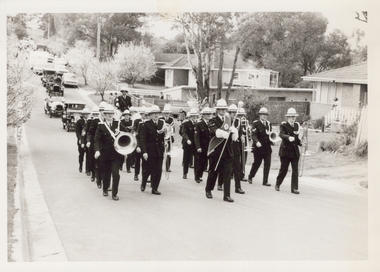 Ringwood and District Historical Society
Photograph, First Ringwood Spring Fair at various locations. The Police band in Notlen Street in 1971
... First Ringwood Spring Fair at various locations. The Police band in Notlen Street in 1971...(Pam Payne) First Ringwood Spring Fair at various locations. The Police band in Notlen Street in 1971 Photograph ...First Ringwood Spring Fair (did they ever hold another?) at various locations. In Notlen St the band included Gendarme the famous Victoria Police horse, and the Cobb and Co coach. The balance of the Spring Pair photos were taken in the park/ gardens opposite the old Ringwood Market site. c1971. (Pam Payne) -
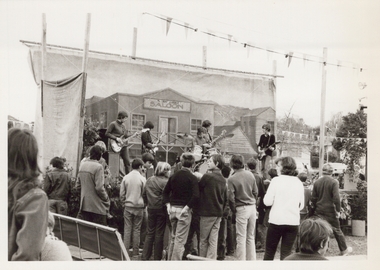 Ringwood and District Historical Society
Photograph, First Ringwood Spring Fair at various locations. Band playing in Charter Street park in 1971
... First Ringwood Spring Fair at various locations. Band playing in Charter Street park in 1971...(Pam Payne) First Ringwood Spring Fair at various locations. Band playing in Charter Street park in 1971 Photograph ...First Ringwood Spring Fair (did they ever hold another?) at various locations. In Notlen St the band included Gendarme the famous Victoria Police horse, and the Cobb and Co coach. The balance of the Spring Pair photos were taken in the park/ gardens opposite the old Ringwood Market site. 1971. (Pam Payne) -
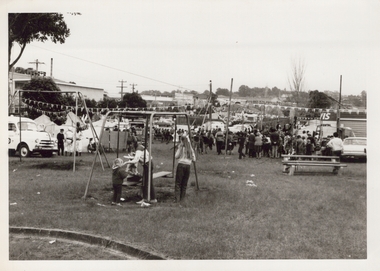 Ringwood and District Historical Society
Photograph, First Ringwood Spring Fair at various locations. Playing in Charter Street Park in 1971
... First Ringwood Spring Fair at various locations. Playing in Charter Street Park in 1971...(Pam Payne) First Ringwood Spring Fair at various locations. Playing in Charter Street Park in 1971 Photograph ...First Ringwood Spring Fair (did they ever hold another?) at various locations. In Notlen St the band included Gendarme the famous Victoria Police horse, and the Cobb and Co coach. The balance of the Spring Pair photos were taken in the park/ gardens opposite the old Ringwood Market site. 1971. (Pam Payne) -
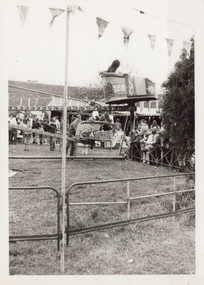 Ringwood and District Historical Society
Photograph, First Ringwood Spring Fair at various locations. Rides in Charter Street Park in 1971
... First Ringwood Spring Fair at various locations. Rides in Charter Street Park in 1971...(Pam Payne) First Ringwood Spring Fair at various locations. Rides in Charter Street Park in 1971 Photograph ...First Ringwood Spring Fair (did they ever hold another?) at various locations. In Notlen St the band included Gendarme the famous Victoria Police horse, and the Cobb and Co coach. The balance of the Spring Pair photos were taken in the park/ gardens opposite the old Ringwood Market site. 1971. (Pam Payne) -
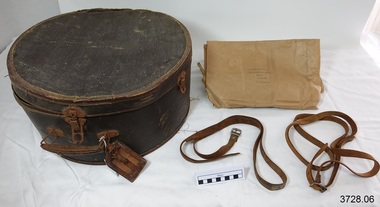 Flagstaff Hill Maritime Museum and Village
Functional object - Hat box, early to mid-20th century
... Fair Star lines. ABOUT DREWS Drew’s, Leather Goods Specialists, was located at 70 Swanston St, corner of Queen’s Walk, Melbourne, at the time that this hat box was sold by the company. Queen’s Walk was constructed in 1889. It was a lavish ‘L’ shaped arcade that connected Swanston Street...Fair Star lines. ABOUT DREWS Drew’s, Leather Goods Specialists, was located at 70 Swanston St, corner of Queen’s Walk, Melbourne, at the time that this hat box was sold by the company. Queen’s Walk was constructed in 1889. It was a lavish ‘L’ shaped arcade that connected Swanston Street ...This large hat box was owned by Miss Katherine Robertson (now deceased). It was sold by Drews, a leather and travel goods shop in Melbourne, and has been made as good quality, sturdy travel luggage. It has its own leather luggage label buckled to the handle and there are remnants of labels on the base of the hat box, signifying that it has indeed been used as luggage. A hat box such as this one is made to protect, store and transport head wear. Hat boxes became popular in the 19th and early 20th century when hats were a part of the modern fashion. Inside the hat box is a brown paper wrapper with two Great Britain postage stamps attached. Both have the portrait image of Queen Elizabeth II (1) orange 1/2d (2) green ten pence. These stamps belong to the Wildings series and were issued 1952-1954. The wrapper was sent by J McGregor in Glasgow, Scotland to Katherine Robertson in Sale, Victoria. The postmark stamp shows it was sent in 1955. The paper had once been folded around something rectangular in shape, perhaps a book. The hat box was recently found by Archie’s daughter, niece of Katherine, when she was looking for something else in the ceiling of her home. The hat box had been there, with the brown paper wrapper inside, for about 30 years, forgotten by the family. There are no family members remaining now to tell the full story. ABOUT MISS KATHERINE ROBERTSON The Robertson family emigrated from the Isle of Wight and settled in Woorndoo, Western Victoria, Australia. Katherine Robinson was the 10th child of 13 children, born in 1906 and lived until 1995. The youngest child in the family was a boy named Archibald (Archie) who was born in 1911. His daughter is the donor of the hat box. Katherine went to school at Woorndoo and later became a trained teacher. She taught in many places, amongst them were Alexandria, Geelong, Sale, Stawell and Ballarat. People said “She was a school teacher 24 hours a day!” She was insistent on being called Miss Katherine Robinson, and no-one dare call her a shortened name in any way, not Kate, or Katie or even Kathie. She spoke with the authority of a teacher throughout her life, never asking but always giving her requests as orders. Miss Katherine Robinson remained single all her life. She bought items that were the best quality and workmanship, which gives reason for the strong and well-travelled hat box. She enjoyed going on trips and travelled the world twice. While on her journeys Katherine would knit Fair Isle patterned socks using fine 4 ply wool because she “Didn’t believe in wasting time!” Katherine’s niece remembers being in Melbourne at Station Pier, seeing her Aunt off on one of her journeys. She recalls the atmosphere and the colourful streamers in the air that celebrated the special occasion. Katherine travelled on the Oriana and Fair Star lines. ABOUT DREWS Drew’s, Leather Goods Specialists, was located at 70 Swanston St, corner of Queen’s Walk, Melbourne, at the time that this hat box was sold by the company. Queen’s Walk was constructed in 1889. It was a lavish ‘L’ shaped arcade that connected Swanston Street to Collins Street and was home to many specialist stores. In the 1950’s Drews address was advertised as Collins Street. In the late 1960’s Queen’s Walk was purchased by the Melbourne City Council and demolished in the early 1970’s, to be replaced by the Melbourne City Square. This very sturdy and good quality hat box is an example of travel luggage available to and used by the Victorian population of Australia in the early to mid-20th century. The retailer of this hat box, Drews, operated from premises on the corner of Swanston St and Queen’s Walk in Melbourne where many other specialist shops were located. Queen’s Walk was only in existence for around 70 years, 1889-late 1960, before it was demolished to make way for Melbourne’s City Square. Hat box, large, deep round shape with a straight section where lid is joined on at the back. Dated early to mid-1900’s. Brown coloured, textured heavy weight card box with folding metal carry handle, three clip closures for lid, metal hinge on back of lid. Purple maker’s label inside lid - DREWS, Leather Goods Specialists, Melbourne. Leather luggage tag has two rectangular cut-outs on front, attached with buckle strap. Underside of lid has two supporting leather straps attached to base. Base has inner cardboard liner around most of circumference. Contained inside are two leather straps with metal buckles. Label remnants, red, attached under base. Hat box was owned by Miss Katherine Robertson. Also inside is brown paper wrapper with three hand written addresses, in blue nib pen, and two attached Great Britain postage stamps, Queen Elizabeth II (1) Orange stamp, QE II, ½d (2) Green stamp, QE II, ten pence. It is postmarked [19] 55. Purple label has printing "70 SWANSTON STREET / Cr. QUEEN'S WALK / DREWS / LEATHER GOODS / SPECIALISTS / MELBOURNE". Wrapper inside has two hand written addresses (1J) Mrs. K. F. Robertson / 33 Mcalister Street / Sale / Victoria / Australia” (2) “from / J Mc Gregor / 15 Napier’s Hall St / Glasgow N W / Scotland” Postmark “ - -em 55” & “CLAS-“ OR “GLAS-“ [GLASGOW] flagstaff hill, warrnambool, shipwrecked coast, flagstaff hill maritime museum, maritime museum, shipwreck coast, flagstaff hill maritime village, great ocean road, luggage, hat box, hatbox, hat storage box, hat travel case, hat case, bandbox, drews melbourne, drew’s melbourne, drew’s handbags, travel goods, travel luggage, hat box suitcase, hat box luggage, 1952-1954 gb postage stamps 1/2d orange queen elizabeth ii, katherine robertson, archibald (archie) robertson of woorndoo, j mcgregor -
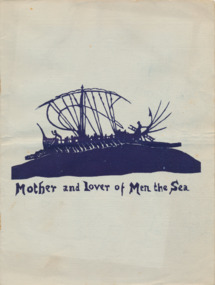 Mission to Seafarers Victoria
Programme, Violet Teague, Mother and Lover of Men the Sea, 1910
... Street. The "Tableaux vivants", called "Tennison's Dream of Fair Women" were arranged by artist Violet Teague. ...Street. The "Tableaux vivants", called "Tennison's Dream of Fair Women" were arranged by artist Violet Teague. ...On the 19th and 20th September 1910, the Mission organised a fundraising evening at the Masonic Hall on Collins Street. The "Tableaux vivants", called "Tennison's Dream of Fair Women" were arranged by artist Violet Teague. She arranged and painted the decors for the "tableaux vivants" in the Siddeley Mission. It's likely she also created the cover of this programme. "Mother and Lover of Men the Sea" is a verse form the poem: The Triumph of Time by Algernon Charles Swinburne While she was working, seamen from the Carnarvon Bay shipwreck were welcomed to the institute and subsequently invited to the evening. "They went through a large room, where a lady was standing on a scaffolding pointing a scene for the enter" tainment which is to take place this evening in the Masonic-hall. The lady was Miss Violet Teague, but she took her mind and her brush off the effects in marine blue sufficiently long to learn the main outlines of the story. " (Argus 19 September 1910). "During the evening the Rev W F Haire, acting chaplain to the mission announced that among those present were the shipwrecked survivors of the Carnarvon Bay, which was wrecked at King Island on Thursday last The men, who bore no traces of the hardships they endured took their places on the platform, whilst the large audience cheered itself hoarse and sang "For They Are Jolly Good relics". (Argus 20 September 1910) In 1935, Violet Teague was on the passengers on the C.B. Pedersen, one of the last windjammers. She Drew and painted during her voyage and exhibited the artworks in 1938.This rare programme is the last remaining testimony of the relationship between the Mission and famous artists of the time who provided illustrations for quotation calendars (Daryl Lyndsay, John Shirlow).12 pages programme. The cover is light blue paper with the design of the Greek ship printed in black ink.violet teague, tableaux vivants, 1910, fundraising, theatre, play, algernon charles swinburne, sponsors, advertising, carnarvon bay, shipwreck, una le souef, masonic hall, lady gibson-carmichael, willsmere certified milk and co, fry's cocoa, remington typewriter, hypol, lhlg, ladies harbour lights guild
