
Showing 9 items matching "structural elements"
-
 Moorabbin Air Museum
Book - Aircraft engineering, Analysis and Design of Flight Vehicle Structures
... Strength of structural elements & composite structures...Aircraft engineering Statically determinate structures Theory & methods for solving statically indeterminate structures Beam bending & sheer stresses / membrane stresses / column & plate instabiity Introduction to practical aircraft stress analysis Theory of elasticity & thermoelasticity Flight vehicle materials & their properties Strength of structural elements & composite structures Connections & design details Overview of the work of an aerospace structures engineer, circa 1973 Front / back covers wrapped in protectivce paper Analysis and Design of Flight Vehicle Structures Book Aircraft engineering ...Overview of the work of an aerospace structures engineer, circa 1973Front / back covers wrapped in protectivce papernon-fictionOverview of the work of an aerospace structures engineer, circa 1973statically determinate structures, theory & methods for solving statically indeterminate structures, beam bending & sheer stresses / membrane stresses / column & plate instabiity, introduction to practical aircraft stress analysis, theory of elasticity & thermoelasticity, flight vehicle materials & their properties, strength of structural elements & composite structures, connections & design details -
Moorabbin Air Museum
Book - Aircraft structue, Metal Airplane Structures
... ...Structural elements...Aircraft structure Types of metal aircraft Construction materials Structural elements Welded joints Riveted joints Stressed skin design Types of metal wings Metal wing beams Wing design Fuselage design Hull & float design Overview of design & construction of major components of various aircraft, circa 1938 Metal Airplane Structures Book Aircraft structue ...Overview of design & construction of major components of various aircraft, circa 1938non-fictionOverview of design & construction of major components of various aircraft, circa 1938types of metal aircraft, construction materials, structural elements, welded joints, riveted joints, stressed skin design, types of metal wings, metal wing beams, wing design, fuselage design, hull & float design -
 Wyndham Art Gallery (Wyndham City Council)
Sculpture, Kylie Stillman, The Remains, 2013
... In Kylie’s words these are: 'the basic structural elements and gestures that make things things - the stroke that makes a painting, the scribble that makes a pen work, the notation that makes writing, the intertwining of wool that makes a garment, the weave of fibres that make furnishings'. - Chloe Watson (2013)...In Kylie’s words these are: 'the basic structural elements and gestures that make things things - the stroke that makes a painting, the scribble that makes a pen work, the notation that makes writing, the intertwining of wool that makes a garment, the weave of fibres that make furnishings'. - Chloe Watson (2013) Australian Art Sculpture Female artist Paperback books and timber base The Remains Sculpture Kylie Stillman ...Something new has happened in Kylie Stillman’s work. It is not a departure. Perhaps a better way of explaining it would be an inward looking, a reflection on process and purpose. In the twelve small book stacks that make up this series, we find not birds or trees – the forms that have become familiar tropes in Kylie’s art – but a stroke, a scribble, a loop, a weave. In Kylie’s words these are: 'the basic structural elements and gestures that make things things - the stroke that makes a painting, the scribble that makes a pen work, the notation that makes writing, the intertwining of wool that makes a garment, the weave of fibres that make furnishings'. - Chloe Watson (2013)Paperback books and timber baseaustralian art, sculpture, female artist -
Federation University Historical Collection
Book, The Elements of Structure: An Intriduction fo the Principals of Building and Structural Engineering, 1970
... The Elements of Structure: An Intriduction fo the Principals of Building and Structural Engineering...engineering brian shreenan foundations columns arches slabs'dam walls Blue soft covered book The Elements of Structure: An Intriduction fo the Principals of Building and Structural Engineering Book ...Blue soft covered book engineering, brian shreenan, foundations, columns, arches, slabs'dam walls -
 Flagstaff Hill Maritime Museum and Village
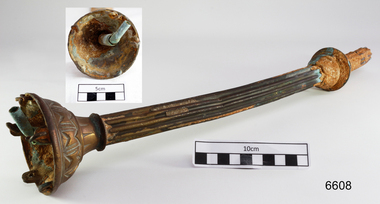
Functional object - Gas Fitting, Before 1878
... The artefact is a short cross-section of part of a functional part of a brass fitting that suspended a gas lamp, providing structural support, and internally, supplying the gas for its ignition. It combines elegant design with the elements required for safe and efficient delivery of gas. ...The artefact is a short cross-section of part of a functional part of a brass fitting that suspended a gas lamp, providing structural support, and internally, supplying the gas for its ignition. It combines elegant design with the elements required for safe and efficient delivery of gas. ...The artefact is a short cross-section of part of a functional part of a brass fitting that suspended a gas lamp, providing structural support, and internally, supplying the gas for its ignition. It combines elegant design with the elements required for safe and efficient delivery of gas. It was recovered from the LOCH ARD shipwreck site. There are similar artefacts in the Flagstaff Hill collection. The LOCH ARD left Gravesend (London) on 2 March 1878, bound for Melbourne, with a crew of 37, 17 passengers, and a diverse and valuable cargo of manufactured goods, luxury items, and refined metal. Some of the cargo was intended for Melbourne’s first International Exhibition to be held in 1880. At 3 am, 1 June 1878, the ship was wrecked against the high limestone cliffs of Mutton Bird Island on Victoria’s south west coast near Port Campbell. Only two people survived the disaster — Tom Pearce, a male crew member, and Eva Carmichael, a female passenger. The cargo proved too difficult to salvage in the vessel’s exposed condition and was largely written off. The manifest of goods in the LOCH ARD’s holds included “Fittings gas (4 cases)”. The gas lighting of streets, public buildings, and the dwellings of wealthier private citizens, was already well advanced in the cities and major towns of the Australian colonies. In 1841 Sydney was the first to be gas lit with 23 street lamps, 106 hotel lamps, and 200 private residences connected to the Darlinghurst “gasometer” by an underground network of metal pipes. “The dim days of oil and tallow are gone by!” pronounced one newspaper, flushed with civic pride. The 1850s Gold Rush promoted a similar attitude of confidence and affluence in the Colony of Victoria. In 1855 Melbourne was connected to its own system of subterranean gas pipes despite the same high rates of 25 shillings per 1000 cubic feet being charged, (reduced to 15 shillings in 1865 with cheaper sources of coal). By1858 Kyneton had its own gasworks to light the town (fuelled by eucalyptus leaves) and Geelong followed suit in 1860. Had the LOCH ARD reached its intended destination in 1878, it is probable that the 4 cases of brass gas light fittings on board would have found a ready market.The gas fitting is significant for its association with the LOCH ARD shipwreck, which is of State significance and is listed on the Victorian Heritage Register S417. The fitting is an example of a late 19th-century plumbing and light fitting.A pressed brass gas light fitting, recovered from the wreck of the LOCH ARD. The elegant and functional fitting extends from an ornate 8cm diameter ceiling flange, and comprises two short lengths of fluted column pipe with a brass joiner that are severed (cut off) at the end. Within this decorative outer layer of 3cm diameter is a full length brass tube liner, which is in turn protecting a narrow 0.75cm copper gas pipe that also runs full length. The artefact is generally unrestored with reddish/cream sandstone concretion, but is in good condition.warrnambool, shipwreck coast, flagstaff hill, shipwrecked coast, flagstaff hill maritime village, flagstaff hill maritime museum, shipwreck artefact, maritime museum, gas lamps, gas lighting, gas works, brass fittings, gas pipes, loch ard, 1878 shipwreck, victorian affluence, colonial gas lighting -
 Robin Boyd Foundation
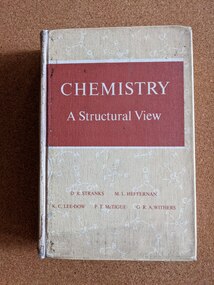
Book, D.R. Stranks, M.L. Heffernan, K.C. Lee Dow, P.T. McTigue, G.R.A. Withers, Chemistry: A Structural View, 1969
... Chemistry Walsh St library First cover page, blue pen annotations on a periodic table: "Merrin James / Form 6", "Architecture I", "TRANSITION ELEMENTS" Pen underlining and annotations throughout book Hardcover Chemistry: A Structural View Book D.R. ...HardcoverFirst cover page, blue pen annotations on a periodic table: "Merrin James / Form 6", "Architecture I", "TRANSITION ELEMENTS" Pen underlining and annotations throughout bookchemistry, walsh st library -
 Robin Boyd Foundation
Book, W. Morgan, The Elements of Structure, 1970
... Structural analysis (engineering) Walsh St library First page "Peter L. Dale"; between pages 152 and 153 are two handwritten pages listing various books and prices Softcover. The Elements ...This is a 1970 reprint. First published in 1964.Softcover.First page "Peter L. Dale"; between pages 152 and 153 are two handwritten pages listing various books and pricesstructural analysis (engineering), walsh st library -
Moorabbin Air Museum
Manual - Boeing aircraft repair manuals, Increasing Self - Reliance to Develop Repairs. The Boeing Company Customer Services
... Typical structural component loading & materials for fuselage & wings/empennage...Elements...Boeing repair manuals Workshop goals & objectives Summary of Applicable FARs Classes of structural components Typical structural component loading & materials for fuselage & wings/empennage Elements of a repair Examples of repairs Summary of Boeing workshop designed to make airlines more self reliant, circa 2000 Increasing Self - Reliance to Develop Repairs. ...Summary of Boeing workshop designed to make airlines more self reliant, circa 2000non-fictionSummary of Boeing workshop designed to make airlines more self reliant, circa 2000workshop goals & objectives, summary of applicable fars, classes of structural components, typical structural component loading & materials for fuselage & wings/empennage, elements of a repair, examples of repairs -
 Kew Historical Society Inc
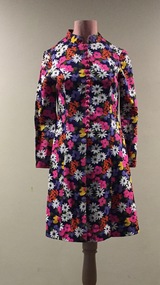
Coat dress, Kenneth Pirrie, 1967-8
... elements met bright, counter-culture psychedelia. This coat dress stands as a stellar, physically intact index of mid-century Australian fashion innovation. It documents a pivotal socio-cultural era when locally manufactured ready-to-wear labels successfully captured and redirected global youth subcultures specifically for the domestic market. The piece demonstrates the high-caliber printmaking and structured garment construction that earned Kenneth Pirrie national acclaim. It provides an excellent material baseline of the late-1960s shift away from structural ...This garment reflects the apex of the Australian "Youthquake" movement between 1967 and 1968. During this tight window, international mod influences from London's Carnaby Street fused heavily with local Australian manufacturing. Melbourne emerged as the absolute epicenter of the nation's revolutionary ready-to-wear "rag trade," led by visionary young designers who rebelled against traditional haute couture. Kenneth Pirrie, starting his label in 1959, became a crucial vanguard of this shift. By 1967, Pirrie was heavily commissioning his own exclusive textile prints—capitalizing on newly popularized, easy-to-launder synthetic crepes, crimplenes, and lightweight blends that mirrored the fast-paced, modern lifestyles of younger working women. The high collar and structured button-front design seen here explicitly capture the brief design transition where military tailoring elements met bright, counter-culture psychedelia.This coat dress stands as a stellar, physically intact index of mid-century Australian fashion innovation. It documents a pivotal socio-cultural era when locally manufactured ready-to-wear labels successfully captured and redirected global youth subcultures specifically for the domestic market. The piece demonstrates the high-caliber printmaking and structured garment construction that earned Kenneth Pirrie national acclaim. It provides an excellent material baseline of the late-1960s shift away from structural, monochromatic mod toward organic, vivid flower-power palettes. The dress, owned by Melbourne architect, Dione McIntyre, possesses exceptional local provenance. It highlights the local domestic and commercial history of Kew and greater Melbourne, recording what the fashion-conscious public actually bought, wore, and preserved during a period of massive industry transformationAn A-line, knee-length woman’s garment designed to function as a standalone dress or light structured coat. The piece is constructed from a dark base fabric featuring a densely populated, screen-printed psychedelic floral motif. The pattern exhibits stylized white, pink, magenta, and purple blossoms with golden-yellow centers, typifying the iconic "flower power" aesthetic of the late sixties. The garment features a structured, high Nehru collar closing directly down a central front-button placket. It has tailored, long inset sleeves terminating in clean cuffs, a fitted torso that gently flares outward from the hips into a minimalist A-line skirt, and an overall sharp, geometric silhouette.Label: Kenneth Pirriekenneth pirrie, women's clothing, australian fashion - 1970s, mcintyre collection, day wear, coat dresses
