
Showing 10 items matching "submarine technology"
-
 Monbulk RSL Sub Branch
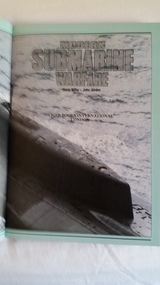
Book, David Miller, Modern submarine warfare, 1991
... ...Submarine technology...Submarine warfare Submarine technology A history of the development of submarine technology Index, ill, p.208. ...A history of the development of submarine technologyIndex, ill, p.208.non-fictionA history of the development of submarine technologysubmarine warfare, submarine technology -
 Flagstaff Hill Maritime Museum and Village
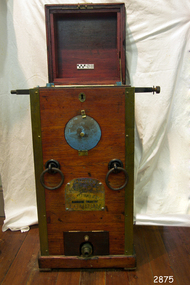
Machine - Diving Compressor, Siebe Gorman & Co. Ltd, 1880-1890
... technology Life Saving Deep sea diving maritime museum maritime village manine history maritime history marine engineers marine diving deep-sea diving E G Ward vintage diving compressor E. G. Ward E.G. Ward Edward Ward Ted Ward Plate on the back 'WATER SUPPLY" "WATER OVERFLOW" "WATER DRAIN-IN" Pressure gauge dial "BOURDON'S PRESSURE GAUGE" STEBE GORMAN & CO. LONDON", "LBS PRESSURE" "FEET OF SALT WATER" Plate on the front " PATENT, Siebe Gorman & Co Ltd Submarine ...This compressor was part of the E.G. Ward Collection. It is connected to the diving suit and boots, also in our collection. Siebe Gorman & Company Ltd was a British company that developed diving equipment and breathing equipment and worked on commercial diving and marine salvage projects. The company advertised itself as 'Submarine Engineers'. It was founded by Augustus Siebe, a German-born British engineer chiefly known for his contributions to diving equipment. Siebe Gorman traded as an engineering firm for over 180 years, from 1819 to 1999. The early success of the business was due to its founder, the Prussian immigrant Christian 'Augustus' Siebe (1788-1872). For business reasons, he applied for and was granted British citizenship in 1856. He was a gifted engineer who was able to translate theoretical problems into practical, working products. During the industrial Victorian period, the business traded as 'A. Siebe's at 145 High Street, Holborn, London, but in 1828, new premises were acquired at 5 Denmark Street, Soho. The family firm produced a wide range of manufactured goods, including paper-making machinery, measuring machinery, water-pumps, refrigeration equipment and diving apparatus. Augustus Siebe specialised in submarine engineering early on, and the company gained a reputation for the manufacture of safe, reliable diving apparatus. Augustus Siebe is best remembered for the development and manufacture of the ‘closed’ Diving Dress based on the ideas of Charles and John Deane, George Edwards and Charles Pasley. Apart from some small modifications to valves and diver communications, the basic 12 bolt ‘closed’ diving dress remained relatively unchanged after the 1870s. Later company successes were also based on innovation, with new products that could be successfully developed and manufactured to high standards. This was largely attributed to the inventive nature, foresight, engineering and entrepreneurial skills of Robert Henry Davis (1870-1965). In 1882, RH Davis joined the company of 'Siebe & Gorman' as a young 11-year-old office boy, and he was to remain with the company until he died in 1965. Augustus Siebe retired in 1869 and handed over the company to a new partnership of Henry H. Siebe (1830-1885) and William A. O'Gorman (1834-1904). The new firm traded as 'Siebe & Gorman' (1870-1879) from premises in and around Mason Street, Westminster Bridge Road, Lambeth, London. The two partners soon recognised the potential of R.H. Davis, and in 1894, aged 24, he became General Manager of Siebe & Gorman. Davis increasingly ran the company until the surviving partner (W.A. Gorman) died in 1904. The firm was disposed of to the Vickers (armaments) family, and a new company, Siebe Gorman & Co. Ltd. (1905-1998) was formed. Under the chairmanship of Albert Vickers, R.H. Davis was kept on as Managing Director, and the company forged ahead. However, after WW1, the Great Depression caused manufacturing output and share prices to slump. In 1924, Robert Davis made a deal with the Vickers Board and acquired control of the company through majority shares. Under his leadership, the Siebe Gorman Company flourished, and in time, four of his sons also joined the firm. The company gained a worldwide reputation for the manufacture of diving apparatus, decompression and observation chambers, and safety breathing apparatus of all types for use on the land, in the air and under the sea (including mine rescue, tunnelling, aircraft, diving, submarine escape and in other hazardous environments). Close research and development links with the MOD (especially the Admiralty), also provided a lucrative outlet for the company's products. In 1932, Robert Davis was knighted by King George V, principally for his invention of the ‘Davis Submerged Escape Apparatus’ (D.S.E.A.). Siebe Gorman essentially remained a family firm from the beginning (under A Siebe) until it became a public company for the first time in 1952. However, following WW2, British manufacturing stagnated through stifled investment and post-war austerity, and there was little innovation. Siebe Gorman's fortunes began to decline as an ageing Sir Robert Davis failed to invest or change the company's business and management practices. In 1959, Siebe Gorman was acquired by the “Fairy Group” and the ailing Sir Robert was made Life President. Consequently, nothing changed, and the slow decline continued until Sir Robert's death in March 1965. Around 1960, Siebe Gorman acquired the diving apparatus manufacturer C E Heinke, and for a brief period, it manufactured some diving equipment under the combined name of Siebe Heinke. Around 1964, Mr E. 'Barry' Stephens was appointed as the new Managing Director to modernise Siebe Gorman. Changes were made, including a move to a new factory in Wales in 1975. The new company concentrated on firefighting breathing apparatus and escape equipment, and the move coincided with the loss of many of the older, traditional craft skills. Between 1985 and 1998, Siebe expanded through acquisitions, and several other companies were acquired. The Siebe Gorman (diving apparatus) company has therefore traded as A. Siebe (1819-1870); Siebe & Gorman (1870-1879); Siebe Gorman & Co (1880-1904); Siebe Gorman & Co. Ltd (1905-1998).The diving compressor, along with associated equipment in the Flagstaff Hill collection, represents a highly significant snapshot of marine history. These items are particularly important in understanding the evolution of diving equipment, with a special focus on their use in salvage operations before and throughout the Second World War. Manufactured by a company renowned for its inventions, development, and innovation in marine engineering, the equipment demonstrates the progression of technology in deep-sea diving. Early helmets and related items produced by this company remain highly sought after by collectors worldwide, highlighting their historical and technological value. The presence of these items within the Flagstaff Hill Maritime Museum allows for a unique insight into the working conditions and methods employed by divers. It also illustrates the considerable dangers they faced while performing such essential and hazardous work, underscoring the critical role played by these professionals in maritime history.A single cylinder divers' pump by Siebe Gorman & Co Ltd, London, eccentric hand cranked in brass, brass-mounted mahogany case with instructions to the underside of the lid, brass-covered pressure gauge and air outlet, brass maker's plaque to the front, water inlet and outlet to the rear, green-painted lifting rings. Machinery has some blue-painted areas on the metal. This compressor is part of the E.G. Ward Collection.Plate on the back 'WATER SUPPLY" "WATER OVERFLOW" "WATER DRAIN-IN" Pressure gauge dial "BOURDON'S PRESSURE GAUGE" STEBE GORMAN & CO. LONDON", "LBS PRESSURE" "FEET OF SALT WATER" Plate on the front " PATENT, Siebe Gorman & Co Ltd Submarine Engineers" below emblem (Lion, Crown, Horse)flagstaff hill, warrnambool, flagstaff-hill, maritime-museum, diving compressor, london, siebe gorman & co ltd, marine technology, life saving, deep sea diving, maritime museum, maritime village, manine history, maritime history, marine engineers, marine diving, deep-sea diving, e g ward, vintage diving compressor, e. g. ward, e.g. ward, edward ward, ted ward -
 Flagstaff Hill Maritime Museum and Village
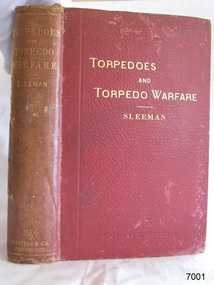
Book - Reference/History/Naval Armaments Technical Manual, Griffin & Co. (Publishers by appointment to Her Majesty and H.R.H. the Duke of Edinburugh), Torpedoes and Torpedo Warfare, 1889
... This work is significant, mainly as an early comprehensive handbook on torpedoes and submarine warfare rather than as a literary classic. It is historically important because it captures torpedo doctrine and technology at a moment when self-propelled torpedoes had recently become central to naval warfare Its significance today is mostly historical and technical. ...Torpedoes and Torpedo Warfare is a late-19th century naval history/manual about the development of submarine warfare, torpedoes, mines, and the vessels and tactics used to deploy them. It was originally written as a technical survey of the weapon’s rise and practical use, with diagrams and detailed descriptions. The book traces the evolution of torpedo warfare from early submarine mines through the introduction of electric detonation and later improvements. It is part history, part technical handbook.Torpedoes and Torpedo Warfare, by C. Sleeman. Containing a complete account of the progress of submarine warfare; also a detailed description of matters appertaining thereto, including the latest improvements, with 83 full-page illustrations, diagrams etc. Second Edition. 1889. Published by Griffin & Co, U.K. Hard-cover, bound book, red with gold lettering. Inscription inside the cover. non-fictionTorpedoes and Torpedo Warfare is a late-19th century naval history/manual about the development of submarine warfare, torpedoes, mines, and the vessels and tactics used to deploy them. It was originally written as a technical survey of the weapon’s rise and practical use, with diagrams and detailed descriptions. The book traces the evolution of torpedo warfare from early submarine mines through the introduction of electric detonation and later improvements. It is part history, part technical handbook. warrnambool, shipwrecked-coast, flagstaff-hill, flagstaff-hill-maritime-museum, maritime-museum, shipwreck-coast, flagstaff-hill-maritime-village, shipwrecked-artefact, book, c. sleeman author, torpedo warfare, submarine warfare -
 Bendigo Military Museum
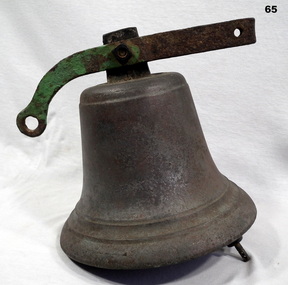
Tool - SHIPS BELL, c.1900
... The Freighter had been torpedoed by a German Submarine in WW1. maritime technology ship relics military history - navy ships fittings souvenirs Ship's bell, rough cast bronze? ...This bell was apparently salvaged from a Freighter by Syd Storrie a Merchany Navy Sailor. The Freighter had been torpedoed by a German Submarine in WW1.Ship's bell, rough cast bronze? Clapper is rough cast steel. There is an old steel mounting bracket at the top, painted green. maritime technology, ship relics, military history - navy, ships fittings, souvenirs -
 Monbulk RSL Sub Branch
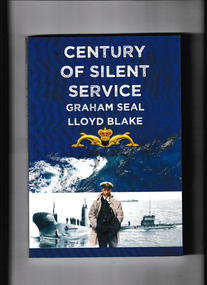
Book, Boolarong Press, Century of silent service, 2013
... Submarine warfare Australia's Submariners are a group with an extremely strong sense of identity that goes well beyond occupational comradeship or the esprit de corps of military life in peace or war. Since 1914, the unique skills, attitudes, values and demands of the work they do and the environment in which they do it have forged unparalleled camaraderie. A camaraderie that extends beyond nationality, embracing submariners past and present of every other nation. No one but submariners understand the experience of diving deep beneath the waves in technology ...Australia's Submariners are a group with an extremely strong sense of identity that goes well beyond occupational comradeship or the esprit de corps of military life in peace or war. Since 1914, the unique skills, attitudes, values and demands of the work they do and the environment in which they do it have forged unparalleled camaraderie. A camaraderie that extends beyond nationality, embracing submariners past and present of every other nation. No one but submariners understand the experience of diving deep beneath the waves in technology filled tubes of steel, each submariner totally dependent on the other for a safe return to the surface. The ethos of Australia's submariners is based upon these factors and remains strong even when they leave the sea and take up other occupations. Australia's future submarines will certainly present challenges in terms of sophistication, technology and capability however the characteristics of our submariners evolved over previous generations will remain much the same; trained and equipped to meet the challenges; just as they have been met and surmounted so many times, in silence, over a century of service.Bib, ill, maps, p.243.non-fictionAustralia's Submariners are a group with an extremely strong sense of identity that goes well beyond occupational comradeship or the esprit de corps of military life in peace or war. Since 1914, the unique skills, attitudes, values and demands of the work they do and the environment in which they do it have forged unparalleled camaraderie. A camaraderie that extends beyond nationality, embracing submariners past and present of every other nation. No one but submariners understand the experience of diving deep beneath the waves in technology filled tubes of steel, each submariner totally dependent on the other for a safe return to the surface. The ethos of Australia's submariners is based upon these factors and remains strong even when they leave the sea and take up other occupations. Australia's future submarines will certainly present challenges in terms of sophistication, technology and capability however the characteristics of our submariners evolved over previous generations will remain much the same; trained and equipped to meet the challenges; just as they have been met and surmounted so many times, in silence, over a century of service.royal australian navy - submarine forces, submarine warfare -
 National Vietnam Veterans Museum (NVVM)
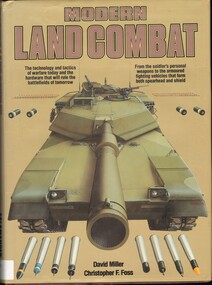
Book, Miller, David and Foss, Christopher F, Modern Land Combat, 1987
... In combination with the earlier titles devoted to Modern Air Combat, Modern fighting Helicopters, Modern Naval Combat and Modern Submarine Warfare, it completes a detailed, graphically illustrated survey of the technology, hardware and tactics involved in all the main areas of current military activity. ...The organisation of this book follows the established style of the successful series of which if forms part. In combination with the earlier titles devoted to Modern Air Combat, Modern fighting Helicopters, Modern Naval Combat and Modern Submarine Warfare, it completes a detailed, graphically illustrated survey of the technology, hardware and tactics involved in all the main areas of current military activity.The organisation of this book follows the established style of the successful series of which if forms part. In combination with the earlier titles devoted to Modern Air Combat, Modern fighting Helicopters, Modern Naval Combat and Modern Submarine Warfare, it completes a detailed, graphically illustrated survey of the technology, hardware and tactics involved in all the main areas of current military activity.military art and science, weapons -
 Moorabbin Air Museum
Document (item) - Bill Prowse Collection WP14 See details in Description, Bill Prowse Collection WP14
... Jet Instrument Flying Trainer Type AT50 Maintenance Handbook Australia Flies First Local Hornet - extract from Flight International Magazine 16/3/85 Techniques of Oblique Aerial Photography of agricultural Field trials CSIRO Alata Magazine - Italy Jindivik Target Program for US Army McGregor Range Dowty Hydraulic System and Undercarriages fitted to Armstrong Whitworth Argosy - Course notes Summary of Evaluation of Tactical Transport Aircraft for RAAF - technical report TTA 13/77 Pilot's Notes General RAF Govt of India Press 1943 AP 2095 (RAF) Air BP Journal Number 28 Jindivik Details Sketch Nomad 22B Promotional Catalogue GAF Mirage Metallurgy Technical Memo No 322 Canberra Metallurgy Tech Memo 319 Fatigue racking in mail landing wheels Handbook of wireless Telegraphy Vol 1 1938 Jindivik target Program US Army Aircraft Flight Test recording and Analysis System AFTRAS Tech notes Mission Avionics for Medium Range Maritime Reconnaissance Patrol Aircraft - proposal by Litton Systems for GAF 1993 Assessment of Installation of Edward Davis Jet Engine in Jindivik Initial Study to redesign Jindivik Wing Nomad 22 Fenwick Aviation - French 1972 Jindivik Publication B4A-PO3 Equipment bench test Specs Mirage Metallurgy Memo 302 - disc brakes Mirage Metallurgy Tech memo 326 Corrosion of main landing wheels Adour Mk 871.F405 Rolls RoyceLeading the Trainer Market Adour/F405 Turbo Fan Jet Engine Promotional Jindivik Promotional Catalogue weapons test facilityJindivik Promotional Catalogue weapons test facility Canberra Production line magazine leaflet Mirage IIIO and IIID handwritten report ATAR 8 and 9 Snecma Engine Promotional engine Malkara Guided Weapon promotional leaflet CAC Promotional leaflet brief history 1939 to 1966 Fighters for today and tomorrow McDonnell Douglas McDonnell Douglas Hornet Production details Australian Industry Participation Program Northrop Turana Australia's Target reprint of article from Aircraft Magazine Ikara Anti Submarine guided weapon system - single page promotional Nomad de-icing team UK 1979 Jindivik weapons target facility The Hunted One promotional catalogue Jindivik tow system - line drawings Mirage III Bulletins Meteor Target a/c accident A77-802 Investigation result 1969 GAF Brochure and products 1969 Defence Science and Technology Organisation Brochures for Aeronautical and Maritime Research Lab Jindivik Mk4 Report GAF Jindivick brief history Design proposal for Searchlight on N22 Nomad The Link Trainer - article Thrust Alignment for launch/firing at Woomera Ikara - photos Turana - naval target 1970 article Ceres Agricultural CAC proposal Magazine Missile and Razzi 1962 RFDS 50th anniversary publication magazine Potential new workload estimates for GAF 1983 Parachute Assembly deceleration Type 936-71 ...Jet Instrument Flying Trainer Type AT50 Maintenance Handbook Australia Flies First Local Hornet - extract from Flight International Magazine 16/3/85 Techniques of Oblique Aerial Photography of agricultural Field trials CSIRO Alata Magazine - Italy Jindivik Target Program for US Army McGregor Range Dowty Hydraulic System and Undercarriages fitted to Armstrong Whitworth Argosy - Course notes Summary of Evaluation of Tactical Transport Aircraft for RAAF - technical report TTA 13/77 Pilot's Notes General RAF Govt of India Press 1943 AP 2095 (RAF) Air BP Journal Number 28 Jindivik Details Sketch Nomad 22B Promotional Catalogue GAF Mirage Metallurgy Technical Memo No 322 Canberra Metallurgy Tech Memo 319 Fatigue racking in mail landing wheels Handbook of wireless Telegraphy Vol 1 1938 Jindivik target Program US Army Aircraft Flight Test recording and Analysis System AFTRAS Tech notes Mission Avionics for Medium Range Maritime Reconnaissance Patrol Aircraft - proposal by Litton Systems for GAF 1993 Assessment of Installation of Edward Davis Jet Engine in Jindivik Initial Study to redesign Jindivik Wing Nomad 22 Fenwick Aviation - French 1972 Jindivik Publication B4A-PO3 Equipment bench test Specs Mirage Metallurgy Memo 302 - disc brakes Mirage Metallurgy Tech memo 326 Corrosion of main landing wheels Adour Mk 871.F405 Rolls RoyceLeading the Trainer Market Adour/F405 Turbo Fan Jet Engine Promotional Jindivik Promotional Catalogue weapons test facilityJindivik Promotional Catalogue weapons test facility Canberra Production line magazine leaflet Mirage IIIO and IIID handwritten report ATAR 8 and 9 Snecma Engine Promotional engine Malkara Guided Weapon promotional leaflet CAC Promotional leaflet brief history 1939 to 1966 Fighters for today and tomorrow McDonnell Douglas McDonnell Douglas Hornet Production details Australian Industry Participation Program Northrop Turana Australia's Target reprint of article from Aircraft Magazine Ikara Anti Submarine guided weapon system - single page promotional Nomad de-icing team UK 1979 Jindivik weapons target facility The Hunted One promotional catalogue Jindivik tow system - line drawings Mirage III Bulletins Meteor Target a/c accident A77-802 Investigation result 1969 GAF Brochure and products 1969 Defence Science and Technology Organisation Brochures for Aeronautical and Maritime Research Lab Jindivik Mk4 Report GAF Jindivick brief history Design proposal for Searchlight on N22 Nomad The Link Trainer - article Thrust Alignment for launch/firing at Woomera Ikara - photos Turana - naval target 1970 article Ceres Agricultural CAC proposal Magazine Missile and Razzi 1962 RFDS 50th anniversary publication magazine Potential new workload estimates for GAF 1983 Parachute Assembly deceleration Type 936-71 Bill Prowse Collection WP14 Document Bill Prowse Collection WP14 See details in Description ... -
 Lakes Entrance Historical Society
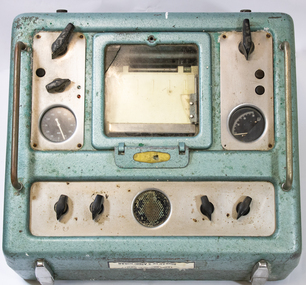
Equipment - Asdic Echo Sounder
... This technology was developed by the British during WW2 to detect submarines...This technology was developed by the British during WW2 to detect submarines Historical MARITIME TECHNOLOGY Fisheries First fish finder in Australia - installed on boat 'Maasbanker' in 1968. ...First fish finder used in Australia. This technology was developed by the British during WW2 to detect submarinesHistoricalFirst fish finder in Australia - installed on boat 'Maasbanker' in 1968. Simrad SK3 Asdic Soundermaritime technology, fisheries -
 Lilydale RSL Sub Branch
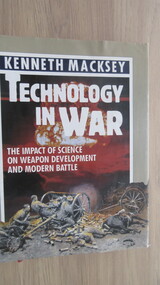
Book, Kenneth Macksey, Technology in War, 1986
... Kenneth Macksey first identifies the key developments, then by reference to specific battles discusses the tremendous impact on strategy and tactics of inventions as varied as Bessemer steel, the tank submarine, jet engine, atom bomb, computer and laser. Book Technology in War Book Kenneth Macksey Grub Street Sagdos ...Kenneth Macksey first identifies the key developments, then by reference to specific battles discusses the tremendous impact on strategy and tactics of inventions as varied as Bessemer steel, the tank submarine, jet engine, atom bomb, computer and laser.Booknon-fictionKenneth Macksey first identifies the key developments, then by reference to specific battles discusses the tremendous impact on strategy and tactics of inventions as varied as Bessemer steel, the tank submarine, jet engine, atom bomb, computer and laser. -
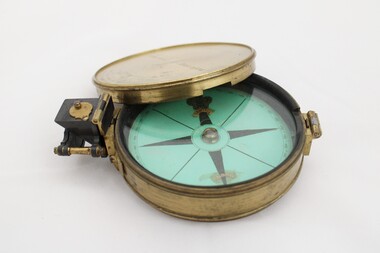 National Communication Museum
Equipment - Prismatic compass, Alfred E Sawtell, before 1872
... technologies such as his prismatic surveying compass. The unknown and hostile landscape claimed the lives of several men and scores of transport animals in the dogged pursuit of telegraphic connection to the rest of the world. Completed in August 1872, the Line connected Australia to the world via telegraph wires running 3,200 kilometres from Port Augusta in South Australia, to Darwin, then connecting via submarine cable to Java and beyond. ...technologies such as his prismatic surveying compass. The unknown and hostile landscape claimed the lives of several men and scores of transport animals in the dogged pursuit of telegraphic connection to the rest of the world. Completed in August 1872, the Line connected Australia to the world via telegraph wires running 3,200 kilometres from Port Augusta in South Australia, to Darwin, then connecting via submarine cable to Java and beyond. ...After years of precursory surveying, debate and proposals the most ambitious civil engineering project of the day, the Overland Telegraph Line, began construction in September 1870. Superintendent of Telegraphs, Sir Charles Todd led the construction through “terra incognita,” guided by the precursory surveys of John McDowall Stuart and technologies such as his prismatic surveying compass. The unknown and hostile landscape claimed the lives of several men and scores of transport animals in the dogged pursuit of telegraphic connection to the rest of the world. Completed in August 1872, the Line connected Australia to the world via telegraph wires running 3,200 kilometres from Port Augusta in South Australia, to Darwin, then connecting via submarine cable to Java and beyond. The “earth [had been] girdled with a magic chain” according to the then Governor of New South Wales, Sir Hercules Robinson. How does it work? For use in surveying, the sight vane and prism are turned up on their hinge and the instrument is held horizontally either in the palm of one's hand or on a tripod. Two small discs of red and green glass attached to the prism can be flipped down over the sight line to reduce glare. The objective is to bring the subject into the sightline created by the prism, aligning with the thread of the sight-vane until the subject is bisected evenly. Once aligned, the division on the card may be read through the prism. This reading provides the magnetic azimuth, used for calculating the bearings of distant landmarks. Circular instrument mounted in a brass case with glass window and brass lid. The compass card face four black compass points printed on mint green paper; on the underside the magnetic needle would be affixed, all held in place by a brass knob at the centre. The arched labels of "Sawtell" and "Adelaide" and the Prince of Wales feathers appear to have been affixed with adhesive which has since yellowed in the areas of application on the compass card. The compass face is printed with numbers, every 10 degrees from 10 - 360, printed in reverse indicating this compass would have once held a mirror at the sighting bracket. On one side of the brass case is a brass hinged sighting-prism, possibly of ebonite. The sighting-prism is mounted in a hinged brass bracket on one edge of the brass case. It has two flip-type filter glasses (red and green) and folds down into a retracted travelling position. A hinged brass bracket on the opposite edge would have held the sighting bracket - carrying the sighting vane and mirror - which is now missing or removed. Under the hinge is a lever, possibly related to the movement of the bracket. Underneath the brass case is an indented circle with screw threads, possibly for attachment to a tripod, and indistinguishable marks scratched into the surface.Etched on to the centre of the lid, "Sawtell ADELAIDE / No 792." Affixed to the paper compass face, possibly from separate pieces of paper, "SAWTELL / ADELAIDE" with the Prince of Wales Feathers above "SAWTELL". Underneath on remains of white tape in red: "159."surveying, compass, charles todd, overland telegraph line, telegraph
