
Showing 195 items matching "suburban australia"
-
 Broadmeadows Historical Society & Museum
Document - Letter, Roby, 9 June 1964
... ...suburban Australia...Personal correspondence family relationships engagement announcements social customs mid 20th century daily life suburban Australia international travel plans Japan travel Hong Kong travel civic roles mayoral identity handwritten letters 1960s Australia Envelope Front / Address side: PLEASE POST EARLY AUSTRALIA BEFORE LUNCH BEFORE FOUR O'CLOCK/9 JUN 1964/Miss Kath Fletcher/14 Wembley Road/Fawkner / Vic Letter text: 64 Fisher Drive/Mile End/South Australia/9-6-1964/Dear Kath/Many thanks for your kind/ thoughts and the Ticket for my Birthday I/think Kath this ticket should show results/as the whole thing seems to be wrapped up/in such great occasions/ Vally & I was / terribly thrilled with the great news of your/engagement to Keith (ARC) I am sure that it/will mean great happiness to you both because/what we saw of ARC he is a very fine/gentleman and yourself you Know our/Thoughts so once again luck to you both/ also Mum:/ As you know we have our name down/for Japan & Hong Kong next July 1965 and passing/through Melbourne we will certainly look up the/ Mayor & Mayoress/ Will Vally is scribbling something/so will conclude this note with our Deepest & Sincere/wishes to you both and may God Grant you all the/happiness that is due to you/(A Kiss for / Kiss for Mum/ Roby)/Yours sweetly/Roby Single page handwritten letter, ink on paper. ...The letter was written from Mile End, South Australia, and references anticipated overseas travel to Japan and Hong Kong in July 1965, as well as civic roles (“Mayor & Mayoress”), situating the item in mid 20th century Australian social and family networks.This item is a well documented example of everyday Australian correspondence in the 1960s, notable for its clear geographic origin, personal engagement announcement, and references to international travel and civic identity, enhancing its social and historic interpretive value.Single page handwritten letter, ink on paper. Envelope Front / Address side: PLEASE POST EARLY AUSTRALIA BEFORE LUNCH BEFORE FOUR O'CLOCK/9 JUN 1964/Miss Kath Fletcher/14 Wembley Road/Fawkner / Vic Letter text: 64 Fisher Drive/Mile End/South Australia/9-6-1964/Dear Kath/Many thanks for your kind/ thoughts and the Ticket for my Birthday I/think Kath this ticket should show results/as the whole thing seems to be wrapped up/in such great occasions/ Vally & I was / terribly thrilled with the great news of your/engagement to Keith (ARC) I am sure that it/will mean great happiness to you both because/what we saw of ARC he is a very fine/gentleman and yourself you Know our/Thoughts so once again luck to you both/ also Mum:/ As you know we have our name down/for Japan & Hong Kong next July 1965 and passing/through Melbourne we will certainly look up the/ Mayor & Mayoress/ Will Vally is scribbling something/so will conclude this note with our Deepest & Sincere/wishes to you both and may God Grant you all the/happiness that is due to you/(A Kiss for / Kiss for Mum/ Roby)/Yours sweetly/Roby personal correspondence, family relationships, engagement announcements, social customs, mid 20th century daily life, suburban australia, international travel plans, japan travel, hong kong travel, civic roles, mayoral identity, handwritten letters, 1960s australia -
 Tatura Irrigation & Wartime Camps Museum
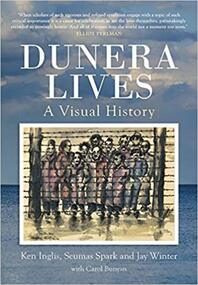
Book, Dunera Lives. Volume 1 A Visual History, 2018
... 40 Exhibition Walk, Clayton , suburban Melbourne, Victoria, Australia ...A remarkable, thoroughly researched and detailed record of "Dunera" internee artists with examples of their varied styles of water and colour paintings, sketches and cartoons. Vivid reminders of the whole experience of internment in Australia during World War 2 for these men. Launched at the Jewish Museum in St Kilda, Sunday July 8th and Monday July 9th at Readings Books in Melbourne.Visual history of camp life of the Dunera boysBlue soft cover, with front cover painting by Emil Wittenberg. Painted at Tatura on 23rd May 1941, depicts a group of Dunera internees behind barbed wire. B/W and colour photos, sketches, paintings and watercolour.To the memory of Amirah Inglis. A photograph of Kenneth Stanley Inglis, 7 October 1929 - 1 December 2017dunera boys -
 Tatura Irrigation & Wartime Camps Museum
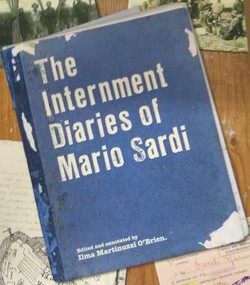
Book, Mario Sardi, The Internment Diaries of Mario Sardi, 2013
... Alphington, suburban Melbourne, Victoria, Australia ...A series of 5 diaries. Introduction: The Internment Experience at Loveday. Diary No 1 27th April 1942 to 23rd June 1942. Diary No 2. 24th June 1942 to 23 August 1942. Diary No 3 24th August 1942 to 24th March 1943. Diary No 4 25th March 1943 to @ 21st August 1943. Diary No 5 22th August 1943 to 18th Jan 1945. Book's title is written on a small book shape to look like a diary, which is superimposed on front cover, covering pictures of Mario and his cane cutter friends along with diary excerpts. includes bibliographical references and index. -
 Robin Boyd Foundation
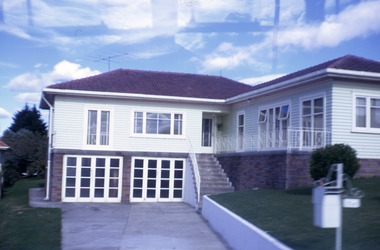
Slide, Robin Boyd, 1967
... Suburban architecture, possibly Australia...slide robin boyd Made in Australia / 3 / MAY 67M6 / 12 (Handwritten) Colour slide in a mount. Suburban architecture, possibly Australia Slide Robin Boyd ...Colour slide in a mount. Suburban architecture, possibly AustraliaMade in Australia / 3 / MAY 67M6 / 12 (Handwritten)slide, robin boyd -
 Robin Boyd Foundation
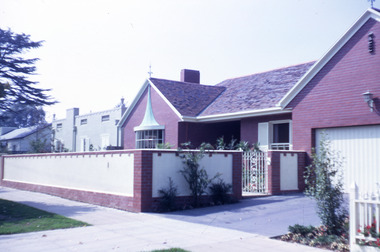
Slide, Robin Boyd, 1967
... Suburban architecture, possibly Australia or New Zealand...From New Zealand, he travelled on to Montreal, Canada, where he was Exhibits Architect for the Australian Pavilion at Expo ‘67. slide robin boyd Made in Australia / 27 / APR 67M4 / Encircled 16 (Handwritten) / Encircled 1 (Handwritten) Colour slide in a mount. Suburban ...Robin Boyd was an invited speaker at the 1967 New Zealand Institute of Architects Conference held in Queenstown, New Zealand. From New Zealand, he travelled on to Montreal, Canada, where he was Exhibits Architect for the Australian Pavilion at Expo ‘67. Colour slide in a mount. Suburban architecture, possibly Australia or New ZealandMade in Australia / 27 / APR 67M4 / Encircled 16 (Handwritten) / Encircled 1 (Handwritten)slide, robin boyd -
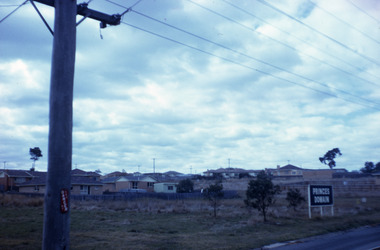 Robin Boyd Foundation
Slide, Robin Boyd, 1967
... Princes Domain, land tract, possibly suburban Melbourne, Victoria, Australia...slide robin boyd Made in Australia / 8 / JUN 67M6 / Encircled 28a (Handwritten) Colour slide in a mount. Princes Domain, land tract, possibly suburban Melbourne, Victoria, Australia Slide Robin Boyd ...Colour slide in a mount. Princes Domain, land tract, possibly suburban Melbourne, Victoria, AustraliaMade in Australia / 8 / JUN 67M6 / Encircled 28a (Handwritten)slide, robin boyd -
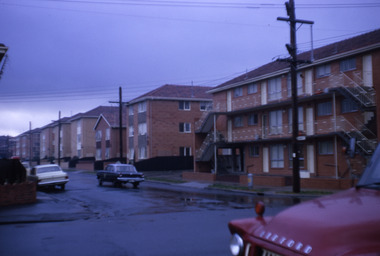 Robin Boyd Foundation
Slide, Robin Boyd, 1967
... Low rise apartment blocks, possibly suburban Melbourne, Victoria, Australia...slide robin boyd Made in Australia / 6 / JUN 67M6 / Encircled 27 (Handwritten) Colour slide in a mount. Low rise apartment blocks, possibly suburban Melbourne, Victoria, Australia Slide Robin Boyd ...Colour slide in a mount. Low rise apartment blocks, possibly suburban Melbourne, Victoria, AustraliaMade in Australia / 6 / JUN 67M6 / Encircled 27 (Handwritten)slide, robin boyd -
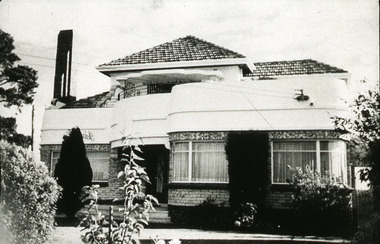 Robin Boyd Foundation
Slide, Robin Boyd
... (Possibly) Suburban house, Melbourne, Victoria, Australia...Melbourne slide Inscribed Made in Australia / Encircled 24 (Handwritten) Colour slide in a mount. (Possibly) Suburban house, Melbourne, Victoria, Australia Slide Robin Boyd ...Colour slide in a mount. (Possibly) Suburban house, Melbourne, Victoria, AustraliaInscribed Made in Australia / Encircled 24 (Handwritten)melbourne, slide -
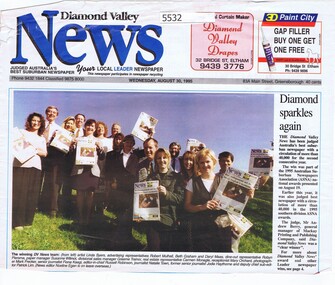 Greensborough Historical Society
Newspaper Clipping, Diamond Valley News, Diamond sparkles again, 30/08/1995
... Article on the award to Diamond Valley News for best Australian suburban newspaper 1995....Article on the award to Diamond Valley News for best Australian suburban newspaper 1995. diamond valley news Newspaper clipping, group colour photograph of newspaper staff Diamond sparkles again Newspaper Clipping Diamond Valley News ...Article on the award to Diamond Valley News for best Australian suburban newspaper 1995.Newspaper clipping, group colour photograph of newspaper staff diamond valley news -
 Greensborough Historical Society
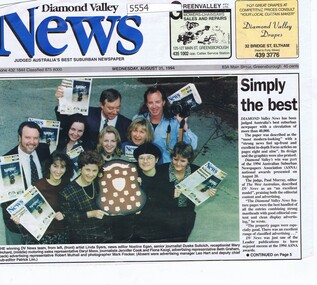
Newspaper Clipping, Diamond Valley News, Simply the best, 31/08/1994
... Article on the award to Diamond Valley News for best Australian suburban newspaper 1994...Article on the award to Diamond Valley News for best Australian suburban newspaper 1994 diamond valley news Newspaper clipping text and colour group photograph of newspaper staff Simply the best Newspaper Clipping Diamond Valley News ...Article on the award to Diamond Valley News for best Australian suburban newspaper 1994Newspaper clipping text and colour group photograph of newspaper staffdiamond valley news -
![Scouting in Hawthorn: a history 1909-1993 / [by] Albert P. Isaacs](/media/collectors/550653872162f11fb04854aa/items/5ece0389f36c2704c4f06e50/item-media/5ece043af36c2704c4f07611/item-fit-380x285.jpg?cb=6) Kew Historical Society Inc
Kew Historical Society IncBook, Albert P. Isaacs, Scouting in Hawthorn: a history 1909-1993, 1993
... .] : The Scout Association of Australia, East Suburban Area, Hawthorn District, District Association, 1993 134 p. : ill., ports. ; 30 cm. ....] : The Scout Association of Australia, East Suburban Area, Hawthorn District, District Association, 1993 134 p. : ill., ports. ; 30 cm. ...[Hawthorn, Vic.] : The Scout Association of Australia, East Suburban Area, Hawthorn District, District Association, 1993 134 p. : ill., ports. ; 30 cm. non-fictionscouting (youth activity) -- victoria -- hawthorn -- history, scout association of australia. hawthorn district -- history. -
 Greensborough Historical Society
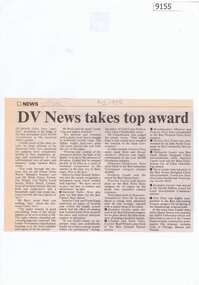
Article - Newspaper Clipping, Diamond Valley News, DV News takes top award, August 1995
... Article about Diamond Valley News receiving ASNA awards (Australian Suburban Newspaper Awards) . Editor in chief was Russell Robinson....Article about Diamond Valley News receiving ASNA awards (Australian Suburban Newspaper Awards) . Editor in chief was Russell Robinson. ...Article about Diamond Valley News receiving ASNA awards (Australian Suburban Newspaper Awards) . Editor in chief was Russell Robinson.Black and white text onlydiamond valley news, russell robinson, local newspapers -
University of Melbourne, Burnley Campus Archives
Document (item) - Masters and PhD Research papers, Anne Vale, 2005 - 2009
... Box D contains CD and hard copy of Master of Horticulture thesis, "Olive Mellor & the Australian Suburban Garden" (2005) and the PhD thesis, "Lives & Legacies: Exceptional Australian Garden-Makers of the 20th Century" (2009)...Box D contains CD and hard copy of Master of Horticulture thesis, "Olive Mellor & the Australian Suburban Garden" (2005) and the PhD thesis, "Lives & Legacies: Exceptional Australian Garden-Makers of the 20th Century" (2009) Anne Vale Document Masters and PhD Research papers Anne Vale ...olive mellor (nee holttum), edna walling, emily gibson, c.b. luffmann, olive pink, peter valdor, margaret hendry, alistair knox, david glen, tom garnett, kevin heinze, jean galbraith, , bill mollison, betty maloney, jean walker, george seddon, diana snape, joan law-smith, thomas shepherd, john turner, john stevens, william sangster, paul sorensen, ellis stones, margaret darling, sophie ducker, mervyn davis, jocely brown, beatrice bligh, grace fraser, peter cundall, gordon ford, fiona brockhoff, clive blazey, masters thesis, phd thesis -
 Clunes Museum
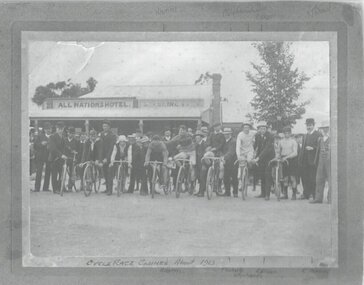
Photograph, CYCLE RACE
... PHOTOGRAPH TAKEN IN FRONT OF ALL NATIONS HOTEL CORNER OF TALBOT ROAD AND SUBURBAN STREET, CLUNES, VICTORIA, AUSTRALIA...PHOTOGRAPH TAKEN IN FRONT OF ALL NATIONS HOTEL CORNER OF TALBOT ROAD AND SUBURBAN STREET, CLUNES, VICTORIA, AUSTRALIA PHOTOGRAPHY SPORT BICYCLE BYCICLE RACE 1912 OR 1913 CYCLE RACE CLUNES ABOUT 1913 NAMES WRITTEN ON OF PARTICIPANTS. ...START OF CYCLE RACE CLUNES. H. HARRIS, F. ROBERTS,W. RICHARDS, E. OLSON, R.THOMAS. PHOTOGRAPH TAKEN IN FRONT OF ALL NATIONS HOTEL CORNER OF TALBOT ROAD AND SUBURBAN STREET, CLUNES, VICTORIA, AUSTRALIAPHOTOGRAPH OF START CYCLE RACE ABOUT 1912 OR 1913 PICTURE TAKEN IN FRONT OF ALL NATIONS HOTELCYCLE RACE CLUNES ABOUT 1913 NAMES WRITTEN ON OF PARTICIPANTS. H HARRIS , F ROBERTS, W RICHARDS, E OLSEN R THOMAS,photography, sport, bicycle, bycicle race 1912 or 1913 -
 Robin Boyd Foundation
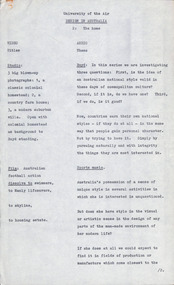
Document - Script, Robin Boyd, University of the Air. Design in Australia 2. The home, 1964
... Australia... Robin Boyd... Private home... homesteads... Australian home... suburban...Boyd believes that the Australian suburban villa is authentically vernacular in the sense of social phenomenon....Boyd believes that the Australian suburban villa is authentically vernacular in the sense of social phenomenon. ...Robin Boyd was involved in creating several TV series for the ABC University of the Air. 'Design in Australia' was an eight part series. (Items D184-D193 contain all the manuscripts except part six titled 'Communications'.) In Part 2, through a brief discussion of the history of Australian houses, both urban and rural, Boyd points out distinct Australian qualities that differentiate the domestic houses from their European and American origins. Boyd believes that the Australian suburban villa is authentically vernacular in the sense of social phenomenon.This is a draft script for the ABC television program 'University of the Air', subtitled 'Design in Australia', broadcast in 1965.Typewritten (c copy), foolscap, 16 pagesuniversity of the air, design in australia, robin boyd, private home, homesteads, australian home, suburban villa, vernacular, manuscript -
 Federation University Historical Collection
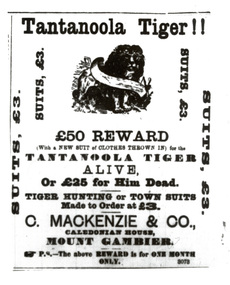
Newspaper - Newsclippings, Tantanoola Tiger Newsclippings
... suburban circle, about 8 miles from the general Post Office. They show you footprints, and point to the carcasses of mangled cows and calves. Casts have been taken of the footprints for examination by scientific men, who pronounce them doglike, and yet not doglike, but panther-like, which gives a nervous turn, for the panther may take up killing children and grown-up people. One tiger will not account for so many apparitions. There must have been a general strike among the menageries, and a breaking-up companies. ... * Research article by Philip A. Clarke "Indigenous Spirit and Ghost Folklore of 'Settled' Australia...suburban circle, about 8 miles from the general Post Office. They show you footprints, and point to the carcasses of mangled cows and calves. Casts have been taken of the footprints for examination by scientific men, who pronounce them doglike, and yet not doglike, but panther-like, which gives a nervous turn, for the panther may take up killing children and grown-up people. One tiger will not account for so many apparitions. There must have been a general strike among the menageries, and a breaking-up companies. ... * Research article by Philip A. Clarke "Indigenous Spirit and Ghost Folklore of 'Settled' Australia ...In the early 1880s a small circus travelled between Millicent and Mt Gambier, South Australia. After camping overnight they discovered their Bengal Tiger at escaped and disappeared into dense scrub. After searching for hours they continued to Mt Gambier and reported the loss of the tiger to police. Police and local volunteers continued the search for the escaped tiger, but no sighting were made. In the early 1890s sheep in the Tantanoola area started to disappear with the still unsighted tiger being blamed. In 1893 reports of an unusual animal in the Tantanoola area started, with many describing the animal as the missing tiger, or a large dog. One eye witness claimed to have seen the animal carrying a full grown sheep in its mouth. The reports grew in number and exaggeration with sightings from Robe to Bendigo. In the Tantanoola district children were escorted with shotgun guards to and from school, with many homes keeping guns at the ready in case the tiger suddenly appeared. In August 1895 Tom Donovan shot the "Tantanoola Tiger" on Mt Salt Station, around 20 kms south of Tantanoola. The corpse was taken to Marks, a Mount Gambier taxidermist, at which time the animal was identified as an Assyrian or Northern Russian Wolf. Donovan displayed the animal far and wide. Despite the animal's death sheep continued to disappear from properties in the district over many years. It was of particular concern between 1909 and 1910. At that time Herbert Allchurch, an Adelaide detective, was sent to solve the mystery. A few days after his arrival Allchruch went to the front bar of the Tiger Hotel and arrested local rabbit shooter and trapper, Charlie Edmunson, with sheep stealing. After his 1911 trial Edmunson admitted to stealing over 4,000 sheep during the previous 20 years. He was gaoled for six years with hard-labour in January 1911. Edmunson had been selling the skins of the stolen sheep, leaving the carcusses to rot. He earned around five pounds per week during the 1990s and early 1900s, a time when the economy was depressed. It is not known had the animal known as the Tantanoola Tiger came to Australia, but it is believed it survived one of three ships wrecked of the coast between 1890 and 1893, making it to shore along with some of the shipwrecked passengers. (From a card produced by the Tantanoola Tiger Hotel, where the 'tiger' is on display.)A collection of Newsclippings from 1892 - 1895 photocopied onto A4 white paper. The clippings relate to the Tantanoola Tiger. Clippings include: * Border Watch 1892 - Tantanoola Tiger Reward * Sydney Morning Herald, 04/07/1857 - Animals in Zoological Gardens, including a number of large cats. * Claims the Tantanoola Tiger was an escaped circus animal (ie The Advertiser [Adelaide], 31 October 1893) * Search parties for the Tantanoola Tiger (ie Barrier Miner 19/05/1893; Barrier Miner 03/1081893) * Thylacine claim (ie Morning Bulletin [Rockhampton] 11/03/1895 * Afghan and Indian Hunters (ie Barrier Miner 07/02/1895) * Sighting by John Bird of Scarsdale - Wanganui Herald 15/12/1900. " ... Mr Bird was travelling on foot along a lonely track through very dense scrub, when he was stricken with amazement to see a full-grown tiger standing in a small dam about 30ft away, and holding in its jaws the carcass of a newly-killed lamb. He remained long enough to thoroughly take in the animals appearance, and then beat a hasty retreat unmolested. His description of the animal is as follows: A tawny-coloured creature, with a dirty mottled skin; in general appearance like an immense cat; body 4ft long, and of a uniform thickness from shoulder to hindquarters; in bulk equal to a very large pig. The legs were hidden in the water. A similar animal is reported to gave been seen near Canico, some miles away. ..." * Victorian country sightings # Bullarto - Argus 06/05/1905 # Dean - Launceston Examiner 28/01/1895 # Bendigo - Hobart Mercury 15/03/1895 # Ballan - Launceston Examiner 03/08/1895 * South Australian register 17/06/1885 " There is a tiger or panther wandering at large in Victoria, according to a rumour. It has taken the place of the Bunyip, whom hundreds have seen but none captured. This tiger is supposed to have broken loose from a travelling menagerie in the North-eastern district. At the beginning we should like it roved that such an escape ever took place. Perhaps the showmen were afraid to report the fact to the police; at any rate they did not do so. The first story about the tiger being seen came from the neighborhood of Wangaratta, 60 miles from the place where it is said to have commenced business on its own account. He was followed, but vanished among trees. Next we hear of a strange animal, bigger than a St Bernard's dog, but shorter legged, having appeared at least 150 miles from Wangaratta. Between Lilydale and Wangaratta there is a dividing range 2,000 feet high in the lowest past, besides several large rivers. An finally, the tiger - changed from a panther - is reported as having been seen within the suburban circle, about 8 miles from the general Post Office. They show you footprints, and point to the carcasses of mangled cows and calves. Casts have been taken of the footprints for examination by scientific men, who pronounce them doglike, and yet not doglike, but panther-like, which gives a nervous turn, for the panther may take up killing children and grown-up people. One tiger will not account for so many apparitions. There must have been a general strike among the menageries, and a breaking-up companies. ... * Research article by Philip A. Clarke "Indigenous Spirit and Ghost Folklore of 'Settled' Australia. australian animal folklore collection, tantanoola tiger, tom donovan, herbert allchurch, charles edmunson, sheep, charlie edmunson, mythical, myth, folklore -
 The Beechworth Burke Museum
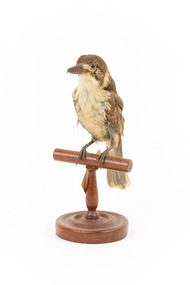
Animal specimen - Grey Butcher Bird, Trustees of the Australian Museum, 1860-1880
... Grey Butcherbirds live in wooded habitats, including suburban areas, from the north of Western Australia, across different parts of the top of the country, through to mid-eastern Queensland, and then south along the eastern side of the country all the way down to Tasmania. ...Grey Butcherbirds live in wooded habitats, including suburban areas, from the north of Western Australia, across different parts of the top of the country, through to mid-eastern Queensland, and then south along the eastern side of the country all the way down to Tasmania. ...Grey Butcherbirds live in wooded habitats, including suburban areas, from the north of Western Australia, across different parts of the top of the country, through to mid-eastern Queensland, and then south along the eastern side of the country all the way down to Tasmania. They have a 'lovely, lilting song', and are fiercely protective of their nests and chicks, swooping at presumed attackers with enough strength to sometimes draw blood. Adult Grey Butcher Birds are typically a light grey colour with dark heads and white underparts. The brown colouring on this animal suggests that it is a young bird, with its grey adult feathers coming in. This bird appears thinner than most Grey Butcher Birds, but it is unclear if this is because of its age or because of inaccurate taxidermy. This specimen is part of a collection of almost 200 animal specimens that were originally acquired as skins from various institutions across Australia, including the Australian Museum in Sydney and the National Museum of Victoria (known as Museums Victoria since 1983), as well as individuals such as amateur anthropologist Reynell Eveleigh Johns between 1860-1880. These skins were then mounted by members of the Burke Museum Committee and put-on display in the formal space of the Museum’s original exhibition hall where they continue to be on display. This display of taxidermy mounts initially served to instruct visitors to the Burke Museum of the natural world around them, today it serves as an insight into the collecting habits of the 19th century.This specimen is part of a significant and rare taxidermy mount collection in the Burke Museum. This collection is scientifically and culturally important for reminding us of how science continues to shape our understanding of the modern world. They demonstrate a capacity to hold evidence of how Australia’s fauna history existed in the past and are potentially important for future environmental research. This collection continues to be on display in the Museum and has become a key part to interpreting the collecting habits of the 19th century. This specimen is particularly special in the Burke Museum Collection as it is part of a male/female pair (see Relationships). Many birds in the collection were originally donated in male/female pairs, but at least one specimen has been lost, leaving these as one of the few surviving sets.This Grey Butcher Bird (likely female, based on size) has a light grey and brown bill with a sharp hook. The majority of the feathers on its back and tail are an olive-brown colour. The feathers of its underparts, the patches on either side of its bill, and two stripes coming up either side of its neck are a yellow-white colour. There are some light grey feathers coming through in small patches, particularly across the back, the top of the underparts, and along the upper half of the legs. The eyes are brown. The bird stands on a brown, wooden perch with a circular bar, curved stand, and circular base. It has an identification tag tied around its right leg.18a. / Collared Crow. Shrike / See Catalogue; Page 10. /taxidermy mount, taxidermy, animalia, burke museum, beechworth, australian museum, skin, australian birds, butcher bird, butcherbird, grey butcher bird, collared crow-shrike, australian butcherbird, tasmanian butcherbird, tasmania, bird pair -
 The Beechworth Burke Museum
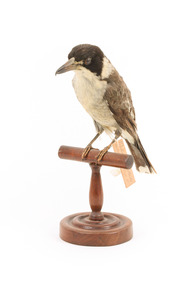
Animal specimen - Grey Butcherbird, Trustees of the Australian Museum, 1860-1880
... Grey Butcherbirds live in wooded habitats, including suburban areas, from the north of Western Australia, across different parts of the top of the country, through to mid-eastern Queensland, and then south along the eastern side of the country all the way down to Tasmania. ...Grey Butcherbirds live in wooded habitats, including suburban areas, from the north of Western Australia, across different parts of the top of the country, through to mid-eastern Queensland, and then south along the eastern side of the country all the way down to Tasmania. ...Grey Butcherbirds live in wooded habitats, including suburban areas, from the north of Western Australia, across different parts of the top of the country, through to mid-eastern Queensland, and then south along the eastern side of the country all the way down to Tasmania. They have a 'lovely, lilting song', and are fiercely protective of their nests and chicks, swooping at presumed attackers with enough strength to sometimes draw blood. Adult Grey Butcher Birds are typically a light grey colour with dark heads and white underparts, while their young are typically olive-brown. The mix of these two types of colouring on this animal suggests that it is a younger bird. This bird appears thinner than most Grey Butcher Birds, but it is unclear if this is because of its age or because of inaccurate taxidermy. This specimen is part of a collection of almost 200 animal specimens that were originally acquired as skins from various institutions across Australia, including the Australian Museum in Sydney and the National Museum of Victoria (known as Museums Victoria since 1983), as well as individuals such as amateur anthropologist Reynell Eveleigh Johns between 1860-1880. These skins were then mounted by members of the Burke Museum Committee and put-on display in the formal space of the Museum’s original exhibition hall where they continue to be on display. This display of taxidermy mounts initially served to instruct visitors to the Burke Museum of the natural world around them, today it serves as an insight into the collecting habits of the 19th century.This specimen is part of a significant and rare taxidermy mount collection in the Burke Museum. This collection is scientifically and culturally important for reminding us of how science continues to shape our understanding of the modern world. They demonstrate a capacity to hold evidence of how Australia’s fauna history existed in the past and are potentially important for future environmental research. This collection continues to be on display in the Museum and has become a key part to interpreting the collecting habits of the 19th century. This specimen is particularly special in the Burke Museum Collection as it is part of a male/female pair (see Relationships). Many birds in the collection were originally donated in male/female pairs, but at least one specimen has been lost, leaving these as one of the few surviving sets.This Grey Butcherbird (likely male, based on size) has a bill that is dark grey at the front with a sharp hook but becomes lighter towards the face. The majority of the feathers on its back are light brown with some grey feathers around the lower half. It's crown area is a dark black colour and its tail is a dark grey. The feathers of its underparts and a small patch on either side of the neck are a yellow-white colour. There are also grey feathers coming through on its underparts. The eyes are brown. The bird stands on a brown, wooden perch with a circular bar, curved stand, and circular base. It has an identification tag tied around its left leg.19a / Collared Crow. Shrike / See Catalogue, Page 10 /taxidermy mount, taxidermy, animalia, burke museum, beechworth, australian museum, skin, australian birds, butcher bird, butcherbird, grey butcherbird, collared crow-shrike, australian butcherbird, tasmanian butcherbird, tasmania, bird pair -
 The Beechworth Burke Museum
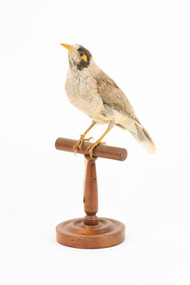
Animal specimen - Noisy Miner, Trustees of the Australian Museum, 1860-1880
... Australia and Tasmania. Noisy Miners are found in woodlands and open forests. They have also become well adapted to suburban situations and are a common sight in parks and gardens. ...Australia and Tasmania. Noisy Miners are found in woodlands and open forests. They have also become well adapted to suburban situations and are a common sight in parks and gardens. ...Noisy Miners are native to Australia and can be found on the East Coast. Noisy Miners live in northern Queensland and all along the eastern coast to South Australia and Tasmania. Noisy Miners are found in woodlands and open forests. They have also become well adapted to suburban situations and are a common sight in parks and gardens. The Noisy Miner feeds on nectar, fruits and insects. Very occasionally they will eat small reptiles and amphibians. Food is either taken from trees or on the ground. In keeping with its highly social nature, the Noisy Miner usually feeds in large groups. The Noisy miner specimen is mounted accurately. This specimen is part of a collection of almost 200 animal specimens that were originally acquired as skins from various institutions across Australia, including the Australian Museum in Sydney and the National Museum of Victoria (known as Museums Victoria since 1983), as well as individuals such as amateur anthropologist Reynell Eveleigh Johns between 1860-1880. These skins were then mounted by members of the Burke Museum Committee and put-on display in the formal space of the Museum’s original exhibition hall where they continue to be on display. This display of taxidermy mounts initially served to instruct visitors to the Burke Museum of the natural world around them, today it serves as an insight into the collecting habits of the 19th century.This specimen is part of a significant and rare taxidermy mount collection in the Burke Museum. This collection is scientifically and culturally important for reminding us of how science continues to shape our understanding of the modern world. They demonstrate a capacity to hold evidence of how Australia’s fauna history existed in the past and are potentially important for future environmental research. This collection continues to be on display in the Museum and has become a key part to interpreting the collecting habits of the 19th century.The Noisy Miner is identified by its mostly grey body and black crown and cheeks. The bill is yellow, as are the legs and the naked skin behind the eye. The name is well suited as the common calls are uttered repeatedly by the members of the colony .Despite their moderate size, Noisy Miners aggressively attack larger birds such as hawks and kookaburras. These attacks may be so vigorous that most other birds are excluded from an area occupied by Noisy Miners.Swing tag: 65a. Garrulous Honey-Eater / See Catalogue, page 19 /taxidermy mount, taxidermy, animalia, burke museum, beechworth, australian museum, skin, reynell eveleigh johns, bird, australian birds, noisy miner, garrulous honeyeater, yellow beak, honeyeater, east coast -
 The Beechworth Burke Museum
Animal specimen - Grey Currawong, Trustees of the Australian Museum, 1860-1880
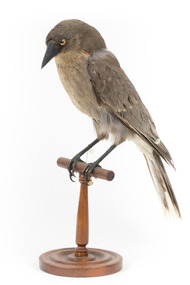
... Australia, including in Tasmania. It is an endangered species in the Northern Territory although the reasons why are not yet known. They prefer a wide range of habitats including coastal to arid and can also be occasionally found in suburban areas. ...Australia, including in Tasmania. It is an endangered species in the Northern Territory although the reasons why are not yet known. They prefer a wide range of habitats including coastal to arid and can also be occasionally found in suburban areas. ...This specimen is a Grey Currawong. There are six subspecies of Grey Currawongs and they can sometimes interbreed with other species of Currawong leading to a divergent series of appearances amongst the species. The species can be found in the south western to south eastern parts of Australia, including in Tasmania. It is an endangered species in the Northern Territory although the reasons why are not yet known. They prefer a wide range of habitats including coastal to arid and can also be occasionally found in suburban areas. This specimen was misidentified as a Grey Crow in original catalogue records and is part of a collection of almost 200 animal specimens that were originally acquired as skins from various institutions across Australia, including the Australian Museum in Sydney and the National Museum of Victoria (known as Museums Victoria since 1983), as well as individuals such as amateur anthropologist Reynell Eveleigh Johns between 1860-1880. These skins were then mounted by members of the Burke Museum Committee and put-on display in the formal space of the Museum’s original exhibition hall where they continue to be on display. This display of taxidermy mounts initially served to instruct visitors to the Burke Museum of the natural world around them, today it serves as an insight into the collecting habits of the 19th century.This specimen is part of a significant and rare taxidermy mount collection in the Burke Museum. This collection is scientifically and culturally important for reminding us of how science continues to shape our understanding of the modern world. They demonstrate a capacity to hold evidence of how Australia’s fauna history existed in the past and are potentially important for future environmental research. This collection continues to be on display in the Museum and has become a key part to interpreting the collecting habits of the 19th century.This Grey Currawong has mainly grey plumage with a white tail tip and darker undercarriage. It has yellow irises, made of glass, and brown claws. The bill is dark in colour. This specimen has been placed upon a wooden mount in a downwards facing position. It has a paper tag attached to its right leg.16a / Grey Cro [torn] / See Cat / [torn] /axidermy mount, taxidermy, animalia, burke museum, beechworth, australian museum, skin, reynell eveleigh johns, bird, grey crow, grey currawong, currawong -
 Flagstaff Hill Maritime Museum and Village
Container - Tin, McKenzies Foods, circa 1930s
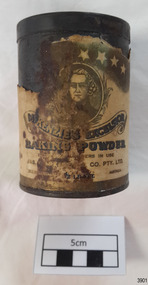
... It those times in Australia all manner of household items, including food and drink, were sold by hawkers (salesmen) who travelled from door to door in both suburban and rural areas. ...It those times in Australia all manner of household items, including food and drink, were sold by hawkers (salesmen) who travelled from door to door in both suburban and rural areas. ...This tin once contained McKenzie’s baking powder, a cooking ingredient. It was donated with other similar tins that were used by the donor’s mother who was married in 1932. It those times in Australia all manner of household items, including food and drink, were sold by hawkers (salesmen) who travelled from door to door in both suburban and rural areas. The donor remembered the bicarb soda tin on her mother’s pantry shelf. The McKenzie’s Baking Powder label adds the information that the ingredients were “Prepared with Aerophos, Regd. Trade Mark, the finest raising ingredient. A product of Albright & Wilson, Australia Pty. Ltd.” It also says that it “Excels all others in use”. The Australian family business, McKenzie’s Foods, began in Melbourne in 1852 and continues today, now run be the fifth generation of descendants from the original owners. Its baking and cookery products are well recognised by Australians. This tin originates in the early 1900s from an Australian company that is now managed by fifth generation descendants of the original family after its inception in 1852. The tin increases in significance for its use as a recognised object found in many Australian kitchens since early days. It gives a snapshot into domestic life and social norms of the pre and post war period in Melbourne The tin is significant for its association with a local family in the 1930s for the preparation of family meals. Tin container, cylindrical, with cream paper label with gold highlights, motif and text. Used for selling McKenzie’s Excelsior baking powder. Container has push-on lid. Quantity of 1/2 LB. NETT. Made in Australia by Jas. F. McKenzie & Co. Pty Ltd. Text includes “JAS. F. McKENZIE & CO. PTY. LTD. / AUSTRALIA“ “McKENZIE’S EXCELSIOR / BAKING POWDER”. Motif: man’s portrait within oval frame with wheat sheaf border, placed below figures of sun, moon and stars. Information and instructions. flagstaff hill asset, baking powder tin, container, flagstaff hill museum, kitchen item, cookery, baking, grocery, mckenzie, rising agent, food container, flagstaff hill, warrnambool, shipwrecked coast, flagstaff hill maritime museum, maritime museum, shipwreck coast, flagstaff hill maritime village, great ocean road, tin, cooking ingredient, baking powder, mckenqie -
 Flagstaff Hill Maritime Museum and Village
Container - Tin, W T Rawleigh, Circa 1930s
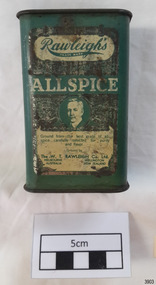
... It those times in Australia all manner of household items, including food and drink, were sold by hawkers (salesmen) who travelled from door to door in both suburban and rural areas. ...It those times in Australia all manner of household items, including food and drink, were sold by hawkers (salesmen) who travelled from door to door in both suburban and rural areas. ...This tin once contained Rawleigh's Allspice, a cooking ingredient. It was donated with other similar tins that were used by the donor’s mother who was married in 1932. It those times in Australia all manner of household items, including food and drink, were sold by hawkers (salesmen) who travelled from door to door in both suburban and rural areas. The donor remembered the tin on her mother’s pantry shelf. The Rawleigh Nutmegs label stated “Selected whole nutmegs not ground but granulated to preserve full strength and flavour.” The company had operated in Melbourne, Australia, and Wellington, New Zealand. W.T. Rawleigh & Co. was established by William Rawleigh in America in 1889 and later expanded into Australia. The company made a variety of household products in a factory in Collins Place, Melbourne, between 1930 and 1935. It specialised in medicines and remedies, food additives, cleaning products and toiletries. The company in Melbourne expanded into their factory in Dawson Street, Brunswick, in the mid-1930s. Independent salesmen, often referred to as ‘The Rawleigh’s man’, sold Rawleigh products door-to-door between the wars and after the Second World War in the Melbourne suburbs. Rayleigh’s products are still produced today. The tin is significant for its association with W.T Rawleigh, one of Melbourne’s strong growing manufacturers in period particularly between the World Wars. Rawleigh’s was, and still is, well known for its household and cleaning products, medicines, food additives and toiletries. The tin increases in significance for its use as a recognised object found in many Australian kitchens since early days. It gives a snapshot into domestic life and social norms of the pre and post war period in Melbourne The tin is significant for its association with a local family in the 1930s for the preparation of family meals. Rawleigh's rectangular Allspice spice tin, green, with directions for use on back and sides of container.Text “Rawleigh’s ALLSPICE” “The W.T. RAWLEIGH Co. Ltd.” “MELGOURNE / AUSTRALIA” “WELLINGTON / NEW ZEALAND” Motif: Man’s portrait in a circle. Other text includes information about spices.flagstaff hill museum, container, spice container, rawleigh company, tin container, kitchen item, tin, cooking ingredient, food container, grocery, allspice, rawleigh co. -
 Flagstaff Hill Maritime Museum and Village
Container - Tin, W T Rawleigh, Circa 1930s
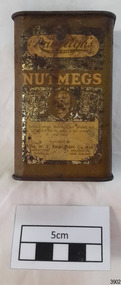
... It those times in Australia all manner of household items, including food and drink, were sold by hawkers (salesmen) who travelled from door to door in both suburban and rural areas. ...It those times in Australia all manner of household items, including food and drink, were sold by hawkers (salesmen) who travelled from door to door in both suburban and rural areas. ...This tin once contained Rayleigh's Nutmegs, a cooking ingredient. It was donated with other similar tins that were used by the donor’s mother who was married in 1932. It those times in Australia all manner of household items, including food and drink, were sold by hawkers (salesmen) who travelled from door to door in both suburban and rural areas. The donor remembered the tin on her mother’s pantry shelf. The Rawleigh Nutmegs label stated “Selected whole nutmegs not ground but granulated to preserve full strength and flavour.” The company had operated in Melbourne, Australia, and Wellington, New Zealand. W.T. Rawleigh & Co. was established by William Rawleigh in America in 1889 and later expanded into Australia. The company made a variety of household products in a factory in Collins Place, Melbourne, between 1930 and 1935. It specialised in medicines and remedies, food additives, cleaning products and toiletries. The company in Melbourne expanded into their factory in Dawson Street, Brunswick, in the mid-1930s. Independent salesmen, often referred to as ‘The Rawleigh’s man’, sold Rawleigh products door-to-door between the wars and after the Second World War in the Melbourne suburbs. Rayleigh’s products are still produced today. The tin is significant for its association with W.T Rawleigh, one of Melbourne’s strong growing manufacturers in period particularly between the World Wars. Rawleigh’s was, and still is, well known for its household and cleaning products, medicines, food additives and toiletries. The tin increases in significance for its use as a recognised object found in many Australian kitchens since early days. It gives a snapshot into domestic life and social norms of the pre and post war period in Melbourne The tin is significant for its association with a local family in the 1930s for the preparation of family meals. Rawleigh spice tin, rectangular, tall, used for storing Rawleigh's nutmeg. Tin has a flip-top lid, is coloured gold and comes with directions for use on front, back and sides of container.Text includes “W.T. RAWLEIGH Co. Ltd.”, “MELBOURNE / AUSTRALIA”, WELLINGTON / NEW ZEALAND” “Rawleigh’s / NUTMEGS” Motif: man’s portrait in a circle. Other text includes information about spices.tin container, flagstaff hill, warrnambool, shipwrecked coast, flagstaff hill maritime museum, maritime museum, shipwreck coast, flagstaff hill maritime village, great ocean road, food container, tin, kitchen item, container, cooking ingredient, grocery, spice container, nutmeg, rawleigh co. -
 Flagstaff Hill Maritime Museum and Village
Container - Tin, McKenzies Foods, circa 1930s
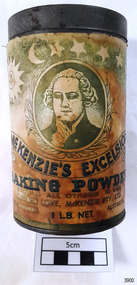
... It those times in Australia all manner of household items, including food and drink, were sold by hawkers (salesmen) who travelled from door to door in both suburban and rural areas. ...It those times in Australia all manner of household items, including food and drink, were sold by hawkers (salesmen) who travelled from door to door in both suburban and rural areas. ...This tin once contained McKenzie’s baking powder, a cooking ingredient. It was donated with other similar tins that were used by the donor’s mother who was married in 1932. It those times in Australia all manner of household items, including food and drink, were sold by hawkers (salesmen) who travelled from door to door in both suburban and rural areas. The donor remembered the bicarb soda tin on her mother’s pantry shelf. The McKenzie’s Baking Powder label adds the information that the ingredients were “Prepared with Aerophos, Regd. Trade Mark, the finest raising ingredient. A product of Albright & Wilson, Australia Pty. Ltd.” It also says that it “Excels all others in use”. The company began in Melbourne in 1852 and continues today, now run be the fifth generation of descendants from the original owners. This tin originates in the early 1900s from an Australian company that is now managed by fifth generation descendants of the original family after its inception in 1852. The tin increases in significance for its use as a recognised object found in many Australian kitchens since early days. It gives a snapshot into domestic life and social norms of the pre and post war period in Melbourne The tin is significant for its association with a local family in the 1930s for the preparation of family meals. Tin container, cylindrical, with cream and green paper label with gold highlights, motif and text. Used for selling McKenzie’s Excelsior baking powder. Container has push-on lid. Quantity of 1LB. NET. Made in Australia by McKenzie Ltd.Text includes “CLIFFORD LOVE, McKENZIE PTY. LTD.” “McKENZIE’S EXCELSIOR / BAKING POWDER”. Motif: man’s portrait within oval frame with wheat sheaf border, placed below figures of sun, moon and stars. Information and instructions. flagstaff hill asset, baking powder tin, container, flagstaff hill museum, kitchen item, cooking ingredients, flagstaff hill, warrnambool, shipwrecked coast, flagstaff hill maritime museum, maritime museum, shipwreck coast, flagstaff hill maritime village, great ocean road, tin, cooking ingredient, food container, grocery, cookery, rising agent, baking powder, mckenzie, mckenzie foods -
 City of Moorabbin Historical Society (Operating the Box Cottage Museum)
Manufactured Glass, brown bottle 'Fauldings Aspirin', c1950
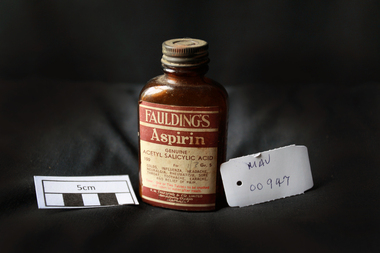
... suburban Glen Osmond home in Adelaide. Scammel’s two sons took over the business in 1888 and in 1890 the Company expanded to West Australia, then Sydney, Brisbane and finally, in 1924, Faulding began operations in Exhibition Street, Melbourne, eventually adding wholesale activities. 1986 With a presence in every city, from Darwin to Tasmania. ...suburban Glen Osmond home in Adelaide. Scammel’s two sons took over the business in 1888 and in 1890 the Company expanded to West Australia, then Sydney, Brisbane and finally, in 1924, Faulding began operations in Exhibition Street, Melbourne, eventually adding wholesale activities. 1986 With a presence in every city, from Darwin to Tasmania. ...Francis Hardy Faulding 1816 – 1868 arrived in Sydney 1842. He was a Surgeon on the emigrant ship Nabob. 1845 Francis Hardy Faulding opened his first pharmacy at 5 Rundle Street in Adelaide and the business prospered. In 1867 he formed F.H Faulding & Co with Luther Scammel. as wholesale druggists and manufacturing chemists. Two of the Faulding company's major innovations were the development of a process for distillation of eucalyptus oil, and the development of the test for determining the eucalyptol content of the oil. Faulding's success was founded on eucalyptus oil, which formed the basis of an antiseptic marketed as "Solyptol" In 1868 Francis Hardy Faulding died, aged 52 at his suburban Glen Osmond home in Adelaide. Scammel’s two sons took over the business in 1888 and in 1890 the Company expanded to West Australia, then Sydney, Brisbane and finally, in 1924, Faulding began operations in Exhibition Street, Melbourne, eventually adding wholesale activities. 1986 With a presence in every city, from Darwin to Tasmania. Faulding becomes a truly national company. 2008 Zuelllig Group takes control Focusing solely on pharmaceutical wholesaling and distribution, Hong Kong based Zuelllig Group takes over control of Symbion Pharmacy Services. 2008 Symbion Pharmacy Services exceeds $3 billion with one of the country's largest networks of warehousing systems and service A brown glass, bottle with a metal screw top containing ‘Faulding's Aspirin’ tabletsFront label : FAULDINGS / ASPIRIN / GENUINE / ACETYL SALICYLIC ACID / 100 Gr 5 / for / Colds, .............. / DOSE ........... / F.H.FAULDING & CO LTD / MANUFACTURING CHEMISTS / AUSTRALIApharmacy, medicines, faulding f.h., scammell luther, faulding's aspirin, glassware, bottles, moorabbin, bentleigh, cheltenham, antiseptics, analgesics, pharmaceuticals, south australia, ss nabob, f.h.faulding & co. -
City of Moorabbin Historical Society (Operating the Box Cottage Museum)
Newsletter - City of Moorabbin Historical Society No. 6 January / February 1962, City of Moorabbin Historical Society Newsletter No. 6 January / February 1962, 1962
... Sheehy in January / February 1962 The Aims of the CMHS are ‘to record the history of the City, and register something of the Australian Atmosphere, which the necessary speed-up in post-world-war two (WW11) immigration has caused to be lost; to produce a magazine at regular intervals, featuring the work of pioneers and the changing Australian scene; to work constantly with a long range view towards building a hall where records and exhibits can be housed’ The Original Newsletters reflect the history and heritage of the former City of Moorabbin — derived from Mooroobin, ‘a resting place’ in the Bunurrung spoken language. In 1994, the City of Moorabbin was integrated into the Cities of Bayside, Glen Eira, Kingston and Monash. This Issue - Centenary Year Moorabbin; from Pastoral, Fishing, market gardening to suburban...Sheehy in January / February 1962 The Aims of the CMHS are ‘to record the history of the City, and register something of the Australian Atmosphere, which the necessary speed-up in post-world-war two (WW11) immigration has caused to be lost; to produce a magazine at regular intervals, featuring the work of pioneers and the changing Australian scene; to work constantly with a long range view towards building a hall where records and exhibits can be housed’ The Original Newsletters reflect the history and heritage of the former City of Moorabbin — derived from Mooroobin, ‘a resting place’ in the Bunurrung spoken language. In 1994, the City of Moorabbin was integrated into the Cities of Bayside, Glen Eira, Kingston and Monash. This Issue - Centenary Year Moorabbin; from Pastoral, Fishing, market gardening to suburban ...This is Newsletter No.6 produced by CMHS President Mr T.A. Sheehy in January / February 1962 The Aims of the CMHS are ‘to record the history of the City, and register something of the Australian Atmosphere, which the necessary speed-up in post-world-war two (WW11) immigration has caused to be lost; to produce a magazine at regular intervals, featuring the work of pioneers and the changing Australian scene; to work constantly with a long range view towards building a hall where records and exhibits can be housed’ The Original Newsletters reflect the history and heritage of the former City of Moorabbin — derived from Mooroobin, ‘a resting place’ in the Bunurrung spoken language. In 1994, the City of Moorabbin was integrated into the Cities of Bayside, Glen Eira, Kingston and Monash. This Issue - Centenary Year Moorabbin; from Pastoral, Fishing, market gardening to suburban industrial; 'The Tuck Family'; Moorabbin City Band;This is No 6 Newsletter of CMHS January / February 196 CMHS obtained a Kingston City Council Community Grant 2016 for the digitization and preservation of these Original CMHS Newsletters commenced in 1961 2 x pages Foolscap paper printed on 1 side.CITY OF MOORABBIN HISTORICAL / SOCIETY / President T.A Sheehy ...... Ssecretary Mrs L. Harvey ...../ NEWSLETTER No 6 January / February 1962 -
Greensborough Historical Society
DVD, Channel 5 Productions et al, The Inner Circle Railway Line, 1888o
... The Inner Circle was a steam era suburban railway line (later electrified) in Melbourne, Australia. It served the inner-northern suburbs of Parkville, Carlton North, Fitzroy North, and Fitzroy and later expanded to outer suburbs. ...The Inner Circle was a steam era suburban railway line (later electrified) in Melbourne, Australia. It served the inner-northern suburbs of Parkville, Carlton North, Fitzroy North, and Fitzroy and later expanded to outer suburbs. ...The Inner Circle was a steam era suburban railway line (later electrified) in Melbourne, Australia. It served the inner-northern suburbs of Parkville, Carlton North, Fitzroy North, and Fitzroy and later expanded to outer suburbs. It opened in 1888. In this video, the viewer is taken on a train journey around the Melbourne rail network and also looks at the stations and lines that have since closed.Original footage of Melbourne's railways.1 x DVD in black case. DVD of approx 43 minutes.melbourne rail network, transportation, railways -
 Ringwood and District Historical Society
Newspaper - Clippings, Local Newspaper Mergers and Readership Demographics in Ringwood/Maroondah - 1995-1998
... (The Hurley Awards acknowledge the work of suburban and regional newspaper photographers throughout Australia.) 3. The Mail 21 May 1996 - We're Maroondah now. "... ...(The Hurley Awards acknowledge the work of suburban and regional newspaper photographers throughout Australia.) 3. The Mail 21 May 1996 - We're Maroondah now. "... ...Collection of seven newspaper articles glued to paper backing.1. The Mail 30 May 1995 - The Mail kept them informed - "The impact of the war (WWII) on the Ringwood and Croydon communities is reflected in the war-time editions of the Mail." ... 2. The Mail 3 October 1995 - Award - "Former Ringwood/Croydon Mail photographer Michelle Kelcey received a third place in the cadet section of the 1995 Hurley Awards." (The Hurley Awards acknowledge the work of suburban and regional newspaper photographers throughout Australia.) 3. The Mail 21 May 1996 - We're Maroondah now. "... Ringwood-Croydon Mail has changed names ... your Leader newspaper is now called the Maroondah Mail." ... 4. The Mail 22 July 1997 - The typical resident by Patrick Carlyon. "... some of the conclusions from the 1996 census released last week by the Australian Bureau of Statistics." ... 5. The Mail 2 December 1997 - Snapshot of Maroondah by Lynne Kinsey. "... This snapshot of Maroondah's population was revealed in Victoria in Fact, a Department of Infrasctructure report on the first release of 1996 Census data." ... 6. The Mail 21 April 1998 - How Maroondah Fits Into The Picture. "... a report based on 1996 Census data ... of 31 metropolitan Melbourne municipalities, including Maroondah." ... 7. Maroondah Post 25 January 1995 - Maroondah Post - a new name. "... From today the Maroondah Post will service all of the new City of Maroondah ..." (following merge of Croydon Post and Ringwood Post). -
 Greensborough Historical Society
Decorative object - Commemorative Plate, Westminster, City of Heidelberg Golden Jubilee - 1934-1984, 1984
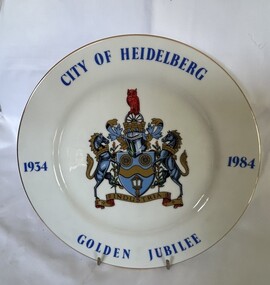
... Australia. The story of: 'Coat of Arms - The carriage wheels and lamp commemorate the early beginnings of the City about 1840 when the Heidelberg Road Trust was the local authority; the wavy band and wattle blossom are symbolic of the River Yarra, whilst the supporters represent the customary mode of transport at the time. The mural crown is the emblem of local government and these perpetuate the distinctive record of the City of Heidelberg in having the first suburban...Australia. The story of: 'Coat of Arms - The carriage wheels and lamp commemorate the early beginnings of the City about 1840 when the Heidelberg Road Trust was the local authority; the wavy band and wattle blossom are symbolic of the River Yarra, whilst the supporters represent the customary mode of transport at the time. The mural crown is the emblem of local government and these perpetuate the distinctive record of the City of Heidelberg in having the first suburban ...A strictly limited edition produced for the Rotary Club of Heidelberg, Australia' for the celebration of the Golden Jubilee of the City of Heidelberg (now City of Banyule).China plate with gilt edging; wording City of Heidelberg, Golden Jubilee,1934-1984 borders around the plate with the crest placed in the middle. "City of Heidelberg Golden Jubile1934-1984" with Coat of Arms. Underside Rotary International Crest; Fine China, Westminster Australia. The story of: 'Coat of Arms - The carriage wheels and lamp commemorate the early beginnings of the City about 1840 when the Heidelberg Road Trust was the local authority; the wavy band and wattle blossom are symbolic of the River Yarra, whilst the supporters represent the customary mode of transport at the time. The mural crown is the emblem of local government and these perpetuate the distinctive record of the City of Heidelberg in having the first suburban form of local Government of the Colony. An owl, the symbol of wisdom, is also embodied in the crest as our City is named after Heidelberg in Germany whose University founded in AD 1386, became one of the most famous seats of learning. The motto "Industrica" provides a link with the early seal of the City. The municipality was declared a City by Act of Parliament on April 11, 1934.'city of heidelberg, heidelberg, commemorative items, city of banyule -
 The Beechworth Burke Museum
Animal specimen - Musk Lorikeet, Trustees of the Australian Museum, 1860-1880
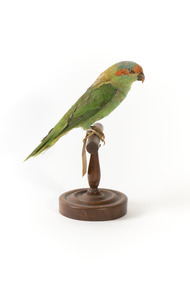
... Australia. They also live in the drier areas of Tasmania. These birds are common in suburban and urban areas and are nomadic, meaning they are willing to travel significant distance to find flowering trees. ...Australia. They also live in the drier areas of Tasmania. These birds are common in suburban and urban areas and are nomadic, meaning they are willing to travel significant distance to find flowering trees. ...The Musk Lorikeet is a bright coloured bird which commonly resides in south-eastern Australia. They also live in the drier areas of Tasmania. These birds are common in suburban and urban areas and are nomadic, meaning they are willing to travel significant distance to find flowering trees. The bright colours of this Lorikeet enable the bird to camouflage in dense foliage. This specimen is part of a collection of almost 200 animal specimens that were originally acquired as skins from various institutions across Australia, including the Australian Museum in Sydney and the National Museum of Victoria (known as Museums Victoria since 1983), as well as individuals such as amateur anthropologist Reynell Eveleigh Johns between 1860-1880. These skins were then mounted by members of the Burke Museum Committee and put-on display in the formal space of the Museum’s original exhibition hall where they continue to be on display. This display of taxidermy mounts initially served to instruct visitors to the Burke Museum of the natural world around them, today it serves as an insight into the collecting habits of the 19th century.This specimen is part of a significant and rare taxidermy mount collection in the Burke Museum. This collection is scientifically and culturally important for reminding us of how science continues to shape our understanding of the modern world. They demonstrate a capacity to hold evidence of how Australia’s fauna history existed in the past and are potentially important for future environmental research. This collection continues to be on display in the Museum and has become a key part to interpreting the collecting habits of the 19th century.The Musk Lorikeet is a beautiful species of parrot with mainly green plumage. it has a patch of yellow on the side of the breast which has faded to a grey on this specimen. This could be due to the impact of the taxidermy process or a product of time. The bird has an orange patch on the forehead and band through he eye to the ear coverts which has also faded from a brighter red colour. The crown of this bird is grey and would have been a grey-blue colour originally.87a / (89a)? Musk Lorikeet / See catalogue, page 24. /taxidermy mount, taxidermy, animalia, burke museum, beechworth, australian museum, skin, reynell eveleigh johns, bird, australian birds, lorikeet, musk lorikeet
