
Showing 24 items matching "suiting fabric"
-
 Embroiderers Guild, Victoria
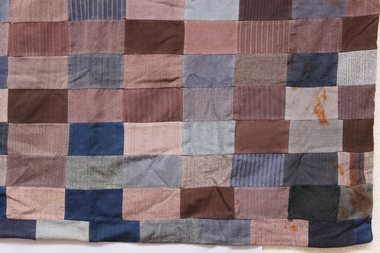
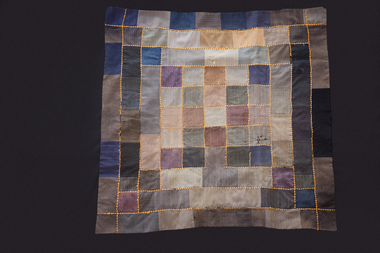
Textile - Wagga Quilt, Margaretta Egan (1860-1939), Early 1900's
... ...Suiting fabric...Suiting fabric made into a Wagga (quilt). Lined with cotton....Suiting fabric made into a Wagga (quilt). Lined with cotton. ...A Wagga quilt is a resourceful, utilitarian Australian quilt, traditionally made from repurposed materials like jute (burlap) sacks, old blankets, and clothing scraps, embodying the spirit of "making do" in the bush for drovers, swagmen, and families. Named likely from Wagga Wagga flour bags, these functional, often rough, creations served as warm bedding, distinct from fancier patchwork, and showcase a unique part of Australian textile heritage. Suiting fabric made into a Wagga (quilt). Lined with cotton.Margaretta Egan, Portland on reverse.patchwork, suiting fabric, waggas -
 National Wool Museum
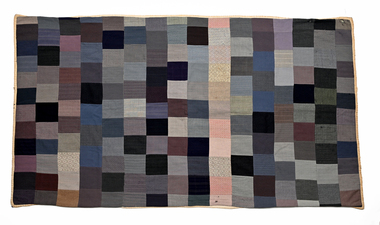
Textile - Wagga, Irene Isabel Pitt, c. 1930s
... ...suiting fabric...Wagga blanket made from suiting fabric samples, with calico cotton backing. ... - donor, 2025 wagga suiting fabric Irene Isabel Pitt Natimuk Western District Victoria sewing blankets Wagga blanket made from suiting fabric samples, with calico cotton backing. ...This wagga was made by the donor's paternal grandmother, Irene Isabel Pitt (nee Haase). Irene was born in Natimuk, Victoria in 1894 and grew up on a wheat farm in the Western District of Victoria. Her father owned a bakery in Natimuk, as well as several farms. Irene was a typical country woman versed in all home maker skills including knitting and sewing. After she married, she lived in suburban Melbourne. I recall seeing the waggas on the bed in the spare room. My brother suggested that one of the waggas may have been used under the mattress to help prevent draughts. - donor, 2025Wagga blanket made from suiting fabric samples, with calico cotton backing. Machine pieced, with hand stitched binding.wagga, suiting fabric, irene isabel pitt, natimuk, western district victoria, sewing, blankets -
 National Wool Museum
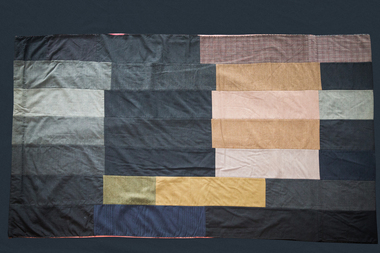
Textile - Suitings Quilt
... Origins are unknown, however it may be possible that since the creator of this quilt has used larger than usual pieces of suiting material, they may have worked as or knew of a tailor for their fabrics....Quilt made of large strips of men's suiting fabric. Machine stitched. Red flannel backing....Origins are unknown, however it may be possible that since the creator of this quilt has used larger than usual pieces of suiting material, they may have worked as or knew of a tailor for their fabrics. quilting history patchwork history running stitch group running stitch collection quilting - history patchwork - history Quilt made of large strips of men's suiting fabric. ...Origins are unknown, however it may be possible that since the creator of this quilt has used larger than usual pieces of suiting material, they may have worked as or knew of a tailor for their fabrics.Quilt made of large strips of men's suiting fabric. Machine stitched. Red flannel backing.quilting history, patchwork history, running stitch group, running stitch collection, quilting - history, patchwork - history -
 National Wool Museum
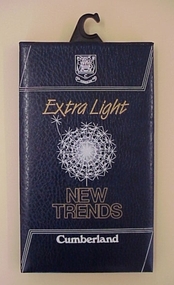
Book, Cloth Sample, Cumberland "extra light" new trends
... A cloth sample book, containing samples of Cumberland "extra light" suiting fabric....A cloth sample book, containing samples of Cumberland "extra light" suiting fabric. Textile Design Cumberland Cloth - worsted Cumberland "extra light" new trends Book, Cloth Sample ...A cloth sample book, containing samples of Cumberland "extra light" suiting fabric.textile design, cumberland, cloth - worsted -
 National Wool Museum
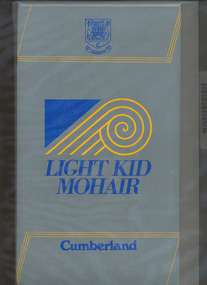
Book, Cloth Sample, Cumberland "Light kid mohair"
... A cloth sample book, containing samples of Cumberland "light kid mohair" suiting fabric....A cloth sample book, containing samples of Cumberland "light kid mohair" suiting fabric. Textile Design Cumberland Cloth - worsted Mohair Cumberland "Light kid mohair" Book, Cloth Sample ...A cloth sample book, containing samples of Cumberland "light kid mohair" suiting fabric.textile design, cumberland, cloth - worsted, mohair -
 National Wool Museum
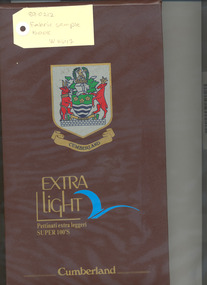
Book, Cloth Sample, Cumberland "extra light super 100's"
... A cloth sample book, containing samples of Cumberland "extra light super 100's" suiting fabric....A cloth sample book, containing samples of Cumberland "extra light super 100's" suiting fabric. Textile Design Cumberland Cloth - worsted Cumberland "extra light super 100's" Book, Cloth Sample ...A cloth sample book, containing samples of Cumberland "extra light super 100's" suiting fabric.textile design, cumberland, cloth - worsted -
 National Wool Museum
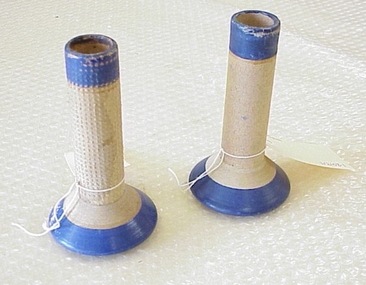
Spool
... Large bobbin to hold fine yarns like silk or mercerised cotton (slippery, shiny threads) Used in production ofmen's suiting fabric with a fine stripe or thread effect....Large bobbin to hold fine yarns like silk or mercerised cotton (slippery, shiny threads) Used in production ofmen's suiting fabric with a fine stripe or thread effect. ...Spools used at Foster Valley Mill. Large bobbin to hold fine yarns like silk or mercerised cotton (slippery, shiny threads) Used in production ofmen's suiting fabric with a fine stripe or thread effect. -
 National Wool Museum
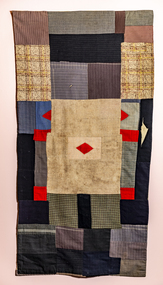
Textile - Quilt, 1910 - 1940
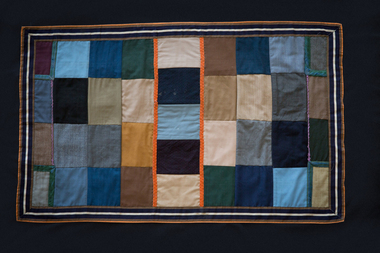
... Made from squares of patchwork suiting, machine stitched with red diamond and rectangle motifs at strategic positions. The diamonds look like they have been inserted in the fabric pieces where a dart has been cut and opened out....Quilt made of squares of patchwork suiting and fabric offcuts, machine stitched with red diamond and rectangle motifs at strategic positions....Made from squares of patchwork suiting, machine stitched with red diamond and rectangle motifs at strategic positions. The diamonds look like they have been inserted in the fabric pieces where a dart has been cut and opened out. quilting history patchwork history running stitch group running stitch collection quilting - history patchwork - history Quilt made of squares of patchwork suiting and fabric offcuts, machine stitched with red diamond and rectangle motifs at strategic positions. ...Part of the "Wagga collection". Made from squares of patchwork suiting, machine stitched with red diamond and rectangle motifs at strategic positions. The diamonds look like they have been inserted in the fabric pieces where a dart has been cut and opened out.Quilt made of squares of patchwork suiting and fabric offcuts, machine stitched with red diamond and rectangle motifs at strategic positions.quilting history, patchwork history, running stitch group, running stitch collection, quilting - history, patchwork - history -
 National Wool Museum
Textile - Quilt, 1940-1959
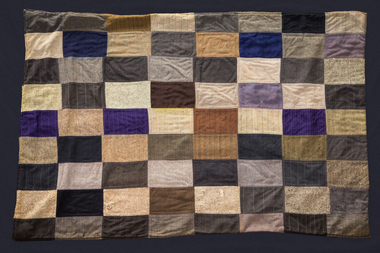
... It shows how important old and disused suiting fabric was for quilt making during World War Two. ...It shows how important old and disused suiting fabric was for quilt making during World War Two. ...This small woollen suiting wagga was machine stitched, backed with orange cotton and edged with brown navy and white striped braid. It shows how important old and disused suiting fabric was for quilt making during World War Two. Part of the Running Stitch collection.Small woollen suitings wagga. It is machine stitched, backed with orange cotton and edged with brown navy and white striped braid. Two rows of orange braid and purple ric rac are stitched across the wagga.handicrafts quilting quilting - history, running stitch collection, running stitch group, handicrafts, quilting, quilting - history, world war two, wwii -
 National Wool Museum
Textile - Child's Quilt, 1930s - 1940s
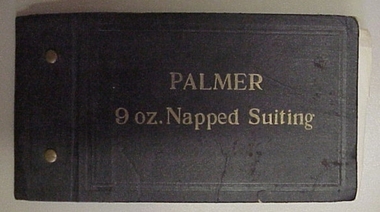
... This wagga has been made of regular sized, machine sewn patches of mens suiting fabrics. The fabrics would almost certainly have been sourced from a sample book of fabrics for mens suits, owing to their regular size and the fact that many have the same pattern but vary in colour....This wagga has been made of regular sized, machine sewn patches of mens suiting fabrics. The fabrics would almost certainly have been sourced from a sample book of fabrics for mens suits, owing to their regular size and the fact that many have the same pattern but vary in colour. patchwork wagga fabrics mens suits pattern necessity Wagga, made from samples of mens suiting in machine sewn patchwork. ...This wagga has been made of regular sized, machine sewn patches of mens suiting fabrics. The fabrics would almost certainly have been sourced from a sample book of fabrics for mens suits, owing to their regular size and the fact that many have the same pattern but vary in colour.Wagga, made from samples of mens suiting in machine sewn patchwork.patchwork, wagga, fabrics, mens suits, pattern, necessity -
 National Wool Museum
Sample Book, Palmer 9 oz. Napped Suiting
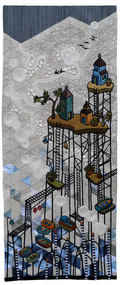
... Textile sample book owned by Ernest Waddington and containing samples of mens suiting in heavy dark fabrics with a nap....Textile sample book owned by Ernest Waddington and containing samples of mens suiting in heavy dark fabrics with a nap. Weaving Raising PALMER / 9 oz. ...Textile sample book owned by Ernest Waddington and containing samples of mens suiting in heavy dark fabrics with a nap.PALMER / 9 oz. Napped Suiting Ernest / Waddingtonweaving, raising -
 National Wool Museum
Textile - DIY Deluge Design No. 5, Alison Withers, 2023
... Made by piecing, applique and free machine stitching, using industrial felt, hand dyed merino felt, woollen suiting, cotton fabric, wool theatre curtain backing and cotton and polyester thread....Made by piecing, applique and free machine stitching, using industrial felt, hand dyed merino felt, woollen suiting, cotton fabric, wool theatre curtain backing and cotton and polyester thread. ...Artist Alison Withers work DIY Deluge Design No. 5 was awarded Expressions: The Wool Quilt Acquisitive Award in 2023. Works were received from across Australasia and internationally from some of quilting’s most highly regarded and awarded artists. Finalists work was displayed at Art Quilt Australia 2023 presented by Ozquilt Network and the National Wool Museum from 12 August to 12 November 2023. Artist Statement: It's clear we need to adapt the anatomy of our human spaces to become more resilient to the increasingly unavoidable impacts of climate change. Made by piecing, applique and free machine stitching, using industrial felt, hand dyed merino felt, woollen suiting, cotton fabric, wool theatre curtain backing and cotton and polyester thread.Rectangular portrait orientated art quilt depicting an environmental scene including boats, lights, elevated buildings, plants and birds on a background of shades of cream, blue and grey. A baton is sewn into the back at the bottom.Back: DIY Deluge Design No.5 / Alison Withersquilt, ozquilt network, prize, wool, art, felt, piecing, applique -
 National Wool Museum
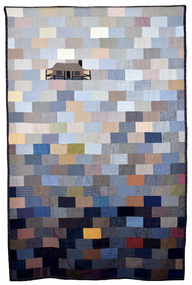
Textile - Quilt, Judy Turner, The Fading Dream of Australian Home Ownership, 1989
... The quilt was made using approximately 270 different men’s woollen suiting samples. The fabrics in the quilt were a gift from Micheal Haze who was a travelling men’s ware salesman and friend of the artist’s late husband. ...The quilt was made using approximately 270 different men’s woollen suiting samples. The fabrics in the quilt were a gift from Micheal Haze who was a travelling men’s ware salesman and friend of the artist’s late husband. ...‘The Fading Dream of Australian Home Ownership’ was made by Judy Turner in 1989 for her son Nicholas (then 14 years) after a family discussion about mortgages and rising interest rates (17% at the time), out of concern for his generation. “Perhaps this will keep my son warm when he can’t afford a house”, wrote Judy at the time. As a quilting teacher for over thirty years, Judy was well aware of the ‘wagga’ tradition of making do with what you have and reusing resources to make something useful. The quilt was made using approximately 270 different men’s woollen suiting samples. The fabrics in the quilt were a gift from Micheal Haze who was a travelling men’s ware salesman and friend of the artist’s late husband. The suiting samples were used just as they were, without cutting, and are stacked liked house bricks. The pieces have been machine pieced and tied. The quilt has woollen backing, with no batting. Judy’s son Nicholas, always interested in drawing, and keen to see what his mother was making, helped with the drawing and design of the house. The quilt has been exhibited in Canberra, Armidale and Sydney and featured in publications in Australian and Japan. Judy’s work has been exhibited Nationally and Internationally, including in Japan, Korea, Germany, Switzerland and the United States of America. Judy’s work has featured extensively in publications around the world, and has received many awards. Her work is held in public and private collections across Australia and the USA. As well as a successful career as an artist, Judy spent three decades imparting skills to the next generation as a patient and skilled teacher. ARTIST STATEMENT The medium of my artistic practice is quilt making and my focus is the use of colour and speedy, accurate and efficient methods of making successful quilts. In 1995 I developed an original technique of applying woollen yarn to a woollen background, focusing on the subtle blending of colour to express an idea. Author of Awash With Colour (1997) and co-author with Margaret Rolfe of Successful Scrap Quilts (2002).Quilt featuring block pieces in tones of grey, blue, tan and brown, graduating in light to dark tones from top to bottom. The top third features a house with a verandah.quilt, wagga, home, house, housing affordability, design -
 National Wool Museum
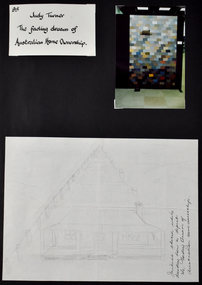
Document - The Fading Dream of Australian Home Ownership, Design and Photograph, Judy Turner, 1989
... The quilt was made using approximately 270 different men’s woollen suiting samples. The fabrics in the quilt were a gift from Micheal Haze who was a travelling men’s ware salesman and friend of the artist’s late husband. ...The quilt was made using approximately 270 different men’s woollen suiting samples. The fabrics in the quilt were a gift from Micheal Haze who was a travelling men’s ware salesman and friend of the artist’s late husband. ...‘The Fading Dream of Australian Home Ownership’ was made by Judy Turner in 1989 for her son Nicholas (then 14 years) after a family discussion about mortgages and rising interest rates (17% at the time), out of concern for his generation. “Perhaps this will keep my son warm when he can’t afford a house”, wrote Judy at the time. As a quilting teacher for over thirty years, Judy was well aware of the ‘wagga’ tradition of making do with what you have and reusing resources to make something useful. The quilt was made using approximately 270 different men’s woollen suiting samples. The fabrics in the quilt were a gift from Micheal Haze who was a travelling men’s ware salesman and friend of the artist’s late husband. The suiting samples were used just as they were, without cutting, and are stacked liked house bricks. The pieces have been machine pieced and tied. The quilt has woollen backing, with no batting. Judy’s son Nicholas, always interested in drawing, and keen to see what his mother was making, helped with the drawing and design of the house. The quilt has been exhibited in Canberra, Armidale and Sydney and featured in publications in Australian and Japan. Judy’s work has been exhibited Nationally and Internationally, including in Japan, Korea, Germany, Switzerland and the United States of America. Judy’s work has featured extensively in publications around the world, and has received many awards. Her work is held in public and private collections across Australia and the USA. As well as a successful career as an artist, Judy spent three decades imparting skills to the next generation as a patient and skilled teacher. ARTIST STATEMENT The medium of my artistic practice is quilt making and my focus is the use of colour and speedy, accurate and efficient methods of making successful quilts. In 1995 I developed an original technique of applying woollen yarn to a woollen background, focusing on the subtle blending of colour to express an idea. Author of Awash With Colour (1997) and co-author with Margaret Rolfe of Successful Scrap Quilts (2002).Folio page depicting three items attached to a black card background. One item is a title written in black ink on white background, another is a photograph of a quilt, the third shows a hand drawn sketch of a house with a verandah.Front: [handwritten] 95 / Judy Turner / The fading dream of / Australian Home Ownership. / Initial sketch while / deciding how to depict / the Fading Dream of / Australian Home Ownership.quilt, wagga, home, house, housing affordability, design -
 National Wool Museum
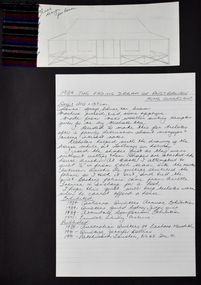
Document - The Fading Dream of Australian Home Ownership, Design and Fabric Sample, Judy Turner, 1989
... The quilt was made using approximately 270 different men’s woollen suiting samples. The fabrics in the quilt were a gift from Micheal Haze who was a travelling men’s ware salesman and friend of the artist’s late husband. ...The quilt was made using approximately 270 different men’s woollen suiting samples. The fabrics in the quilt were a gift from Micheal Haze who was a travelling men’s ware salesman and friend of the artist’s late husband. ...‘The Fading Dream of Australian Home Ownership’ was made by Judy Turner in 1989 for her son Nicholas (then 14 years) after a family discussion about mortgages and rising interest rates (17% at the time), out of concern for his generation. “Perhaps this will keep my son warm when he can’t afford a house”, wrote Judy at the time. As a quilting teacher for over thirty years, Judy was well aware of the ‘wagga’ tradition of making do with what you have and reusing resources to make something useful. The quilt was made using approximately 270 different men’s woollen suiting samples. The fabrics in the quilt were a gift from Micheal Haze who was a travelling men’s ware salesman and friend of the artist’s late husband. The suiting samples were used just as they were, without cutting, and are stacked liked house bricks. The pieces have been machine pieced and tied. The quilt has woollen backing, with no batting. Judy’s son Nicholas, always interested in drawing, and keen to see what his mother was making, helped with the drawing and design of the house. The quilt has been exhibited in Canberra, Armidale and Sydney and featured in publications in Australian and Japan. Judy’s work has been exhibited Nationally and Internationally, including in Japan, Korea, Germany, Switzerland and the United States of America. Judy’s work has featured extensively in publications around the world, and has received many awards. Her work is held in public and private collections across Australia and the USA. As well as a successful career as an artist, Judy spent three decades imparting skills to the next generation as a patient and skilled teacher. ARTIST STATEMENT The medium of my artistic practice is quilt making and my focus is the use of colour and speedy, accurate and efficient methods of making successful quilts. In 1995 I developed an original technique of applying woollen yarn to a woollen background, focusing on the subtle blending of colour to express an idea. Author of Awash With Colour (1997) and co-author with Margaret Rolfe of Successful Scrap Quilts (2002).Folio page depicting three items attached to a black card background. One item is a red, blue, black and white textile sample, another is a hand drawn sketch of a house, the third shows hand written text on lined paper in black ink.Front: [handwritten] Final / design / for housequilt, wagga, home, house, housing affordability, design -
 National Wool Museum
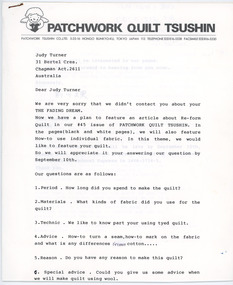
Document - The Fading Dream of Australian Home Ownership, Letters, Judy Turner et al, 1991
... The quilt was made using approximately 270 different men’s woollen suiting samples. The fabrics in the quilt were a gift from Micheal Haze who was a travelling men’s ware salesman and friend of the artist’s late husband. ...The quilt was made using approximately 270 different men’s woollen suiting samples. The fabrics in the quilt were a gift from Micheal Haze who was a travelling men’s ware salesman and friend of the artist’s late husband. ...‘The Fading Dream of Australian Home Ownership’ was made by Judy Turner in 1989 for her son Nicholas (then 14 years) after a family discussion about mortgages and rising interest rates (17% at the time), out of concern for his generation. “Perhaps this will keep my son warm when he can’t afford a house”, wrote Judy at the time. As a quilting teacher for over thirty years, Judy was well aware of the ‘wagga’ tradition of making do with what you have and reusing resources to make something useful. The quilt was made using approximately 270 different men’s woollen suiting samples. The fabrics in the quilt were a gift from Micheal Haze who was a travelling men’s ware salesman and friend of the artist’s late husband. The suiting samples were used just as they were, without cutting, and are stacked liked house bricks. The pieces have been machine pieced and tied. The quilt has woollen backing, with no batting. Judy’s son Nicholas, always interested in drawing, and keen to see what his mother was making, helped with the drawing and design of the house. The quilt has been exhibited in Canberra, Armidale and Sydney and featured in publications in Australian and Japan. Judy’s work has been exhibited Nationally and Internationally, including in Japan, Korea, Germany, Switzerland and the United States of America. Judy’s work has featured extensively in publications around the world, and has received many awards. Her work is held in public and private collections across Australia and the USA. As well as a successful career as an artist, Judy spent three decades imparting skills to the next generation as a patient and skilled teacher. ARTIST STATEMENT The medium of my artistic practice is quilt making and my focus is the use of colour and speedy, accurate and efficient methods of making successful quilts. In 1995 I developed an original technique of applying woollen yarn to a woollen background, focusing on the subtle blending of colour to express an idea. Author of Awash With Colour (1997) and co-author with Margaret Rolfe of Successful Scrap Quilts (2002).Two typed letters held together with a staple. The first letter has a grey printed letter head which includes a logo of a person with wings holding a heart.[printed] PATCHWORK QUILT TSUSHINquilt, wagga, home, house, housing affordability, design -
 National Wool Museum
Textile - Quilt, Mrs Elizabeth Morton, c.1934
... A small knee rug made from suiting samples machine stitched together. It is backed with black silk fabric and finished with a running stitch of orange wool oversewn with black wool thread....The buyer chose a sample and then sent it back with measurements and received a "mail order" suit. farming quilting quilting - history wanera benjeroop farming quilting quilting - history A small knee rug made from suiting samples machine stitched together. It is backed with black silk fabric and finished with a running stitch of orange wool oversewn with black wool thread. ...Made by Mrs Noel (Lizzie) Morton, the donor's mother on their farm "Wanera" at Benjeroop on the Murray River. It was stitched with a treadle machine. Her sister Flora MacDonald did the running stitch and provided the silk backing. The squares were sent as samples from a firm called "Fred Hesse" who advertised in the Melbourne papers "Be smart and dressy In a suit by Fred Hesse". The buyer chose a sample and then sent it back with measurements and received a "mail order" suit.A small knee rug made from suiting samples machine stitched together. It is backed with black silk fabric and finished with a running stitch of orange wool oversewn with black wool thread.farming quilting quilting - history, wanera benjeroop, farming, quilting, quilting - history -
 National Wool Museum
Folder, sample
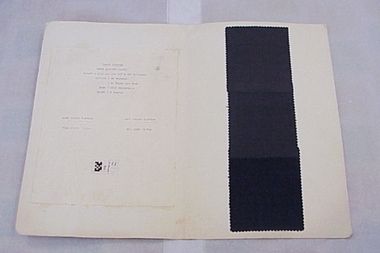
... Weaving samples folder: 3 "FANCY WOOLLEN (MENS SUITING RANGE)" patterns with 3 black/grey cloth samples Weaving Textile Industry Textile Design Weaving Textile Industry Textile Design 5651 (ink) FANCY WOOLLEN COATING FABRIC Folder, sample ...Weaving samples folder: 3 "FANCY WOOLLEN (MENS SUITING RANGE)" patterns with 3 black/grey cloth samples5651 (ink) FANCY WOOLLEN COATING FABRICweaving textile industry textile design, weaving, textile industry, textile design -
 National Wool Museum
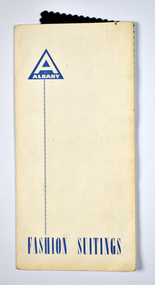
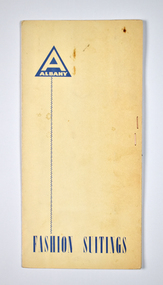
Booklet - Albany Fashion Suitings, Albany Woollen Mills
... Samples Fabric Brochure Albany Woollen Mills School Uniforms front: [printed] ALBANY / FASHION SUITINGS Folded card brochure with printed blue text on the back and front. ...Folded card brochure with printed blue text on the back and front. Fabric samples attached with hand written text on the inside.front: [printed] ALBANY / FASHION SUITINGSsamples, fabric, brochure, albany woollen mills, school uniforms -
 National Wool Museum
Booklet - Albany Fashion Suitings, Albany Woollen Mills
... Samples Fabric Brochure Albany Woollen Mills School Uniforms front: [printed] ALBANY / FASHION SUITINGS Folded card brochure with printed blue text on the back and front. ...Folded card brochure with printed blue text on the back and front. Fabric samples attached with hand written text on the inside.front: [printed] ALBANY / FASHION SUITINGSsamples, fabric, brochure, albany woollen mills, school uniforms -
 National Wool Museum
Booklet - Albany Fashion Suitings, Albany Woollen Mills
... Samples Fabric Brochure Albany Woollen Mills School Uniforms front: [printed] ALBANY / FASHION SUITINGS Folded card brochure with printed blue text on the back and front. ...Folded card brochure with printed blue text on the back and front. Fabric samples attached with hand written text on the inside.front: [printed] ALBANY / FASHION SUITINGSsamples, fabric, brochure, albany woollen mills, school uniforms -
 National Wool Museum
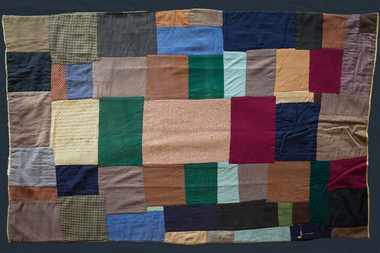
Quilt, Suitings quilt
... fabric pieces in a quilt made of scraps doesn't always preclude a conscious sense of design. The pieces in this quilt have been carefully arranged according to size and colour, possibly indicating that it was intended to go on a bed as a spread without a cover. Placed in a room that may not have been adorned with many other decorative items, this quilt would have been a colourful and inexpensive home furnishing solution. quilting history patchwork history running stitch group running stitch collection quilting - history patchwork - history Patchwork quilt made from large pieces of wool suitings, colourful clothing off cuts and woollen blankets. ...The apparently haphazard arrangement of fabric pieces in a quilt made of scraps doesn't always preclude a conscious sense of design. The pieces in this quilt have been carefully arranged according to size and colour, possibly indicating that it was intended to go on a bed as a spread without a cover. Placed in a room that may not have been adorned with many other decorative items, this quilt would have been a colourful and inexpensive home furnishing solution.Patchwork quilt made from large pieces of wool suitings, colourful clothing off cuts and woollen blankets. The quilt has been hand stitched together with stitches that hold the front and back sides together. Either a large single bed size or small double bed size.quilting history, patchwork history, running stitch group, running stitch collection, quilting - history, patchwork - history -
 National Wool Museum
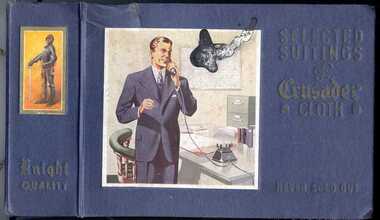
Sample Book, "Selected Suitings of Crusader Cloth" sample book
... fabric sample pieces to make quilts. The Australian Woollen Mills was an example of a woollen mill which went into worsted production making good quality English-type suiting. ...fabric sample pieces to make quilts. The Australian Woollen Mills was an example of a woollen mill which went into worsted production making good quality English-type suiting. ...This book dates from the 1940s and was part of the Running Stitch collection of quilts, probably because it was common for women to acquire these books from travelling salesmen. This sample book is an example of the type made by textile mills and given to tailors to sell fabric for made to measure suits. With little money to spare during the austere years of the war, women often acquired these books from tailors when the fabrics were no longer available. They made use of the fabric sample pieces to make quilts. The Australian Woollen Mills was an example of a woollen mill which went into worsted production making good quality English-type suiting. They were very successful until the 1960's when the oversupply of worsted fabrics from Europe and Asia led to the decline of the industry in this country. This book was displayed in the Running Stitch exhibition "Wool Quilts Old and New" of 1985 where it was catalogue entry number 40.Australian Woollen Mills Crusader fabric sample book, c.1940sKnight / QUALITY SELECTED / SUITINGS / of / Crusader / CLOTH / NEVER SOLD OUT Crusader / CLOTH / Makes the best suits "Crusader" / WORSTEDaustralian woollen mills pty ltd running stitch group, cloth - worsted, running stitch collection -
 Whitehorse Historical Society Inc.
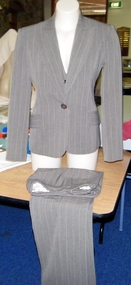
Clothing - Womens Suit, 1980's
... fabric and is all about the cut and proper finishing. The looks and silhouettes change every season but not dramatically, it is more that they evolve from season to season.'|The George Gross label was first conceived in Adelaide by Gross and his business partner Harry Watt. As designer, both were working for other fashion houses and saw a gap In the market for elegant evening wear, suiting ...Attached George Gross Biography. Vogue Australia|With more than 40 years in the industry,- George Gross is one of Australia's best known fashion designers. Designing his own. label for the last 35 years, Gross is renowned for his glamorous evening wear, corporate and race wear ranges. Embodying style and sophistication, Gross has dressed celebrities the world over in his eponymous label.|With his first creation - a sequined shift, at the tender age of 16 George still believes 'every collection starts with the fabric and is all about the cut and proper finishing. The looks and silhouettes change every season but not dramatically, it is more that they evolve from season to season.'|The George Gross label was first conceived in Adelaide by Gross and his business partner Harry Watt. As designer, both were working for other fashion houses and saw a gap In the market for elegant evening wear, suiting and separates. Joining with his twin sister Kathy, the three began with a small Adelaide store and expanded to include more than 500 retailers worldwide at the height of their business.|Inspired by real women, Gross showcases his love of colour, cut and quality with each collection. His aim is to create sensuous clothing that women of any age, shape or taste look fabulous wearing. Attributing his longevity to a desire for experimentation while also listening to his customers' needs, Gross designs the fabric prints and only uses the best quality natural fibres from Europe.|Gross and Watt have won 13 Australian fashion design awards between them and both work closely with charities throughout Australia. Working primarily with Breast and Prostate Cancer Research, George organises parades around Australia, especially in their home town of Adelaide.|Gross now has seven stand alone stores, nine concession areas in David Jones department stores and numerous wholesale clients Australia wide. Having finished summer 2009, George is now working on winter 2010, his 73rd collection with many more to come.Three piece Grey - brown pin stripe pants suit. Fully lined pants, shaped waist band. Zip front & turned up cuffs. Jacket fully lined, wide reveres, single breasted, one button. Two pockets. Tailored waistcoat, 5 buttons. Two imitation pockets. Stretched lace backGeorge Grosscostume, female
