
Showing 14 items matching "sunday school fund"
-
 Clunes Museum
Ephemera - TICKET, 1893
... ...sunday school fund...IN AID OF THE SUNDAY SCHOOL FUND S. PAUL'S CHURCH GRAND DRAWING ROOM ENTERTAINMENT TOWN HALL, CLUNES THURSDAY, AUGUST 17TH, 1893 COMMENCE EIGHT O'CLOCK P.M. ...st paul's church clunes sunday school fund leisure activity fundraising IN AID OF THE SUNDAY SCHOOL FUND S. ...WHITE CARD WITH GOLD AND BLACK PRINTIN AID OF THE SUNDAY SCHOOL FUND S. PAUL'S CHURCH GRAND DRAWING ROOM ENTERTAINMENT TOWN HALL, CLUNES THURSDAY, AUGUST 17TH, 1893 COMMENCE EIGHT O'CLOCK P.M. FRONT SEATS - 1s. 6d GUARDIAN PRINT CLUNESst paul's church clunes, sunday school fund, leisure activity, fundraising -
 Uniting Church Archives - Synod of Victoria
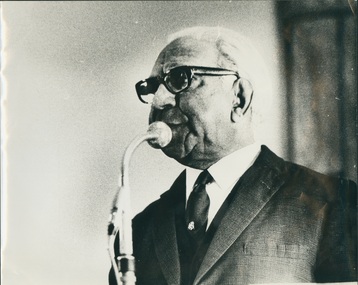
B&W photo of another photo or newspaper photograph of Pastor Sir Douglas Nicholls, Undated
... Gladys taught Sunday school, undertook endless fund-raising and welfare work beside her husband, and became his greatest supporter and financial manager. ...Gladys taught Sunday school, undertook endless fund-raising and welfare work beside her husband, and became his greatest supporter and financial manager. ...Sir Douglas Ralph Nicholls (1906-1988), footballer, pastor, activist and governor, was born on 9 December 1906 at Cummeragunja Aboriginal mission, New South Wales, fifth child of Herbert Nicholls, seasonal worker, and his wife Florence, née Atkinson. Doug grew up at Cummeragunja, on the Murray River near Barmah, in its golden years of Aboriginal autonomy. Thomas Shadrach James gave him and other Yorta Yorta children a sound primary education, reinforcing the pride and self-assurance gained from their parents. As Doug grew, so too did the powers of the State’s Aboriginal Protection Board. Doug’s elder sister Hilda was removed about 1915. When Doug reached 14, he was moved off under the Aborigines Protection Act (1909) to find work. He took a job with dredging teams constructing levees on the Murray. Like other youths in the region Nicholls played Australian rules football, emulating kinsmen who had won local premierships since the 1890s. Doug and his brother Herbert (‘Dowie’) played with Tongala in the mid-1920s. Melbourne football beckoned, Doug trying out unsuccessfully for Carlton in 1927. He signed with the Northcote Victorian Football Association team, despite his nervousness about his Aboriginality, and was given a job with Northcote City Council. ‘Dowie’ joined him for a season. Doug was short at 5 ft 2 ins (158 cm), but muscular and lightning fast. He competed regularly during a boom in professional running, winning many heat and place prizes. In 1929 he won the Nyah and Warracknabeal gifts, earning a sash and £100 in each, together with a case of cutlery in the latter. Using his speed on the wing for Northcote, he produced great spring and agility from his compact body. The Sporting Globe reported in 1929 that ‘he flashes through packs of big men, whisks around small men . . . and attempts marks at the back of any six-footer’. In front-on clashes he was flattened only to rise again. The sole Aborigine in the VFA, he was known affectionately as the ‘flying Abo’ but called worse by his opponents’ barrackers. He competed for five seasons, being named ‘best and fairest’ twice, appearing in three association grand finals and winning in 1929. Keen to earn more than a seasonal wage, in 1931 Nicholls accepted a three-year contract with Jimmy Sharman’s travelling boxing show. The bouts matched opposites, local against tent boxer, white against black, and sometimes men of different sizes. He faced stiff competition from those who wanted to best the noted Melbourne black footballer, the crowd adding racial abuse. A far better footballer than boxer, he copped some punishment. Fighting in the Melbourne Stadium in December 1931, he was described by Truth as ‘slow and awkward’, but packing a ‘good wallop’. In 1932 Sharman, who treated his boxers fairly, released Nicholls to join the Fitzroy Victorian Football League team, which agreed to employ him as its groundsman. He played fifty-four games for Fitzroy over six seasons until knee trouble forced him out in 1937. Winning cups in 1934 and 1935, he played alongside Haydn Bunton and Wilfred (‘Chicken’) Smallhorn. Grand finals eluded him but he represented Victoria twice. Following his mother’s death, Nicholls revisited the Church of Christ chapel in Northcote, where they had worshipped together. On 17 July 1932 he experienced a conversion. He was soon baptised and witnessed openly, leading his fellow footballers to occasional church parades. Nicholls exhibited leadership qualities. William Cooper, founder of the Australian Aborigines’ League and Nicholls’ Yorta Yorta kinsman and fellow Christian, encouraged the young footballer. In February 1935 Cooper, Nicholls and others lobbied Thomas Paterson, the Commonwealth minister for the interior, over the need for Federal control of Aboriginal affairs. Nicholls attended the Day of Mourning protest for Aborigines held in Sydney on 26 January 1938, declaring: ‘after 150 years our people are still influenced and bossed by white people. I know we can proudly hold our own with others if given the chance’. When Cooper retired in November 1940 Nicholls became secretary of the AAL. On 2 June 1941 Nicholls enlisted in the Citizen Military Forces. He trained at Seymour and Bonegilla before being posted to the 29th Battalion. As Major Frank Corr’s batman, he was popular with other soldiers who tolerated his preaching and Bible reading. His army service was brief, however, and he was discharged in Melbourne on compassionate grounds on 22 January 1942. His biographer claimed that the Fitzroy police requested his return to mediate in the racial tensions developing between servicemen and the mostly respectable Aboriginal families living in crowded and dilapidated Fitzroy housing; Aboriginal people maintain that they requested his release. Nicholls began welfare work and religious services from an Aboriginal home in Gertrude Street, Fitzroy. In April 1942, ‘Dowie’ died of road accident trauma, leaving his wife, Gladys, née Bux, and three children. On 26 December 1942 at Moama Methodist Church, New South Wales, Nicholls married her, a caring gesture which developed into a loving partnership. In January 1943 he initiated ‘Aboriginal Sunday’, featuring a gum leaf orchestra and choir. By 1955 this service had moved to July and later evolved into National Aborigines and Islanders Day Observance Committee (NAIDOC) week. Ordained a Churches of Christ pastor in 1945, Nicholls conducted a vigorous ministry from a chapel in Gore Street, Fitzroy. His work survived on donations, a small honorarium, and his employment as team coach (1947) and curator at the Northcote Football Ground. In the 1950s Gladys established grocery and opportunity shops to earn income and provide services. Their house soon overflowed with people in need or visitors to Melbourne. Nicholls also hosted inspiring African American visitors such as the pianist Winifred Attwell and the singer Harry Belafonte. His ministry extended to Aboriginal country communities. Gladys taught Sunday school, undertook endless fund-raising and welfare work beside her husband, and became his greatest supporter and financial manager. They formed an Aboriginal Girls’ Hostel in 1956, for which they acted as house parents, and bought holiday units for Aborigines at Queenscliff. Persistently advocating Aboriginal rights, Nicholls protested about the impact of the Woomera rocket range on the people of the Warburton Ranges, co-ordinated the production of a concert, Out of the Dark, scripted by Jean Campbell, to rectify the omission of Aborigines from Victoria’s Commonwealth jubilee celebrations, and criticised the Victorian Aboriginal Protection Board. In 1957 when the board was transformed into the Aborigines’ Welfare Board, he and Harold Blair were appointed as Aboriginal representatives. Maintaining the stance of a political moderate, he did not bear grudges and sought to build bridges between black and white. He co-operated with any group that aided the cause, including the Council of Aboriginal Rights, whose executive were members of the Communist Party of Australia. This association attracted the attention of the Australian Security Intelligence Organization, which in 1957 began to keep a file on Nicholls. In May 1957 Nicholls formed the Victorian Aborigines Advancement League with Doris Blackburn and Gordon Bryant, a Federal parliamentarian. As its paid field officer and spokesman, Nicholls contested assimilation policies and used film to raise awareness of issues. When the Welfare Board attempted to close Lake Tyers reserve, Gippsland, he resigned in disgust and led a protest march on parliament in May 1963. The AAL also petitioned the United Nations on land rights in June, perhaps the first indigenous body to do so. He argued for new premises at 58 Cunningham Street, Northcote, opened in 1966 as the ‘Doug Nicholls Centre’. In 1958 Nicholls was a foundation member of the Federal Council for Aboriginal Advancement (Federal Council for the Advancement of Aboriginal and Torres Strait Islanders after 1964), which he served as national field officer (1961) and Victorian secretary (1962-63). While an innovator in tactics, he was alarmed by the influence of confrontational ‘black power’ politics in the AAL and resigned as a director amid turmoil on this issue in 1969, claiming the concept was a ‘bitter word’, not needed in Australia. Similar tensions in FCAATSI led him to join with Kath Walker (Oodgeroo Noonuccal) in establishing the short-lived National Tribal Council as an alternative forum. As the AAL leadership moderated their stance, he returned as president (1969-74) of the new all-Aboriginal organisation. He was also a keen patron of the National Aboriginal Sports Foundation, founded in 1969. Many honours were conferred on Nicholls: he was appointed MBE (1957) and OBE (1968) and knighted (1972). In 1962 he was named Victorian ‘Father of the Year’ and the State’s second Aboriginal justice of the peace. Crowned Melbourne’s 1973 King of Moomba, he was declared Bapu Mamus (a Torres Strait term for ‘headman’) by the NTC. On 1 December 1976 Sir Douglas was appointed Governor of South Australia, but his health deteriorated within weeks, making it difficult for him to perform his official duties. In March 1977 he hosted Queen Elizabeth during her royal tour and was appointed KCVO. He relinquished his governorship on 30 April 1977 following a stroke. Ill health continued to dog him during retirement, but he played his Nelson Eddy records, enjoyed his expanding family, and when able, ministered to the Aboriginal Church at the League’s premises. Sir Douglas Nicholls died on 4 June 1988 at Mooroopna, predeceased (1981) by his wife and survived by his five children. He was given a state funeral and buried in tribal ground at Cummeragunja cemetery. Among the many tributes to him are an oval at Northcote, handed to the AAL in 1982, a Canberra suburb gazetted in 1991, and a fellowship for Indigenous leadership established in 2003, all in his name, and a statue of Sir Doug and Lady Nicholls by Louis Laumen, unveiled in 2007 in Parliament Gardens, Melbourne. Sir Douglas Nicholls is shown speaking at a microphone; head and shoulders; dressed in a suit.Pastor Douglas Nicholls -
 Eltham District Historical Society Inc
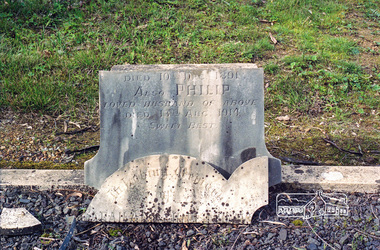
Negative - Photograph, Harry Gilham, Grave of Sarah and Phillip Shillinglaw, Eltham Cemetery, Victoria, Sep 2009
... Their house Shillinglaw Cottage (built by George Stebbings) still exists, though it was moved with funding from local residents in 1963-64 when faced with demolition to make room for new Council Offices. Philip was actively involved with the Methodist Church as preacher, Church Steward and Sunday School teacher. ...Their house Shillinglaw Cottage (built by George Stebbings) still exists, though it was moved with funding from local residents in 1963-64 when faced with demolition to make room for new Council Offices. Philip was actively involved with the Methodist Church as preacher, Church Steward and Sunday School teacher. ...Philip Shillinglaw and his wife Sarah came to Eltham in 1882. Their property "Wattle Brae" originally encompassed present-day Eltham Central Park and part of Eltham Library, extending north to include Andrew Park and the site of the railway station. An early photo shows that much of it was planted for crops. They also had cows; in 1913 Philip wrote to the local paper complaining about an earlier report that one of them had been killed on the railway line. "I give an emphatic denial to the report. It is not true." Their house Shillinglaw Cottage (built by George Stebbings) still exists, though it was moved with funding from local residents in 1963-64 when faced with demolition to make room for new Council Offices. Philip was actively involved with the Methodist Church as preacher, Church Steward and Sunday School teacher. A Sunday School picnic and a sports carnival were held on his paddock. Eight of his children attended Eltham Primary School. In 1908 he ploughed part of the schoolyard (possibly for use as a garden) free of charge. When Philip died in 1914, his funeral was described as one of the largest ever seen in Eltham. He and Sarah are buried in Eltham Cemetery. In Loving Memory of Sarah Ann Shillinglaw Died 10th Dec. 1891 Also Phillip Loved husband of above Died 18th Aug. 1914 Sweet BestRoll of 35mm colour negative film, 6 stripsKodak GC 400-9eltham cemetery, gravestones, phillip shillinglaw, sarah ann shillinglaw -
 Eltham District Historical Society Inc
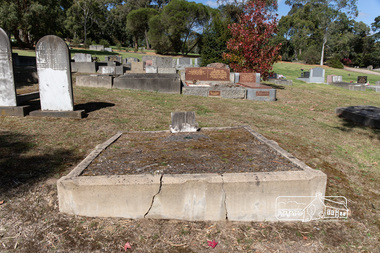
Photograph, Peter Pidgeon, Grave of Sarah and Phillip Shillinglaw, Eltham Cemetery, Victoria, 5 April 2021
... Their house Shillinglaw Cottage (built by George Stebbings) still exists, though it was moved with funding from local residents in 1963-64 when faced with demolition to make room for new Council Offices. Philip was actively involved with the Methodist Church as preacher, Church Steward and Sunday School teacher. ...Their house Shillinglaw Cottage (built by George Stebbings) still exists, though it was moved with funding from local residents in 1963-64 when faced with demolition to make room for new Council Offices. Philip was actively involved with the Methodist Church as preacher, Church Steward and Sunday School teacher. ...Philip Shillinglaw and his wife Sarah came to Eltham in 1882. Their property "Wattle Brae" originally encompassed present-day Eltham Central Park and part of Eltham Library, extending north to include Andrew Park and the site of the railway station. An early photo shows that much of it was planted for crops. They also had cows; in 1913 Philip wrote to the local paper complaining about an earlier report that one of them had been killed on the railway line. "I give an emphatic denial to the report. It is not true." Their house Shillinglaw Cottage (built by George Stebbings) still exists, though it was moved with funding from local residents in 1963-64 when faced with demolition to make room for new Council Offices. Philip was actively involved with the Methodist Church as preacher, Church Steward and Sunday School teacher. A Sunday School picnic and a sports carnival were held on his paddock. Eight of his children attended Eltham Primary School. In 1908 he ploughed part of the schoolyard (possibly for use as a garden) free of charge. When Philip died in 1914, his funeral was described as one of the largest ever seen in Eltham. He and Sarah are buried in Eltham Cemetery. In Loving Memory of Sarah Ann Shillinglaw Died 10th Dec. 1891 Also Phillip Loved husband of above Died 18th Aug. 1914 Sweet BestBorn Digitaleltham cemetery, gravestones, phillip shillinglaw, sara ann shillinglaw -
 Bendigo Historical Society Inc.
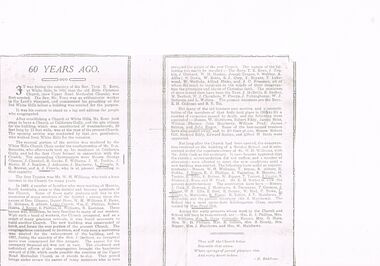
Document - CORNISH COLLECTION: COPIES OF ARTICLE/BOOK/DOCUMENT RE CORNISH CHURCH HISTORY/LIFE IN BENDIGO, 1866
... Various copies of article/book/document re Cornish church history/life in Bendigo; a; programme of celebratory activities for Jubilee of Methodist Church and Sunday School, McKenzie Street - 1916 (handwritten note: ''Former Bible Christian'') - various activities for the period Oct 1st to October 9th; shows poor photographic copy of church building and adjacent Sunday School; stapled is letter from Pastor (A E Wellard) and Officers of the church re the celebrations addressed to ''Dear Friend'' with reference to the inauguration of a Thanksgiving Fund....Various copies of article/book/document re Cornish church history/life in Bendigo; a; programme of celebratory activities for Jubilee of Methodist Church and Sunday School, McKenzie Street - 1916 (handwritten note: ''Former Bible Christian'') - various activities for the period Oct 1st to October 9th; shows poor photographic copy of church building and adjacent Sunday School; stapled is letter from Pastor (A E Wellard) and Officers of the church re the celebrations addressed to ''Dear Friend'' with reference to the inauguration of a Thanksgiving Fund. ...Document. Various copies of article/book/document re Cornish church history/life in Bendigo; a; programme of celebratory activities for Jubilee of Methodist Church and Sunday School, McKenzie Street - 1916 (handwritten note: ''Former Bible Christian'') - various activities for the period Oct 1st to October 9th; shows poor photographic copy of church building and adjacent Sunday School; stapled is letter from Pastor (A E Wellard) and Officers of the church re the celebrations addressed to ''Dear Friend'' with reference to the inauguration of a Thanksgiving Fund.(original of this letter has been cut and repaired with tape (showing up on copy). B. article titled ''60 Years Ago'' - two pages from unknown source with reference to the White Hills Bible Christian Church and the establishment of the church following that in California Gully (Upper Road Methodist Church) - numerous names of choir, early pioneers, ministers of the church, superintendents; c. two pages of information about the ''Back to Upper Road - Diamond Jubilee church, May 1924. Church services on Sunday May 18th; Trustees' Tea Monday 19th May and Children's Day, Sunday May 25th (two services and evening Re-union Tea and Concert - names of ministers and organizers provided. Poor quality reproduction of buildings.buildings, church, methodist church, methodist church. bible christian church. -
Port Melbourne Historical & Preservation Society
Programme - Holy Trinity Anglican Church, Weekly Pew Sheet, 2014
... One of a group of documents from 160th anniversary celebration of Holy Trinity Anglican Church (Ref: Alson 3325) Weekly pewsheet for the service of thanksgiving on Trinity Sunday 15.06.2014 including inserted plea for donations to fund a Sunday School (container)...Religion - Anglican (Holy Trinity) Celebrations fetes and exhibitions Rev Noel Whale One of a group of documents from 160th anniversary celebration of Holy Trinity Anglican Church (Ref: Alson 3325) Weekly pewsheet for the service of thanksgiving on Trinity Sunday 15.06.2014 including inserted plea for donations to fund a Sunday School (container) Programme Holy Trinity Anglican Church, Weekly Pew Sheet ...One of a group of documents from 160th anniversary celebration of Holy Trinity Anglican Church (Ref: Alson 3325) Weekly pewsheet for the service of thanksgiving on Trinity Sunday 15.06.2014 including inserted plea for donations to fund a Sunday School (container)religion - anglican (holy trinity), celebrations fetes and exhibitions, rev noel whale -
Glen Eira Historical Society
Article - St Mary The Virgin, Kooyong Road, South Caulfield
... Fund, the removal from the Elsternwick to the new Caulfield circuit. The silver Jubilee celebrations. Article by Iris Kenatick being a local preacher in the circuit, and list of Pastors and Ministers from 1917 – 1989. Kooyong Road Church Ontario Street Catterall J. M Rev. Caulfield South Caulfield Methodist Circuit Elsternwick Hawthorn Road Bambra Road Eddy J. H. McLelcan MR. Bundeera Road Clarence Street Hunt W. H. Foy and Gibson Balaclava North Road Penny E. R. Field A. B Sunday Schools ...Brief history of the Kooyong Road Church; taken from A Coming Together by Gwenda Mann and Gordon Gray, (a short account of some of the highlights of the first Fifty years of the Kooyong Road Methodist Church, Caulfield, Victoria), date unknown and photocopied. The article details the commencement of the Methodist churches circuit. Includes some history of the churches, early parishioners, the Trust Organ Fund, the removal from the Elsternwick to the new Caulfield circuit. The silver Jubilee celebrations. Article by Iris Kenatick being a local preacher in the circuit, and list of Pastors and Ministers from 1917 – 1989.kooyong road church, ontario street, catterall j. m rev., caulfield south, caulfield methodist circuit, elsternwick, hawthorn road, bambra road, eddy j. h., mclelcan mr., bundeera road, clarence street, hunt w. h., foy and gibson, balaclava, north road, penny e. r., field a. b, sunday schools, eddy mrs., field mrs., hunt mrs., leach a. g, leach mrs, levens miss, levens mr., spargo mr, spargo mrs, taylor mrs, watson mrs., festivals and celebrations, clemens v. miss, sprunt miss, bishop miss, king miss (2), cox mr, choirs, church furniture, venus street, watson amy, dodds p., oliver f. mrs, campbell h., truscott a, truscott mrs., mcgregor f. mrs, jupiter street, organs, halls, hawthorn road church, tennis courts, foundation stones, kindergartens, cricket clubs, blake e. b rev, mcgregor f. r., price c, pearson a, mahaffy j. b, hollyock e, blake mrs, aveling mrs, cripps mrs, veitch mrs, sharp w, sprunt b, hillier h. r., hillier mrs, (cousins) dulcie, cousins rowley, st mary the virgin, watson(lund) amy, millar joan, kenafick iris, governors, huntingfield lord, festivals and celebrations, clergy, church services, church festivals -
Glen Eira Historical Society
Book - St Peter's Catholic Church, Bentleigh East
... Sunday School... Baptism Support... Children Liturgy Of The Word... Pre Marriage Program... Cancer Support Group... Ministry To The Sick... Loss And Grief Support... Junior Youth Support... Senior Youth Support... Outreach... Bingo... The Parish Fete... White Elephant... Young Vinnies... St Vincent de Paul... Spirituality In The Pub (S.I.P)... The Passionist Family Group Movement... Rite Of Christian Initiation For Adults (R.C.I.A)... Prayer Around The Cross... St Peter's Prayer Group... St Peter's Choir... Antioch... Catholic War Veterans Association... Memorial Bursary Fund...Heriot Maurice FR McKenna Fred FR Wade Terry FR Gebbie Gordon FR Casey William FR Maloney Des FR O’Sullivan FR Guiney John Upton John Stephen Kennedy James O’ Meara Noreen SR Coakley Daniel FR Chevalier Wilma Sierakowski Michael FR Centre Road Bentleigh East Bignell Road Opal Court The Lighthouse Project McKenna Centre Memorial Stone The Anchor Bayside Learning Memorial Garden And Wall St Peter's School Presentation Sisters Daughters Of Our Lady Of The Sacred Heart Casey Reserve Outside School Hours Program Moorleigh Community Centre St James College St James College Chapel Loganville Hostel Loganville Social Committee The Beacon Moongala Drop-In Centre Berlin Wall Souvenir St Peter's Memorial Book Faith And Life Development Altar Servers Deaneries Bentleigh Chadstone Clayton Bentleigh East Moorabbin East Murrumbeena Oakleigh Ormond Clayton South Liturgy Group Friday Mass Sacramental Sponsoring Sunday School Baptism Support Children Liturgy Of The Word Pre Marriage Program Cancer Support Group Ministry To The Sick Loss And Grief Support Junior Youth Support Senior Youth Support Outreach Bingo The Parish Fete White Elephant Young Vinnies St Vincent de Paul Spirituality In The Pub (S.I.P) The Passionist Family Group Movement Rite Of Christian Initiation For Adults (R.C.I.A) Prayer Around The Cross St Peter's Prayer Group St Peter's Choir Antioch Catholic War Veterans Association Memorial Bursary Fund Catechetics St Peter's Catholic Church Book St Peter's Catholic Church, Bentleigh East ...The Golden Harvest Is A Book That Continues The History Of St Peter’s Parish, Bentleigh East From 1984 – 2005. The Book Discusses Community Life For The Previous 25 Years, Specifically Outreach And Services, Liturgy, Faith Education, And Fundraising, Finishing With Recollections From Parishioners.heriot maurice fr, mckenna fred fr, wade terry fr, gebbie gordon fr, casey william fr, maloney des fr, o’sullivan fr, guiney john, upton john stephen, kennedy james, o’ meara noreen sr, coakley daniel fr, chevalier wilma, sierakowski michael fr, centre road, bentleigh east, bignell road, opal court, the lighthouse project, mckenna centre, memorial stone, the anchor, bayside learning, memorial garden and wall, st peter's school, presentation sisters, daughters of our lady of the sacred heart, casey reserve, outside school hours program, moorleigh community centre, st james college, st james college chapel, loganville hostel, loganville social committee, the beacon, moongala drop-in centre, berlin wall souvenir, st peter's memorial book, faith and life development, altar servers, deaneries, bentleigh, chadstone, clayton, bentleigh east, moorabbin east, murrumbeena, oakleigh, ormond, clayton south, liturgy group, friday mass, sacramental sponsoring, sunday school, baptism support, children liturgy of the word, pre marriage program, cancer support group, ministry to the sick, loss and grief support, junior youth support, senior youth support, outreach, bingo, the parish fete, white elephant, young vinnies, st vincent de paul, spirituality in the pub (s.i.p), the passionist family group movement, rite of christian initiation for adults (r.c.i.a), prayer around the cross, st peter's prayer group, st peter's choir, antioch, catholic war veterans association, memorial bursary fund, catechetics, st peter's catholic church -
 Sunshine and District Historical Society Incorporated
Administrative record - Financial Records and Statements: St John's Anglican Church, Deer Park, 1950s - Accounts + some correspondence
... Sunday School requisites. Projects Committee (canvas). See also Fund raising 1817-05. ...Sunday School requisites. Projects Committee (canvas). See also Fund raising 1817-05. ...Largely kept by Gwen Mousley and possibly by her father Mr J.E. Mousley. Donated to Sunshine & District Historical Society by Gwen.st. johns church, deer park, miles street, church -
 Surrey Hills Historical Society Collection
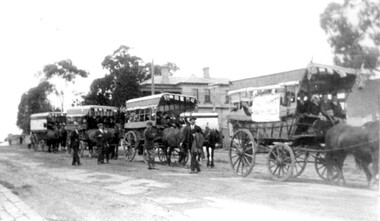
Photograph, Preparing to leave for the St George's Church of England Sunday School picnic, Mont Albert Road, 1922, 1922
... School at Surrey Hills. The building was partly funded by donations, profits from a bazaar and concert, and other people donated furnishings. The church had boundaries along Mont Albert Road and St Georges Road. In 1998 the Church was sold and converted into a complex of units. Its current address is 19 St Georges Avenue, Mont Albert. The annual Sunday...School at Surrey Hills. The building was partly funded by donations, profits from a bazaar and concert, and other people donated furnishings. The church had boundaries along Mont Albert Road and St Georges Road. In 1998 the Church was sold and converted into a complex of units. Its current address is 19 St Georges Avenue, Mont Albert. The annual Sunday ...The drags would have been leaving St George's Church of England in Mont Albert Road. The foundation stone for St George's Church of England, Mont Albert was laid in 1886 on land donated by Edward Dyer and the first service was preached in January 1887. From 1904 until 1907 it was known as Holy Trinity, Surrey Hills. The original church was weatherboard and replaced by a brick one in the Gothic Revival style which was designed by local architect George J V Blackburne, who also designed the Wesleyan School at Surrey Hills. The building was partly funded by donations, profits from a bazaar and concert, and other people donated furnishings. The church had boundaries along Mont Albert Road and St Georges Road. In 1998 the Church was sold and converted into a complex of units. Its current address is 19 St Georges Avenue, Mont Albert. The annual Sunday School picnic was held at Hampton and drags were the usual mode of transport. 'Lugano' was built in 1893 for William Wilson, a prominent stonemason and importer of marble fireplaces. In 1903 it became the home of William Holmes who was Chief Electrical Engineer for the Victorian Railways. He designed the electrification of the Melbourne suburban network. 'Lugano' stayed in the Holmes family until the 1930s. The annual Sunday School picnic was held at at a variety of locations and drags were the usual mode of transport. Donor information is that this was taken as the congregation prepared to depart for at Hampton on the picnic held on 25/2/1922. There are 2 copies: the original donated print and an enlargement. The original was mounted on card with photo mounts along with 506, 871, 872, and 873. It measures 13 cm x 9 cm.Black and white photo of 4 'drags' (horse-drawn hooded carriages) lined up in Mont Albert Road near the corner of St George's Avenue, in readiness for departure for the Sunday School picnic. The carriages are loaded with people and decorated with flags. The front carriage has a material sign attached to the side; the top line of writing is not decipherable, but the bottom one reads "SURREY HILLS". Four men stand in the road, which has bluestone curb and channelling. In the background is 'Lugano'.On rear in ink: "S.S. picnic to Hampton / 25th. Feb. 1922" and in a different hand in biro: "At Mont Albert. St George's Church"churches, holy trinity church, anglican church, sunday schools, picnics, lugano, horse-drawn vehicles, william wilson, willaim holmes, st george's church of england, mont albert, mont albert road -
 Surrey Hills Historical Society Collection
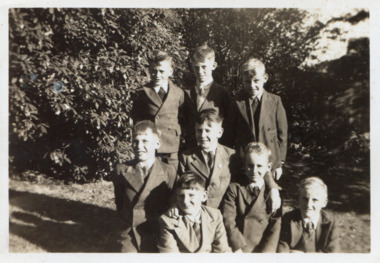
Photograph, Boys from St Georges Sunday School, 1945, 1945
... School at Surrey Hills. The building was partly funded by donations, profits from a bazaar and concert, and other people donated furnishings. The church had boundaries along Mont Albert Road and St Georges Road. In 1998 the Church was sold and converted into a complex of units. Its current address is 19 St Georges Avenue, Mont Albert. Children Mary Clucas Clothing and dress 1945 St Georges Sunday ...The foundation stone for St George's Church of England, Mont Albert was laid in 1886 on land donated by Edward Dyer and the first service was preached in January 1887. From 1904 until 1907 it was known as Holy Trinity, Surrey Hills. The original church was weatherboard and replaced by a brick one in the Gothic Revival style which was designed by local architect George J V Blackburne, who also designed the Wesleyan School at Surrey Hills. The building was partly funded by donations, profits from a bazaar and concert, and other people donated furnishings. The church had boundaries along Mont Albert Road and St Georges Road. In 1998 the Church was sold and converted into a complex of units. Its current address is 19 St Georges Avenue, Mont Albert.Black and white photo of 8 boys in suit jackets. 3 boys standing, 3 kneeling with one hanging his arm around shoulder of boy next to him and hand on shoulder of one of 2 boys sitting in front. Outdoor setting with tree and foliage behind. First names of boys identified as Barrie, Maurice, Robin, David, Arthur, Geoff, David and Ian.REAR: Barrie, Maurice, Robin/ David, Arthur/Geoff, David, Ian/March 1945/St Georges SS/1945/children, mary clucas, clothing and dress, 1945, st georges sunday school, holy trinity church, mont albert, sunday schools, surrey hills, st george's anglican church, 1940-1949 -
 Linton and District Historical Society Inc
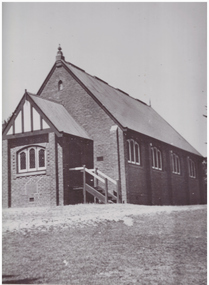
Photograph, Methodist Church, Grantley Street, Linton
... Sunday School meetings began there in November 1859. By 1860 the church building was considered too small. The land was sold to Mr. Brewer, and the building was removed to a site in Grantley Street and enlarged. Shortly after this, it was decided to build a new church, a wooden structure which was opened in 1861. This building was still in use at the time of the Methodist Church Jubilee in 1910, however around 1905 a fund...Sunday School meetings began there in November 1859. By 1860 the church building was considered too small. The land was sold to Mr. Brewer, and the building was removed to a site in Grantley Street and enlarged. Shortly after this, it was decided to build a new church, a wooden structure which was opened in 1861. This building was still in use at the time of the Methodist Church Jubilee in 1910, however around 1905 a fund ...Methodist Church meetings and services are known to have been held in tents on the Lintons diggings from the late 1850s. A small wooden church was built in in 1858-59 in Sussex Street, Linton (near where Shepherd's store was located). Sunday School meetings began there in November 1859. By 1860 the church building was considered too small. The land was sold to Mr. Brewer, and the building was removed to a site in Grantley Street and enlarged. Shortly after this, it was decided to build a new church, a wooden structure which was opened in 1861. This building was still in use at the time of the Methodist Church Jubilee in 1910, however around 1905 a fund was established to build a new brick church (pictured), which was opened in 1913. This building was sold and became a private residence about 1979.Black and white photograph of brick church building, leadlight windows in three sections at front and alongside. Sets of steps leading to doors on both sides of church front entrance porch.methodist church linton -
 Linton and District Historical Society Inc
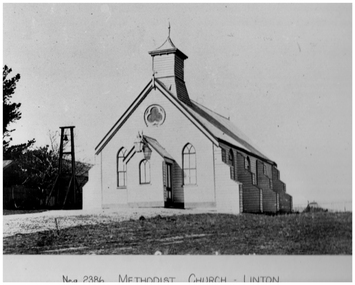
Photograph, Methodist Church, Linton, Timber Construction, Opened 1861
... Sunday School meetings began there in November 1859. By 1860 the church building was considered too small. The land was sold to Mr. Brewer, and the building was removed to a site in Grantley Street and enlarged. Shortly after this, it was decided to build a new church, also of timber construction, which was opened in 1861. This building (pictured) was still in use at the time of the Methodist Church Jubilee in 1910, however around 1905 a fund...Sunday School meetings began there in November 1859. By 1860 the church building was considered too small. The land was sold to Mr. Brewer, and the building was removed to a site in Grantley Street and enlarged. Shortly after this, it was decided to build a new church, also of timber construction, which was opened in 1861. This building (pictured) was still in use at the time of the Methodist Church Jubilee in 1910, however around 1905 a fund ...Methodist Church meetings and services are known to have been held in tents on the Lintons diggings from the late 1850s. A small wooden church was built in in 1858-59 in Sussex Street, Linton (near where Shepherd's store was located). Sunday School meetings began there in November 1859. By 1860 the church building was considered too small. The land was sold to Mr. Brewer, and the building was removed to a site in Grantley Street and enlarged. Shortly after this, it was decided to build a new church, also of timber construction, which was opened in 1861. This building (pictured) was still in use at the time of the Methodist Church Jubilee in 1910, however around 1905 a fund was established to build a new brick church which was opened in 1913. This brick building was sold and became a private residence about 1979.Black and white photograph which has been printed as a post card. The photograph shows a timber church which has a kind of turret, and side buttresses. Bell tower on left of picture. Large lamp hanging from entrance porch.methodist church linton, postcards -
 Wodonga & District Historical Society Inc
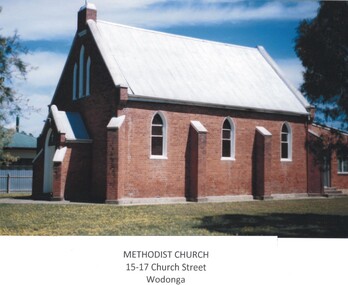
Photograph - First Methodist Church, Wodonga
... Sunday School classes were conducted in the Methodist Hall. In 1961 the Church building and land was purchased by the Ukrainian Community for £2,000. Ukrainian Catholic families in Wodonga donated £100 each towards the purchase. Additional fund...Sunday School classes were conducted in the Methodist Hall. In 1961 the Church building and land was purchased by the Ukrainian Community for £2,000. Ukrainian Catholic families in Wodonga donated £100 each towards the purchase. Additional fund ...Land for the Methodist Church in Wodonga was reserved in 1864. By 1865 the Reverend Francis Neale, a Wesleyan minister was appointed to Albury from where he supervised the congregation at Wodonga Creek until a church was built in 1873. By 1885 Wodonga and the other preaching places on the Victorian side of the Murray had become a separate circuit under the Reverend L. J Rowlands. This circuit included Bethanga. Kiewa. Leneva, Kergunyah and Bonegilla. In the 1960s the Methodist congregation built a new chapel in Hovell Street, Wodonga. The creation of the Uniting Church during the 1970s meant that the services were held in the former Presbyterian Church and joint Sunday School classes were conducted in the Methodist Hall. In 1961 the Church building and land was purchased by the Ukrainian Community for £2,000. Ukrainian Catholic families in Wodonga donated £100 each towards the purchase. Additional fund raising such as carol singing in nearby towns (Benalla, Wangaratta, Albury and Wodonga) assisted with the purchase of the Church. The former Methodist Church was in poor condition and the members of its new congregation undertook the replacement of the floor, the footings, replastering of the walls and the construction of an altar. The renovations cost a further £400. Once a month a priest came up from Melbourne to conduct services in the Church. On completion it was blessed by Bishop Ivan Prasko to become St Olga's Catholic Church (Ukrainian). In 1965 the Church was dedicated to its patron St Volodymir, with Bishop Varlamm (Sydney) and Bishop Donat (Melbourne) taking part in the ceremony. The members of the Ukrainian Catholic community also built a hall and smaller chapel in Hunt Street, Wodonga. With a declining congregation, this property became more manageable to maintain than the original brick building and the decision was made to close the building in 2010. In 2022 the building and extensive block of land in Church Street was sold commercially for potential redevelopment.These images are significant because they depict an early Wodonga Church building.A collection of coloured photographs depicting the first Methodist Church in Wodonga, Victoria It was a red brick church with a steeply pitched gable roof and parapeted gable walls. There was a small front porch with matching roof and gable treatment to the front. Simple timber Gothic windows were along the sides, with a tri-partite window above the porch. Two sections of this window featured stained glass, the other was opaque glass. Red brick buttresses were topped with white-painted render, as were the parapets, and the windows were also outlined with white painted render. Timber joinery was painted white. A front path led directly to the porch and the Church was flanked by mature oak trees. A small, relatively modern red brick skillion extension was added to the rear of the building.wodonga churches, methodist church wodonga, ukrainian catholic church wodonga
