
Showing 6 items matching "sunderland bay"
-
 Phillip Island and District Historical Society Inc.
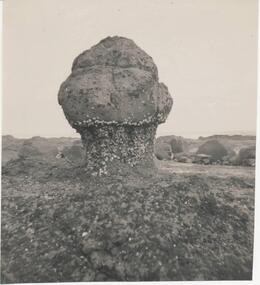
Photograph, Dr G Baker
... ...sunderland bay...Photograph of a natural bollard on the reef at Sunderland Bay, Phillip Island...Sunderland Bay, Phillip Island , Victoria, Australia...One of a collection of over 400 photographs in an album commenced in 1960 and presented to the Phillip Island & Westernport Historical Society by the Shire of Phillip Island local history photography rock formation black & white photograph coastline sunderland bay Dr G Baker John Jenner Bryant West Photograph of a natural bollard on the reef at Sunderland Bay, Phillip Island Photograph Dr G Baker John Jenner Bryant West ...One of a collection of over 400 photographs in an album commenced in 1960 and presented to the Phillip Island & Westernport Historical Society by the Shire of Phillip IslandPhotograph of a natural bollard on the reef at Sunderland Bay, Phillip Islandlocal history, photography, rock formation, black & white photograph, coastline, sunderland bay, dr g baker, john jenner, bryant west -
 Flagstaff Hill Maritime Museum and Village
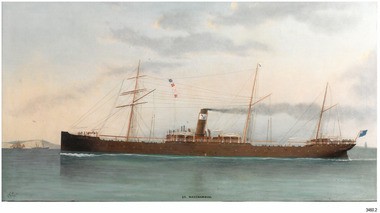
Photograph - Vessel, Sail and Steam Ship, S.S. Warrnambool
... Sunderland Ship Building Company...migrant ship...1892 ship...home flag...BAL...Australian export...S.S.Warrnambool...dover strait...english chanel...Port of Warrnambool...Lady Bay...The images connect the SS Warrnambool to the international trade of cargo and passengers. flagstaff hill warrnambool Photograph steam ship Warrnambool flagstaff hill maritime village shipwreck coast SS Warrnambool Captain Charles Keith Miller CKM 1893 William Lund Warrnambool Town Council Blue Anchor Line Lund Line ladies of Warrnambool house flag diagonal blue anchor Captain Miller Sunderland Ship Building Company migrant ship 1892 ship home flag BAL Australian export S.S.Warrnambool dover strait english chanel Port of Warrnambool Lady Bay MRVB Captain Charles Miller Captain Joshua Edward Iibery ostriches Queen Victoria British and South American Steam Navigation Co. ...This photograph and a matching earlier photograph are images of a 1989 oil-on-canvas painting owned by the donor. They show the British sail and steam ship SS Warrnambool at Dover Strait in the English Channel. Each photograph was accompanied by a letter, one written in 2001 and the other in 2003, confirming that the artist of the painting was by Charles Keith Miller, signed with his initials “CKM” and dated “1893”. The images show the ship’s home flag with a diagonal blue anchor flying from the masthead. The same symbol is painted on the ship’s black funnel. The signal flags on the foremast display ‘M’ ‘R’ ‘V’ ‘B’, with each flag signalling a meaning in the International Code of Signals. While the SS Warrnambool was visiting Melbourne on its maiden voyage on December 1, 1892, a painting of that Lind Line ship by marine artist C.K. Miller was presented to the Town Council of Warrnambool by Mr. William Lund of London, owner of the Lind Line, or Blue Anchor Line. At that time, the Ladies of Warrnambool presented the ship with a ‘house’ flag bearing the Blue Anchor Line’s symbol, made by them especially for the occasion during the preceding moth. On December 6, the homeward bound ship anchored for a short time off the Port of Warrnambool, and a boat was launched from Lady Bay to take a group of friends to the ship with a delivery of gifts. After three cheers each for the ship and its Captain the SS Warrnambool continued its journey towards Britain via Adelaide. Although the painting was gifted in December 1892, it is post-dated “1893”. The reason for the discrepancy is unclear but whatever the reason, the provenance of the painting was confirmed at auctions of this painting and other works by the same artist. CHARLES KEITH MILLER 1836-1907:- Captain Charles Miller left his home in Scotland at the age of 15 years for a life at sea. He earned his Master’s Certificate ten years later. After being the captain of sailing ships, he moved to the steamships because they were faster. He married in 1866 and settled in Glasgow. Over the following eleven years, he and his wife had five children, then sadly, his wife passed away. Captain Miller returned to the sea for a while, but in 1888, he gave up his sea life to spend his time as a marine artist. His understanding of seafaring life and vessels, combined with his artistic skills, enabled him to produce fine art, and several galleries and museums have collections of his sought-after works. S.S. WARRNAMBOOL 1892-1925:- The sail and steamship SS Warrnambool was built in 1892 by the Sunderland Ship Building Company for the Lund Line of London, founded by William Lund in 1869, and registered in London. It efficiently carried passengers and cargo worldwide, including Australia, under its master, Captain Joshua Edward Ilbery, who had many years of experience with the Lund’s Blue Anchor Line, or BAL, which owned a fleet of sail and steamships. The funnels its steamships were painted black, with a white band around the top bearing a diagonal blue anchor and chain, also shown on the company’s house flag. The Lund Line ships were given Australian place names beginning with the letter “W”. Master Mariner, Captain Joshua Ilbery, was lost at sea without a trace in 1909, along with the ship SS Waratah. The ‘no frills’ service carried passengers and cargo to and from Europe around the Cape of Good Hope, stopping at various ports. The ship was involved in bringing home returned soldiers in 1895. At one time, it carried a doctor from Victoria, Australia, to assist at the war front in South Africa. The ship had a very good reputation for its cargo arriving almost always in excellent condition. Exported goods from Australia included iron safes, flour, wool, apples, frozen rabbits, butter, cheese, pork, cattle, poultry and sheep. One remarkable delivery contained Ostriches for Queen Victoria, and they survived the journey well. The SS Warrnambool was sold in 1900 to the British and South American Steam Navigation Co. Ltd of Liverpool and was renamed ‘Harmodius’. R.P. Houston & Company of London managed the company, and its Houston Line funnels were red with a black top. The Harmodius was sold in 1919 to K.S.S. Co. Ltd, managed by Kaye Son & Co. Ltd. of Liverpool, and was renamed ‘Kut’. The line had black funnels with a white ‘K’ in a diamond or between white stripes. In 1926, it was purchased by T.W. Ward Ltd. and broken up. NOTE- other vessels named “Warrnambool” Two other vessels carried the name “Warrnambool” (1)- HMAS Warrnambool J202 (1941-1947), a Bathurst-class corvette vessel owned by the Royal Australian Navy, was destroyed by a mine. (2)- HMAS Warrnambool FCPB204 (1980-2005), a Fremantle Class Patrol Boat of the RAN. The photograph is significant for its association with the painting "SS Warrnambool" by renowned marine artist Charles Keith Miller, whose paintings are well valued. The painting by C K Miller, the photograph, both bear the name Warrnambool, and the house flag of the Lind Line, are connected through the gifts exchanged between the ship company owner, the Town of Warrnambool and the Ladies of Warrnambool. The images connect the SS Warrnambool to the international trade of cargo and passengers. Coloured photograph of a painting depicting the Blue Anchor Line’s 1892 steamship S.S. Warrnambool. The three-masted ship in calm water. Its sails are lowered, and smoke is rising from its funnel. It displays four raised signal flags, a house flag and a blue ensign on the ship. The funnel also bears the house flag's symbol. There are figures on deck. The signature of the painting's artist, CKM (Charles Keith Miller), and a title on the lower edge of the photograph.House flag symbol, [diagonal blue anchor on white background] Text "CKM" and "1893" Text "S. S. WARRNAMBOOL."flagstaff hill, warrnambool, photograph, steam ship warrnambool, flagstaff hill maritime village, shipwreck coast, ss warrnambool, captain, charles keith miller, ckm, 1893, william lund, warrnambool town council, blue anchor line, lund line, ladies of warrnambool, house flag, diagonal blue anchor, captain miller, sunderland ship building company, migrant ship, 1892 ship, home flag, bal, australian export, s.s.warrnambool, dover strait, english chanel, port of warrnambool, lady bay, mrvb, captain charles miller, captain joshua edward iibery, ostriches, queen victoria, british and south american steam navigation co., harmodius, r.p. houston & company, houston line, k.s.s. co. ltd, kaye son & co. ltd, kut, t.w. ward ltd -
 Bendigo Military Museum
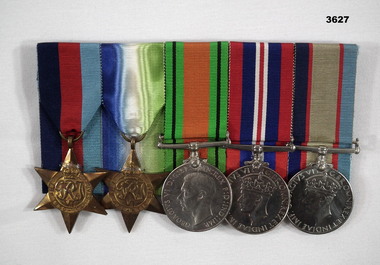
Award - MEDALS RAAF, Post 1945
... Sunderland Sqd which was a large long range patrol Flying Boat. The unit was mainly Australians from many nations. He rises through the ranks to T/F/Sgt, Officer, Pilot Officer, Flying Officer and last Flight Lieutenant on 10.3.1945. He is discharged from the RAAF on 7.12.1945 at RAF Station Beecles Suffolk England. 461 Sqd was a Coastal Command unit mostly involved in submarine detection and hunting in the Atlantic and Bay of Biscay. ...Sunderland Sqd which was a large long range patrol Flying Boat. The unit was mainly Australians from many nations. He rises through the ranks to T/F/Sgt, Officer, Pilot Officer, Flying Officer and last Flight Lieutenant on 10.3.1945. He is discharged from the RAAF on 7.12.1945 at RAF Station Beecles Suffolk England. 461 Sqd was a Coastal Command unit mostly involved in submarine detection and hunting in the Atlantic and Bay of Biscay. ...Reginald Charles ALLARDICE enlisted first in the CMF on 10.8.1940 age 21 years Regt No V40236. During this time he applied to join the RAAF so was discharged from the Army on 21.5.1942 as a Pte in the 24/39th Bn. Two days later he is in the RAAF as a Trainee Aircrew WEF No 418577. On 31.12.1942 he is listed as a LAC (Leading Aircraftsman. Ongoing training sees him at Benalla, Mallala in SA, Mt Gambier, Pt Cook, Camp Miles Standish USA. Finally he is stationed in England at Pembroke with 461 Sqd RAAF with the rank of Sgt on 10.10.1943. This was a Sunderland Sqd which was a large long range patrol Flying Boat. The unit was mainly Australians from many nations. He rises through the ranks to T/F/Sgt, Officer, Pilot Officer, Flying Officer and last Flight Lieutenant on 10.3.1945. He is discharged from the RAAF on 7.12.1945 at RAF Station Beecles Suffolk England. 461 Sqd was a Coastal Command unit mostly involved in submarine detection and hunting in the Atlantic and Bay of Biscay. They were involved in the D Day landings. The Sqd lost 20 aircraft to enemy action and accidents. A total of 86 Sqd members were lost of which 64 were Australian.Medals, individual with ribbons re R.C.Allardice. (1) 1939 - 45 Star, original not engraved. (2) Atlantic Star, original not engraved. (3) Defence Medal. (4) British War Medal 1939 - 45. (5) Australian Service Medal 1939 - 45. (.3, .4, .5) “418577 R.C.ALLARDICE”medals, campaign, service, world war2 -
 Queenscliffe Maritime Museum
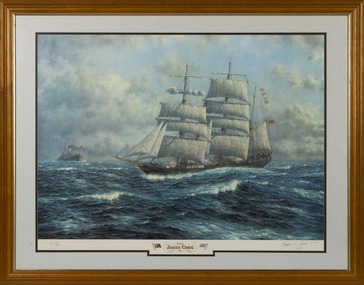
Print - Reproduction print, framed, Oswald L Brett, Barque James Craig 1874, 1974
... Sunderland England she was employed carrying cargo around the world and rounded Cape Horn 23 times in 26 years. In 1900 she was acquired by Mr J J Craig, renamed James Craig in 1905 and began to operate between New Zealand and Australia until 1911. Unable to compete with freight cargo, in later years James Craig was used as a collier and later laid up, then used as a hulk, until eventually being abandoned at Recherche Bay in Tasmania. ...Sunderland England she was employed carrying cargo around the world and rounded Cape Horn 23 times in 26 years. In 1900 she was acquired by Mr J J Craig, renamed James Craig in 1905 and began to operate between New Zealand and Australia until 1911. Unable to compete with freight cargo, in later years James Craig was used as a collier and later laid up, then used as a hulk, until eventually being abandoned at Recherche Bay in Tasmania. ...Built in 1874 in Sunderland England she was employed carrying cargo around the world and rounded Cape Horn 23 times in 26 years. In 1900 she was acquired by Mr J J Craig, renamed James Craig in 1905 and began to operate between New Zealand and Australia until 1911. Unable to compete with freight cargo, in later years James Craig was used as a collier and later laid up, then used as a hulk, until eventually being abandoned at Recherche Bay in Tasmania. In 1932 she was sunk by fishermen who blasted a 3-metre hole in her stern. Restoration of James Craig began in 1972, when volunteers (now the Sydney Heritage Fleet) refloated her and towed her to Hobart for initial repairs. Brought back to Sydney under tow in 1981, her hull was placed on a submersible pontoon to allow work on the hull restoration to proceed. Over twenty-five years, the vessel was restored and relaunched in 1997. In 2001 restoration work was completed and she continues to go to sea.Mr Robeert Greenway A framed reproduction of a painting by Oswald L Brett on canvas paper of the Barque James Craig 1874 Barque James Craig 1874. Images of two flags; a red ensign and a ships flag 'Craig'; Oswald L Brett N.Y. 1978 james craig, windjammers, barque -
 Waverley RSL Sub Branch
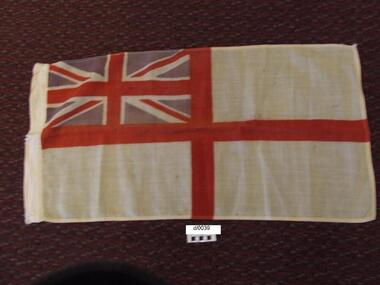
Flag White Ensign from Sunderland Flyingboat
... This flag was carried by the Sunderland Aircraft "U" of 288 Squadron in 1942-44 Based NW approach UK Loch ERNE NI ,Bay of Biscay Pembroke dock Mt. ...This flag was carried by the Sunderland Aircraft "U" of 288 Squadron in 1942-44 Based NW approach UK Loch ERNE NI ,Bay of Biscay Pembroke dock Mt. ...This flag was carried by the Sunderland Aircraft "U" of 288 Squadron in 1942-44 Based NW approach UK Loch ERNE NI ,Bay of Biscay Pembroke dock Mt. Battern & Poole, Iceland Reykjavic, Faroes Vagaar, & Mediterranean Cloth flag with Union Jack in top left corner on with white background showing Cross of St. Georgeflag, ensign, sunderland, 288 squadron -
 Bendigo Military Museum
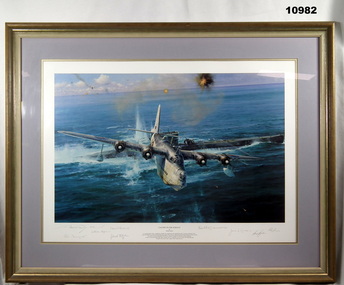
Print - SUNDERLAND, FRAMED, Robert Taylor, "CAUGHT ON THE SURFACE", 1970's
... ./ In a strange quirk of fate, a Sunderland of Number 461 Squadron RAAF, identification letter U, destroys submarine U-461,/ a type XIV tanker, one of three German submarines caught on the surface by Allied aircraft in the Bay of Biscay, on July 30 1943. / At extreme low level, Sunderland U/461 braves a barrage of gunfire from all circling submarines...../ In a strange quirk of fate, a Sunderland of Number 461 Squadron RAAF, identification letter U, destroys submarine U-461,/ a type XIV tanker, one of three German submarines caught on the surface by Allied aircraft in the Bay of Biscay, on July 30 1943. / At extreme low level, Sunderland U/461 braves a barrage of gunfire from all circling submarines. ...From inscriptions and markings; 'To deliver a successful depth charge attack, sinking U-461 in a single pass. In an act of grace, the Sunderland pilot/ returned to the scene to drop a dinghy to the U-Boat survivors. Limited Edition "209/500".Print - on paper, print of a painting, in colour, depicting a "Sunderland" aircraft - flying boat attacking a U-boat. Background of sea and sky. Painting by aviation artist Robert Taylor. Title information and 9 signatures below painting. Frame - timber with light brown, gold and beige coloured paint. Decorative moulding. Mount - light purple colored cardboard. Glass front and cardboard backs.Information printed below painting on print "CAUGHT ON THE SURFACE"/ by/ Robert Taylor./ In a strange quirk of fate, a Sunderland of Number 461 Squadron RAAF, identification letter U, destroys submarine U-461,/ a type XIV tanker, one of three German submarines caught on the surface by Allied aircraft in the Bay of Biscay, on July 30 1943. / At extreme low level, Sunderland U/461 braves a barrage of gunfire from all circling submarines.print, framed accessories, military history, airforce, aircraft raaf
