
Showing 20 items matching "surgical mask"
-
 St Vincent's Hospital Melbourne Archives
Uniform - Nurses surgical gauze mask worn by Nurse Joan D'Arch in unknown era
... Nurses surgical gauze mask worn by Nurse Joan D'Arch in unknown era....Surgical mask...The custom made re-usable surgical mask would have been used in hospital settings where infection control was vital and prior to the introduction of disposable mask. ...Uniform Nurses surgical gauze mask worn by Nurse Joan D'Arch in unknown era. ...The custom made re-usable surgical mask would have been used in hospital settings where infection control was vital and prior to the introduction of disposable mask. surgical mask, surgical nursing, st vincent's hospital melbourne, joan mary d'arch -
 Royal Australian and New Zealand College of Obstetricians & Gynaecologists (RANZCOG)
Surgical gauze mask used by Dr Mitchell Henry O'Sullivan
... Surgical gauze mask used by Dr Mitchell Henry O'Sullivan...The ends of the tape were used to tie the mask to the doctor's face covering the nose and mouth. Surgical gauze mask used by Dr Mitchell Henry O'Sullivan ...Dr Mitchell Henry O'Sullivan worked in the Victorian country town of Casterton as a general practitioner from 1919 until his death in 1977. He also practiced obstetrics. His son, Dr David More O'Sullivan donated his obstetric bag and its contents to the College in 1999. The bag and contents are a unique time capsule of the type of instruments and pharmaceuticals used in the inter-war period.Mask is made up of several layers of muslin gauze sewn together with cotton tape. The ends of the tape were used to tie the mask to the doctor's face covering the nose and mouth.surgery -
 Alfred Hospital Nurses League - Nursing History Collection
Book - Illustrated book, Anna Kent et al, Frontline Midwife: My story of survival and keeping safe, 2022
... Coloured headshot of a woman (author Anna Kent) wearing a surgical mask and scrubs, a necklace and a badge with a blsck firearm within a red circle and a diagonal line through it (a "no guns" or "gun free zone" symbol) wraps around the spine and both front and back covers. ...Coloured headshot of a woman (author Anna Kent) wearing a surgical mask and scrubs, a necklace and a badge with a blsck firearm within a red circle and a diagonal line through it (a "no guns" or "gun free zone" symbol) wraps around the spine and both front and back covers. ...In Frontline Midwife, Anna Kent shares her extraordinary experiences as a nurse, midwife and mother, illuminating the lives of women that are irreparably affected, includes her work with Medicines Sans FromtiersBook with aqua cover and black and white print. Coloured headshot of a woman (author Anna Kent) wearing a surgical mask and scrubs, a necklace and a badge with a blsck firearm within a red circle and a diagonal line through it (a "no guns" or "gun free zone" symbol) wraps around the spine and both front and back covers. Back cover has a tatement by the author and two reviews of the book. In Frontline Midwife, Anna Kent shares her extraordinary experiences as a nurse, midwife and mother, illuminating the lives of women that are irreparably affected, includes her work with Medicines Sans Fromtiersnursing, midwifery, anna kent, medicines sans frontiers -
 Royal Australian and New Zealand College of Obstetricians & Gynaecologists (RANZCOG)
Sculpture - Carved wooden figurine of a doctor holding a baby
... The doctor is male, and is wearing spectacles and full surgical attire, consisting of a green surgical gown and cap, with a white surgical mask. Brown trouser cuffs and black shoes are visible below the gown. ...The doctor is male, and is wearing spectacles and full surgical attire, consisting of a green surgical gown and cap, with a white surgical mask. Brown trouser cuffs and black shoes are visible below the gown. ...The origin of this statue is unknown, but it may possibly be German.Carved wooden figurine of a doctor holding a baby. The doctor is male, and is wearing spectacles and full surgical attire, consisting of a green surgical gown and cap, with a white surgical mask. Brown trouser cuffs and black shoes are visible below the gown. The doctor is holding a baby by its ankles in his left hand, and is holding his right hand as if about to pat hit the baby on the bottom. The baby is facing the doctor, head pointing towards the ground. Sticker on base of figurine bears the handwritten initials 'MW'.obstetrics -
Royal Australian and New Zealand College of Obstetricians & Gynaecologists (RANZCOG)
Sculpture - Lladro porcelain statuette of a midwife, with baby, Lladro, 1987-1989
... The subject is wearing a blue medical gown and cap, with a surgical face mask hanging around her neck. The subject is wearing black high heeled shoes. ...The subject is wearing a blue medical gown and cap, with a surgical face mask hanging around her neck. The subject is wearing black high heeled shoes. ...Lladro are famous for their porcelain. This particular statuette was first produced in 1971 and was retired by the company in 1998.Statuette of a midwife. The subject has white skin and curly blonde hair. The subject is wearing a blue medical gown and cap, with a surgical face mask hanging around her neck. The subject is wearing black high heeled shoes. The subject is holding a baby in their right hand, with the baby's tummy resting on the subject's palm. The subject's left hand is raised as if about to 'smack' the baby on the bottom. The subject is standing over a plant pot from which a small tree appears to be sprouting. A blue sticker with the number '24' is attached upside down to the back of the plant pot. There is a Lladro maker's mark on the underside of the base of the statuette. Underside of the base is also inscribed with a model number '5431' and other small markings.obstetrics -
 Royal Australian and New Zealand College of Obstetricians & Gynaecologists (RANZCOG)
Sculpture - Bisque porcelain figurine of a doctor
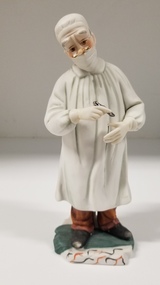
... The doctor has grey hair and is in surgical attire, with white gown, gloves, surgical hat and mask. The cuffs of his brown trousers, and his black shoes, are visible below the gown. ...The doctor has grey hair and is in surgical attire, with white gown, gloves, surgical hat and mask. The cuffs of his brown trousers, and his black shoes, are visible below the gown. ...Bisque porcelain figurine of a male doctor holding a medical instrument. The doctor has grey hair and is in surgical attire, with white gown, gloves, surgical hat and mask. The cuffs of his brown trousers, and his black shoes, are visible below the gown. The doctor is wearing glasses on the end of his nose, and holds a surgical tool in his right hand. The figurine is standing on a base with a painted green stripe across the centre, and is supported by a pillar at the back which is decorated with decorative orange and black squiggly lines. Orange and black squiggly lines also feature on the front of the base. Handwritten lettering on a sticker on underside of base reads 'FF'. -
 Geoffrey Kaye Museum of Anaesthetic History
Equipment - Mask, Ramsay Surgical Limited
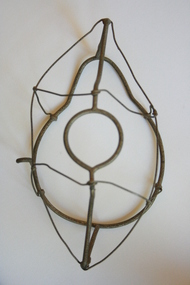
... Equipment Mask Ramsay Surgical Limited ...One of a range of metal face masks designed to have a cover which helps protect the patient's face.Wire frame mask designed to cover mouth and nose. There is a metal hook on the left hand side protuding from the base of the mask and wire mesh raised from the base with a circle in the middle.facemask, anaesthesia, ramsay surgical -
 Geoffrey Kaye Museum of Anaesthetic History
Equipment - Mask, Julliard, 1877
... mask completely enclosing the patient's face excluding any possibility of carbon dioxide being excreted. This object was found in the possession of the Italian Army in Libya in 1940, and donated to the museum by Dr Geoffrey Kaye. Gustave Julliard, of Geneva, after a death from chloroform had occurred in his practice, abandoned the use of that anaesthetic and adopted ether. He administered it from a large, wire frame, the outside of which was covered with waxed cloth to make it impermeable to air, the inside with surgical...mask completely enclosing the patient's face excluding any possibility of carbon dioxide being excreted. This object was found in the possession of the Italian Army in Libya in 1940, and donated to the museum by Dr Geoffrey Kaye. Gustave Julliard, of Geneva, after a death from chloroform had occurred in his practice, abandoned the use of that anaesthetic and adopted ether. He administered it from a large, wire frame, the outside of which was covered with waxed cloth to make it impermeable to air, the inside with surgical ...This is a large metal framework covered in gauze, the whole mask completely enclosing the patient's face excluding any possibility of carbon dioxide being excreted. This object was found in the possession of the Italian Army in Libya in 1940, and donated to the museum by Dr Geoffrey Kaye. Gustave Julliard, of Geneva, after a death from chloroform had occurred in his practice, abandoned the use of that anaesthetic and adopted ether. He administered it from a large, wire frame, the outside of which was covered with waxed cloth to make it impermeable to air, the inside with surgical gauze on to which the ether was poured. Large metal wire frame mask, covered in waxed paper, with gauze wrapped around the rim to prevent ether leaking out, effectively forming a rebreathing apparatus.ether, carbon dioxide, italian army, libya, 1940 -
 Geoffrey Kaye Museum of Anaesthetic History
Equipment - Waring's cone, Ramsay Surgical Limited, 1902
... The object was donated by Ramsay Surgical Limited in 1944. waring's cone facemask metal sponge anaesthetic ether ramsay surgical limited cone Cylindrical metal face mask with a high neck that is open at both ends. ...The object was donated by Ramsay Surgical Limited in 1944. Cylindrical metal face mask with a high neck that is open at both ends. The larger opening was placed over the patient's mouth while the smaller opening, comprising a sponge to absorb the anaesthetic and a hinged perforated lid, was used to administer the anaesthetic.waring's cone, facemask, metal, sponge, anaesthetic, ether, ramsay surgical limited, cone -
 Geoffrey Kaye Museum of Anaesthetic History
Equipment - Inhaler, Analgesia, Penthrane
... surgical outpatients. Penthrane Analgesia Self-administration Wooden box with metal clasp and hinges and two sections inside, divided by balsa wood. One side contains an amber plastic and black rubber facial mask ...Originally distributed by Abbott Laboratories. This device is used for the self-administration of Penthane, an analgesic. Designed for use in emergency rooms, obstetrics, orthopaedics and surgical outpatients.Wooden box with metal clasp and hinges and two sections inside, divided by balsa wood. One side contains an amber plastic and black rubber facial mask, along with a inhaler tube and felt square. The other side contains a cylindrical metal device with a black plastic handle secured to one end and a portal for attaching the facial mask at the other.penthrane, analgesia, self-administration -
 Geoffrey Kaye Museum of Anaesthetic History
Equipment - Mask, Ether, Ferguson, 1905
... Mask...Ether...Robert Ferguson...Inhalation...Ramsay Surgical...Mask Ether Robert Ferguson Inhalation Ramsay Surgical Limited Wire mask for ether inhalation. ...The inner dome of the Ferguson's mask was covered in an ordinary vaporising surface of gauze, while the outer tower (circular ring) was enveloped in a domette bag closing at the top to exclude the air so that the ether vapor could be concentrated.Wire mask for ether inhalation. The handle for the mask is made from the same wire as the mesh and there is a circular wire ring above the mask.mask, ether, robert ferguson, inhalation, ramsay surgical limited -
 Geoffrey Kaye Museum of Anaesthetic History
Container - Qantas bag
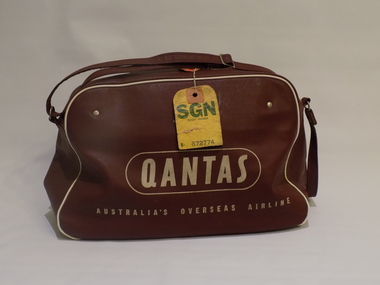
... surgical team long xuyen bien hoa anaesthesia training Brick-red vinyl bag with white Qantas branding including the flying kangaroo printed on both sides. The bag has a zipper opening and contains an anaesthetic apparatus mounted on a piece of wooden particle board. There are two black hoses, a white hose, a black plastic connector, a metal t-bar connect, a green resuscitation bag and black face mask ...Dr James (Jim) Villiers went to Vietnam as an anaesthetist with the Australian Surgical Team (civilian) during 1963. He used this bag for carry-on luggage. Despite assurances about the quality of resources available on arrival, he carried an essential part of the breathing circuit for an EMO vaporiser in his carry-on. The actual vaporiser was packed in his check-in luggage. In 1963 the Vietnamese government sought training in Australia in anaesthetics for several medical technicians. Australia was not able to meet the request as anaesthesia training in Australia is restricted to qualified doctors. Instead, the Dean of the Faculty of Anaesthetists at RACS suggested sending a team of anaesthetists to Vietnam to conduct training for technicians there. However, they requested a preliminary survey be undertaken in order to determine the abilities of the prospective trainees and establish contacts with medical authorities in Vietnam. James (Jim) Villiers was one of the people who undertook the survey and made a report. Training of Vietnamese medical technicians was undertaken using the Epstein MacIntosh Oxford Anaesthetic Apparatus (EMO). This equipment was robust, portable and relatively cheap, there are few moving parts for servicing, it requires only ether and air for operation.Brick-red vinyl bag with white Qantas branding including the flying kangaroo printed on both sides. The bag has a zipper opening and contains an anaesthetic apparatus mounted on a piece of wooden particle board. There are two black hoses, a white hose, a black plastic connector, a metal t-bar connect, a green resuscitation bag and black face mask.james villiers, malignant hyperthermia, vietnam, qantas, australian surgical team, long xuyen, bien hoa, anaesthesia training -
 Geoffrey Kaye Museum of Anaesthetic History
Tool - Mask, Schimmelbusch, Elliott, c. 1930s
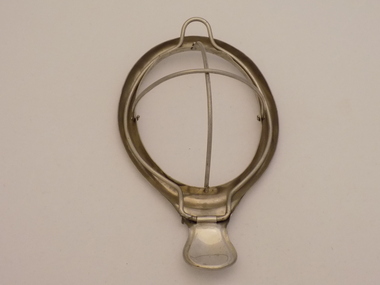
... Curt Theodor Schimmelbusch (November 16, 1860 – August 2, 1895) was a German physician and pathologist who invented the Schimmelbusch mask, for the safe delivery of anaesthetics to surgical patients. In 1890, Schimmelbusch invented a mask for the delivery of anaesthetics to surgical patients. ...Curt Theodor Schimmelbusch (November 16, 1860 – August 2, 1895) was a German physician and pathologist who invented the Schimmelbusch mask, for the safe delivery of anaesthetics to surgical patients. In 1890, Schimmelbusch invented a mask for the delivery of anaesthetics to surgical patients. ...Curt Theodor Schimmelbusch (November 16, 1860 – August 2, 1895) was a German physician and pathologist who invented the Schimmelbusch mask, for the safe delivery of anaesthetics to surgical patients. In 1890, Schimmelbusch invented a mask for the delivery of anaesthetics to surgical patients. It was primarily designed for ether anaesthesia, but he also proposed its use for chloroform anaesthesia. Schimmelbusch designed a metal mask, over which a gauze could be stretched and secured. The mask was placed over the patient's mouth and nose, and anaesthetic was applied to the gauze, allowing the patient to inhale the anaesthetic as they breathed normally. Around the edge of the mask, a trough collected the residual anaesthetic, rather than allowing it to drip onto the patient's face.Oval shaped metal mask with a collapsible cross-shaped dome, hinged clamp and flat handleStamped into underside of handle: ELLIOTT SYDNEYschimmelbusch, mask, open method, chloroform, ether, german, physician, pathologist -
 Geoffrey Kaye Museum of Anaesthetic History
Equipment - Inhaler, Clover, The Holborn Surgical Instrument Company, 1877
... When the patient had been duly "weaned over" to ether, the mask was lifted, the N2O allowed to escape, the bag refilled with exhaled air, and normal anaesthesia "a la Clover's inhaler" was continued. Joseph Clover Mitigated-ether Nitrous Oxide N2O Closed method Manufacturer's logo: THE HOLBORN / SURGICAL INSTRUMENT CO. ...Dr. Joseph Clover (1825-1882), an English physician, first described his Portable Regulating Ether Inhaler on Jan. 20, 1877. Clover was an especially sought after anesthesiologist and early pioneer in the specialty. This was the best-known of many inhalers that Clover designed. The dome-shaped reservoir was turned to points on a control dial to gradually increase or decrease the percentage of the air that passed over the ether. Several inventors based new inhalers on this, while the original continued to be manufactured as late as the beginning of WWII. Clover, to spare the patient the unpleasantness of induction with his "closed" inhaler (1877), suggested the "mitigated-ether" technique. The inhaler was fitted with a bypass tap for the reception of N2O. The bag was filled with the gas and anaesthesia was inducted a combination of N2O and asphyxiation. Ether was then admitted gradually by rotation of the bowl of the inhaler. When the patient had been duly "weaned over" to ether, the mask was lifted, the N2O allowed to escape, the bag refilled with exhaled air, and normal anaesthesia "a la Clover's inhaler" was continued.Metal domed chamber with a bulb attachment for rebreather bag, including a tap mechanism. Remnants of the paper rebreather bag are attached to the bulb. At the other end is a yellow facemask made of plastic (probably celluloid). The manufacturer's logo has been moulded into the dome of the chamber.Manufacturer's logo: THE HOLBORN / SURGICAL INSTRUMENT CO. LTD. / LONDON •Blue sticker with white writing: O.2.4.joseph clover, mitigated-ether, nitrous oxide, n2o, closed method -
 Royal Australian and New Zealand College of Obstetricians & Gynaecologists (RANZCOG)
Sculpture - Ceramic vignette of an obstetrician and patient after childbirth, Gale Pitt, c. 1996
... The doctor is in surgical attire and wearing a gown, cap and mask. ...The doctor is in surgical attire and wearing a gown, cap and mask. Sculpture Ceramic vignette of an obstetrician and patient after childbirth Gale Pitt ...This sculpture was completed by British artist Gale Pitt as part of a commission.Sculpture of a delivery room scene in glazed white ceramic. In the scene, a woman lies on a bed in a gown, whilst a doctor stands next to her holding a baby. The doctor is in surgical attire and wearing a gown, cap and mask. -
 Royal Australian and New Zealand College of Obstetricians & Gynaecologists (RANZCOG)
Chadborn modification Schimmelbusch ether inhaler used by Dr Mitchell Henry O'Sullivan
... Curt Schimmelbusch (1860-1895), a German physician, designed his original mask around 1889 while an assistant surgeon. Surgical assistants were often assigned the task of delivering the anesthetic. ...Curt Schimmelbusch (1860-1895), a German physician, designed his original mask around 1889 while an assistant surgeon. Surgical assistants were often assigned the task of delivering the anesthetic. ...Dr. Curt Schimmelbusch (1860-1895), a German physician, designed his original mask around 1889 while an assistant surgeon. Surgical assistants were often assigned the task of delivering the anesthetic. During anesthesia it was not uncommon for ether and chloroform to get onto the patient’s skin, causing irritation. Chloroform can even cause burn-like reactions. Schimmelbusch designed the rim of his mask so that both sides curve away from the patient’s face to form a kind of trough. He intended the trough-like rim to collect excess anesthetic that would otherwise have trickled onto the patient’s face. To anesthetize a patient, gauze was stretched over the metal bars and fastened in place by the hinge. The mask was placed over the patient’s nose and mouth, and the anesthetic was applied in drops or lightly poured onto the gauze so that the patient breathed in evaporated anesthetic as well as air. This type of mask is sometimes still used today for ether anesthesia in developing countries when other means are not available. (Wood Library Museum of Anesthesiology) This particular object is a modified version of Schimmelbusch's design, known as Chadborn's modification.Oval shaped chromium plated mask with two metal strips linked front to back and side to side to create a dome. An oval shaped mobile wire frame is attached to the lower part of the mask by a hinge at the back, approximately two inches from the lip of the metal handle. A "U" shaped bit of metal is attached to the front of the mask which acts as a clip to fasten the wire frame to the lower section of the mask.anaesthesia -
 Alfred Hospital Nurses League - Nursing History Collection
Book - Illustrated textbook, Carmel Humphrey, Surgical Nursing, 1983
... There is also a coloures photograph of three people in green surgical gowns, white caps and masks standing underneath a theatre light. ...There is also a coloures photograph of three people in green surgical gowns, white caps and masks standing underneath a theatre light. ...Book covers clinical reasoning and procedural skills for nursing students. It supports clinical practice guidelines and research-based care in the 1980'sIllustrated book with white cover that has a clear protective plastic film. On front cover there is dark blue print detailing title, editor and publisher. There is also a coloures photograph of three people in green surgical gowns, white caps and masks standing underneath a theatre light. Title, author and publisher are also printed on the spine [dark blue}non-fictionBook covers clinical reasoning and procedural skills for nursing students. It supports clinical practice guidelines and research-based care in the 1980'snursing, nursing study and teaching-history -
 Royal Australasian College of Surgeons Museum and Archives
Tool - Schimmelbusch anaesthetic mask, Mid 20th Century
... Schimmelbusch model of anesthetic masks, used during the 20th century in Australia. Good example of the surgical instruments used by anesthetists. surgery anesthetic chloroform Anaesthetic mask made of stainless steel. ...Schimmelbusch model of anesthetic masks, used during the 20th century in Australia. Good example of the surgical instruments used by anesthetists. Anaesthetic mask made of stainless steel. Used in conjunction with a chloroform cloth. All screws intact. Spring handle is placed at the rounded end of the mask. surgery, anesthetic, chloroform -
 Ballarat Base Hospital Trained Nurses League
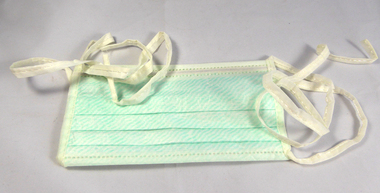
Surgical Masks, Disposible
... Surgical, Masks, Disposible Surgical Masks, Disposible ...surgical, masks, disposible -
 Royal Australasian College of Surgeons Museum and Archives
Equipment - Schimmelbusch anaesthetic mask, Mid 20th Century
... mask, as opposed to the spring. The chloroform cloth was possibly held in place by the clamp, instead of a spring. surgery anesthetic chloroform surgical instrument Martin and Co. ...The Schimmelbusch mask is an open breathing system for delivering an anesthetic. The device was invented by Curt Schimmelbusch in 1889, and was used until the 1950s (though it is still applied in some developing countries). The device consists of a wire frame which is covered with several beds of gauze and applied to the patient's face over the mouth and nose. Then high-volatility anesthetic (usually diethyl ether or halothane, and historically chloroform) is dripped on it, allowing the patient to inhale a mix of the evaporated anesthetic and air. The device is designed to prevent the anesthetic from coming in contact with the patient's skin, where it can cause irritation.This model differs from the others in that the mask's handle is attached to the mask, as opposed to the spring. The chloroform cloth was possibly held in place by the clamp, instead of a spring. Schimmelbusch anasthetic mask, made of Stainless steel. This mask was used with chloroform cloth. Missing spring. Martin and Co.surgery, anesthetic, chloroform, surgical instrument
