
Showing 7 items matching "survival knife"
-
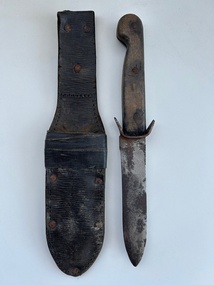 Moorabbin Air Museum
Weapon (Item) - RAF Survival Knife With Leather Scabbard
... RAF Survival Knife With Leather Scabbard....RAF Survival Knife With Leather Scabbard....RAF Survival Knife with wooden slab grip and leather scabbard, overall length 27cm,blade length 14.5cm...RAF Survival Knife with wooden slab grip and leather scabbard, overall length 27cm,blade length 14.5cm RAF Survival Knife With Leather Scabbard. ... -
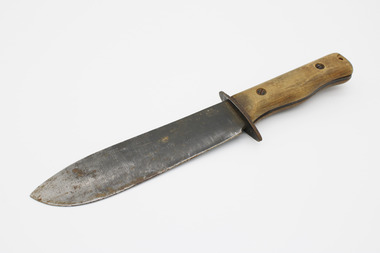 Woodend RSL
British WWII RAF and Special Forces Survival Knife, Late WWII?
... British WWII RAF and Special Forces Survival Knife......survival knife...Heavy duty survival knife with single edged oval shaped broad blade and wooden handle contoured for grip. ...A rare example of a Type D Survival Knife issued to British RAF during the latter part of WWII. british airforce survival knife ww2 wwii type d Blunt end of blade near grip there is engraved '27C/2360', reverse side is the makers mark 'Rodgers Sheffield England'. ...A rare example of a Type D Survival Knife issued to British RAF during the latter part of WWII.Heavy duty survival knife with single edged oval shaped broad blade and wooden handle contoured for grip. Two large screws secure the grips. The pommel end has a wrist cord hole (cord not present). See also item 2020.000034-2 (leather sheath). Blunt end of blade near grip there is engraved '27C/2360', reverse side is the makers mark 'Rodgers Sheffield England'.british airforce, survival knife, ww2, wwii, type d -
![Leather Sheath [for British WWII RAF and Special Forces Survival Knife], Late WWII?](/media/collectors/5e1fa04e21ea6716e8015174/items/5e422c5f21ea670e50758fe1/item-media/5e5f072f21ea670a70bc6d30/item-fit-380x285.jpg?cb=6) Woodend RSL
Woodend RSLLeather Sheath [for British WWII RAF and Special Forces Survival Knife], Late WWII?
... Leather Sheath [for British WWII RAF and Special Forces Survival Knife]......survival knife...See also item 2020.000034-1 (survival knife). ...See also item 2020.000034-1 (survival knife). Leather Sheath [for British WWII RAF and Special Forces Survival Knife] Rodgers ...A rare example of a Type D Survival Knife leather sheath issued to British RAF during the latter part of WWII.Burgundy stained thick leather knife sheath, folded over blade length and secured with stitching and studs, above sheath there is a belt loop, secured with three silver coloured studs at base. At top of the belt loop there is an additional attached loop for securing grip of knife with press stud. See also item 2020.000034-1 (survival knife). british airforce, survival knife, wwii, type d, ww2, sheath -
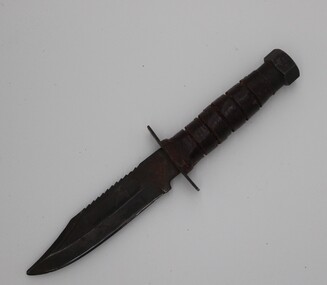 National Vietnam Veterans Museum (NVVM)
Equipment - Survival knife, US
... Survival knife, US......survival knife...A wooden bolt secures the spheres. Equipment Survival knife, US ...Sapper L S Sempel of Royal Australian Engineers traded an Australian Army shirt for this knife, then used it to probe for mines during his service, 1966-1967.Knife with metal blade attached to a wooden handle and bolt hilt. The handle is made up of six wooden spheres joined to the blade. A wooden bolt secures the spheres.Shelham 4131 Japan inscribed on the knife blade.knife, mines, survival knife, us army kabar knife, kabar, engineer, sapper, vietnam, trade, sempel, ka-bar -
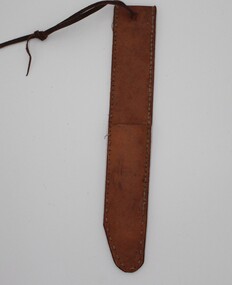 National Vietnam Veterans Museum (NVVM)
Equipment - Scabbard for survival knife
... Scabbard for survival knife...See Survival knife cat. no. 2024.17.1...Equipment Scabbard for survival knife ...See Survival knife cat. no. 2024.17.1Brown leather knife scabbard with cotton stitching and a thin leather tie at the top.scabbard, leather, us army kabar knife, ka-bar, knife -
 Australian Commando Association - Victoria
Tool - Knife Survival
... Knife Survival...Tool Knife Survival ... -
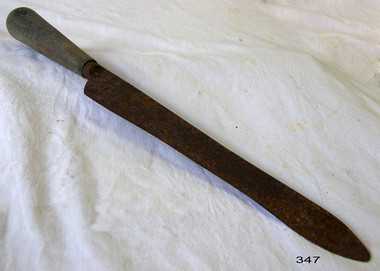 Flagstaff Hill Maritime Museum and Village
Domestic object - Knife
... From the early days of our race, the knife represented one of the first and most important tools that enabled rise of our technology, military, culture, science and all other things that brought us to this point of modern civilisation. As a vital tool for survival...From the early days of our race, the knife represented one of the first and most important tools that enabled rise of our technology, military, culture, science and all other things that brought us to this point of modern civilisation. As a vital tool for survival ...From the early days of our race, the knife represented one of the first and most important tools that enabled rise of our technology, military, culture, science and all other things that brought us to this point of modern civilisation. As a vital tool for survival, combat, construction and food preparation, the knife quickly became the most basic tool from which all others were born. In those ancient times, 500,000 years ago, sharpened stones started slowly evolving, becoming more and more like their modern counterpart. Before the time when fire enabled the melting of the various metals, and forging them into modern knives, their stone counterparts received several visual upgrades. Double bladed knives were most popular, and their wooden or stone hilts were decorated with animal skins and feathers. Those knives represented a great deal of pride for the warriors and elders who owned them, and that tradition continued to be practised with the arrival of the Bronze Age. The appearance of metallurgy brought the ability to create knives from softer types of metal. Even though knives from bronze did not provide durability over longer periods of time [easily dulled, and susceptible to corrosion), their sharpness and slim designed proved to be superior to any stone knife tool. As the centuries went on, iron and then steel became commonplace across the entire world. Knives created from those materials were much more durable and easier to maintain their sharpness after prolonged use. During medieval times in Europe, steel metallurgy managed to evolve knives from small single or double-bladed edges to larger sizes - swords, spears and axes. Even with all those advancements, the use of knives as an eating utensil continued to be used in some small circles. Even as early as the 15th century, wealthy circles of people started carrying personal knives, intended for double use - both eating and defending against threats. During those times the host were not obliged to provide their guest with any kind of eating utensil in addition to plates, so wealthy males used their eating knives for cutting their own meals, and the meals of nearby female guests. Slim double-bladed knives were good for cutting and piercing foods. As the use of forks became widespread in the whole of Europe by the late 17th century, most people used this kind of small knife on a regular basis (a combination of two knives, one for stabilising and other for cutting the meal). http://www.eatingutensils.net/history-of-cutlery/knife-history/The knife is one of the most important items that has enabled the development of civilisation over thousands of years.Carving knife with wooden handle and rusted slender metal blade.None.flagstaff hill, warrnambool, shipwrecked-coast, flagstaff-hill, flagstaff-hill-maritime-museum, maritime-museum, shipwreck-coast, flagstaff-hill-maritime-village, knife, kitchen equipment, dining
