
Showing 4 items matching "swept wing design"
-
 Moorabbin Air Museum
Book - AGARD reports, Transonic Aerodynamics
... design...Wing profiles in transonic flow...Unsteady transonic flow...Viscous transonic flow...Shock & rear separation...Airfoil pressure distribution...Supercritical wing profiles...Leading edge supersonic velocity peaks...Thickness distribution...Swept...AGARD reports Transonic shock free flow Transonic aerofoil problem Supercritical airfoil theory Compressible flow computations Airfoil flows in transonic freestream Transonic airfoil design Wing profiles in transonic flow Unsteady transonic flow Viscous transonic flow Shock & rear separation Airfoil pressure distribution Supercritical wing profiles Leading edge supersonic velocity peaks Thickness distribution Swept wing design Pressure distribution in wings Wing- body interference Wind tunnel experiments on interference Overview of transonic aerodynamics, circa 1968 Transonic Aerodynamics Book AGARD reports ...Overview of transonic aerodynamics, circa 1968non-fictionOverview of transonic aerodynamics, circa 1968transonic shock free flow, transonic aerofoil problem, supercritical airfoil theory, compressible flow computations, airfoil flows in transonic freestream, transonic airfoil design, wing profiles in transonic flow, unsteady transonic flow, viscous transonic flow, shock & rear separation, airfoil pressure distribution, supercritical wing profiles, leading edge supersonic velocity peaks, thickness distribution, swept wing design, pressure distribution in wings, wing- body interference, wind tunnel experiments on interference -
 Australian Gliding Museum
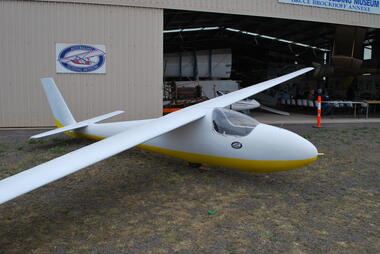
Machine - Glider – Sailplane, 1963
... wing. The instruments are not present except for altimeter. Fin and rudder are of swept back design. ...This type is of note because it was the first Australian designed and built sailplane to be used in a world gliding competition (Jack Iggulden in Argentina in 1963). australian gliding glider sailplane schneider es59 arrow darling downs soaring club wollongong gliding club ron geake Plate in cockpit with details of manufacturer states; manufactured by E. Schneider Ltd, Adelaide SA; Type ES 59; Serial Number 62; Date August 1963. This Schneider ES59 Arrow is a single seat wooden sailplane with one piece wing. The instruments are not present except for altimeter. Fin and rudder are of swept ...This aircraft is one of 9 single seat ES 59 advanced club sailplanes manufactured by Edmund Schneider Pty Ltd in the 1960s. It was first flown in August 1963 and delivered to the Darling Downs Soaring Club at Toowoomba Queensland. At that Club it had 2603 flights and recorded a total airtime of 1475 hours. In addition to many local circuits and soaring and cross country flying, it was used at gliding competitions, including Nationals at Benalla in December 1964, State Championships at Oakey in April 1965, at Warwick in April 1966, and at (Inverell?) in March 1967. On at least 15 occasions flight times in excess of 5 hours duration were achieved. On 5 October 1970, the glider had a new life when it was relocated to Wollongong in New South Wales. It recorded 1927 flights with a total airtime of 1179 hours at the club between October 1970 and June 1988. Competition appearances included the State Championships held at Forbes in January 1972. Places away from Wollongong where the glider was launched include Cootamundra, Wagga, Temora, Marulon, Narromine, Leeton, Nowra, Goulburn, Horsham, Greenthorpe. On 15 June 1988 it was transferred to Ron Geake who transported it to Warrego in Northern Territory (flown once at Alice Springs), and then to Gympie in Queensland where it was flown about 20 times by the end of 1995. It was also flown on a small number of occasions at Forbes in New South Wales in 1996 and 1997. During 1998 and 1999 the glider was sparsely used (9 flights) at locations that have not been recorded. From May 1999 until transfer to the Australian Gliding Museum in May 2011 it apparently was not flown. Aggregate airtime hours for the glider stand at 2702 hours 53 minutes. It has been launched 4569 times. A good example of a Schneider ES59 sailplane from the 1960s. This type is of note because it was the first Australian designed and built sailplane to be used in a world gliding competition (Jack Iggulden in Argentina in 1963). This Schneider ES59 Arrow is a single seat wooden sailplane with one piece wing. The instruments are not present except for altimeter. Fin and rudder are of swept back design. Colour scheme is white with lemon yellow fuselage underbelly. The aircraft came to the museum on an open trailer that had been designed to carry the one piece wing. Plate in cockpit with details of manufacturer states; manufactured by E. Schneider Ltd, Adelaide SA; Type ES 59; Serial Number 62; Date August 1963.australian gliding, glider, sailplane, schneider, es59, arrow, darling downs soaring club, wollongong gliding club, ron geake -
 Australian Gliding Museum
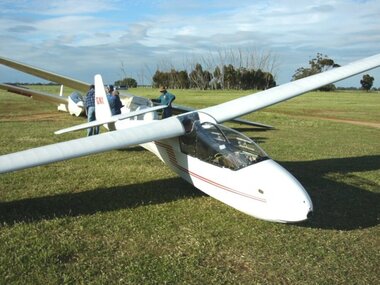
Machine - Glider – Sailplane, March 1964
... The Schleicher K7 is a high wing tandem two-seat sailplane designed in the late 1950s by Rudolf Kaiser for the Alexander Schleicher company in Germany. The fuselage is built using steel tube framing covered with fabric. The swept...The Schleicher K7 is a high wing tandem two-seat sailplane designed in the late 1950s by Rudolf Kaiser for the Alexander Schleicher company in Germany. The fuselage is built using steel tube framing covered with fabric. The swept ...The Schleicher K7 is a high wing tandem two-seat sailplane designed in the late 1950s by Rudolf Kaiser for the Alexander Schleicher company in Germany. The fuselage is built using steel tube framing covered with fabric. The swept-forward cantilever wing is of wood and fabric construction with a single spar and a plywood covered leading edge “D” box for strength. The wing is equipped with Schempp-Hirth airbrakes. The K7 first flew in 1959. It is a versatile design that can be used for both basic and more advanced training of pilots. Over 500 were built. VH-GNX was manufactured in Germany and imported into Australia by Edmund Schneider Limited. It was test flown by them at Parafield Aerodrome, Adelaide, South Australia in March 1964. The original owner of VH-GNX was the Adelaide Soaring Club and it was maintained by Edmund Schneider Limited until May 1971. It appears that about this time it was transferred to the Gold Coast Soaring Club. In July 1974, after it had flown for an aggregate 3075 hours from 13919 flights, it was purchased by the Bundaberg Soaring Club. About 10 years later, it was acquired by the Bendigo Gliding Club. At that stage it had recorded over 4600 hours flying time from 21546 launches. When it was retired from service by the Bendigo Gliding Club in June 2006 due to age related defects the hours flown had reached 7259 from 31820 flights. It appears that the airframe has had a relatively trouble free life with only minor damage from storage / ground handling incidents, a heavy landing (January 1987) and a bird strike (January 2002). It was donated to the Museum in April 2007.This exhibit is an example of the Schleicher K7 two seat sailplane type.Two seat high wing glider sailplane finished in white with red detailing.Serial Number 7134, registered as VH-GNX. The registration appears on each side of the Fin / Rudder in red letteringaustralian gliding, glider, sailplane, schleicher, k7, schneider, adelaide soaring club, gold coast soaring club, bundaberg soaring club, bendigo gliding club -
Moorabbin Air Museum
Book - AGARD reports, Fluid Motion Problems in Wind Tunnel Design
... swept wing...Prediction of boundary layer transition on sheared wings...Need for high Reynolds number transonic tunnels...Influence of free stream turbulence...Design...AGARD reports Boundary layer on infinite swept wing Prediction of boundary layer transition on sheared wings Need for high Reynolds number transonic tunnels Influence of free stream turbulence Design of ventilated walls Studies on the design & operation of low speed & transonic wind tunnels, circa 1973 Fluid Motion Problems in Wind Tunnel Design Book AGARD reports ...Studies on the design & operation of low speed & transonic wind tunnels, circa 1973non-fictionStudies on the design & operation of low speed & transonic wind tunnels, circa 1973boundary layer on infinite swept wing, prediction of boundary layer transition on sheared wings, need for high reynolds number transonic tunnels, influence of free stream turbulence, design of ventilated walls
