
Showing 8 items matching "swift boat"
-
 National Vietnam Veterans Museum (NVVM)
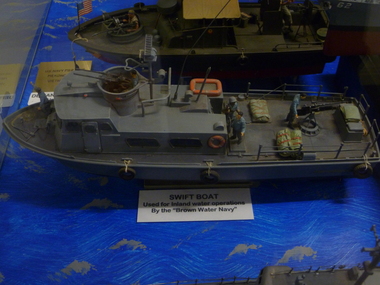
Model, Swift Boat
... Swift Boat......Swift Boat...SWIFT BOAT Used for Inland water operations By "Brown Water Navy"...Model Boat Swift Boat Brown Water Navy SWIFT BOAT Used for Inland water operations By "Brown Water Navy" The boat has grey body and black bottom stands on two legs base. ...The boat has grey body and black bottom stands on two legs base. The control room is half of the deck. It has 1 soldier at the front, 1 soldier in the cockpit and 2 soldiers controlling the stiring wheel. At the back of the boat, a soldier controls a machine gun.SWIFT BOAT Used for Inland water operations By "Brown Water Navy"model boat, swift boat, brown water navy -
 Queenscliffe Maritime Museum
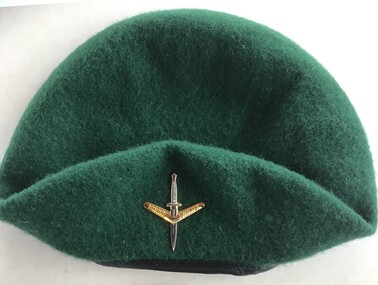
Uniform - Beret
... boats set off on a training exercise from Point Lonsdale to Point Nepean, simulating a raid. The weather was calm at Point Lonsdale on a midweek evening 50 years ago, but 50 years ago weather forecasts were not yet reliable. By nightfall a massive storm came through and all hell broke loose. Soon, three young Victorians were dead and more than 70 others were rescued from huge seas in Bass Strait. Green commando beret similar to ones worn by commandos involved in Rip Disaster of 1960 commandos beret Unit insignia: "Strike Swiftly ...On the evening of February 17, 1960, 74 peacetime commandos in army boats set off on a training exercise from Point Lonsdale to Point Nepean, simulating a raid. The weather was calm at Point Lonsdale on a midweek evening 50 years ago, but 50 years ago weather forecasts were not yet reliable. By nightfall a massive storm came through and all hell broke loose. Soon, three young Victorians were dead and more than 70 others were rescued from huge seas in Bass Strait.Green commando beret similar to ones worn by commandos involved in Rip Disaster of 1960Commando beret (green) with unit insigniaUnit insignia: "Strike Swiftly"commandos, beret -
 National Vietnam Veterans Museum (NVVM)
Photograph, USN Swift boats with Audio, CDT-3 members aboard operate in the Mekong Delta
... USN Swift boats with Audio, CDT-3 members aboard operate in the Mekong Delta. ...B/w photograph. One soldier in the front boat with his hands on a gun & another boat in the rear.united states swift boats -
 Inverloch Historical Society
000858 - Photograph - early 1930s - Cal Wyeth's boat West Wind launch - being moved from Pine Lodge on Beach Rd now Ramsey Boulevard - outside Newton's store right- from Hazel Swift
... 000858 - Photograph - early 1930s - Cal Wyeth's boat West Wind launch - being moved from Pine Lodge on Beach Rd now Ramsey Boulevard - outside Newton's store right- from Hazel Swift...000858 - Photograph - early 1930s - Cal Wyeth's boat West Wind launch - being moved from Pine Lodge on Beach Rd now Ramsey Boulevard - outside Newton's store right- from Hazel Swift ... -
 Lakes Entrance Historical Society
Photograph - Nungurner, Hammarstrom Ian, 1988 c
... Colour photograph of fishing boat Nungurner working in Bass Strait, showing fishing net being trawled behind swiftly moving vessel. ...Fishing Industry Ocean Ships and Shipping Colour photograph of fishing boat Nungurner working in Bass Strait, showing fishing net being trawled behind swiftly moving vessel. ...Colour photograph of fishing boat Nungurner working in Bass Strait, showing fishing net being trawled behind swiftly moving vessel. Lakes Entrance Victoriafishing industry, ocean, ships and shipping -
 Glenelg Shire Council Cultural Collection
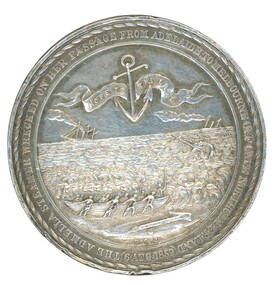
Medal - Medal - Admella Shipwreck - awarded to John Dusting, Brush and MacDonnell, 1859
... boat. Of the 113 people on board Admella at the time of her wreck only 24 survived. At the official enquiry into the disaster, fog, lightning, compasses and bad mapping were all considered as the cause, but finally the swift and unpredictable currents which run between Cape Jaffa and Cape Northumberland were given the official blame. ...boat. Of the 113 people on board Admella at the time of her wreck only 24 survived. At the official enquiry into the disaster, fog, lightning, compasses and bad mapping were all considered as the cause, but finally the swift and unpredictable currents which run between Cape Jaffa and Cape Northumberland were given the official blame. ...On Friday 5 August 1859, the steamship, Admella, left Adelaide bound for Melbourne. IT carried 82 passengers, a crew of 31 and 4 racehorses. he Admella was a 395 ton screw steamer built at Port Glasgow, Scotland in 1857. Her name is said to be derived from the ports she served - Adelaide, Melbourne and Launceston. It took her 42 hours to travel between Adelaide and Melbourne, usually stopping at Portland, Port Fairy and Warrnambool, making her the fastest ship to travel this route. The Admella’s final journey was her 36th voyage. Admella had been built with watertight bulkheads, riveted to the hull. These were designed as a special safety feature, but when the ship grounded on Carpenters Rocks it took only 15 minutes for the hull to break in three along the rivet lines. Many people were drowned immediately, and six horses stabled on deck tried to swim to shore. At least one of them made it alive. On Saturday August 6 1859, at 5am, Admella struck a reef. The three onboard lifeboats were washed away as were the four cork lifebelts kept on deck. Rubber lifebelts kept below deck were instantly lost. Cape Northumberland Lighthouse near Port McDonnell was about 24 km away so Captain McEwan ordered rocket flares to be fired to gain attention. However, all the ship’s rockets were damp. Only one ignited but soon fizzled out. The Captain attempted to make a raft but was unsuccessful and nearly drowned in the process. The ship was only about a kilometre from shore, but the surf, currents, cold water and sharks resulted in five men dying trying to reach safety. It wasn’t until Sunday afternoon that two sailors, managed to get to shore using a raft. It took them three hours and they then had to walk about 32 kilometres along the shore in the dark to Northumberland Lighthouse without shoes. They were met by Ben Germein the lighthouse keeper. His horse had died so he had to walk to a nearby station to borrow a horse. The horse he chose threw him off so in the end the station owner, Peter Black, rode the 24 km to the Mount Gambier telegraph station to share the news of the disaster. After several unsuccessful rescue attempts, eight days after the initial disaster, 19 people were rescued by the Portland Lifeboat and three people, including Captain McEwan were rescued in one of Admella’s lifeboats which had been found on the shore and fixed. It was captained by Ben Germein with six volunteer oarsmen. This was Germain’s sixth attempt to reach the wreck in the damaged boat. Of the 113 people on board Admella at the time of her wreck only 24 survived. At the official enquiry into the disaster, fog, lightning, compasses and bad mapping were all considered as the cause, but finally the swift and unpredictable currents which run between Cape Jaffa and Cape Northumberland were given the official blame. This medal is associated with one of Australia's worst maritime disasters, the wreck of SS Admella. This incident is significant to Portland because the Portland Lifeboat and its crew took part in a heroic rescue. 19 people were rescued by the crew of the Lifeboat. The Portland Lifeboat is listed on Victoria's State Heritage Register.Round silver medal awarded to John Dusting by the Victorian Colonists for his heroic efforts as part of the crew of the Portland Lifeboat in the rescue of survivors of the Admella Shipwreck. Admella wrecked off the South Australian Coast in 1859. This silver medal was one of only 39 silver medals awarded. There were 3 gold medals awarded. The medal is presented in a blue box. The box has beveled edges. Inside the lid is a fabric insert with details of the silversmith printed. The medal sits in a circular insert with a blue ribbon for taking the medal out with ease.Obverse: Scene of shipwreck near the coastline. In the foreground there is the Portland Lifeboat with crew. Above is an anchor with ribbon. Text around the edge of the medal reads 'The Admella Steamer wrecked on her passage from Adelaide to Melbourne off Cape Northumberland'. Across the ribbon - Hope to the last Reverse: Wreath around the edge. Beams of light from the sky. Text reads: Awarded to John Dusting/ By the Victorian Colonists / For / Heroic Exertions / In Saving Life / (Under divine providence) / From the wreck of the Admellaportland lifeboat, admella, shipwrecks, admella shipwreck, admella medals, dusting, glenelg shire council cultural collection, portland -
 Glenelg Shire Council Cultural Collection
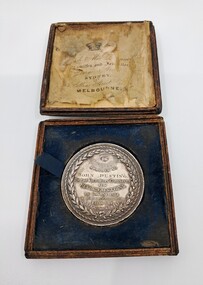
Medal - Box for Medal - Admella Shipwreck - awarded to John Dusting, Brush and MacDonnell, 1859
... boat. Of the 113 people on board Admella at the time of her wreck only 24 survived. At the official enquiry into the disaster, fog, lightning, compasses and bad mapping were all considered as the cause, but finally the swift and unpredictable currents which run between Cape Jaffa and Cape Northumberland were given the official blame. ...boat. Of the 113 people on board Admella at the time of her wreck only 24 survived. At the official enquiry into the disaster, fog, lightning, compasses and bad mapping were all considered as the cause, but finally the swift and unpredictable currents which run between Cape Jaffa and Cape Northumberland were given the official blame. ...On Friday 5 August 1859, the steamship, Admella, left Adelaide bound for Melbourne. IT carried 82 passengers, a crew of 31 and 4 racehorses. he Admella was a 395 ton screw steamer built at Port Glasgow, Scotland in 1857. Her name is said to be derived from the ports she served - Adelaide, Melbourne and Launceston. It took her 42 hours to travel between Adelaide and Melbourne, usually stopping at Portland, Port Fairy and Warrnambool, making her the fastest ship to travel this route. The Admella’s final journey was her 36th voyage. Admella had been built with watertight bulkheads, riveted to the hull. These were designed as a special safety feature, but when the ship grounded on Carpenters Rocks it took only 15 minutes for the hull to break in three along the rivet lines. Many people were drowned immediately, and six horses stabled on deck tried to swim to shore. At least one of them made it alive. On Saturday August 6 1859, at 5am, Admella struck a reef. The three onboard lifeboats were washed away as were the four cork lifebelts kept on deck. Rubber lifebelts kept below deck were instantly lost. Cape Northumberland Lighthouse near Port McDonnell was about 24 km away so Captain McEwan ordered rocket flares to be fired to gain attention. However, all the ship’s rockets were damp. Only one ignited but soon fizzled out. The Captain attempted to make a raft but was unsuccessful and nearly drowned in the process. The ship was only about a kilometre from shore, but the surf, currents, cold water and sharks resulted in five men dying trying to reach safety. It wasn’t until Sunday afternoon that two sailors, managed to get to shore using a raft. It took them three hours and they then had to walk about 32 kilometres along the shore in the dark to Northumberland Lighthouse without shoes. They were met by Ben Germein the lighthouse keeper. His horse had died so he had to walk to a nearby station to borrow a horse. The horse he chose threw him off so in the end the station owner, Peter Black, rode the 24 km to the Mount Gambier telegraph station to share the news of the disaster. After several unsuccessful rescue attempts, eight days after the initial disaster, 19 people were rescued by the Portland Lifeboat and three people, including Captain McEwan were rescued in one of Admella’s lifeboats which had been found on the shore and fixed. It was captained by Ben Germein with six volunteer oarsmen. This was Germain’s sixth attempt to reach the wreck in the damaged boat. Of the 113 people on board Admella at the time of her wreck only 24 survived. At the official enquiry into the disaster, fog, lightning, compasses and bad mapping were all considered as the cause, but finally the swift and unpredictable currents which run between Cape Jaffa and Cape Northumberland were given the official blame. This medal is associated with one of Australia's worst maritime disasters, the wreck of SS Admella. This incident is significant to Portland because the Portland Lifeboat and its crew took part in a heroic rescue. 19 people were rescued by the crew of the Lifeboat. The Portland Lifeboat is listed on Victoria's State Heritage Register.The medal is presented in a blue box. The box has beveled edges. Inside the lid is a fabric insert with details of the silversmith printed. The medal sits in a circular insert with a blue ribbon for taking the medal out with ease.portland lifeboat, admella, shipwrecks, admella shipwreck, admella medals, dusting, glenelg shire council cultural collection, portland -
 Glenelg Shire Council Cultural Collection
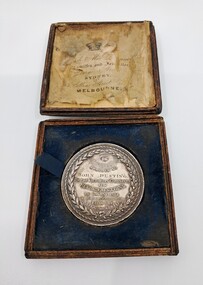
Medal - Medal - Admella Shipwreck - awarded to John Dusting, Brush and MacDonnell, 1859
... boat. Of the 113 people on board Admella at the time of her wreck only 24 survived. At the official enquiry into the disaster, fog, lightning, compasses and bad mapping were all considered as the cause, but finally the swift and unpredictable currents which run between Cape Jaffa and Cape Northumberland were given the official blame....boat. Of the 113 people on board Admella at the time of her wreck only 24 survived. At the official enquiry into the disaster, fog, lightning, compasses and bad mapping were all considered as the cause, but finally the swift and unpredictable currents which run between Cape Jaffa and Cape Northumberland were given the official blame. ...On Friday 5 August 1859, the steamship, Admella, left Adelaide bound for Melbourne. IT carried 82 passengers, a crew of 31 and 4 racehorses. he Admella was a 395 ton screw steamer built at Port Glasgow, Scotland in 1857. Her name is said to be derived from the ports she served - Adelaide, Melbourne and Launceston. It took her 42 hours to travel between Adelaide and Melbourne, usually stopping at Portland, Port Fairy and Warrnambool, making her the fastest ship to travel this route. The Admella’s final journey was her 36th voyage. Admella had been built with watertight bulkheads, riveted to the hull. These were designed as a special safety feature, but when the ship grounded on Carpenters Rocks it took only 15 minutes for the hull to break in three along the rivet lines. Many people were drowned immediately, and six horses stabled on deck tried to swim to shore. At least one of them made it alive. On Saturday August 6 1859, at 5am, Admella struck a reef. The three onboard lifeboats were washed away as were the four cork lifebelts kept on deck. Rubber lifebelts kept below deck were instantly lost. Cape Northumberland Lighthouse near Port McDonnell was about 24 km away so Captain McEwan ordered rocket flares to be fired to gain attention. However, all the ship’s rockets were damp. Only one ignited but soon fizzled out. The Captain attempted to make a raft but was unsuccessful and nearly drowned in the process. The ship was only about a kilometre from shore, but the surf, currents, cold water and sharks resulted in five men dying trying to reach safety. It wasn’t until Sunday afternoon that two sailors, managed to get to shore using a raft. It took them three hours and they then had to walk about 32 kilometres along the shore in the dark to Northumberland Lighthouse without shoes. They were met by Ben Germein the lighthouse keeper. His horse had died so he had to walk to a nearby station to borrow a horse. The horse he chose threw him off so in the end the station owner, Peter Black, rode the 24 km to the Mount Gambier telegraph station to share the news of the disaster. After several unsuccessful rescue attempts, eight days after the initial disaster, 19 people were rescued by the Portland Lifeboat and three people, including Captain McEwan were rescued in one of Admella’s lifeboats which had been found on the shore and fixed. It was captained by Ben Germein with six volunteer oarsmen. This was Germain’s sixth attempt to reach the wreck in the damaged boat. Of the 113 people on board Admella at the time of her wreck only 24 survived. At the official enquiry into the disaster, fog, lightning, compasses and bad mapping were all considered as the cause, but finally the swift and unpredictable currents which run between Cape Jaffa and Cape Northumberland were given the official blame.This medal is associated with one of Australia's worst maritime disasters, the wreck of SS Admella. This incident is significant to Portland because the Portland Lifeboat and its crew took part in a heroic rescue. 19 people were rescued by the crew of the Lifeboat. The Portland Lifeboat is listed on Victoria's State Heritage Register. Only 39 silver medals were awarded after the incident. Three gold medals were awarded.Round silver medal awarded to John Dusting by the Victorian Colonists for his heroic efforts as part of the crew of the Portland Lifeboat in the rescue of survivors of the Admella Shipwreck. Admella wrecked off the South Australian Coast in 1859. This silver medal was one of only 39 silver medals awarded. There were 3 gold medals awarded. The medal is presented in a blue box. The box has beveled edges. Inside the lid is a fabric insert with details of the silversmith printed. The medal sits in a circular insert with a blue ribbon for taking the medal out with ease.Obverse: Scene of shipwreck near the coastline. In the foreground there is the Portland Lifeboat with crew. Above is an anchor with ribbon. Text around the edge of the medal reads 'The Admella Steamer wrecked on her passage from Adelaide to Melbourne off Cape Northumberland'. Across the ribbon - Hope to the last Reverse: Wreath around the edge. Beams of light from the sky. Text reads: Awarded to John Dusting/ By the Victorian Colonists / For / Heroic Exertions / In Saving Life / (Under divine providence) / From the wreck of the Admellaadmella, portland, glenelg shire council cultural collection, portland lifeboat, admella shipwreck, shipwreck
