
Showing 7 items matching "swiss cottage design"
-
 Flagstaff Hill Maritime Museum and Village
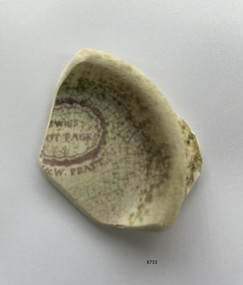
Ceramic - China Fragment, J&W Pratt/F&R Pratt, c mid nineteenth century
... ...Swiss Cottage Design...Swiss Cottage" (sometimes catalogued as Swiss Riverside Scene or The Alpine Cottage). The "Swiss Cottage" pattern typically features a rustic, asymmetric two-story Alpine chalet or cottage. In the foreground or mid-ground, a small wooden footbridge which spans a stream, and traveling figures or a peasant woman in local Swiss dress. The Fragment "OT PAGE" could be FOOTPAGE which suggests that the design...The popular Swiss Chalet design on the lid is an example of transfer which made decorative ceramic items more affordable and the product more appealing. Flagstaff Hill Maritime Museum and Village Earthenware Pot Lid Transferware J & W Pratt China Fragment Great Ocean Rd Red Transferware Swiss Cottage Design Bottom partial - "SWISS/OT PAGE/(inside a red scalloped border)/&W. ...J & W Pratt was an earthenware manufacturing firm operating in Lane Delph (Fenton), Stoke-on-Trent, England, from 1836 to 1859. The company produced traditional domestic earthenware and tableware, including hand-painted items like the Oriental-inspired "Indiana" pattern plates. J & W Pratt ceased operations in 1859 following a period of financial difficulty. The family's broader pottery legacy continued through F & R Pratt & Co. The object appears to be a 19th-century Victorian transferware pot lid featuring the pattern "The Swiss Cottage" (sometimes catalogued as Swiss Riverside Scene or The Alpine Cottage). The "Swiss Cottage" pattern typically features a rustic, asymmetric two-story Alpine chalet or cottage. In the foreground or mid-ground, a small wooden footbridge which spans a stream, and traveling figures or a peasant woman in local Swiss dress. The Fragment "OT PAGE" could be FOOTPAGE which suggests that the design was adapted from a specific 19th-century travel book or travel chronicle featuring steel-plate engravings with FOOTPAGE, indicating where the publisher found the original art. Pot lids were originally manufactured to seal ceramic pots that contained every day commodities like bear's grease (a popular Victorian hair pomade), cold creams, or toothpastes. Because the graphics were so beautifully detailed, Victorians would wash and save the lids once the pot was empty, often framing or mounting them. This object is significant as it represents a rare fragment of earthenware in common use in the mid nineteenth century. The popular Swiss Chalet design on the lid is an example of transfer which made decorative ceramic items more affordable and the product more appealing. Earthenware fragment with smooth edges worn by emersion in the sea. The top has red transferware design showing a two story cottage and footbridge. The underneath has crazed glazing and a partial manufacture stamp indicating J & W Pratt. The piece has a partially raised flange.Bottom partial - "SWISS/OT PAGE/(inside a red scalloped border)/&W. PRATT"flagstaff hill maritime museum and village, earthenware, pot lid, transferware, j & w pratt, china fragment, great ocean rd, red transferware, swiss cottage design -
 Eltham District Historical Society Inc
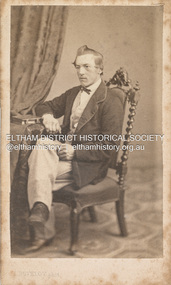
Photograph, Louis Buvelot, Possibly Phillip Shillinglaw, 1865
... cottage though Stebbings retained ownership until 1888 at which time it was transferred to Shillinglaw. Photographer: Louis Buvelot Swiss landscape painter and portrait photographer, settled in Melbourne in 1864, admired by the artists from the Heidelberg area such as Tom Roberts and Arthur Streeton who bestowed him with the accolade of 'Father of Australian painting’. In the 1870s, his work increasingly drew elements from Australian landscape such as the bush land in works like Lilydale (1878) and Bush Track. "Louis Buvelot :: biography at :: at Design...cottage though Stebbings retained ownership until 1888 at which time it was transferred to Shillinglaw. Photographer: Louis Buvelot Swiss landscape painter and portrait photographer, settled in Melbourne in 1864, admired by the artists from the Heidelberg area such as Tom Roberts and Arthur Streeton who bestowed him with the accolade of 'Father of Australian painting’. In the 1870s, his work increasingly drew elements from Australian landscape such as the bush land in works like Lilydale (1878) and Bush Track. "Louis Buvelot :: biography at :: at Design ...Famous Swiss landcape painter Louis Buvelot came to Melbourne in 1864 and set up a portrait photography studio which he operated for one year only in 1865. This photograph is believed to be the oldest photo in the Shillinglaw Family Album collection. It is believed that the subject is a young Phillip Shillinglaw, without beard, at age 22 or 23. Phillip Shillinglaw was born Melbourne, August 7, 1842. He married Sarah Ann Kidd in Heidelberg, Victoria, February 28, 1872. In 1881 Phillip and Sarah and their small family moved to Eltham and made home in what was later to become known as Shillinglaw Cottage but which Phillip named 'Wattle Brae'. Shillinglaw Cottage is significant to Eltham’s local history. It is one of the earliest known buildings still in existence. Records suggest that the cottage was built circa 1859 by a man named Cochrane, believed to be Thomas Cochrane, in conjunction with George Stebbings though it is not known what Stebbings’s contribution was. It is believed Stebbings owned the cottage between 1874 and 1888. According to Margaret Ball’s (2017) book Shillinglaw Family of Eltham 1660-2007, Thomas Cochrane and family lived there from 1867 to 1874 however this is contrary to the records of assessable rates levied by the Eltham District Road Board, established in 1858, which shows Cochrane was the owner occupier (in Little Eltham) of approximately 25 acres of cultivated land and 25 acres of pastureland upon which a hut was sited in 1860. It is suspected that George Stebbings may have acquired the property from Cochrane in 1874 as it is noted that he had a tenant for a period, James Rossiter, who was the editor for the Evelyn Observer in Kangaroo Ground in 1874 (LATE SHIRE OFFICE AT KANGAROO GROUND (1934, February 16). Advertiser (Hurstbridge, Vic. : 1922 - 1939), p. 5. Retrieved February 25, 2022, from http://nla.gov.au/nla.news-article56743657). In 1881 Phillip Shillinglaw became the ratepayer for the cottage though Stebbings retained ownership until 1888 at which time it was transferred to Shillinglaw. Photographer: Louis Buvelot Swiss landscape painter and portrait photographer, settled in Melbourne in 1864, admired by the artists from the Heidelberg area such as Tom Roberts and Arthur Streeton who bestowed him with the accolade of 'Father of Australian painting’. In the 1870s, his work increasingly drew elements from Australian landscape such as the bush land in works like Lilydale (1878) and Bush Track. "Louis Buvelot :: biography at :: at Design and Art Australia Online." Daao https://www.daao.org.au/bio/louis-buvelot/biography/. Accessed 9 Mar. 2023. On arriving in Melbourne in February 1865 Buvelot bought a photographer's studio at 92 Bourke Street East and took portraits for a year. In 1866 he moved to 88 La Trobe Street East and resumed his painting while Caroline-Julie gave French lessons to help Buvelot to establish himself as an artist in Melbourne. "Biography - Abram-Louis Buvelot." Australian Dictionary of Biography https://adb.anu.edu.au/biography/buvelot-abramlouis-3132. Accessed 2 Dec. 2022. CARTE-DE-VISITE (cdv) 1857-1890 Cartes-de-visite (cdv's) are the most common form of photograph from the nineteenth century, generally measuring two and a half inches by four and an eighth inches (6.3 x 10.5 cm) when mounted, sepia toned, mounted on a card which was generally printed with the photographer's name and address on the back or beneath the portrait. - Frost, Lenore; Dating Family Photos 1850-1920; Valiant Press Pty. Ltd., Berwick, Victoria 1991marg ball collection, shillinglaw family photo album 1, 1865, l. buvelot photographer, louis buvelot, phillip shillinglaw (1842-1914), unknown -
 Robin Boyd Foundation
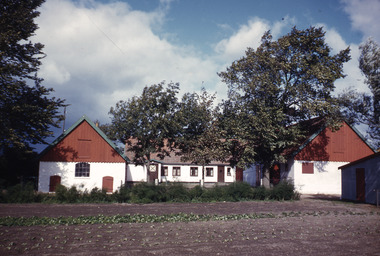
Slide, Robin Boyd, 1950
... design of Mildura art gallery. The scholarship helped fund their first overseas trip. Robin and Patricia were passengers on the Greek ship “Cyrenia” departing in May 1950, passing through the Suez Canal and landing in Genoa five weeks later. For six months, they travelled extensively throughout Europe (predominantly driving themselves) - France, Italy, United Kingdom, Sweden, Denmark, Germany, Austria, Switzerland and Spain. Haddon Travelling Scholarship Haddon robin boyd slide Sweden / Cottage ...Penleigh Boyd, Robin and Patricia Boyd's son, writes “Prior to 1950 Robin, like most other amateur or hobby photographers, took black and white printed photographs. The oldest slides date from 1950 when Robin and Patricia travelled to Europe on Robin’s Robert Haddon Travelling Scholarship.” In 1948 Robin Boyd was awarded ‘joint first place’ in the Robert Haddon competition for his design of Mildura art gallery. The scholarship helped fund their first overseas trip. Robin and Patricia were passengers on the Greek ship “Cyrenia” departing in May 1950, passing through the Suez Canal and landing in Genoa five weeks later. For six months, they travelled extensively throughout Europe (predominantly driving themselves) - France, Italy, United Kingdom, Sweden, Denmark, Germany, Austria, Switzerland and Spain.Colour slide in a mount. Tradional U-shaped country house, SwedenSweden / Cottage / Country House / Trad. U-Shape (All Handwritten)haddon travelling scholarship, haddon, robin boyd, slide -
 Robin Boyd Foundation
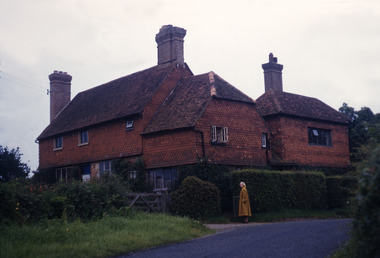
Slide, Robin Boyd, 1950
... design of Mildura art gallery. The scholarship helped fund their first overseas trip. Robin and Patricia were passengers on the Greek ship “Cyrenia” departing in May 1950, passing through the Suez Canal and landing in Genoa five weeks later. For six months, they travelled extensively throughout Europe (predominantly driving themselves) - France, Italy, United Kingdom, Sweden, Denmark, Germany, Austria, Switzerland and Spain. Haddon Travelling Scholarship Haddon robin boyd slide England Surrey (Handwritten) / 'Yew Tree Cottage ...Penleigh Boyd, Robin and Patricia Boyd's son, writes “Prior to 1950 Robin, like most other amateur or hobby photographers, took black and white printed photographs. The oldest slides date from 1950 when Robin and Patricia travelled to Europe on Robin’s Robert Haddon Travelling Scholarship.” In 1948 Robin Boyd was awarded ‘joint first place’ in the Robert Haddon competition for his design of Mildura art gallery. The scholarship helped fund their first overseas trip. Robin and Patricia were passengers on the Greek ship “Cyrenia” departing in May 1950, passing through the Suez Canal and landing in Genoa five weeks later. For six months, they travelled extensively throughout Europe (predominantly driving themselves) - France, Italy, United Kingdom, Sweden, Denmark, Germany, Austria, Switzerland and Spain.Colour slide in a mount. "Yew Tree Cottage", Surrey, EnglandEngland Surrey (Handwritten) / 'Yew Tree Cottage' Surrey (Handwritten)haddon travelling scholarship, haddon, robin boyd, slide -
 Robin Boyd Foundation
Slide, Robin Boyd, 1950
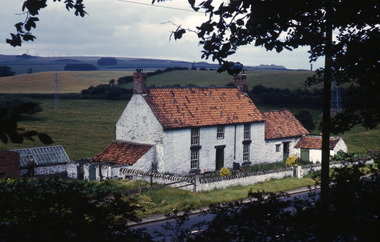
... design of Mildura art gallery. The scholarship helped fund their first overseas trip. Robin and Patricia were passengers on the Greek ship “Cyrenia” departing in May 1950, passing through the Suez Canal and landing in Genoa five weeks later. For six months, they travelled extensively throughout Europe (predominantly driving themselves) - France, Italy, United Kingdom, Sweden, Denmark, Germany, Austria, Switzerland and Spain. Haddon Travelling Scholarship Haddon robin boyd slide England Cottage ...Penleigh Boyd, Robin and Patricia Boyd's son, writes “Prior to 1950 Robin, like most other amateur or hobby photographers, took black and white printed photographs. The oldest slides date from 1950 when Robin and Patricia travelled to Europe on Robin’s Robert Haddon Travelling Scholarship.” In 1948 Robin Boyd was awarded ‘joint first place’ in the Robert Haddon competition for his design of Mildura art gallery. The scholarship helped fund their first overseas trip. Robin and Patricia were passengers on the Greek ship “Cyrenia” departing in May 1950, passing through the Suez Canal and landing in Genoa five weeks later. For six months, they travelled extensively throughout Europe (predominantly driving themselves) - France, Italy, United Kingdom, Sweden, Denmark, Germany, Austria, Switzerland and Spain.Colour slide in a mount. Unknown Cottage, EnglandEngland Cottage (Handwritten)haddon travelling scholarship, haddon, robin boyd, slide -
 Robin Boyd Foundation
Slide, Robin Boyd, 1950
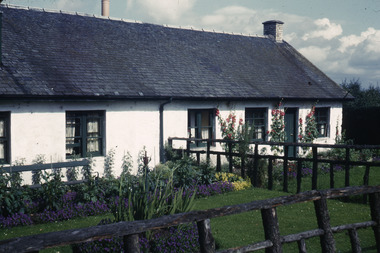
... design of Mildura art gallery. The scholarship helped fund their first overseas trip. Robin and Patricia were passengers on the Greek ship “Cyrenia” departing in May 1950, passing through the Suez Canal and landing in Genoa five weeks later. For six months, they travelled extensively throughout Europe (predominantly driving themselves) - France, Italy, United Kingdom, Sweden, Denmark, Germany, Austria, Switzerland and Spain. Haddon Travelling Scholarship Haddon robin boyd slide Scotland / Cottage ...Penleigh Boyd, Robin and Patricia Boyd's son, writes “Prior to 1950 Robin, like most other amateur or hobby photographers, took black and white printed photographs. The oldest slides date from 1950 when Robin and Patricia travelled to Europe on Robin’s Robert Haddon Travelling Scholarship.” In 1948 Robin Boyd was awarded ‘joint first place’ in the Robert Haddon competition for his design of Mildura art gallery. The scholarship helped fund their first overseas trip. Robin and Patricia were passengers on the Greek ship “Cyrenia” departing in May 1950, passing through the Suez Canal and landing in Genoa five weeks later. For six months, they travelled extensively throughout Europe (predominantly driving themselves) - France, Italy, United Kingdom, Sweden, Denmark, Germany, Austria, Switzerland and Spain.Colour slide in a mount. Country cottage, near Perth, ScotlandScotland / Cottage / Country House Near Perth (All Handwritten)haddon travelling scholarship, haddon, robin boyd, slide -
 St Kilda Historical Society
Ephemera - Invitation - wedding, Invitation to wedding of Miss Swindles and Mr John Nicholson 1867, 1867 (original)
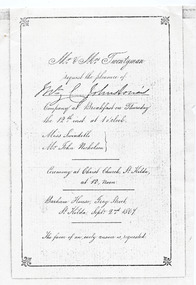
... It was a magnificent residence built in the regency style to the design of architect John Gill and set in landscaped grounds of nine acres and included an ancient Swiss cottage. ...It was a magnificent residence built in the regency style to the design of architect John Gill and set in landscaped grounds of nine acres and included an ancient Swiss cottage. ...The Argus, 27 September 1867 p4 - MARRIAGES: NICHOLSON—SWINDELLS.—On the 12th inst., at Christ Church, St. Kilda, by the Rev. D. Seddon, John, eldest son of the late Hon. W. Nicholson, to Gertrude Sarah, youngest daughter of the late James Swindells, Esq., of Manchester. No cards. https://trove.nla.gov.au/newspaper/article/5779002 Barham House was built in 1850 by Edward Bernard Green (1809-1861) a successful land speculator. It was a magnificent residence built in the regency style to the design of architect John Gill and set in landscaped grounds of nine acres and included an ancient Swiss cottage. When Green died in 1861, his executor was his neighbour, William Nicholson (1816-65) who owned Fernleigh immediately to the north in Grey Street, but actually lived in Barham House during his time as Premier of Victoria 1859 - 1860 until his death in 1865. In 1866 Richard Twentyman purchased Fernleigh from the Nicholson Estate and a year later he married Nicholson's widow, Sarah. Both remained at Barham House until June 1870. In 1871 the building was substantially remodelled and re-named Eildon. It is one of the larger surviving 19th century houses in Melbourne.Black and white photocopy of invitation, wedding breakfast menu and envelope(handwritten) Original in possession of Lady Johnston. (handwritten) Gerty's marriage? Invitation: Mr and Mrs Twentyman request the pleasure of [unclear] Johnstone's Company at Breakfast on Thursday the 12th at 1 o'clock. Miss Swindells Mr John Nicholson. Ceremony at Christ Church St Kilda, at 12, Noon Barham House, Grey Street, St Kilda Sept. 2nd. 1867 The favour of an early answer is requested Menu: Déjeuner Barham House, St Kilda, 12. September, 1867. Menu items listed on following page Envelope: [unclear] Johnstone Esq Care of J C Johnstone Esq Sunburybarham house, christ church, st kilda, 19th century, eildon house, grey street
