
Showing 61 items matching "syrian campaign"
-
 Bendigo Military Museum
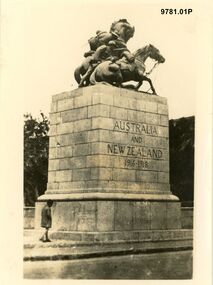
Photograph - FRED CARLETON 2/23RD ALBUM, Australia Palestine Egypt
... ...Syrian campaign...Refer Cat No 142.7 for his full service history. 2/23rd Battalion Tobruk El Alamein Western Desert Campain Fred Carleton Syrian campaign Rats of Tobruk Cairo Some images have inscriptions on verso. ...Frederick Lloyd Carleton VX1555 served in the 2/23rd Battalion, 9th Division in the Middle East and in the Pacific. The images detail his day to day life at the front and on leave. He served during the siege of Tobruk and at El Alamein, and was a lifelong member of the Bendigo sub-branch of the Rats of Tobruk Association. Refer Cat No 142.7 for his full service history.Collection of 76 photographs taken during service in 2/23rd in Middle East.Some images have inscriptions on verso. These are included in the title information displayed with each image as it is clicked on.2/23rd battalion, tobruk, el alamein, western desert campain, fred carleton, syrian campaign, rats of tobruk, cairo -
 Returned Nurses RSL Sub-branch
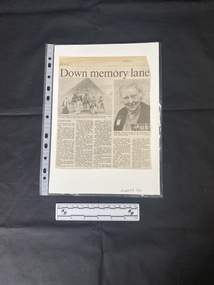
Newspaper - Newspaper clipping, Manuela Cifra, Down memory lane, [1995]
... ...Syrian campaign...World War 2 WWII WW2 World War II Middle East 2/1st Casualty Clearing Station Nan Schofield Egypt Battle of Bardia Greece Syrian campaign Syria Japanese American Barrack Hospital Ipswitch Labuan Island Children's Health Bureau Melbourne 'NEWS'[graphite pencil, left top] 'AANS'[graphite pencil, right top] A newspaper clipping of a story of five columns of text beneath two black and white photos. ...Jean Hanna was one of a group of old collegians who presented a book containing the names of eighty former students who served World War II to Presbyterian Ladies College, Burwood. Jean, 93, had seen war firsthand, working twelve hour shifts in tent hospitals, nursing sick, wounded, amputees and POW's. By 1937 Jean was the sister-in-charge of the Alfred Hospital's operating theatre and after a European tour where she witnessed Germany arming, displaying swastikas everywhere and restricting movement in and out of Germany, Jean registered with the Australian Nursing Service and were called up. April 1940 saw Jean amoung the first Victorian nursing sisters to go overseas. Jean nursed in tent hospitals in Gaza, Mersa Matruh, Nazareth and Colombo before heading home to Australia to nurse sick and wounded from New Guinea. In April 1945 Jean went to another tent hospital in Borneo, where she cared for civilians and POW's, including a survivor of the Sandakan death march. Discharged in 1946, Jean joined the Alfred Hospital again until her retirement in 1962. A newspaper clipping of a story of five columns of text beneath two black and white photos. The photo on the left is of four women in uniform, two on camels and two on donkeys, with three men on foot, in front of a pyramid. The photo on the right os on an older woman wearing service medals.'NEWS'[graphite pencil, left top] 'AANS'[graphite pencil, right top]world war 2, wwii, ww2, world war ii, middle east, 2/1st casualty clearing station, nan schofield, egypt, battle of bardia, greece, syrian campaign, syria, japanese, american barrack hospital, ipswitch, labuan island, children's health bureau, melbourne -
 Bendigo Military Museum
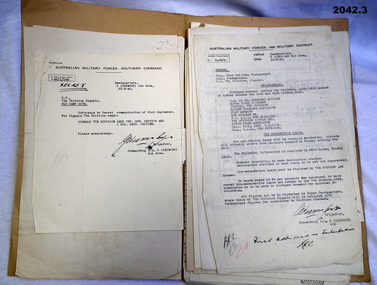
Document - DOCUMENTS WW2, Australian Army, 1939 - 1943
... Most are from the 'Syrian Campaign' in 1941. They range from general through confidential to most secret and was in the effects of Lt. ...Most are from the 'Syrian Campaign' in 1941. They range from general through confidential to most secret and was in the effects of Lt. ...Items relate to Benjamin Thomas Roy Chadd No's 10594, VX20311, 1st and 2nd AIF. Refer Cat No 2039 for his service history.3 manilla folders each containing assorted miscellaneous documents from WWII. Most are from the 'Syrian Campaign' in 1941. They range from general through confidential to most secret and was in the effects of Lt. Col B.R. CHADD. .1) “Secret 1940” .2) “1941” .3) “1942-1943” Operational orders. Embark and dis-embark orders. Signal notes. Ciphers - Sit Reps Palestine/Syriadocuments-military, signals -
 Returned Nurses RSL Sub-branch
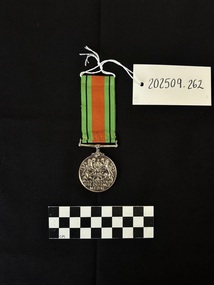
Medal - The Defence Medal, Unknown
... Overseas service included the Middle East, east of the Suez Canal (less the period of the Syrian Campaign) or Malaya prior to the Japanese invasion on 8 December 1941....Overseas service included the Middle East, east of the Suez Canal (less the period of the Syrian Campaign) or Malaya prior to the Japanese invasion on 8 December 1941. ...Medal belonged to Joan Grace Gibson (Mitchell) Service numbers: VFX53656 VX53656 VX38752. The Defence Medal was awarded for 6 months service in a prescribed non-operational area subject to enemy air attack or closely threatened in Australia and overseas, 12 months non-operational service in the forces overseas from or outside Australia.Within Australia, the qualifying area was the Northern Territory, north of 14 degrees 30 minutes south, and the Torres Strait Islands. The qualifying period was between 3 September 1939 and 2 September 1945. Overseas service included the Middle East, east of the Suez Canal (less the period of the Syrian Campaign) or Malaya prior to the Japanese invasion on 8 December 1941.The medal is of high significance and should be kept in the collection.The Defence Medal, made from cool-to-touch cupro-nickel, showcases intricate design and engraving details. On the reverse, a Royal Crown rests above a small oak tree growing on land surrounded by water, flanked by two lions as supporters. The inscription '1939 1945' encircles the design, with 'THE DEFENCE MEDAL' in exergue, and the artist's monogram HWP (H. Wilson Parker) subtly placed among the tree roots. The medal’s rim is engraved with 'VFC53656 J.G. GIBSON.' The obverse features the uncrowned effigy of King George VI, facing left, with the initials 'HP' for designer TH Paget beneath the truncated neck. Around the perimeter, the legend reads 'GEORGIVS VI D:G:BR:OMN:REX ET INDIAE IMP:', [Latin meaning: 'George VI, by the Grace of God, King of all the Britains and Emperor of India.] The ribbon is orange with green outer stripes, each green stripe having a black pin stripe running down the centre. The green represents the Islands of the United Kingdom, the orange represents enemy attacks, and the black represents the black outs. The ribbon offers a textured ribbed feel under the fingers.'VFX53656 J. G. GIBSON' [Engraved around the rim of the medal]world war 2, world war ii, world war two, wwii, ww2, joan grace gibson -
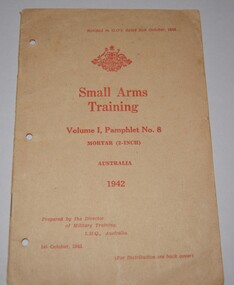 Wangaratta RSL Sub Branch
Pamphlet - Small Arms Training, Mortar (2 inch), 1/10/1942
... He disembarked for the Middle East in November, 1940 and fought in the Syrian campaign in 1941. In 1942 the 2/14th Battalion returned to Australia and sent to Papua where he fought at the Battle of Isurava before the battalion was sent to Gona. ...He disembarked for the Middle East in November, 1940 and fought in the Syrian campaign in 1941. In 1942 the 2/14th Battalion returned to Australia and sent to Papua where he fought at the Battle of Isurava before the battalion was sent to Gona. ...Australian Army manual focusing on the principles of mortar and bombs, covering essential skills to provide soldiers with the knowledge needed in combat. Booklet belonged to Robert Francis ISKOV VX15237 born at Glenrowan served with the 59th Battalion CMF before joining the 2/14th Battalion at Caulfield in September 1940. He disembarked for the Middle East in November, 1940 and fought in the Syrian campaign in 1941. In 1942 the 2/14th Battalion returned to Australia and sent to Papua where he fought at the Battle of Isurava before the battalion was sent to Gona. On 1943 Bob returned to Australia to undertake officer training and in 1945 with the 2/23rd Battalion sailed to Morotai and served with the battalion on Tarakan. He returned to Australia in November, 1945 and discharged a month later.Soft cover pamphlet with red lettering containing 18 pages including diagramsVolume 1 Pamphlet 8 1st October 1942.ww2, military training pamphlet, small arms training, 1942, mortar -
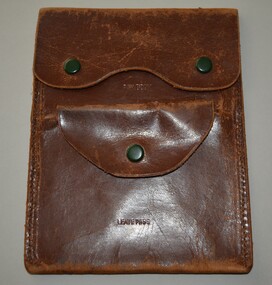 Wangaratta RSL Sub Branch
Accessory - Document pouch, C1940
... He disembarked for the Middle East in November, 1940 and fought in the Syrian campaign in 1941. In 1942 the 2/14th Battalion returned to Australia and sent to Papua where he fought at the Battle of Isurava before the battalion was sent to Gona. ...He disembarked for the Middle East in November, 1940 and fought in the Syrian campaign in 1941. In 1942 the 2/14th Battalion returned to Australia and sent to Papua where he fought at the Battle of Isurava before the battalion was sent to Gona. ...Brown leather pouch made specifically to house a pay book and leave pass. No maker’s name or identification. Item belonged to Robert Francis ISKOV VX15237 served with the 59th Battalion/Hume Regiment CMF before joining the 2/14th Battalion at Caulfield in September 1940. He disembarked for the Middle East in November, 1940 and fought in the Syrian campaign in 1941. In 1942 the 2/14th Battalion returned to Australia and sent to Papua where he fought at the Battle of Isurava before the battalion was sent to Gona. On 1943 Bob returned to Australia to undertake officer training and in 1945 with the 2/23rd Battalion sailed to Morotai and served with the battalion on Tarakan. He returned to Australia in November, 1945 and discharged a month laterBrown leather pouch consisting of two separate compartments with front flaps affixed with metal press down studs.Pay Book Leave Passpouch, ww2, bob iskov -
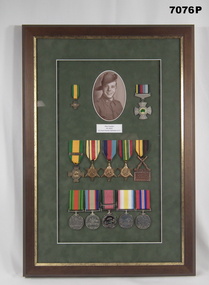 Bendigo Military Museum
Award - MEDALS & PHOTOGRAPH WW2, Post WW2
... Maxwell Barry Cowden VX19297 enlisted in the 2/nd AIF on 30.5.1940 age 18 years (put his age up to 21) in 2/2 Pioneer Battalion AIF, embarked for the Middle East 8.4.1941, promoted L/Cpl 25.6.1941, promoted Cpl 29.10.1941, took part in the Syrian Campaign. On 31.1.1942 the unit embarked for Australian but were diverted to Java to defend it, disembarked 18.2.1942. ...Maxwell Barry Cowden VX19297 enlisted in the 2/nd AIF on 30.5.1940 age 18 years (put his age up to 21) in 2/2 Pioneer Battalion AIF, embarked for the Middle East 8.4.1941, promoted L/Cpl 25.6.1941, promoted Cpl 29.10.1941, took part in the Syrian Campaign. On 31.1.1942 the unit embarked for Australian but were diverted to Java to defend it, disembarked 18.2.1942. ...Maxwell Barry Cowden VX19297 enlisted in the 2/nd AIF on 30.5.1940 age 18 years (put his age up to 21) in 2/2 Pioneer Battalion AIF, embarked for the Middle East 8.4.1941, promoted L/Cpl 25.6.1941, promoted Cpl 29.10.1941, took part in the Syrian Campaign. On 31.1.1942 the unit embarked for Australian but were diverted to Java to defend it, disembarked 18.2.1942. Java surrendered and they were taken POW, reported MIA on 30.4.1942 then after as POW. As a POW he worked on the Burma Railway. In December 1944 they were on the Hell Ship AWA Maru and sailed for Japan to work in the Coal Mines arriving mid Jan 1945. He was repatriated back to Australia on the HMS Formidable, discharged on 28.11.1945 with the rank of Cpl. Refer also Cat No 7077.Brown wood frame with gold edge, contains a photo and medals on a green background re a WW2 soldier/POW. The medals are a mixture of official and unofficial not in the correct order. Medals top. 1. Miniature Dutch medal 1942 - 45 official. 2. Prisoner of war medal, commemorative unofficial. Centre row. 1.Dutch medal 1942 - 45 official. 2. Africa star, official. 3. 1939 - 45 Star, official. 4. Pacific Star, official. 5. Front line service medal, unofficial. Bottom. 1. Defence medal, official. 2.Australian Service medal 1939 - 45, official. 3. For Combatant duties in active service, unofficial. 4. Foreign service medal, unofficial. 5. British war medal 1939 - 45, official."Max Cowden VX19297 2/2 Pioneer Battalion AIF"award, medals, photo, pow, 2/2 -
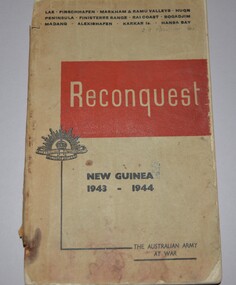 Wangaratta RSL Sub Branch
Book - Booklet, Director General of Public Relations Australian Army, Reconquest New Guinea 1943-1944, c1944
... He disembarked for the Middle East in November, 1940 and fought in the Syrian campaign in 1941. In 1942 the 2/14th Battalion returned to Australia and sent to Papua where he fought at the Battle of Isurava before the battalion was sent to Gona. ...He disembarked for the Middle East in November, 1940 and fought in the Syrian campaign in 1941. In 1942 the 2/14th Battalion returned to Australia and sent to Papua where he fought at the Battle of Isurava before the battalion was sent to Gona. ...The Reconquest of New Guinea in 1943–1944 was a massive, grueling Allied offensive that shattered the Japanese Eighteenth Army through a combination of amphibious assaults, airborne operations, and brutal jungle warfare. Booklet belonged to Robert Francis ISKOV VX15237 born at Glenrowan served with the 59th Battalion CMF before joining the 2/14th Battalion at Caulfield in September 1940. He disembarked for the Middle East in November, 1940 and fought in the Syrian campaign in 1941. In 1942 the 2/14th Battalion returned to Australia and sent to Papua where he fought at the Battle of Isurava before the battalion was sent to Gona. On 1943 Bob returned to Australia to undertake officer training and in 1945 with the 2/23rd Battalion sailed to Morotai and served with the battalion on Tarakan. He returned to Australia in November, 1945 and discharged a month later.Soft cover booklet containing 160 pages including maps and photographs. Cover is cream colour cardboard with black print and rising sun crest.Front Cover - The Australian Army at War. Rear Cover - Overseas Edition Not For Public Sale ww2, new guinea, booklet, reconquest -
 Wangaratta RSL Sub Branch
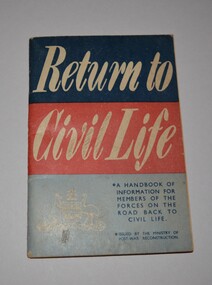
Booklet, Thomas Henry Tennant, Return to Civil Life - A handbook of information for members of the forces on the road back to civil life, 1/9/1945
... He disembarked for the Middle East in November, 1940 and fought in the Syrian campaign in 1941. In 1942 the 2/14th Battalion returned to Australia and sent to Papua where he fought at the Battle of Isurava before the battalion was sent to Gona. ...He disembarked for the Middle East in November, 1940 and fought in the Syrian campaign in 1941. In 1942 the 2/14th Battalion returned to Australia and sent to Papua where he fought at the Battle of Isurava before the battalion was sent to Gona. ...The Return to Civil Life booklet is a194 handbook issued by the Australian Ministry of Post-War Reconstruction to guide WWII service members returning to civilian life. Booklet belonged to Robert Francis ISKOV VX15237 born at Glenrowan served with the 59th Battalion CMF before joining the 2/14th Battalion at Caulfield in September 1940. He disembarked for the Middle East in November, 1940 and fought in the Syrian campaign in 1941. In 1942 the 2/14th Battalion returned to Australia and sent to Papua where he fought at the Battle of Isurava before the battalion was sent to Gona. On 1943 Bob returned to Australia to undertake officer training and in 1945 with the 2/23rd Battalion sailed to Morotai and served with the battalion on Tarakan. He returned to Australia in November, 1945 and discharged a month later. Tri colour soft cover booklet containing 55 pages Issued by the Ministry of Post War Reconstructionww2, new guinea, booklet, return to civil life, 1945 -
 Wangaratta RSL Sub Branch
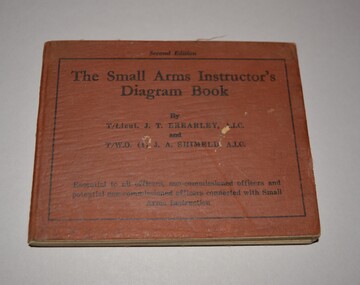
Book, Halstead Press Pty Limited, The Small Arms Instructor's Diagram Book, 1942
... He disembarked for the Middle East in November, 1940 and fought in the Syrian campaign in 1941. In 1942 the 2/14th Battalion returned to Australia and sent to Papua where he fought at the Battle of Isurava before the battalion was sent to Gona. ...He disembarked for the Middle East in November, 1940 and fought in the Syrian campaign in 1941. In 1942 the 2/14th Battalion returned to Australia and sent to Papua where he fought at the Battle of Isurava before the battalion was sent to Gona. ...The Small Arms Instructor's Diagram Book (1942) is a military training aid containing visual illustrations, mechanism plates, and trajectory diagrams used by Commonwealth forces during World War II. Booklet belonged to Robert Francis ISKOV VX15237 born at Glenrowan served with the 59th Battalion CMF before joining the 2/14th Battalion at Caulfield in September 1940. He disembarked for the Middle East in November, 1940 and fought in the Syrian campaign in 1941. In 1942 the 2/14th Battalion returned to Australia and sent to Papua where he fought at the Battle of Isurava before the battalion was sent to Gona. On 1943 Bob returned to Australia to undertake officer training and in 1945 with the 2/23rd Battalion sailed to Morotai and served with the battalion on Tarakan. He returned to Australia in November, 1945 and discharged a month later.A monograph publication by T/Lieut. J. T Brearley and T/W.O (1) J.A.ShimeldBrown cloth covered hard cover book containing 92 pages mainly of diagrams.Second Editionww2, new guinea, 1942, instructor's diagram book, small arms, second edition -
 Wangaratta RSL Sub Branch
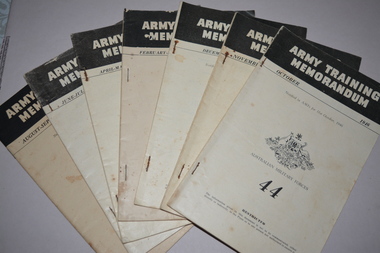
Pamphlet, WIlke & Co Pty Ltd, Army Training Memorandum, 1946
... He disembarked for the Middle East in November, 1940 and fought in the Syrian campaign in 1941. In 1942 the 2/14th Battalion returned to Australia and sent to Papua where he fought at the Battle of Isurava before the battalion was sent to Gona. ...He disembarked for the Middle East in November, 1940 and fought in the Syrian campaign in 1941. In 1942 the 2/14th Battalion returned to Australia and sent to Papua where he fought at the Battle of Isurava before the battalion was sent to Gona. ...Seven consecutively numbered 44-50 dated between October 1946 and August/September 1947 Australian Army Training Memorandum pamphlets featuring short articles. Booklet belonged to Robert Francis ISKOV VX15237 born at Glenrowan served with the 59th Battalion CMF before joining the 2/14th Battalion at Caulfield in September 1940. He disembarked for the Middle East in November, 1940 and fought in the Syrian campaign in 1941. In 1942 the 2/14th Battalion returned to Australia and sent to Papua where he fought at the Battle of Isurava before the battalion was sent to Gona. On 1943 Bob returned to Australia to undertake officer training and in 1945 with the 2/23rd Battalion sailed to Morotai and served with the battalion on Tarakan. He returned to Australia in November, 1945 and discharged a month laterSeries of seven soft cover pamphlets with black lettering containing short articles and diagramsVolume 44 -50 (October 1946 - August/September 1947) Restrictedww2, military training pamphlet, 1946-1947, australian army memorandum -
 Wangaratta RSL Sub Branch
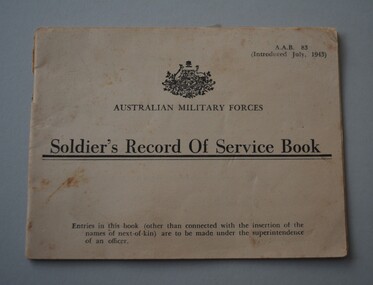
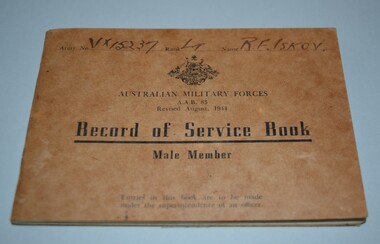
Booklet - Record of Service Book, The Specialty Press Pty Ltd, C1943
... He disembarked for the Middle East in November, 1940 and fought in the Syrian campaign in 1941. In 1942 the 2/14th Battalion returned to Australia and sent to Papua where he fought at the Battle of Isurava before the battalion was sent to Gona. ...He disembarked for the Middle East in November, 1940 and fought in the Syrian campaign in 1941. In 1942 the 2/14th Battalion returned to Australia and sent to Papua where he fought at the Battle of Isurava before the battalion was sent to Gona. ...Soldiers' Record of Service books such as the historical Australian Military Forces A.A.B. 83 were personal logs carried by service members to document enlistment, postings, courses, and medical history. Item belonged to Robert Francis ISKOV VX15237 served with the 59th Battalion/Hume Regiment CMF before joining the 2/14th Battalion at Caulfield in September 1940. He disembarked for the Middle East in November, 1940 and fought in the Syrian campaign in 1941. In 1942 the 2/14th Battalion returned to Australia and sent to Papua where he fought at the Battle of Isurava before the battalion was sent to Gona. On 1943 Bob returned to Australia to undertake officer training and in 1945 with the 2/23rd Battalion sailed to Morotai and served with the battalion on Tarakan. He returned to Australia in November, 1945 and discharged a month later Cream paper booklet with crest and lettering in black ink on front cover containing 20 pagesA.A.B 83 Introduced July 1943 Australian Military Forcesww2, bob iskov, soldier's record of service book -
 Wangaratta RSL Sub Branch
Booklet - Record of Service Book, The Specialty Press Pty Ltd, C1944
... He disembarked for the Middle East in November, 1940 and fought in the Syrian campaign in 1941. In 1942 the 2/14th Battalion returned to Australia and sent to Papua where he fought at the Battle of Isurava before the battalion was sent to Gona. ...He disembarked for the Middle East in November, 1940 and fought in the Syrian campaign in 1941. In 1942 the 2/14th Battalion returned to Australia and sent to Papua where he fought at the Battle of Isurava before the battalion was sent to Gona. ...Soldiers' Record of Service books such as the historical Australian Military Forces A.A.B. 83 were personal logs carried by service members to document enlistment, postings, courses, and medical history. Item belonged to Robert Francis ISKOV VX15237 served with the 59th Battalion/Hume Regiment CMF before joining the 2/14th Battalion at Caulfield in September 1940. He disembarked for the Middle East in November, 1940 and fought in the Syrian campaign in 1941. In 1942 the 2/14th Battalion returned to Australia and sent to Papua where he fought at the Battle of Isurava before the battalion was sent to Gona. On 1943 Bob returned to Australia to undertake officer training and in 1945 with the 2/23rd Battalion sailed to Morotai and served with the battalion on Tarakan. He returned to Australia in November, 1945 and discharged a month later Brown cardboard booklet with crest and lettering in black ink on front cover containing 40 pages VX15237 Lt R F ISKOV Australian Military Forcesww2, bob iskov, soldier's record of service book, amf -
 Wangaratta RSL Sub Branch
Accessory - Machete Scabbard, H Carson Ltd, c1941
... He disembarked for the Middle East in November, 1940 and fought in the Syrian campaign in 1941. In 1942 the 2/14th Battalion returned to Australia and sent to New Guinea where he fought at the Battle of Isurava before the battalion was sent to Gona. ...He disembarked for the Middle East in November, 1940 and fought in the Syrian campaign in 1941. In 1942 the 2/14th Battalion returned to Australia and sent to New Guinea where he fought at the Battle of Isurava before the battalion was sent to Gona. ...This leather scabbard was mostly likely made by H Carson Ltd in Canada who were suppliers to the military during WW2 of leather sheaths/scabbards. The item is from a collection that belonged to Robert Francis ISKOV VX15237 born at Glenrowan served with the 59th Battalion CMF before joining the 2/14th Battalion at Caulfield in September 1940. He disembarked for the Middle East in November, 1940 and fought in the Syrian campaign in 1941. In 1942 the 2/14th Battalion returned to Australia and sent to New Guinea where he fought at the Battle of Isurava before the battalion was sent to Gona. On 1943 Bob returned to Australia to undertake officer training and in 1945 with the 2/23rd Battalion sailed to Morotai and served with the battalion on Tarakan. He returned to Australia in November, 1945 and discharged a month later.Brown leather scabbard with belt loop and strap fitted with brass stud attached by three studs to sheath.H C Co LTD 941ww2, new guinea, bob iskov, bush knife, machete, scabbard -
 Wangaratta RSL Sub Branch
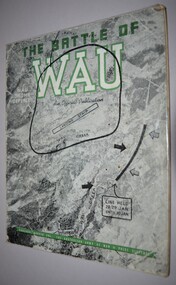
Book - Booklet, The Battle of Wau, c1944
... He disembarked for the Middle East in November, 1940 and fought in the Syrian campaign in 1941. In 1942 the 2/14th Battalion returned to Australia and sent to Papua where he fought at the Battle of Isurava before the battalion was sent to Gona. ...He disembarked for the Middle East in November, 1940 and fought in the Syrian campaign in 1941. In 1942 the 2/14th Battalion returned to Australia and sent to Papua where he fought at the Battle of Isurava before the battalion was sent to Gona. ...This booklet gives historical accounts of the pivotal WWII campaign in Papua New Guinea where Australian forces secured a critical victory over the Japanese in early 1943. It was released by the Department of Information in 1943/1944, and features contemporary maps and illustrations. Booklet belonged to Robert Francis ISKOV VX15237 born at Glenrowan served with the 59th Battalion CMF before joining the 2/14th Battalion at Caulfield in September 1940. He disembarked for the Middle East in November, 1940 and fought in the Syrian campaign in 1941. In 1942 the 2/14th Battalion returned to Australia and sent to Papua where he fought at the Battle of Isurava before the battalion was sent to Gona. On 1943 Bob returned to Australia to undertake officer training and in 1945 with the 2/23rd Battalion sailed to Morotai and served with the battalion on Tarakan. He returned to Australia in November, 1945 and discharged a month later.Soft cover booklet covered in plastic contains 32 pages including maps and illustrations. Cover has black and white copy of aerial photograph with writing highlighted in green. Brochure number one. The Australian Army at War. Price sixpence.ww2, new guinea, booklet, the battle of wau -
 Wangaratta RSL Sub Branch
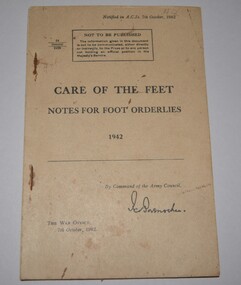
Booklet, J T Picken and Sons, Care of the Feet - Notes for Foot Orderlies, c1942
... He disembarked for the Middle East in November, 1940 and fought in the Syrian campaign in 1941. In 1942 the 2/14th Battalion returned to Australia and sent to Papua where he fought at the Battle of Isurava before the battalion was sent to Gona. ...He disembarked for the Middle East in November, 1940 and fought in the Syrian campaign in 1941. In 1942 the 2/14th Battalion returned to Australia and sent to Papua where he fought at the Battle of Isurava before the battalion was sent to Gona. ...The 1942 "Care of the Feet" booklet refers to a restricted military pamphlet published by the British War Office on October 7, 1942, titled "Care of the Feet - Notes for Foot Orderlies". It was marked as a restricted document ("Not to be published") and issued by the Army Council. Booklet belonged to Robert Francis ISKOV VX15237 born at Glenrowan served with the 59th Battalion CMF before joining the 2/14th Battalion at Caulfield in September 1940. He disembarked for the Middle East in November, 1940 and fought in the Syrian campaign in 1941. In 1942 the 2/14th Battalion returned to Australia and sent to Papua where he fought at the Battle of Isurava before the battalion was sent to Gona. On 1943 Bob returned to Australia to undertake officer training and in 1945 with the 2/23rd Battalion sailed to Morotai and served with the battalion on Tarakan. He returned to Australia in November, 1945 and discharged a month later.Cream cardboard covered booklet containing 48 pages including diagrams. Not to be Publishedww2, new guinea, booklet, care of the feet - notes for foot orderlies, 1942 -
 Wangaratta RSL Sub Branch
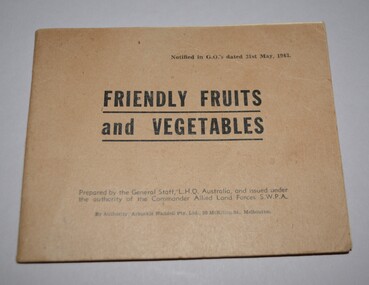
Booklet, Arbuckle Waddell Pty Ltd, Friendly Fruits and Vegetables, c1943
... He disembarked for the Middle East in November, 1940 and fought in the Syrian campaign in 1941. In 1942 the 2/14th Battalion returned to Australia and sent to Papua where he fought at the Battle of Isurava before the battalion was sent to Gona. ...He disembarked for the Middle East in November, 1940 and fought in the Syrian campaign in 1941. In 1942 the 2/14th Battalion returned to Australia and sent to Papua where he fought at the Battle of Isurava before the battalion was sent to Gona. ..."Friendly Fruits and Vegetables" is a specific WWII-era jungle survival guide which served as a visual pamphlet to help downed aircrews identify edible jungle plants, avoid dangerous ones, and find survival resources Booklet belonged to Robert Francis ISKOV VX15237 born at Glenrowan served with the 59th Battalion CMF before joining the 2/14th Battalion at Caulfield in September 1940. He disembarked for the Middle East in November, 1940 and fought in the Syrian campaign in 1941. In 1942 the 2/14th Battalion returned to Australia and sent to Papua where he fought at the Battle of Isurava before the battalion was sent to Gona. On 1943 Bob returned to Australia to undertake officer training and in 1945 with the 2/23rd Battalion sailed to Morotai and served with the battalion on Tarakan. He returned to Australia in November, 1945 and discharged a month later.Cream cardboard covered booklet containing 71 pages including photographs. ww2, new guinea, booklet, 1943, friendly fruits and vegetables, aircrews -
 Wangaratta RSL Sub Branch
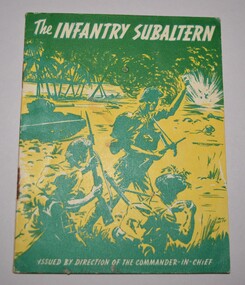
Booklet, LHQ Press, The Infantry Subaltern's Task, c1943
... He disembarked for the Middle East in November, 1940 and fought in the Syrian campaign in 1941. In 1942 the 2/14th Battalion returned to Australia and sent to Papua where he fought at the Battle of Isurava before the battalion was sent to Gona. ...He disembarked for the Middle East in November, 1940 and fought in the Syrian campaign in 1941. In 1942 the 2/14th Battalion returned to Australia and sent to Papua where he fought at the Battle of Isurava before the battalion was sent to Gona. ..."The Infantry Subaltern's Task," was an official tactical booklet issued by the Australian Army's Land Headquarters (South West Pacific Area) designed to instruct newly commissioned subalterns (platoon commanders) on jungle warfare, leadership, and operational realities in the Pacific. Booklet belonged to Robert Francis ISKOV VX15237 born at Glenrowan served with the 59th Battalion CMF before joining the 2/14th Battalion at Caulfield in September 1940. He disembarked for the Middle East in November, 1940 and fought in the Syrian campaign in 1941. In 1942 the 2/14th Battalion returned to Australia and sent to Papua where he fought at the Battle of Isurava before the battalion was sent to Gona. On 1943 Bob returned to Australia to undertake officer training and in 1945 with the 2/23rd Battalion sailed to Morotai and served with the battalion on Tarakan. He returned to Australia in November, 1945 and discharged a month later.Green yellow and white soft cover booklet containing 20 pages. Front cover depicts three soldiers and a tank in foreground of river and palm trees. Issued by direction of the Commander in Chiefww2, new guinea, booklet, 1943, the infantry subaltern, swpa -
 Wangaratta RSL Sub Branch
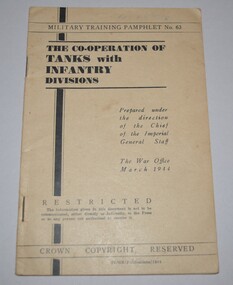
Pamphlet - Military Training Pamphlet No 63, The Co-operation of Tanks with Infantry Divisions, 1944
... He disembarked for the Middle East in November, 1940 and fought in the Syrian campaign in 1941. In 1942 the 2/14th Battalion returned to Australia and sent to Papua where he fought at the Battle of Isurava before the battalion was sent to Gona. ...He disembarked for the Middle East in November, 1940 and fought in the Syrian campaign in 1941. In 1942 the 2/14th Battalion returned to Australia and sent to Papua where he fought at the Battle of Isurava before the battalion was sent to Gona. ...Military Training Pamphlet (MTP) No. 63, "The Co-Operation of Tanks with Infantry Divisions" is a World War II British Army publication issued by the War Office in 1944. It established the tactical framework for combined arms operations leading up to the invasion of North-West Europe. Booklet belonged to Robert Francis ISKOV VX15237 born at Glenrowan served with the 59th Battalion CMF before joining the 2/14th Battalion at Caulfield in September 1940. He disembarked for the Middle East in November, 1940 and fought in the Syrian campaign in 1941. In 1942 the 2/14th Battalion returned to Australia and sent to Papua where he fought at the Battle of Isurava before the battalion was sent to Gona. On 1943 Bob returned to Australia to undertake officer training and in 1945 with the 2/23rd Battalion sailed to Morotai and served with the battalion on Tarakan. He returned to Australia in November, 1945 and discharged a month later.Soft cover pamphlet with black lettering containing 30 pages Restricted Crown Copyright Reservedww2, 1944, war office, military training pamphlet -
 Wangaratta RSL Sub Branch
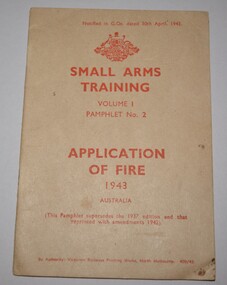
Pamphlet - Small Arms Training, Victorian Railways Printing Works, Application of Fire, 1943
... He disembarked for the Middle East in November, 1940 and fought in the Syrian campaign in 1941. In 1942 the 2/14th Battalion returned to Australia and sent to Papua where he fought at the Battle of Isurava before the battalion was sent to Gona. ...He disembarked for the Middle East in November, 1940 and fought in the Syrian campaign in 1941. In 1942 the 2/14th Battalion returned to Australia and sent to Papua where he fought at the Battle of Isurava before the battalion was sent to Gona. ...Australian Army manual focusing on the principles of effective rifle fire. Covering essential skills such as estimating distance, assessing wind effects, and understanding angles, this pamphlet provided soldiers with the knowledge needed for accurate marksmanship in combat. Booklet belonged to Robert Francis ISKOV VX15237 born at Glenrowan served with the 59th Battalion CMF before joining the 2/14th Battalion at Caulfield in September 1940. He disembarked for the Middle East in November, 1940 and fought in the Syrian campaign in 1941. In 1942 the 2/14th Battalion returned to Australia and sent to Papua where he fought at the Battle of Isurava before the battalion was sent to Gona. On 1943 Bob returned to Australia to undertake officer training and in 1945 with the 2/23rd Battalion sailed to Morotai and served with the battalion on Tarakan. He returned to Australia in November, 1945 and discharged a month later.Soft cover pamphlet with red lettering containing 31 pages and diagramsVolume 1 Pamphlet 2 Pamphlet supersedes the 1937 edition and that reprinted with amendments 1942.ww2, military training pamphlet, small arms training, 1943 -
 Wangaratta RSL Sub Branch
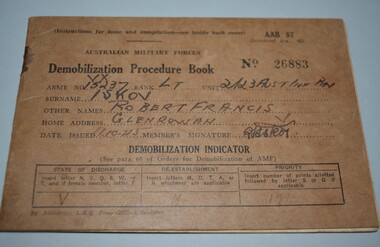
Booklet - Demobilization Procedure Book, LHQ Press, C1945
... He disembarked for the Middle East in November, 1940 and fought in the Syrian campaign in 1941. In 1942 the 2/14th Battalion returned to Australia and sent to Papua where he fought at the Battle of Isurava before the battalion was sent to Gona. ...He disembarked for the Middle East in November, 1940 and fought in the Syrian campaign in 1941. In 1942 the 2/14th Battalion returned to Australia and sent to Papua where he fought at the Battle of Isurava before the battalion was sent to Gona. ...The Demobilization Procedure Book (reference AAB 87) was an essential handbook issued by the Australian Military Forces (AMF) to service personnel at the end of World War II. It guided them through dispersal, rehabilitation, and discharge. Item belonged to Robert Francis ISKOV VX15237 served with the 59th Battalion/Hume Regiment CMF before joining the 2/14th Battalion at Caulfield in September 1940. He disembarked for the Middle East in November, 1940 and fought in the Syrian campaign in 1941. In 1942 the 2/14th Battalion returned to Australia and sent to Papua where he fought at the Battle of Isurava before the battalion was sent to Gona. On 1943 Bob returned to Australia to undertake officer training and in 1945 with the 2/23rd Battalion sailed to Morotai and served with the battalion on Tarakan. He returned to Australia in November, 1945 and discharged a month later Brown cardboard booklet with lettering in black ink on front cover containing 32 pagesNo 26883 VX15237 LT 2/23 Aust Inf Bn Robert Francis ISKOV Glenrowan Date issued 11.10.1945 ww2, bob iskov, demobilization procedure book, amf -
 Wangaratta RSL Sub Branch
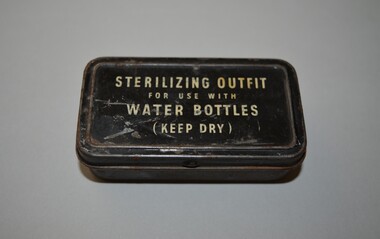
Container - Sterilizing Outfit, Tromax Limited, C1942-45
... He disembarked for the Middle East in November, 1940 and fought in the Syrian campaign in 1941. In 1942 the 2/14th Battalion returned to Australia and sent to Papua where he fought at the Battle of Isurava before the battalion was sent to Gona. ...He disembarked for the Middle East in November, 1940 and fought in the Syrian campaign in 1941. In 1942 the 2/14th Battalion returned to Australia and sent to Papua where he fought at the Battle of Isurava before the battalion was sent to Gona. ...Water Sterilization Outfit manufactured in Australia to sterilize water for use in the field by soldiers particularly deployed to Borneo and New Guinea/Kokoda Track Campaigns during WW2, where clean jungle drinking water was a matter of survival. Item belonged to Robert Francis ISKOV VX15237 served with the 59th Battalion/Hume Regiment CMF before joining the 2/14th Battalion at Caulfield in September 1940. He disembarked for the Middle East in November, 1940 and fought in the Syrian campaign in 1941. In 1942 the 2/14th Battalion returned to Australia and sent to Papua where he fought at the Battle of Isurava before the battalion was sent to Gona. On 1943 Bob returned to Australia to undertake officer training and in 1945 with the 2/23rd Battalion sailed to Morotai and served with the battalion on Tarakan. He returned to Australia in November, 1945 and discharged a month laterRectangular tin with hinged lid containing two clear glass vials of water sterilization tablets. The tin is plain metal apart from the black lid with white lettering. The two vials are stoppered with cork. The thinner vial contains small round blue tablets, while the thicker vial contains a white substance and has a paper label titled '50 Sterilizing Tablets'.LID - 'STERILIZING OUTFIT / FOR USE WITH / WATER BOTTLES / (KEEP DRY) ww2, bob iskov, amf, sterilizing outfit, new guinea -
 Wangaratta RSL Sub Branch
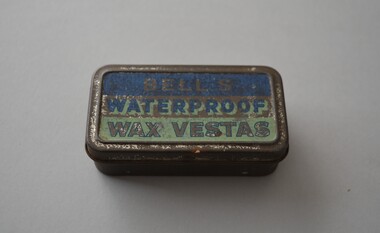
Container - Waterproof Wax Vestas, R Bell & Co, C1939-45
... He disembarked for the Middle East in November, 1940 and fought in the Syrian campaign in 1941. In 1942 the 2/14th Battalion returned to Australia and sent to Papua where he fought at the Battle of Isurava before the battalion was sent to Gona. ...He disembarked for the Middle East in November, 1940 and fought in the Syrian campaign in 1941. In 1942 the 2/14th Battalion returned to Australia and sent to Papua where he fought at the Battle of Isurava before the battalion was sent to Gona. ...Container of small wax coated matches designed to resist moisture. Widely known for supplying troops during World War II (1939–1945), specifically utilized in Australian military emergency ration packs and by personnel on the Kokoda Track. Item belonged to Robert Francis ISKOV VX15237 served with the 59th Battalion/Hume Regiment CMF before joining the 2/14th Battalion at Caulfield in September 1940. He disembarked for the Middle East in November, 1940 and fought in the Syrian campaign in 1941. In 1942 the 2/14th Battalion returned to Australia and sent to Papua where he fought at the Battle of Isurava before the battalion was sent to Gona. On 1943 Bob returned to Australia to undertake officer training and in 1945 with the 2/23rd Battalion sailed to Morotai and served with the battalion on Tarakan. He returned to Australia in November, 1945 and discharged a month laterRectangular tin with hinged lid containing small timber matches with wax heads. The tin is plain metal apart from two tone blue lid with lettering. Underneath is a serrated patch used to strike the match. Bell's Waterproof Wax Vestas ww2, bob iskov, amf, new guinea, vestas -
 Wangaratta RSL Sub Branch
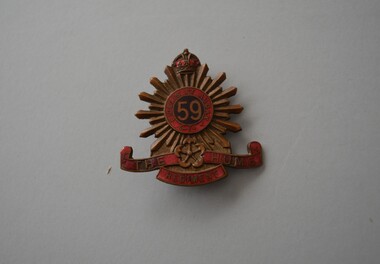
Badge - Hat and collar badges, C1939
... He disembarked for the Middle East in November, 1940 and fought in the Syrian campaign in 1941. In 1942 the 2/14th Battalion returned to Australia and sent to Papua where he fought at the Battle of Isurava before the battalion was sent to Gona. ...He disembarked for the Middle East in November, 1940 and fought in the Syrian campaign in 1941. In 1942 the 2/14th Battalion returned to Australia and sent to Papua where he fought at the Battle of Isurava before the battalion was sent to Gona. ...Original Militia issue hat badge with smaller matching pair of collar badges worn by members of the Victorian based 59th Battalion. In 1939 the battalion underwent a name change, adopting the territorial title of the "Hume Regiment." Item belonged to Robert Francis ISKOV VX15237 served with the 59th Battalion/Hume Regiment CMF before joining the 2/14th Battalion at Caulfield in September 1940. He disembarked for the Middle East in November, 1940 and fought in the Syrian campaign in 1941. In 1942 the 2/14th Battalion returned to Australia and sent to Papua where he fought at the Battle of Isurava before the battalion was sent to Gona. On 1943 Bob returned to Australia to undertake officer training and in 1945 with the 2/23rd Battalion sailed to Morotai and served with the battalion on Tarakan. He returned to Australia in November, 1945 and discharged a month laterBrass badge features a central red enamel circle containing the raised numeral 59 circled by a motto with radiating design with crown on top and scroll underneathMotto - Fidelis Et Audax Scroll -The Hume Regimentww2, bob iskov, amf, new guinea, 59th battalion, hat and collar badges, hume regiment -
 Wangaratta RSL Sub Branch
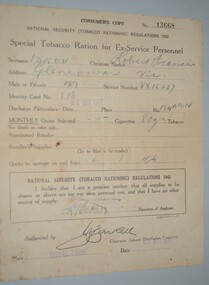
Ephemera - Consumer's Copy - Tobacco Ration, H E Daw, C1942
... He disembarked for the Middle East in November, 1940 and fought in the Syrian campaign in 1941. In 1942 the 2/14th Battalion returned to Australia and sent to Papua where he fought at the Battle of Isurava before the battalion was sent to Gona. ...He disembarked for the Middle East in November, 1940 and fought in the Syrian campaign in 1941. In 1942 the 2/14th Battalion returned to Australia and sent to Papua where he fought at the Battle of Isurava before the battalion was sent to Gona. ...National Security (Tobacco Rationing) Regulations established on February 24, 1942. The "Consumer's Copy" was issued as a personal ration document requiring citizens to register with a nominated retailer to purchase their restricted tobacco or cigarette quota. Item belonged to Robert Francis ISKOV VX15237 served with the 59th Battalion/Hume Regiment CMF before joining the 2/14th Battalion at Caulfield in September 1940. He disembarked for the Middle East in November, 1940 and fought in the Syrian campaign in 1941. In 1942 the 2/14th Battalion returned to Australia and sent to Papua where he fought at the Battle of Isurava before the battalion was sent to Gona. In 1943 Bob returned to Australia to undertake officer training and in 1945 with the 2/23rd Battalion sailed to Morotai and served with the battalion on Tarakan. He returned to Australia in November, 1945 and discharged a month laterBlack printed form for special tobacco ration for ex service personnel on cream colour paper including personal details. Consumer's Copy No 13668ww2, bob iskov, amf, new guinea, 59th battalion, tobacco ration, 1942 -
4th/19th Prince of Wales's Light Horse Regiment Unit History Room
Medal, Africa Star, abt 1945
... The Africa Star may also be awarded for operational service as a member of the Australian Defence Force during the Syrian Campaign in the period from 8 June 1941 to 11 July 1941. ...The Africa Star may also be awarded for operational service as a member of the Australian Defence Force during the Syrian Campaign in the period from 8 June 1941 to 11 July 1941. ...The Africa Star was granted for operational service in North Africa from the date of the entry of Italy into the war on 10 June 1940, up to the date of the cessation of operations against the enemy in North Africa on 12 May 1943. The Africa Star may also be awarded for operational service as a member of the Australian Defence Force during the Syrian Campaign in the period from 8 June 1941 to 11 July 1941. This medal is awarded for a minimum of one days operational service in North Africa, west of the Suez Canal between 10 June 1940 and 12 May 1943 and in Syria between 8 June 1941 and 11 July 1941. Clasps Three clasps were issued for the Africa Star: 8 th Army 1 st Army North Africa 1942-43 Only one clasp is worn and when the ribbon is worn alone a ribbon emblem, ‘8', ‘1' or silver rosette as appropriate is worn to denote the award of a clasp. The Medal The Africa Star is a six–pointed star of yellow copper zinc alloy. The obverse has a central design of the Royal and Imperial cypher, surmounted by a crown. The cypher is surrounded by a circlet containing the words ‘The Africa Star'. Stars issued to Australian personnel have recipient names engraved on the plain reverse. The Ribbon The Africa Star ribbon colours represent the desert and the service of the Armies, Naval Forces, Merchant Navy and the Air Forces. Recipient is not engraved on reverse, so, either a replica or not issued to Australianmedal africa star -
 Wangaratta RSL Sub Branch
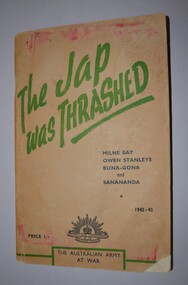
Book - Booklet, The Jap was Thrashed - Milne Bay Owen Stanleys Guna-Gona and Sanananda 1942-43, c1944
... He disembarked for the Middle East in November, 1940 and fought in the Syrian campaign in 1941. In 1942 the 2/14th Battalion returned to Australia and sent to Papua where he fought at the Battle of Isurava before the battalion was sent to Gona. ...He disembarked for the Middle East in November, 1940 and fought in the Syrian campaign in 1941. In 1942 the 2/14th Battalion returned to Australia and sent to Papua where he fought at the Battle of Isurava before the battalion was sent to Gona. ...This book, contains 128 pages including photographs and maps, chronicles the Australian Army's campaigns against Japanese forces in New Guinea during World War II, specifically the battles at Milne Bay, the Owen Stanley Range, Buna, Gona, and Sanananda. Published under the authority of General Sir Thomas Blamey, it served as an official morale-boosting narrative to highlight the resilience of the Australian soldier. Booklet belonged to Robert Francis ISKOV VX15237 born at Glenrowan served with the 59th Battalion CMF before joining the 2/14th Battalion at Caulfield in September 1940. He disembarked for the Middle East in November, 1940 and fought in the Syrian campaign in 1941. In 1942 the 2/14th Battalion returned to Australia and sent to Papua where he fought at the Battle of Isurava before the battalion was sent to Gona. On 1943 Bob returned to Australia to undertake officer training and in 1945 with the 2/23rd Battalion sailed to Morotai and served with the battalion on Tarakan. He returned to Australia in November, 1945 and discharged a month later.Cream colour cardboard soft cover booklet with green and black writing and crest on front cover.Price 1/- The Australian Army at Warww2, new guinea, the jap was thrashed, booklet -
 Wangaratta RSL Sub Branch
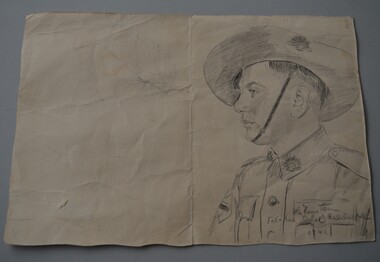
Drawing - Sketch, C1941
... He disembarked for the Middle East in November, 1940 and fought in the Syrian campaign in 1941. In 1942 the 2/14th Battalion returned to Australia and sent to Papua where he fought at the Battle of Isurava before the battalion was sent to Gona. ...He disembarked for the Middle East in November, 1940 and fought in the Syrian campaign in 1941. In 1942 the 2/14th Battalion returned to Australia and sent to Papua where he fought at the Battle of Isurava before the battalion was sent to Gona. ...This hand drawn sketch of Robert ISKOV in uniform showing unit patch of the 2/14th Battalion on right sleeve was taken at a Tel-Aviv Cafe dated 1941. During WW2 Tel Aviv was a vibrant modern coastal hub known for its European style cafe culture. Cafes like Balalaika served as major social centers where allied soldiers interacted with local residents. Item belonged to Robert Francis ISKOV VX15237 served with the 59th Battalion/Hume Regiment CMF before joining the 2/14th Battalion at Caulfield in September 1940. He disembarked for the Middle East in November, 1940 and fought in the Syrian campaign in 1941. In 1942 the 2/14th Battalion returned to Australia and sent to Papua where he fought at the Battle of Isurava before the battalion was sent to Gona. In 1943 Bob returned to Australia to undertake officer training and in 1945 with the 2/23rd Battalion sailed to Morotai and served with the battalion on Tarakan. He returned to Australia in November, 1945 and discharged a month later Lead pencil chest high sketch of soldier in Australian Army Uniform on cardboard. Tel Aviv Cafe, Balalaikaww2, bob iskov, amf, 2/14th battalion, tel aviv, sketch, balalaika -
 Wangaratta RSL Sub Branch
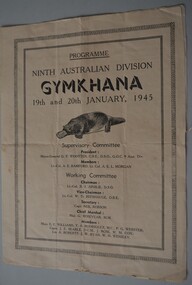
Programme, 9th Australian Division Gymkhana, C1945
... He disembarked for the Middle East in November, 1940 and fought in the Syrian campaign in 1941. In 1942 the 2/14th Battalion returned to Australia and sent to Papua where he fought at the Battle of Isurava before the battalion was sent to Gona. ...He disembarked for the Middle East in November, 1940 and fought in the Syrian campaign in 1941. In 1942 the 2/14th Battalion returned to Australia and sent to Papua where he fought at the Battle of Isurava before the battalion was sent to Gona. ...Programme of the 9th Australian Division Gymkhana held 19th and 20th January 1945 at Herberton Racecourse, Atherton Tableland, Queensland. The event featured a wide array of sporting, military, and horse racing events to boost morale and physical readiness. The carnival was a massive logistical gathering for the "Magnificent 9th" prior to their final amphibious deployments to Borneo. The Australian War Memorial maintains historical film coverage of this specific event. Item belonged to Robert Francis ISKOV VX15237 served with the 59th Battalion/Hume Regiment CMF before joining the 2/14th Battalion at Caulfield in September 1940. He disembarked for the Middle East in November, 1940 and fought in the Syrian campaign in 1941. In 1942 the 2/14th Battalion returned to Australia and sent to Papua where he fought at the Battle of Isurava before the battalion was sent to Gona. In 1943 Bob returned to Australia to undertake officer training and in 1945 with the 2/23rd Battalion sailed to Morotai and served with the battalion on Tarakan. He returned to Australia in November, 1945 and discharged a month later Large beige coloured paper folded in half to form four pages with black image of a platypus and lettering on cover 19th and 20th January 1945ww2, bob iskov, amf, 9th division, gymkhana, 1945, herberton, programme -
 Wangaratta RSL Sub Branch
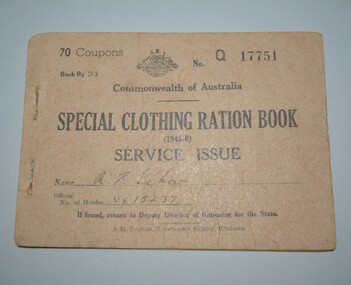
Booklet - Special Clothing Ration Book, A H Tucker, C1945
... He disembarked for the Middle East in November, 1940 and fought in the Syrian campaign in 1941. In 1942 the 2/14th Battalion returned to Australia and sent to Papua where he fought at the Battle of Isurava before the battalion was sent to Gona. ...He disembarked for the Middle East in November, 1940 and fought in the Syrian campaign in 1941. In 1942 the 2/14th Battalion returned to Australia and sent to Papua where he fought at the Battle of Isurava before the battalion was sent to Gona. ...A special clothing ration book (or supplementary clothing card) refers to extra coupon booklets issued during WWII. These supplemented the standard annual coupon allowance for citizens needing extra garments World War II civilian "Service Issue" clothing ration books were special coupon booklets introduced in Australia in June 1942 to manage extreme shortages of textiles and factory labor diverted to military uniforms. Citizens received an annual quota of coupons to ensure equitable sharing of clothes. Item belonged to Robert Francis ISKOV VX15237 served with the 59th Battalion/Hume Regiment CMF before joining the 2/14th Battalion at Caulfield in September 1940. He disembarked for the Middle East in November, 1940 and fought in the Syrian campaign in 1941. In 1942 the 2/14th Battalion returned to Australia and sent to Papua where he fought at the Battle of Isurava before the battalion was sent to Gona. On 1943 Bob returned to Australia to undertake officer training and in 1945 with the 2/23rd Battalion sailed to Morotai and served with the battalion on Tarakan. He returned to Australia in November, 1945 and discharged a month later Brown cardboard booklet with lettering in black ink on front cover containing 2 half pagesQ17751 70 coupons R F ISKOV VX15237ww2, bob iskov, special clothing ration book, service issue
