
Showing 7 items matching "t.e. molloy"
-
 Federation University Historical Collection
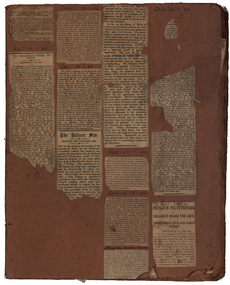
Book - Scrapbook, Ballarat School of Mines Scrapbook, 1899, 1872-1908
... ...T.E. Molloy...Murphy Mary Browne technical education andrew berry r-ray xray Watson's focus tubes rohmkorff coil treloar wooster T.E. Molloy W/m/ acheson ladies art association Ballarat Art Gallery Association maud glover bertha s. williamson hnery foster native telurides of gold eliza kershaw edith curnow .1) Scrapbook of newspaper clipping in oversize scrapbook .2) White file of newspaper clippings 1872-1908 Ballarat School of Mines Scrapbook, 1899 Book Scrapbook ....1) Scrapbook of newspaper clipping in oversize scrapbook .2) White file of newspaper clippings 1872-1908newsclips, newspaper cuttings, schools of mines, sale school of mines, bairnsdale school of mines, daylesford school of mines, castlemaine school of mines, bendigo school of mines, stawell school of mines, st arnaud school of mines, alfred mica smith, industrial institute, james bickett, redmond barry, ballarat school of mines opening, mining engineering, pottery, charles fenner, pottery classes, maurice copland, plumbing, harold herbert, ballarat school of mines statistics, andrew anderson, j.c. molloy, art schools, ballarat west art school, herbert h. smith, amelia h. troon, martha pinkerton, r.t. vale, david ham, clunes, rivett bland obituary, university of melbourne affiliation, gilbert dawbarn, kernot, james patterson, john rowe, cassilis chlorination, r.w. lamb, j. flegeltaub, tasmanian examination, balarat school of mines museum, latham watson, state school students, w. longstafff, daisy ditchburn, e. grownow, ballarat east art school, art gallery association technical art school, e. guse, j.g. williamson, m.f. williamson, george biknell, print engraving, a.e.c. kerr, a.n.a. fete, hannay electro-cyanide process, james oddie, r.m. serjeant, xrays, roentgen xrays, lizzie drape, mines bill, henry forster, technical education in germany, deeble's patent, p. cohen, deeble's cyanide plant donation, h. rosales, thomas hart, ballarat observatory, robert denham pinnock, isaac james jones, edward ivan rosenblum, samuel ernest figgis, r.w. best, thomas f. morkham, beatrice j. flude, bertha craig, drucilla hopwood, george bird, james galbally, mining exchange, transit theodilite, univerisity of melbourne, affiliation, t.d. wanliss, scrapbook, s.e. figgis, j. dawbarn, gilbert dawbarn, g.g. simpson, brown coal, parwan, bacchus marsh, a. berry, f.m. krause, practical mining, cassilis, tasmanian exhibition, ballarat school of mines dilapidated, thomas bath, cyanide, elextirc rock drills, herbert franklin, frank bruce, henry rivett bland, j.n. dunn, dr pinnick, theo williams, steiglitz gold mines, meredith, a.f. balderson, j.m. bickett, f.j. martell, cosmo newberry, m. lindsay, pyrites, pyrites roaster, blucjer amagamator, ludovico hart, photographer, art gallery association's technical art school, ballarat east school of art, otto riegelbuth, hugh colquhoun, louis lemp, g.a.f. soderstron, e. gude, a.f. tweedie, m.l. tuxen, george h. bicknell, c.v. brind, a.h. troon, r. flohm, c.s. proctor, m. oddie, b.s. williamson, f.h.w. robinson, photography classes, i.g. wittkowski, h.r. murphy, mary browne, technical education, andrew berry, r-ray, xray, watson's focus tubes, rohmkorff coil, treloar, wooster, t.e. molloy, w/m/ acheson, ladies art association, ballarat art gallery association, maud glover, bertha s. williamson, hnery foster, native telurides of gold, eliza kershaw, edith curnow -
 City of Ballarat Libraries
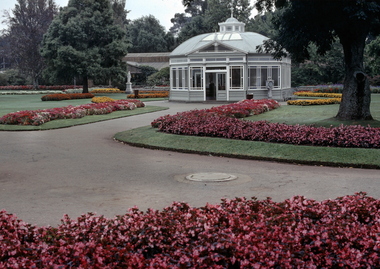
35 mm Slide, Statuary Pavilion, Ballarat Botanical Gardens circa late1950s
... The pavilion, designed by architect T.E. Molloy on an octagonal plan with a convex curved roof, was constructed in 1887, and houses the statues Flight from Pompeii, Rebekah, Susannah, Modesty and Ruth. ...The pavilion, designed by architect T.E. Molloy on an octagonal plan with a convex curved roof, was constructed in 1887, and houses the statues Flight from Pompeii, Rebekah, Susannah, Modesty and Ruth. ...James Russell Thompson (1818-1886) a successful mining investor and stockbroker of the Ballarat Stock Exchange, gifted the pavilion and the statues within, as a 10,000 pound bequest to the City in his will. The pavilion, designed by architect T.E. Molloy on an octagonal plan with a convex curved roof, was constructed in 1887, and houses the statues Flight from Pompeii, Rebekah, Susannah, Modesty and Ruth. The pavilion is a major feature of the Ballarat Botanical Gardens, and unique in Victoria. It is a favourite subject for photographers, and Mrs Strange has captured it surrounded by massed small begonias. Mrs Bon Strange and her husband Bert were well known Ballarat residents. When Mrs Strange died some years ago, her extensive slide collection was sorted through and those relevant to Ballarat were gifted to the Ballarat Library. botanical gardens, lake wendouree, james russell thompson, statuary pavilion, weighing machine -
 City of Ballarat
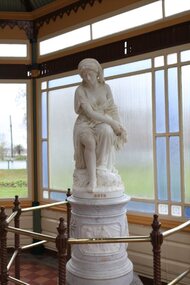
Public Artwork, Ruth by Charles F. Summers, Circa 1885
... The Pavilion, designed by the major Ballarat architect T.E. Molloy, is unusual for its top-lit central lantern and curved roofs. ...The Pavilion, designed by the major Ballarat architect T.E. Molloy, is unusual for its top-lit central lantern and curved roofs. ...Ruth was designed and carved by Charles Francis Summers, one of five white marble statues housed in the Statuary Pavilion, Ballarat Botanical Gardens. The Pavilion and its statues were unveiled in 1888 by Premier Duncan Gillies, a former colleague of James Russell Thompson whose bequest to the City enabled the purchase, in Italy, of the statues. The Flight from Pompeii and the four accompanying statues are housed in the Statuary Pavilion in the Ballarat Botanical Gardens. The Flight from Pompeii, in the centre, was designed by Professor Carlo Benzoni and carved by Charles Francis Summers while the four accompanying statues were all designed and carved by Charles Francis Summers. The octagonal Pavilion was specially designed by T.E. Molloy in 1887 to house the statuary. The five statues and Pavilion are believed to be unique in Australia. The Flight from Pompeii, Modesty, Rebekah, Ruth and Susannah are aesthetically significant as they are a group of statues, which are a fine example of the design of Professor G.M. Benzoni [Flight from Pompeii] and the design and carving of Charles Francis Summers. The carving of the Flight from Pompeii is both sensitive and finely done and both the design and carving of Modesty, Rebekah, Ruth and Susannah is sensitive and delicate with great attention to detail. The group is historically important as it epitomises the 'beautification' of the city in the 1880s by men who made their money from gold and who wished to give to the city money for projects such the statuary Pavilion and its contents. The Flight from Pompeii group is located in the Botanical Gardens, which were then also being developed in the Victorian style. This also illustrates the social feeling of the time in which the wealthy had made their money and were wanting to develop in a most substantial way, as well as to 'beautify' the city in which they lived. The Pavilion, designed by the major Ballarat architect T.E. Molloy, is unusual for its top-lit central lantern and curved roofs. The statues are seen to their best advantage because of the provision of all-round and top natural lighting. Classified: 03/03/2003 Victorian Heritage Database. the artwork is of historic and aesthetic significance to the people of BallaratWhite marble statue, Ruth is in a seated position with a loosely draped dress.Ruthruth -
 City of Ballarat
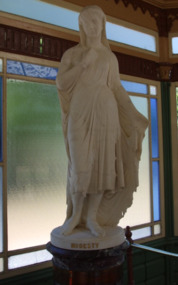
Artwork, other - Public Artwork, Modesty by Charles Francis Summers, Circa 1885
... The Pavilion, designed by the major Ballarat architect T.E. Molloy, is unusual for its top-lit central lantern and curved roofs. ...The Pavilion, designed by the major Ballarat architect T.E. Molloy, is unusual for its top-lit central lantern and curved roofs. ...Modesty was designed and carved by Charles Francis Summers, one of five white marble statues housed in the Statuary Pavilion, Ballarat Botanical Gardens. The Pavilion and its statues were unveiled in 1888 by Premier Duncan Gillies, a former colleague of James Russell Thompson whose bequest to the City enabled the purchase, in Italy, of the statues. The Flight from Pompeii and the four accompanying statues are housed in the Statuary Pavilion in the Ballarat Botanical Gardens. The Flight from Pompeii, in the centre, was designed by Professor Carlo Benzoni and carved by Charles Francis Summers while the four accompanying statues were all designed and carved by Charles Francis Summers. The octagonal Pavilion was specially designed by T.E. Molloy in 1887 to house the statuary. The five statues and Pavilion are believed to be unique in Australia. The Flight from Pompeii, Modesty, Rebekah, Ruth and Susannah are aesthetically significant as they are a group of statues, which are a fine example of the design of Professor G.M. Benzoni [Flight from Pompeii] and the design and carving of Charles Francis Summers. The carving of the Flight from Pompeii is both sensitive and finely done and both the design and carving of Modesty, Rebekah, Ruth and Susannah is sensitive and delicate with great attention to detail. The group is historically important as it epitomises the 'beautification' of the city in the 1880s by men who made their money from gold and who wished to give to the city money for projects such the statuary Pavilion and its contents. The Flight from Pompeii group is located in the Botanical Gardens, which were then also being developed in the Victorian style. This also illustrates the social feeling of the time in which the wealthy had made their money and were wanting to develop in a most substantial way, as well as to 'beautify' the city in which they lived. The Pavilion, designed by the major Ballarat architect T.E. Molloy, is unusual for its top-lit central lantern and curved roofs. The statues are seen to their best advantage because of the provision of all-round and top natural lighting. Classified: 03/03/2003 Victorian Heritage Database. The artwork is of historic and aesthetic significance to the people of BallaratWhite marble statue, Modesty standing with right arm folded over chest, robed and with veil over face.Modestymodesty -
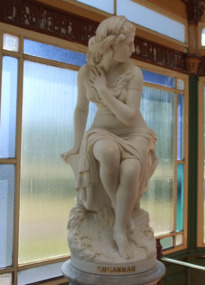 City of Ballarat
Artwork, other - Public Artwork, Charles F. Summers, Susannah, Circa 1885
... The Pavilion, designed by the major Ballarat architect T.E. Molloy, is unusual for its top-lit central lantern and curved roofs. ...The Pavilion, designed by the major Ballarat architect T.E. Molloy, is unusual for its top-lit central lantern and curved roofs. ...Susannah designed and carved by Charles Francis Summers and accompanies four statues in the Statuary Pavilion in the Ballarat Botanical Gardens. The Pavilion and its statues were unveiled in 1888 by Premier Duncan Gillies, a former colleague of James Russell Thompson whose bequest to the City enabled the purchase, in Italy, of the statues. The Flight from Pompeii and the four accompanying statues are housed in the Statuary Pavilion in the Ballarat Botanical Gardens. The Flight from Pompeii, in the centre, was designed by Professor Carlo Benzoni and carved by Charles Francis Summers while the four accompanying statues were all designed and carved by Charles Francis Summers. The octagonal Pavilion was specially designed by T.E. Molloy in 1887 to house the statuary. The five statues and Pavilion are believed to be unique in Australia. The Flight from Pompeii, Modesty, Rebekah, Ruth and Susannah are aesthetically significant as they are a group of statues, which are a fine example of the design of Professor G.M. Benzoni [Flight from Pompeii] and the design and carving of Charles Francis Summers. The carving of the Flight from Pompeii is both sensitive and finely done and both the design and carving of Modesty, Rebekah, Ruth and Susannah is sensitive and delicate with great attention to detail. The group is historically important as it epitomises the 'beautification' of the city in the 1880s by men who made their money from gold and who wished to give to the city money for projects such the statuary Pavilion and its contents. The Flight from Pompeii group is located in the Botanical Gardens, which were then also being developed in the Victorian style. This also illustrates the social feeling of the time in which the wealthy had made their money and were wanting to develop in a most substantial way, as well as to 'beautify' the city in which they lived. The Pavilion, designed by the major Ballarat architect T.E. Molloy, is unusual for its top-lit central lantern and curved roofs. The statues are seen to their best advantage because of the provision of all-round and top natural lighting. Classified: 03/03/2003 Victorian Heritage Database.The artwork is of historic and aesthetic significance to the people of Ballarat White marble statue, female seated with cloth draped over lower body.Susannahsusannah, summers -
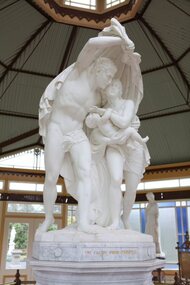 City of Ballarat
Artwork, other - Public Artwork, Carlo Benzoni, The Flight From Pompeii, Circa 1885
... The Pavilion, designed by the major Ballarat architect T.E. Molloy, is unusual for its top-lit central lantern and curved roofs. ...The Flight from Pompeii was designed by Professor Carlo Benzoni and carved by Charles Francis Summers, one of five white marble statues housed in the Statuary Pavilion, Ballarat Botanical Gardens.The Pavilion and its statues were unveiled in 1888 by Premier Duncan Gillies, a former colleague of James Russell Thompson whose bequest to the City enabled the purchase, in Italy, of the statues. The Flight from Pompeii and the four accompanying statues are housed in the Statuary Pavilion in the Ballarat Botanical Gardens. The Flight from Pompeii, in the centre, was designed by Professor Carlo Benzoni and carved by Charles Francis Summers while the four accompanying statues were all designed and carved by Charles Francis Summers. The octagonal Pavilion was specially designed by T.E. Molloy in 1887 to house the statuary. The five statues and Pavilion are believed to be unique in Australia. The Flight from Pompeii, Modesty, Rebekah, Ruth and Susannah are aesthetically significant as they are a group of statues, which are a fine example of the design of Professor G.M. Benzoni [Flight from Pompeii] and the design and carving of Charles Francis Summers. The carving of the Flight from Pompeii is both sensitive and finely done and both the design and carving of Modesty, Rebekah, Ruth and Susannah is sensitive and delicate with great attention to detail. The group is historically important as it epitomises the 'beautification' of the city in the 1880s by men who made their money from gold and who wished to give to the city money for projects such the statuary Pavilion and its contents. The Flight from Pompeii group is located in the Botanical Gardens, which were then also being developed in the Victorian style. This also illustrates the social feeling of the time in which the wealthy had made their money and were wanting to develop in a most substantial way, as well as to 'beautify' the city in which they lived. The Pavilion, designed by the major Ballarat architect T.E. Molloy, is unusual for its top-lit central lantern and curved roofs. The statues are seen to their best advantage because of the provision of all-round and top natural lighting. Classified: 03/03/2003 Victorian Heritage Database.White marble statue of a male, female and baby (family) in flight.The Flight From Pompeii by Charles Summersflight, pompeii, benzoni, summers -
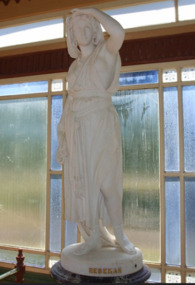 City of Ballarat
Artwork, other - Public Artwork, Rebekah by Charles Summers, Circa 1885
... The Pavilion, designed by the major Ballarat architect T.E. Molloy, is unusual for its top-lit central lantern and curved roofs. ...Rebekah was designed and carved by Charles Francis Summers, one of five white marble statues housed in the Statuary Pavilion, Ballarat Botanical Gardens.The Pavilion and its statues were unveiled in 1888 by Premier Duncan Gillies, a former colleague of James Russell Thompson whose bequest to the City enabled the purchase, in Italy, of the statues. The Flight from Pompeii and the four accompanying statues are housed in the Statuary Pavilion in the Ballarat Botanical Gardens. The Flight from Pompeii, in the centre, was designed by Professor Carlo Benzoni and carved by Charles Francis Summers while the four accompanying statues were all designed and carved by Charles Francis Summers. The octagonal Pavilion was specially designed by T.E. Molloy in 1887 to house the statuary. The five statues and Pavilion are believed to be unique in Australia. The Flight from Pompeii, Modesty, Rebekah, Ruth and Susannah are aesthetically significant as they are a group of statues, which are a fine example of the design of Professor G.M. Benzoni [Flight from Pompeii] and the design and carving of Charles Francis Summers. The carving of the Flight from Pompeii is both sensitive and finely done and both the design and carving of Modesty, Rebekah, Ruth and Susannah is sensitive and delicate with great attention to detail. The group is historically important as it epitomises the 'beautification' of the city in the 1880s by men who made their money from gold and who wished to give to the city money for projects such the statuary Pavilion and its contents. The Flight from Pompeii group is located in the Botanical Gardens, which were then also being developed in the Victorian style. This also illustrates the social feeling of the time in which the wealthy had made their money and were wanting to develop in a most substantial way, as well as to 'beautify' the city in which they lived. The Pavilion, designed by the major Ballarat architect T.E. Molloy, is unusual for its top-lit central lantern and curved roofs. The statues are seen to their best advantage because of the provision of all-round and top natural lighting. Classified: 03/03/2003 Victorian Heritage Database. White marble statue of a woman standing with left arm raised to her head and draped in cloth to form a robe tied at the front.Rebekah
