
Showing 8 items matching "tablecloth and napkins"
-
 Flagstaff Hill Maritime Museum and Village
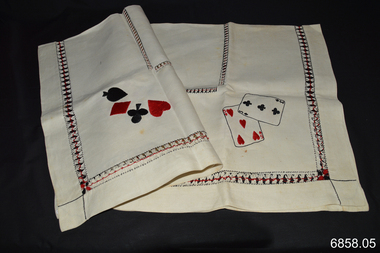
Tablecloth and Napkins, early to mid 1900's
... This tablecloth and napkins set was donated to Flagstaff Hill Maritime Village by the family of Doctor William Roy Angus, Surgeon and Oculist. ...Tablecloth and napkins (4) set. White linen tablecloth with red and black embroidered playing cards on all pieces and drawn thread work borders. ...Angus Collection. Tablecloth and Napkins ...This tablecloth and napkins set was donated to Flagstaff Hill Maritime Village by the family of Doctor William Roy Angus, Surgeon and Oculist. It is part of the “W.R. Angus Collection” that includes historical medical equipment, surgical instruments and material once belonging to Dr Edward Ryan and Dr Thomas Francis Ryan, (both of Nhill, Victoria) as well as Dr Angus’ own belongings. The Collection’s history spans the medical practices of the two Doctors Ryan, from 1885-1926 plus that of Dr Angus, up until 1969. ABOUT THE “W.R.ANGUS COLLECTION” Doctor William Roy Angus M.B., B.S., Adel., 1923, F.R.C.S. Edin.,1928 (also known as Dr Roy Angus) was born in Murrumbeena, Victoria in 1901 and lived until 1970. He qualified as a doctor in 1923 at University of Adelaide, was Resident Medical Officer at the Royal Adelaide Hospital in 1924 and for a period was house surgeon to Sir (then Mr.) Henry Simpson Newland. Dr Angus was briefly an Assistant to Dr Riddell of Kapunda, then commenced private practice at Curramulka, Yorke Peninsula, SA, where he was physician, surgeon and chemist. In 1926, he was appointed as new Medical Assistant to Dr Thomas Francis Ryan (T.F. Ryan, or Tom), in Nhill, Victoria, where his experiences included radiology and pharmacy. In 1927 he was Acting House Surgeon in Dr Tom Ryan’s absence. Dr Angus had become engaged to Gladys Forsyth and they decided he further his studies overseas in the UK in 1927. He studied at London University College Hospital and at Edinburgh Royal Infirmary and in 1928, was awarded FRCS (Fellow from the Royal College of Surgeons), Edinburgh. He worked his passage back to Australia as a Ship’s Surgeon on the on the Australian Commonwealth Line’s T.S.S. Largs Bay. Dr Angus married Gladys in 1929, in Ballarat. (They went on to have one son (Graham 1932, born in SA) and two daughters (Helen (died 12/07/1996) and Berenice (Berry), both born at Mira, Nhill ) According to Berry, her mother Gladys made a lot of their clothes. She was very talented and did some lovely embroidery including lingerie for her trousseau and beautifully handmade baby clothes. Dr Angus was a ‘flying doctor’ for the A.I.M. (Australian Inland Ministry) Aerial Medical Service in 1928 . Its first station was in the remote town of Oodnadatta, where Dr Angus was stationed. He was locum tenens there on North-South Railway at 21 Mile Camp. He took up this ‘flying doctor’ position in response to a call from Dr John Flynn; the organisation was later known as the Flying Doctor Service, then the Royal Flying Doctor Service. A lot of his work during this time involved dental surgery also. Between 1928-1932 he was surgeon at the Curramulka Hospital, Yorke Peninsula, South Australia. In 1933 Dr Angus returned to Nhill and purchased a share of the Nelson Street practice and Mira hospital (a 2 bed ward at the Nelson Street Practice) from Dr Les Middleton one of the Middleton Brothers, the current owners of what previously once Dr Tom Ryan’s practice. Dr Tom and his brother had worked as surgeons included eye surgery. Dr Tom Ryan performed many of his operations in the Mira private hospital on his premises. He had been House Surgeon at the Nhill Hospital 1902-1926. Dr Tom Ryan had one of the only two pieces of radiology equipment in Victoria during his practicing years – The Royal Melbourne Hospital had the other one. Over the years Dr Tom Ryan had gradually set up what was effectively a training school for country general-practitioner-surgeons. Each patient was carefully examined, including using the X-ray machine, and any surgery was discussed and planned with Dr Ryan’s assistants several days in advance. Dr Angus gained experience in using the X-ray machine there during his time as assistant to Dr Ryan. When Dr Angus bought into the Nelson Street premises in Nhill he was also appointed as the Nhill Hospital’s Honorary House Surgeon 1933-1938. His practitioner’s plate from his Nhill surgery is now mounted on the doorway to the Port Medical Office at Flagstaff Hill Maritime Village, Warrnambool. When Dr Angus took up practice in the Dr Edward and Dr Tom Ryan’s old premises he obtained their extensive collection of historical medical equipment and materials spanning 1884-1926. A large part of this collection is now on display at the Port Medical Office at Flagstaff Hill Maritime Village in Warrnambool. In 1939 Dr Angus and his family moved to Warrnambool where he purchased “Birchwood,” the 1852 home and medical practice of Dr John Hunter Henderson, at 214 Koroit Street. (This property was sold in1965 to the State Government and is now the site of the Warrnambool Police Station. and an ALDI sore is on the land that was once their tennis court). The Angus family was able to afford gardeners, cooks and maids; their home was a popular place for visiting dignitaries to stay whilst visiting Warrnambool. Dr Angus had his own silk worm farm at home in a Mulberry tree. His young daughter used his centrifuge for spinning the silk. Dr Angus was appointed on a part-time basis as Port Medical Officer (Health Officer) in Warrnambool and held this position until the 1940’s when the government no longer required the service of a Port Medical Officer in Warrnambool; he was thus Warrnambool’s last serving Port Medical Officer. (Masters of immigrant ships arriving in port reported incidents of diseases, illness and death and the Port Medical Officer made a decision on whether the ship required Quarantine and for how long, in this way preventing contagious illness from spreading from new immigrants to the residents already in the colony.) Dr Angus was a member of the Australian Medical Association, for 35 years and surgeon at the Warrnambool Base Hospital 1939-1942, He served as a Surgeon Captain during WWII1942-45, in Ballarat, Victoria, and in Bonegilla, N.S.W., completing his service just before the end of the war due to suffering from a heart attack. During his convalescence he carved an intricate and ‘most artistic’ chess set from the material that dentures were made from. He then studied ophthalmology at the Royal Melbourne Eye and Ear Hospital and created cosmetically superior artificial eyes by pioneering using the intrascleral cartilage. Angus received accolades from the Ophthalmological Society of Australasia for this work. He returned to Warrnambool to commence practice as an ophthalmologist, pioneering in artificial eye improvements. He was Honorary Consultant Ophthalmologist to Warrnambool Base Hospital for 31 years. He made monthly visits to Portland as a visiting surgeon, to perform eye surgery. He represented the Victorian South-West subdivision of the Australian Medical Association as its secretary between 1949 and 1956 and as chairman from 1956 to 1958. In 1968 Dr Angus was elected member of Spain’s Barraquer Institute of Barcelona after his research work in Intrasclearal cartilage grafting, becoming one of the few Australian ophthalmologists to receive this honour, and in the following year presented his final paper on Living Intrasclearal Cartilage Implants at the Inaugural Meeting of the Australian College of Ophthalmologists in Melbourne In his personal life Dr Angus was a Presbyterian and treated Sunday as a Sabbath, a day of rest. He would visit 3 or 4 country patients on a Sunday, taking his children along ‘for the ride’ and to visit with him. Sunday evenings he would play the pianola and sing Scottish songs to his family. One of Dr Angus’ patients was Margaret MacKenzie, author of a book on local shipwrecks that she’d seen as an eye witness from the late 1880’s in Peterborough, Victoria. In the early 1950’s Dr Angus, painted a picture of a shipwreck for the cover jacket of Margaret’s book, Shipwrecks and More Shipwrecks. She was blind in later life and her daughter wrote the actual book for her. Dr Angus and his wife Gladys were very involved in Warrnambool’s society with a strong interest in civic affairs. He had an interest in people and the community They were both involved in the creation of Flagstaff Hill, including the layout of the gardens. After his death (28th March 1970) his family requested his practitioner’s plate, medical instruments and some personal belongings be displayed in the Port Medical Office surgery at Flagstaff Hill Maritime Village, and be called the “W. R. Angus Collection”. The W.R. Angus Collection is significant for still being located at the site it is connected with, Doctor Angus being the last Port Medical Officer in Warrnambool. The collection of medical instruments and other equipment is culturally significant, being an historical example of medicine from late 19th to mid-20th century. Dr Angus assisted Dr Tom Ryan, a pioneer in the use of X-rays and in ocular surgery. Tablecloth and napkins (4) set. White linen tablecloth with red and black embroidered playing cards on all pieces and drawn thread work borders. Card table sized cloth. Part of the W.R. Angus Collection.flagstaff hill, warrnambool, shipwrecked coast, flagstaff hill maritime museum, maritime museum, shipwreck coast, flagstaff hill maritime village, great ocean road, dr w r angus, tablecloth and napkins, tablecloth set with playing cards motif, table linen, manchester -
 Whitehorse Historical Society Inc.
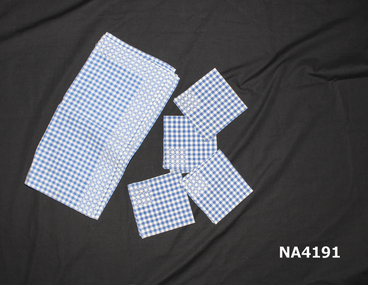
Textile - Table Cloth and Napkins
... Blue and white check gingham 84 cm square Tablecloth, decorated with 4 rows of white cross stitch around borders.Four matching 26cm square matching table napkins....domestic items table setting Blue and white check gingham 84 cm square Tablecloth, decorated with 4 rows of white cross stitch around borders.Four matching 26cm square matching table napkins. ...Blue and white check gingham 84 cm square Tablecloth, decorated with 4 rows of white cross stitch around borders.Four matching 26cm square matching table napkins.domestic items, table setting -
 Kew Historical Society Inc
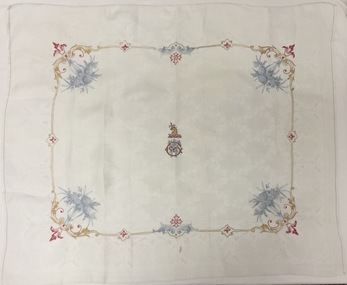
Textile, Damask Tablecloth embroidered with the Greenlaw Crest, 1882-1890
... Small white damask tablecloth or napkin embroidered with the crest of William Greenlaw, the owner of Villa Alba in Walmer Street, Kew. ...This rare textile is associated with the most significant period of Villa Alba's history and is an example of the colonial aspirations of its citizens in the boom years of the 1880s before the crash that engulfed the owner. villa alba william greenlaw tablecloths Greenlaw crest - griffin holding thistle in beak over initials WG Small white damask tablecloth or napkin embroidered with the crest of William Greenlaw, the owner of Villa Alba in Walmer Street, Kew. ...When the newly married William and Anna Maria Greenlaw acquired the property in 1862, an existing house known as Studley Villa stood on the land. John Hodgson probably built the latter soon after he bought three portions of land here in 1853. The Greenlaws changed the name of the residence to Villa Alba in about 1870 and in 1882-84 rebuilt the house to create the present mansion. After William Greenlaw’s death in 1895, John Ballinger rented the house until 1914. The lease then passed to Samuel and Esther Fripp, who went on to purchase the property in 1918 after Anna Maria Greenlaw’s death in 1918.This rare textile is associated with the most significant period of Villa Alba's history and is an example of the colonial aspirations of its citizens in the boom years of the 1880s before the crash that engulfed the owner.Small white damask tablecloth or napkin embroidered with the crest of William Greenlaw, the owner of Villa Alba in Walmer Street, Kew. The embroidery of the crest and borders of garlands are completed in multicoloured silk thread.Greenlaw crest - griffin holding thistle in beak over initials WGvilla alba, william greenlaw, tablecloths -
 Mont De Lancey
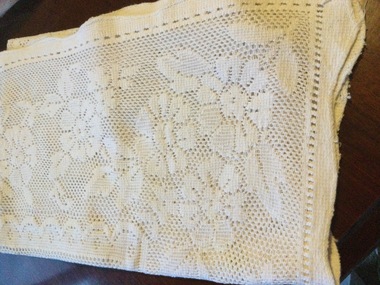
Textile - Tablecloth, Unknown
... Tablecloths were used to protect the table from damage when in use with cutlery, chinaware and general use. ...Included were napkins, bed linens, tea towels and various cloths for every household function and were to sustain the bride and her future family throughout their lifetime together. tablecloths Cloths Table linen Household textiles A white lace rectangular tablecloth with a floral pattern and wide scalloped edge. ...Tablecloths were used to protect the table from damage when in use with cutlery, chinaware and general use. More decorative white cloths were used for special occasions and to show general position in society or wealth. The trousseau of a young woman in the 1900's consisted essentially of how many tablecloths she had collected - her dowry in many ways showed the more linen she had the wealthier she was. Included were napkins, bed linens, tea towels and various cloths for every household function and were to sustain the bride and her future family throughout their lifetime together.A white lace rectangular tablecloth with a floral pattern and wide scalloped edge.tablecloths, cloths, table linen, household textiles -
 Musculoskeletal Health Australia (now held by the Glen Eira Historical Society)
Photograph - Group photo, 22/04/2004
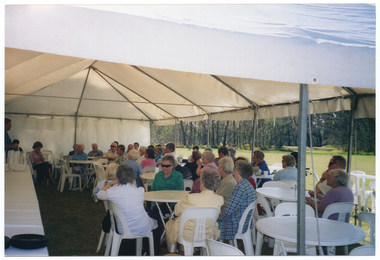
... In the foreground, on one side of the man speaking, there is a long rectangular table covered with a white tablecloth. On top of the table, at the far end, there are stacked glasses and polystyrene cups, and some paper napkins. ...In the foreground, on one side of the man speaking, there is a long rectangular table covered with a white tablecloth. On top of the table, at the far end, there are stacked glasses and polystyrene cups, and some paper napkins. ...On Thursday the 22nd of April, as part of National Arthritis Week (NAW) 2004, Arthritis Victoria held an Eastern Regional Seminar and Luncheon at Jells Park in Wheelers Hill. In this photo, an unidentified man addresses attendees at the seminar.COL wide frame, side view photo of a man (partially obscured) standing in a large marquee, speaking to a group of people. He is in the background of the photo, at the edge of the left hand side of the frame. The group is sitting on white plastic chairs at a white plastic tables. In the foreground, on one side of the man speaking, there is a long rectangular table covered with a white tablecloth. On top of the table, at the far end, there are stacked glasses and polystyrene cups, and some paper napkins. On top of the table, in the foreground, there are two stacks of black plasctic plates. The internal metal frame of the white marquee in which they are located is evident. In the background, outside of the marquee, there is a large park with several trees.[Handwritten in pencil] Jells Park NAWarthritis foundation of victoria, afv, arthritis victoria, av, national arthritis week, naw, eastern regional, seminar, guest speakers, education, information, support, research, advocacy, luncheon, jells park, wheelers hill, 2004 -
 Flagstaff Hill Maritime Museum and Village
Clothing - Apron, circa late19th to early 20th Century
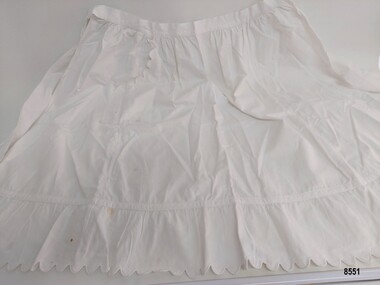
... The word "apron" comes from the old French word "naperon" which means a napkin or small tablecloth. This apron is one of two similar aprons that were donated from the estate of Susan Henry nee Vedmore (1944 - 2021). ...The word "apron" comes from the old French word "naperon" which means a napkin or small tablecloth. This apron is one of two similar aprons that were donated from the estate of Susan Henry nee Vedmore (1944 - 2021). ...An apron is an outer protective garment worn over clothes to cover the front of the body. In Victorian and Edwardian times, women were using aprons for both utility (they were easier to wash than dresses) and fashion and women's magazines and pattern companies were offering patterns to allow women to be to sew their own aprons at home. There are different styles of aprons including bib aprons, waist or half aprons, pinafores, tabards and pinner aprons. The word "apron" comes from the old French word "naperon" which means a napkin or small tablecloth. This apron is one of two similar aprons that were donated from the estate of Susan Henry nee Vedmore (1944 - 2021). It is in very good condition and appears to be more decorative (and possibly used only on special occasions) rather than everyday wear. Susan's family (Harold and Gladys Vedmore) immigrated to Australia from Wales in 1955 and settled in Warrnambool. Susan was well known in the Warrnambool community for her work supporting children and families across the district - particular those with disabilities, or those who were homeless, unemployed or isolated. Susan was the founding trustee of the "Vedmore Foundation" - a Warrnambool philanthropic trust set up in 2010 to support a range of charitable and not-for-profit causes by providing grant assistance. In 2021, she was awarded a Medal of the Order of Australia for services to the community.This item is an example of clothing worn by working women in the late 19th and early 20th centuryShort white cotton apron featuring gathering along the waist band and a gathered frill with scalloped edging along the bottom. The scalloped trim is repeated on the edge of a single pocket on the right hand side. It has ties attached to both ends of the waist band and the main body of the apron is made of of three rectangular pieces of cotton joined with french seams.warrnambool, great ocean road, textiles, lady's garment, apron, parlour apron, waitress apron, half apron, waist apron, handmade, domestic clothing, domestic work, vedmore foundation, susan henry oam -
 Flagstaff Hill Maritime Museum and Village
Clothing - Apron, circa late19th to early 20th Century
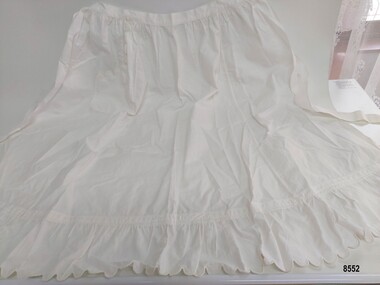
... The word "apron" comes from the old French word "naperon" which means a napkin or small tablecloth. This apron is one of two similar aprons that were donated from the estate of Susan Henry nee Vedmore (1944 - 2021). ...The word "apron" comes from the old French word "naperon" which means a napkin or small tablecloth. This apron is one of two similar aprons that were donated from the estate of Susan Henry nee Vedmore (1944 - 2021). ...An apron is an outer protective garment worn over clothes to cover the front of the body. In Victorian and Edwardian times, women were using aprons for both utility (they were easier to wash than dresses) and fashion and women's magazines and pattern companies were offering patterns to allow women to be to sew their own aprons at home. There are different styles of aprons including bib aprons, waist or half aprons, pinafores, tabards and pinner aprons. The word "apron" comes from the old French word "naperon" which means a napkin or small tablecloth. This apron is one of two similar aprons that were donated from the estate of Susan Henry nee Vedmore (1944 - 2021). It is in very good condition and appears to be more decorative (and possibly used only on special occasions) rather than everyday wear. Susan's family (Harold and Gladys Vedmore) immigrated to Australia from Wales in 1955 and settled in Warrnambool. Susan was well known in the Warrnambool community for her work supporting children and families across the district - particular those with disabilities, or those who were homeless, unemployed or isolated. Susan was the founding trustee of the "Vedmore Foundation" - a Warrnambool philanthropic trust set up in 2010 to support a range of charitable and not-for-profit causes by providing grant assistance. In 2021, she was awarded a Medal of the Order of Australia for services to the community.This item is an example of clothing worn by working women in the late 19th and early 20th century Long white cotton apron featuring gathering along the waist band and a gathered frill with scalloped edging along the bottom. The scalloped trim is repeated on the edge of a single pocket on the right hand side. It has ties attached to both ends of the waist band and the main body of the apron is made of of three rectangular pieces of cotton joined with french seams.warrnambool, great ocean road, ladies' garment, apron, half apron, waist apron, domestic clothing, domestic work, parlour apron, waitress apron, handmade, sewing, vedmore foundation, susan henry oam -
 Embroiderers Guild, Victoria
Textile - Organdie Applique Cloth
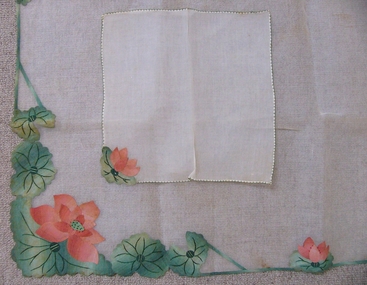
... Embroidery Tablecloths Napkins China Applique Label: Made in China Cream organza supper cloth and 4 matching serviettes. ...Cream organza supper cloth and 4 matching serviettes. Cloth has a hand appliqued design of waterlilies in salmon pinks and greens in each corner. The serviettes have a small waterlily in one corner, and a rolled buttonholed edge.Label: Made in Chinaembroidery, tablecloths, napkins, china, applique
