
Showing 10 items matching "tailplane design"
-
 Moorabbin Air Museum
Book - Aircraft design, Synthesis of Subsonic Airplane Design
... ...Tailplane design...Aircraft design General aspects of aircraft configuration development General arrangement Fuselage design Subsonic engine technology Design for performance Choice of engine/propeller & powerplant installation Wing design Airplane weight & balance Tailplane design Undercarriage Aerodynamic & operational characteristics Presentation of a preliminary design Introduction to preliminary design of subsonic general aviation & transport aircraft, circa 1976 Synthesis of Subsonic Airplane Design Book Aircraft design ...Introduction to preliminary design of subsonic general aviation & transport aircraft, circa 1976non-fictionIntroduction to preliminary design of subsonic general aviation & transport aircraft, circa 1976general aspects of aircraft configuration development, general arrangement, fuselage design, subsonic engine technology, design for performance, choice of engine/propeller & powerplant installation, wing design, airplane weight & balance, tailplane design, undercarriage, aerodynamic & operational characteristics, presentation of a preliminary design -
 Australian Gliding Museum
Machine - Glider – Sailplane, 1940
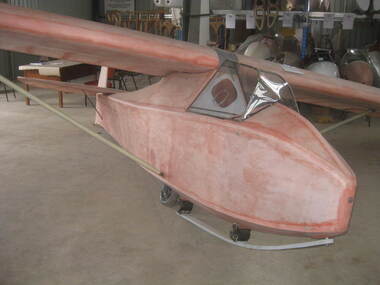
... designed and built glider similar in some respects to the Hutter H17. Its usage is relevant to the history of gliding in Victoria in the post war years. Also the aircraft provides an insight into gliding technology in Australia in the 1940s. australian gliding glider sailplane coogee tom proctor victorian motorless flight group geelong gliding club Wood and fabric single seat glider sailplane with strutted wings and strutted tailplane – features metal framed perspex canopy, central fuselage skid and wheel, small tail skid, instruments include airspeed, turn and bank indicator; variometer and altimeter. ...The “Coogee” is an intermediate single seat sailplane designed and built by Tom Proctor in 1940. Only one was built. It was first flown at Stuart Hill near Bendigo Victoria in January 1941 and was maintained in flying condition until 1967. The aircraft was flown extensively by the Victorian Motorless Flight Group (now the Melbourne Gliding Club) and Geelong Gliding Club and several subsequent owners. This exhibit is a "one off" Australian designed and built glider similar in some respects to the Hutter H17. Its usage is relevant to the history of gliding in Victoria in the post war years. Also the aircraft provides an insight into gliding technology in Australia in the 1940s. Wood and fabric single seat glider sailplane with strutted wings and strutted tailplane – features metal framed perspex canopy, central fuselage skid and wheel, small tail skid, instruments include airspeed, turn and bank indicator; variometer and altimeter. Metal parts include struts and fairing covering wing joint. All surfaces are pink doped – awaiting painting.australian gliding, glider, sailplane, coogee, tom proctor, victorian motorless flight group, geelong gliding club -
 Australian Gliding Museum
Machine - Glider – Sailplane, 1949
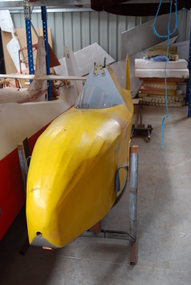
... design that became a popular choice for home building in the post war years in Australia when gliding as a sport was in recovery. Some examples are still flying. australian gliding glider sailplane hutter sweetwings fleetwings reichelt riley wynne milligan Small single seat glider. Fuselage and wing struts are painted yellow. Wings, rudder and tailplane ...The Hutter H17 is a small single seat glider with a wing span of 9.69 metres, designed in 1934 by Wolfgang Hutter, for flying in the Austrian Alps. Construction of the museum’s example, “Sweetwings” (now registered as VH-GQM), commenced in Perth in 1949. It is one of two Hutter H17 gliders built in Western Australia by N.J. Wynne and A.G. Milligan at the time – the other “Fleetwings” (formerly VH-HDQ and since re-registered as VH-GXV) is located at Millicent, South Australia. Ownership transferred to G.R. Reichelt of Tocumwal New South Wales and later to D.B. Hunt of Thornbury in Melbourne and later Mt Isa, Queensland. It was acquired by Bill Riley of Tocumwal who donated it to the Museum. The glider was last flown on 25 October 1979 at Tocumwal. This exhibit is an example of a 1930s small wood and fabric glider that was designed in Austria for hill soaring. It is a simple design that became a popular choice for home building in the post war years in Australia when gliding as a sport was in recovery. Some examples are still flying.Small single seat glider. Fuselage and wing struts are painted yellow. Wings, rudder and tailplane / elevator are primed with pink dope. It has an open cockpit with small clear Perspex wind screen. Instruments include airspeed indicator and altimeter tucked neatly under front edge of the cockpit rim.australian gliding, glider, sailplane, hutter, sweetwings, fleetwings, reichelt, riley, wynne, milligan -
 Australian Gliding Museum
Machine - Glider – Sailplane, 1969
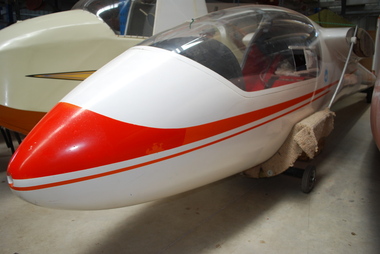
... Early fibreglass design that was manufactured in numbers. australian gliding glider sailplane bolkow phoebus cohn nagele linder eppler Serial number 866 on plate affixed inside cockpit – registration VH-GSW which has been painted on the sides of the fuselage rear of the wings. A Freistaat Bayern crest has been applied to each side of the vertical stabilizer. The Phoebus is a modern looking single seat glass fibre sailplane with a ‘T’ tailplane ...The Phoebus is a fibreglass composite sailplane that was designed by H. Nagele, R. Linder and R. Eppler in the early 1960s for competition flying. It is a derivative from the Akaflieg Stuttart Phonix which was the first sailplane to be built of fibreglass. The first Phoebus, a Standard Class design with a 15 metre wingspan, flew in 1964. The Phoebus C is the open class version of the type that was introduced in 1967. It has a 17 metre wing span, retractable wheel and tail brake parachute. Several hundred Phoebus sailplanes (all versions) were made by the manufacturer Bolkow at Ottobrun in Germany before production ended in 1970. The Museum’s Phoebus C, serial number 866, was built in 1969. It was donated to the Museum by Ian Cohn in 2008. Early fibreglass design that was manufactured in numbers. The Phoebus is a modern looking single seat glass fibre sailplane with a ‘T’ tailplane. It is finished in white with light red detailing including thin red stripe on wings and some red striping on fuselage sides from nose to underneath wings.Serial number 866 on plate affixed inside cockpit – registration VH-GSW which has been painted on the sides of the fuselage rear of the wings. A Freistaat Bayern crest has been applied to each side of the vertical stabilizer. australian gliding, glider, sailplane, bolkow, phoebus, cohn, nagele, linder, eppler -
 Australian Gliding Museum
Machine - Glider – Sailplane, 1967
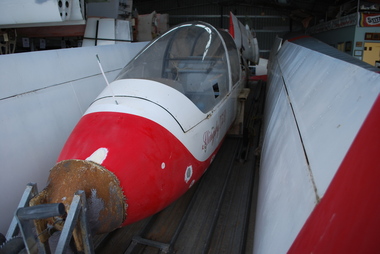
... designed by J. Sellars in the 1960s as an easily maintained two seat trainer suitable for RAF Air Training Corp use and for sale in the USA and Australian markets where wooden gliders were becoming less popular. The Slingsby T53 prototype first flew in 1967. The T53B version has a conventional fixed tailplane...designed by J. Sellars in the 1960s as an easily maintained two seat trainer suitable for RAF Air Training Corp use and for sale in the USA and Australian markets where wooden gliders were becoming less popular. The Slingsby T53 prototype first flew in 1967. The T53B version has a conventional fixed tailplane ...The Slingsby T53 glider was designed by J. Sellars in the 1960s as an easily maintained two seat trainer suitable for RAF Air Training Corp use and for sale in the USA and Australian markets where wooden gliders were becoming less popular. The Slingsby T53 prototype first flew in 1967. The T53B version has a conventional fixed tailplane with elevator instead of the all-moving tailplane of the original type. The “B” version also has ailerons of narrower chord and lacks wing flaps. Further changes were made to the fin (extended above the tailplane) for the final “C” version. Production of the T53 at Slingsby was disrupted by a fire at the factory in 1968. As a consequence the contract to supply 40 of the type to the RAF was cancelled and only a relatively small number (possibly 27) were made by Slingsby before the project was discontinued. The rights were later sold to Yorkshire Sailplanes. It designated the glider as the YS53 Sovereign – only a few were produced (possibly 3). The Australian Gliding Museum’s example is a type “B” model. It bears serial number 1686 and was manufactured in 1967. It was registered in Australia as VH-GUB in name of Boonah Gliding Club, Boonah, which is about 90 kilometres south west of Brisbane in Queensland. Locally it was called “the Bomber”! This exhibit is a representative example of the Slingsby T53 sailplane type. It is a rarity in Australia.All metal twin seat glider / sailplane, painted white with red tips and markings.“Slingsby T53B” on each side of fuselage below cockpit opening; Registration VH-GUB on each side of fuselage at rear.australian gliding, glider, sailplane, slingsby, t53, sellars, boonah gliding club, slocombe, boyle -
 Australian Gliding Museum
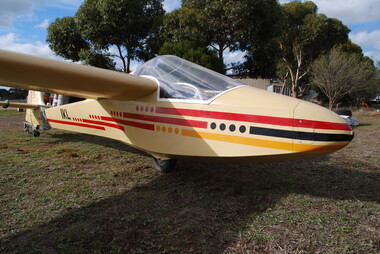
Machine - Glider – Sailplane, 2001
... VH-IKL differs from the original Woodstock 1 design in one respect in that the rear fuselage has been modified to enable the tailplane to be removed for de-rigging. ...VH-IKL differs from the original Woodstock 1 design in one respect in that the rear fuselage has been modified to enable the tailplane to be removed for de-rigging. ...This glider type was designed by Jim Maupin in United States in the 1970s. The prototype first flew in 1978. It is a design intended as suitable for amateur construction using wood (principally Douglas Fir and Birch plywood). It is understood that hundreds of sets of plans have been sold. It is not known how many Woodstocks have been built but there are at least 3 flyable examples in existence in Australia. Over time the design has been altered increasing the wingspan from 11.9 metres to 12.6 metres and then to 13.1 metres for Types 1, 2 and 3 respectively. Some builders of Woodstock gliders have also made their own changes to the Jim Maupin design. The construction of the Museum’s Woodstock (a “Woodstock 1”) was commenced by Ken Davies who, due to age related health difficulties, was unable to finish the project. The project was taken over by James Garay and was completed in 2001. It is registered with the Gliding Federation of Australia as GFA/HB123 and allocated letters VH-IKL. It is practically a new aircraft with very few flying hours logged. VH-IKL differs from the original Woodstock 1 design in one respect in that the rear fuselage has been modified to enable the tailplane to be removed for de-rigging. The Museum holds technical drawings prepared by Ken Davies in relation to this feature of the glider. James Garay kindly donated VH-IKL to the Australian Gliding Museum in March 2013. An example of a successful glider-sailplane design for amateur construction from the 1970s.Home built single seat sailplane of wooden construction finished in a light desert sand colour with aboriginal art theme markings.Marked with registration – VH-IKLaustralian gliding, glider, sailplane, woodstock, maupin, davies, garay, woody roo -
 Australian Gliding Museum
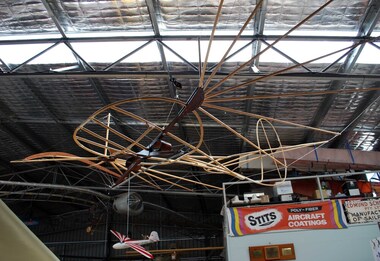
Equipment - Glider – Hang Glider Type, 2013 - 2014
... The Lilienthal design apparently had a tendency to pitch down and a tailplane was added to mitigate this problem. ...The Lilienthal design apparently had a tendency to pitch down and a tailplane was added to mitigate this problem. ...Otto Lilienthal (1848-1896) from Berlin, Germany, is widely credited as being the first person to make repeated successful gliding flights. He was known for adopting a thorough scientific approach founded on observations of the flight of birds in relation to the problem of inventing a man carrying heavier than air machine that would fly. He developed and tested bird-like gliders controlled by weight shift by the pilot (a similar method to modern hang gliders). The pilot held on to the glider with his forearms resting in hoops mounted on the main structural beam connecting the wings. The weight shift was achieved by the pilot swinging his trunk and legs. In contrast, the pilot of a modern hang glider is suspended below the glider and, with the use of an A-frame, allows the whole body to be moved around to achieve control. The Lilienthal design apparently had a tendency to pitch down and a tailplane was added to mitigate this problem. Lilienthal flew from hills in the Rhinow region and from a conical hill he built near Berlin. He made over 2000 flights. Importantly, for others seeking to progress manned flight at the time and also for the historical record, reports of Lilienthal’s flights (some with photographs) were published and Lilienthal detailed his experiences and corresponded with other flight pioneers. Lilienthal’s work became well known and influenced Orville and Wilbur Wright in their initial experiments with gliders in 1899 (although in their quest to design and fly an aeroplane they relied on new data created by wind tunnel testing). The replica built by Bruce Hearn is of the 1893 Lilienthal glider. It is very similar to the “Normal-Segalapparat” (Normal Glider) for which patent protection was later granted a few years later. The Lilienthal replica glider is an important addition to the AGM collection as it represents the beginning of successful gliding flight. Hang glider made of wood with wire bracing – yet to be covered with authentic cotton fabric. The glider has a small plate with identification details including name of builder (Bruce Hearn) glider, hang glider, lilienthal, hearn, replica -
 Australian Gliding Museum
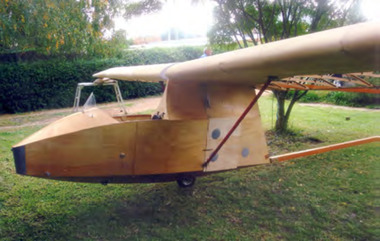
Machine - Glider – Sailplane, 2015
... tailplane were changes adopted for the “Salamandra 53”. An export version designated “53A” was sold to and built under licence in China. Production of the Salamandra ceased in the early 1960s. Total production may have been in excess of 500. The glider was well regarded as a light weight trainer capable of soaring performance. The Museum’s replica was built by Ray Ash and may be may be classified as a “Salamandra 53”. However, he has added something of his own to the design...tailplane were changes adopted for the “Salamandra 53”. An export version designated “53A” was sold to and built under licence in China. Production of the Salamandra ceased in the early 1960s. Total production may have been in excess of 500. The glider was well regarded as a light weight trainer capable of soaring performance. The Museum’s replica was built by Ray Ash and may be may be classified as a “Salamandra 53”. However, he has added something of his own to the design ...The Salamandra is a Polish glider designed by Waclaw Czerwinski at the Military Glider Workshops in Krakow in 1936. This glider, designated “W.W.S.1”, was produced in substantial numbers prior to the second world war and used in Poland and some other eastern European countries for training pilots. Only one example survived the war, hidden away in the village of Goleszow in Silesia. In addition, no technical drawings could be found, so when the glider was discovered, the Gliding Institute being keen to re-establish gliding in Poland, used the glider to draw up new plans for construction. Five were built for the Institute in 1947 before production was resumed of the “Salamandra 48” at the SZD Jezow Workshops. Improvement were made by adding airbrakes and structural changes for the “Salamandra 49” and a windscreen and larger tailplane were changes adopted for the “Salamandra 53”. An export version designated “53A” was sold to and built under licence in China. Production of the Salamandra ceased in the early 1960s. Total production may have been in excess of 500. The glider was well regarded as a light weight trainer capable of soaring performance. The Museum’s replica was built by Ray Ash and may be may be classified as a “Salamandra 53”. However, he has added something of his own to the design by replacing the cable runs in the wings with control rods. The glider is substantially complete. The wings and tail / rudder surfaces have been covered with poly-fibre fabric. The fuselage woodwork is sealed with varnish. In addition to the finishing work (including painting) and rigging of the main components, the linkages for Ray’s control rod modification may need further engineering to make them operational. The Ray Ash Salamandra is the first of the type to appear in Australia. The Salamandra did not play any role in the development of gliding in Australia in the early years. However, it is an important exhibit in that it shows in tangible form a nacelle fuselage training glider in configuration and construction detail. As such it revisits the pioneering era of the 1930s and 1940s in Australia when wood, wire and fabric were the rule and the nacelle primary glider was generally the first step up for pilots who had mastered the basics in an open primary.Nacelled solo training glider of traditional wood and fabric construction. Construction incomplete.Noneaustralian gliding, sailplane, glider, salamandra, czerwinshi, poland, ash -
 Australian Gliding Museum
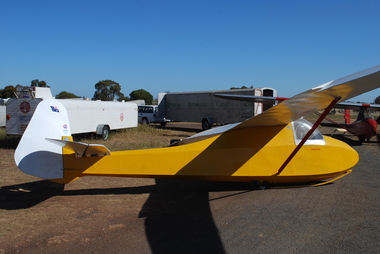
Machine - Glider - Sailplane, 1937
... The exhibit is of great significance for Australian gliding history – the Golden Eagle is a flyable 1930s aircraft in excellent condition that was designed and built by an Australian gliding pioneer. australian gliding glider sailplane golden eagle richardson patching vmfg victorian motorless flight group Registration letters “FC” on fuselage nose port side, Australian flag, Vintage Gliders Australia and VMFG decals on rudder, “Golden Eagle” lettering in red on each side of the fuselage below the canopy, Aboriginal flag decal on port side of fuselage below the canopy. Single seat wood and fabric sailplane finished with white wings, tailplane ...The Golden Eagle is an original design by Geoff Richardson. Geoff commenced gliding in the early days of the sport circa 1933 in Melbourne, flying at Coode Island and Mt Frazer. In 1934, he began construction of a secondary type glider but scrapped it upon realizing that a better design was needed. He conducted further research and came up with a sailplane of similar size and general arrangement to the Grunau Baby but with a “Gull” wing using a Gottingen 535 wing section (the same as for the Grunau Baby). Geoff did all the technical calculations himself and even made up and tested a Casein glue for the construction. Geoff competed construction of his new sailplane (which he called the “Golden Eagle”) in 1937 and it was test flown at Laverton at the western edge of Melbourne in September 1937. On the same day, at Laverton, the Gliding Club of Victoria flew its new Grunau Baby 2 sailplane which it had imported as a finished machine from Edmund Schneider in Germany. The Golden Eagle was found to fly well, having a similar performance to the Grunau Baby. In the 1950s, the Golden Eagle was modified by rebuilding the front of the fuselage to enclose the cockpit with a Perspex canopy. A landing wheel was incorporated behind the skid. Spoilers were added to the wings and a trim tab to the elevators. The Golden Eagle has been flown with the VMFG (Victorian Motorless Flight Group) for most of its long life. When donated to the Australian Gliding Museum in 2016 by Alan Patching it was probably the oldest, continuously airworthy glider in the world. Having regard to the historical significance of the Golden Eagle, the Museum has decided to not to fly it anymore to avoid risk of loss or damage. The exhibit is of great significance for Australian gliding history – the Golden Eagle is a flyable 1930s aircraft in excellent condition that was designed and built by an Australian gliding pioneer. Single seat wood and fabric sailplane finished with white wings, tailplane and rudder and yellow fuselage Registration letters “FC” on fuselage nose port side, Australian flag, Vintage Gliders Australia and VMFG decals on rudder, “Golden Eagle” lettering in red on each side of the fuselage below the canopy, Aboriginal flag decal on port side of fuselage below the canopy. australian gliding, glider, sailplane, golden eagle, richardson, patching, vmfg, victorian motorless flight group -
Moorabbin Air Museum
Photograph (Item) - 14 Photos of CAC Boomerangs including Modified Experimental Variants, Keith Meggs Collection 14x CAC Boomerang Photos, Circa 1944
... This appears to be an experimental variant fitted with a turbo-supercharger and a tailplane closely resembling the P-51 Mustang. This represents the CAC's attempts to improve the Boomerang design before settling on license-building the Mustang....This appears to be an experimental variant fitted with a turbo-supercharger and a tailplane closely resembling the P-51 Mustang. This represents the CAC's attempts to improve the Boomerang design before settling on license-building the Mustang. ...Photos are of several Boomerangs, but mostly concern A46-1001. This appears to be an experimental variant fitted with a turbo-supercharger and a tailplane closely resembling the P-51 Mustang. This represents the CAC's attempts to improve the Boomerang design before settling on license-building the Mustang.
