
Showing 6 items matching "taj mahal hotel"
-
 Returned Nurses RSL Sub-branch
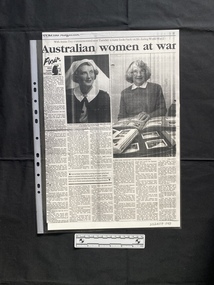
Magazine - Photocopy of magazine clipping, Karen Matthews, Australian women at war, unknown
... ...Taj Mahal Hotel...WWII WW2 World War 2 World War Two Victoria Victoria Barracks St Kilda Rd Epworth Hospital POWs Prisoners of War Vyner Brooke Japanese Banka Island Taj Mahal Hotel Nazareth Tobruk Derna English America Strathalen Columba Singapore British Darwin 10th AGH Spencer St Station Victorian Villa Doug Cornford Moratai A black and white photocopy of a large magazine clipping, consisting of a title, two large photos and six columns of text. ...Betty Duval (now Cornford) decided to sign up with Australia's Defence Forces in February 1941 to have an adventure. Four weeks later she was off to Victoria Dock with all the nurses to head overseas, destination unknown. Betty was onboard the Mauretania, one of the convoy with the HMS Hobart, HM Queen Mary, Aquitania, and New Amsterdam, and a naval escort ship. Soon after leaving Perth the Queen Mary split off for Malaya. Of the sixty-five nursing sisters on board, only twenty-four would ever return to Australia alive. Betty and the Mauretania arrived in Bombay. During the next fourteen months the nurses of the 2/9th Australian General Hospital (AGH) manned hospitals in Palestine and Egypt, depending entirely on the war and troop movements. Early 1942 saw Prime Minister John Curtain order the 6th and 7th Australian divisions withdraw from the Middle East. Betty boarded the [Strathallan], again with destination unknown. Arriving home in Melbourne saw Betty move on to nursing in Adelaide until her unit was to be sent to New Guinea for fifteen months. In 1945 Betty was discharged from the Army and married her sweetheart Doug.A black and white photocopy of a large magazine clipping, consisting of a title, two large photos and six columns of text. Both photos are of the same woman, the smaller one shows her as a young woman in nurse's uniform, the larger shows her present day, as an older woman, looking at photo albums.wwii, ww2, world war 2, world war two, victoria, victoria barracks, st kilda rd, epworth hospital, pows, prisoners of war, vyner brooke, japanese, banka island, taj mahal hotel, nazareth, tobruk, derna, english, america, strathalen, columba, singapore, british, darwin, 10th agh, spencer st station, victorian villa, doug cornford, moratai -
 Bendigo Military Museum
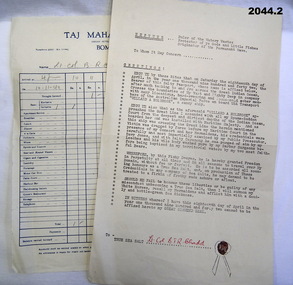
Memorabilia - TRAVEL DOCUMENTS WW2, 1939 - 1940
... Humorous certificate. .2) Receipt from Taj Mahal Hotel, Bombay. Both in name of Lt. Col. ...Humorous certificate. .2) Receipt from Taj Mahal Hotel, Bombay. Both in name of Lt. Col. ...the items belonged to Benjanin Thomas Roy Chadd No's 10594, VX20311, 1st and 2nd AIF. Refer Cat No 2039 for his service history..1) Ceremony of crossing the line (equator). Humorous certificate. .2) Receipt from Taj Mahal Hotel, Bombay. Both in name of Lt. Col. B. R. CHADD2044.1) Name at bottom “Lt. Col. B. T. R. CHADD” 2044.2) Name at top: “Lt. Col. B. R. CHADD, Date 10 Nov 40”documents - certificates, personal effects-travel goods -
 Melbourne Legacy
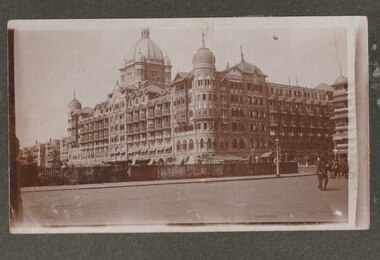
Photograph, Bombay, 1920
... The photo is of the Taj Mahal Palace Hotel, which opened in 1903. There are many photos of Bombay in the album when the Ceramic had a stopover on its way back to the Australia. ...Sepia photo of the Taj Mahal Palace Hotel in Bombay glued to black cardboard in an album of photos from 1920....The photo is of the Taj Mahal Palace Hotel, which opened in 1903. There are many photos of Bombay in the album when the Ceramic had a stopover on its way back to the Australia. ...One photo from an album belonging to JB McLean, of his voyage home from World War 1 in 1920 on the Ceramic. The photo is of the Taj Mahal Palace Hotel, which opened in 1903. There are many photos of Bombay in the album when the Ceramic had a stopover on its way back to the Australia. The Ceramic departed Tillbury, UK 12th March and docked in Freemantle on 27th April 1920 and then went onto Adelaide, Melbourne and Sydney. The Ceramic was a transport vessel built in Belfast in 1913 for the White Star Line to transport frozen produce and apples from Australia to UK. It was taken over by the Australian Government for troop transport in October 1914 and could carry over 3,000 troops. This trip in 1920 there were 1467 on board, there were women and children as well as 439 soldiers returning home, one of whom was John 'Basil' McLean. Was with other World War 1 memorabilia that has come from Private John Basil McLean, 2nd Reinforcements, 37th Battalion, A.I.F. There was a large collection of postcards so he may have been collecting them as souvenirs. J.B. McLean (Service No. 13824) was from near Maffra, Victoria and enlisted on 22 January 1916. He embarked on 16 December 1916 for Europe. His full war record is available from AWM. He spent time with the Australian Field Artillery (Pack Section). At the end of the war he worked for a year at the A.I.F. Headquarters in London before returning to Australia on the 'Ceramic', arriving Portsea in 1920.A collection of items from John Basil McLean is in the archive. Kept as an indication of what founding legatees experienced in World War One and what they saw on the way home.Sepia photo of the Taj Mahal Palace Hotel in Bombay glued to black cardboard in an album of photos from 1920.souvenir, world war one, jb mclean, ship, ceramic, bombay -
 Melbourne Legacy
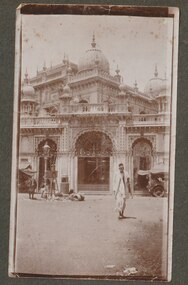
Photograph, Bombay, 1920
... Sepia photo of the Taj Mahal Palace Hotel in Bombay glued to black cardboard in an album of photos from 1920....Kept as an indication of what founding legatees experienced in World War One and what they saw on the way home. souvenir world war one jb mclean ship ceramic bombay Sepia photo of the Taj Mahal Palace Hotel in Bombay glued to black cardboard in an album of photos from 1920. ...Four photos from an album belonging to JB McLean, of his voyage home from World War 1 in 1920 on the Ceramic. The photos show buildings around Bombay. There are many photos of Bombay in the album when the Ceramic had a stopover on its way back to the Australia. The Ceramic departed Tillbury, UK 12th March and docked in Freemantle on 27th April 1920 and then went onto Adelaide, Melbourne and Sydney. The Ceramic was a transport vessel built in Belfast in 1913 for the White Star Line to transport frozen produce and apples from Australia to UK. It was taken over by the Australian Government for troop transport in October 1914 and could carry over 3,000 troops. This trip in 1920 there were 1467 on board, there were women and children as well as 439 soldiers returning home, one of whom was John 'Basil' McLean. Was with other World War 1 memorabilia that has come from Private John Basil McLean, 2nd Reinforcements, 37th Battalion, A.I.F. There was a large collection of postcards so he may have been collecting them as souvenirs. J.B. McLean (Service No. 13824) was from near Maffra, Victoria and enlisted on 22 January 1916. He embarked on 16 December 1916 for Europe. His full war record is available from AWM. He spent time with the Australian Field Artillery (Pack Section). At the end of the war he worked for a year at the A.I.F. Headquarters in London before returning to Australia on the 'Ceramic', arriving Portsea in 1920.A collection of items from John Basil McLean is in the archive. Kept as an indication of what founding legatees experienced in World War One and what they saw on the way home.Sepia photo of the Taj Mahal Palace Hotel in Bombay glued to black cardboard in an album of photos from 1920.souvenir, world war one, jb mclean, ship, ceramic, bombay -
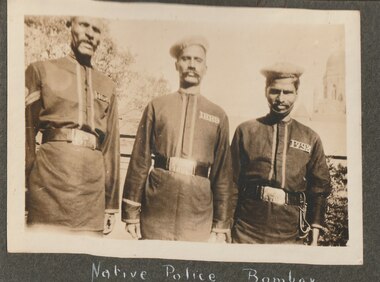 Melbourne Legacy
Photograph, Bombay, 1920
... Sepia photo of the Taj Mahal Palace Hotel in Bombay glued to black cardboard in an album of photos from 1920....Sepia photo of the Taj Mahal Palace Hotel in Bombay glued to black cardboard in an album of photos from 1920. ...One photo from an album belonging to JB McLean, of his voyage home from World War 1 in 1920 on the Ceramic. The photo show three policemen from Bombay in their uniform. There are many photos of Bombay in the album when the Ceramic had a stopover on its way back to the Australia. The Ceramic departed Tillbury, UK 12th March and docked in Freemantle on 27th April 1920 and then went onto Adelaide, Melbourne and Sydney. The Ceramic was a transport vessel built in Belfast in 1913 for the White Star Line to transport frozen produce and apples from Australia to UK. It was taken over by the Australian Government for troop transport in October 1914 and could carry over 3,000 troops. This trip in 1920 there were 1467 on board, there were women and children as well as 439 soldiers returning home, one of whom was John 'Basil' McLean. Was with other World War 1 memorabilia that has come from Private John Basil McLean, 2nd Reinforcements, 37th Battalion, A.I.F. There was a large collection of postcards so he may have been collecting them as souvenirs. J.B. McLean (Service No. 13824) was from near Maffra, Victoria and enlisted on 22 January 1916. He embarked on 16 December 1916 for Europe. His full war record is available from AWM. He spent time with the Australian Field Artillery (Pack Section). At the end of the war he worked for a year at the A.I.F. Headquarters in London before returning to Australia on the 'Ceramic', arriving Portsea in 1920.A collection of items from John Basil McLean is in the archive. Kept as an indication of what founding legatees experienced in World War One and what they saw on the way home.Sepia photo of the Taj Mahal Palace Hotel in Bombay glued to black cardboard in an album of photos from 1920.Handwritten 'Native Police Bombay' in white ink.souvenir, world war one, jb mclean, ship, ceramic, bombay -
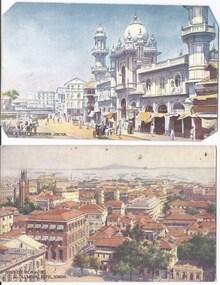 Melbourne Legacy
Postcard, Postcards of India
... 01139.1 Bombay - A street scene, Pydowni Junction 01139.2 Bird's eye view of Fort from Taj Mahal Hotel, Bombay 01139.3 Cuffe Parade - Bombay 01139.4 General Post Office - Bombay 01139.5 Bombay - Queen's Road showing palms 01139.6 A woman tapping rubber tree (possibly from Sri Lanka as it was printed in Colombo). 01139.7 Bombay from Harbour Each one has the word POST CARD on the reverse with room for an address and an area for Correspondence. ...These places in Bombay, India could have been visited by the first Legatees when they were soldiers in World War 1. souvenir world war one 01139.1 Bombay - A street scene, Pydowni Junction 01139.2 Bird's eye view of Fort from Taj Mahal Hotel, Bombay 01139.3 Cuffe Parade - Bombay 01139.4 General Post Office - Bombay 01139.5 Bombay - Queen's Road showing palms 01139.6 A woman tapping rubber tree (possibly from Sri Lanka as it was printed in Colombo). 01139.7 Bombay from Harbour Each one has the word POST CARD on the reverse with room for an address and an area for Correspondence. ...Postcards were a common form of souvenirs for soldiers who were travelling either during World War 1, or just after, or while returning to Australia. These postcard scenes are from Bombay which is a stop on the route from Australia to Europe. India was often the first time young soldiers saw a different culture on their way to the first World War. These were with other World War 1 memorabilia that has come from Private John Basil McLean, 2nd Reinforcements, 37th Battalion, A.I.F. There was a large collection of postcards so he may have been collecting them as souvenirs (none of these have been written on or posted). J.B. McLean (Service No. 13824) was from near Maffra, Victoria and enlisted on 22 January 1916. He embarked on 16 December 1916 for Europe. His full war record is available from AWM. He spent time with the Australian Field Artillery (Pack Section). At the end of the war he worked for a year at the A.I.F. Headquarters in London before returning to Australia on the 'Ceramic', (which stopped in Bombay), arriving Portsea in 1920.Postcards were a very common form of communication in the first World War. Postcards as souvenirs or as correspondence would have been familiar to the first Legatees as they had served in World War 1. These places in Bombay, India could have been visited by the first Legatees when they were soldiers in World War 1.Postcards x 7 with images from Bombay in India.01139.1 Bombay - A street scene, Pydowni Junction 01139.2 Bird's eye view of Fort from Taj Mahal Hotel, Bombay 01139.3 Cuffe Parade - Bombay 01139.4 General Post Office - Bombay 01139.5 Bombay - Queen's Road showing palms 01139.6 A woman tapping rubber tree (possibly from Sri Lanka as it was printed in Colombo). 01139.7 Bombay from Harbour Each one has the word POST CARD on the reverse with room for an address and an area for Correspondence. Different makers.souvenir, world war one
