
Showing 13 items matching "talbot museum"
-
 Ballarat Heritage Services
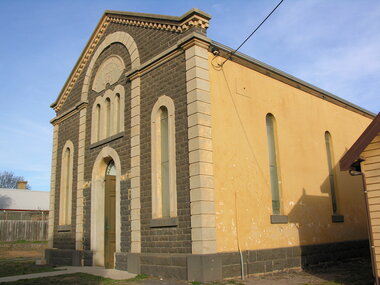
Photograph, Talbot Primative Church, c2014
... ...Talbot Museum...The Talbot Primitive Methodist refers to a former Primitive Methodist Church in Talbot, Victoria, Australia, that was built in 1870 and is now the home of the Talbot Arts & Historical Museum. The bluestone church building, a distinctive example of Romanesque design, now houses a wide array of historical exhibits about the region's goldfields history, including mining relics, photographs, documents, and communications equipment. ...Fo Talbot Primartive Methodist Church Talbot Museum Colour photographs of Talbot Primative Church. ...The Talbot Primitive Methodist refers to a former Primitive Methodist Church in Talbot, Victoria, Australia, that was built in 1870 and is now the home of the Talbot Arts & Historical Museum. The bluestone church building, a distinctive example of Romanesque design, now houses a wide array of historical exhibits about the region's goldfields history, including mining relics, photographs, documents, and communications equipment. The building is recognized for its sophisticated and relatively large Romanesque design, featuring a novel facade combining elements of a Classical temple front and a Roman triumphal arch. FoColour photographs of Talbot Primative Church.talbot, primartive methodist church, talbot museum -
 Ballarat Heritage Services
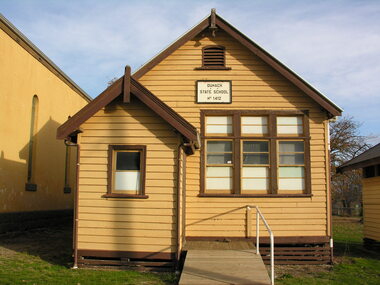
Photograph, Dunach State School, c2014, c2014
... ...Talbot Museum...Dunach State School Education Talbot Museum Colour photograph of a weatherboard School. ...Colour photograph of a weatherboard School. dunach state school, education, talbot museum -
 The Beechworth Burke Museum
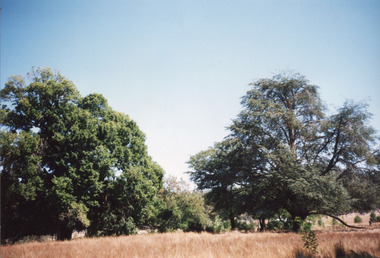
Photograph, 2000
... museum...school...education...trees...nature...state school...woolshed...gold mining...teachers...over time...Owens and Murray advertiser...public meetings...public dance...c. o'donoghue...spring creek...state governor...Sir Reginald Talbot...The image is also useful for prompting discussion about how Beechworth has changed over time, with the photograph taken 78 years after the school closed down. beechworth burke museum school education trees nature state school woolshed gold mining teachers over time Owens and Murray advertiser public meetings public dance c. o'donoghue spring creek state governor Sir Reginald Talbot miners honour roll world war 1 Woolshed State. / School site / 2000 / - remnant trees / / co A colour rectangular photograph printed on glossy photographic paper. ...Woolshed is a small area about five kilometres north west of Beechworth, and almost about 225km north east of Melbourne. When gold was discovered at the nearby Spring Creek in February 1852, Woolshed was one of three settlements set up to house miners and their families. At its peak in 1857, Woolshed was also populated by 29 storekeepers and 14 hotels, as well as the Woolshed State School, which stood near where this photograph was taken. The school often played host to public meetings, as well as a public dance in 1897. The school was subject to some controversy in 1874 when one parent complained about the head of the school in the local newspaper, the Owens and Murray Advertiser, and at least three letters to the editor were exchanged between the two. According to the parent, C. O'Donoghue was not providing enough amusement for the children and was disrespectful to parents and staff. When the State Governor, Sir Reginald Talbot, visited Beechworth in 1906, the school organised a celebratory welcome. The Woolshed State School was ultimately closed in 1922 as miners had exhausted the Spring Creek gold supply and were moving elsewhere. This photograph, taken in about 2000, shows the trees that grew on or near the site of the original school. The Woolshed State School Honour Roll, with a list of the men from the school who served in the First World War, also still exists. It is stored in the Beechworth RSL as of 2015.This photograph is significant for its connection to an important site in Beechworth's gold mining history. Woolshed served a significant community of miners, with a population of at least 138 according to the 1911 census, with families that needed the school site to ensure their children's education. The image is also useful for prompting discussion about how Beechworth has changed over time, with the photograph taken 78 years after the school closed down.A colour rectangular photograph printed on glossy photographic paper.Woolshed State. / School site / 2000 / - remnant trees / / cobeechworth, burke museum, school, education, trees, nature, state school, woolshed, gold mining, teachers, over time, owens and murray advertiser, public meetings, public dance, c. o'donoghue, spring creek, state governor, sir reginald talbot, miners, honour roll, world war 1 -
 The Beechworth Burke Museum
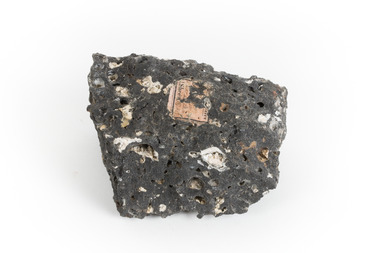
Geological specimen - Basalt, Unknown
... museum...Beechworth...Geological Specimen...geology...basalt...basalt specemin...indigo shire...Talbot...Many of these specimens were sent to research and collecting organisations across Australia, including the Burke Museum, to educate and encourage further study. burke museum Beechworth Geological Specimen geology basalt basalt specemin indigo shire Talbot Cainozoic igneous rock Geological survey / [illegible] / A smaller than hand sized rock specimen which is dark grey in colour with small holes and white deposits across its surface. ...Basalt is a common igneous rock that composes most of the Earth's surface and can be found on the Moon and other rocky planets of the Solar System. It is generally composed minerals such as calcic plagioclase, clinopyroxene and iron ore which form grains that are indistinguishable to the naked eye. It can be dark grey or black in colouring and sometimes may contain holes left by gas bubbles. Most of the Earth's basalt was produced in environments such as oceanic divergent boundaries, oceanic hotspots, and mantle plumes and hotspots beneath continents. Basalt is commonly used in construction where it is crushed and used for multiple purposes such as concrete aggregate, road base, or railroad ballast. Thin slabs of basalt can also be cut and used for floor tiles, stone monuments, and building veneer. This particular specimen was excavated from Talbot in Victoria, which was a small gold mining town established in 1852. As basalt is a common rock, it is not specific to Talbot. However, this specimen can be assumed to be of the Cainozoic age due to previous geomorphic surveys of the area. This particular type of Basalt was used mainly for roads due to the durability of the rock.Basalt holds significance due to the continued use of the rock from historic until present times. The rock has been utilised for many types of construction and is still used for the same purposes today. Basalt also has significance to the Earth and other rocky planets of the Solar System as it makes up most of the planet's surface. This specimen is part of a larger collection of geological and mineral specimens collected from around Australia (and some parts of the world) and donated to the Burke Museum between 1868-1880. A large percentage of these specimens were collected in Victoria as part of the Geological Survey of Victoria that begun in 1852 (in response to the Gold Rush) to study and map the geology of Victoria. Collecting geological specimens was an important part of mapping and understanding the scientific makeup of the earth. Many of these specimens were sent to research and collecting organisations across Australia, including the Burke Museum, to educate and encourage further study.A smaller than hand sized rock specimen which is dark grey in colour with small holes and white deposits across its surface.Geological survey / [illegible] /burke museum, beechworth, geological specimen, geology, basalt, basalt specemin, indigo shire, talbot, cainozoic, igneous rock -
 The Beechworth Burke Museum
Geological specimen - Ropy Lava
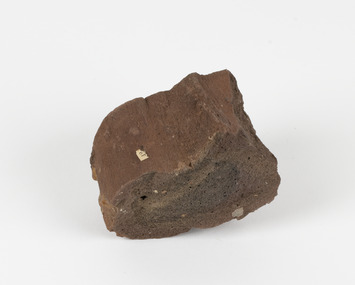
... Many of these specimens were sent to research and collecting organisations across Australia, including the Burke Museum, to educate and encourage further study. Victoria Talbot lava ropy ropy lava mineral Geological Specimen geological geological heritage natural stone natural history 42 / Hand sized specimen in brown/red hues Geological specimen Ropy Lava ...‘Ropy lava’ is known for its sculptural and layered qualities. It occurs in specific lava flows that are slow moving and slow cooling, allowing for unique formations to be created out of the motion. Ropy Lava is a flow that has a hardened crust with molten material underneath, the tension between these states is what creates its characteristic form. The brown/red hue of the stone is an indication of age, as it is oxidised iron deposits. This rock deposit is thought to be sourced from the area by Talbot, in western Victoria. This area has a rich mineral history and experienced the gold rush in the 1850's. The traditional owners of this area are the Dja Dja Wurrung people.This geological specimen shows the conditions in which the Australian landscape was created as well as provides an indication as to how these events occurred. It is representative of a common natural process that contextualises the formation of Australia with the formation of other landmasses. This specimen is part of a larger collection of geological and mineral specimens collected from around Australia (and some parts of the world) and donated to the Burke Museum between 1868-1880. A large percentage of these specimens were collected in Victoria as part of the Geological Survey of Victoria that begun in 1852 (in response to the Gold Rush) to study and map the geology of Victoria. Collecting geological specimens was an important part of mapping and understanding the scientific makeup of the earth. Many of these specimens were sent to research and collecting organisations across Australia, including the Burke Museum, to educate and encourage further study.Hand sized specimen in brown/red hues42 / victoria, talbot, lava, ropy, ropy lava, mineral, geological specimen, geological, geological heritage, natural stone, natural history -
 Ballarat Tramway Museum
Postcard - Set of 6 and background card, Ken Flood, "Launceston Municipal Tramways"
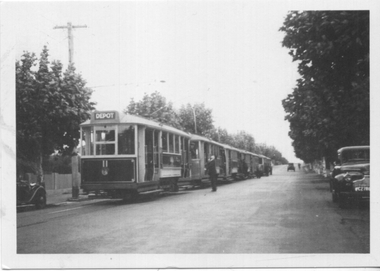
... The background card gives a short history of Launceston trams and the reproduction of two tickets. 1 - Postcard 1 - No. 11 leads a line up of cars in Elphin Road - Ken Flood 6-3-1948 2 - No 27, Mumford St loop - Ken Flood - 9-10-1948 3 - No. 24 Wellington St, photo Ken Flood, 26-2-1949 4 - No. 9 turns from George St into Cameron St - 25-9-1948 - Photo Ken Flood 5 - No. 26 - Talbot Road terminus - 1-11-1948 - Ken Flood 6 - No. 9 Elphin Road, 13-10-1948 - Ken Flood Yields information about Launceston trams, the Museum having No 14 on display, No. 14 from 2022. ...The Postcards show trams of Launceston which operated from 1911 to 1952, published by International Railway Postcards of Launceston. The background card gives a short history of Launceston trams and the reproduction of two tickets. 1 - Postcard 1 - No. 11 leads a line up of cars in Elphin Road - Ken Flood 6-3-1948 2 - No 27, Mumford St loop - Ken Flood - 9-10-1948 3 - No. 24 Wellington St, photo Ken Flood, 26-2-1949 4 - No. 9 turns from George St into Cameron St - 25-9-1948 - Photo Ken Flood 5 - No. 26 - Talbot Road terminus - 1-11-1948 - Ken Flood 6 - No. 9 Elphin Road, 13-10-1948 - Ken Flood Yields information about Launceston trams, the Museum having No 14 on display, No. 14 from 2022.Set of 6 black and white postcards and a story card. Each have a caption on the rear and a place for a stamp and address.launceston, tramways, tramcars -
 Clunes Museum
Photograph
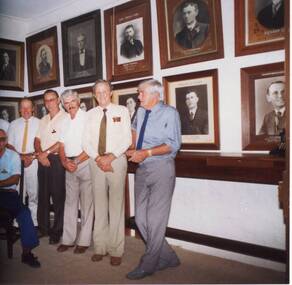
... COUNCILLORS OF TALBOT & CLUNES SHIRE IN MAYORS ROOM OF CLUNES MUSEUM ? WALLY COOK ? ...LOCAL HISTORY PHOTOGRAPHY PHOTOGRAPHS MUSEUM CLUNES COUNCILLORS OF TALBOT & CLUNES SHIRE IN MAYORS ROOM OF CLUNES MUSEUM ? ...COUNCILLORS OF TALBOT & CLUNES SHIRE IN MAYORS ROOM OF CLUNES MUSEUM ? WALLY COOK ? ROBERT SEERS, ?? RON PRYORlocal history, photography, photographs, museum, clunes -
 Clunes Museum
Document - EXTRACTS
... DONATED TO MUSEUM BY SHIRE TALBOT AND CLUNES....DONATED TO MUSEUM BY SHIRE TALBOT AND CLUNES. local history document local government shire talbot & clunes. extracts of minutes CREAM COVER WIRE BINDING SCHOOL EXERCISE BOOK CONTAINING HANDWRITTEN EXTRACTS OF CLUNES MUNICIPAL COUNCIL. ...DONATED TO MUSEUM BY SHIRE TALBOT AND CLUNES.CREAM COVER WIRE BINDING SCHOOL EXERCISE BOOK CONTAINING HANDWRITTEN EXTRACTS OF CLUNES MUNICIPAL COUNCIL. MINUTES - BOOK NO 1 - 1860 - 1869 - BOOK NO 2 - 1869 - 1877 - BOOK NO 3 - 1877 - 1914 - BOOK NO 4 - 1914 - 1939local history, document, local government, shire talbot & clunes. extracts of minutes -
 Clunes Museum
Photograph, PRIMARY SCHOOL
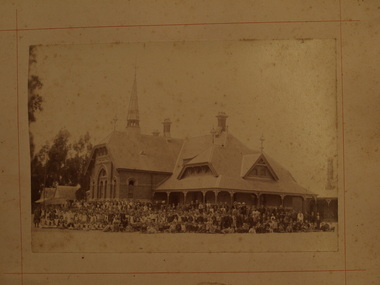
... THE BUILDING IN TALBOT ROAD IS NOW A BOTTLE MUSEUM....THE BUILDING IN TALBOT ROAD IS NOW A BOTTLE MUSEUM. local history photographs schools 136 PRIMARY SCHOOL BLACK AND WHITE PHOTOGRAPH OF SOUTH CLUNES SCHOOL, WITH SPIRE ON TOP. ...CLUNES SOUTH SCHOOL CLUNES WAS CLOSED IN 1923 AND PUPILS TRANSFERRED TO NORTH CLUNES SCHOOL. THE BUILDING IN TALBOT ROAD IS NOW A BOTTLE MUSEUM.BLACK AND WHITE PHOTOGRAPH OF SOUTH CLUNES SCHOOL, WITH SPIRE ON TOP. LARGE GROUP OF PUPILS IN FRONT OF BUILDING. THE KEMPSON - SKELLET HOUSE ON LEFT OF PHOTOGRAPH.local history, photographs, schools 136, primary school -
Clunes Museum
Newspaper - NEWSPAPER ARTICLE, SENSATIONAL RAILWAY SMASH, AUGUST 1909
... MCCALLUM'S CREEK BRIDGE RAILWAY SMASH CLUNES TALBOT NEWSPAPER CUTTING LAMINATED SHEET USED IN THE MUSEUM. DESCRIPTION OF SENSATIONAL RAILWAY SMASH AT McCALLUM'S CREEK BRIDGE SENSATIONAL RAILWAY SMASH Newspaper NEWSPAPER ARTICLE ...NEWSPAPER CUTTING LAMINATED SHEET USED IN THE MUSEUM. DESCRIPTION OF SENSATIONAL RAILWAY SMASH AT McCALLUM'S CREEK BRIDGEmccallum's creek bridge, railway smash, clunes, talbot -
 Melbourne Athenaeum Archives
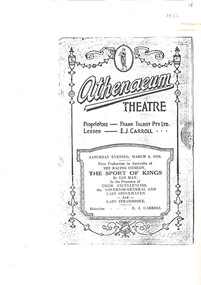
Theatre program, Cass & Clothier (Printers), The Sport of Kings (play) by Ian Hay performed at the Athenaeum Theatre commencing 6 March1926 - reproduction, 1926
... The theatre management continues to feature live performances. athenaeum theatre program the sport of kings racing comedy frank talbot pty ltd e j carroll ian hay frank bradley Photocopy of a program held at the Museum of Performing Arts The Sport of Kings (play) by Ian Hay performed at the Athenaeum Theatre commencing 6 March1926 - reproduction Theatre program Cass & Clothier (Printers) ...The play was produced by EJ Carroll at the Athenaeum Theatre, the Australian premiere. The play enjoyed a long and successful run with Frank Bradley setting a record by performing as leading man for forty weeks. Frank Talbot had leased the Athenaeum Hall for several years before negotiating with the Melbourne Athenaeum board members to renovate the hall into a modern theatre. The work was completed in 1923. The theatre became a well-known venue for plays but later, as movies became popular a biograph box was constructed to house movie projectors. The theatre manager, Frank Talbot, who leased the theatre from the Melbourne Athenaeum, signed an agreement with British Dominion Films in 1932, to show only British movies. Hoyts Theatres took over the lease in 1955 and later the Melbourne Theatre Company performed in the theatre, bringing live performances back to the theatre for several years. Programs of the early performances of plays are a reminder of the original purpose of the theatre. The theatre management continues to feature live performances.Photocopy of a program held at the Museum of Performing Arts athenaeum theatre, program, the sport of kings, racing comedy, frank talbot pty ltd, e j carroll, ian hay, frank bradley -
 8th/13th Victorian Mounted Rifles Regimental Collection
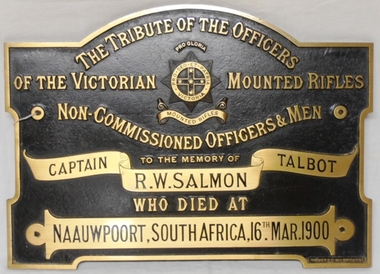
Bronze plaque, 1900 circa
... Talbot and secretary of the Fire Brigade. The plaque was discovered by retired Military Police officer, Captain Watson and donated to 8/13 VMR Museum circa 1983. ...Talbot and secretary of the Fire Brigade. The plaque was discovered by retired Military Police officer, Captain Watson and donated to 8/13 VMR Museum circa 1983. ...Captain Robert Westrup Salmon was born at Daisy Hill near Talbot 12 July 1862. He joined the Victorian Mounted Rifles in 1883; was commissioned Lieutenant in 1892 and appointed Adjutant (Volunteer) of 2nd Battalion VMR in 1892. He embarked with the 1st Contingent VMR to South Africa in 1899 with the rank of captain. At the battle of Jasfontein (Garsfontein) he was highly complimented in the London Times and other English newspapers for the skilful manner in which he handled the Mounted Infantry under his command. At the time of his death from Enteric Fever on 16 March 1900 at Naauwpoort South Africa he was Staff Captain of the Australian Regiment. Captain Salmon was a councillor of the Borough of Talbot, trustee of the Racing Club and the Cemetery; member of the Board of Directors of the MUIOOF; past master of the Masonic Lodge; church warden of St Michael’s Church Talbot and secretary of the Fire Brigade. The plaque was discovered by retired Military Police officer, Captain Watson and donated to 8/13 VMR Museum circa 1983. Rare example of a memorial plaque to an officer of the Boer War. It is not known where or if it was originally mounted but a church building would seem likely. Large bronze plaque to the memory of Captain Robert Westrup Salmon who died of Enteric Fever while serving with the 1st Contingent Victorian Mounted Rifles during the Boer War. A framed display with photograph of the donor Captain Watson handing the plaque to Officer Commanding 'A' Squadron 8/13 VMR at Buna Barracks Albury in 1984 now accompanies the bronze plaque.Cast in raised lettering surrounding a Victorian Mounted Rifles badge "The tribute of the Officers of the Victorian Mounted Rifles Non-Commissioned Officers & Men to the memory of Captain RS Salmon Talbot who died at Naauwpoort South Africa 16th Mar. 1900"salmon robert westrup captain, talbot, boer war -
 Ballarat Heritage Services
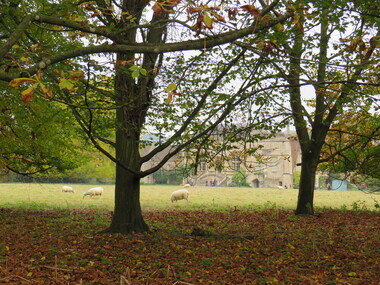
Photograph - Digital Photograph, Dorothy Wickham, Abbey, Lacock, United Kingdom, 2016
... The first photograph is said to have been taken from the windows of Lacock Abbey.In August 1835 Talbot made the earliest known surviving photographic negative using a wooden camera.The rare small photogenic image of the latticed window in the south gallery of Lacock is now in the collection of the Science Museum at Bradford, UK....The first photograph is said to have been taken from the windows of Lacock Abbey.In August 1835 Talbot made the earliest known surviving photographic negative using a wooden camera.The rare small photogenic image of the latticed window in the south gallery of Lacock is now in the collection of the Science Museum at Bradford, UK. ...The abbey was founded by the Countess of Salisbury in 1229 for Augustinian Canonesses. It prospered throughout the middle ages. It was bought by William Henry Fox Talbot (1800-77). He was part of a scientific and enlightened group of men, which led him to discover the process of photography. The first photograph is said to have been taken from the windows of Lacock Abbey.In August 1835 Talbot made the earliest known surviving photographic negative using a wooden camera.The rare small photogenic image of the latticed window in the south gallery of Lacock is now in the collection of the Science Museum at Bradford, UK.Colour photograph of Abbey, Lacock, United Kingdomlacock abbey, church
