
Showing 8 items matching "tasmania - transport - history"
-
 Victorian Railway History Library
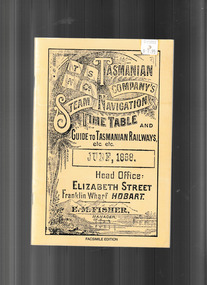
Book, Tasmanian Steam Navigation Company, The Tasmanian steam navigation company's time table & guide to Tasmanian railways, etc., etc. : a guide to commercial marine, rail and road transport available to Tasmanian travellers in June 1888, colonial, intercolonial and overseas, 1996
... Tasmania - Transport - History...Tasmania - Transport - History Timetables - Tasmania Facsimile version of the Original p.52. ...Facsimile version of the Originalp.52.non-fictionFacsimile version of the Originaltasmania - transport - history, timetables - tasmania -
 Bendigo Historical Society Inc.
Document - Jonathan Harris / Axedale
... His father Jonathan Snr was transported to Australia and his wife obtained permission to follow him as a free settler when Jonathan jnr was about 7 yrs.In 1842, Jonathan snr (who held a ticket of leave) and his son Jonathan Jnr were found guilty of theft and transported to Tasmania. Family history suggests that following his term, Jonathan jnr became a police detective before returning to Victoria. ...His father Jonathan Snr was transported to Australia and his wife obtained permission to follow him as a free settler when Jonathan jnr was about 7 yrs.In 1842, Jonathan snr (who held a ticket of leave) and his son Jonathan Jnr were found guilty of theft and transported to Tasmania. Family history suggests that following his term, Jonathan jnr became a police detective before returning to Victoria. ...Jonathan Harris was born in Sussex England in 1822. His father Jonathan Snr was transported to Australia and his wife obtained permission to follow him as a free settler when Jonathan jnr was about 7 yrs.In 1842, Jonathan snr (who held a ticket of leave) and his son Jonathan Jnr were found guilty of theft and transported to Tasmania. Family history suggests that following his term, Jonathan jnr became a police detective before returning to Victoria. He and his wife had a store at Third White Hill in Bendigo and one day while walking to Eaglehawk, Jonathan found a rich vein of gold in what was to become the Hustlers Mine. He took large samples to England for crushing and subsequently sold his claim. Upon returning to Melbourne he conducted a business before taking up land at Axedale. He farmed here, including the growing of apples up until his death 20/7/1881. His efforts must have been successful as following his death the sale of property at Axedale included two pieces of land that each had two cottages that had been rented out. Jonathan was also on the board of the Axedale School.An eight page document with newspaper articles and information about the life of Axedale man Jonathan Harris.jonathon harris, axedale, mining. -
 Flagstaff Hill Maritime Museum and Village
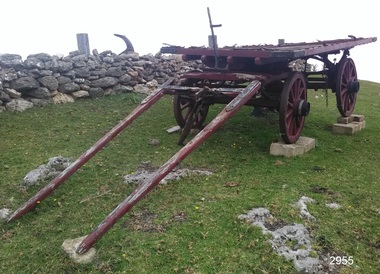
Wagon, circa 1850s
... history: The Bostock family were prominent in Warrnambool from the 1850s to the 1880s. Patriarch Robert Bostock had in 1813 been transported to Sydney from Sierra Leone for having 'felonious traded in slaves' and sentenced to 14 years transportation. He moved to Tasmania...history: The Bostock family were prominent in Warrnambool from the 1850s to the 1880s. Patriarch Robert Bostock had in 1813 been transported to Sydney from Sierra Leone for having 'felonious traded in slaves' and sentenced to 14 years transportation. He moved to Tasmania ...Bostock & Manifold were all from pioneering families in the Western District of Victoria almost from the time of settlement. Family history: The Bostock family were prominent in Warrnambool from the 1850s to the 1880s. Patriarch Robert Bostock had in 1813 been transported to Sydney from Sierra Leone for having 'felonious traded in slaves' and sentenced to 14 years transportation. He moved to Tasmania in 1821 where he died in 1847. A number of his children came to Port Phillip. Edward Robert Bostock held the Jellabad run from 1849 to 1853. George Bostock (1826-1858) was a Warrnambool Shire Councillor in 1856. Thomas Edward Bostock (1828-1874) was a Shire Councillor in the late 1860s. Augustus Bostock (1833-1920) lived in Warrnambool. Augustus Bostock was the 9th child of Robert and Rachael Bostock of Vaucluse Epping Forest, Van Diemen's Land. He was only 4 years old when his mother died. He was inspired by his father to seek his fortune in the Western District of Victoria. He arrived around 1850. He married Margaret Aitkin in July 1865. Augustus owned several properties in the district and leased others. He sat on the court of Warrnambool, Mortlake or Hexham as required. He resided at Marramook in Hawkesdale and later moved to Vaucluse in Hopetoun Road Warrnambool, where he died in 1920 at the age of 87. The Wagon is significant locally and state wide for its association with Augustus Bostock who was involved in many aspects of life in the Western District of Victoria, racing, cricket, and social activities to name a few. Bostock & Manifold were all from pioneering families in the Western District of Victoria almost from the time of settlement. The wagon is significant for its historical and economic association with the local Warrnambool business of Manifold & Bostock. These men had leased and owned vast tracts of land and operated businesses around the district together at various times often associated with the farming industry. One example is the Manifold & Bostock store and flour mill from which the wagon dray is believed to have been associated with for the delivery of goods. Their flour mill began operation in 1850 in 7-17 Stanley St South Warrnambool and was known as “Jetty Mills” Manifold and Bostock in 1858 purchased the Mill from John and G Elliot (brothers) with half an acre of ground and a cottage for £1600. It appears addresses of the company changed over the years as the town grew. These are listed in “Jones, Lewis & Peggy flour mills of Victoria” showing the company operating from, Fairy Street and later at the Merri River near the cutting, known as Banyan and Merri Streets. The company ceased trading in 1870. The Wagon Dray is also an example of agricultural freight and general transportation during the 1800 and 1900 century.A four-wheeled wooden horse-drawn wagon with flat top described as a Wagon Dray in historical writings. Painted brown and black. The wagon has rear brakes, wooden, operated from a metal handle at the front of the Wagon. Front wheels are attached to a turnstile to allow easy turning of the wagon. This flat-topped, horse driven, four-wheeled Wagon was used for cartage by the business of Manifold & Bostock, Warrnambool. The original sign writing of the wagon is obscured or painted over. There is a feint mark of lettering to the sides and back edges of the cart Manifold & Bostock. "Manifold and Bostock" very feintflagstaff hill, warrnambool, shipwrecked-coast, flagstaff-hill, flagstaff-hill-maritime-museum, maritime-museum, flagstaff-hill-maritime-village, cartage, manifold and bostock of warrnambool, manifold family of western victoria, bostock family of western victoria, four wheeled wagon, wagon, horse drawn wagon, farm wagon, aitkin, aitkin bostock manifold, dray, aitkin family, cart, aitken, flour mill -
 Sunshine and District Historical Society Incorporated
Document - Brimbank Rising, Tony Smith, 2018
... transport corridors serving Melbourne’s rapid western and northwestern expansion. Brimbank Rising steps through local prehistory and history with attention to planning events from Hoddle’s 1840 survey to the recent Regional Rail Link which shape the area. Across five periods, this history sees planning as a contributory process to city shaping, with specific plans as snapshots in time of endorsed intentions, all through the lens of complexity, connectedness and contingency. Recent geological and ecological history had been productively harnessed by the Wurundjeri before all were disrupted by the arrival of unauthorised settlers from Tasmania...transport corridors serving Melbourne’s rapid western and northwestern expansion. Brimbank Rising steps through local prehistory and history with attention to planning events from Hoddle’s 1840 survey to the recent Regional Rail Link which shape the area. Across five periods, this history sees planning as a contributory process to city shaping, with specific plans as snapshots in time of endorsed intentions, all through the lens of complexity, connectedness and contingency. Recent geological and ecological history had been productively harnessed by the Wurundjeri before all were disrupted by the arrival of unauthorised settlers from Tasmania ...The suburban municipality of Brimbank is strategically located across key transport corridors serving Melbourne’s rapid western and northwestern expansion. Brimbank Rising steps through local prehistory and history with attention to planning events from Hoddle’s 1840 survey to the recent Regional Rail Link which shape the area. Across five periods, this history sees planning as a contributory process to city shaping, with specific plans as snapshots in time of endorsed intentions, all through the lens of complexity, connectedness and contingency. Recent geological and ecological history had been productively harnessed by the Wurundjeri before all were disrupted by the arrival of unauthorised settlers from Tasmania and their livestock focused on serving markets in and using methods more appropriate to the other side of the world. Following colonial separation and the discovery of gold in 1851, the second part follows the expansion of heavy rail and the multifaceted influence of leading industrialist H V McKay’s Sunshine Harvester Works through and between the booms of the 1880s and 1920s. Postwar flooding of the Harvester Works, and of the region with migrants, demanded major infrastructure investment and municipal capabilities which were consistent with wider suburbanisation and growing dominance of road transport without challenging the area’s politically safe status. The penultimate section is focused on concurrent events in 2009 and how they play out through council in administration’s Sunshine Rising campaign to capitalise on the local potential of Sunshine’s rail upgrade and complementary infrastructure investments. Finally, there is discussion of current state policies and planning which relate to Brimbank and which the council and community need to continue to work with and advocate for further Rising to ensure Brimbank’s potential as service corridor for the Growth Areas is realised.Brimbank Rising From a History of Failed Local Councils, Officers and Administrators Promote and Support Sunshine Risingaboriginal, first nation, h.v. mckay, sunshine harvester factory -
 Ballarat Heritage Services
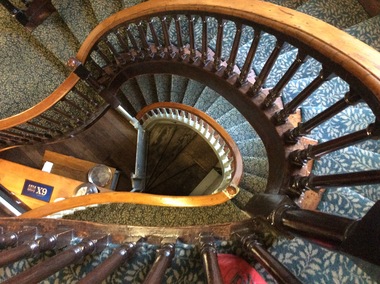
Photograph - Colour, The Bear Hotel, Devizes, England, 2017
... For more information see https://devizes.org.uk/index.php/history/history-of-devizes.html Some convicts that were tried at the Devizes Assizes were transported to Australia. Amongst these was John Chew, who stole metal, and who was transported to Tasmania. ...For more information see https://devizes.org.uk/index.php/history/history-of-devizes.html Some convicts that were tried at the Devizes Assizes were transported to Australia. Amongst these was John Chew, who stole metal, and who was transported to Tasmania. ...Devizes is a medieval market town in the centre of Wiltshire, near Stonehenge and Avebury, and east of Bath. For more information see https://devizes.org.uk/index.php/history/history-of-devizes.html Some convicts that were tried at the Devizes Assizes were transported to Australia. Amongst these was John Chew, who stole metal, and who was transported to Tasmania. He married in Tasmania, but descendants of his family settled in Victoria, Australia. Colour photograph of a circular staircase at the Bear Hotel in Devizes. devizes, bear hotel, staircase, window, john chew -
 Victorian Railway History Library
Book, Joy, Stewart et al, Tasmanian Railways A Report to the Hon P.J.Nixon M.P. Minister of Transport, 1977
... Government reports - railways - Tasmania Tasmanian railways - History A Report to the Hon P.J.Nixon M.P. Federal Minister of Transport about the Tasmanian Government Railways in 1977. maps, p.132. ...A Report to the Hon P.J.Nixon M.P. Federal Minister of Transport about the Tasmanian Government Railways in 1977.maps, p.132.non-fictionA Report to the Hon P.J.Nixon M.P. Federal Minister of Transport about the Tasmanian Government Railways in 1977.government reports - railways - tasmania, tasmanian railways - history -
 Victorian Railway History Library
Book, Chamberlain, Brian, Early Steam in Tasmania, 1987
... steam locomotives - Tasmania - history Broad gauge railways - Tasmania - history A history of the first 17 years of 'Broad Gauge' 5'3" railways in Tasmania plus a section on tall masted ships involved in transporting those locomotives to Australia. ill, p.146. ...A history of the first 17 years of 'Broad Gauge' 5'3" railways in Tasmania plus a section on tall masted ships involved in transporting those locomotives to Australia.ill, p.146.non-fictionA history of the first 17 years of 'Broad Gauge' 5'3" railways in Tasmania plus a section on tall masted ships involved in transporting those locomotives to Australia.steam locomotives - tasmania - history, broad gauge railways - tasmania - history -
 Victorian Railway History Library
Book, Cooper, Ian G, Launceston Municipal Transport 1911-1955, 2006
... Local transit -- Tasmania -- Launceston -- History Trams and tramways A history of the tram and bus network in Launceston Tasmania from 1911 to 1955. ill, maps, p.170. Launceston Municipal Transport ...A history of the tram and bus network in Launceston Tasmania from 1911 to 1955.ill, maps, p.170.non-fictionA history of the tram and bus network in Launceston Tasmania from 1911 to 1955.local transit -- tasmania -- launceston -- history, trams and tramways
