
Showing 6 items matching "tawny frogmouth"
-
 The Beechworth Burke Museum
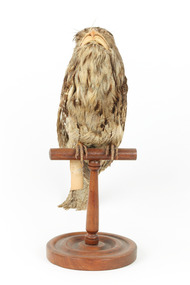
Animal specimen - Tawny Frogmouth, Trustees of the Australian Museum, 1860-1880
... Tawny Frogmouth......tawny frogmouth...The Tawny Frogmouth, although often mistaken for an owl, is a nocturnal Australian bird of the Podargidae family that is more closely related to the nightjars. ...This Tawny Frogmouth has a broad head and a creamy beige coloured wide triangular beak with a hooked tip. ...The Tawny Frogmouth, although often mistaken for an owl, is a nocturnal Australian bird of the Podargidae family that is more closely related to the nightjars. ...The Tawny Frogmouth, although often mistaken for an owl, is a nocturnal Australian bird of the Podargidae family that is more closely related to the nightjars. They are widespread in terms of distribution and can be found all across mainland Australia and Tasmania in a diverse variety of habitats from woodlands, forests and urban areas. Masters of camouflage, the Tawny Frogmouth sleeps during the day on tree branches in a stiff upward facing position (as with this specimen) to mimic broken tree branches, their feathers assist in this deception as the mottled grey and brown colours blend into the environment seamlessly. This specimen differs in colours from the usual appearance of a Tawny Frogmouth, as the beak is usually a olive-grey to blackish tone and the plumage is generally more dominantly grey all over the bird. This specimen is part of a collection of almost 200 animal specimens that were originally acquired as skins from various institutions across Australia, including the Australian Museum in Sydney and the National Museum of Victoria (known as Museums Victoria since 1983), as well as individuals such as amateur anthropologist Reynell Eveleigh Johns between 1860-1880. These skins were then mounted by members of the Burke Museum Committee and put-on display in the formal space of the Museum’s original exhibition hall where they continue to be on display. This display of taxidermy mounts initially served to instruct visitors to the Burke Museum of the natural world around them, today it serves as an insight into the collecting habits of the 19th century.This specimen is part of a significant and rare taxidermy mount collection in the Burke Museum. This collection is scientifically and culturally important for reminding us of how science continues to shape our understanding of the modern world. They demonstrate a capacity to hold evidence of how Australia’s fauna history existed in the past and are potentially important for future environmental research. This collection continues to be on display in the Museum and has become a key part to interpreting the collecting habits of the 19th century.This Tawny Frogmouth has a broad head and a creamy beige coloured wide triangular beak with a hooked tip. The plumage on the head and back of the bird is a combination of darker and rufous browns, mottled with streaks of cream and grey. The underside of the bird from the bottom of the beak to the tail tip is a lighter cream colour with streaks of rufous-brown. The feet are an orange-brown colour. This specimen is adopting the skyward looking pose associated with the species, mimicking dead tree branches.1a. / More-Park / See Catalogue, page 7 /taxidermy mount, taxidermy, burke museum, beechworth, australian museum, skin, reynell eveleigh johns, bird, australian birds, tawny frogmouth, frogmouth -
 Eltham District Historical Society Inc
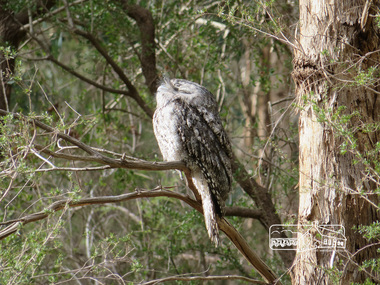
Photograph, Liz Pidgeon, Tawny Frogmouth, Candlebark Park, 16 July 2017, 16 July 2017
... Tawny Frogmouth, Candlebark Park, 16 July 2017......tawny frogmouth...eltham candlebark park tawny frogmouth Born Digital Tawny Frogmouth, Candlebark Park, 16 July 2017 Photograph Liz Pidgeon ...Born Digitaleltham, candlebark park, tawny frogmouth -
 Whitehorse Historical Society Inc.
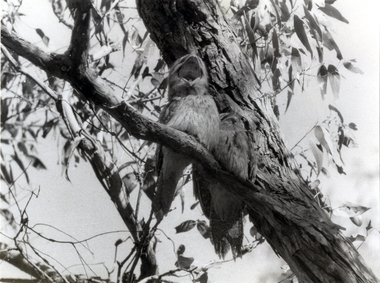
Photograph, Tawny Frogmouths, Blackburn Lake, 1975
... tawny frogmouth...Black & white photo of tawny frogmouths at Blackburn Lake Sanctuary in 1975....Used by Robin Da Costa in 'Blackburn: a picturesque history' tawny frogmouth blackburn lake sanctuary Black & white photo of tawny frogmouths at Blackburn Lake Sanctuary in 1975. ...Used by Robin Da Costa in 'Blackburn: a picturesque history'Black & white photo of tawny frogmouths at Blackburn Lake Sanctuary in 1975.tawny frogmouth, blackburn lake sanctuary -
 Embroiderers Guild, Victoria
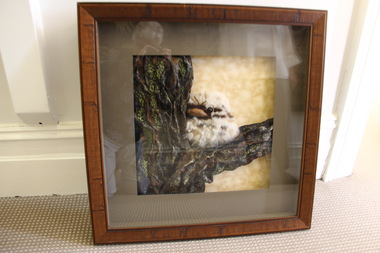
Artwork, other - Picture, Linda Worthington, Baby Tawny Frogmouth Owl, 2010
... Baby Tawny Frogmouth Owl...Recessed frame. Baby Tawny Frogmouth Owl Artwork, other Picture Linda Worthington ...Designed and made by Linda Worthington for the Guild's Wool Exhibition 2010, and sold to the donor Joan Lefroy.Baby owl, couched brushed wool, some emu feathers. Glass eye. Owl is on tree, of constructed fabric. Threads of wool fibres, black sheer, free machine stitched and hand stitched. Recessed frame. embroidery, picture, owl, wool, emu fathers, exhibition 2010 -
 Eltham District Historical Society Inc
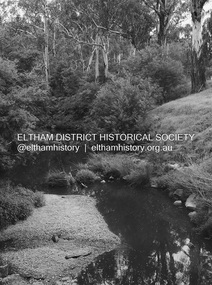
Photograph - Digital Photograph, Alan King, Diamond Creek, Barak Bushlands, Eltham, 2008
... They form part of an important habitat corridor linking the Yarra River to the Kinglake National Park.1 Manna Gums, tawny frogmouths and platypuses are some of the indigenous plants and animals that have made their home there. ...They form part of an important habitat corridor linking the Yarra River to the Kinglake National Park.1 Manna Gums, tawny frogmouths and platypuses are some of the indigenous plants and animals that have made their home there. ...A habitat corridor and it strengthens the community. Published: Nillumbik Now and Then / Marguerite Marshall 2008; photographs Alan King with Marguerite Marshall.; p185 Barak Bushlands lie west of the Diamond Creek on the corner of Falkiner Street and busy, noisy Main Road. They form part of an important habitat corridor linking the Yarra River to the Kinglake National Park.1 Manna Gums, tawny frogmouths and platypuses are some of the indigenous plants and animals that have made their home there. The bushlands are the result of more than nine years of hard work by the local community with the Nillumbik Council, to transform a degraded flood plain into this refuge of natural beauty. In 1997, shortly after moving into the new Riverside Estate on Falkiner Street, Eltham, several residents noticed the sorry state of the Diamond Creek and surrounding area. Part of it was used as a cow paddock and although small patches of vegetation survived, the area was infested with weeds, rabbits, rubbish and drainage from the housing estate. At various times the 4.4 hectares had been used as a market garden and for shire stock piles. The residents began to restore the area by revegetating land along the Diamond Creek. In 1998 they established the Friends of the Diamond Creek Falkiner Street Reserve2 and 35 families joined from the 90-house Estate. Carolyn Mellor, as the Friends’ Land Manager, undertook a four-year horticulture course to guide this massive project for a volunteer organisation. Since 1999, she has been the Friends’ President. In 1999 the Friends urged the Nillumbik Council to undertake a feasibility study into establishing a wetland system and urban forest. Work began in 2002 with Nillumbik Council funding the project, supplemented by government grants. The Friends also received grants from Melbourne Water and Parks Victoria. Aided by the Friends and other community members, the Council created the Barak Bushlands consisting of a forest, a wetland, a bridge, a path and open space. The beautiful wetland treats most of the estate’s stormwater runoff. Storm water is filtered through plants in the wetland ponds then is released slowly into the billabong, before flowing into the Diamond Creek. The wetland also helps to minimise flooding and the improved water quality provides a flora and fauna habitat. The Friends and other volunteers planted more than 27,000 plants, more than one third of which they grew from seeds they collected at Lower Eltham and Wingrove Parks. Eltham High School students planted thousands of these through a Year Eight program introduced for this purpose. Other groups who assisted were: Green Corps, local Scouts and Guides – 2nd Montmorency, 1st Diamond Creek and 1st Eltham Cub Packs, Eltham College students, Eltham East Primary School, Landcare members, Eltham Lions Club and the Eltham Baptist Church. To maintain enthusiasm for the mammoth task, the Friends and other volunteers ‘adopted’ trees to water and wrote their names on the stakes. In 2004, to recognise the area’s original occupiers, the reserve was named Barak Bushlands. William Barak, who lived from 1824 to 1903, was the last chief of the Yarra Yarra tribe of the Wurundjeri-willam people. Traces of these original inhabitants remain in scar trees (bark sections removed to make a shield or canoe). That same year the Friends’ group was a finalist in the prestigious Federal Government, Banksia Environmental Awards. The Friends have also participated in Clean Up Australia, removing tonnes of rubbish and regularly testing the billabong, wetland and creek, for pollutants. For years the Friends, together with the Australian Platypus Conservancy, have tagged, measured and checked the health of platypuses from the Diamond and Mullum Mullum Creeks. With Latrobe University the Friends have conducted night walks to view owls, possums, bats and sugar gliders. Challenges for the council and the Friends continue with a large rabbit population, some vandalism, weed eradication and maintenance. However, thanks to this community effort, locals can now escape confined urban living on small blocks of land and enjoy the beauty of indigenous plants and animals. Working together has also strengthened the local community,This collection of almost 130 photos about places and people within the Shire of Nillumbik, an urban and rural municipality in Melbourne's north, contributes to an understanding of the history of the Shire. Published in 2008 immediately prior to the Black Saturday bushfires of February 7, 2009, it documents sites that were impacted, and in some cases destroyed by the fires. It includes photographs taken especially for the publication, creating a unique time capsule representing the Shire in the early 21st century. It remains the most recent comprehenesive publication devoted to the Shire's history connecting local residents to the past. nillumbik now and then (marshall-king) collection, barak bushlands, diamond creek (creek), eltham -
 Healesville Sanctuary Heritage Centre
Newspaper - Cutting, The Herald, Melbourne, Froggy feels so chirpy, 11 November 1983
... 1980s young tawny frogmouth found on road taken to Sanctuary , will be released soon photocopy x 1 Froggy feels so chirpy Newspaper Cutting The Herald, Melbourne ...young tawny frogmouth found on road taken to Sanctuary , will be released soonphotocopy x 1non-fictionyoung tawny frogmouth found on road taken to Sanctuary , will be released soon1980s
