
Showing 253 items matching "taylors road"
-
 Croydon Conservation Society Inc.
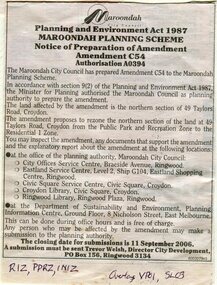
Newspaper, 'Notice of Preparation of Amendment Amendment C54' for 49 Taylors Road, Croydon, Authorisation A0394
... 'Notice of Preparation of Amendment Amendment C54' for 49 Taylors Road, Croydon, Authorisation A0394...Handwritten inscriptions in ink at base of notice: RIZ, PPRZ, INIZ, Overlays VP01, SL 03 Newspaper extract with inscription at base of notice 'Notice of Preparation of Amendment Amendment C54' for 49 Taylors Road, Croydon, Authorisation A0394 Newspaper ...Newspaper extract with inscription at base of noticeHandwritten inscriptions in ink at base of notice: RIZ, PPRZ, INIZ, Overlays VP01, SL 03 -
 Croydon Conservation Society Inc.
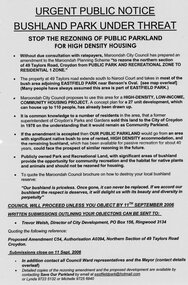
Document, Public Notice 'Bushland Park Under Threat' at 49 Taylors road Croydon, adjacent to Eastfield Park, Croydon
... Public Notice 'Bushland Park Under Threat' at 49 Taylors road Croydon, adjacent to Eastfield Park, Croydon...Two page document, page 2 with map Public Notice 'Bushland Park Under Threat' at 49 Taylors road Croydon, adjacent to Eastfield Park, Croydon Document ...Two page document, page 2 with map -
 Croydon Conservation Society Inc.
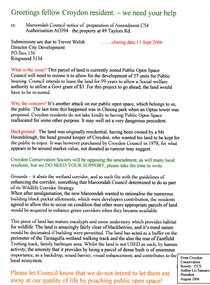
Letter, Letter to Croydon residents from the Croydon Conservation Society president seeking support against zoning Amendment C54 relating to 49 Taylors Road, Croydon, August 2006
... Letter to Croydon residents from the Croydon Conservation Society president seeking support against zoning Amendment C54 relating to 49 Taylors Road, Croydon, August 2006...One page typed open letter Letter to Croydon residents from the Croydon Conservation Society president seeking support against zoning Amendment C54 relating to 49 Taylors Road, Croydon, August 2006 Letter ...One page typed open letter -
 Sunshine and District Historical Society Incorporated
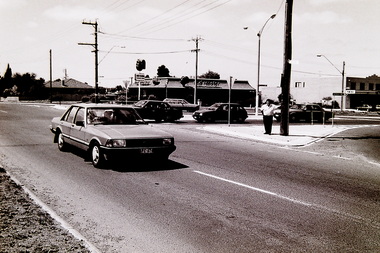
Photograph - Taylors Rd Cnr Arthur St St. Albans Photograph, Sunshine Advocate, 1991
... Taylors Road...As the population of the district increased, the intersection of Taylors Road and Arthur Street became a very busy and dangerous intersection. ...As the population of the district increased, the intersection of Taylors Road and Arthur Street became a very busy and dangerous intersection. ...As the population of the district increased, the intersection of Taylors Road and Arthur Street became a very busy and dangerous intersection. For many years the local residents campaigned for traffic lights to be installed at the intersection.This photograph was used in an edition of the Sunshine Advocate during one of many campaigns by the local residents for the installation of traffic lights at the intersection.5668 - Taylors Rd Cnr Arthur St St. Albans (Sun Adv 125.1) 1990 Photo 01.JPGtaylors road, arthur street, st. albans -
 Sunshine and District Historical Society Incorporated
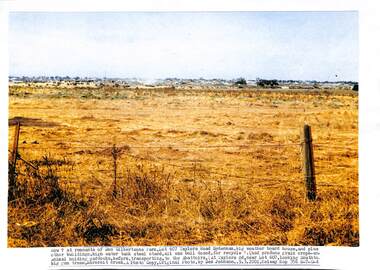
Photograph - Remnants of Don Gilbertsons holding, Johnson Des, 2001
... ... Taylors Road...Photocopy Photograph by Des Johnson 9 March 2002 Remnants of Don Gilbertsons animal holding paddock Lot 607 Taylors Road Sydenham Looking south over Kororoit Creek to a new housing estate now Caroline Springs and to Ballarat Road Deer Park Melway map 356 H-7-10 and 358 G-4 High water tank steel stand all bull dozed for recycling (had produce grain crops and animal holding paddocks before transporting to the abattoirs looking south to big gum trees...Gilbertsons Taylors Road Sydenham Photocopy Photograph by Des Johnson 9 March 2002 Remnants of Don Gilbertsons animal holding paddock Lot 607 Taylors Road Sydenham Looking south over Kororoit Creek to a new housing estate now Caroline Springs and to Ballarat Road Deer Park Melway map 356 H-7-10 and 358 G-4 High water tank steel stand all bull dozed for recycling (had produce grain crops and animal holding paddocks before transporting to the abattoirs looking south to big gum trees Remnants of Don Gilbertsons holding Photograph Remnants of Don Gilbertsons holding Johnson Des ...Photocopy Photograph by Des Johnson 9 March 2002 Remnants of Don Gilbertsons animal holding paddock Lot 607 Taylors Road Sydenham Looking south over Kororoit Creek to a new housing estate now Caroline Springs and to Ballarat Road Deer Park Melway map 356 H-7-10 and 358 G-4 High water tank steel stand all bull dozed for recycling (had produce grain crops and animal holding paddocks before transporting to the abattoirs looking south to big gum treesgilbertsons, taylors road, sydenham -
 Sunshine and District Historical Society Incorporated
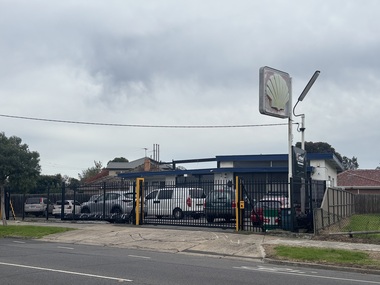
Photograph - St. Albans - Service Station Photographs, John Alchin, 2026
... ...Taylors Road...Albans - Double T Repairs 2026 Photo 02.jpeg 5862.05 - Taylors Road 33 St. Albans - 7 - 11 Petrol Station.jpeg 5862.06 - Main Road East 172 - T And J Road Motors 2026 Photo 01.jpeg 5862.06 - Main Road East 172 - T And J Road Motors 2026 Photo 02.jpeg 5862.07 - St. ...Albans Conrad Street East Esplanade Main Road East Main Road West Taylors Road St. Albans Road Kings Road 5862.01 - Conrad Street 34 St. ...Collection of photographs of current and former service stations in the St. Albans area.5862.01 - Conrad Street 34 St. Albans - Refined Motorworks 2026 Photo 01.jpeg 5862.02 - Conrad Street 34 St. Albans - Refined Motorworks 2026 Photo 02.jpeg 5862.03 - East Esplanade 34 St. Albans - Double T Repairs 2026 Photo 01.jpeg 5862.04 - East Esplanade 34 St. Albans - Double T Repairs 2026 Photo 02.jpeg 5862.05 - Taylors Road 33 St. Albans - 7 - 11 Petrol Station.jpeg 5862.06 - Main Road East 172 - T And J Road Motors 2026 Photo 01.jpeg 5862.06 - Main Road East 172 - T And J Road Motors 2026 Photo 02.jpeg 5862.07 - St. Albans Road 27 St. Albans - Astron Service Station 2026 Photo 01.jpeg 5862.07 - St. Albans Road 27 St. Albans - Astron Service Station 2026 Photo 02.jpeg 5862.07 - St. Albans Road 27 St. Albans - Astron Service Station 2026 Photo 03.jpeg 5862.08 - St. Albans Road 29 St. Albans - St. Albans Complete Car Care Centre And Bridgestone Tyres And Auto 2026.jpeg 5862.09 - St. Albans Road 31 St. Albans - G. I. Auto Care 2026 Photo 01.jpeg 5862.09 - St. Albans Road 31 St. Albans - G. I. Auto Care 2026 Photo 02.jpeg 5862.09 - St. Albans Road 31 St. Albans - G. I. Auto Care 2026 Photo 03.jpeg 5862.10 - Sunshine Avenue 53 St. Albans - 7 - 11 Petrol Station.jpeg 5862.11 - Sunshine Avenue 55 St. Albans - Former Mobil Petrol Station (Now Doctor Clinic And Pharmacy Shop).jpeg 5862.12 - Kings Road 70 St. Albans - 7 - 11 Service Station.jpeg 5862.13 - Main Road West 267 St. Albans - Reddy Express Service Station And My Car Service Centre.JPG 5862.14 - Main Road West 267 St. Albans - Reddy Express Service Station And My Car Service Centre.JPG 5862.15 - McKechnie Street 52 St. Albans - Former Service Station 2026.jpg 5862.16 - McKechnie Street 52 St. Albans - Former Service Station 2026.jpegservice station, st. albans, conrad street, east esplanade, main road east, main road west, taylors road, st. albans road, kings road -
 Sunshine and District Historical Society Incorporated
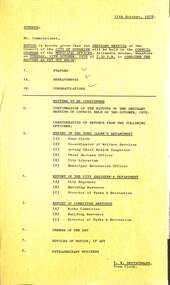
Administrative record - City of Sunshine - Commissioner Mr Alexander "Alex" George Gillon Collection 1976 - 1982 - Notice of Ordinary Meeting of The Council of The City of Sunshine on 17th October 1978, City of Sunshine, 11th October 1978
... ...Taylors Road...Mactaggart (Victoria) Pty Ltd Establishment of Rendering Plant Report of Inspector of Weights & Measures Report of the Medical Officer of Health Report of Chief By-Laws Officer Parking Restrictions Fairbairn Road and Tallintyre Road Report of the City Librarian Library Week Report of the Municipal Recreation Officer Tallintyre Reserve Football Ground Sunshine Heights Football Club and West United Football Club Summer Grounds Rental Costs Sporting Season 1978/79 Swimming Pool Management Plan Report of the City Engineer Retail Network Planning Strategy Town Planning General Proposed Shopping Centre Taylors Road City of Keilor Newmarket Saleyards and Special Use Zone 7 Planning Permit Application Sky Sign 193 Hampshire Road Sunshine Amendment 70 Part 4B to the Melbourne Metropolitan Planning Scheme Planning Permit Application Advertising Bunting North East Corner Mitchell Street and Ashley Street Planning Permit Application Consulting Rooms Lot 7 Devonshire Road North West Corner Gertrude Street Planning Permit Application Service Premise and Caretaker's Dwelling Lot 1 Ballarat Road Sunshine Rezoning Land Occupied by the Sunshine Swimming Pool Kennedy Street and Service Street Proposed Children's Service Centre Andrea Street St. ...Burton Crescent Maribyrnong Fairbairn Road Tallintyre Road Sunshine West Tallintyre Reserve Kermeen Street Sunshine Heights Football Club West United Football Club Taylors Road St. Albans Newmarket Saleyards Hampshire Road Sunshine Mitchell Street Ashley Street Maidstone Devonshire Road Gertrude Street Ballarat Road Sunshine Swimming Pool Kennedy Street Service Street Andrea Street Disraeli Street Buchanan Street Justin Road Tottenham Ormond Road Berkshire Road Sunshine North Bon Thomas Reserve Quinn Street Deer Park Mapledene Court Dinnell Street Western Highway Anderson Road Wright Street Fourth Avenue Mia Court Birchwood Boulevard Phyliss Parade Ridley Street Albion Notice of the Ordinary Meeting of the City of Sunshine 17th October 1978 Report of the Town Clerk's Department Report of the Town Clerk Lease G.U.D. ...Notice of the Ordinary Meeting of the City of Sunshine 17th October 1978 Report of the Town Clerk's Department Report of the Town Clerk Lease G.U.D. Premises Maribyrnong Funding Recreational Projects Inquiry into Role of Local Government Home Help Subsidies Municipal Boundaries Between Keilor and Sunshine Creation of Reserve Fund Report of the Co-Ordinator of Welfare Services Early Childhood Development Programme Report of the Chief Health Inspector Health Act Registrations Applications for Transfer of Proprietorship of Premises under the Health Act B.C.G. Campaign Sunshine Municipality Mantoux Test for Active Tuberculosis J.L. Mactaggart (Victoria) Pty Ltd Establishment of Rendering Plant Report of Inspector of Weights & Measures Report of the Medical Officer of Health Report of Chief By-Laws Officer Parking Restrictions Fairbairn Road and Tallintyre Road Report of the City Librarian Library Week Report of the Municipal Recreation Officer Tallintyre Reserve Football Ground Sunshine Heights Football Club and West United Football Club Summer Grounds Rental Costs Sporting Season 1978/79 Swimming Pool Management Plan Report of the City Engineer Retail Network Planning Strategy Town Planning General Proposed Shopping Centre Taylors Road City of Keilor Newmarket Saleyards and Special Use Zone 7 Planning Permit Application Sky Sign 193 Hampshire Road Sunshine Amendment 70 Part 4B to the Melbourne Metropolitan Planning Scheme Planning Permit Application Advertising Bunting North East Corner Mitchell Street and Ashley Street Planning Permit Application Consulting Rooms Lot 7 Devonshire Road North West Corner Gertrude Street Planning Permit Application Service Premise and Caretaker's Dwelling Lot 1 Ballarat Road Sunshine Rezoning Land Occupied by the Sunshine Swimming Pool Kennedy Street and Service Street Proposed Children's Service Centre Andrea Street St. Albans Plan of Subdivision Disraeli Street and Buchanan Street Plan of Subdivision Justin Road South East Side Consolidation of Title Ormond Road Contract Kerb & Channel Berkshire Road Location and Construction of Outer Ring Road and F12 Bon Thomas Reserve Development Boring Operation M.M.B.W. Sewerage Mapledene Court and Dinnell Street Sunshine West Street Lighting Cost Sharing Western Highway (Ballarat Road) between Hampshire Road and Anderson Road Sunshine View Estate Stage 2 Partial Private Street Scheme Hampshire Road and Wright Street Traffic Signals Finalisation of Fourth Avenue Group Private Street Scheme Provision of Sewerage Facilities Tallintyre Road Report of the Building Surveyor Building Over Easement 204 Wright Street Sunshine West Building Over Easement 2 Mia Court Sunshine Building Over Easement 745 Ballarat Road Deer Park Siting of Building 58 Birchwood Boulevard Deer Park Siting of Building Lot 42 Phyliss Parade Deer Park Ruinous and Dangerous Building 28 & 30 Ridley Street Sunshine Ruinous and Dangerous Building 41 Wright Street Sunshine city of sunshine, alexander "alex" george gillon, g.u.d., burton crescent, maribyrnong, fairbairn road, tallintyre road, sunshine west, tallintyre reserve, kermeen street, sunshine heights football club, west united football club, taylors road, st. albans, newmarket saleyards, hampshire road, sunshine, mitchell street, ashley street, maidstone, devonshire road, gertrude street, ballarat road, sunshine swimming pool, kennedy street, service street, andrea street, disraeli street, buchanan street, justin road, tottenham, ormond road, berkshire road, sunshine north, bon thomas reserve, quinn street, deer park, mapledene court, dinnell street, western highway, anderson road, wright street, fourth avenue, mia court, birchwood boulevard, phyliss parade, ridley street, albion -
 Sunshine and District Historical Society Incorporated
Administrative record - City of Sunshine - Commissioner Mr Alexander "Alex" George Gillon Collection 1976 - 1982 - Minutes of the Ordinary Meeting of Council Held on 17th October 1978, City of Sunshine, 17th October 1978
... ...Taylors Road...Mactaggart (Victoria) Pty Ltd Establishment of Rendering Plant Report of Inspector of Weights & Measures Report of the Medical Officer of Health Report of Chief By-Laws Officer Parking Restrictions Fairbairn Road and Tallintyre Road Report of the City Librarian Library Week Report of the Municipal Recreation Officer Tallintyre Reserve Football Ground Sunshine Heights Football Club and West United Football Club Summer Grounds Rental Costs Sporting Season 1978/79 Swimming Pool Management Plan Report of the City Engineer Retail Network Planning Strategy Town Planning General Proposed Shopping Centre Taylors Road City of Keilor Newmarket Saleyards and Special Use Zone 7 Planning Permit Application Sky Sign 193 Hampshire Road Sunshine Amendment 70 Part 4B to the Melbourne Metropolitan Planning Scheme Planning Permit Application Advertising Bunting North East Corner Mitchell Street and Ashley Street Planning Permit Application Consulting Rooms Lot 7 Devonshire Road North West Corner Gertrude Street Planning Permit Application Service Premise and Caretaker's Dwelling Lot 1 Ballarat Road Sunshine Rezoning Land Occupied by the Sunshine Swimming Pool Kennedy Street and Service Street Proposed Children's Service Centre Andrea Street St. ...Burton Crescent Maribyrnong Tallintyre Reserve Sunshine Heights Football Club West United Football Club Kermeen Street Sunshine West Taylors Road St. Albans Hampshire Road Sunshine Mitchell Street Ashley Street Maidstone Devonshire Road Gertrude Street Ballarat Road Sunshine Swimming Pool Kennedy Street Service Street Andrea Street Disraeli Street Buchanan Street Justin Road Tottenham Ormond Road Berkshire Road Bon Thomas Reserve Quinn Street Deer Park Mapledene Court Dinnell Street Western Highway Anderson Road Wright Street Fourth Avenue Tallintyre Road Mia Court Birchwood Boulevard Phyliss Parade Ridley Street Albion Warrs Road Highpoint City Rosamond Road Minutes of the Ordinary Meeting of Council held on 17th October 1978 Report of the Town Clerk's Department Report of the Town Clerk Lease G.U.D. ...Minutes of the Ordinary Meeting of Council held on 17th October 1978 Report of the Town Clerk's Department Report of the Town Clerk Lease G.U.D. Premises Maribyrnong Funding Recreational Projects Inquiry into Role of Local Government Home Help Subsidies Municipal Boundaries Between Keilor and Sunshine Creation of Reserve Fund Report of the Co-Ordinator of Welfare Services Early Childhood Development Programme Report of the Chief Health Inspector Health Act Registrations Applications for Transfer of Proprietorship of Premises under the Health Act B.C.G. Campaign Sunshine Municipality Mantoux Test for Active Tuberculosis J.L. Mactaggart (Victoria) Pty Ltd Establishment of Rendering Plant Report of Inspector of Weights & Measures Report of the Medical Officer of Health Report of Chief By-Laws Officer Parking Restrictions Fairbairn Road and Tallintyre Road Report of the City Librarian Library Week Report of the Municipal Recreation Officer Tallintyre Reserve Football Ground Sunshine Heights Football Club and West United Football Club Summer Grounds Rental Costs Sporting Season 1978/79 Swimming Pool Management Plan Report of the City Engineer Retail Network Planning Strategy Town Planning General Proposed Shopping Centre Taylors Road City of Keilor Newmarket Saleyards and Special Use Zone 7 Planning Permit Application Sky Sign 193 Hampshire Road Sunshine Amendment 70 Part 4B to the Melbourne Metropolitan Planning Scheme Planning Permit Application Advertising Bunting North East Corner Mitchell Street and Ashley Street Planning Permit Application Consulting Rooms Lot 7 Devonshire Road North West Corner Gertrude Street Planning Permit Application Service Premise and Caretaker's Dwelling Lot 1 Ballarat Road Sunshine Rezoning Land Occupied by the Sunshine Swimming Pool Kennedy Street and Service Street Proposed Children's Service Centre Andrea Street St. Albans Plan of Subdivision Disraeli Street and Buchanan Street Plan of Subdivision Justin Road South East Side Consolidation of Title Ormond Road Contract Kerb & Channel Berkshire Road Location and Construction of Outer Ring Road and F12 Bon Thomas Reserve Development Boring Operation M.M.B.W. Sewerage Mapledene Court and Dinnell Street Sunshine West Street Lighting Cost Sharing Western Highway (Ballarat Road) between Hampshire Road and Anderson Road Sunshine View Estate Stage 2 Partial Private Street Scheme Hampshire Road and Wright Street Traffic Signals Finalisation of Fourth Avenue Group Private Street Scheme Provision of Sewerage Facilities Tallintyre Road Report of the Building Surveyor Building Over Easement 204 Wright Street Sunshine West Building Over Easement 2 Mia Court Sunshine Building Over Easement 745 Ballarat Road Deer Park Siting of Building 58 Birchwood Boulevard Deer Park Siting of Building Lot 42 Phyliss Parade Deer Park Ruinous and Dangerous Building 28 & 30 Ridley Street Sunshine Ruinous and Dangerous Building 41 Wright Street Sunshine Report of Committee Meetings Finance Committee Plant Purchase Out of Replacement Account Agenda and Forward Planning Committee Proposal to Construct Warrs Road (Northern Section) Under the Provisions of Division 10 of Part XIX of the Local Government Act 1958 Extraordinary Business Planning Permit Application Take Away Food Premises Cafe Amusement Parlour Highpoint City 200 Rosamond Road city of sunshine, alexander "alex" george gillon, g.u.d., burton crescent, maribyrnong, tallintyre reserve, sunshine heights football club, west united football club, kermeen street, sunshine west, taylors road, st. albans, hampshire road, sunshine, mitchell street, ashley street, maidstone, devonshire road, gertrude street, ballarat road, sunshine swimming pool, kennedy street, service street, andrea street, disraeli street, buchanan street, justin road, tottenham, ormond road, berkshire road, bon thomas reserve, quinn street, deer park, mapledene court, dinnell street, western highway, anderson road, wright street, fourth avenue, tallintyre road, mia court, birchwood boulevard, phyliss parade, ridley street, albion, warrs road, highpoint city, rosamond road -
 Sunshine and District Historical Society Incorporated
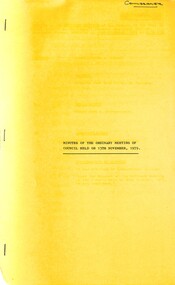
Administrative record - City of Sunshine - Commissioner Mr Alexander Alex George Gillon Collection 1976 - 1982 - Minutes of the ordinary meeting of council held on 13th November 1979, City of Sunshine, 13th November 1979
... ...Taylors Road...Minutes of the Ordinary Meeting of Council held on 13th November 1979 Report of the Town Clerk's Department Report of the Town Clerk Cleaning Contract Proposed Exercise of Option Proposed Deer Park Branch Library Deer Park Shopping Centre Constitution of Melbourne and Metropolitan Board of Works Proposed Variation Municipal Officers' (City of Sunshine) Award Creation of Carriage Easement Rosslare Estate Deer Park Proposed Variation of Lease Maribyrnong R.S.L Maribyrnong Hall Dickson Street Private Street Construction Scheme Trees & Shrubs for New Home Owners' Vouchers Extensions 27 Duke Street Report of the Co-Ordinator of Welfare Services Charging of Fees at Community Health Centres Work Test on Unemployment Benefits Family Day Care Co-Ordination Footscray Society for the Ages Subsidy for Children's Services Development Officer Family Day Care Special Needs Subsidy Report of the Chief Health Surveyor Smorgons Paper Plant Somerville Road Tottenham Application for Septic Tank Systems Braybrook Infant Welfare Centre Use by Braybrook Playgroup Infant Welfare Health Act Registrations for 1979 Prosecutions Proceedings Sunshine Magistrates Court Complaints Relating to Public Halls & Reception Rooms 44 Hampshire Road Sunshine Complaints Relating to Public Halls & Reception Rooms Brooklyn Community Hall Cypress Avenue Report of the Superintendent of Traffic & By-Laws Court Proceedings Parking and Traffic Infringements Dog Act Snake Eradication Lions Club of Deer Park Carols by Candlelight Shopping Trolleys Report of the City Engineer & Planner Proposed Shopping Centre Taylors Road Planning Permit Application Cafe and Amusement Lot 1 Parlour Derrimut Street Albion Planning Permit Application Transport Depot McDonald Road Brooklyn Planning Permit Application Transport Depot Lot 3 Francis Street Brooklyn Proposed Amendment No 115 to the Melbourne Metropolitan Planning Scheme Planning Permit Application Factory Lot 42 & 43 Western Avenue South East Corner of Fourth Avenue Planning Permit Application Factory Extension Lot 7 Berkshire Road North East Corner of Salisbury Street Planning Permit Application Internally Illuminated Sign South West Corner Tinto Close and Allandale Drive Deer Park Planning Permit Application Extension to Existing Educational Establishment Involving Agriculture and Animal Husbandry Corner Station Road and Middle Road Planning Permit Application St. ...Deer Park Branch Library Deer Park Shopping Centre Duke Street Smorgons Paper Plant Somerville Road Tottenham Braybrook Infant Welfare Centre Braybrook Playgroup Hampshire Road Brooklyn Community Hall Cypress Avenue Lions Club of Deer Park Deer Park Lions Club Taylors Road St. Albans Derrimut Street Albion McDonald Road Brooklyn Francis Street Western Avenue Fourth Avenue Berkshire Road Salisbury Street Sunshine North Tinto Close Allandale Drive Station Road Middle Road Derrimut St. ...Minutes of the Ordinary Meeting of Council held on 13th November 1979 Report of the Town Clerk's Department Report of the Town Clerk Cleaning Contract Proposed Exercise of Option Proposed Deer Park Branch Library Deer Park Shopping Centre Constitution of Melbourne and Metropolitan Board of Works Proposed Variation Municipal Officers' (City of Sunshine) Award Creation of Carriage Easement Rosslare Estate Deer Park Proposed Variation of Lease Maribyrnong R.S.L Maribyrnong Hall Dickson Street Private Street Construction Scheme Trees & Shrubs for New Home Owners' Vouchers Extensions 27 Duke Street Report of the Co-Ordinator of Welfare Services Charging of Fees at Community Health Centres Work Test on Unemployment Benefits Family Day Care Co-Ordination Footscray Society for the Ages Subsidy for Children's Services Development Officer Family Day Care Special Needs Subsidy Report of the Chief Health Surveyor Smorgons Paper Plant Somerville Road Tottenham Application for Septic Tank Systems Braybrook Infant Welfare Centre Use by Braybrook Playgroup Infant Welfare Health Act Registrations for 1979 Prosecutions Proceedings Sunshine Magistrates Court Complaints Relating to Public Halls & Reception Rooms 44 Hampshire Road Sunshine Complaints Relating to Public Halls & Reception Rooms Brooklyn Community Hall Cypress Avenue Report of the Superintendent of Traffic & By-Laws Court Proceedings Parking and Traffic Infringements Dog Act Snake Eradication Lions Club of Deer Park Carols by Candlelight Shopping Trolleys Report of the City Engineer & Planner Proposed Shopping Centre Taylors Road Planning Permit Application Cafe and Amusement Lot 1 Parlour Derrimut Street Albion Planning Permit Application Transport Depot McDonald Road Brooklyn Planning Permit Application Transport Depot Lot 3 Francis Street Brooklyn Proposed Amendment No 115 to the Melbourne Metropolitan Planning Scheme Planning Permit Application Factory Lot 42 & 43 Western Avenue South East Corner of Fourth Avenue Planning Permit Application Factory Extension Lot 7 Berkshire Road North East Corner of Salisbury Street Planning Permit Application Internally Illuminated Sign South West Corner Tinto Close and Allandale Drive Deer Park Planning Permit Application Extension to Existing Educational Establishment Involving Agriculture and Animal Husbandry Corner Station Road and Middle Road Planning Permit Application St. Albans Hotel Drive-In Bottle Shop McKechnie Street Planning Permit Application T.A.B. Hampshire Road Sunshine Sunshine View Estate Provision of Water and Sewerage Facilities Declaration of Sewerage Area No 3890 Lots 204 to 209 Mapledene Court and Lots 93 to 99 Dinnell Street Declaration of Sewerage Area No 3884 All Lots in Edward Street, Lots 280 to 278 and Lots 250 to 245 and 213 to Poole Street, Lots 207 to 194 Vincent Street, Lots 267 to 265, 264 to 262, 232. to 230, 229 to 227 and 193 to 191 Railway Parade South, Lots 190 to 188, 152, 151, 115 to 114 Railway Parade Deer Park Railway Station Weekend Volumes of Vehicles to Sunshine Tip Installation and Maintenance of Fire Hydrants Mowers Stolen from Reserves - Scovell Reserve, Barclay Reserve, Lloyd Reserve, Cranwell Park, Dempster Park, Errington Reserve & Pennell Reserve Francis Street Intersection Near Princess Highway East (Geelong Road) and Millers Road Station Road Widening Melbourne Metropolitan Planning Scheme Amendment No 81 Part 4 88 Station Road Deer Park Buckley Street / Main Road East Collector Road Melbourne Metropolitan Planning Scheme Amendment No 104 Traffic Control Items Metcon Signs Additions to Network Connor Shea and Chapman Street Report of the Building Surveyor Building Over Easement 31 Redditch Crescent Deer Park Building Over Easement Lot 20 Riverview Court Maribyrnong Brick Garage 37 Buckley Street Sunshine North 77 Oleander Drive St. Albans Underground Tank Application 31B Sun Crescent Fence 31 Oakland Street Maribyrnong Orders of the Day Accounts Submitted for Payment as at 25th October 1979 Sunshine View Estate Stage 2 Drainagemaribyrnong hall, raleigh road, maribyrnong, deer park library, deer park, dickson street, sunshine, maribyrnong r.s.l., deer park branch library, deer park shopping centre, duke street, smorgons paper plant, somerville road, tottenham, braybrook infant welfare centre, braybrook playgroup, hampshire road, brooklyn community hall, cypress avenue, lions club of deer park, deer park lions club, taylors road, st. albans, derrimut street, albion, mcdonald road, brooklyn, francis street, western avenue, fourth avenue, berkshire road, salisbury street, sunshine north, tinto close, allandale drive, station road, middle road, derrimut, st. albans hotel, mckechnie street, mapledene court, dinnell street, sunshine west, edward street, poole street, vincent street, railway parade, sunshine tip, scovell reserve, scovell crescent, maidstone, barclay reserve, king edward avenue, lloyd reserve, camperdown street, cranwell park, cranwell street, braybrook, dempster park, phoenix street, errington reserve, main road east, pennell reserve, burke street, princess highway, geelong road, millers road, buckley street, connor shea, chapman street, redditch crescent, riverview court, oleander drive, sun crescent, oakland street -
 Sunshine and District Historical Society Incorporated
Administrative record - City of Sunshine - Commissioner Mr Alexander "Alex" George Gillon Collection 1976 - 1982 - Minutes of the Ordinary Meeting of Council Held on 19th September 1978, City of Sunshine, 19th September 1978
... ...Taylors Road...Minutes of the Ordinary Meeting of Council Held on 19th September 1978 Report of the Town Clerk's Department Report of the Town Clerk Proposed Western Region Refuse Disposal Group Constitution of Representation on the Melbourne and Metropolitan Board of Works Municipal Clerks Conference Tasmania 13th to 17th November 1978 Home Help and Welfare Officers Subsidies Appointment of Auditor for Year 1978/79 Municipal Association Increase in Annual Subscriptions Federal Budget Effect on Municipal Finances Compulsory Acquisition Lots 43 & 44 Northumberland Road Compensation Report of the Chief Health Inspector Health Act Registrations Applications for Transfer of Proprietorship of Premises under the Health Act Prosecution Proceedings Sunshine Magistrates Court Approval to Use a Septic Tank System at Factory Premises Lot 310 Ayton Street Sunshine North Closure of Albion North Infant Welfare Centre Protean Environment Protection Appeal Application for Approval to Install a Septic Tank Recirculation Sand Filter System at the Stansfield Steel Product Fairbairn Road Sunshine West Application for Permission to Permit a Garage to be Occupied for Human Habitation at 19 Bardsley Street Sunshine West Report of the Medical Officer of Health Report of the Chief By-Laws Officer Court Proceedings Parking Infringements By-Laws Officer Course R.M.I.T. 20th October 1978 Limited Parking Ballarat Road Between Butler Street and Errol Street Braybrook Report of the City Librarian 1978 Library Week Amnesty Report of the City Engineer Planning Permit Flats North West Corner Cornwall Road and Monash Street Town Planning Appeal Planning Permit Flats Lot 9 Mernda Street Planning Permit Application Panel Beating Works & Spray-Painting Lot 219 McIntyre Road Sunshine North Planning Permit Application Sky Sign 556 Ballarat Road Albion Planning Permit Application Advertising Sign Highpoint Shopping Centre Lots 8, 9, 10, 11 & Part 12 Rosamond Road Melbourne Metropolitan Outline Plan for Cities of Keilor and Sunshine Amendment 70 Part 4A to the Melbourne Metropolitan Planning Scheme Planning Permit Application Nursing Home Lots 100 & 101 North Road Ardeer Proposed Shopping Centre Taylors Road St. Albans Planning Permit Application Maintenance Office Churchill Avenue Situated Between Churchill Avenue and Hargraves Crescent Planning Permit Application Place of Assembly for Unemployed Youth Contact Centre 818 Ballarat Road Deer Park Planning Permit Application Nursing Home Thomson Street Maidstone Planning Permit Sky Sign 86 Mitchell Street Planning Permit Application Private Tip Part Lot 35 Reid Street Albion & Advice to Denton Avenue Residents Planning Permit Flats 19 King Edward Avenue Planning Permit Application 21 Factories Lot 2 Burke Street & Lot 8 Mullenger Road Royal Australian Planning Institute 15th Congress Report Plan of Subdivision Reno Auto Sales Hampshire Road Corner Ballarat Road Plan of Subdivision Stage 8 Nickson's Estate Consolidated of Title Ballarat Road, Alford Street & Victor Street Shell Co of Aust Creation of Easement Lot 382 Newbury Street Consolidated of Title Glengala Road Between Links Street and Evelyn Crescent Consolidated of Title Verdun Street Plan of Transfer and Consolidation S.C.I. ...City of Sunshine Alexander "Alex" George Gillon Northumberland Road Sunshine North Albion North Infant Welfare Centre Stansfield Steel Product Fairbairn Road Sunshine West Bardsley Street Ballarat Road Butler Street Errol Street Braybrook Cornwall Road Monash Street Sunshine Mernda Street McIntyre Road Albion Highpoint Shopping Centre Rosamond Road Maribyrnong North Road Ardeer Taylors Road St. Albans Churchill Avenue Hargraves Crescent Deer Park Thomson Street Maidstone Mitchell Street Reid Street Denton Avenue King Edward Avenue Burke Street Mullenger Road Hampshire Road Alford Street Victor Street Newbury Street Links Street Glengala Road Evelyn Crescent Verdun Street Consolidation S.C.I. ...Minutes of the Ordinary Meeting of Council Held on 19th September 1978 Report of the Town Clerk's Department Report of the Town Clerk Proposed Western Region Refuse Disposal Group Constitution of Representation on the Melbourne and Metropolitan Board of Works Municipal Clerks Conference Tasmania 13th to 17th November 1978 Home Help and Welfare Officers Subsidies Appointment of Auditor for Year 1978/79 Municipal Association Increase in Annual Subscriptions Federal Budget Effect on Municipal Finances Compulsory Acquisition Lots 43 & 44 Northumberland Road Compensation Report of the Chief Health Inspector Health Act Registrations Applications for Transfer of Proprietorship of Premises under the Health Act Prosecution Proceedings Sunshine Magistrates Court Approval to Use a Septic Tank System at Factory Premises Lot 310 Ayton Street Sunshine North Closure of Albion North Infant Welfare Centre Protean Environment Protection Appeal Application for Approval to Install a Septic Tank Recirculation Sand Filter System at the Stansfield Steel Product Fairbairn Road Sunshine West Application for Permission to Permit a Garage to be Occupied for Human Habitation at 19 Bardsley Street Sunshine West Report of the Medical Officer of Health Report of the Chief By-Laws Officer Court Proceedings Parking Infringements By-Laws Officer Course R.M.I.T. 20th October 1978 Limited Parking Ballarat Road Between Butler Street and Errol Street Braybrook Report of the City Librarian 1978 Library Week Amnesty Report of the City Engineer Planning Permit Flats North West Corner Cornwall Road and Monash Street Town Planning Appeal Planning Permit Flats Lot 9 Mernda Street Planning Permit Application Panel Beating Works & Spray-Painting Lot 219 McIntyre Road Sunshine North Planning Permit Application Sky Sign 556 Ballarat Road Albion Planning Permit Application Advertising Sign Highpoint Shopping Centre Lots 8, 9, 10, 11 & Part 12 Rosamond Road Melbourne Metropolitan Outline Plan for Cities of Keilor and Sunshine Amendment 70 Part 4A to the Melbourne Metropolitan Planning Scheme Planning Permit Application Nursing Home Lots 100 & 101 North Road Ardeer Proposed Shopping Centre Taylors Road St. Albans Planning Permit Application Maintenance Office Churchill Avenue Situated Between Churchill Avenue and Hargraves Crescent Planning Permit Application Place of Assembly for Unemployed Youth Contact Centre 818 Ballarat Road Deer Park Planning Permit Application Nursing Home Thomson Street Maidstone Planning Permit Sky Sign 86 Mitchell Street Planning Permit Application Private Tip Part Lot 35 Reid Street Albion & Advice to Denton Avenue Residents Planning Permit Flats 19 King Edward Avenue Planning Permit Application 21 Factories Lot 2 Burke Street & Lot 8 Mullenger Road Royal Australian Planning Institute 15th Congress Report Plan of Subdivision Reno Auto Sales Hampshire Road Corner Ballarat Road Plan of Subdivision Stage 8 Nickson's Estate Consolidated of Title Ballarat Road, Alford Street & Victor Street Shell Co of Aust Creation of Easement Lot 382 Newbury Street Consolidated of Title Glengala Road Between Links Street and Evelyn Crescent Consolidated of Title Verdun Street Plan of Transfer and Consolidation S.C.I. Meat & Paper Pty Ltd and Ready Mix Concrete Somerville Road Strata Subdivision 17 St. Albans Road Tenders for Annual Supplies Annual Supply Bituminous Concrete Contract Contract Reconstruction of Sydney Street Contract Cypress Avenue Reinstatement Contract Cumberland Street Private Street Scheme Contract Sheffield Estate Private Street Scheme Finalisation of Cumberland Street Private Street Scheme Finalisation of Sheffield Estate Private Street Scheme Sewerage Facilities M.M.B.W. Statcon Signal Remodel Programme Deferred Payment of Costs Scheme Signal Installation Programme 1978/79 and Reranking of Statewide Listing for Deferred Payment Scheme Station Road Outfall Drain Through Commonwealth Property 9th A.R.R.B. Conference Brisbane Report Establishment of Recycling Depot at Sunshine Tip Bon Thomas Reserve Pre-School Centre Report of the Building Surveyor Australian Wool Corporation Francis Street Brooklyn 60 Allison Street Sunshine West Uniform Buildings Regulations Draft Amendment No 10 Report of the Director of Parks & Recreation Bon Thomas Reserve Development Barclay Reserve Metering od Facilities Orders of the Day Accounts Submitted for Payment as at 31st August 1978 Extraordinary Business Report of the Town Clerk Supplementary Valuations by Approved Report of the City Engineer Planning Permit Application Place of Assembly for Community Youth Support Scheme 20 Barnes Crescent Sunshine West Planning Permit Application Institutional Home Tallintyre Road Sunshine West Planning Permit Application Factory Extension to Existing Industrial Complex Scotland Street, Hillary Street & Rutland Street Braybrook Mines (Amendment) Bill 1978 Federated Municipal and Shire Council Employees Union National Safety Council of Australia city of sunshine, alexander "alex" george gillon, northumberland road, sunshine north, albion north infant welfare centre, stansfield steel product, fairbairn road, sunshine west, bardsley street, ballarat road, butler street, errol street, braybrook, cornwall road, monash street, sunshine, mernda street, mcintyre road, albion, highpoint shopping centre, rosamond road, maribyrnong, north road, ardeer, taylors road, st. albans, churchill avenue, hargraves crescent, deer park, thomson street, maidstone, mitchell street, reid street, denton avenue, king edward avenue, burke street, mullenger road, hampshire road, alford street, victor street, newbury street, links street, glengala road, evelyn crescent, verdun street, consolidation s.c.i. meat & paper pty ltd, somerville road, brooklyn, st. albans road, sydney street, cypress avenue, cumberland street, station road, bon thomas reserve pre-school centre, quinn street, sunshine tip, australian wool corporation, francis street, allison street, barclay reserve, barnes crescent, scotland street, hillary street, rutland street -
 Sunshine and District Historical Society Incorporated
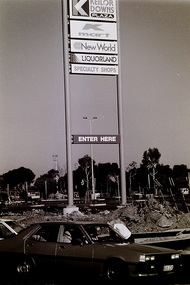
Photograph - Keilor Down Plaza Opening 1989 Photographs, Adam Ellwood, 27th November 1989
... ...Taylors Road...Keilor Downs Plaza Taylors Road Keilor Downs Opening of St. Albans Shopping Centre (Keilor Downs Plaza) 202.4 Digital scans of black and white negatives Photograph Keilor Down Plaza Opening 1989 Photographs Adam Ellwood The Sunshine Advocate ...The Keilor Downs Shopping Centre, now known as Keilor Central, began as a purpose‑built suburban retail hub in 1990 and has evolved through several ownership, branding, and expansion phases. It was developed as part of the rapid suburban growth of Keilor Downs in the late 1980s–early 1990s, coinciding with the opening of the Keilor Downs Post Office in May 1990. The plaza was anchored by major tenants including Kmart and Coles, establishing it as the suburb’s primary retail destination. These photographs, taken by The Advocate newspaper, were captured after months of anticipation and heavy publicity surrounding the opening of the new shopping centre. Despite the build‑up, the centre failed to open as planned due to an industrial dispute.These photographs provide a rare glimpse of the first major shopping centre in the Keilor Downs area opening. Much of the car parking infrastructure was not completed when the centre opened.Opening of St. Albans Shopping Centre (Keilor Downs Plaza) 202.4keilor downs plaza, taylors road, keilor downs -
 Sunshine and District Historical Society Incorporated
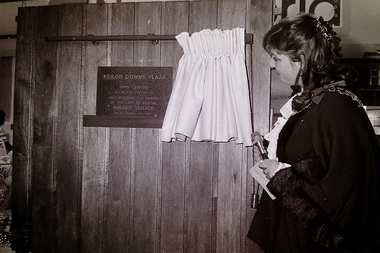
Photograph - Keilor Downs Shopping Centre Opening By Mayor Of Keilor Andrea Surace, Sharon Cavanagh, 13th December 1989
... ...Taylors Road...Keilor Downs Shopping Centre Keilor Downs Plaza Taylors Road Keilor Downs Andrea Surace Opening Of Keilor Downs Shopping Centre By Mayor Of Keilor 6762.01 - Keilor Downs Shopping Centre Opening By Mayor Of Keilor Andrea Surace 1989.JPG Andrea Surace, Mayor of Keilor 6762.02 - Keilor Downs Shopping Centre Opening By Mayor Of Keilor Andrea Surace 1989.JPG Andrea Surace, Mayor of Keilor 6762.03 - Keilor Downs Shopping Centre Opening By Mayor Of Keilor Andrea Surace 1989.JPG Andrea Surace, Mayor of Keilor 6762.04 - Keilor Downs Shopping Centre Opening By Mayor Of Keilor Andrea Surace 1989.JPG Michael Wood, The entrepreneur who steered the project to completion Digital scans of black and white negatives Photograph Keilor Downs Shopping Centre Opening By Mayor Of Keilor Andrea Surace Sharon Cavanagh The Sunshine Advocate ...The Keilor Downs Shopping Centre, now known as Keilor Central, began as a purpose‑built suburban retail hub in 1990 and has evolved through several ownership, branding, and expansion phases. It was developed as part of the rapid suburban growth of Keilor Downs in the late 1980s–early 1990s, coinciding with the opening of the Keilor Downs Post Office in May 1990. The plaza was anchored by major tenants including Kmart and Coles, establishing it as the suburb’s primary retail destination. These photographs, taken by The Advocate newspaper, capture the official opening of the new shopping centre. After months of construction, planning, and community interest, the ceremony marked a significant milestone for the district. Local dignitaries, business owners, and residents attended the event, reflecting the optimism surrounding the centre’s role in revitalising retail activity and providing a modern commercial hub for the surrounding suburbs.Opening Of Keilor Downs Shopping Centre By Mayor Of Keilor 6762.01 - Keilor Downs Shopping Centre Opening By Mayor Of Keilor Andrea Surace 1989.JPG Andrea Surace, Mayor of Keilor 6762.02 - Keilor Downs Shopping Centre Opening By Mayor Of Keilor Andrea Surace 1989.JPG Andrea Surace, Mayor of Keilor 6762.03 - Keilor Downs Shopping Centre Opening By Mayor Of Keilor Andrea Surace 1989.JPG Andrea Surace, Mayor of Keilor 6762.04 - Keilor Downs Shopping Centre Opening By Mayor Of Keilor Andrea Surace 1989.JPG Michael Wood, The entrepreneur who steered the project to completionkeilor downs shopping centre, keilor downs plaza, taylors road, keilor downs, andrea surace -
 Bendigo Historical Society Inc.
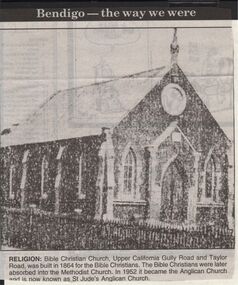
Newspaper - JENNY FOLEY COLLECTION: RELIGION
... Religion: Bible Christian Church, Upper California Gully Road and Taylor Road, was built in 1864 for the Bible Christians. ...Religion: Bible Christian Church, Upper California Gully Road and Taylor Road, was built in 1864 for the Bible Christians. ...Bendigo Advertiser "The way we were" from 1999. Religion: Bible Christian Church, Upper California Gully Road and Taylor Road, was built in 1864 for the Bible Christians. The Bible Christians were later absorbed into the Methodist Church. In 1952 it became the Anglican Church and is nopw known as St Jude's Anglican Church.newspaper, bendigo advertiser, the way we were -
 Whitehorse Historical Society Inc.
Article, Horse-And-Cart Man, 1950's
... An article about George Taylor of Quarry Road, Mitcham who mainly delivered firewood by horse and cart....Taylor George An article about George Taylor of Quarry Road, Mitcham who mainly delivered firewood by horse and cart. ...An article about George Taylor of Quarry Road, Mitcham who mainly delivered firewood by horse and cart.An article about George Taylor of Quarry Road, Mitcham who mainly delivered firewood by horse and cart.An article about George Taylor of Quarry Road, Mitcham who mainly delivered firewood by horse and cart.taylor, george -
 Sunshine and District Historical Society Incorporated
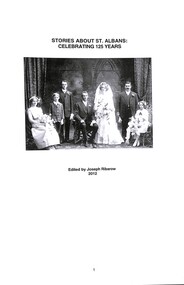
Document - Stories About St. Albans Celebrating 125 Years, Joseph "Joe" Ribarow, 2018 Revised and reprinted
... This attracted the new pioneers' families to the district, such as the McAuleys, Boyds, Andersons, Stevens, Colemans, Griffiths, McRaes, King and others to acquire land along Taylors Road and in the Western part of St. Albans through to Sydenham....This attracted the new pioneers' families to the district, such as the McAuleys, Boyds, Andersons, Stevens, Colemans, Griffiths, McRaes, King and others to acquire land along Taylors Road and in the Western part of St. Albans through to Sydenham. ...The most significant phase in the settlement of St. Albans occurred in the early 1900s when the Closer Settlement board subdivided Overnewton Estate into blocks of 200 to 300 acres and offered these for selection. This attracted the new pioneers' families to the district, such as the McAuleys, Boyds, Andersons, Stevens, Colemans, Griffiths, McRaes, King and others to acquire land along Taylors Road and in the Western part of St. Albans through to Sydenham.The stories in this document are about the families who are directly connected to the above era or came somewhat later, but all have contributed to the development of community. They are stories about transition of St. Albans from a sparse rural district to a number of crowded suburban neighborhoods.Stories About St. Albans Celebrating 125 Years Marion McAuley John Stevens Self and Goddard Jimmy Knowles Isabelle Davidson John Perrett Fred Barlowst. albans, john stevens, self and goddard, jimmy knowles, isabelle davidson, john perrett, fred barlow, marion mcauley -
 Bendigo Historical Society Inc.
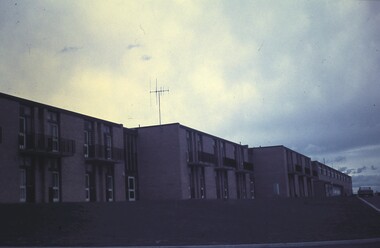
Slide - BENDIGO & EASTER FAIR, c1966
... Corner of Specimen Hill Road and Taylor Street, Golden Square (Bendigo)....Corner of Specimen Hill Road and Taylor Street, Golden Square (Bendigo). ...Bethlehem Home for the Aged. Corner of Specimen Hill Road and Taylor Street, Golden Square (Bendigo).slide, bendigo, bethlehem home, bethlehem home for the aged -
 Bendigo Historical Society Inc.
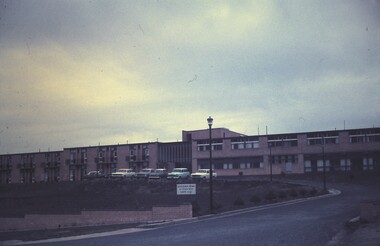
Slide - BENDIGO & EASTER FAIR, c1966
... Bethlehem Home for the Aged, corner Specimen Hill Road and Taylor street, Golden Square (Bendigo)....SLIDE Bendigo bethlehem Bethlehem Home for the Aged Bethlehem Home for the Aged, corner Specimen Hill Road and Taylor street, Golden Square (Bendigo). ...Bethlehem Home for the Aged, corner Specimen Hill Road and Taylor street, Golden Square (Bendigo).slide, bendigo, bethlehem, bethlehem home for the aged -
 Sunshine and District Historical Society Incorporated
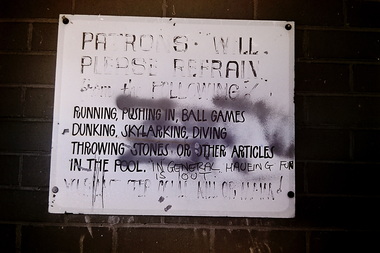
Photograph - Deer Park Swimming Pool Sassella Park Station Road Deer Park 1988 Photographs, The Sunshine Advocate, 15th June 1988
... Despite the campaign, the government instead built a new pool at Taylors Road, Keilor Downs, not Deer Park. The old Deer Park pool was demolished, and the site is now used as overflow parking for events at Sassella Park....Despite the campaign, the government instead built a new pool at Taylors Road, Keilor Downs, not Deer Park. The old Deer Park pool was demolished, and the site is now used as overflow parking for events at Sassella Park. ...A formal, concrete constructed swimming pool was built in the north‑east corner of Sassella Park, Station Road, Deer Park. Sassella Park itself was established in 1929 as a major sports ground for the district In 1972, the pool was ordered to close due to major leaks in the structure. The closure sparked significant community protest, with strong support from local residents and several councillors who wanted a new pool built on the same site. Despite the campaign, the government instead built a new pool at Taylors Road, Keilor Downs, not Deer Park. The old Deer Park pool was demolished, and the site is now used as overflow parking for events at Sassella Park.Bernard Reilly Deer Park Swimming Pool 532.2deer park swimming pool, sassella park, station road, deer park -
 Sunshine and District Historical Society Incorporated
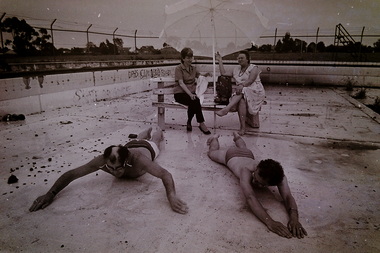
Photograph - Deer Park Swimming Pool Station Road Deer Park 1988 Photograph, Adam Ellwood, 21st October 1988
... Despite the campaign, the government instead built a new pool at Taylors Road, Keilor Downs, not Deer Park. The old Deer Park pool was demolished, and the site is now used as overflow parking for events at Sassella Park....Despite the campaign, the government instead built a new pool at Taylors Road, Keilor Downs, not Deer Park. The old Deer Park pool was demolished, and the site is now used as overflow parking for events at Sassella Park. ...A formal, concrete constructed swimming pool was built in the north‑east corner of Sassella Park, Station Road, Deer Park. Sassella Park itself was established in 1929 as a major sports ground for the district In 1972, the pool was ordered to close due to major leaks in the structure. The closure sparked significant community protest, with strong support from local residents and several councillors who wanted a new pool built on the same site. Despite the campaign, the government instead built a new pool at Taylors Road, Keilor Downs, not Deer Park. The old Deer Park pool was demolished, and the site is now used as overflow parking for events at Sassella Park.People in empty swimming pool Deer Park Swimming Pooldeer park swimming pool, sassella park, station road, deer park -
 Sunshine and District Historical Society Incorporated
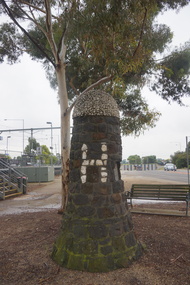
Photograph - Sydenham Hume & Hovell Cairn, John Alchin, 2020
... The monument has been moved twice due to road works as it was originally on the north‑west corner of Taylors Road & Sydenham Road. The first time it was relocated it was moved to position very close to the original position. ...The monument has been moved twice due to road works as it was originally on the north‑west corner of Taylors Road & Sydenham Road. The first time it was relocated it was moved to position very close to the original position. ...This is one of two Hume and Hovell Cairns erected in the City of Brimbank. The Sydenham cairn was erected on 19 December 1924, exactly 100 years after the explorers passed through the district. It was built by residents of St Albans and Sydenham as part of a statewide centenary program that installed 37 monuments along the expedition route. The monument has been moved twice due to road works as it was originally on the north‑west corner of Taylors Road & Sydenham Road. The first time it was relocated it was moved to position very close to the original position. The second time it was moved approximately 200 metres in a southerly direction and is now located at the Keilor Plains Station (East Esplanade). In November 2024, the Sydenham & District Historical Society held a 100‑year anniversary event for the cairn and a 200‑year anniversary of the 1824 expedition. Attendees included City of Brimbank Mayor Thuy Dang, Members of Natalie Suleyman MP’s office and local historians including Karen Schmidt and Bruce Lancashire. 5623.01 - Sydenham Hume And Hovell Monument 2nd April 2020 Photo 02.JPG 5623.02 - Sydenham Hume And Hovell Monument 2nd April 2020 Photo 03.JPG 5623.03 - Sydenham Hume And Hovell Monument 2nd April 2020 Photo 01.JPG Hume & Hovell passed here Dec. 19th 1824. Erected by Residents of St. Albans and Sydenham, December 19th 1924. sydenham, hume and hovell, keilor plains railway station -
 Sunshine and District Historical Society Incorporated
Archive - Monuments
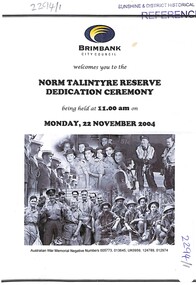
... 2294.01 - Flyer Norm Talintyre Reserve Dedication Ceremony 22 November 2004|2294.02 - Handwritten notes Survey of local monuments|2294.03 - Letter to Royal Historical Society of Victoria 21 November 1986 Victorian register of memorials|2294.04 - Questionaire Royal Historical Society of Victoria 7 August 1985 McKay Gates|2294.05 - Questionaire Royal Historical Society of Victoria 7 August 1985 War Memorial Maribyrnong Reserve|2294.06 - Questionaire Royal Historical Society of Victoria 7 August 1985 Hiroshima Day Plaque|2294.07 - Questionaire Royal Historical Society of Victoria 7 August 1985 Errington Reserve Gates|2294.08 - Questionaire Royal Historical Society of Victoria 7 August 1985 Memorial Cairn Hume and Hovell Cnr Taylors Road and Sydenham Road St Albans|2294.09 - Questionaire Royal Historical Society of Victoria 7 August 1985 Memorial Cairn Hume and Hovell Cnr Station Road and Ballarat Road Deer Park|2294.10 - Letter to MMBW 28 June 1985 Combined Historic Building Register|2294.11 - Barry Searle Note...District 2294.01 - Flyer Norm Talintyre Reserve Dedication Ceremony 22 November 2004|2294.02 - Handwritten notes Survey of local monuments|2294.03 - Letter to Royal Historical Society of Victoria 21 November 1986 Victorian register of memorials|2294.04 - Questionaire Royal Historical Society of Victoria 7 August 1985 McKay Gates|2294.05 - Questionaire Royal Historical Society of Victoria 7 August 1985 War Memorial Maribyrnong Reserve|2294.06 - Questionaire Royal Historical Society of Victoria 7 August 1985 Hiroshima Day Plaque|2294.07 - Questionaire Royal Historical Society of Victoria 7 August 1985 Errington Reserve Gates|2294.08 - Questionaire Royal Historical Society of Victoria 7 August 1985 Memorial Cairn Hume and Hovell Cnr Taylors Road and Sydenham Road St Albans|2294.09 - Questionaire Royal Historical Society of Victoria 7 August 1985 Memorial Cairn Hume and Hovell Cnr Station Road and Ballarat Road Deer Park|2294.10 - Letter to MMBW 28 June 1985 Combined Historic Building Register|2294.11 - Barry Searle Note Collection of documents relating to monuments in the district Archive Monuments ...2294.01 - Flyer Norm Talintyre Reserve Dedication Ceremony 22 November 2004|2294.02 - Handwritten notes Survey of local monuments|2294.03 - Letter to Royal Historical Society of Victoria 21 November 1986 Victorian register of memorials|2294.04 - Questionaire Royal Historical Society of Victoria 7 August 1985 McKay Gates|2294.05 - Questionaire Royal Historical Society of Victoria 7 August 1985 War Memorial Maribyrnong Reserve|2294.06 - Questionaire Royal Historical Society of Victoria 7 August 1985 Hiroshima Day Plaque|2294.07 - Questionaire Royal Historical Society of Victoria 7 August 1985 Errington Reserve Gates|2294.08 - Questionaire Royal Historical Society of Victoria 7 August 1985 Memorial Cairn Hume and Hovell Cnr Taylors Road and Sydenham Road St Albans|2294.09 - Questionaire Royal Historical Society of Victoria 7 August 1985 Memorial Cairn Hume and Hovell Cnr Station Road and Ballarat Road Deer Park|2294.10 - Letter to MMBW 28 June 1985 Combined Historic Building Register|2294.11 - Barry Searle Notedistrict -
 Sunshine and District Historical Society Incorporated
Document - Victorian Heritage Register Black Arch Rail Bridge Railway Culverts Sunshine Railway Signal Box & Hume & Hovell Cairn St Albans
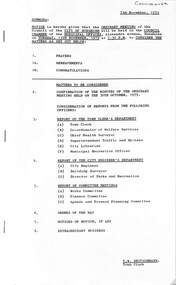
... Recommendation for inclusion are Black Arch Rail Bridge Sunshine road Sunshine Railway Culvert Sydenham Road St Albans Railway Culvert Victoria Road Sydenham Sunshine Railway Signal Box Hampshire road Sunshine Hume & Hovell Cairn East Esplanade & Taylors road St Albans|Victorian Heritage register Recommendation and determination on a nomination to the Victorian Heritage Register Black Arch rail bridge is not of sufficient cultural heritage|Victorian Heritage register Recommendation and determination on a nomination to the Victorian Heritage Register Railway Culvert Sydenham Road is not of sufficient cultural heritage|Victorian Heritage register Recommendation and determination on a nomination to the Victorian Heritage Register Railway culvert Victoria Road is not of sufficient cultural heritage|Victorian Heritage register Recommendation and determination on a nomination to the Victorian Heritage Register Sunshine Railway Signal Box Hampshire Road is not of sufficient cultural heritage|Victorian Heritage register Recommendation and determination on a nomination to the Victorian Heritage Register Hume and Hovell Cairn is not of sufficient cultural heritage|Resolution re Sunshine Signal Box to write to PTC December 1997|Newspaper Atricle The Advocate 28th September 1999 - 1880s area listed for the Victorian Heritage Register|Memoriam of Heritage Advice on Municipal Offices Alexander Avenue by Bryce Raworth Pty Ltd...Recommendation for inclusion are Black Arch Rail Bridge Sunshine road Sunshine Railway Culvert Sydenham Road St Albans Railway Culvert Victoria Road Sydenham Sunshine Railway Signal Box Hampshire road Sunshine Hume & Hovell Cairn East Esplanade & Taylors road St Albans|Victorian Heritage register Recommendation and determination on a nomination to the Victorian Heritage Register Black Arch rail bridge is not of sufficient cultural heritage|Victorian Heritage register Recommendation and determination on a nomination to the Victorian Heritage Register Railway Culvert Sydenham Road is not of sufficient cultural heritage|Victorian Heritage register Recommendation and determination on a nomination to the Victorian Heritage Register Railway culvert Victoria Road is not of sufficient cultural heritage|Victorian Heritage register Recommendation and determination on a nomination to the Victorian Heritage Register Sunshine Railway Signal Box Hampshire Road is not of sufficient cultural heritage|Victorian Heritage register Recommendation and determination on a nomination to the Victorian Heritage Register Hume and Hovell Cairn is not of sufficient cultural heritage|Resolution re Sunshine Signal Box to write to PTC December 1997|Newspaper Atricle The Advocate 28th September 1999 - 1880s area listed for the Victorian Heritage Register|Memoriam of Heritage Advice on Municipal Offices Alexander Avenue by Bryce Raworth Pty Ltd Collection of documents relating to nominations to the Victorian Heritage Register and determinations Document Victorian Heritage Register Black Arch Rail Bridge Railway Culverts Sunshine Railway Signal Box & Hume & Hovell Cairn St Albans ...Letter to Brimbank City Council for a Heritage Centre in the Harvester Site dated 3 December 1994|Letter from Heritage Victoria for items for inclusion in the Victorian Heritage Register for Railway Culverts and 039 Sunshine Railway Signal Box and H040 Black Arch Rail Bridge and Hume & Hovell Cairn St Albans but advised only recommended for inclusion at a local planning scheme level.|Letter from Tom Rigg to Heritage Victoria requesting for items to be included|Newspaper Article Herald Sun 18 June 2001 Inclusion as Heritage Place Trestle Bridge Arundel Road Keilor and HV McKay Memorial Gardens Anderson Road Sunshine. Recommendation for inclusion are Black Arch Rail Bridge Sunshine road Sunshine Railway Culvert Sydenham Road St Albans Railway Culvert Victoria Road Sydenham Sunshine Railway Signal Box Hampshire road Sunshine Hume & Hovell Cairn East Esplanade & Taylors road St Albans|Victorian Heritage register Recommendation and determination on a nomination to the Victorian Heritage Register Black Arch rail bridge is not of sufficient cultural heritage|Victorian Heritage register Recommendation and determination on a nomination to the Victorian Heritage Register Railway Culvert Sydenham Road is not of sufficient cultural heritage|Victorian Heritage register Recommendation and determination on a nomination to the Victorian Heritage Register Railway culvert Victoria Road is not of sufficient cultural heritage|Victorian Heritage register Recommendation and determination on a nomination to the Victorian Heritage Register Sunshine Railway Signal Box Hampshire Road is not of sufficient cultural heritage|Victorian Heritage register Recommendation and determination on a nomination to the Victorian Heritage Register Hume and Hovell Cairn is not of sufficient cultural heritage|Resolution re Sunshine Signal Box to write to PTC December 1997|Newspaper Atricle The Advocate 28th September 1999 - 1880s area listed for the Victorian Heritage Register|Memoriam of Heritage Advice on Municipal Offices Alexander Avenue by Bryce Raworth Pty Ltdsunshine, heritage -
 Sunshine and District Historical Society Incorporated
Administrative record - City of Sunshine - Commissioner Mr Alexander Alex George Gillon Collection 1976 - 1982 - Notice of ordinary meeting of the council 13th November 1979, City of Sunshine, 7th November 1979
... Notice of Ordinary Meeting of the Council 13th November 1979 Report of the Town Clerk's Department Report of the Town Clerk Cleaning Contract Proposed Exercise of Option Proposed Deer Park Branch Library Deer Park Shopping Centre Constitution of Melbourne and Metropolitan Board of Works Proposed Variation Municipal Officers' (City of Sunshine) Award Creation of Carriage Easement Rosslare Estate Deer Park Proposed Variation of Lease Maribyrnong R.S.L Maribyrnong Hall Dickson Street Private Street Construction Scheme Trees & Shrubs for New Home Owners' Vouchers Extensions 27 Duke Street Report of the Co-Ordinator of Welfare Services Charging of Fees at Community Health Centres Work Test on Unemployment Benefits Family Day Care Co-Ordination Footscray Society for the Ages Subsidy for Children's Services Development Officer Family Day Care Special Needs Subsidy Report of the Chief Health Surveyor Smorgons Paper Plant Somerville Road Tottenham Application for Septic Tank Systems Braybrook Infant Welfare Centre Use by Braybrook Playgroup Infant Welfare Health Act Registrations for 1979 Prosecutions Proceedings Sunshine Magistrates Court Complaints Relating to Public Halls & Reception Rooms 44 Hampshire Road Sunshine Complaints Relating to Public Halls & Reception Rooms Brooklyn Community Hall Cypress Avenue Report of the Superintendent of Traffic & By-Laws Court Proceedings Parking and Traffic Infringements Dog Act Snake Eradication Lions Club of Deer Park Carols by Candlelight Shopping Trolleys Report of the City Engineer & Planner Proposed Shopping Centre Taylors Road Planning Permit Application Cafe and Amusement Lot 1 Parlour Derrimut Street Albion Planning Permit Application Transport Depot McDonald Road Brooklyn Planning Permit Application Transport Depot Lot 3 Francis Street Brooklyn Proposed Amendment No 115 to the Melbourne Metropolitan Planning Scheme Planning Permit Application Factory Lot 42 & 43 Western Avenue South East Corner of Fourth Avenue Planning Permit Application Factory Extension Lot 7 Berkshire Road North East Corner of Salisbury Street Planning Permit Application Internally Illuminated Sign South West Corner Tinto Close and Allandale Drive Deer Park Planning Permit Application Extension to Existing Educational Establishment Involving Agriculture and Animal Husbandry Corner Station Road and Middle Road Planning Permit Application St. ...Albans Pennell Reserve Burke Street Princess Highway Geelong Road Millers Road Buckley Street Connor Shea Redditch Crescent Riverview Court Oleander Drive Sun Crescent Oakland Street Maidstone Notice of Ordinary Meeting of the Council 13th November 1979 Report of the Town Clerk's Department Report of the Town Clerk Cleaning Contract Proposed Exercise of Option Proposed Deer Park Branch Library Deer Park Shopping Centre Constitution of Melbourne and Metropolitan Board of Works Proposed Variation Municipal Officers' (City of Sunshine) Award Creation of Carriage Easement Rosslare Estate Deer Park Proposed Variation of Lease Maribyrnong R.S.L Maribyrnong Hall Dickson Street Private Street Construction Scheme Trees & Shrubs for New Home Owners' Vouchers Extensions 27 Duke Street Report of the Co-Ordinator of Welfare Services Charging of Fees at Community Health Centres Work Test on Unemployment Benefits Family Day Care Co-Ordination Footscray Society for the Ages Subsidy for Children's Services Development Officer Family Day Care Special Needs Subsidy Report of the Chief Health Surveyor Smorgons Paper Plant Somerville Road Tottenham Application for Septic Tank Systems Braybrook Infant Welfare Centre Use by Braybrook Playgroup Infant Welfare Health Act Registrations for 1979 Prosecutions Proceedings Sunshine Magistrates Court Complaints Relating to Public Halls & Reception Rooms 44 Hampshire Road Sunshine Complaints Relating to Public Halls & Reception Rooms Brooklyn Community Hall Cypress Avenue Report of the Superintendent of Traffic & By-Laws Court Proceedings Parking and Traffic Infringements Dog Act Snake Eradication Lions Club of Deer Park Carols by Candlelight Shopping Trolleys Report of the City Engineer & Planner Proposed Shopping Centre Taylors Road Planning Permit Application Cafe and Amusement Lot 1 Parlour Derrimut Street Albion Planning Permit Application Transport Depot McDonald Road Brooklyn Planning Permit Application Transport Depot Lot 3 Francis Street Brooklyn Proposed Amendment No 115 to the Melbourne Metropolitan Planning Scheme Planning Permit Application Factory Lot 42 & 43 Western Avenue South East Corner of Fourth Avenue Planning Permit Application Factory Extension Lot 7 Berkshire Road North East Corner of Salisbury Street Planning Permit Application Internally Illuminated Sign South West Corner Tinto Close and Allandale Drive Deer Park Planning Permit Application Extension to Existing Educational Establishment Involving Agriculture and Animal Husbandry Corner Station Road and Middle Road Planning Permit Application St. ...Notice of Ordinary Meeting of the Council 13th November 1979 Report of the Town Clerk's Department Report of the Town Clerk Cleaning Contract Proposed Exercise of Option Proposed Deer Park Branch Library Deer Park Shopping Centre Constitution of Melbourne and Metropolitan Board of Works Proposed Variation Municipal Officers' (City of Sunshine) Award Creation of Carriage Easement Rosslare Estate Deer Park Proposed Variation of Lease Maribyrnong R.S.L Maribyrnong Hall Dickson Street Private Street Construction Scheme Trees & Shrubs for New Home Owners' Vouchers Extensions 27 Duke Street Report of the Co-Ordinator of Welfare Services Charging of Fees at Community Health Centres Work Test on Unemployment Benefits Family Day Care Co-Ordination Footscray Society for the Ages Subsidy for Children's Services Development Officer Family Day Care Special Needs Subsidy Report of the Chief Health Surveyor Smorgons Paper Plant Somerville Road Tottenham Application for Septic Tank Systems Braybrook Infant Welfare Centre Use by Braybrook Playgroup Infant Welfare Health Act Registrations for 1979 Prosecutions Proceedings Sunshine Magistrates Court Complaints Relating to Public Halls & Reception Rooms 44 Hampshire Road Sunshine Complaints Relating to Public Halls & Reception Rooms Brooklyn Community Hall Cypress Avenue Report of the Superintendent of Traffic & By-Laws Court Proceedings Parking and Traffic Infringements Dog Act Snake Eradication Lions Club of Deer Park Carols by Candlelight Shopping Trolleys Report of the City Engineer & Planner Proposed Shopping Centre Taylors Road Planning Permit Application Cafe and Amusement Lot 1 Parlour Derrimut Street Albion Planning Permit Application Transport Depot McDonald Road Brooklyn Planning Permit Application Transport Depot Lot 3 Francis Street Brooklyn Proposed Amendment No 115 to the Melbourne Metropolitan Planning Scheme Planning Permit Application Factory Lot 42 & 43 Western Avenue South East Corner of Fourth Avenue Planning Permit Application Factory Extension Lot 7 Berkshire Road North East Corner of Salisbury Street Planning Permit Application Internally Illuminated Sign South West Corner Tinto Close and Allandale Drive Deer Park Planning Permit Application Extension to Existing Educational Establishment Involving Agriculture and Animal Husbandry Corner Station Road and Middle Road Planning Permit Application St. Albans Hotel Drive-In Bottle Shop McKechnie Street Planning Permit Application T.A.B. Hampshire Road Sunshine Sunshine View Estate Provision of Water and Sewerage Facilities Declaration of Sewerage Area No 3890 Lots 204 to 209 Mapledene Court and Lots 93 to 99 Dinnell Street Declaration of Sewerage Area No 3884 All Lots in Edward Street, Lots 280 to 278 and Lots 250 to 245 and 213 to Poole Street, Lots 207 to 194 Vincent Street, Lots 267 to 265, 264 to 262, 232. to 230, 229 to 227 and 193 to 191 Railway Parade South, Lots 190 to 188, 152, 151, 115 to 114 Railway Parade Deer Park Railway Station Weekend Volumes of Vehicles to Sunshine Tip Installation and Maintenance of Fire Hydrants Mowers Stolen from Reserves - Scovell Reserve, Barclay Reserve, Lloyd Reserve, Cranwell Park, Dempster Park, Errington Reserve & Pennell Reserve Francis Street Intersection Near Princess Highway East (Geelong Road) and Millers Road Station Road Widening Melbourne Metropolitan Planning Scheme Amendment No 81 Part 4 88 Station Road Deer Park Buckley Street / Main Road East Collector Road Melbourne Metropolitan Planning Scheme Amendment No 104 Traffic Control Items Metcon Signs Additions to Network Connor Shea and Chapman Street Report of the Building Surveyor Building Over Easement 31 Redditch Crescent Deer Park Building Over Easement Lot 20 Riverview Court Maribyrnong Brick Garage 37 Buckley Street Sunshine North 77 Oleander Drive St. Albans Underground Tank Application 31B Sun Crescent Fence 31 Oakland Street Maribyrnong Orders of the Day Accounts Submitted for Payment as at 25th October 1979 Sunshine View Estate Stage 2 Drainagedeer park library, duke street, sunshine, maribyrnong hall, raleigh road, maribyrnong, deer park shopping centre, deer park, dickson street, maribyrnong r.s.l., smorgons paper plant, somerville road, tottenham, braybrook infant welfare centre, braybrook playgroup, hampshire road, brooklyn community hall, cypress avenue, lions club of deer park, deer park lions club, derrimut street, albion, mcdonald road, francis street, western avenue, fourth avenue, berkshire road, salisbury street, sunshine north, tinto close, allandale drive, station road, middle road, derrimut, st. albans hotel, mckechnie street, mapledene court, dinnell street, sunshine west, edward street, poole street, vincent street, railway parade, sunshine tip, scovell reserve, scovell crescent, barclay reserve, king edward avenue, lloyd reserve, camperdown street, cranwell park, cranwell street, braybrook, dempster park, phoenix street, errington reserve, main road east, st. albans, pennell reserve, burke street, princess highway, geelong road, millers road, buckley street, connor shea, redditch crescent, riverview court, oleander drive, sun crescent, oakland street, maidstone -
 Sunshine and District Historical Society Incorporated
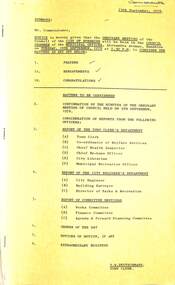
Administrative record - City of Sunshine - Commissioner Mr Alexander "Alex" George Gillon Collection 1976 - 1982 - Notice of the ordinary meeting of the Council of the city of Sunshine on 19th September 1978, City of Sunshine, 13th September 1978
... Notice of the ordinary meeting of the Council of the city of Sunshine on 19th September 1978 Report of the Town Clerk's Department Report of the Town Clerk Proposed Western Region Refuse Disposal Group Constitution of Representation on the Melbourne and Metropolitan Board of Works Municipal Clerks Conference Tasmania 13th to 17th November 1978 Home Help and Welfare Officers Subsidies Appointment of Auditor for Year 1978/79 Municipal Association Increase in Annual Subscriptions Federal Budget Effect on Municipal Finances Compulsory Acquisition Lots 43 & 44 Northumberland Road Compensation Report of the Chief Health Inspector Health Act Registrations Applications for Transfer of Proprietorship of Premises under the Health Act Prosecution Proceedings Sunshine Magistrates Court Approval to Use a Septic Tank System at Factory Premises Lot 310 Ayton Street Sunshine North Closure of Albion North Infant Welfare Centre Protean Environment Protection Appeal Application for Approval to Install a Septic Tank Recirculation Sand Filter System at the Stansfield Steel Product Fairbairn Road Sunshine West Application for Permission to Permit a Garage to be Occupied for Human Habitation at 19 Bardsley Street Sunshine West Report of the Medical Officer of Health Report of the Chief By-Laws Officer Court Proceedings Parking Infringements By-Laws Officer Course R.M.I.T. 20th October 1978 Limited Parking Ballarat Road Between Butler Street and Errol Street Braybrook Report of the City Librarian 1978 Library Week Amnesty Report of the City Engineer Planning Permit Flats North West Corner Cornwall Road and Monash Street Town Planning Appeal Planning Permit Flats Lot 9 Mernda Street Planning Permit Application Panel Beating Works & Spray-Painting Lot 219 McIntyre Road Sunshine North Planning Permit Application Sky Sign 556 Ballarat Road Albion Planning Permit Application Advertising Sign Highpoint Shopping Centre Lots 8, 9, 10, 11 & Part 12 Rosamond Road Melbourne Metropolitan Outline Plan for Cities of Keilor and Sunshine Amendment 70 Part 4A to the Melbourne Metropolitan Planning Scheme Planning Permit Application Nursing Home Lots 100 & 101 North Road Ardeer Proposed Shopping Centre Taylors Road St. Albans Planning Permit Application Maintenance Office Churchill Avenue Situated Between Churchill Avenue and Hargraves Crescent Planning Permit Application Place of Assembly for Unemployed Youth Contact Centre 818 Ballarat Road Deer Park Planning Permit Application Nursing Home Thomson Street Maidstone Planning Permit Sky Sign 86 Mitchell Street Planning Permit Application Private Tip Part Lot 35 Reid Street Albion & Advice to Denton Avenue Residents Planning Permit Flats 19 King Edward Avenue Planning Permit Application 21 Factories Lot 2 Burke Street & lot 8 Mullender Road Royal Australian Planning Institute 15th Congress Report Plan of Subdivision Reno Auto Sales Hampshire Road Corner Hampshire Road Plan of Subdivision Stage 8 Nickson's Estate Consolidated of Title Ballarat Road, Alford Street & Victor Street Shell Co of Aust Creation of Easement Lot 382 Newbury Street Consolidated of Title Glengala Road Between Links Street and Evelyn Crescent Consolidated of Title Verdun Street Plan of Transfer and Consolidation S.C.I. ...Albans Highpoint City Pre-School Rosamond Road Maribyrnong Errington Reserve Main Road East Sunshine City Band Fairbairn Road Ballarat Road Thomson Street King Edward Avenue Albion Cumberland Street Sunshine Tip Bon Thomas Reserve Pre-School Centre Notice of the ordinary meeting of the Council of the city of Sunshine on 19th September 1978 Report of the Town Clerk's Department Report of the Town Clerk Proposed Western Region Refuse Disposal Group Constitution of Representation on the Melbourne and Metropolitan Board of Works Municipal Clerks Conference Tasmania 13th to 17th November 1978 Home Help and Welfare Officers Subsidies Appointment of Auditor for Year 1978/79 Municipal Association Increase in Annual Subscriptions Federal Budget Effect on Municipal Finances Compulsory Acquisition Lots 43 & 44 Northumberland Road Compensation Report of the Chief Health Inspector Health Act Registrations Applications for Transfer of Proprietorship of Premises under the Health Act Prosecution Proceedings Sunshine Magistrates Court Approval to Use a Septic Tank System at Factory Premises Lot 310 Ayton Street Sunshine North Closure of Albion North Infant Welfare Centre Protean Environment Protection Appeal Application for Approval to Install a Septic Tank Recirculation Sand Filter System at the Stansfield Steel Product Fairbairn Road Sunshine West Application for Permission to Permit a Garage to be Occupied for Human Habitation at 19 Bardsley Street Sunshine West Report of the Medical Officer of Health Report of the Chief By-Laws Officer Court Proceedings Parking Infringements By-Laws Officer Course R.M.I.T. 20th October 1978 Limited Parking Ballarat Road Between Butler Street and Errol Street Braybrook Report of the City Librarian 1978 Library Week Amnesty Report of the City Engineer Planning Permit Flats North West Corner Cornwall Road and Monash Street Town Planning Appeal Planning Permit Flats Lot 9 Mernda Street Planning Permit Application Panel Beating Works & Spray-Painting Lot 219 McIntyre Road Sunshine North Planning Permit Application Sky Sign 556 Ballarat Road Albion Planning Permit Application Advertising Sign Highpoint Shopping Centre Lots 8, 9, 10, 11 & Part 12 Rosamond Road Melbourne Metropolitan Outline Plan for Cities of Keilor and Sunshine Amendment 70 Part 4A to the Melbourne Metropolitan Planning Scheme Planning Permit Application Nursing Home Lots 100 & 101 North Road Ardeer Proposed Shopping Centre Taylors Road St. Albans Planning Permit Application Maintenance Office Churchill Avenue Situated Between Churchill Avenue and Hargraves Crescent Planning Permit Application Place of Assembly for Unemployed Youth Contact Centre 818 Ballarat Road Deer Park Planning Permit Application Nursing Home Thomson Street Maidstone Planning Permit Sky Sign 86 Mitchell Street Planning Permit Application Private Tip Part Lot 35 Reid Street Albion & Advice to Denton Avenue Residents Planning Permit Flats 19 King Edward Avenue Planning Permit Application 21 Factories Lot 2 Burke Street & lot 8 Mullender Road Royal Australian Planning Institute 15th Congress Report Plan of Subdivision Reno Auto Sales Hampshire Road Corner Hampshire Road Plan of Subdivision Stage 8 Nickson's Estate Consolidated of Title Ballarat Road, Alford Street & Victor Street Shell Co of Aust Creation of Easement Lot 382 Newbury Street Consolidated of Title Glengala Road Between Links Street and Evelyn Crescent Consolidated of Title Verdun Street Plan of Transfer and Consolidation S.C.I. ...Notice of the ordinary meeting of the Council of the city of Sunshine on 19th September 1978 Report of the Town Clerk's Department Report of the Town Clerk Proposed Western Region Refuse Disposal Group Constitution of Representation on the Melbourne and Metropolitan Board of Works Municipal Clerks Conference Tasmania 13th to 17th November 1978 Home Help and Welfare Officers Subsidies Appointment of Auditor for Year 1978/79 Municipal Association Increase in Annual Subscriptions Federal Budget Effect on Municipal Finances Compulsory Acquisition Lots 43 & 44 Northumberland Road Compensation Report of the Chief Health Inspector Health Act Registrations Applications for Transfer of Proprietorship of Premises under the Health Act Prosecution Proceedings Sunshine Magistrates Court Approval to Use a Septic Tank System at Factory Premises Lot 310 Ayton Street Sunshine North Closure of Albion North Infant Welfare Centre Protean Environment Protection Appeal Application for Approval to Install a Septic Tank Recirculation Sand Filter System at the Stansfield Steel Product Fairbairn Road Sunshine West Application for Permission to Permit a Garage to be Occupied for Human Habitation at 19 Bardsley Street Sunshine West Report of the Medical Officer of Health Report of the Chief By-Laws Officer Court Proceedings Parking Infringements By-Laws Officer Course R.M.I.T. 20th October 1978 Limited Parking Ballarat Road Between Butler Street and Errol Street Braybrook Report of the City Librarian 1978 Library Week Amnesty Report of the City Engineer Planning Permit Flats North West Corner Cornwall Road and Monash Street Town Planning Appeal Planning Permit Flats Lot 9 Mernda Street Planning Permit Application Panel Beating Works & Spray-Painting Lot 219 McIntyre Road Sunshine North Planning Permit Application Sky Sign 556 Ballarat Road Albion Planning Permit Application Advertising Sign Highpoint Shopping Centre Lots 8, 9, 10, 11 & Part 12 Rosamond Road Melbourne Metropolitan Outline Plan for Cities of Keilor and Sunshine Amendment 70 Part 4A to the Melbourne Metropolitan Planning Scheme Planning Permit Application Nursing Home Lots 100 & 101 North Road Ardeer Proposed Shopping Centre Taylors Road St. Albans Planning Permit Application Maintenance Office Churchill Avenue Situated Between Churchill Avenue and Hargraves Crescent Planning Permit Application Place of Assembly for Unemployed Youth Contact Centre 818 Ballarat Road Deer Park Planning Permit Application Nursing Home Thomson Street Maidstone Planning Permit Sky Sign 86 Mitchell Street Planning Permit Application Private Tip Part Lot 35 Reid Street Albion & Advice to Denton Avenue Residents Planning Permit Flats 19 King Edward Avenue Planning Permit Application 21 Factories Lot 2 Burke Street & lot 8 Mullender Road Royal Australian Planning Institute 15th Congress Report Plan of Subdivision Reno Auto Sales Hampshire Road Corner Hampshire Road Plan of Subdivision Stage 8 Nickson's Estate Consolidated of Title Ballarat Road, Alford Street & Victor Street Shell Co of Aust Creation of Easement Lot 382 Newbury Street Consolidated of Title Glengala Road Between Links Street and Evelyn Crescent Consolidated of Title Verdun Street Plan of Transfer and Consolidation S.C.I. Meat & Paper Pty Ltd and Ready Mix Concrete Somerville Road Strata Subdivision 17 St. Albans Road Tenders for Annual Supplies Annual Supply Bituminous Concrete Contract Contract Reconstruction of Sydney Street Contract Cypress Avenue Reinstatement Contract Cumberland Street Private Street Scheme Contract Sheffield Estate Private Street Scheme Finalisation of Cumberland Street Private Street Scheme Finalisation of Sheffield Estate Private Street Scheme Sewerage Facilities M.M.B.W. Statcon Signal Remodel Programme Deferred Payment of Costs Scheme Signal Installation Programme 1978/79 and Reranking of Statewide Listing for Deferred Payment Scheme Station Road Outfall Drain Through Commonwealth Property 9th A.R.R.B. Conference Brisbane Report Establishment of Recycling Depot at Sunshine Tip Bon Thomas Reserve Pre-School Centre Report of the Building Surveyor Australian Wool Corporation Francis Street Brooklyn 60 Allison Street Sunshine West Uniform Buildings Regulations Draft Amendment No 10 Report of the Director of Parks & Recreation Bon Thomas Reserve Development Barclay Reserve Metering od Facilities Orders of the Day Accounts Submitted for Payment as at 31st August 1978 city of sunshine, alexander "alex" george gillon, macedon street, maidstone, fairbairn road pre-school, parsons reserve, stanford street, ralph street, robert bruce reserve, sunshine west, station road, deer park, tallingtyre reserve, kermeen street, bon thomas pre-school, quinn street, diamond avenue pre-school, diamond avenue, albanvale, orama street pre-school, orama street, st. albans, highpoint city pre-school, rosamond road, maribyrnong, errington reserve, main road east, sunshine city band, fairbairn road, ballarat road, thomson street, king edward avenue, albion, cumberland street, sunshine tip, bon thomas reserve pre-school centre -
 Sunshine and District Historical Society Incorporated
Document - Heritage Places Formerly With the City Of Sunshine 13th July 2009, Sunshine and District Historical Society Inc, 13th July 2009
... McKay Offices (Eastern portion of the complex) 2 Devonshire Road HO18 Albion VR DC Substation Talmage Street Albion H028 Pig And Calf Market 55 Market Road Brooklyn H029 Monsanto Chemicals Huntsman Chemical Co 455 Somerville Road Brooklyn H030 Deer Park Explosive Factories Complex Off Ballarat Road Deer Park H032 6737 - Heritage Places Formerly With the City Of Sunshine 13th July 2009 Page 2.jpg Heritage Place (Cont) Hume And Hovell Cairn Cnr Station Road And Ballarat Road Deer Park H034 Anderson Farm House 100 Taylors Road St. Albans HO36 Hume And Hovell Cairn East Esplanade St. ...McKay Offices (Eastern portion of the complex) 2 Devonshire Road HO18 Albion VR DC Substation Talmage Street Albion H028 Pig And Calf Market 55 Market Road Brooklyn H029 Monsanto Chemicals Huntsman Chemical Co 455 Somerville Road Brooklyn H030 Deer Park Explosive Factories Complex Off Ballarat Road Deer Park H032 6737 - Heritage Places Formerly With the City Of Sunshine 13th July 2009 Page 2.jpg Heritage Place (Cont) Hume And Hovell Cairn Cnr Station Road And Ballarat Road Deer Park H034 Anderson Farm House 100 Taylors Road St. Albans HO36 Hume And Hovell Cairn East Esplanade St. ...This list of City of Sunshine heritage‑listed properties is protected because they demonstrate important aspects of the area’s history — industrial innovation, early settlement, worker housing, civic development, and significant Aboriginal cultural landscapes. Heritage Listed Reference Numbers: Sunshine - Deer Park area 6737 - Heritage Places Formerly With the City Of Sunshine 13th July 2009 Page 1.jpg Heritage Precincts Commonwealth Munitions Housing Estate HO H019 Concrete Housing Estate Leith Avenue Sunshine HO H020 ICI Residential Area Deer Park HO H021 Sunshine Commercial Heritage Area HO H022 McKay Housing Estate Durham Road HOC H023 McKay Housing Estate King Edward Avenue HOC H024 Railway Estate Sunshine HO H025 War Service Homes Heritage Area Sunshine HO H026 Heritage Place Massey Ferguson Complex Devonshire Road Sunshine H03 John Darling & Son Flour Mill 74 Sydney Street Albion H04 Rail Bridge (Albion Viaduct) Over Maribyrnong River HO5 Black Powder Mill Parklea Avenue And Grassy Point Road Cairnlea HO6 Foxley Lodge Farm And Its Drystone Walls 472A Boundary Road Derrimut H08 1 Corio Steet Sunshine H09 H.V. McKay Memorial Gardens HO10 H.V. McKay Offices 2 Devonshire Road Sunshine HO11 Main Outfall Sewer Brimbank (Brooklyn) HO13 Mt. Derrimut Homestead, Its Drystone Walls And Associated Buildings Including The Meteorological Centre Mt. Derrimut Road Derrimut H017 H. V. McKay Offices (Eastern portion of the complex) 2 Devonshire Road HO18 Albion VR DC Substation Talmage Street Albion H028 Pig And Calf Market 55 Market Road Brooklyn H029 Monsanto Chemicals Huntsman Chemical Co 455 Somerville Road Brooklyn H030 Deer Park Explosive Factories Complex Off Ballarat Road Deer Park H032 6737 - Heritage Places Formerly With the City Of Sunshine 13th July 2009 Page 2.jpg Heritage Place (Cont) Hume And Hovell Cairn Cnr Station Road And Ballarat Road Deer Park H034 Anderson Farm House 100 Taylors Road St. Albans HO36 Hume And Hovell Cairn East Esplanade St. Albans H038 Sunshine Signal Box Off Hampshire Road H039 Black Arch Rail Bridge Sunshine Road Sunshine H040 Sugar Gum Row Talmage Street Albion H042 Railway Culvert Sydenham Road St. Albans HO43 Sunshine Advocate Office 11 - 15 Sun Crescent Sunshine H051 Keigilo, now Sacred Heart Presbytery 4 Winifred Street St. Albans HO52 H.V. McKay Memorial Gates Anderson Road Sunshine H053 H.V. McKay Memorial Presbyterian Church Anderson Road Sunshine H054 Sam McKay House And Garden 147 Anderson Road Sunshine H055 Former Sunshine Technical School Derby Road Sunshine H056 Former Sunshine Girls Technical School Derby Road Sunshine H057 Pedestrian Footbridge Over Railway 1 Devonshire Road Sunshine H058 House At 48 Station Place Sunshine H061 ANZ Bank Former ES&A Bank 115 Durham Road Sunshine H063 Sunshine Metropolitan Fire Station And Flats 330 Hampshire Road Sunshine H064 Derrimut Hotel 132 Durham Road Sunshine H065 St. Mark's Anglican Church 49 Suns Crescent Sunshine H066 Robinson House 33 Sun Crescent Sunshine H067 St. Theresa Catholic Church & School 26 Adelaide Street Albion H070 Curacloe H071 Former Wunderlich Now West End Market 47 - 49 McIntyre Road Sunshine North H073 Selwyn Park Albion H074 Sunshine Baptist Church 42 Ridley Street & 16 Sydney Street Albion H075 Cameron House & Dairy H076 6737 - Heritage Places Formerly With the City Of Sunshine 13th July 2009 Page 3.jpg Heritage Place (Cont) Houses & Trees 22 - 24 Talmage Street Albion H077 Ford (Solomon Ford) Burke Road To Canning Street Avondale Heights H079 Lions House Of Sunshine 8 Watt Street Sunshine H080 Guiding Star Hotel 700 Geelong Road Brooklyn H081 Hunt Club Hotel 775 Ballarat Road Deer Park H082 Deer Park Hotel 760 Ballarat Road Deer Park H083 Deer Park Primary School No 1434 812 Ballarat Road Deer Park H084 Opie's Dairy 2 - 4 Egan Street Deer Park H086 St. John's Anglican Church & Hall 2 - 4 Miles Street Deer Park H087 Neale Road Ford 192 Neale Road Deer Park H088 Deer Park Hall 50 Station Road Deer Park H089 Sunshine Market 13 - 19 City Place Sunshine H091 House St. Albans Estate 16 Arthur Street St. Albans HO98 St. Albans Uniting Church (Formerly Presbyterian) 24 - 26 East Esplanade St. Albans HO99 St. George's Free Serbian Orthodox Church 6 Kate Street St. Albans HO101 Errington Reserve & Memorial Gardens 309A Main Road East St. Albans HO102 St. Albans Community Hall Youth Club 309A Main Road East St. Albans HO103 Methodist Church & Hall 32 Devonshire Road Sunshine H0105 Macedonian Community Centre 45 Fourth Avenue Sunshine H0106 Hannah McKay House 145 Anderson Road Albion HO107 6737 - Heritage Places Formerly With the City Of Sunshine 13th July 2009 Page 4.jpg Heritage Place (Cont) Chemist Shop 234 Hampshire Road Sunshine H0108 Sunshine Municipal Offices 6 - 18 Alexandra Avenue Sunshine H0109 Sunshine Primary School 3113 111 Derby Road Sunshine H0110 Standard Steel 12 - 16 Market Road Sunshine H0111 Our Lady of the Immaculate Conception Catholic Church 93 Monash Street Sunshine H0113 Parsons House 114 Moris Street Sunshine H0114 Our Lady's School Station Place Monash Street Sunshine H0115 Palmas 2 Tyler Street Sunshine H0116 St. Andrews Greek Orthodox Church (Greek Cypriot) 14 Simmie Street Sunshine West H0119 William McKay House 150 Durham Road Sunshine H0121 Albion Primary School No 4265 61 - 81 Adelaide Street Albion H0122 Ralph's Meatworks 690 Geelong Road Brooklyn H0123 Former Church of Christ 81 - 83 Hampshire Road Sunshine H0125 Former Masonic Lodge No 226 93 Hampshire Road Sunshine H0126 Sunshine Picture Theatre 126 - 128 Hampshire Road Sunshine H0127 Shops 193 - 199 Hampshire Road Sunshine H0130 Ukrainian Catholic Church 2 Holmes Street Ardeer H0132 Shops 207 - 219 Hampshire Road Sunshine H0133 Victorian Row House 25 Benjamin Street Sunshine H0134 Victorian Row House 29 Benjamin Street Sunshine H0135 Victorian Row House 31 Benjamin Street Sunshine H0136 Victorian Row House 33 Benjamin Street Sunshine H0137 Victorian Row House 35 Benjamin Street Sunshine H0138 50 Forrest Street Albion H0139 -
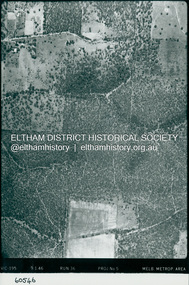 Eltham District Historical Society Inc
Photograph - Aerial Photograph, Landata, Eltham; Crown Allotment 15, Section 5, Parish of Nillumbik (Stokes Orchard Estate), Dec. 1945
... Taylor had extensive land holdings stretching west towards Bible Street and Main Road. ...Taylor had extensive land holdings stretching west towards Bible Street and Main Road. ...Centred on present day Diosma Rd, Stokes Pl, Nyora Rd and Eucalyptus Rd Historic Aerial Imagery Source: Landata.vic.gov.au Aerial Photo Details: Project No :5 Project : MELBOURNE AND METROPOLITAN AREA PROJECT Run : 36 Frame : 60546 Date : 12/1945 Film Type : B/W Camera : EAG4 Flying Height : 10200 Scale : 6000 Film Number : 195 GDA2020 : 37°42'47"S, 145°09'56"E MGA2020 : 338306, 5824438 (55) Melways : 22 C4 (ed. 42) A History of the Development of Crown Allotment 15, Section 5, Parish of Nillumbik – Stokes Orchard Crown Allotment 15, Section 5, Parish of Nillumbik (CA15) is a square allotment of 158 acres or approximately a quarter of a square mile. It lies just beyond the eastern end of Pitt Street, south of Nyora Road to the northern end of Eucalyptus Road and extends east from Eucalyptus Road to Reynolds Road. The topography of CA15 is generally steep, sloping up to a hill near the centre of the land, the ridgeline passing through the properties along the southern side of Diosma Road. Eucalyptus Road is a straight north-south road with its northern end at the north west corner of CA15. Until the end of the 1970s this road was an un-named Government Road and was largely not open to traffic. With residential development in the 1970s the road was constructed, and the council allocated the name obviously in recognition of the predominant species of the local bushland. CA15 was purchased from the Crown by George D’Arley Boursiquot, a prominent Melbourne printer, on 28th October 1852. On November 23, 1922, former Member for Gippsland and Melbourne Real Estate Agent, Hubert Patrick Keogh purchased the allotment then sold it March 13, 1925, to local farmer, Robert David Taylor, a former Shire of Eltham Councillor (1911-1920) and Shire President (1919). Taylor had extensive land holdings stretching west towards Bible Street and Main Road. The Taylor home was situated at the top of the hill in Bible Street at present day 82 Bible Street. At the time of Taylor’s purchase in 1925, CA15 was subdivided into 48 lots that could be described as small rural properties or large residential lots. A typical lot size was one hectare or 2.5 acres. The subdivision created two roads, Nyora Road, and Diosma Road, each following an irregular alignment between Eucalyptus and Reynolds Roads. However, the lots were not sold off separately nor were the roads constructed. The land effectively remained as one parcel for many further years. Robert David Taylor died November 30, 1934, and probate was granted to his son of the same name, Robert David Taylor of Bible Street, Salesman and William McLelland Vance Taylor of 73 Emmeline Street, Northcote, Clerk, with the transfer of the land into their names on July 8, 1935. Frank Stokes worked as a qualified accountant at Kennons leather factory in Burnley, while living at 1 Thomas Street, Mitcham. He suffered from migraines and wanted to return to working the land (he had previously worked on farms and orchards since coming to Australia from England in 1926, both in WA and Vic.). He first travelled to the district by train in July 1942 to find land with the intention to establish an orchard. By chance he met Arthur Bird of Bird Orchard (bounded by Pitt Street, Eucalyptus Road, and Wattle Grove) and they got talking over their common interest. Arthur put Frank up for the night and pointed out the land, 158 acres- part of the Taylor Estate- £900, Crown Allotment 15, Section 5, Parish of Nillumbik (CA15) somewhat diagonally opposite Bird Orchard. Stokes applied through the Riverina Agency to purchase the land who in turn applied for permission from Canberra to sell as there was a new government regulation introduced during the Second World War banning land sales except for immediate production. Stokes obtained a loan on his Mitcham house of £600 @ 5% and paid £450 deposit with quarterly payments of £15 spread over 5 years. Stokes was assisted and advised by Arthur Bird who farmed the neighbouring orchard. In early 1943 Stokes took possession and would catch the train out to Eltham on Fridays after work and began building a hut on the corner of Nyora Road and the Government Road (Eucalyptus Road) for shelter and to lock up tools. He established an orchard on the central western part of the land through the centre of which ran a natural waterway (part of the present-day linear park) and was able to pay a neighbour (Hawkins) to help with clearing and fencing 25 acres, and with a horse and single furrowed plough, planted approximately 2,500 fruit trees - cherries, peaches, plums, almonds, pears, apricots and lemons as well as a few apples and oranges; a massive task. Aerial photographs from the 1940s through to the 1990s clearly show the orchard with most of the larger CA15 site remaining as natural bushland. A huge problem was hares and rabbits eating all the new buds off the tiny trees. As well as laying poison he painted the trees with a mixture of cow manure and lime, often working by moonlight. Procurement of wire and wire netting was difficult because of the war but after much effort he obtained a permit from the Agricultural Department for supplies in March 1944. In February 1945 Stokes applied for a permit to build a “packing shed” as no house building was allowed. It was to be 33 feet x 21 feet and cost £312. It was constructed mostly from second-hand materials, which were hard to obtain, especially iron for roofing. Stokes finished work at Kennons on October 31, 1945, and in March 1946 he sold the family home at Mitcham for £1,230 plus £170 for furniture. On May 15, 1946, title to the CA15 property was issued to Frank Howard Alfred Stokes, Orchardist and Gladys Ethel Stokes, Married Woman, both of Pitt Street, Eltham. The family of five then moved into the very unfinished “packing shed” at Eltham, which was a struggle to weatherproof. Eventually rooms were divided off and lined with hessian bags and whitewashed. Their income was firewood (cut and sold), selling rockery stones and cut Sweet Bursaria. (It was discovered during the 1940s that Sweet Bursaria contained the sunscreen compound Aesculin. The RAAF utilised this compound from Sweet Bursaria during WW2 for pilots and gunners.) The orchard’s first fruit sale was a half-case of Le Vanq peaches in December 1947 for the price of 8 shillings. In 1956 plans for house were drawn and Glen Iris bricks purchased (1956 Olympic Rings variant). The building of the house commenced in 1957 - 12 feet of original packing shed was removed – and was completed in 1959. Water was connected from newly built pressure storage on the property at the end of 1959 and the electricity connection for the first time at 3pm on April 29, 1960. The house remains to present day (somewhat modified) at 1 Nyora Road, home to Nyora Studio Gallery. On occasions, spare remnants of the 1956 bricks have been known to be unearthed in gardens on the estate as they were utilised by Frank Stokes to fill in rabbit holes. On May 26, 1950, a parcel of land was compulsorily acquired by the Melbourne and Metropolitan Board of Works on the hilltop to establish an easement for a high-level service reservoir to augment Eltham’s water supply. The project also included pipe tracks for the necessary water mains. The reservoir has now been superseded by higher level water tanks east of Reynolds Road and its former site is now a public reserve. On November 27, 1964, the State Electricity Commission served notice to compulsorily acquire a further parcel through the eastern part of the land for a major electricity transmission line that augmented supply from the La Trobe Valley to Melbourne. The easement was registered February 11, 1966. The easement was widened July 18, 1969 for a second transmission line to be constructed. In 1971 Melbourne Metropolitan Planning Scheme amendments adopted Nyora Road as the boundary between a residential zone to the north and a rural zone to the south. This determined the future development of the land. In the mid-1970s the Shire of Eltham divided the orchard into numerous rate-able parcel lots, the 48 lots having been established in 1925 and the subsequent rates assessment proved unsustainable for Stokes. He commenced selling lots outside the boundary of the orchard, north of Diosma and South of Nyora. However shortly later the land between Nyora and Diosma Roads and west of the electricity easement was sold and subdivided into residential lots, a housing development by Macquarie Builders and marketed as the Stokes Orchard Estate. New streets were created, and most were named after trees, although one, Stokes Place, commemorates the former owners. The development was undertaken in two stages; Stage 1 (1975) encompassing Scarlet Ash Court, Ironbark Close and Peppermint Grove bounded by Nyora and Eucalyptus roads and Stage 2 (1978) encompassing Stokes Place, Orchard Way, The Crest and The Lookout bound by Nyora and Diosma roads. The developer, Macquarie Builders went bankrupt shortly after the release of Stage 2 leaving many purchasers to fend for themselves and arrange for their own independent builders. There were also difficulties with sewerage for the land immediately south of Diosma Road and so the conventional residential lots were abandoned in favour of larger lots. The development of Orchard Way, The Crest and The Lookout did not proceed as planned and the proposed lots were incorporated into five-acre parcels instead. These included a low-density group housing development by the Graves family and the award winning Choong House (1983) with Gordon Ford developed garden immediately next door situated on the ridge of the hill nestled amongst the original bush, Eucalypt trees and Sweet Bursaria. In 1994, Nillumbik Shire Council applied Significant Environment and Significant Landscape overlays upon the properties on the south side of Diosma Road to ensure protection of this natural bush garden environment. With the arrival of the sewer along Diosma Road in the 1990s, most of these five-acre parcels have since been subdivided multiple times. The Choong house presently sits on a 2.7-acre property, which in 2022 Nillumbik Council nominated for Cultural Significance Heritage protection and is considered potentially significant at State level. The Stokes family were also associated with the Eltham Christian Church. In the 1970s this church had met in temporary premises in Eltham. Lots of the original 1925 subdivision remained south of Nyora Road and a number of these lots were utilized for the Eltham Christian School, which was established by the Eltham Christian Church in 1981. The school operated on this site until 2000. The premises are now used by The Vine Baptist Church. By the mid-1980s the whole of CA15 had been developed for residential and school purposes, except for the sections north of Diosma Road and between the transmission lines and Reynolds Road. Sewerage issues had been resolved for the section north of Diosma Road and in 1987 it was in the process of being subdivided into residential lots. The development coincided with the discovery of colonies of the rare and endangered Eltham Copper Butterfly on the site. This resulted in a community and political campaign to save the butterfly habitat. With the co-operation of the land developer the subdivision was altered to create two bushland reserves in the critical butterfly habitat areas. In the late 1980s the State Government was investigating options for establishing a metropolitan ring road link between Diamond Creek and Ringwood. The chosen route was adjacent to Reynolds Road and so this created a freeze on development of CA15 between Reynolds Road and the electricity easement. The ring road proposal was eventually abandoned, and this part of the land was subdivided into low density residential lots. Diosma Road has been discontinued at the electricity easement and the eastern part incorporated into View Mount Court with access from Reynolds Road. The whole of CA15 has now been developed for residential or associated purposes, ranging from conventional density to quite low density south of Nyora Road. Some remnants of the orchard remain, a few cherry trees on the Graves property and a lone apple tree in Stokes Place. The butterfly reserves comprise significant areas of remnant bushland. Linear reserves through the estate link with central Eltham via the Woodridge linear reserve and with Research along the electricity easement. CA15 as it exists today has a complicated history of rural use, Government acquisition, urban development, and community action. References: • “Stokes Orchard, an incomplete history”; Russell Yeoman with Doug Orford • Correspondence, Beryl Bradbury (nee Stokes) • Aerial Photographs, 1931-1991, Landata (landata.vic.gov.au) • Certificate of Title, Vol. 4930 Fol. 985900 • Plan Number LP 10859 aerial photo, diosma road, eltham copper butterfly, eucalyptus road, ironbark close, nyora road, peppermint grove, peter & elizabeth pidgeon collection, power transmission lines, reynolds road, scarlet ash court, stokes orchard estate, stokes place, woodridge estate, frank stokes -
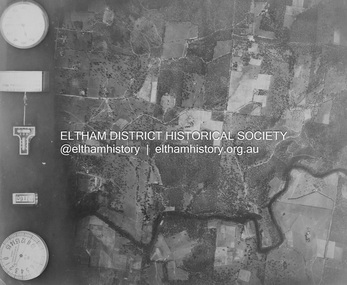 Eltham District Historical Society Inc
Photograph - Aerial Photograph, Landata, Eltham; Crown Allotment 15, Section 5, Parish of Nillumbik (Stokes Orchard Estate), Nov. 1931
... Taylor had extensive land holdings stretching west towards Bible Street and Main Road. ...Taylor had extensive land holdings stretching west towards Bible Street and Main Road. ...Centred over present day Reynolds Road and Mount Pleasant Road, Eltham (including Diosma Rd, Stokes Pl, Nyora Rd and Eucalyptus Rd) Historic Aerial Imagery Source: Landata.vic.gov.au Aerial Photo Details: Project No :1931 Project : MALDON PRISON Run : 21 Frame : 3160 Date : 11/1931 Film Type : B/W Camera : F8 Flying Height : 11000 Scale : 18860 Film Number : 60 GDA2020 : 37°43'31"S, 145°10'20"E MGA2020 : 338912, 5823086 (55) Melways : 22 E8 (ed. 42) A History of the Development of Crown Allotment 15, Section 5, Parish of Nillumbik – Stokes Orchard Crown Allotment 15, Section 5, Parish of Nillumbik (CA15) is a square allotment of 158 acres or approximately a quarter of a square mile. It lies just beyond the eastern end of Pitt Street, south of Nyora Road to the northern end of Eucalyptus Road and extends east from Eucalyptus Road to Reynolds Road. The topography of CA15 is generally steep, sloping up to a hill near the centre of the land, the ridgeline passing through the properties along the southern side of Diosma Road. Eucalyptus Road is a straight north-south road with its northern end at the north west corner of CA15. Until the end of the 1970s this road was an un-named Government Road and was largely not open to traffic. With residential development in the 1970s the road was constructed, and the council allocated the name obviously in recognition of the predominant species of the local bushland. CA15 was purchased from the Crown by George D’Arley Boursiquot, a prominent Melbourne printer, on 28th October 1852. On November 23, 1922, former Member for Gippsland and Melbourne Real Estate Agent, Hubert Patrick Keogh purchased the allotment then sold it March 13, 1925, to local farmer, Robert David Taylor, a former Shire of Eltham Councillor (1911-1920) and Shire President (1919). Taylor had extensive land holdings stretching west towards Bible Street and Main Road. The Taylor home was situated at the top of the hill in Bible Street at present day 82 Bible Street. At the time of Taylor’s purchase in 1925, CA15 was subdivided into 48 lots that could be described as small rural properties or large residential lots. A typical lot size was one hectare or 2.5 acres. The subdivision created two roads, Nyora Road, and Diosma Road, each following an irregular alignment between Eucalyptus and Reynolds Roads. However, the lots were not sold off separately nor were the roads constructed. The land effectively remained as one parcel for many further years. Robert David Taylor died November 30, 1934, and probate was granted to his son of the same name, Robert David Taylor of Bible Street, Salesman and William McLelland Vance Taylor of 73 Emmeline Street, Northcote, Clerk, with the transfer of the land into their names on July 8, 1935. Frank Stokes worked as a qualified accountant at Kennons leather factory in Burnley, while living at 1 Thomas Street, Mitcham. He suffered from migraines and wanted to return to working the land (he had previously worked on farms and orchards since coming to Australia from England in 1926, both in WA and Vic.). He first travelled to the district by train in July 1942 to find land with the intention to establish an orchard. By chance he met Arthur Bird of Bird Orchard (bounded by Pitt Street, Eucalyptus Road, and Wattle Grove) and they got talking over their common interest. Arthur put Frank up for the night and pointed out the land, 158 acres- part of the Taylor Estate- £900, Crown Allotment 15, Section 5, Parish of Nillumbik (CA15) somewhat diagonally opposite Bird Orchard. Stokes applied through the Riverina Agency to purchase the land who in turn applied for permission from Canberra to sell as there was a new government regulation introduced during the Second World War banning land sales except for immediate production. Stokes obtained a loan on his Mitcham house of £600 @ 5% and paid £450 deposit with quarterly payments of £15 spread over 5 years. Stokes was assisted and advised by Arthur Bird who farmed the neighbouring orchard. In early 1943 Stokes took possession and would catch the train out to Eltham on Fridays after work and began building a hut on the corner of Nyora Road and the Government Road (Eucalyptus Road) for shelter and to lock up tools. He established an orchard on the central western part of the land through the centre of which ran a natural waterway (part of the present-day linear park) and was able to pay a neighbour (Hawkins) to help with clearing and fencing 25 acres, and with a horse and single furrowed plough, planted approximately 2,500 fruit trees - cherries, peaches, plums, almonds, pears, apricots and lemons as well as a few apples and oranges; a massive task. Aerial photographs from the 1940s through to the 1990s clearly show the orchard with most of the larger CA15 site remaining as natural bushland. A huge problem was hares and rabbits eating all the new buds off the tiny trees. As well as laying poison he painted the trees with a mixture of cow manure and lime, often working by moonlight. Procurement of wire and wire netting was difficult because of the war but after much effort he obtained a permit from the Agricultural Department for supplies in March 1944. In February 1945 Stokes applied for a permit to build a “packing shed” as no house building was allowed. It was to be 33 feet x 21 feet and cost £312. It was constructed mostly from second-hand materials, which were hard to obtain, especially iron for roofing. Stokes finished work at Kennons on October 31, 1945, and in March 1946 he sold the family home at Mitcham for £1,230 plus £170 for furniture. On May 15, 1946, title to the CA15 property was issued to Frank Howard Alfred Stokes, Orchardist and Gladys Ethel Stokes, Married Woman, both of Pitt Street, Eltham. The family of five then moved into the very unfinished “packing shed” at Eltham, which was a struggle to weatherproof. Eventually rooms were divided off and lined with hessian bags and whitewashed. Their income was firewood (cut and sold), selling rockery stones and cut Sweet Bursaria. (It was discovered during the 1940s that Sweet Bursaria contained the sunscreen compound Aesculin. The RAAF utilised this compound from Sweet Bursaria during WW2 for pilots and gunners.) The orchard’s first fruit sale was a half-case of Le Vanq peaches in December 1947 for the price of 8 shillings. In 1956 plans for house were drawn and Glen Iris bricks purchased (1956 Olympic Rings variant). The building of the house commenced in 1957 - 12 feet of original packing shed was removed – and was completed in 1959. Water was connected from newly built pressure storage on the property at the end of 1959 and the electricity connection for the first time at 3pm on April 29, 1960. The house remains to present day (somewhat modified) at 1 Nyora Road, home to Nyora Studio Gallery. On occasions, spare remnants of the 1956 bricks have been known to be unearthed in gardens on the estate as they were utilised by Frank Stokes to fill in rabbit holes. On May 26, 1950, a parcel of land was compulsorily acquired by the Melbourne and Metropolitan Board of Works on the hilltop to establish an easement for a high-level service reservoir to augment Eltham’s water supply. The project also included pipe tracks for the necessary water mains. The reservoir has now been superseded by higher level water tanks east of Reynolds Road and its former site is now a public reserve. On November 27, 1964, the State Electricity Commission served notice to compulsorily acquire a further parcel through the eastern part of the land for a major electricity transmission line that augmented supply from the La Trobe Valley to Melbourne. The easement was registered February 11, 1966. The easement was widened July 18, 1969 for a second transmission line to be constructed. In 1971 Melbourne Metropolitan Planning Scheme amendments adopted Nyora Road as the boundary between a residential zone to the north and a rural zone to the south. This determined the future development of the land. In the mid-1970s the Shire of Eltham divided the orchard into numerous rate-able parcel lots, the 48 lots having been established in 1925 and the subsequent rates assessment proved unsustainable for Stokes. He commenced selling lots outside the boundary of the orchard, north of Diosma and South of Nyora. However shortly later the land between Nyora and Diosma Roads and west of the electricity easement was sold and subdivided into residential lots, a housing development by Macquarie Builders and marketed as the Stokes Orchard Estate. New streets were created, and most were named after trees, although one, Stokes Place, commemorates the former owners. The development was undertaken in two stages; Stage 1 (1975) encompassing Scarlet Ash Court, Ironbark Close and Peppermint Grove bounded by Nyora and Eucalyptus roads and Stage 2 (1978) encompassing Stokes Place, Orchard Way, The Crest and The Lookout bound by Nyora and Diosma roads. The developer, Macquarie Builders went bankrupt shortly after the release of Stage 2 leaving many purchasers to fend for themselves and arrange for their own independent builders. There were also difficulties with sewerage for the land immediately south of Diosma Road and so the conventional residential lots were abandoned in favour of larger lots. The development of Orchard Way, The Crest and The Lookout did not proceed as planned and the proposed lots were incorporated into five-acre parcels instead. These included a low-density group housing development by the Graves family and the award winning Choong House (1983) with Gordon Ford developed garden immediately next door situated on the ridge of the hill nestled amongst the original bush, Eucalypt trees and Sweet Bursaria. In 1994, Nillumbik Shire Council applied Significant Environment and Significant Landscape overlays upon the properties on the south side of Diosma Road to ensure protection of this natural bush garden environment. With the arrival of the sewer along Diosma Road in the 1990s, most of these five-acre parcels have since been subdivided multiple times. The Choong house presently sits on a 2.7-acre property, which in 2022 Nillumbik Council nominated for Cultural Significance Heritage protection and is considered potentially significant at State level. The Stokes family were also associated with the Eltham Christian Church. In the 1970s this church had met in temporary premises in Eltham. Lots of the original 1925 subdivision remained south of Nyora Road and a number of these lots were utilized for the Eltham Christian School, which was established by the Eltham Christian Church in 1981. The school operated on this site until 2000. The premises are now used by The Vine Baptist Church. By the mid-1980s the whole of CA15 had been developed for residential and school purposes, except for the sections north of Diosma Road and between the transmission lines and Reynolds Road. Sewerage issues had been resolved for the section north of Diosma Road and in 1987 it was in the process of being subdivided into residential lots. The development coincided with the discovery of colonies of the rare and endangered Eltham Copper Butterfly on the site. This resulted in a community and political campaign to save the butterfly habitat. With the co-operation of the land developer the subdivision was altered to create two bushland reserves in the critical butterfly habitat areas. In the late 1980s the State Government was investigating options for establishing a metropolitan ring road link between Diamond Creek and Ringwood. The chosen route was adjacent to Reynolds Road and so this created a freeze on development of CA15 between Reynolds Road and the electricity easement. The ring road proposal was eventually abandoned, and this part of the land was subdivided into low density residential lots. Diosma Road has been discontinued at the electricity easement and the eastern part incorporated into View Mount Court with access from Reynolds Road. The whole of CA15 has now been developed for residential or associated purposes, ranging from conventional density to quite low density south of Nyora Road. Some remnants of the orchard remain, a few cherry trees on the Graves property and a lone apple tree in Stokes Place. The butterfly reserves comprise significant areas of remnant bushland. Linear reserves through the estate link with central Eltham via the Woodridge linear reserve and with Research along the electricity easement. CA15 as it exists today has a complicated history of rural use, Government acquisition, urban development, and community action. References: • “Stokes Orchard, an incomplete history”; Russell Yeoman with Doug Orford • Correspondence, Beryl Bradbury (nee Stokes) • Aerial Photographs, 1931-1991, Landata (landata.vic.gov.au) • Certificate of Title, Vol. 4930 Fol. 985900 • Plan Number LP 10859 aerial photo, diosma road, eltham copper butterfly, eucalyptus road, ironbark close, nyora road, peppermint grove, peter & elizabeth pidgeon collection, power transmission lines, reynolds road, scarlet ash court, stokes orchard estate, stokes place, woodridge estate, frank stokes -
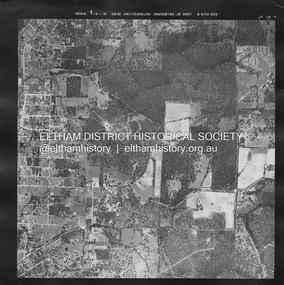 Eltham District Historical Society Inc
Photograph - Aerial Photograph, Landata, Eltham; Crown Allotment 15, Section 5, Parish of Nillumbik (Stokes Orchard Estate), Jan. 1951
... Taylor had extensive land holdings stretching west towards Bible Street and Main Road. ...Taylor had extensive land holdings stretching west towards Bible Street and Main Road. ...Centred on present day Diosma Rd, Stokes Pl, Nyora Rd and Eucalyptus Rd Historic Aerial Imagery Source: Landata.vic.gov.au Aerial Photo Details: Project No :65 Project : MELBOURNE AND METROPOLITAN PROJECT NO. 2 Run : 8 Frame : 71 Date : 01/1951 Film Type : B/W Camera : EAG9 Flying Height : 12200 Scale : 12000 Film Number : 1419 GDA2020 : 37°43'14"S, 145°09'46"E MGA2020 : 338081, 5823608 (55) Melways : 22 C6 (ed. 42) A History of the Development of Crown Allotment 15, Section 5, Parish of Nillumbik – Stokes Orchard Crown Allotment 15, Section 5, Parish of Nillumbik (CA15) is a square allotment of 158 acres or approximately a quarter of a square mile. It lies just beyond the eastern end of Pitt Street, south of Nyora Road to the northern end of Eucalyptus Road and extends east from Eucalyptus Road to Reynolds Road. The topography of CA15 is generally steep, sloping up to a hill near the centre of the land, the ridgeline passing through the properties along the southern side of Diosma Road. Eucalyptus Road is a straight north-south road with its northern end at the north west corner of CA15. Until the end of the 1970s this road was an un-named Government Road and was largely not open to traffic. With residential development in the 1970s the road was constructed, and the council allocated the name obviously in recognition of the predominant species of the local bushland. CA15 was purchased from the Crown by George D’Arley Boursiquot, a prominent Melbourne printer, on 28th October 1852. On November 23, 1922, former Member for Gippsland and Melbourne Real Estate Agent, Hubert Patrick Keogh purchased the allotment then sold it March 13, 1925, to local farmer, Robert David Taylor, a former Shire of Eltham Councillor (1911-1920) and Shire President (1919). Taylor had extensive land holdings stretching west towards Bible Street and Main Road. The Taylor home was situated at the top of the hill in Bible Street at present day 82 Bible Street. At the time of Taylor’s purchase in 1925, CA15 was subdivided into 48 lots that could be described as small rural properties or large residential lots. A typical lot size was one hectare or 2.5 acres. The subdivision created two roads, Nyora Road, and Diosma Road, each following an irregular alignment between Eucalyptus and Reynolds Roads. However, the lots were not sold off separately nor were the roads constructed. The land effectively remained as one parcel for many further years. Robert David Taylor died November 30, 1934, and probate was granted to his son of the same name, Robert David Taylor of Bible Street, Salesman and William McLelland Vance Taylor of 73 Emmeline Street, Northcote, Clerk, with the transfer of the land into their names on July 8, 1935. Frank Stokes worked as a qualified accountant at Kennons leather factory in Burnley, while living at 1 Thomas Street, Mitcham. He suffered from migraines and wanted to return to working the land (he had previously worked on farms and orchards since coming to Australia from England in 1926, both in WA and Vic.). He first travelled to the district by train in July 1942 to find land with the intention to establish an orchard. By chance he met Arthur Bird of Bird Orchard (bounded by Pitt Street, Eucalyptus Road, and Wattle Grove) and they got talking over their common interest. Arthur put Frank up for the night and pointed out the land, 158 acres- part of the Taylor Estate- £900, Crown Allotment 15, Section 5, Parish of Nillumbik (CA15) somewhat diagonally opposite Bird Orchard. Stokes applied through the Riverina Agency to purchase the land who in turn applied for permission from Canberra to sell as there was a new government regulation introduced during the Second World War banning land sales except for immediate production. Stokes obtained a loan on his Mitcham house of £600 @ 5% and paid £450 deposit with quarterly payments of £15 spread over 5 years. Stokes was assisted and advised by Arthur Bird who farmed the neighbouring orchard. In early 1943 Stokes took possession and would catch the train out to Eltham on Fridays after work and began building a hut on the corner of Nyora Road and the Government Road (Eucalyptus Road) for shelter and to lock up tools. He established an orchard on the central western part of the land through the centre of which ran a natural waterway (part of the present-day linear park) and was able to pay a neighbour (Hawkins) to help with clearing and fencing 25 acres, and with a horse and single furrowed plough, planted approximately 2,500 fruit trees - cherries, peaches, plums, almonds, pears, apricots and lemons as well as a few apples and oranges; a massive task. Aerial photographs from the 1940s through to the 1990s clearly show the orchard with most of the larger CA15 site remaining as natural bushland. A huge problem was hares and rabbits eating all the new buds off the tiny trees. As well as laying poison he painted the trees with a mixture of cow manure and lime, often working by moonlight. Procurement of wire and wire netting was difficult because of the war but after much effort he obtained a permit from the Agricultural Department for supplies in March 1944. In February 1945 Stokes applied for a permit to build a “packing shed” as no house building was allowed. It was to be 33 feet x 21 feet and cost £312. It was constructed mostly from second-hand materials, which were hard to obtain, especially iron for roofing. Stokes finished work at Kennons on October 31, 1945, and in March 1946 he sold the family home at Mitcham for £1,230 plus £170 for furniture. On May 15, 1946, title to the CA15 property was issued to Frank Howard Alfred Stokes, Orchardist and Gladys Ethel Stokes, Married Woman, both of Pitt Street, Eltham. The family of five then moved into the very unfinished “packing shed” at Eltham, which was a struggle to weatherproof. Eventually rooms were divided off and lined with hessian bags and whitewashed. Their income was firewood (cut and sold), selling rockery stones and cut Sweet Bursaria. (It was discovered during the 1940s that Sweet Bursaria contained the sunscreen compound Aesculin. The RAAF utilised this compound from Sweet Bursaria during WW2 for pilots and gunners.) The orchard’s first fruit sale was a half-case of Le Vanq peaches in December 1947 for the price of 8 shillings. In 1956 plans for house were drawn and Glen Iris bricks purchased (1956 Olympic Rings variant). The building of the house commenced in 1957 - 12 feet of original packing shed was removed – and was completed in 1959. Water was connected from newly built pressure storage on the property at the end of 1959 and the electricity connection for the first time at 3pm on April 29, 1960. The house remains to present day (somewhat modified) at 1 Nyora Road, home to Nyora Studio Gallery. On occasions, spare remnants of the 1956 bricks have been known to be unearthed in gardens on the estate as they were utilised by Frank Stokes to fill in rabbit holes. On May 26, 1950, a parcel of land was compulsorily acquired by the Melbourne and Metropolitan Board of Works on the hilltop to establish an easement for a high-level service reservoir to augment Eltham’s water supply. The project also included pipe tracks for the necessary water mains. The reservoir has now been superseded by higher level water tanks east of Reynolds Road and its former site is now a public reserve. On November 27, 1964, the State Electricity Commission served notice to compulsorily acquire a further parcel through the eastern part of the land for a major electricity transmission line that augmented supply from the La Trobe Valley to Melbourne. The easement was registered February 11, 1966. The easement was widened July 18, 1969 for a second transmission line to be constructed. In 1971 Melbourne Metropolitan Planning Scheme amendments adopted Nyora Road as the boundary between a residential zone to the north and a rural zone to the south. This determined the future development of the land. In the mid-1970s the Shire of Eltham divided the orchard into numerous rate-able parcel lots, the 48 lots having been established in 1925 and the subsequent rates assessment proved unsustainable for Stokes. He commenced selling lots outside the boundary of the orchard, north of Diosma and South of Nyora. However shortly later the land between Nyora and Diosma Roads and west of the electricity easement was sold and subdivided into residential lots, a housing development by Macquarie Builders and marketed as the Stokes Orchard Estate. New streets were created, and most were named after trees, although one, Stokes Place, commemorates the former owners. The development was undertaken in two stages; Stage 1 (1975) encompassing Scarlet Ash Court, Ironbark Close and Peppermint Grove bounded by Nyora and Eucalyptus roads and Stage 2 (1978) encompassing Stokes Place, Orchard Way, The Crest and The Lookout bound by Nyora and Diosma roads. The developer, Macquarie Builders went bankrupt shortly after the release of Stage 2 leaving many purchasers to fend for themselves and arrange for their own independent builders. There were also difficulties with sewerage for the land immediately south of Diosma Road and so the conventional residential lots were abandoned in favour of larger lots. The development of Orchard Way, The Crest and The Lookout did not proceed as planned and the proposed lots were incorporated into five-acre parcels instead. These included a low-density group housing development by the Graves family and the award winning Choong House (1983) with Gordon Ford developed garden immediately next door situated on the ridge of the hill nestled amongst the original bush, Eucalypt trees and Sweet Bursaria. In 1994, Nillumbik Shire Council applied Significant Environment and Significant Landscape overlays upon the properties on the south side of Diosma Road to ensure protection of this natural bush garden environment. With the arrival of the sewer along Diosma Road in the 1990s, most of these five-acre parcels have since been subdivided multiple times. The Choong house presently sits on a 2.7-acre property, which in 2022 Nillumbik Council nominated for Cultural Significance Heritage protection and is considered potentially significant at State level. The Stokes family were also associated with the Eltham Christian Church. In the 1970s this church had met in temporary premises in Eltham. Lots of the original 1925 subdivision remained south of Nyora Road and a number of these lots were utilized for the Eltham Christian School, which was established by the Eltham Christian Church in 1981. The school operated on this site until 2000. The premises are now used by The Vine Baptist Church. By the mid-1980s the whole of CA15 had been developed for residential and school purposes, except for the sections north of Diosma Road and between the transmission lines and Reynolds Road. Sewerage issues had been resolved for the section north of Diosma Road and in 1987 it was in the process of being subdivided into residential lots. The development coincided with the discovery of colonies of the rare and endangered Eltham Copper Butterfly on the site. This resulted in a community and political campaign to save the butterfly habitat. With the co-operation of the land developer the subdivision was altered to create two bushland reserves in the critical butterfly habitat areas. In the late 1980s the State Government was investigating options for establishing a metropolitan ring road link between Diamond Creek and Ringwood. The chosen route was adjacent to Reynolds Road and so this created a freeze on development of CA15 between Reynolds Road and the electricity easement. The ring road proposal was eventually abandoned, and this part of the land was subdivided into low density residential lots. Diosma Road has been discontinued at the electricity easement and the eastern part incorporated into View Mount Court with access from Reynolds Road. The whole of CA15 has now been developed for residential or associated purposes, ranging from conventional density to quite low density south of Nyora Road. Some remnants of the orchard remain, a few cherry trees on the Graves property and a lone apple tree in Stokes Place. The butterfly reserves comprise significant areas of remnant bushland. Linear reserves through the estate link with central Eltham via the Woodridge linear reserve and with Research along the electricity easement. CA15 as it exists today has a complicated history of rural use, Government acquisition, urban development, and community action. References: • “Stokes Orchard, an incomplete history”; Russell Yeoman with Doug Orford • Correspondence, Beryl Bradbury (nee Stokes) • Aerial Photographs, 1931-1991, Landata (landata.vic.gov.au) • Certificate of Title, Vol. 4930 Fol. 985900 • Plan Number LP 10859 aerial photo, diosma road, eltham copper butterfly, eucalyptus road, ironbark close, nyora road, peppermint grove, peter & elizabeth pidgeon collection, power transmission lines, reynolds road, scarlet ash court, stokes orchard estate, stokes place, woodridge estate, frank stokes -
 Eltham District Historical Society Inc
Photograph - Aerial Photograph, Landata, Eltham; Crown Allotment 15, Section 5, Parish of Nillumbik (Stokes Orchard Estate), Feb. 1956
... Taylor had extensive land holdings stretching west towards Bible Street and Main Road. ...Taylor had extensive land holdings stretching west towards Bible Street and Main Road. ...Centred on present day Diosma Rd, Stokes Pl, Nyora Rd and Eucalyptus Rd Historic Aerial Imagery Source: Landata.vic.gov.au Aerial Photo Details: Project No :250 Project : MELBOURNE OUTER SUBURBS PROJECT Run : 18 Frame : 94 Date : 02/1956 Film Type : B/W Camera : EAG9 Flying Height : 10000 Scale : 12000 Film Number : 1176 GDA2020 : 37°42'30"S, 145°09'44"E MGA2020 : 338008, 5824963 (55) Melways : 22 C3 (ed. 42) A History of the Development of Crown Allotment 15, Section 5, Parish of Nillumbik – Stokes Orchard Crown Allotment 15, Section 5, Parish of Nillumbik (CA15) is a square allotment of 158 acres or approximately a quarter of a square mile. It lies just beyond the eastern end of Pitt Street, south of Nyora Road to the northern end of Eucalyptus Road and extends east from Eucalyptus Road to Reynolds Road. The topography of CA15 is generally steep, sloping up to a hill near the centre of the land, the ridgeline passing through the properties along the southern side of Diosma Road. Eucalyptus Road is a straight north-south road with its northern end at the north west corner of CA15. Until the end of the 1970s this road was an un-named Government Road and was largely not open to traffic. With residential development in the 1970s the road was constructed, and the council allocated the name obviously in recognition of the predominant species of the local bushland. CA15 was purchased from the Crown by George D’Arley Boursiquot, a prominent Melbourne printer, on 28th October 1852. On November 23, 1922, former Member for Gippsland and Melbourne Real Estate Agent, Hubert Patrick Keogh purchased the allotment then sold it March 13, 1925, to local farmer, Robert David Taylor, a former Shire of Eltham Councillor (1911-1920) and Shire President (1919). Taylor had extensive land holdings stretching west towards Bible Street and Main Road. The Taylor home was situated at the top of the hill in Bible Street at present day 82 Bible Street. At the time of Taylor’s purchase in 1925, CA15 was subdivided into 48 lots that could be described as small rural properties or large residential lots. A typical lot size was one hectare or 2.5 acres. The subdivision created two roads, Nyora Road, and Diosma Road, each following an irregular alignment between Eucalyptus and Reynolds Roads. However, the lots were not sold off separately nor were the roads constructed. The land effectively remained as one parcel for many further years. Robert David Taylor died November 30, 1934, and probate was granted to his son of the same name, Robert David Taylor of Bible Street, Salesman and William McLelland Vance Taylor of 73 Emmeline Street, Northcote, Clerk, with the transfer of the land into their names on July 8, 1935. Frank Stokes worked as a qualified accountant at Kennons leather factory in Burnley, while living at 1 Thomas Street, Mitcham. He suffered from migraines and wanted to return to working the land (he had previously worked on farms and orchards since coming to Australia from England in 1926, both in WA and Vic.). He first travelled to the district by train in July 1942 to find land with the intention to establish an orchard. By chance he met Arthur Bird of Bird Orchard (bounded by Pitt Street, Eucalyptus Road, and Wattle Grove) and they got talking over their common interest. Arthur put Frank up for the night and pointed out the land, 158 acres- part of the Taylor Estate- £900, Crown Allotment 15, Section 5, Parish of Nillumbik (CA15) somewhat diagonally opposite Bird Orchard. Stokes applied through the Riverina Agency to purchase the land who in turn applied for permission from Canberra to sell as there was a new government regulation introduced during the Second World War banning land sales except for immediate production. Stokes obtained a loan on his Mitcham house of £600 @ 5% and paid £450 deposit with quarterly payments of £15 spread over 5 years. Stokes was assisted and advised by Arthur Bird who farmed the neighbouring orchard. In early 1943 Stokes took possession and would catch the train out to Eltham on Fridays after work and began building a hut on the corner of Nyora Road and the Government Road (Eucalyptus Road) for shelter and to lock up tools. He established an orchard on the central western part of the land through the centre of which ran a natural waterway (part of the present-day linear park) and was able to pay a neighbour (Hawkins) to help with clearing and fencing 25 acres, and with a horse and single furrowed plough, planted approximately 2,500 fruit trees - cherries, peaches, plums, almonds, pears, apricots and lemons as well as a few apples and oranges; a massive task. Aerial photographs from the 1940s through to the 1990s clearly show the orchard with most of the larger CA15 site remaining as natural bushland. A huge problem was hares and rabbits eating all the new buds off the tiny trees. As well as laying poison he painted the trees with a mixture of cow manure and lime, often working by moonlight. Procurement of wire and wire netting was difficult because of the war but after much effort he obtained a permit from the Agricultural Department for supplies in March 1944. In February 1945 Stokes applied for a permit to build a “packing shed” as no house building was allowed. It was to be 33 feet x 21 feet and cost £312. It was constructed mostly from second-hand materials, which were hard to obtain, especially iron for roofing. Stokes finished work at Kennons on October 31, 1945, and in March 1946 he sold the family home at Mitcham for £1,230 plus £170 for furniture. On May 15, 1946, title to the CA15 property was issued to Frank Howard Alfred Stokes, Orchardist and Gladys Ethel Stokes, Married Woman, both of Pitt Street, Eltham. The family of five then moved into the very unfinished “packing shed” at Eltham, which was a struggle to weatherproof. Eventually rooms were divided off and lined with hessian bags and whitewashed. Their income was firewood (cut and sold), selling rockery stones and cut Sweet Bursaria. (It was discovered during the 1940s that Sweet Bursaria contained the sunscreen compound Aesculin. The RAAF utilised this compound from Sweet Bursaria during WW2 for pilots and gunners.) The orchard’s first fruit sale was a half-case of Le Vanq peaches in December 1947 for the price of 8 shillings. In 1956 plans for house were drawn and Glen Iris bricks purchased (1956 Olympic Rings variant). The building of the house commenced in 1957 - 12 feet of original packing shed was removed – and was completed in 1959. Water was connected from newly built pressure storage on the property at the end of 1959 and the electricity connection for the first time at 3pm on April 29, 1960. The house remains to present day (somewhat modified) at 1 Nyora Road, home to Nyora Studio Gallery. On occasions, spare remnants of the 1956 bricks have been known to be unearthed in gardens on the estate as they were utilised by Frank Stokes to fill in rabbit holes. On May 26, 1950, a parcel of land was compulsorily acquired by the Melbourne and Metropolitan Board of Works on the hilltop to establish an easement for a high-level service reservoir to augment Eltham’s water supply. The project also included pipe tracks for the necessary water mains. The reservoir has now been superseded by higher level water tanks east of Reynolds Road and its former site is now a public reserve. On November 27, 1964, the State Electricity Commission served notice to compulsorily acquire a further parcel through the eastern part of the land for a major electricity transmission line that augmented supply from the La Trobe Valley to Melbourne. The easement was registered February 11, 1966. The easement was widened July 18, 1969 for a second transmission line to be constructed. In 1971 Melbourne Metropolitan Planning Scheme amendments adopted Nyora Road as the boundary between a residential zone to the north and a rural zone to the south. This determined the future development of the land. In the mid-1970s the Shire of Eltham divided the orchard into numerous rate-able parcel lots, the 48 lots having been established in 1925 and the subsequent rates assessment proved unsustainable for Stokes. He commenced selling lots outside the boundary of the orchard, north of Diosma and South of Nyora. However shortly later the land between Nyora and Diosma Roads and west of the electricity easement was sold and subdivided into residential lots, a housing development by Macquarie Builders and marketed as the Stokes Orchard Estate. New streets were created, and most were named after trees, although one, Stokes Place, commemorates the former owners. The development was undertaken in two stages; Stage 1 (1975) encompassing Scarlet Ash Court, Ironbark Close and Peppermint Grove bounded by Nyora and Eucalyptus roads and Stage 2 (1978) encompassing Stokes Place, Orchard Way, The Crest and The Lookout bound by Nyora and Diosma roads. The developer, Macquarie Builders went bankrupt shortly after the release of Stage 2 leaving many purchasers to fend for themselves and arrange for their own independent builders. There were also difficulties with sewerage for the land immediately south of Diosma Road and so the conventional residential lots were abandoned in favour of larger lots. The development of Orchard Way, The Crest and The Lookout did not proceed as planned and the proposed lots were incorporated into five-acre parcels instead. These included a low-density group housing development by the Graves family and the award winning Choong House (1983) with Gordon Ford developed garden immediately next door situated on the ridge of the hill nestled amongst the original bush, Eucalypt trees and Sweet Bursaria. In 1994, Nillumbik Shire Council applied Significant Environment and Significant Landscape overlays upon the properties on the south side of Diosma Road to ensure protection of this natural bush garden environment. With the arrival of the sewer along Diosma Road in the 1990s, most of these five-acre parcels have since been subdivided multiple times. The Choong house presently sits on a 2.7-acre property, which in 2022 Nillumbik Council nominated for Cultural Significance Heritage protection and is considered potentially significant at State level. The Stokes family were also associated with the Eltham Christian Church. In the 1970s this church had met in temporary premises in Eltham. Lots of the original 1925 subdivision remained south of Nyora Road and a number of these lots were utilized for the Eltham Christian School, which was established by the Eltham Christian Church in 1981. The school operated on this site until 2000. The premises are now used by The Vine Baptist Church. By the mid-1980s the whole of CA15 had been developed for residential and school purposes, except for the sections north of Diosma Road and between the transmission lines and Reynolds Road. Sewerage issues had been resolved for the section north of Diosma Road and in 1987 it was in the process of being subdivided into residential lots. The development coincided with the discovery of colonies of the rare and endangered Eltham Copper Butterfly on the site. This resulted in a community and political campaign to save the butterfly habitat. With the co-operation of the land developer the subdivision was altered to create two bushland reserves in the critical butterfly habitat areas. In the late 1980s the State Government was investigating options for establishing a metropolitan ring road link between Diamond Creek and Ringwood. The chosen route was adjacent to Reynolds Road and so this created a freeze on development of CA15 between Reynolds Road and the electricity easement. The ring road proposal was eventually abandoned, and this part of the land was subdivided into low density residential lots. Diosma Road has been discontinued at the electricity easement and the eastern part incorporated into View Mount Court with access from Reynolds Road. The whole of CA15 has now been developed for residential or associated purposes, ranging from conventional density to quite low density south of Nyora Road. Some remnants of the orchard remain, a few cherry trees on the Graves property and a lone apple tree in Stokes Place. The butterfly reserves comprise significant areas of remnant bushland. Linear reserves through the estate link with central Eltham via the Woodridge linear reserve and with Research along the electricity easement. CA15 as it exists today has a complicated history of rural use, Government acquisition, urban development, and community action. References: • “Stokes Orchard, an incomplete history”; Russell Yeoman with Doug Orford • Correspondence, Beryl Bradbury (nee Stokes) • Aerial Photographs, 1931-1991, Landata (landata.vic.gov.au) • Certificate of Title, Vol. 4930 Fol. 985900 • Plan Number LP 10859 aerial photo, diosma road, eltham copper butterfly, eucalyptus road, ironbark close, nyora road, peppermint grove, peter & elizabeth pidgeon collection, power transmission lines, reynolds road, scarlet ash court, stokes orchard estate, stokes place, woodridge estate, frank stokes -
 Eltham District Historical Society Inc
Photograph - Aerial Photograph, Landata, Eltham; Crown Allotment 15, Section 5, Parish of Nillumbik (Stokes Orchard Estate), Jan. 1962
... Taylor had extensive land holdings stretching west towards Bible Street and Main Road. ...Taylor had extensive land holdings stretching west towards Bible Street and Main Road. ...Centred on present day Diosma Rd, Stokes Pl, Nyora Rd and Eucalyptus Rd Historic Aerial Imagery Source: Landata.vic.gov.au Aerial Photo Details: Project No :539 Project : MELBOURNE-GEELONG PROJECT Run : 5 Frame : 14 Date : 01/1962 Film Type : B/W Camera : RC5 Flying Height : 6000 Scale : 15840 Film Number : 1524 GDA2020 : 37°42'42"S, 145°09'51"E MGA2020 : 338177, 5824603 (55) Melways : 22 C4 (ed. 42) A History of the Development of Crown Allotment 15, Section 5, Parish of Nillumbik – Stokes Orchard Crown Allotment 15, Section 5, Parish of Nillumbik (CA15) is a square allotment of 158 acres or approximately a quarter of a square mile. It lies just beyond the eastern end of Pitt Street, south of Nyora Road to the northern end of Eucalyptus Road and extends east from Eucalyptus Road to Reynolds Road. The topography of CA15 is generally steep, sloping up to a hill near the centre of the land, the ridgeline passing through the properties along the southern side of Diosma Road. Eucalyptus Road is a straight north-south road with its northern end at the north west corner of CA15. Until the end of the 1970s this road was an un-named Government Road and was largely not open to traffic. With residential development in the 1970s the road was constructed, and the council allocated the name obviously in recognition of the predominant species of the local bushland. CA15 was purchased from the Crown by George D’Arley Boursiquot, a prominent Melbourne printer, on 28th October 1852. On November 23, 1922, former Member for Gippsland and Melbourne Real Estate Agent, Hubert Patrick Keogh purchased the allotment then sold it March 13, 1925, to local farmer, Robert David Taylor, a former Shire of Eltham Councillor (1911-1920) and Shire President (1919). Taylor had extensive land holdings stretching west towards Bible Street and Main Road. The Taylor home was situated at the top of the hill in Bible Street at present day 82 Bible Street. At the time of Taylor’s purchase in 1925, CA15 was subdivided into 48 lots that could be described as small rural properties or large residential lots. A typical lot size was one hectare or 2.5 acres. The subdivision created two roads, Nyora Road, and Diosma Road, each following an irregular alignment between Eucalyptus and Reynolds Roads. However, the lots were not sold off separately nor were the roads constructed. The land effectively remained as one parcel for many further years. Robert David Taylor died November 30, 1934, and probate was granted to his son of the same name, Robert David Taylor of Bible Street, Salesman and William McLelland Vance Taylor of 73 Emmeline Street, Northcote, Clerk, with the transfer of the land into their names on July 8, 1935. Frank Stokes worked as a qualified accountant at Kennons leather factory in Burnley, while living at 1 Thomas Street, Mitcham. He suffered from migraines and wanted to return to working the land (he had previously worked on farms and orchards since coming to Australia from England in 1926, both in WA and Vic.). He first travelled to the district by train in July 1942 to find land with the intention to establish an orchard. By chance he met Arthur Bird of Bird Orchard (bounded by Pitt Street, Eucalyptus Road, and Wattle Grove) and they got talking over their common interest. Arthur put Frank up for the night and pointed out the land, 158 acres- part of the Taylor Estate- £900, Crown Allotment 15, Section 5, Parish of Nillumbik (CA15) somewhat diagonally opposite Bird Orchard. Stokes applied through the Riverina Agency to purchase the land who in turn applied for permission from Canberra to sell as there was a new government regulation introduced during the Second World War banning land sales except for immediate production. Stokes obtained a loan on his Mitcham house of £600 @ 5% and paid £450 deposit with quarterly payments of £15 spread over 5 years. Stokes was assisted and advised by Arthur Bird who farmed the neighbouring orchard. In early 1943 Stokes took possession and would catch the train out to Eltham on Fridays after work and began building a hut on the corner of Nyora Road and the Government Road (Eucalyptus Road) for shelter and to lock up tools. He established an orchard on the central western part of the land through the centre of which ran a natural waterway (part of the present-day linear park) and was able to pay a neighbour (Hawkins) to help with clearing and fencing 25 acres, and with a horse and single furrowed plough, planted approximately 2,500 fruit trees - cherries, peaches, plums, almonds, pears, apricots and lemons as well as a few apples and oranges; a massive task. Aerial photographs from the 1940s through to the 1990s clearly show the orchard with most of the larger CA15 site remaining as natural bushland. A huge problem was hares and rabbits eating all the new buds off the tiny trees. As well as laying poison he painted the trees with a mixture of cow manure and lime, often working by moonlight. Procurement of wire and wire netting was difficult because of the war but after much effort he obtained a permit from the Agricultural Department for supplies in March 1944. In February 1945 Stokes applied for a permit to build a “packing shed” as no house building was allowed. It was to be 33 feet x 21 feet and cost £312. It was constructed mostly from second-hand materials, which were hard to obtain, especially iron for roofing. Stokes finished work at Kennons on October 31, 1945, and in March 1946 he sold the family home at Mitcham for £1,230 plus £170 for furniture. On May 15, 1946, title to the CA15 property was issued to Frank Howard Alfred Stokes, Orchardist and Gladys Ethel Stokes, Married Woman, both of Pitt Street, Eltham. The family of five then moved into the very unfinished “packing shed” at Eltham, which was a struggle to weatherproof. Eventually rooms were divided off and lined with hessian bags and whitewashed. Their income was firewood (cut and sold), selling rockery stones and cut Sweet Bursaria. (It was discovered during the 1940s that Sweet Bursaria contained the sunscreen compound Aesculin. The RAAF utilised this compound from Sweet Bursaria during WW2 for pilots and gunners.) The orchard’s first fruit sale was a half-case of Le Vanq peaches in December 1947 for the price of 8 shillings. In 1956 plans for house were drawn and Glen Iris bricks purchased (1956 Olympic Rings variant). The building of the house commenced in 1957 - 12 feet of original packing shed was removed – and was completed in 1959. Water was connected from newly built pressure storage on the property at the end of 1959 and the electricity connection for the first time at 3pm on April 29, 1960. The house remains to present day (somewhat modified) at 1 Nyora Road, home to Nyora Studio Gallery. On occasions, spare remnants of the 1956 bricks have been known to be unearthed in gardens on the estate as they were utilised by Frank Stokes to fill in rabbit holes. On May 26, 1950, a parcel of land was compulsorily acquired by the Melbourne and Metropolitan Board of Works on the hilltop to establish an easement for a high-level service reservoir to augment Eltham’s water supply. The project also included pipe tracks for the necessary water mains. The reservoir has now been superseded by higher level water tanks east of Reynolds Road and its former site is now a public reserve. On November 27, 1964, the State Electricity Commission served notice to compulsorily acquire a further parcel through the eastern part of the land for a major electricity transmission line that augmented supply from the La Trobe Valley to Melbourne. The easement was registered February 11, 1966. The easement was widened July 18, 1969 for a second transmission line to be constructed. In 1971 Melbourne Metropolitan Planning Scheme amendments adopted Nyora Road as the boundary between a residential zone to the north and a rural zone to the south. This determined the future development of the land. In the mid-1970s the Shire of Eltham divided the orchard into numerous rate-able parcel lots, the 48 lots having been established in 1925 and the subsequent rates assessment proved unsustainable for Stokes. He commenced selling lots outside the boundary of the orchard, north of Diosma and South of Nyora. However shortly later the land between Nyora and Diosma Roads and west of the electricity easement was sold and subdivided into residential lots, a housing development by Macquarie Builders and marketed as the Stokes Orchard Estate. New streets were created, and most were named after trees, although one, Stokes Place, commemorates the former owners. The development was undertaken in two stages; Stage 1 (1975) encompassing Scarlet Ash Court, Ironbark Close and Peppermint Grove bounded by Nyora and Eucalyptus roads and Stage 2 (1978) encompassing Stokes Place, Orchard Way, The Crest and The Lookout bound by Nyora and Diosma roads. The developer, Macquarie Builders went bankrupt shortly after the release of Stage 2 leaving many purchasers to fend for themselves and arrange for their own independent builders. There were also difficulties with sewerage for the land immediately south of Diosma Road and so the conventional residential lots were abandoned in favour of larger lots. The development of Orchard Way, The Crest and The Lookout did not proceed as planned and the proposed lots were incorporated into five-acre parcels instead. These included a low-density group housing development by the Graves family and the award winning Choong House (1983) with Gordon Ford developed garden immediately next door situated on the ridge of the hill nestled amongst the original bush, Eucalypt trees and Sweet Bursaria. In 1994, Nillumbik Shire Council applied Significant Environment and Significant Landscape overlays upon the properties on the south side of Diosma Road to ensure protection of this natural bush garden environment. With the arrival of the sewer along Diosma Road in the 1990s, most of these five-acre parcels have since been subdivided multiple times. The Choong house presently sits on a 2.7-acre property, which in 2022 Nillumbik Council nominated for Cultural Significance Heritage protection and is considered potentially significant at State level. The Stokes family were also associated with the Eltham Christian Church. In the 1970s this church had met in temporary premises in Eltham. Lots of the original 1925 subdivision remained south of Nyora Road and a number of these lots were utilized for the Eltham Christian School, which was established by the Eltham Christian Church in 1981. The school operated on this site until 2000. The premises are now used by The Vine Baptist Church. By the mid-1980s the whole of CA15 had been developed for residential and school purposes, except for the sections north of Diosma Road and between the transmission lines and Reynolds Road. Sewerage issues had been resolved for the section north of Diosma Road and in 1987 it was in the process of being subdivided into residential lots. The development coincided with the discovery of colonies of the rare and endangered Eltham Copper Butterfly on the site. This resulted in a community and political campaign to save the butterfly habitat. With the co-operation of the land developer the subdivision was altered to create two bushland reserves in the critical butterfly habitat areas. In the late 1980s the State Government was investigating options for establishing a metropolitan ring road link between Diamond Creek and Ringwood. The chosen route was adjacent to Reynolds Road and so this created a freeze on development of CA15 between Reynolds Road and the electricity easement. The ring road proposal was eventually abandoned, and this part of the land was subdivided into low density residential lots. Diosma Road has been discontinued at the electricity easement and the eastern part incorporated into View Mount Court with access from Reynolds Road. The whole of CA15 has now been developed for residential or associated purposes, ranging from conventional density to quite low density south of Nyora Road. Some remnants of the orchard remain, a few cherry trees on the Graves property and a lone apple tree in Stokes Place. The butterfly reserves comprise significant areas of remnant bushland. Linear reserves through the estate link with central Eltham via the Woodridge linear reserve and with Research along the electricity easement. CA15 as it exists today has a complicated history of rural use, Government acquisition, urban development, and community action. References: • “Stokes Orchard, an incomplete history”; Russell Yeoman with Doug Orford • Correspondence, Beryl Bradbury (nee Stokes) • Aerial Photographs, 1931-1991, Landata (landata.vic.gov.au) • Certificate of Title, Vol. 4930 Fol. 985900 • Plan Number LP 10859 aerial photo, diosma road, eltham copper butterfly, eucalyptus road, ironbark close, nyora road, peppermint grove, peter & elizabeth pidgeon collection, power transmission lines, reynolds road, scarlet ash court, stokes orchard estate, stokes place, woodridge estate, frank stokes
