
Showing 7 items matching "temporary markings"
-
 Moorabbin Air Museum
Book - RAAF Mirage Aircraft - General & Technical Information, Mirage III O Colours & Markings
... ...Temporary markings...RAAF Mirage Aircraft - General & Technical Information Protective measures Lizards Standard fare Special colours & markings Body paint Temporary markings Walk around Overview of RAAF Mirage colour schemes & markings for modellers & enthusiasts, circa 2014 Mirage III O Colours & Markings Book RAAF Mirage Aircraft - General & Technical Information ...Overview of RAAF Mirage colour schemes & markings for modellers & enthusiasts, circa 2014non-fictionOverview of RAAF Mirage colour schemes & markings for modellers & enthusiasts, circa 2014protective measures, lizards, standard fare, special colours & markings, body paint, temporary markings, walk around -
 Kiewa Valley Historical Society
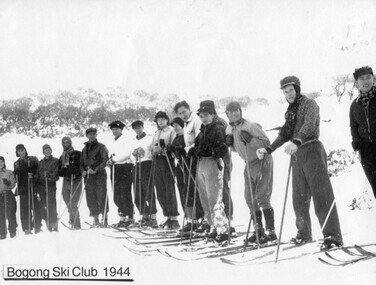
Photographs –Collection of 10 copies and original black and white photographs and printed articles relating to skiing on the Bogong High Plains
... markings 6 & 7 Short article relating to photos on each page 8. Handwritten signature on rear of photo (Sandra Conea) 10 Faded unreadable photographers stamp and handwritten numbers 6875 on rear Collection of 10 copies and original black and white photographs and printed articles relating to skiing on the Bogong High Plains. Some pieces have been enlarged to A3 poster size copies for display purposes 1. Copy of black and white photograph of group of skiers at Falls Creek 2. Copy of photograph of early skier on Bogong High Plains with temporary ...After World War II, the Kiewa Hydro-Electric Scheme was started in the Kiewa River Valley by the State Electricity Commission of Victoria. On land previously used only for summer cattle grazing in the natural alpine grasslands, the first ski lodge was built in 1948 by workers from the hydro scheme as skiing was a popular recreation. Many of the hydro employees were of European background and had grown up enjoying skiing and snow sports in their homelands and were keen to continue to pursue their winter sports interests. The first lift, a rope tow, was built in 1951 at Falls Creek and the first chairlift in Australia was constructed there in 1957. Two T-Bars were opened in 1961. In 1964, the Victorian Municipal Directory recorded that Falls Creek had 29 ski club lodges and 16 commercial lodges. The area became a popular tourist destination for both winter and summer sports.: Employees of the State Electricity Commission of Victoria in the Kiewa River Valley were the earliest skiers on the Bogong High Plains and built one of the first ski lodges at Falls Creek. They were amongst those pivotal in the development of the skiing and tourist industry at Falls Creek and on the Bogong High Plains. Collection of 10 copies and original black and white photographs and printed articles relating to skiing on the Bogong High Plains. Some pieces have been enlarged to A3 poster size copies for display purposes 1. Copy of black and white photograph of group of skiers at Falls Creek 2. Copy of photograph of early skier on Bogong High Plains with temporary buildings and tents in the background 3. Copy of photograph of 3 skiers on Mt McKay 4. Copy of SECV photograph of Rocky Valley Camp under snow 5. Early sepia photograph of Falls Creek village with skiers in the foreground 6. Copy of a page from booklet (SECV?) promoting the benefits of owning a holiday home in the Bogong Village area 7. Copy of a page from booklet (SECV?) promoting the benefits of holidaying in and around Falls Creek/Mt Beauty 8. Panoramic view of ski fields with skis in the foreground 9. Photograph of young skier (identity unknown) 10. Photograph of 2 male skiers (identity unknown) performing a small jump 1. Bogong Ski Club Members & Friends 1944 2. Jack Neve – electrician. Rocky Valley 3. 17.5.55 Skiers ascending Mt McKay 4. State Electricity Commission of Victoria. Date:17.8.55 No:K8132 Kiewa Hydro Electric Works. Rocky Valley Camp – From Engineering Office 5 & 9 No markings 6 & 7 Short article relating to photos on each page 8. Handwritten signature on rear of photo (Sandra Conea) 10 Faded unreadable photographers stamp and handwritten numbers 6875 on rear secv; bogong high plains; skiers; falls creek; tourism -
 Kiewa Valley Historical Society
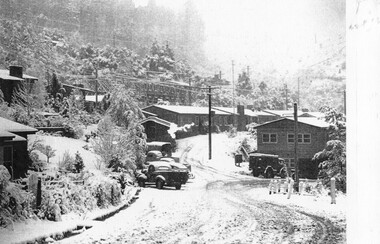
Photographs – Set of 9 black and white photographs and photocopies of original photographs depicting the early days of Bogong Village during the 1940’s, circa 1940's
... temporary buildings and the housing and the amount of infrastructure required to accommodate the needs of the residents of the area including workers, their families and other support staff. Bogong Village; 1939 fires; Kiewa Hydro Electric Scheme; 1. Handwritten under photo – August 1948 2. Printed under photo: STATE ELECTRICITY COMMISSION OF VICTORIA Date: 25.8.48 Time: 9am No:K 4680 Kiewa Hydro-Electric Works. Bogong Township 3. Handwritten on back of photo- V.I.P. Lodge, Bogong 4 – 5. No markings ...Bogong Village, which was known as “The Junction”, is well recorded. The first tent camp was at the junction of Pretty Valley and Rocky Valley streams in the early 40’s. Further downstream were the sawmill, stables and blacksmith’s forge. Horses were the main mode of transport in the early days. The road to Bogong had reached the lookout spur just beyond Roper’s Spur track just before the 1939 fires. The early forties saw rapid growth of the village, with single and married men’s quarters, workshops, mess huts and administrative offices. The facilities necessary for communal living were quickly in place- a post office, police station, co-op store, medical centre, community hall/theatre, tennis courts and school. Much of the temporary accommodation that housed groups such as the Albion Quarrying Company were in the area now under water.Pictorial history of the early years of Bogong Village including one photo taken following the devastating fires of 1939. Photos show the terrain in which Bogong Village was built, the early construction used for the temporary buildings and the housing and the amount of infrastructure required to accommodate the needs of the residents of the area including workers, their families and other support staff. Set of 9 black and white photographs and photocopies of photographs depicting early buildings at Bogong Village . Photos show very early construction buildings as well as the village in various weather conditions, including snowing and after bush fires. (some official SECV photographs) 1. Bogong Village in heavy snow 2. Bogong Township during heavy snow (SECV Official Photo) 3. VIP Lodge at Bogong in the snow 4. Bogong Village - circa 1940’s 5. Bogong Village under street lights 6. Lewis Construction Camp (SECV Official Photo) 7. Albion Quarrying Co. Camp (SECV Official Photo) 8. Tent camp and early buildings following 1939 fires 9. Typical house – Bogong Village 1. Handwritten under photo – August 1948 2. Printed under photo: STATE ELECTRICITY COMMISSION OF VICTORIA Date: 25.8.48 Time: 9am No:K 4680 Kiewa Hydro-Electric Works. Bogong Township 3. Handwritten on back of photo- V.I.P. Lodge, Bogong 4 – 5. No markings 6. Printed under photo: STATE ELECTRICITY COMMISSION OF VICTORIA Date: 28.11.40 Time: 1.40pm No:K284 Kiewa Hydro-Electric Works. Lewis Construction Camp 7. Printed under photo: STATE ELECTRICITY COMMISSION OF VICTORIA Date: 11.1.41 Time: 10.40am No:K294 Kiewa Hydro-Electric Works. Albion Quarrying Co. Camp – Bogong. Handwritten on back of photo: On the floor of the present dam 8. No markings 9. Printed under photo: STATE ELECTRICITY COMMISSION OF VICTORIA Date: 11.1.46 Time: 1.23pm No:K2181 Kiewa Hydro-Electric Works. Bogong – Typical House bogong village; 1939 fires; kiewa hydro electric scheme; -
 Nillumbik Shire Council
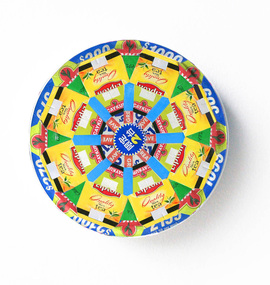
Collage: Elizabeth GOWER (b.1952 SA, AUS -), Cycles 7, 2015
... This series was made ‘in transit’ during the artist’s recent studio residencies at Point[B], New York and Laughing Waters, Eltham, and at three temporary studios in Rome, Berlin and Collingwood. cycles, gower, collage, pattern, logos, commercialism, consumerism, repurpose, recycle, riverbend, laughing waters No inscriptions and markings Kaleidoscope pattern of multiple segments (logos-Lipton tea) from commercial (food) catalogues on commercial packaging (cardboard - round lid). ...The 'Cycles' series is an extension of two large scale provisional installations '150 Rotations', Melbourne Now, National Gallery of Victoria, and '356 Rotations', AC Institute in New York, which also re-purposed and aestheticised multiple paper units into hundreds of circular motifs.The immediate tactile connection with the material excesses and detritus of contemporary consumer culture informs the theoretical framework and conceptual understanding of Gower's practice, and associates her work with ideas of recovery and re-purpose, sustainable practice and thrift strategies that critique excesses of mass production and the notion of impermanence. This series was made ‘in transit’ during the artist’s recent studio residencies at Point[B], New York and Laughing Waters, Eltham, and at three temporary studios in Rome, Berlin and Collingwood.Kaleidoscope pattern of multiple segments (logos-Lipton tea) from commercial (food) catalogues on commercial packaging (cardboard - round lid). No inscriptions and markingscycles, gower, collage, pattern, logos, commercialism, consumerism, repurpose, recycle, riverbend, laughing waters -
 Nillumbik Shire Council
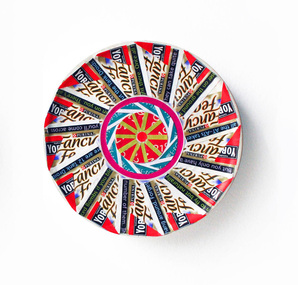
Collage: Elizabeth GOWER (b.1952 SA, AUS), Cycles 11, 2015
... This series was made ‘in transit’ during the artist’s recent studio residencies at Point[B], New York and Laughing Waters, Eltham, and at three temporary studios in Rome, Berlin and Collingwood. cycles, gower, collage, pattern, logos, commercialism, consumerism, repurpose, recycle, riverbend, laughing waters No inscriptions and markings Kaleidoscope pattern of multiple segments (logos-Purina 'fancy feast') from commercial (food) catalogues on commercial packaging (cardboard - round lid). ...The 'Cycles' series is an extension of two large scale provisional installations '150 Rotations', Melbourne Now, National Gallery of Victoria, and '356 Rotations', AC Institute in New York, which also re-purposed and aestheticised multiple paper units into hundreds of circular motifs.The immediate tactile connection with the material excesses and detritus of contemporary consumer culture informs the theoretical framework and conceptual understanding of Gower's practice, and associates her work with ideas of recovery and re-purpose, sustainable practice and thrift strategies that critique excesses of mass production and the notion of impermanence. This series was made ‘in transit’ during the artist’s recent studio residencies at Point[B], New York and Laughing Waters, Eltham, and at three temporary studios in Rome, Berlin and Collingwood.Kaleidoscope pattern of multiple segments (logos-Purina 'fancy feast') from commercial (food) catalogues on commercial packaging (cardboard - round lid). No inscriptions and markingscycles, gower, collage, pattern, logos, commercialism, consumerism, repurpose, recycle, riverbend, laughing waters -
 Nillumbik Shire Council
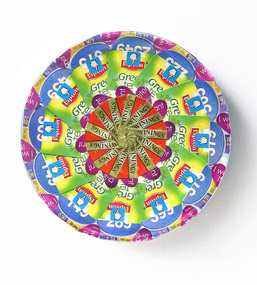
Collage: Elizabeth GOWER (b.1952 SA, AUS), Cycles 10, 2015
... This series was made ‘in transit’ during the artist’s recent studio residencies at Point[B], New York and Laughing Waters, Eltham, and at three temporary studios in Rome, Berlin and Collingwood. cycles, gower, collage, pattern, logos, commercialism, consumerism, repurpose, recycle, riverbend, laughing waters No inscriptions and markings Kaleidoscope pattern of multiple segments (logos-Lipton 'Green Tea') from commercial (food) catalogues on commercial packaging (cardboard - round lid). ...The 'Cycles' series is an extension of two large scale provisional installations '150 Rotations', Melbourne Now, National Gallery of Victoria, and '356 Rotations', AC Institute in New York, which also re-purposed and aestheticised multiple paper units into hundreds of circular motifs.The immediate tactile connection with the material excesses and detritus of contemporary consumer culture informs the theoretical framework and conceptual understanding of Gower's practice, and associates her work with ideas of recovery and re-purpose, sustainable practice and thrift strategies that critique excesses of mass production and the notion of impermanence. This series was made ‘in transit’ during the artist’s recent studio residencies at Point[B], New York and Laughing Waters, Eltham, and at three temporary studios in Rome, Berlin and Collingwood.Kaleidoscope pattern of multiple segments (logos-Lipton 'Green Tea') from commercial (food) catalogues on commercial packaging (cardboard - round lid). No inscriptions and markingscycles, gower, collage, pattern, logos, commercialism, consumerism, repurpose, recycle, riverbend, laughing waters -
 Beechworth RSL Sub-Branch
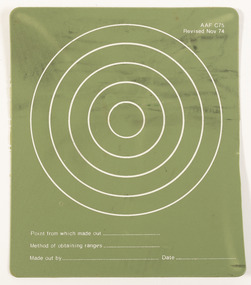
Card, Range, Revised November 1974
... temporary maps to identify objects and ranges for fire control and other military operations. Corporal Bob Gladwin served in Vietnam, but this range card would have been used after the Australian withdrawal from Vietnam in 1973. Range cards were everyday objects used by soldiers throughout the 20th century. They represent the day to day life of military personnel in bases and in the field. range card army australia Front: Various markings ...Range cards are used to estimate ranges between certain objects or positions. Military personnel use range cards as temporary maps to identify objects and ranges for fire control and other military operations. Corporal Bob Gladwin served in Vietnam, but this range card would have been used after the Australian withdrawal from Vietnam in 1973. Range cards were everyday objects used by soldiers throughout the 20th century. They represent the day to day life of military personnel in bases and in the field. Green plastic card, square with rounded edges. Has a series of white, concentric circles in the centre of the front, with white text explaining use. Owner's name marked on the rear.Front: Various markings and text. Rear: CPL Bob Gladwinrange card, army, australia
