
Showing 15 items matching "tennis shorts"
-
 Bendigo Historical Society Inc.
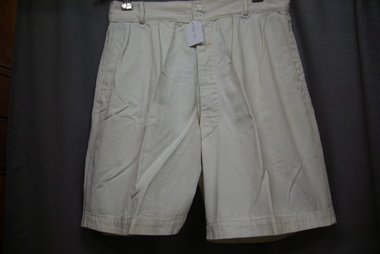
Clothing - AILEEN AND JOHN ELLISON COLLECTION: TENNIS SHORTS, 1940s
... AILEEN AND JOHN ELLISON COLLECTION: TENNIS SHORTS......Tennis shorts...White cotton drill men’s tennis shorts. Fly front with seven buttons - four plastic, three pearl. ...COSTUME Male Tennis shorts Written in ink on inside of front pleat Ellison 47350 White cotton drill men’s tennis shorts. ...White cotton drill men’s tennis shorts. Fly front with seven buttons - four plastic, three pearl. Four pleats in front at waist band (two on each side) and two darts in the back (one each side). Rear bound pocket with button closing. Two side pockets. Five belt loops on 5 cm waist band.Written in ink on inside of front pleat Ellison 47350costume, male, tennis shorts -
 City of Melbourne Libraries
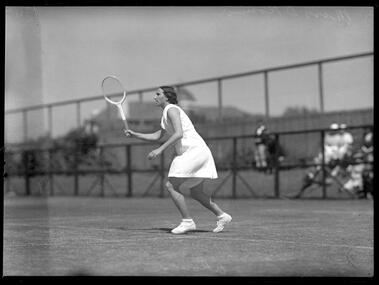
Photograph, Bull, Hugh Jones, 1897-1993, Tennis player, Dorothy Round, Albert Grounds, Melbourne
... Retrieved September 20, 2023, from http://nla.gov.au/nla.news-article51588090 Ban On Shorts For Tennis Girls? (1934, April 15). The Sun (Sydney, NSW : 1910 - 1954), p. 3. ...Retrieved September 20, 2023, from http://nla.gov.au/nla.news-article51588090 Ban On Shorts For Tennis Girls? (1934, April 15). The Sun (Sydney, NSW : 1910 - 1954), p. 3. ...Dorothy Round in shorts English-born Dorothy Round (1909-1982) plays tennis at Albert Park Cricket Ground, wearing her signature white sleeveless dress with divided skirt, pleated to form loose shorts. Dorothy won Wimbledon in 1934 and 1937, and the Australian Open in 1935. In the early 1930s, many women players in Europe and USA swapped stockings and long skirts for bare legs, short skirts and shorts. In October 1933, Mr Harley Malcolm, Secretary of Lawn Tennis Association Australia (LTAA) declared, “I consider shorts not regulation costume and would stop both men and women, particularly women, wearing them. I think women’s desire to strut themselves in such a costume is unreasonable.” However by November, the Victorian Lawn Tennis Association (VLTA) officially allowed shorts at Kooyong for both sexes. At the July 1934 Wimbledon Women’s Final, played in front of the King and Queen, Dorothy wore a sleeveless dress with the skirt divided. Her American competitor, Helen Jacobs, wore white tailored shorts with a black stripe on either side, described as “mannish, though businesslike”. In October, Australian tennis player Mrs Nell Hopman warned, “When Miss Dorothy Round arrives in a few weeks’ time, the LTAA will have to reconsider its decision about women playing in dresses, as she is sure to bring a trunkful of shorts. Miss Round has a “shorts only” rule which I fancy she will stick to here. She is the most stylish player I saw abroad.” The papers also reported that “Mrs Hopman saw no “he girls” among tennis players in Europe. Even the almost universal rule for shorts did not make them look masculine.” Dorothy said, “I wear shorts because they do not get in the way as a frock does. Mine are made in one piece and this avoids any tightness around the waist.” Featured in "Newsworthy: Melbourne in photographs 1933-1936" exhibition at East Melbourne Library, October to December 2023. Exhibition caption by project volunteer, Fiona Collyer. Photographer notations on slide: "Mrs D Round; D Round B6" Description: Dorothy Round plays tennis at Albert Grounds, Albert Park, Melbourne. She is wearing her signature white sleeveless dress with divided skirt, pleated to form loose shorts. Research by project volunteer, Fiona Collyer: Dorothy Round (1909-1982) was an English tennis champion from Dudley, Worcestershire. She won the Wimbledon Women’s Singles in 1934 and 1937. In 1935 she won the Australian Championships Women’s Singles in Melbourne. Dorothy won the Mixed Doubles at Wimbledon in 1934, 1935 and 1936. Dorothy was a staunch Methodist and taught Sunday School at Dudley Wesleyan Methodist Church throughout her career. She did not drink, smoke, dance or play tennis on Sundays and declined to compete in the 1933 French Open as tennis officials refused to comply to her scheduling preferences of No Sundays. During the Wightman Cup in New York when play was rained out on the Saturday, Dorothy refused to return on the Sunday. Officials reluctantly agreed to reschedule the clash for Monday, where she put in a sub par performance, prompting the New York Times to quip “Miss Round doesn’t play on Sundays, and doesn’t play particularly well on Mondays!”. In the early 1930s many women tennis players in Europe and USA abandoned their stockings and long skirts for bare legs, short skirts and shorts and some men swapped their long flannel trousers for shorts. British player Henry “Bunny” Austin was the first top male player to wear shorts at Centre Court Wimbledon in 1933, and his sister Joan Lycett nee Austin became the first female player to play without stockings on Centre Court, appearing with bare legs and ankle socks in 1931. In 1933 Mr Harley Malcolm, Secretary of the Lawn Tennis Association Australia (LTAA) and referee of big tournaments , said “the rules say regulation costume must be worn – I consider shorts are not regulation costume and would stop both men and women, particularly women, wearing them. I think women’s desire to strut themselves in such a costume is unreasonable.” (Herald 5/10/1933) However, by November 1933 the Victorian Lawn Tennis Assn officially allowed shorts as regulation dress at Kooyong for both sexes. One speaker suggested that as the majority of women were knock-kneed, the privilege of wearing shorts would not be taken up extensively by them. He added that women were not intended by nature to wear such garments. Another member mentioned that men were rather handsome objects and “works of art” and would carry off the short pants vogue nicely. (Sun Sydney 15/11/33) At the 1934 Wimbledon Singles Finals, playing in front of King George V and Queen Mary, Dorothy wore her signature outfit of sleeveless white dress with the skirt divided and pleated to form loose shorts and American Helen Jacobs wore white tailored shorts with a black stripe on either side described as “mannish, though business like.” In the lead up to Dorothy’s arrival in Australia to compete in the Australian Championship of 1935, there was much speculation written in the press about Dorothy’s preference for wearing shorts. Tennis player Mrs Nell Hopman warned “When Miss Dorothy Round arrives in a few weeks’ time, the Australian Lawn Tennis Association will have to reconsider its decision about women playing in dresses, as she is sure to bring a trunkful of shorts.” “Miss Round has a “shorts only” rule which I fancy she will stick to here. She is the most stylish player abroad.” Mrs Hopman saw no “he girls” among the tennis players in Europe. Even the almost universal rule for shorts did not make them look masculine. Mrs Hopman brought back a couple of pleated pairs that tennis player and designer Mrs Fearnley-Whittingstall (nee Eileen Bennett) made popular and worn by most English players. “They are really quite radical for they look no more startling than a short, pleated skirt” she said. (Newcastle Sun 1/10/1934) Writing for the Sydney Morning Herald 6/12/34, Dorothy said ”I have heard that a photograph of a player wearing shorts was sent to the Queen for her approval and I understand that she said in reply “that they were very attractive”. The Queen is a frequent and interested visitor to Wimbledon so this story is most credible and possibly explains the lack of official opposition to shorts this year.” “I wear shorts because they do not get in the way as a frock does. You have probably noticed that mine are made in one piece and this avoids any tightness around the waist. I don’t know whether shorts have come to stay. They do not suit everybody and the majority of the men don’t like the women in them and this may help condemn the fashion. I really think the men dislike them because too many people who shorts obviously do not suit rushed to be in the fashion and the result was devastating. For my part, I hope that this comfortable fashion endures.” Dorothy’s doubles partner, English tennis champion Fred Perry, did not approve of shorts for men and was particularly perturbed at the idea of women wearing them. Fred always wore long, white flannel trousers and white collared polo shirt on the tennis court. In July 1935 Dorothy took up a post as a dress designer and sportswear design advisor at British outfitters Jaeger. She published two books – “Modern Lawn Tennis” in 1935 and ”Tennis for Girls” in 1938 – described as cheerful and sensible guides. In 1937, Dorothy married Dr Douglas Leigh Little at Dudley Wesleyan Methodist Church. Her wedding dress was designed by renowned fashion designer Teddy Tinling who specialised in designing tennis dresses. (Tinling designed the dress worn by Billie Jean King for the famous “Battle of the Sexes” tennis match against Bobby Riggs in 1973.) News reel co. Gaumont British News filmed the wedding, showing 10,000 people, mostly women, surging towards the couple, describing it as a riot, and quipping that Dorothy’s forehand was useful when cutting the wedding cake. The city of Dudley gifted the couple an antique walnut bedroom suite chosen by them. Dorothy and Douglas had a son, Ian, and a daughter, Patricia. She gave up competitive tennis to coach and write newspaper articles. In later life she took up golf. Dorothy died of cancer in 1982 aged 73. She was inducted into the International Tennis Hall of Fame 1986. In 2004 a bronze bust of Dorothy was installed at Wimbledon, and in 2013 a life size bronze statue was erected at Priory Park, Dudley. References: MRS. HOPMAN RETURNS (1934, October 1). The Newcastle Sun (NSW : 1918 - 1954), p. 9. Retrieved September 20, 2023, from http://nla.gov.au/nla.news-article166292409 FIGURED IT OUT (1933, November 15). The Sun (Sydney, NSW : 1910 - 1954), p. 13 (FINAL EXTRA). Retrieved September 20, 2023, from http://nla.gov.au/nla.news-article230199908 FASHIONS OF THE TENNIS COURTS. (1934, December 6). The Sydney Morning Herald (NSW : 1842 - 1954), p. 7 (Women's Supplement). Retrieved September 20, 2023, from http://nla.gov.au/nla.news-article28021332 Leading Tennis Referee Condemns Wearing of Shorts (1933, October 5). The Herald (Melbourne, Vic. : 1861 - 1954), p. 11. Retrieved September 20, 2023, from http://nla.gov.au/nla.news-article243193607 DOROTHY ROUND Chooses Going-Away TROUSSEAU (1937, September 4). The Australian Women's Weekly (1933 - 1982), p. 39. Retrieved September 20, 2023, from http://nla.gov.au/nla.news-article51588090 Ban On Shorts For Tennis Girls? (1934, April 15). The Sun (Sydney, NSW : 1910 - 1954), p. 3. Retrieved February 5, 2024, from http://nla.gov.au/nla.news-article230535547 Dorothy Round Little - one of Britain's greatest champions, 13 September 2009, Tennis Forum, https://www.tennisforum.com/threads/dorothy-round-little-one-of-britains-greatest-champions.409612/Photographer notations on slide: "Mrs D Round; D Round B6".tennis, clothing and dress, 1930-1939 -
 City of Melbourne Libraries
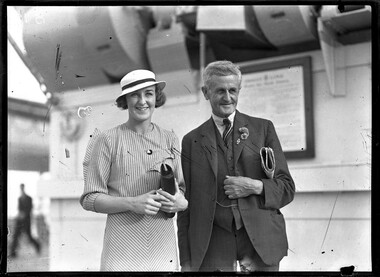
Photograph, Bull, Hugh Jones, 1897-1993, Miss Joan Hartigan and Mr Harley Malcolm embark on the RMS Orford for Wimbledon
... At the 1933 Wimbledon Women’s Final, in front of the King and Queen, English champion Dorothy Round wore her trademark sleeveless dress with a divided skirt and her American competitor Helen Jacobs wore white, tailored shorts with a black stripe on each side, described as “mannish, though businesslike.” In November 1933, the Victorian Lawn Tennis Association officially allowed shorts as regulation dress at Kooyong for both sexes. ...At the 1933 Wimbledon Women’s Final, in front of the King and Queen, English champion Dorothy Round wore her trademark sleeveless dress with a divided skirt and her American competitor Helen Jacobs wore white, tailored shorts with a black stripe on each side, described as “mannish, though businesslike.” In November 1933, the Victorian Lawn Tennis Association officially allowed shorts as regulation dress at Kooyong for both sexes. ...“MISS JOAN HARTIGAN, the well known New South Wales tennis player, who intends to play at Wimbledon this year. A photograph taken on board R.M.S. Orford before she sailed yesterday.” - The Age Photographer notations on slide: "B19" Published: Age (Melbourne, Vic. : 1854 - 1954), Wednesday 21 March 1934, page 13 Published title: MISS JOAN HARTIGAN Published caption: MISS JOAN HARTIGAN the well-known New South Wales tennis player, who intends to play at Wimbledon this year. A photograph taken on board R.M.S. Orford before she sailed yesterday. Trove article identifier: http://nla.gov.au/nla.news-article203827087 Description: On the deck of a ship, a smiling young woman wearing a white hat, printed fabric dress with brooch and holding a black clutch bag stands next to a middle aged man wearing a dark three piece suit and necktie with cornflower buttonhole and lapel pin and a newspaper under his arm. Research by project volunteer, Fiona Collyer: Twenty-one year old Australian Championships, (now known as the Australian Open) winner Miss Joan Hartigan and Mr Harley Malcolm, Lawn Tennis Association of Australia (LTAA) Honorary Secretary and referee, embark on the R.M.S. Orford at Station Pier, Port Melbourne on their way to Wimbledon. The Australian Test cricket and Davis Cup teams were also on the same voyage. Joan Marcia Hartigan (Bathurst) 1912-2000 from Sydney, won the Australian Championships three times in 1933, 1934, 1936 and was a Wimbledon semifinalist in 1934, 1935. A tall, stylish presence in visor and pleated dress, Joan was renowned for her power game and her “upside down backhand” i.e. striking the shot with the same face of the racquet that she hit her forehand. Joan’s world ranking was No.8 in 1934. Unfortunately, her career was interrupted by the outbreak of WW11 with international matches suspended for five years. Joan enlisted in the Australian Military Forces during WW11 and in 1947 she married Hugh Bathurst, private secretary to Senator James Fraser, Prime Minister Ben Chifley’s Health Minister. They had a daughter Mary and a son Thomas who became Chief Justice of NSW. Joan died in Sydney in 2000. In October 1933, Mr Harley Malcolm, declared “I consider shorts not regulation costume and would stop both men and women, particularly women, wearing them. I think women’s desire to strut in such a costume is unreasonable.” However, Harley was on the wrong side of history. In Europe and USA, many women tennis players were swapping their long skirts and stockings for bare legs, short skirts and shorts and men their long flannels for tailored shorts. In 1933, Henry “Bunny” Austin stunned the Wimbledon crowd when he wore shorts onto Centre Court - the first top male player to do so. He found it too hot to play in long trousers so he asked his tailor to run up some prototype shorts. At the 1933 Wimbledon Women’s Final, in front of the King and Queen, English champion Dorothy Round wore her trademark sleeveless dress with a divided skirt and her American competitor Helen Jacobs wore white, tailored shorts with a black stripe on each side, described as “mannish, though businesslike.” In November 1933, the Victorian Lawn Tennis Association officially allowed shorts as regulation dress at Kooyong for both sexes. In 1935, Dorothy wore her shorts while competing in Melbourne at the Australian Championships, Kooyong and there was hardly a murmur of dissent. Mr Harley Malcolm was involved with Australian tennis for 57 years, first as a player, then as a referee and administrator. He always wore a cornflower buttonhole on his lapel as he said the blue in that flower was his favourite colour. Cornflowers are sometimes referred to as “bachelor’s button” due to the old practice of men wearing cornflower buttonholes to indicate they are either in love or ready for courting. The Bleuet de France is the French flower of remembrance. References: WOMEN CITIZENS' MOVEMENT. (1934, March 21). The Age (Melbourne, Vic. : 1854 - 1954), p. 13. Retrieved March 20, 2024, from http://nla.gov.au/nla.news-article203827087 'Joan Hartigan', Wikipedia, https://en.wikipedia.org/wiki/Joan_Hartigan Leading Tennis Referee Condemns Wearing of Shorts (1933, October 5). The Herald (Melbourne, Vic. : 1861 - 1954), p. 11. Retrieved March 6, 2024, from http://nla.gov.au/nla.news-article243193607 REMEMBERING 57 YEARS OF TENNIS (1947, December 10). Daily Mercury (Mackay, Qld. : 1906 - 1954), p. 5. Retrieved April 1, 2024, from http://nla.gov.au/nla.news-article171166922Photographer notations on slide: "B19".tennis, 1930-1939, ships, sport, clothing and dress -
 Ballarat Clarendon College
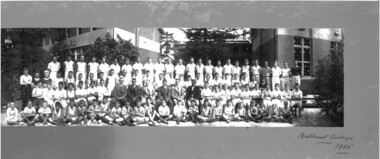
Photograph, Ballarat College student cohort 1935
... Unusual photograph of student cohort because students are not wearing formal school uniform but athletics singlets and shorts or cricket whites. 1935 ballarat college whole of school Handwritten on face of mount: Ballarat College / 1935 Sepia-toned photograph of student cohort on stands in front of main Sturt Street campus buildings; students are in sports uniforms; photograph includes six staff members. Visible in background are shrubbery and sections of Wanliss House, Memorial Hall (1924), Main school building (1912) and the tennis ...Unusual photograph of student cohort because students are not wearing formal school uniform but athletics singlets and shorts or cricket whites. Sepia-toned photograph of student cohort on stands in front of main Sturt Street campus buildings; students are in sports uniforms; photograph includes six staff members. Visible in background are shrubbery and sections of Wanliss House, Memorial Hall (1924), Main school building (1912) and the tennis courts. Handwritten on face of mount: Ballarat College / 19351935, ballarat college, whole of school -
 Bendigo Historical Society Inc.
Photograph - HILDA HILL COLLECTION: BLACK AND WHITE PHOTOS, 1917-1918
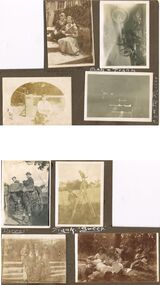
... Man in dark suit white shirt and dark tie holding a tennis racquet over his head, brick wall to left and doorway, on the verandah of 'The Ranche' property. Horse & Gig, man and boy seated on the gig and boy standing behind all dressed dark clothing, man wearing a hat, boy at rear wearing shorts and long socks with boots, to right gable roof shed, 'Durvol' property Kyneton Victoria Australia. ...Man in dark suit white shirt and dark tie holding a tennis racquet over his head, brick wall to left and doorway, on the verandah of 'The Ranche' property. Horse & Gig, man and boy seated on the gig and boy standing behind all dressed dark clothing, man wearing a hat, boy at rear wearing shorts and long socks with boots, to right gable roof shed, 'Durvol' property Kyneton Victoria Australia. ...Series of Black & White Photos Hill Family & Friends Life During The Final Years of The First World War. Hilda Hill and another, seated on steps , background building weatherboard construction and glass windows,girl at rear wearing dark dress with check scarf around her neck, girl at front wearing a lighter colour dress and white blouse, and medal on ribbon around her neck, S.H.L.C. November 1917. Jack & Frank, both dressed in dark suits white shirts and dark ties, man standing outside of vehicle with right arm resting on the car and one foot on the running board, with the family car, dark colour with wooden spoke wheels. Francie, wearing dark skirt and white blouse & the dog, kneeling in front of a netting fence with top rail, background is corrugated iron shed wall. Easter 1918. Man in dark suit white shirt and dark tie holding a tennis racquet over his head, brick wall to left and doorway, on the verandah of 'The Ranche' property. Horse & Gig, man and boy seated on the gig and boy standing behind all dressed dark clothing, man wearing a hat, boy at rear wearing shorts and long socks with boots, to right gable roof shed, 'Durvol' property Kyneton Victoria Australia. Frank & Sweep the dog up a ladder, high paling fence in right background. Six young ladies , three standing and three seated on a white wooden railing fence, all dressed in lightly coloured outer wear, some showing white blouses Kyneton Mineral Springs 27th September 1918. Group of four young ladies all dressed in white and wearing broad brimmed hats, two men one sitting and one lying on the ground, man at rear white shirt and dark tie with broad brimmed hat, man at front, dark trousers and white shirt with dark waistcoat, no person has been identified in this photo, In the shade Hanging Rock?Hilda Hill Personal Colllectionaustralia, history, post war life -
 Bendigo Historical Society Inc.
Photograph - COOK COLLECTION: TENNIS MATCH
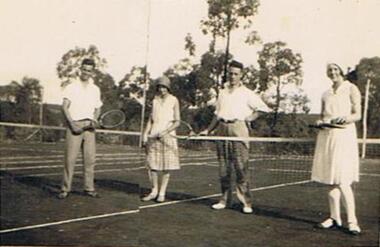
... Photograph: black and white photograph, postcard format, two and two women on tennis court. Men are wearing long trousers with white shorts, sleeves rolled up. ...PHOTOGRAPH Person two males/two females Spring Gully tennis sport Cook Photograph: black and white photograph, postcard format, two and two women on tennis court. Men are wearing long trousers with white shorts, sleeves rolled up. ...Photograph: black and white photograph, postcard format, two and two women on tennis court. Men are wearing long trousers with white shorts, sleeves rolled up. Women are wearing white dresses, knee length. On back of card: E.A. Cook, 231 Carpenter Street, Spring Gully, Bendigo.photograph, person, two males/two females, spring gully, tennis, sport, cook -
 National Wool Museum
Book - Sun-glo Knitting Book, Series 121, F. W. Hughes Pty. Ltd, c.1940s
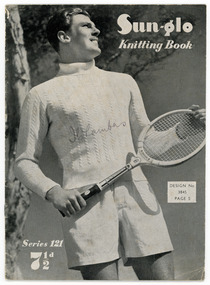
... Front cover shows a man wearing a knitted jumper and shorts holding a tennis racquet. ...Front cover shows a man wearing a knitted jumper and shorts holding a tennis racquet. Book Sun-glo Knitting Book, Series 121 F. ...Sixteen page black and white knitting pattern book featuring men’s jumpers and vests. Book contains black and white photographs and printed text. Front cover shows a man wearing a knitted jumper and shorts holding a tennis racquet. front: [printed] Sun-glo / Knitting Book / DESIGN No. / 3845 / PAGE 5 / Series 121 / 7 ½ d [handwritten] H Lambas?fashion, women, magazine, knitting, crochet, home life, patterns -
 Tennis Australia
Calendar, Circa 1952, Circa 1980
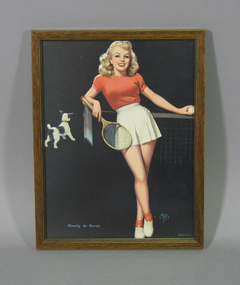
... A reproduction of 1950's calendar art entitled 'READY TO SERVE', depicting a blonde pin-up girl in white shorts posing with racquet and leaning on a tennis net. Materials: Paper, Ink, Cardboard, Glass, Wood...Tennis A reproduction of 1950's calendar art entitled 'READY TO SERVE', depicting a blonde pin-up girl in white shorts posing with racquet and leaning on a tennis net. ...A reproduction of 1950's calendar art entitled 'READY TO SERVE', depicting a blonde pin-up girl in white shorts posing with racquet and leaning on a tennis net. Materials: Paper, Ink, Cardboard, Glass, Woodtennis -
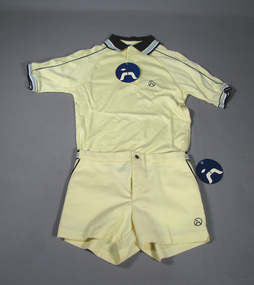 Tennis Australia
Attire, Personal items, Circa 1980
... A John Newcombe Active Sportswear tennis outift. (.1) shirt and (.2) shorts. Materials: Cloth, Plastic, Metal...Tennis A John Newcombe Active Sportswear tennis outift. (.1) shirt and (.2) shorts. Materials: Cloth, Plastic, Metal Attire, Personal items ...A John Newcombe Active Sportswear tennis outift. (.1) shirt and (.2) shorts. Materials: Cloth, Plastic, Metaltennis -
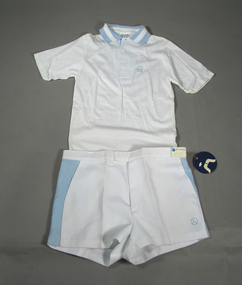 Tennis Australia
Attire, Personal items, Circa 1985
... An Interwoven 'John Newcombe Active Sportswear' tennis outift. (.1) shirt size Small and (.2) shorts size 38. Materials: Cloth, Plastic...Tennis An Interwoven 'John Newcombe Active Sportswear' tennis outift. (.1) shirt size Small and (.2) shorts size 38. Materials: Cloth, Plastic Attire, Personal items ...An Interwoven 'John Newcombe Active Sportswear' tennis outift. (.1) shirt size Small and (.2) shorts size 38. Materials: Cloth, Plastictennis -
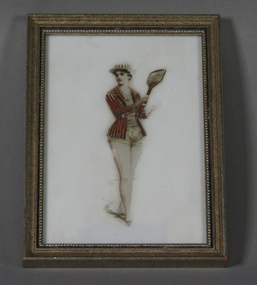 Tennis Australia
Painted plaque, 1895
... Framed ceramic panel handpainted with figure of young woman in shorts and striped blazer swinging a tennis racquet. UV glass. ...Tennis Framed ceramic panel handpainted with figure of young woman in shorts and striped blazer swinging a tennis racquet. ...Framed ceramic panel handpainted with figure of young woman in shorts and striped blazer swinging a tennis racquet. UV glass. Materials: Ceramic, Pigment, Glass, Metal, Papertennis -
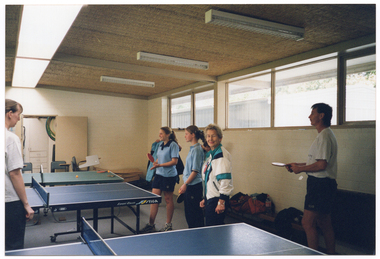 Musculoskeletal Health Australia (now held by the Glen Eira Historical Society)
Photograph - Group photo, 20/10/1999
... tennis tables. Some people are wearing pale blue polo shirts, some are wearing white t-shirts, one woman is wearing a navy, jade, and white tracksuit jacket, and another person (partially obscured) is putting on a blue and navy jacket. They are all wearing either navy shorts...tennis tables. Some people are wearing pale blue polo shirts, some are wearing white t-shirts, one woman is wearing a navy, jade, and white tracksuit jacket, and another person (partially obscured) is putting on a blue and navy jacket. They are all wearing either navy shorts ...On Wednesday, October 20, 1999, World Osteoporosis Day (WOD), Osteoporosis Victoria conducted a morning of physical activities with the Year 9 students at Shelford Girls' Grammar School in Caulfield. Titled, "Come & Try Day", the activities on offer included abseiling, golf, table tennis, Tai Chi, football, and indoor lawn bowls. In this photo, some students are playing table tennis under the supervision of a few instructors.COL photo of several people stand arounding some table tennis tables. Some people are wearing pale blue polo shirts, some are wearing white t-shirts, one woman is wearing a navy, jade, and white tracksuit jacket, and another person (partially obscured) is putting on a blue and navy jacket. They are all wearing either navy shorts or navy tracksuit pants. They are inside a white brick building. A few of them are holding a tennis table racket (also known as a bat or paddle) in their hand. A storage room is evident through an open doorway. There is a view of another building and some trees through the high curtained windows.world osteoporosis day, wod, osteoporosis victoria, ov, come & try day, active for life, just 30 minutes a day, physical activities, exercise, table tennis, shelford girls grammar school, year 9 students, year 9 cohort, high school, secondary school, caulfield, 1999 -
 Musculoskeletal Health Australia (now held by the Glen Eira Historical Society)
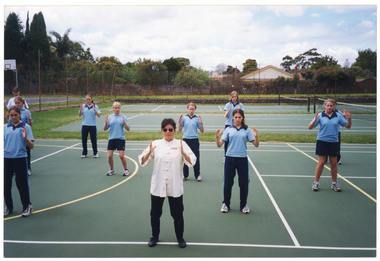
Photograph - Group photo, 20/10/1999
... shorts or track suit pants. The instructor is wearing a cream traditional Chinese shirt with a mandarin collar and black trousers. They are standing on an outdoor tennis...shorts or track suit pants. The instructor is wearing a cream traditional Chinese shirt with a mandarin collar and black trousers. They are standing on an outdoor tennis ...On Wednesday, October 20, 1999, World Osteoporosis Day (WOD), Osteoporosis Victoria conducted a morning of physical activities with the Year 9 students at Shelford Girls' Grammar School in Caulfield. Titled, "Come & Try Day", the activities on offer included abseiling, golf, table tennis, Tai Chi, football, and indoor lawn bowls. In this photo, a Tai Chi instructor leads a group of students in a Tai Chi class. This photo (amongst others from the Come & Try Day) appears on Page 5 of the Vol 12 Issue 4, Summer 1999 edition of the Arthritis Foundation of Victoria's quarterly magazine, Arthritis Update. The photo also appears on page 9 of the Vol 14 Issue 01, Autumn 2001 edition of the magazine under its revised name, Update. In that issue, it accompanies an article titled, "arthritis victoria's schools project". The photo is captioned: "Students participating in Tai Chi classes."COL photo of a woman leading a group of students in an exercise class. The students are dressed in their sports uniform, consisting of a blue polo top and either navy blue shorts or track suit pants. The instructor is wearing a cream traditional Chinese shirt with a mandarin collar and black trousers. They are standing on an outdoor tennis court in rows, spaced well apart from one another. The instructor is standing in the front row, facing the camera, with her back to the students. There are two more tennis courts in the background, and the entire court area is enclosed by a tall cyclone fence.world osteoporosis day, wod, osteoporosis victoria, ov, come & try day, active for life, just 30 minutes a day, physical activities, exercise, tai chi, shelford girls grammar school, year 9 students, year 9 cohort, high school, secondary school, caulfield, 1999 -
 Musculoskeletal Health Australia (now held by the Glen Eira Historical Society)
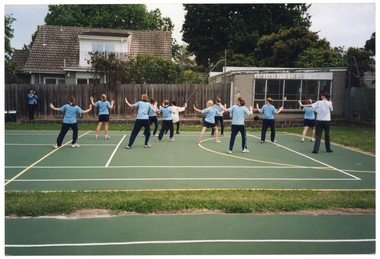
Photograph - Group photo, 20/10/1999
... shorts or track suit pants. The instructor is wearing a cream shirt and black trousers. They are standing on an outdoor tennis courts surrounded by grass. ...shorts or track suit pants. The instructor is wearing a cream shirt and black trousers. They are standing on an outdoor tennis courts surrounded by grass. ...On Wednesday, October 20, 1999, World Osteoporosis Day (WOD), Osteoporosis Victoria conducted a morning of physical activities with the Year 9 students at Shelford Girls' Grammar School in Caulfield. Titled, "Come & Try Day", the activities on offer included abseiling, golf, table tennis, Tai Chi, football, and indoor lawn bowls. This photo depicts a group of students following a Tai Chi instructor's movements during a class while they are being Photographed or filmed by another person.COL photo of a group of students, standing in rows, following a female instructor in some exercises. The students are dressed in their sports uniform, consisting of a blue polo top and either navy blue shorts or track suit pants. The instructor is wearing a cream shirt and black trousers. They are standing on an outdoor tennis courts surrounded by grass. In the background, there is a person wearing a blue shirt and black trousers. They are standing in front of the fence, either Photographing or filming the group. Behind the fence, there is a house and another small building adjoining the property where the fence ends. The Photograph has been taken from behind the group.world osteoporosis day, wod, osteoporosis victoria, ov, come & try day, active for life, just 30 minutes a day, physical activities, exercise, tai chi, shelford girls grammar school, year 9 students, year 9 cohort, high school, secondary school, caulfield, 1999 -
 City of Melbourne Libraries
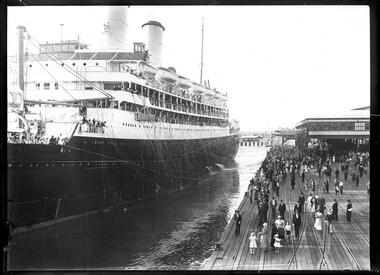
Photograph, Bull, Hugh Jones, 1897-1993, RMS Orford departing from Station Pier, Port Melbourne
... tennis in his slippers. - Batsman Bill Brown dancing the fox-trot, displaying footwork similar to the grace he showed at the wicket. - Alluding to the seasickness of Don Bradman and Stan McCabe and how they were making up for meals lost on the Great (very choppy) Australian Bight. - Miss Joan Hartigan discarding her bright blue shorts for brighter blue bathers and being first into the pool. - Bowler Bill O’Reilly being tripped by a passenger on the deck and spending the voyage with bandaged wrists with daily updates of his progress in the press. - Wicketkeeper Ben Barnett’s conjuring tricks and constant whirring movie camera. - Results of the quoits, ball tennis and bridge tournaments. ...tennis in his slippers. - Batsman Bill Brown dancing the fox-trot, displaying footwork similar to the grace he showed at the wicket. - Alluding to the seasickness of Don Bradman and Stan McCabe and how they were making up for meals lost on the Great (very choppy) Australian Bight. - Miss Joan Hartigan discarding her bright blue shorts for brighter blue bathers and being first into the pool. - Bowler Bill O’Reilly being tripped by a passenger on the deck and spending the voyage with bandaged wrists with daily updates of his progress in the press. - Wicketkeeper Ben Barnett’s conjuring tricks and constant whirring movie camera. - Results of the quoits, ball tennis and bridge tournaments. ...Published: 21 March 1934 The Age p11 Published title: CROWDED TOURIST SHIP WILL CARRY TEST AND DAVIS CUP TEAMS. Published caption: Carrying an exceptionally large number of tourists, business men and prominent sporting personalities, R.M.S. Orford sailed for London yesterday. Over two hundred passengers embarked at Melbourne, and on leaving the Australian coast there will be two thousand persons on board. The Australian Test team will join the vessel at Fremantle and the remaining two Davis Cup representatives will embark at Adelaide. A picture of the Orford taken just as she moved out from Station Pier, Port Melbourne, under her own steam. Trove article identifier: http://nla.gov.au/nla.news-article203826897 Description: Passenger ship about to depart Station Pier, Port Melbourne. Research by project volunteer, Fiona Collyer: The RMS Orford was built by Vickers-Armstrong Shipyard Barrow-in-Furness, Cumbria, England and launched in 1927 by Lady Ryrie, the wife of Sir Granville Ryrie, the Australian Ambassador to the UK. The Orford was owned by the Orient Steam Navigation Ltd and was designed for the mail and passenger service between England and Australia. She was 20,000 tons, 658 ft long, 75 ft across and 80 ft high from water-line to deck. She had eight decks, a swimming pool and cost more than £1,000,000. She could travel at 20 knots – 480 miles a day, a 5 week voyage between Australia and England. There were enough lifeboats to accommodate every person on board. Promoted as a ship of comfort, luxury, speed and grace with spacious, beautifully decorated lounges, smoking-rooms and writing rooms, the SMH 23/11/1928 review said “sitting-rooms where the furniture recreates the air of quiet, exquisite, safe luxury; suites where you may retire from other people, and on a sea voyage other people, even the most charming other people, often begin to resemble one’s worst enemies towards the end of several weeks sea voyaging together”. “Travel like a human being. This is what the great liners give you today. The Orford dining room is enormous (it seated 350 people) the walls sweep up to a white, cool roof supported on decorative pillars. Panels of grey scagliola and carved designs remove the bleak, comfortless air which used to cling to dining-rooms of ships. Everything about them was so wretchedly temporary that you could not enter them without wishing that you stayed at home. They gave you the creeps and indigestion. This room is gay, bright, sunlit, like a luxurious café overlooking the sea.” “You really feel in here that you are a human being and not a piece of cargo endowed with sensation.” The Orford had the punkah louvre system of ventilation which forced draughts through every part of the ship, ensuring “No Ship Smells!!” and avoiding - “… a mayonnaise of all the unpleasant odours generated under heaven. From the hot oil of the engines, from those overheated, bottomless pits below the water-line, from new paint and food, from people perspiring at work, from rope and tar and grease and fruit and wet clothes and tobacco, rises a deplorable incense that lingers unsettlingly in the nostril long after one has left the ship. Those dreadful odours will never rise to torture the senses of passengers who feel that all is over with them.” The modern electric kitchen had a roll making machine capable of producing 2000 rolls for the table an hour and a bread and butter machine which cut the bread into slices and spread the butter in one operation. (The Week – Brisbane 30/11/1928) On 13/10/1928, the Orford made its first voyage to Australia with 520 first class and 1100 3rd class passengers. The name of the passengers embarking and disembarking and their reason for visiting were published in newspapers and the number of migrants for the New Settlers Scheme and the Dreadnought Boys Co program to promote and assist the migration of British youths willing to become farm workers in Australia 1911-1939 were noted too. On the 19th March 1932, RMS Orford featured in the “Parade of Ships” celebrating the official opening of the Sydney Harbour Bridge. Only country people were allowed to book a ticket as a guest on board. The Post Office issued commemorative postage stamps showing the Orford sailing under the bridge. In March 1934, the Orford sailed from Australia to London, via Colombo, Aden, Port Said, Naples, Villefranche, Toulon, Parma, Gibraltar and Channel Port. Amongst the 2000 passengers on board was the Davis Cup Tennis team, tennis champions Joan Hartigan and Nell Hopman, the Australian Test cricket team and British champion swimmer Joyce Cooper. Every day tennis player Harry Hopman and an Australian Press Association reporter radioed through reports on their activities, which included – - Test cricket batsman Len Darling having spend 4 days in his cabin after straining his groin when he slipped over while playing ball tennis in his slippers. - Batsman Bill Brown dancing the fox-trot, displaying footwork similar to the grace he showed at the wicket. - Alluding to the seasickness of Don Bradman and Stan McCabe and how they were making up for meals lost on the Great (very choppy) Australian Bight. - Miss Joan Hartigan discarding her bright blue shorts for brighter blue bathers and being first into the pool. - Bowler Bill O’Reilly being tripped by a passenger on the deck and spending the voyage with bandaged wrists with daily updates of his progress in the press. - Wicketkeeper Ben Barnett’s conjuring tricks and constant whirring movie camera. - Results of the quoits, ball tennis and bridge tournaments. A fancy dress ball was held one night and the cricketers dressed as sheiks and sang “The Riff Song” from the pre-code 1929 operetta film “The Desert Song” starring John Bates as the Red Shadow and Myrna Lay as a native dancing girl. Alan Kippax’s beard blew overboard! Joan Hartigan dressed as Burlington Bertie from the music hall song and Nell Hopman a doll in a box wearing a crinkled paper dress. On arrival at Southampton, while they waited for the gangway to be lowered, Bradman entertained the team at the piano playing popular tunes while the cricketers sang. . In 1935, RMS Orford’s third class accommodation was converted to tourist class. Her passenger capacity was now 468 First Class, 515 tourist class and 440 crew. First saloon from Sydney fares cost for single £76, £82, £88 and Third Class fares were £21, £23, £25. Less than a penny a mile. . In 1936, the Orford embarked the exiled Emperor of Ethiopia, Haile Selassie at Gibraltar on his way to the UK. In 1939, she was requisitioned for Australian government service and on 7/1/1940 she conveyed the first Australian troops to Egypt and was then used to carry French troops from Tamatave, Madagascar to Marseilles. On 1/6/1940 RMS Orford was bombed and set on fire at Marseilles by German aircraft. 14 crew were killed, 25 wounded. In 1947, the wreck was re-floated and broken up at Savona. . . References: R.M.S. ORFORD. (1928, November 23). The Sydney Morning Herald (NSW : 1842 - 1954), p. 14. Retrieved September 15, 2023, from http://nla.gov.au/nla.news-article16511535 ARRIVAL OF THE ORFORD (1928, November 30). The Week (Brisbane, Qld. : 1876 - 1934), p. 21. Retrieved September 15, 2023, from http://nla.gov.au/nla.news-article181126802 CROWDED TOURIST SHIP WILL CARRY TEST AND DAVIS CUP TEAMS. (1934, March 21). The Age (Melbourne, Vic. : 1854 - 1954), p. 11. Retrieved October 5, 2023, from http://nla.gov.au/nla.news-article203826897 Photographer notations on slide: "B19".tennis, ships
