
Showing 205 items matching "tenor"
-
 Coal Creek Community Park & Museum
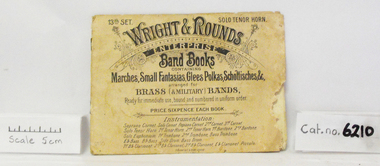
Music Book, Wright & Rounds Band Book, 13th Set, for Solo Tenor Horn
... Wright & Rounds Band Book, 13th Set, for Solo Tenor Horn...Music book, cream paper: Wright & Rounds Enterprise Band Book, 13th Set, Solo Tenor Horn, containing marches, small fantasias, glees polkas, schottisches, for brass & military bands....Wright & Rounds Band Book, 13th Set, for Solo Tenor Horn Music Book ...Music book, cream paper: Wright & Rounds Enterprise Band Book, 13th Set, Solo Tenor Horn, containing marches, small fantasias, glees polkas, schottisches, for brass & military bands. -
 The 5th/6th Battalion Royal Victoria Regiment Historical Collection
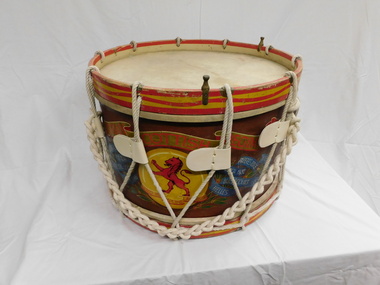
Instrument - Drum, Tenor Drum Rope tension VSR
... Tenor Drum Rope tension VSR...Drum is hand painted with VSR title, Rampart lion with VSR battle honours Tenor Drum Rope tension VSR Instrument Drum ...Used by VSR pipes and drumsUsed by VSR pipes and drumsDrum is of wooden construction with rope tention system. Drum is hand painted with VSR title, Rampart lion with VSR battle honours5/6 rvr pipes and drums, vsr, 5/6rvr bhq -
 Thompson's Foundry Band Inc. (Castlemaine)
Sheet Music, Tenor Trombone Rag
... Tenor Trombone Rag...Tenor Trombone Rag Sheet Music ... -
 Phillip Island and District Historical Society Inc.
Photograph, Rurric & Harry De La Haye Phillip Island Brass Band
... Rurric on left, has a cornet, Harry has a tenor horn....L-R “ DeLaHaye” Harry(cornet), Rurric(jnr) (Tenor horn) Phillip Island Brass Band. Rurric(snr) & Fannie’s 2 sons - Born French Island...Rurric on left, has a cornet, Harry has a tenor horn. Rurric & Harry De La Haye Phillip Island Brass Band Photograph ...Black & white photogragh of two men in uniform. Rurric on left, has a cornet, Harry has a tenor horn.L-R “ DeLaHaye” Harry(cornet), Rurric(jnr) (Tenor horn) Phillip Island Brass Band. Rurric(snr) & Fannie’s 2 sons - Born French Islandphillip island brass band, de la haye family, photographs, musical instruments -
 Ballarat Heritage Services
Program, Opera Under the Stars, 31 August 2002
... OPERA UNDER THE STARS 10th Anniversary Gala Starring Jennifer Barnes~soprano, Jaqueline Moran (Dark) ~Mezzo soprano, Stuart Skelton ~ Tenor, Douglas McNicol ~ Baritone, Francis Greep ~Piano SATURDAY 31 st AUGUST 2002 ~ 8pm THE MANGROVE HOTEL, BROOME...OPERA UNDER THE STARS 10th Anniversary Gala Starring Jennifer Barnes~soprano, Jaqueline Moran (Dark) ~Mezzo soprano, Stuart Skelton ~ Tenor, Douglas McNicol ~ Baritone, Francis Greep ~Piano SATURDAY 31 st AUGUST 2002 ~ 8pm THE MANGROVE HOTEL, BROOME...OPERA UNDER THE STARS 10th Anniversary Gala Starring Jennifer Barnes~soprano, Jaqueline Moran (Dark) ~Mezzo soprano, Stuart Skelton ~ Tenor, Douglas McNicol ~ Baritone, Francis Greep ~Piano SATURDAY 31 st AUGUST 2002 ~ 8pm THE MANGROVE HOTEL, BROOME OPERA UNDER THE STARS, Jennifer Barnes, Jaqueline Moran (Dark), Stuart Skelton, Douglas McNicol, Francis Greep, 2002, THE MANGROVE HOTEL, BROOME OPERA UNDER THE STARS 10th Anniversary Gala Starring Jennifer Barnes~soprano, Jaqueline Moran (Dark) ~Mezzo soprano, Stuart Skelton ~ Tenor, Douglas McNicol ~ Baritone, Francis Greep ~Piano SATURDAY 31 st AUGUST 2002 ~ 8pm THE MANGROVE HOTEL, BROOME One page dark blue background with white text. ...OPERA UNDER THE STARS 10th Anniversary Gala Starring Jennifer Barnes~soprano, Jaqueline Moran (Dark) ~Mezzo soprano, Stuart Skelton ~ Tenor, Douglas McNicol ~ Baritone, Francis Greep ~Piano SATURDAY 31 st AUGUST 2002 ~ 8pm THE MANGROVE HOTEL, BROOMEOne page dark blue background with white text.OPERA UNDER THE STARS 10th Anniversary Gala Starring Jennifer Barnes~soprano, Jaqueline Moran (Dark) ~Mezzo soprano, Stuart Skelton ~ Tenor, Douglas McNicol ~ Baritone, Francis Greep ~Piano SATURDAY 31 st AUGUST 2002 ~ 8pm THE MANGROVE HOTEL, BROOMEopera under the stars, jennifer barnes, jaqueline moran (dark), stuart skelton, douglas mcnicol, francis greep, 2002, the mangrove hotel, broome -
 Mont De Lancey
Tenor Horn, Bohland & Fuchs, Circa 1898 - 1904
... Brass Euphonium or Tenor Horn...Brass Musical instruments Brass Euphonium or Tenor Horn Tenor Horn Bohland & Fuchs ...Played by Harry Henderson, a member of the Wandin Brass Band. Harry Henderson was the Grandson of Henry and Martha Sebire.Brass Euphonium or Tenor Hornbrass musical instruments -
 Bendigo Historical Society Inc.
Document - BACCHOLIAN SINGERS OF LONDON
... 'Baccholian Singers of London' presented throughout Australia by Musica Viva Australia. Neil Jenkins, tenor, Ian Partridge, tenor, Nicholas Curtis, tenor, Ian Humphris, baritone, John Huw Davies, baritone, Brian Etheridge, bass. ...EVENT Entertainment music Baccholian Singers of London Musica Viva Australia Neil Junkins Ian Partridge Nicholas Curtis Ian Humphris John Huw Davies Brian Etheridge The Music Advancement Society of Bendigo 'Baccholian Singers of London' presented throughout Australia by Musica Viva Australia. Neil Jenkins, tenor, Ian Partridge, tenor, Nicholas Curtis, tenor, Ian Humphris, baritone, John Huw Davies, baritone, Brian Etheridge, bass. ...'Baccholian Singers of London' presented throughout Australia by Musica Viva Australia. Neil Jenkins, tenor, Ian Partridge, tenor, Nicholas Curtis, tenor, Ian Humphris, baritone, John Huw Davies, baritone, Brian Etheridge, bass. The Music Advancement Society of Bendigo. C1970'sevent, entertainment, music, baccholian singers of london, musica viva australia, neil junkins, ian partridge, nicholas curtis, ian humphris, john huw davies, brian etheridge, the music advancement society of bendigo -
 Royal Australian Air Force Band
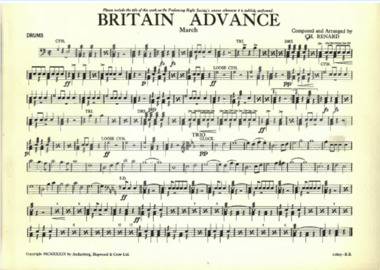
March Card, CH. Renard (Composer, Arranger), Britain Advance, Composed: 1939
... 16 Parts Brass Band Instrumentation Quick March Ascherberg's Brass and Military Band Journal Key Signature: Ab Major Instrumentation: Repiano Cornet Bb Eb Soprano Cornet Solo Cornet Bb 2nd Cornet Bb 3rd Cornet Bb Solo Tenor Horn Eb 2nd Tenor Horn Eb 3rd Tenor Horn Eb 1st Baritone Bb 2nd Baritone Bb 1st Tenor Trombone 2nd Tenor Trombone Bass Trombone Bb Euphonium (Treble Clef) Eb Basses Bb Basses Drums...On Inner Envelope: QM22, Q271 16 Parts Brass Band Instrumentation Quick March Ascherberg's Brass and Military Band Journal Key Signature: Ab Major Instrumentation: Repiano Cornet Bb Eb Soprano Cornet Solo Cornet Bb 2nd Cornet Bb 3rd Cornet Bb Solo Tenor Horn Eb 2nd Tenor Horn Eb 3rd Tenor Horn Eb 1st Baritone Bb 2nd Baritone Bb 1st Tenor Trombone 2nd Tenor Trombone Bass Trombone Bb Euphonium (Treble Clef) Eb Basses Bb Basses Drums Britain Advance March Card CH. ...In 1932 the call was put out to the ABC to start a military band. The band’s task was to record music to play on air four times a week, and to perform live concerts for the public. By November 1933 a band was put together with 40 musicians from around Australia. The band was initially conducted by Captain H. E. Adkins, Director of the Royal Military School of Music, Kneller Hall, London. After the tour, Adkins returned to his position at Kneller Hall, and Stephen Yorke, a retired bandmaster of the Gloucestershire Regiment, was brought out to Australia to become the permanent director and conductor of the band, which he did until the band closed in 1951. During the band’s 17 year history they presented a sizable program of music. Their final concert received a standing ovation from its audience of 1500, with a teary-eyed Yorke. 16 Parts Brass Band Instrumentation Quick March Ascherberg's Brass and Military Band Journal Key Signature: Ab Major Instrumentation: Repiano Cornet Bb Eb Soprano Cornet Solo Cornet Bb 2nd Cornet Bb 3rd Cornet Bb Solo Tenor Horn Eb 2nd Tenor Horn Eb 3rd Tenor Horn Eb 1st Baritone Bb 2nd Baritone Bb 1st Tenor Trombone 2nd Tenor Trombone Bass Trombone Bb Euphonium (Treble Clef) Eb Basses Bb Basses DrumsOuter Envelope: Title, Composer, Instrumentation and Publisher information, QM22. On Inner Envelope: QM22, Q271brass band, australian broadcasting commission, marching band, concert band -
 Federation University Historical Collection
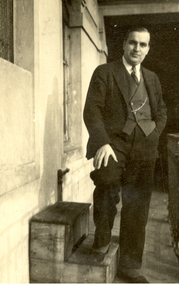
Photograph - Photograph - Black and White, Navarre (Alexander Wright of Smeaton), c1935
... I'm beginning to get the tenor spread about the bottom-jaw"...I'm beginning to get the tenor spread about the bottom-jaw" A black and white photograph of a man in a suit with a waist coat and fob chain standing with one foot on the lower step of a stone building. ...Alexander Wright and Frank Wright were brothers. Both born in Smeaton, lived at Laura Villa, and attended Smeaton State School. His father William was a gold miner and his mother's name was Sarah. Their family won many singing and instrumental awards. A black and white photograph of a man in a suit with a waist coat and fob chain standing with one foot on the lower step of a stone building. He is Navarre (Alexander Wright of Smeaton)Written on the back in black ink " a snap taken on the balcony. I'm beginning to get the tenor spread about the bottom-jaw"alexander wright, navarre, frank wright, smeaton, performing arts -
 Ukrainian Historical Society Sunshine
LP Vinyl Record, CBS Recording "Dnister" Cleveland USA, Songs of the heart
... ...Tenor...Representative of Ukrainian folk music in the 1960s Vinyl record Volodymyr Luciv Tenor 1967 Vinyl record housed in record cover Songs of the heart LP Vinyl Record CBS Recording "Dnister" Cleveland USA ...Representative of Ukrainian folk music in the 1960sVinyl record housed in record covervinyl record, volodymyr luciv, tenor, 1967 -
 Royal Australian Air Force Band
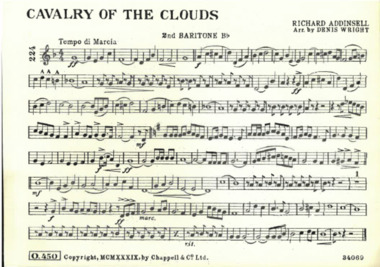
March Card, Addinsell, Richard (Composer) et al, Cavalry Of The Clouds, Composed: 1939
... 16 Parts Brass Band Instrumentation Quick March Key Signature: Eb Major Instrumentation: Repiano Cornet Bb Soprano Cornet Eb Solo Cornet Bb (Conductor) 2nd Cornet Bb 3rd Cornet Bb 1st Horn Eb (or Solo Tenor) 2nd Horn Eb (or 1st Tenor 1st Baritone Bb (& Tenor Saxophone Bb) 2nd Baritone Bb 3rd Horn Eb (or 2nd Tenor) 1st Trombone 2nd Trombone Bass Trombone Euphonium Bb (Treble Clef) Eb Bass (Treble Clef) Contre Bass Bb (Treble Clef) Drums...Brass Band Australian Broadcasting Commission Marching Band Concert Band On envelope:QM31, The Chappell Band Club., A Stirring March Featured in The Great British Film "The Lion Has Wings", Brass Band 2/6, O. 450 16 Parts Brass Band Instrumentation Quick March Key Signature: Eb Major Instrumentation: Repiano Cornet Bb Soprano Cornet Eb Solo Cornet Bb (Conductor) 2nd Cornet Bb 3rd Cornet Bb 1st Horn Eb (or Solo Tenor) 2nd Horn Eb (or 1st Tenor 1st Baritone Bb (& Tenor Saxophone Bb) 2nd Baritone Bb 3rd Horn Eb (or 2nd Tenor) 1st Trombone 2nd Trombone Bass Trombone Euphonium Bb (Treble Clef) Eb Bass (Treble Clef) Contre Bass Bb (Treble Clef) Drums Cavalry Of The Clouds March Card Addinsell, Richard (Composer) Denis Wright (Arranger) Chappell & Co. ...In 1932 the call was put out to the ABC to start a military band. The band’s task was to record music to play on air four times a week, and to perform live concerts for the public. By November 1933 a band was put together with 40 musicians from around Australia. The band was initially conducted by Captain H. E. Adkins, Director of the Royal Military School of Music, Kneller Hall, London. After the tour, Adkins returned to his position at Kneller Hall, and Stephen Yorke, a retired bandmaster of the Gloucestershire Regiment, was brought out to Australia to become the permanent director and conductor of the band, which he did until the band closed in 1951. During the band’s 17 year history they presented a sizable program of music. Their final concert received a standing ovation from its audience of 1500, with a teary-eyed Yorke. 16 Parts Brass Band Instrumentation Quick March Key Signature: Eb Major Instrumentation: Repiano Cornet Bb Soprano Cornet Eb Solo Cornet Bb (Conductor) 2nd Cornet Bb 3rd Cornet Bb 1st Horn Eb (or Solo Tenor) 2nd Horn Eb (or 1st Tenor 1st Baritone Bb (& Tenor Saxophone Bb) 2nd Baritone Bb 3rd Horn Eb (or 2nd Tenor) 1st Trombone 2nd Trombone Bass Trombone Euphonium Bb (Treble Clef) Eb Bass (Treble Clef) Contre Bass Bb (Treble Clef) DrumsOn envelope:QM31, The Chappell Band Club., A Stirring March Featured in The Great British Film "The Lion Has Wings", Brass Band 2/6, O. 450brass band, australian broadcasting commission, marching band, concert band -
 Royal Australian Air Force Band
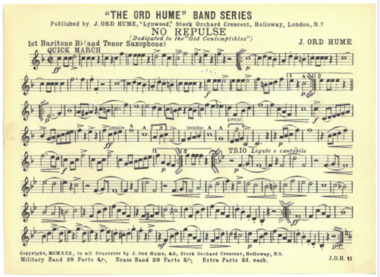
March Card, Hume, J. Ord (Composer), No Repulse, Composed: 1930
... Instrumentation: Solo Cornet Bb (Conductor written along the top) Piccolo Eb Oboe Clarinet Eb 1st Clarinet Bb 2nd Clarinet Bb 3rd Clarinets Bb Bassoon 2nd Bb Baritone Eb Soprano Cornet Alto Saophone 1st Baritone Bb (and Tenor Saxophone) 1st Eb Horn (or Solo Tenor) 2nd Eb Horn (Or 1st Tenor) 3rd Eb Horn (or 2nd Tenor) 4th Eb Horn Repiano Bb (Cornet written) Solo Bb Cornet 2nd Bb Cornet 1st Trombone (Tenor Clef) 2nd Trombone (Tenor Clef) Bass Trombone Euphonium (Bass Clef) Basses (Bass Clef) Drums...Instrumentation: Solo Cornet Bb (Conductor written along the top) Piccolo Eb Oboe Clarinet Eb 1st Clarinet Bb 2nd Clarinet Bb 3rd Clarinets Bb Bassoon 2nd Bb Baritone Eb Soprano Cornet Alto Saophone 1st Baritone Bb (and Tenor Saxophone) 1st Eb Horn (or Solo Tenor) 2nd Eb Horn (Or 1st Tenor) 3rd Eb Horn (or 2nd Tenor) 4th Eb Horn Repiano Bb (Cornet written) Solo Bb Cornet 2nd Bb Cornet 1st Trombone (Tenor Clef) 2nd Trombone (Tenor Clef) Bass Trombone Euphonium (Bass Clef) Basses (Bass Clef) Drums No Repulse March Card Hume, J. ...In 1932 the call was put out to the ABC to start a military band. The band’s task was to record music to play on air four times a week, and to perform live concerts for the public. By November 1933 a band was put together with 40 musicians from around Australia. The band was initially conducted by Captain H. E. Adkins, Director of the Royal Military School of Music, Kneller Hall, London. After the tour, Adkins returned to his position at Kneller Hall, and Stephen Yorke, a retired bandmaster of the Gloucestershire Regiment, was brought out to Australia to become the permanent director and conductor of the band, which he did until the band closed in 1951. During the band’s 17 year history they presented a sizable program of music. Their final concert received a standing ovation from its audience of 1500, with a teary-eyed Yorke. 23 Parts Concert Band Instrumentation Quick March Key Signature: Eb Major "The Ord Hume" Band Series Dedicated to the "Old Contemptibles" Military Band 28 parts 4/-, Brass Band 20 Parts 3/-, Extra Parts 2d. each. Instrumentation: Solo Cornet Bb (Conductor written along the top) Piccolo Eb Oboe Clarinet Eb 1st Clarinet Bb 2nd Clarinet Bb 3rd Clarinets Bb Bassoon 2nd Bb Baritone Eb Soprano Cornet Alto Saophone 1st Baritone Bb (and Tenor Saxophone) 1st Eb Horn (or Solo Tenor) 2nd Eb Horn (Or 1st Tenor) 3rd Eb Horn (or 2nd Tenor) 4th Eb Horn Repiano Bb (Cornet written) Solo Bb Cornet 2nd Bb Cornet 1st Trombone (Tenor Clef) 2nd Trombone (Tenor Clef) Bass Trombone Euphonium (Bass Clef) Basses (Bass Clef) DrumsOn envelope: QM140, March No Re[pulse Ord Hume, Q120, scrubbed out 354 Stamped on the reverse of each card: Australian Broadcasting Commission *Sydney*, The Property of Musical Director & Arranger Charles Godfreybrass band, australian broadcasting commission, marching band, concert band -
 Royal Australian Air Force Band
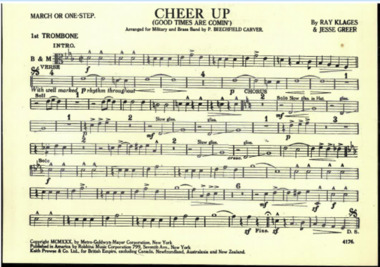
March Card, Jesse Greer (Composer) et al, Cheer Up (Good Times Are Coming), Composed: 1930
... Beechfield Carver Instrumentation: Eb Flute & Piccolo Oboes Eb Clarinets 1st Clarinets Bb 2nd & 3rd Clarinets Bb Bassoons Eb Alto Saxophone 1st Baritone Bb (or Tenor Saxophone) Repiano Cornet Bb Solo Cornet Bb (Conductor) 2nd Cornet Bb 1st Horn Eb (or Solo Tenor) 2nd Horn Eb (or 1st Tenor) 3rd & 4th Horns Eb (or 2nd Tenor) 1st Trombone (Alto Clef) 2nd Trombone (Tenor Clef) Bass Trombone Euphonium (Bass Clef) Bb Bass (Treble Clef) Basses (Bass Clef) Drums & Effects (Tubular Bells in Eb, Sleigh Bells, Tambourine etc.)...Beechfield Carver Instrumentation: Eb Flute & Piccolo Oboes Eb Clarinets 1st Clarinets Bb 2nd & 3rd Clarinets Bb Bassoons Eb Alto Saxophone 1st Baritone Bb (or Tenor Saxophone) Repiano Cornet Bb Solo Cornet Bb (Conductor) 2nd Cornet Bb 1st Horn Eb (or Solo Tenor) 2nd Horn Eb (or 1st Tenor) 3rd & 4th Horns Eb (or 2nd Tenor) 1st Trombone (Alto Clef) 2nd Trombone (Tenor Clef) Bass Trombone Euphonium (Bass Clef) Bb Bass (Treble Clef) Basses (Bass Clef) Drums & Effects (Tubular Bells in Eb, Sleigh Bells, Tambourine etc.) ...In 1932 the call was put out to the ABC to start a military band. The band’s task was to record music to play on air four times a week, and to perform live concerts for the public. By November 1933 a band was put together with 40 musicians from around Australia. The band was initially conducted by Captain H. E. Adkins, Director of the Royal Military School of Music, Kneller Hall, London. After the tour, Adkins returned to his position at Kneller Hall, and Stephen Yorke, a retired bandmaster of the Gloucestershire Regiment, was brought out to Australia to become the permanent director and conductor of the band, which he did until the band closed in 1951. During the band’s 17 year history they presented a sizable program of music. Their final concert received a standing ovation from its audience of 1500, with a teary-eyed Yorke. 23 Parts Concert Band Instrumentation Quick March (March or One-Step) Key Signature: Eb Major Arranged for Military and Brass Band by P. Beechfield Carver Instrumentation: Eb Flute & Piccolo Oboes Eb Clarinets 1st Clarinets Bb 2nd & 3rd Clarinets Bb Bassoons Eb Alto Saxophone 1st Baritone Bb (or Tenor Saxophone) Repiano Cornet Bb Solo Cornet Bb (Conductor) 2nd Cornet Bb 1st Horn Eb (or Solo Tenor) 2nd Horn Eb (or 1st Tenor) 3rd & 4th Horns Eb (or 2nd Tenor) 1st Trombone (Alto Clef) 2nd Trombone (Tenor Clef) Bass Trombone Euphonium (Bass Clef) Bb Bass (Treble Clef) Basses (Bass Clef) Drums & Effects (Tubular Bells in Eb, Sleigh Bells, Tambourine etc.)On envelope: QM33. March or One Step, Cheer up Good Times are Coming, Greer. Q33, 402 (crossed out). Stamped on the reverse of each card: Australian Broadcasting Commission, Sydneybrass band, australian broadcasting commission, marching band, concert band -
 Royal Australian Air Force Band
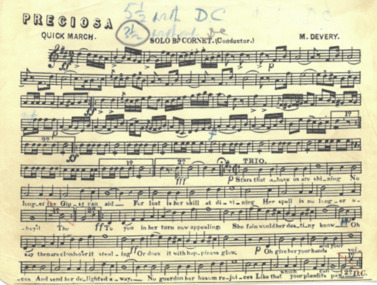
March Card, Devery, M. (Composer), Preciosa, Composed: 1899 (?)
... 23 parts Concert Band instrumentation Quick March Key Signature: C Major Instrumentation: Solo Bb Cornet (Conductor) - with lyrics in the Trio Db Piccolo Oboes Eb Clarinets 1st Bb Clarinet 2nd Bb Clarinet 3rd & 4th Clarinet 1st Bassoon 2nd Bassoon Eb Solo Tenor (penciled Alto Sax) 1st Bb Baritone (penciled Tenor Sax) 1st Eb Tenor 2nd Ed Tenor 1st Eb Horn 2nd Eb Horn 2nd Bb Cornet 1st Trombone 2nd Trombone Bass Trombone Euponium Bombardon Side Drum Bass Drum Handwritten Timpani part...Brass Band Australian Broadcasting Commission Marching Band Concert Band On envelope: QM159, 15 APR 1910, 21 APR 1942, 23 FEB 1943, Q138 Scrubbed out: 419 23 parts Concert Band instrumentation Quick March Key Signature: C Major Instrumentation: Solo Bb Cornet (Conductor) - with lyrics in the Trio Db Piccolo Oboes Eb Clarinets 1st Bb Clarinet 2nd Bb Clarinet 3rd & 4th Clarinet 1st Bassoon 2nd Bassoon Eb Solo Tenor (penciled Alto Sax) 1st Bb Baritone (penciled Tenor Sax) 1st Eb Tenor 2nd Ed Tenor 1st Eb Horn 2nd Eb Horn 2nd Bb Cornet 1st Trombone 2nd Trombone Bass Trombone Euponium Bombardon Side Drum Bass Drum Handwritten Timpani part Preciosa March Card Devery, M. ...In 1932 the call was put out to the ABC to start a military band. The band’s task was to record music to play on air four times a week, and to perform live concerts for the public. By November 1933 a band was put together with 40 musicians from around Australia. The band was initially conducted by Captain H. E. Adkins, Director of the Royal Military School of Music, Kneller Hall, London. After the tour, Adkins returned to his position at Kneller Hall, and Stephen Yorke, a retired bandmaster of the Gloucestershire Regiment, was brought out to Australia to become the permanent director and conductor of the band, which he did until the band closed in 1951. During the band’s 17 year history they presented a sizable program of music. Their final concert received a standing ovation from its audience of 1500, with a teary-eyed Yorke. 23 parts Concert Band instrumentation Quick March Key Signature: C Major Instrumentation: Solo Bb Cornet (Conductor) - with lyrics in the Trio Db Piccolo Oboes Eb Clarinets 1st Bb Clarinet 2nd Bb Clarinet 3rd & 4th Clarinet 1st Bassoon 2nd Bassoon Eb Solo Tenor (penciled Alto Sax) 1st Bb Baritone (penciled Tenor Sax) 1st Eb Tenor 2nd Ed Tenor 1st Eb Horn 2nd Eb Horn 2nd Bb Cornet 1st Trombone 2nd Trombone Bass Trombone Euponium Bombardon Side Drum Bass Drum Handwritten Timpani partOn envelope: QM159, 15 APR 1910, 21 APR 1942, 23 FEB 1943, Q138 Scrubbed out: 419brass band, australian broadcasting commission, marching band, concert band -
 Royal Australian Air Force Band
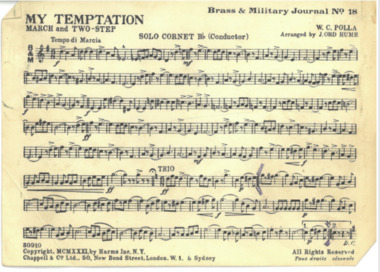
March Card, Polla, W. C. (Composer) et al, My Temptation, Composed: 1931
... 24 parts Concert Band Instrumentation Quick March & Two Step Key Signature: F major Brass & Military Journal No. 18 Instrumentation: Solo Cornet Bb (Conductor) Piccolo Eb Oboe Eb Clarinet 1st Clarinet in Bb 2nd Clarinet in Bb 3rd Clarinet in Bb Bassoon Eb Alto Saxophone 1st Baritone Bb (and Tenor Saxophone Bb) 1st Horn Eb or Solo Tenor 2nd Horn Eb or 1st Tenor 3rd Horn Eb or 2nd Tenor 4th Horn Eb Repiano Cornet Bb 2nd Cornet Bb 1st Trombone 2nd Trombone Bass Trombone Euphonium (bass clef) Basses Contre Bass Bb Drums .... & The Property of Musical Director & Arranger Charles Godfrey 24 parts Concert Band Instrumentation Quick March & Two Step Key Signature: F major Brass & Military Journal No. 18 Instrumentation: Solo Cornet Bb (Conductor) Piccolo Eb Oboe Eb Clarinet 1st Clarinet in Bb 2nd Clarinet in Bb 3rd Clarinet in Bb Bassoon Eb Alto Saxophone 1st Baritone Bb (and Tenor Saxophone Bb) 1st Horn Eb or Solo Tenor 2nd Horn Eb or 1st Tenor 3rd Horn Eb or 2nd Tenor 4th Horn Eb Repiano Cornet Bb 2nd Cornet Bb 1st Trombone 2nd Trombone Bass Trombone Euphonium (bass clef) Basses Contre Bass Bb Drums My Temptation March Card Polla, W. ...In 1932 the call was put out to the ABC to start a military band. The band’s task was to record music to play on air four times a week, and to perform live concerts for the public. By November 1933 a band was put together with 40 musicians from around Australia. The band was initially conducted by Captain H. E. Adkins, Director of the Royal Military School of Music, Kneller Hall, London. After the tour, Adkins returned to his position at Kneller Hall, and Stephen Yorke, a retired bandmaster of the Gloucestershire Regiment, was brought out to Australia to become the permanent director and conductor of the band, which he did until the band closed in 1951. During the band’s 17 year history they presented a sizable program of music. Their final concert received a standing ovation from its audience of 1500, with a teary-eyed Yorke. 24 parts Concert Band Instrumentation Quick March & Two Step Key Signature: F major Brass & Military Journal No. 18 Instrumentation: Solo Cornet Bb (Conductor) Piccolo Eb Oboe Eb Clarinet 1st Clarinet in Bb 2nd Clarinet in Bb 3rd Clarinet in Bb Bassoon Eb Alto Saxophone 1st Baritone Bb (and Tenor Saxophone Bb) 1st Horn Eb or Solo Tenor 2nd Horn Eb or 1st Tenor 3rd Horn Eb or 2nd Tenor 4th Horn Eb Repiano Cornet Bb 2nd Cornet Bb 1st Trombone 2nd Trombone Bass Trombone Euphonium (bass clef) Basses Contre Bass Bb Drums On envelope: QM136, March Two Step My Temptation Polla, Q114, Scrubbed out 375 Stamped on the reverse of each card: Australian Broadcasting Co. & The Property of Musical Director & Arranger Charles Godfreybrass band, australian broadcasting commission, marching band, concert band -
 Royal Australian Air Force Band
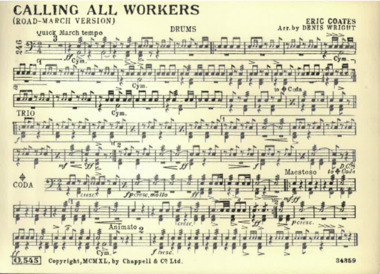
March Card, Eric Coates (Composer) et al, Composed: 1940
... 19 Parts Concert Band Instrumentation (Missing parts: 2nd Horn, all saxes) Quick March (Road-March Version) Key Signature: Bb Major Instrumentation: Flute & Piccolo Db Eb Clarinet 1st Clarinet Bb 2nd Clarinet Bb 3rd Clarinet Bb Soprano Cornet Eb Repiano Cornet Bb Solo Cornet Bb (Conductor) 2nd Cornet Bb 3rd Cornet Bb 1st Horn Eb (or Solo Tenor) 3rd Horn Eb (or 2nd Tenor) 1st Trombone (Tenor Clef) 2nd Trombone (Tenor Clef) Bass Trombone Euphonium Bb (Treble Clef) Eb Bass (Treble Clef) Contre Bass Bb (Treble Clef) Drums...O.545, Brass Band 2/6 19 Parts Concert Band Instrumentation (Missing parts: 2nd Horn, all saxes) Quick March (Road-March Version) Key Signature: Bb Major Instrumentation: Flute & Piccolo Db Eb Clarinet 1st Clarinet Bb 2nd Clarinet Bb 3rd Clarinet Bb Soprano Cornet Eb Repiano Cornet Bb Solo Cornet Bb (Conductor) 2nd Cornet Bb 3rd Cornet Bb 1st Horn Eb (or Solo Tenor) 3rd Horn Eb (or 2nd Tenor) 1st Trombone (Tenor Clef) 2nd Trombone (Tenor Clef) Bass Trombone Euphonium Bb (Treble Clef) Eb Bass (Treble Clef) Contre Bass Bb (Treble Clef) Drums March Card Eric Coates (Composer) Denis Wright (Arranger) Chappell & Co. ...In 1932 the call was put out to the ABC to start a military band. The band’s task was to record music to play on air four times a week, and to perform live concerts for the public. By November 1933 a band was put together with 40 musicians from around Australia. The band was initially conducted by Captain H. E. Adkins, Director of the Royal Military School of Music, Kneller Hall, London. After the tour, Adkins returned to his position at Kneller Hall, and Stephen Yorke, a retired bandmaster of the Gloucestershire Regiment, was brought out to Australia to become the permanent director and conductor of the band, which he did until the band closed in 1951. During the band’s 17 year history they presented a sizable program of music. Their final concert received a standing ovation from its audience of 1500, with a teary-eyed Yorke. 19 Parts Concert Band Instrumentation (Missing parts: 2nd Horn, all saxes) Quick March (Road-March Version) Key Signature: Bb Major Instrumentation: Flute & Piccolo Db Eb Clarinet 1st Clarinet Bb 2nd Clarinet Bb 3rd Clarinet Bb Soprano Cornet Eb Repiano Cornet Bb Solo Cornet Bb (Conductor) 2nd Cornet Bb 3rd Cornet Bb 1st Horn Eb (or Solo Tenor) 3rd Horn Eb (or 2nd Tenor) 1st Trombone (Tenor Clef) 2nd Trombone (Tenor Clef) Bass Trombone Euphonium Bb (Treble Clef) Eb Bass (Treble Clef) Contre Bass Bb (Treble Clef) DrumsOn envelope:QM28, The Chappell Band Club, March By Eric Coates, Featured on all "Music While You Work" Programmes. O.545, Brass Band 2/6brass band, australian broadcasting commission, marching band, concert band -
 Royal Australian Air Force Band
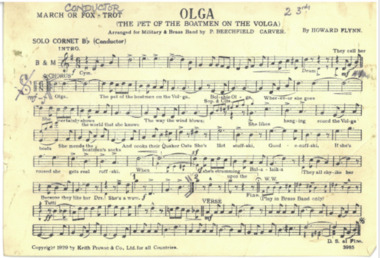
March Card, Howard Flynn (Composer) et al, Olga (The Pet of the Boatmen on the Volga), Composed: 1929
... 20 Parts Concert Band Instrumentation March or Fox Trot Key Signature: F Major Instrumentation: Solo Cornet Bb (Conductor) Eb Flute & Piccolo Oboes Eb Clarinets Solo Bb Clarinet (1st written in pencil) 2nd & 3rd Bb Clarinets Bassoons Eb Alto Saxophone 1st & 2nd Horns Eb (or Solo & 1st Tenor) 3rd & 4th Horns Eb (or 2nd Tenor) Repiano Cornet Bb Solo Cornet Bb (Conductor) 2nd & 3rd Cornets Bb 1st Tenor Trombone 2nd Tenor Trombone Bass Trombone 1st Baritone Bb Euphonium (Bass clef) Basses (Bass clef) Bb Contra Bass (Treble clef) Drums...Brass Band Australian Broadcasting Commission Marching Band Concert Band On envelope: QM145, Olga Flynn, Q131, 346 (Scrubbed out) Stamped on the reverse of each card: Australian Broadcasting Commission *Sydney*, Charles Godfrey 20 Parts Concert Band Instrumentation March or Fox Trot Key Signature: F Major Instrumentation: Solo Cornet Bb (Conductor) Eb Flute & Piccolo Oboes Eb Clarinets Solo Bb Clarinet (1st written in pencil) 2nd & 3rd Bb Clarinets Bassoons Eb Alto Saxophone 1st & 2nd Horns Eb (or Solo & 1st Tenor) 3rd & 4th Horns Eb (or 2nd Tenor) Repiano Cornet Bb Solo Cornet Bb (Conductor) 2nd & 3rd Cornets Bb 1st Tenor Trombone 2nd Tenor Trombone Bass Trombone 1st Baritone Bb Euphonium (Bass clef) Basses (Bass clef) Bb Contra Bass (Treble clef) Drums Olga (The Pet of the Boatmen on the Volga) March Card Howard Flynn (Composer) Carver, P. ...In 1932 the call was put out to the ABC to start a military band. The band’s task was to record music to play on air four times a week, and to perform live concerts for the public. By November 1933 a band was put together with 40 musicians from around Australia. The band was initially conducted by Captain H. E. Adkins, Director of the Royal Military School of Music, Kneller Hall, London. After the tour, Adkins returned to his position at Kneller Hall, and Stephen Yorke, a retired bandmaster of the Gloucestershire Regiment, was brought out to Australia to become the permanent director and conductor of the band, which he did until the band closed in 1951. During the band’s 17 year history they presented a sizable program of music. Their final concert received a standing ovation from its audience of 1500, with a teary-eyed Yorke. 20 Parts Concert Band Instrumentation March or Fox Trot Key Signature: F Major Instrumentation: Solo Cornet Bb (Conductor) Eb Flute & Piccolo Oboes Eb Clarinets Solo Bb Clarinet (1st written in pencil) 2nd & 3rd Bb Clarinets Bassoons Eb Alto Saxophone 1st & 2nd Horns Eb (or Solo & 1st Tenor) 3rd & 4th Horns Eb (or 2nd Tenor) Repiano Cornet Bb Solo Cornet Bb (Conductor) 2nd & 3rd Cornets Bb 1st Tenor Trombone 2nd Tenor Trombone Bass Trombone 1st Baritone Bb Euphonium (Bass clef) Basses (Bass clef) Bb Contra Bass (Treble clef) DrumsOn envelope: QM145, Olga Flynn, Q131, 346 (Scrubbed out) Stamped on the reverse of each card: Australian Broadcasting Commission *Sydney*, Charles Godfreybrass band, australian broadcasting commission, marching band, concert band -
 Rutherglen Historical Society
Image, 1920 (Approximate)
... Members of Rutherglen Band in photograph (Identified on separate sheet of paper): Back left to right - Alec McPherson - Kettle Drum; Thomas Walsh - Tenor Horn; Ollie Nash - Tenor Horn; Alec Johnston - Tenor Horn; Ron Hossack - Trumpet; Les Jones - Turmpet; Arthur Warren - Trumpet; Jack Blowers. ...Members of Rutherglen Band in photograph (Identified on separate sheet of paper): Back left to right - Alec McPherson - Kettle Drum; Thomas Walsh - Tenor Horn; Ollie Nash - Tenor Horn; Alec Johnston - Tenor Horn; Ron Hossack - Trumpet; Les Jones - Turmpet; Arthur Warren - Trumpet; Jack Blowers. ...Donated by Mr Ian Stones, a member of the Rutherglen Historical Society.Black & white group photograph, mounted on cardboard, of Rutherglen Band members taken in Rutherglen Park.Members of Rutherglen Band in photograph (Identified on separate sheet of paper): Back left to right - Alec McPherson - Kettle Drum; Thomas Walsh - Tenor Horn; Ollie Nash - Tenor Horn; Alec Johnston - Tenor Horn; Ron Hossack - Trumpet; Les Jones - Turmpet; Arthur Warren - Trumpet; Jack Blowers. Middle row left to right - Victor Leroy; Alec Hayes; Sam Hossack (Uncle to Arthur); Bill Boyd. Front row (seated) left to right - Jack Blowers Jnr. (called Mark); Bill Bevan; Sterling Warren; Hossack, Arthur; Bert Bevan. -
 Bendigo Historical Society Inc.
Document - GRAND CONCERT
... 'Grand Concert'. Thomas Edmunds tenor. Peter Tillett pianist. C1960's....'Grand Concert'. Thomas Edmunds tenor. Peter Tillett pianist. C1960's. Document GRAND CONCERT ...Bendigo City Hall, Saturday at 8 p. m. 'Grand Concert'. Thomas Edmunds tenor. Peter Tillett pianist. C1960's.event, entertainment, music, grand concert, thomas edmunds, peter tillett -
 Royal Australian Air Force Band
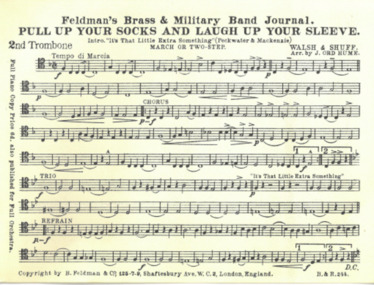
March Card, Walsh & Shuff (Composer) et al, Pull Up Your Socks and Laugh Up Your Sleeve, Composed: ?
... 'It's That Little Extra Something" (Peckwater & Mackenzie) Full Piano Copy Rice 6d. also published for Full Orchestra Instrumentation: Conductor Flute & Piccolo Oboe Eb Clarinet Bb Repiano 1st Clarinet in Bb 2nd Clarinet in Bb 3rd Clarinet in Bb Bassoon Eb Alto Saxophone 1st Baritone Bb & Tenor Saxophone Bb 1st Eb Horn or Solo Tenor 2nd Eb Horn or 1st Tenor 3rd Eb Horn or 2nd Tenor 4th Eb Horn Solo Cornet in Bb 2nd Cornet in Bb 1st Trombone 2nd Trombone Bass Trombone Euphonium (bass clef) Basses Drums...'It's That Little Extra Something" (Peckwater & Mackenzie) Full Piano Copy Rice 6d. also published for Full Orchestra Instrumentation: Conductor Flute & Piccolo Oboe Eb Clarinet Bb Repiano 1st Clarinet in Bb 2nd Clarinet in Bb 3rd Clarinet in Bb Bassoon Eb Alto Saxophone 1st Baritone Bb & Tenor Saxophone Bb 1st Eb Horn or Solo Tenor 2nd Eb Horn or 1st Tenor 3rd Eb Horn or 2nd Tenor 4th Eb Horn Solo Cornet in Bb 2nd Cornet in Bb 1st Trombone 2nd Trombone Bass Trombone Euphonium (bass clef) Basses Drums Pull Up Your Socks and Laugh Up Your Sleeve March Card Walsh & Shuff (Composer) Hume, J. ...In 1932 the call was put out to the ABC to start a military band. The band’s task was to record music to play on air four times a week, and to perform live concerts for the public. By November 1933 a band was put together with 40 musicians from around Australia. The band was initially conducted by Captain H. E. Adkins, Director of the Royal Military School of Music, Kneller Hall, London. After the tour, Adkins returned to his position at Kneller Hall, and Stephen Yorke, a retired bandmaster of the Gloucestershire Regiment, was brought out to Australia to become the permanent director and conductor of the band, which he did until the band closed in 1951. During the band’s 17 year history they presented a sizable program of music. Their final concert received a standing ovation from its audience of 1500, with a teary-eyed Yorke. 23 parts Concert Band Instrumentation Quick March or Two Step Key Signature: F Major Intro. 'It's That Little Extra Something" (Peckwater & Mackenzie) Full Piano Copy Rice 6d. also published for Full Orchestra Instrumentation: Conductor Flute & Piccolo Oboe Eb Clarinet Bb Repiano 1st Clarinet in Bb 2nd Clarinet in Bb 3rd Clarinet in Bb Bassoon Eb Alto Saxophone 1st Baritone Bb & Tenor Saxophone Bb 1st Eb Horn or Solo Tenor 2nd Eb Horn or 1st Tenor 3rd Eb Horn or 2nd Tenor 4th Eb Horn Solo Cornet in Bb 2nd Cornet in Bb 1st Trombone 2nd Trombone Bass Trombone Euphonium (bass clef) Basses DrumsOn envelope: QM161, March at Two Step, Pull up your Socks, Walsh Q137, scrubbed out 407 Stamped on the reverse of each card: Australian Broadcasting Co.brass band, australian broadcasting commission, marching band, concert band -
 Royal Australian Air Force Band
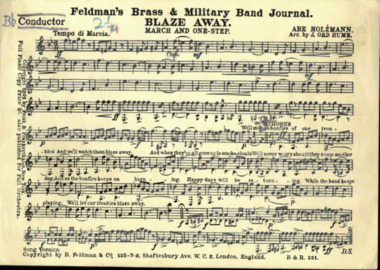
March Card, Abe Holzmann (Composer) et al, Blaze Away, Composed: 1901
... 23 Parts Concert Band Instrumentation Feldman's Brass & Military Band Journal March and One-Step Tempo di Marcia Key Signature: Ab Major Instrumentation: Flute & Piccolo Eb Oboe Eb Clarinet 1st Clarinet Bb 2nd Clarinet Bb 3rd Clarinet Bb Bassoon Alto Saxophone Eb 1st Baritone Bb & Tenor Saxophone Bb (Treble Clef) Conductor (in Bb) Bb Repiano (Cornet) Solo Cornet Bb 2nd Cornet Bb 1st Horn Eb or Solo Tenor 2nd Horn Eb or 1st Tenor 3rd Horn Eb or 2nd Tenor 4th Horn Eb 1st Trombone 2nd Trombone Bass Trombone Euphonium (Bass Clef) Basses (Bass Clef) Drums...Stamped on the reverse of each card: Australian Broadcasting Commission *Sydney* 23 Parts Concert Band Instrumentation Feldman's Brass & Military Band Journal March and One-Step Tempo di Marcia Key Signature: Ab Major Instrumentation: Flute & Piccolo Eb Oboe Eb Clarinet 1st Clarinet Bb 2nd Clarinet Bb 3rd Clarinet Bb Bassoon Alto Saxophone Eb 1st Baritone Bb & Tenor Saxophone Bb (Treble Clef) Conductor (in Bb) Bb Repiano (Cornet) Solo Cornet Bb 2nd Cornet Bb 1st Horn Eb or Solo Tenor 2nd Horn Eb or 1st Tenor 3rd Horn Eb or 2nd Tenor 4th Horn Eb 1st Trombone 2nd Trombone Bass Trombone Euphonium (Bass Clef) Basses (Bass Clef) Drums Blaze Away March Card Abe Holzmann (Composer) Hume, J. ...In 1932 the call was put out to the ABC to start a military band. The band’s task was to record music to play on air four times a week, and to perform live concerts for the public. By November 1933 a band was put together with 40 musicians from around Australia. The band was initially conducted by Captain H. E. Adkins, Director of the Royal Military School of Music, Kneller Hall, London. After the tour, Adkins returned to his position at Kneller Hall, and Stephen Yorke, a retired bandmaster of the Gloucestershire Regiment, was brought out to Australia to become the permanent director and conductor of the band, which he did until the band closed in 1951. During the band’s 17 year history they presented a sizable program of music. Their final concert received a standing ovation from its audience of 1500, with a teary-eyed Yorke. 23 Parts Concert Band Instrumentation Feldman's Brass & Military Band Journal March and One-Step Tempo di Marcia Key Signature: Ab Major Instrumentation: Flute & Piccolo Eb Oboe Eb Clarinet 1st Clarinet Bb 2nd Clarinet Bb 3rd Clarinet Bb Bassoon Alto Saxophone Eb 1st Baritone Bb & Tenor Saxophone Bb (Treble Clef) Conductor (in Bb) Bb Repiano (Cornet) Solo Cornet Bb 2nd Cornet Bb 1st Horn Eb or Solo Tenor 2nd Horn Eb or 1st Tenor 3rd Horn Eb or 2nd Tenor 4th Horn Eb 1st Trombone 2nd Trombone Bass Trombone Euphonium (Bass Clef) Basses (Bass Clef) DrumsOn envelope: QM17, Stamps indicating 19 FEB 1940, 29 JUN 1940, 28 DEC 1940, 23 MAY 1941. Q23, 405 (crossed out). Stamped on the reverse of each card: Australian Broadcasting Commission *Sydney*brass band, australian broadcasting commission, marching band, concert band -
 Coal Creek Community Park & Museum
Phonograph Record, Smilin' Through, Sorter Miss You
... Artist: Henry Moeller, tenor....Artist: Henry Moeller, tenor. Smilin' Through, Sorter Miss You Phonograph Record ...Black shellac phonograph record with a turquoise Gennett label. A side: Smilin' Through. B side: Sorter Miss You. Artist: Henry Moeller, tenor.Reference number 10062-A The Star Piano Company Richmond. INC. -
 Flagstaff Hill Maritime Museum and Village
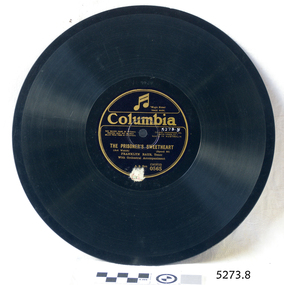
Audio - Gramophone Record, Columbia Records, The Prisoner's Sweetheart, Early-to-mid 20th century
... Title: The Prisoner's Sweetheart Artist: tenor Franklyn Baur Publisher: Columbia Number:141812 Size: 10 inch...Title: The Prisoner's Sweetheart Artist: tenor Franklyn Baur Publisher: Columbia Number:141812 Size: 10 inch The Prisoner's Sweetheart Audio Gramophone Record Columbia Records ...Thomas Edison (1847–1931), an American, invented the phonograph in 1877, making it possible to record sound waves vertically and reproduce them on a wax cylinder so they could be heard again. Later, the German American, Emile Berliner (1851-1929), improved on Edison’s principles, greatly increasing the quality of the reproduced sounds with his invention of the gramophone in 1887, which recorded the sound waves laterally onto a flat shellac disc, or ‘record’. Records could be mass-produced in a factory where audio recordings were converted to a physical copy of that recording on a plate-sized disc. A gramophone machine reproduced the sound by spinning the record on a turntable at a specified number of rotations per minute (RPM) and using a stylus or needle to transfer the vibration via a membrane to a speaker, which amplified the sound. Berliner helped set up affiliated businesses overseas. One of his representatives was William Barry Owen (1860–1914), who, on 23 February 1889, partnered with Edmund Trevor Lloyd Williams (1859–1946) in England to register The Gramophone Company. His Master’s Voice (HMV) soon became the company’s major recording label, popular worldwide. The business based the label's logo of a dog looking into a gramophone horn for ‘his master’s voice’ was based on a painting by English artist Francis Barraud, which featured a terrier called Nipper beside a gramophone. Early gramophone records were mostly made from a material referred to as shellac, a natural ingredient combined with slate powder, and a filler of manilla copal, wood resin, carnauba wax, and carbon black. Although Bakelite seemed a useful, synthetic product, it was unsuccessful as a product for records. Around the time of World War II, lightweight, flexible synthetic vinyl records began replacing shellac records. Common diameters of records: 7 inch, 10 inch, 12 inch and 16 inch Revolutions Per Minute include: 33 1/3, 45, 78 Minutes per side of record: 3, 5.5, 7, 8, 9, 12, 15 and 22 Labels, in minutes per side: Single Play 3-5 min, Extended Play (EP) 7-12 min, Long Play (LP) 12-22 min This gramophone represents a step in the evolution of recording sound. In the 19th century, the human voice was first recorded on wax cylinders and replayed. It was the beginning of a new era in sound. Then, in the 1880s, voice could be recorded onto flat discs like this record, reliably reproduced and replayed many times, even on portable devices. Later, in the mid-20th century the following generation of electronic audio recording began, and later that century, digital recording gave even better reproduction. The record represents a popular means of entertainment for personal and social activities, as well as in some businesses. Shellac gramophone record with a purple and gold label. Title: The Prisoner's Sweetheart Artist: tenor Franklyn Baur Publisher: Columbia Number:141812 Size: 10 inchflagstaff hill, warrnambool, maritime village, maritime museum, flagstaff hill maritime museum and village, shipwreck coast, great ocean road, gramophone, phonograph, sound waves, record, reproduction, audio record, music, sound, thomas edison, emile berliner, 1887, shellac, rpm, william barry owen, edmund trevor lloyd williams, the gramophone company, his master’s voice, hmv, francis barraud, nipper, 10 inch, columbia, 141812, the prisoner's sweetheart, franklyn baur (tenor) -
 Coal Creek Community Park & Museum
Phonograph Record, Somewhere a Voice is Calling, Sleep and the Roses
... B side: Sleep and the Roses. Artist: Tenor John Adams with Orchestra....B side: Sleep and the Roses. Artist: Tenor John Adams with Orchestra. Somewhere a Voice is Calling, Sleep and the Roses Phonograph Record ...Phonograph record, black shellac, with burgundy Regal label. A side: Somewhere a voice is calling. B side: Sleep and the Roses. Artist: Tenor John Adams with Orchestra.Reference number G6940 Label has pink 1/2d stamp on it. -
 Flagstaff Hill Maritime Museum and Village
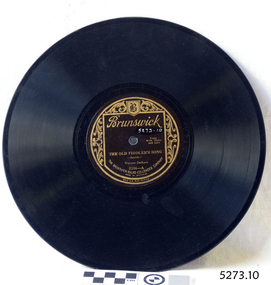
Audio - Gramophone Record, Brunswick Records, The Old Fiddlers Song, Early-to-mid 20th century
... Title: The Old Fiddlers Song Artist: Vernon Delhart, tenor Publisher: Brunswick Number:3234-A Size: 10 inch...Title: The Old Fiddlers Song Artist: Vernon Delhart, tenor Publisher: Brunswick Number:3234-A Size: 10 inch The Old Fiddlers Song Audio Gramophone Record Brunswick Records ...Thomas Edison (1847–1931), an American, invented the phonograph in 1877, making it possible to record sound waves vertically and reproduce them on a wax cylinder so they could be heard again. Later, the German American, Emile Berliner (1851-1929), improved on Edison’s principles, greatly increasing the quality of the reproduced sounds with his invention of the gramophone in 1887, which recorded the sound waves laterally onto a flat shellac disc, or ‘record’. Records could be mass-produced in a factory where audio recordings were converted to a physical copy of that recording on a plate-sized disc. A gramophone machine reproduced the sound by spinning the record on a turntable at a specified number of rotations per minute (RPM) and using a stylus or needle to transfer the vibration via a membrane to a speaker, which amplified the sound. Berliner helped set up affiliated businesses overseas. One of his representatives was William Barry Owen (1860–1914), who, on 23 February 1889, partnered with Edmund Trevor Lloyd Williams (1859–1946) in England to register The Gramophone Company. His Master’s Voice (HMV) soon became the company’s major recording label, popular worldwide. The business based the label's logo of a dog looking into a gramophone horn for ‘his master’s voice’ was based on a painting by English artist Francis Barraud, which featured a terrier called Nipper beside a gramophone. Early gramophone records were mostly made from a material referred to as shellac, a natural ingredient combined with slate powder, and a filler of manilla copal, wood resin, carnauba wax, and carbon black. Although Bakelite seemed a useful, synthetic product, it was unsuccessful as a product for records. Around the time of World War II, lightweight, flexible synthetic vinyl records began replacing shellac records. Common diameters of records: 7 inch, 10 inch, 12 inch and 16 inch Revolutions Per Minute include: 33 1/3, 45, 78 Minutes per side of record: 3, 5.5, 7, 8, 9, 12, 15 and 22 Labels, in minutes per side: Single Play 3-5 min, Extended Play (EP) 7-12 min, Long Play (LP) 12-22 min This gramophone represents a step in the evolution of recording sound. In the 19th century, the human voice was first recorded on wax cylinders and replayed. It was the beginning of a new era in sound. Then, in the 1880s, voice could be recorded onto flat discs like this record, reliably reproduced and replayed many times, even on portable devices. Later, in the mid-20th century the following generation of electronic audio recording began, and later that century, digital recording gave even better reproduction. The record represents a popular means of entertainment for personal and social activities, as well as in some businesses. Shellac gramophone record with a black and gold label. Title: The Old Fiddlers Song Artist: Vernon Delhart, tenor Publisher: Brunswick Number:3234-A Size: 10 inchflagstaff hill, warrnambool, maritime village, maritime museum, flagstaff hill maritime museum and village, shipwreck coast, great ocean road, gramophone, phonograph, sound waves, record, reproduction, audio record, music, sound, thomas edison, emile berliner, 1887, shellac, rpm, william barry owen, edmund trevor lloyd williams, the gramophone company, his master’s voice, hmv, francis barraud, nipper, 10 inch, brunswick records, 3234-a, the old fiddlers song, vernon delhart (tenor) -
 Flagstaff Hill Maritime Museum and Village
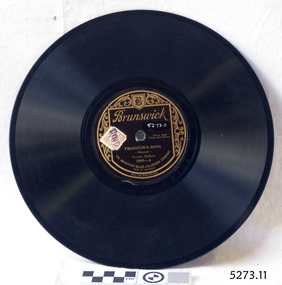
Audio - Gramophone Record, Brunswick Records, Prisoner's Song, Early-to-mid 20th century
... Title: Prisoner's Song Artist: Vernon Dalhart, tenor Publisher: Brunswick Records Number: A-2900 Size: 10 inch...Title: Prisoner's Song Artist: Vernon Dalhart, tenor Publisher: Brunswick Records Number: A-2900 Size: 10 inch Prisoner's Song Audio Gramophone Record Brunswick Records ...Thomas Edison (1847–1931), an American, invented the phonograph in 1877, making it possible to record sound waves vertically and reproduce them on a wax cylinder so they could be heard again. Later, the German American, Emile Berliner (1851-1929), improved on Edison’s principles, greatly increasing the quality of the reproduced sounds with his invention of the gramophone in 1887, which recorded the sound waves laterally onto a flat shellac disc, or ‘record’. Records could be mass-produced in a factory where audio recordings were converted to a physical copy of that recording on a plate-sized disc. A gramophone machine reproduced the sound by spinning the record on a turntable at a specified number of rotations per minute (RPM) and using a stylus or needle to transfer the vibration via a membrane to a speaker, which amplified the sound. Berliner helped set up affiliated businesses overseas. One of his representatives was William Barry Owen (1860–1914), who, on 23 February 1889, partnered with Edmund Trevor Lloyd Williams (1859–1946) in England to register The Gramophone Company. His Master’s Voice (HMV) soon became the company’s major recording label, popular worldwide. The business based the label's logo of a dog looking into a gramophone horn for ‘his master’s voice’ was based on a painting by English artist Francis Barraud, which featured a terrier called Nipper beside a gramophone. Early gramophone records were mostly made from a material referred to as shellac, a natural ingredient combined with slate powder, and a filler of manilla copal, wood resin, carnauba wax, and carbon black. Although Bakelite seemed a useful, synthetic product, it was unsuccessful as a product for records. Around the time of World War II, lightweight, flexible synthetic vinyl records began replacing shellac records. Common diameters of records: 7 inch, 10 inch, 12 inch and 16 inch Revolutions Per Minute include: 33 1/3, 45, 78 Minutes per side of record: 3, 5.5, 7, 8, 9, 12, 15 and 22 Labels, in minutes per side: Single Play 3-5 min, Extended Play (EP) 7-12 min, Long Play (LP) 12-22 min This gramophone represents a step in the evolution of recording sound. In the 19th century, the human voice was first recorded on wax cylinders and replayed. It was the beginning of a new era in sound. Then, in the 1880s, voice could be recorded onto flat discs like this record, reliably reproduced and replayed many times, even on portable devices. Later, in the mid-20th century the following generation of electronic audio recording began, and later that century, digital recording gave even better reproduction. The record represents a popular means of entertainment for personal and social activities, as well as in some businesses. Shellac gramophone record with a black and gold label. Title: Prisoner's Song Artist: Vernon Dalhart, tenor Publisher: Brunswick Records Number: A-2900 Size: 10 inchOn label, white sticker with red printflagstaff hill, warrnambool, maritime village, maritime museum, flagstaff hill maritime museum and village, shipwreck coast, great ocean road, gramophone, phonograph, sound waves, record, reproduction, audio record, music, sound, thomas edison, emile berliner, 1887, shellac, rpm, william barry owen, edmund trevor lloyd williams, the gramophone company, his master’s voice, hmv, francis barraud, nipper, 10 inch, brunswick records, a-2900, prisoner's song, vernon dalhart (tenor) -
 Flagstaff Hill Maritime Museum and Village
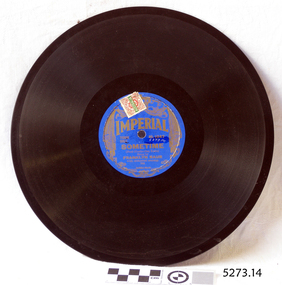
Audio - Gramophone Record, Imperial Records, Sometime, Early-to-mid 20th century
... Title: Sometime Artist: Franklyn Baur, tenor, solo Publisher: Imperial Records Number:1547 Size: 14 inch...Title: Sometime Artist: Franklyn Baur, tenor, solo Publisher: Imperial Records Number:1547 Size: 14 inch Sometime Audio Gramophone Record Imperial Records ...Thomas Edison (1847–1931), an American, invented the phonograph in 1877, making it possible to record sound waves vertically and reproduce them on a wax cylinder so they could be heard again. Later, the German American, Emile Berliner (1851-1929), improved on Edison’s principles, greatly increasing the quality of the reproduced sounds with his invention of the gramophone in 1887, which recorded the sound waves laterally onto a flat shellac disc, or ‘record’. Records could be mass-produced in a factory where audio recordings were converted to a physical copy of that recording on a plate-sized disc. A gramophone machine reproduced the sound by spinning the record on a turntable at a specified number of rotations per minute (RPM) and using a stylus or needle to transfer the vibration via a membrane to a speaker, which amplified the sound. Berliner helped set up affiliated businesses overseas. One of his representatives was William Barry Owen (1860–1914), who, on 23 February 1889, partnered with Edmund Trevor Lloyd Williams (1859–1946) in England to register The Gramophone Company. His Master’s Voice (HMV) soon became the company’s major recording label, popular worldwide. The business based the label's logo of a dog looking into a gramophone horn for ‘his master’s voice’ was based on a painting by English artist Francis Barraud, which featured a terrier called Nipper beside a gramophone. Early gramophone records were mostly made from a material referred to as shellac, a natural ingredient combined with slate powder, and a filler of manilla copal, wood resin, carnauba wax, and carbon black. Although Bakelite seemed a useful, synthetic product, it was unsuccessful as a product for records. Around the time of World War II, lightweight, flexible synthetic vinyl records began replacing shellac records. Common diameters of records: 7 inch, 10 inch, 12 inch and 16 inch Revolutions Per Minute include: 33 1/3, 45, 78 Minutes per side of record: 3, 5.5, 7, 8, 9, 12, 15 and 22 Labels, in minutes per side: Single Play 3-5 min, Extended Play (EP) 7-12 min, Long Play (LP) 12-22 min This gramophone represents a step in the evolution of recording sound. In the 19th century, the human voice was first recorded on wax cylinders and replayed. It was the beginning of a new era in sound. Then, in the 1880s, voice could be recorded onto flat discs like this record, reliably reproduced and replayed many times, even on portable devices. Later, in the mid-20th century the following generation of electronic audio recording began, and later that century, digital recording gave even better reproduction. The record represents a popular means of entertainment for personal and social activities, as well as in some businesses. Shellac gramophone record with a blue and gold label. Title: Sometime Artist: Franklyn Baur, tenor, solo Publisher: Imperial Records Number:1547 Size: 14 inchWhite paper stamp with gold, red and green printflagstaff hill, warrnambool, maritime village, maritime museum, flagstaff hill maritime museum and village, shipwreck coast, great ocean road, gramophone, phonograph, sound waves, record, reproduction, audio record, music, sound, thomas edison, emile berliner, 1887, shellac, rpm, william barry owen, edmund trevor lloyd williams, the gramophone company, his master’s voice, hmv, francis barraud, nipper, imperial record, 1547, sometime, tenor solo, franklyn baur, 14 inch -
 Royal Australian Air Force Band
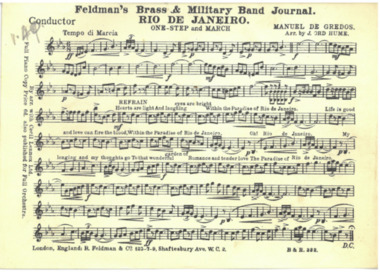
March Card, de Gredos, Manuel (Composer) et al, Rio de Janeiro, Composed: 1930 ?
... Full Piano Copy Price 6d. also published for Full Orchestra Refrain lyrics included on Conductor's score Instrumentation: Conductor Flute & Piccolo Eb Oboe Eb Clarinet 1st Bb Clarinet 2nd Bb Clarinet 3rd Bb Clarinet Bassoon Eb Alto Saxophone 1st Bb Baritone & Tenor Saxophone Bb 1st Eb Horn or Solo Tenor 2nd Eb Horn or 1st Tenor 3rd Eb Horn or 2nd Tenor 4th Eb Horn Bb Repiano Solo Cornet Bb 2nd Cornet Bb 1st Trombone (Alto Clef) 2nd Trombone (Alto Clef) Bass Trombone (Bass Clef) Euphonium (Bass Clef) Basses Drums...Full Piano Copy Price 6d. also published for Full Orchestra Refrain lyrics included on Conductor's score Instrumentation: Conductor Flute & Piccolo Eb Oboe Eb Clarinet 1st Bb Clarinet 2nd Bb Clarinet 3rd Bb Clarinet Bassoon Eb Alto Saxophone 1st Bb Baritone & Tenor Saxophone Bb 1st Eb Horn or Solo Tenor 2nd Eb Horn or 1st Tenor 3rd Eb Horn or 2nd Tenor 4th Eb Horn Bb Repiano Solo Cornet Bb 2nd Cornet Bb 1st Trombone (Alto Clef) 2nd Trombone (Alto Clef) Bass Trombone (Bass Clef) Euphonium (Bass Clef) Basses Drums Rio de Janeiro March Card de Gredos, Manuel (Composer) Hume, J. ...In 1932 the call was put out to the ABC to start a military band. The band’s task was to record music to play on air four times a week, and to perform live concerts for the public. By November 1933 a band was put together with 40 musicians from around Australia. The band was initially conducted by Captain H. E. Adkins, Director of the Royal Military School of Music, Kneller Hall, London. After the tour, Adkins returned to his position at Kneller Hall, and Stephen Yorke, a retired bandmaster of the Gloucestershire Regiment, was brought out to Australia to become the permanent director and conductor of the band, which he did until the band closed in 1951. During the band’s 17 year history they presented a sizable program of music. Their final concert received a standing ovation from its audience of 1500, with a teary-eyed Yorke. 23 parts Concert Band instrumentation One-Step and March Key Signature: Db Major Feldman's Brass & Military Band Journal By arr. with Cecil Lennox Ltd. Full Piano Copy Price 6d. also published for Full Orchestra Refrain lyrics included on Conductor's score Instrumentation: Conductor Flute & Piccolo Eb Oboe Eb Clarinet 1st Bb Clarinet 2nd Bb Clarinet 3rd Bb Clarinet Bassoon Eb Alto Saxophone 1st Bb Baritone & Tenor Saxophone Bb 1st Eb Horn or Solo Tenor 2nd Eb Horn or 1st Tenor 3rd Eb Horn or 2nd Tenor 4th Eb Horn Bb Repiano Solo Cornet Bb 2nd Cornet Bb 1st Trombone (Alto Clef) 2nd Trombone (Alto Clef) Bass Trombone (Bass Clef) Euphonium (Bass Clef) Basses DrumsOn envelope: QM174, March + One Step, Rio de Janeiro, Q148, Scrubbed out 401 Stamped on the reverse of each card: Australian Broadcasting Commission Sydneybrass band, australian broadcasting commission, marching band, concert band -
 Williamstown Historical Society Inc
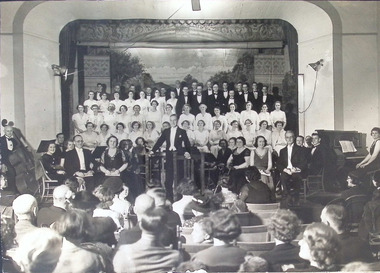
Photograph - Williamstown & Altona Choral Society c.1940, at the Mechanics Institute
... Featuring: Bertram Piper, Conductor; Cardiff Morgan, Tenor; David Rodger, Double Bass; Robert M Gamly, Bass; Doris Willis, Pianist; Emma Cordell & Eunice Palmer ...Williamstown and Altona Choral Society Mechanics Institute c1940 Featuring: Bertram Piper, Conductor; Cardiff Morgan, Tenor; David Rodger, Double Bass; Robert M Gamly, Bass; Doris Willis, Pianist; Emma Cordell & Eunice Palmer Photograph Williamstown & Altona Choral Society c.1940, at the Mechanics Institute ...Featuring: Bertram Piper, Conductor; Cardiff Morgan, Tenor; David Rodger, Double Bass; Robert M Gamly, Bass; Doris Willis, Pianist; Emma Cordell & Eunice Palmer williamstown and altona choral society, mechanics institute, c1940 -
 Royal Australian Air Force Band
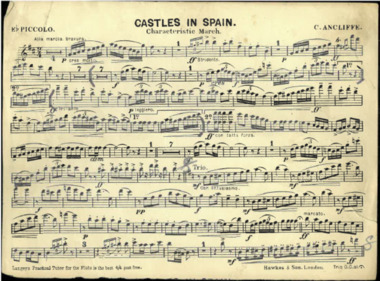
March Card, Charles Ancliffe (composer), Castles in Spain, Composed: 1917
... Concert Band & Brass Band Instrumentation Total 33 Parts Characteristic March Alla Marcia Bravura Key Signature:C minor Instrumentation: Eb Piccolo Oboes Eb Clarinet 1st Bb Clarinet 2nd Bb Clarinet 3rd & 4th Bb Clarinets 1st Bassoon 2nd Bassoon Solo Eb Saxhorn (Eb Alto) 1st Bb Baritone (Bb Tenor) Solo Bb Cornet 1st Bb Cornet 2nd Bb Cornet 3rd & 4th Bb Cornets Eb Trumpets 1st Eb Horn 2nd Eb Horn 3rd Eb Horn 4th Eb Horn 1st Trombone (Bass Clef) 1st Trombone (Tenor Clef) 2nd Trombone (Bass Clef) 2nd Trombone (Tenor Clef) Bass Trombone 2nd Bb Baritone (Bb Tenor) Euphonium (Baritone) Bombardon (Tuba) Eb Bombardon (Treble Clef) Bb Bass Side Drum Bass Drum Additional Hand Written 1st Bb Clarinet...Q26 (additional). 295 (crossed out) Stamped on the reverse of each card: Australian Broadcasting Co., The Property of Musical Director & Arranger Concert Band & Brass Band Instrumentation Total 33 Parts Characteristic March Alla Marcia Bravura Key Signature:C minor Instrumentation: Eb Piccolo Oboes Eb Clarinet 1st Bb Clarinet 2nd Bb Clarinet 3rd & 4th Bb Clarinets 1st Bassoon 2nd Bassoon Solo Eb Saxhorn (Eb Alto) 1st Bb Baritone (Bb Tenor) Solo Bb Cornet 1st Bb Cornet 2nd Bb Cornet 3rd & 4th Bb Cornets Eb Trumpets 1st Eb Horn 2nd Eb Horn 3rd Eb Horn 4th Eb Horn 1st Trombone (Bass Clef) 1st Trombone (Tenor Clef) 2nd Trombone (Bass Clef) 2nd Trombone (Tenor Clef) Bass Trombone 2nd Bb Baritone (Bb Tenor) Euphonium (Baritone) Bombardon (Tuba) Eb Bombardon (Treble Clef) Bb Bass Side Drum Bass Drum Additional Hand Written 1st Bb Clarinet Castles in Spain March Card Charles Ancliffe (composer) Hawkes & Son, U.S.A. ...In 1932 the call was put out to the ABC to start a military band. The band’s task was to record music to play on air four times a week, and to perform live concerts for the public. By November 1933 a band was put together with 40 musicians from around Australia. The band was initially conducted by Captain H. E. Adkins, Director of the Royal Military School of Music, Kneller Hall, London. After the tour, Adkins returned to his position at Kneller Hall, and Stephen Yorke, a retired bandmaster of the Gloucestershire Regiment, was brought out to Australia to become the permanent director and conductor of the band, which he did until the band closed in 1951. During the band’s 17 year history they presented a sizable program of music. Their final concert received a standing ovation from its audience of 1500, with a teary-eyed Yorke. Concert Band & Brass Band Instrumentation Total 33 Parts Characteristic March Alla Marcia Bravura Key Signature:C minor Instrumentation: Eb Piccolo Oboes Eb Clarinet 1st Bb Clarinet 2nd Bb Clarinet 3rd & 4th Bb Clarinets 1st Bassoon 2nd Bassoon Solo Eb Saxhorn (Eb Alto) 1st Bb Baritone (Bb Tenor) Solo Bb Cornet 1st Bb Cornet 2nd Bb Cornet 3rd & 4th Bb Cornets Eb Trumpets 1st Eb Horn 2nd Eb Horn 3rd Eb Horn 4th Eb Horn 1st Trombone (Bass Clef) 1st Trombone (Tenor Clef) 2nd Trombone (Bass Clef) 2nd Trombone (Tenor Clef) Bass Trombone 2nd Bb Baritone (Bb Tenor) Euphonium (Baritone) Bombardon (Tuba) Eb Bombardon (Treble Clef) Bb Bass Side Drum Bass Drum Additional Hand Written 1st Bb ClarinetOn envelope: QM30. Castles in Spain. Ancliffe. Stamps indicating 30 OCT 1940, 30 NOV 1940, 23 APR 1941, 17 JAN 1944. Q26 (additional). 295 (crossed out) Stamped on the reverse of each card: Australian Broadcasting Co., The Property of Musical Director & Arrangerbrass band, australian broadcasting commission, marching band, concert band
