
Showing 9 items matching "the career of hmas melbourne"
-
 Moorabbin Air Museum
Book - AUSTRALIAN NAVAL AVIATION, H.M.A.S. Melbourne 25 Years
... ...The career of HMAS Melbourne...Australian naval aviation Predecessor Melbourne II - Concept The career of HMAS Melbourne Aircraft Into the new decade Officers & crew 1980 Statistics January 1977 History & specifications of Australian aircraft carrier HMAS Melbourne, circa 1980 H.M.A.S. ...History & specifications of Australian aircraft carrier HMAS Melbourne, circa 1980non-fictionHistory & specifications of Australian aircraft carrier HMAS Melbourne, circa 1980predecessor, melbourne ii - concept, the career of hmas melbourne, aircraft, into the new decade, officers & crew 1980, statistics january 1977 -
 Lara RSL Sub Branch
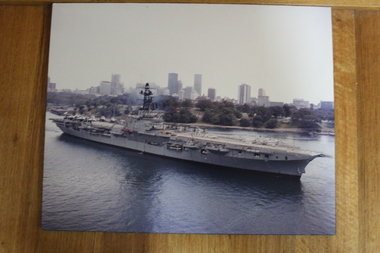
Picture of HMAS Melbourne 21, Australian aircraft carrier, Circa 1960
... HMAS Melbourne (R21) was a Majestic-class light aircraft carrier of the Royal Australian Navy. Operating from 1955 until 1982, she was the third and final conventional aircraft carrier to serve in the RAN. Melbourne was the only Commonwealth naval vessel to sink two friendly warships in peacetime collisions. Melbourne never fired a shot in anger during her career ...HMAS Melbourne (R21) was a Majestic-class light aircraft carrier of the Royal Australian Navy. Operating from 1955 until 1982, she was the third and final conventional aircraft carrier to serve in the RAN. Melbourne was the only Commonwealth naval vessel to sink two friendly warships in peacetime collisions.Melbourne never fired a shot in anger during her career, having only peripheral, non-combat roles in relation to the Indonesia-Malaysia confrontation and the Vietnam War.Rectangular in shape Fibreboard mounted print of HMAS Melbourne.australian aircraft carrier, hmas, lara r.s.l., hmas melbourne -
 Lara RSL Sub Branch
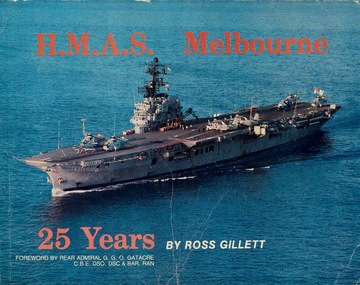
Book, Nautical Press, HMAS Melbourne 25 Years
... Melbourne never fired a shot in anger during her career, having only peripheral, non-combat roles in relation to the Indonesia-Malaysia confrontation and the Vietnam War. However, she was involved in two major collisions with allied vessels. On the evening of 10 February 1964, Melbourne collided with and sank HMAS...Melbourne never fired a shot in anger during her career, having only peripheral, non-combat roles in relation to the Indonesia-Malaysia confrontation and the Vietnam War. However, she was involved in two major collisions with allied vessels. On the evening of 10 February 1964, Melbourne collided with and sank HMAS ...HMAS Melbourne (R21) was a Majestic-class light aircraft carrier of the Royal Australian Navy (RAN). Operating from 1955 until 1982, she was the third and final conventional aircraft carrier to serve in the RAN. Melbourne was the only British Commonwealth naval vessel to sink two friendly warships in peacetime collisions. The ship was laid down for the British Royal Navy as the lead ship of the Majestic class in April 1943, and was launched as HMS Majestic (R77) in February 1945. At the end of World War II, work on the ship was suspended until she was purchased by the RAN in 1947. At the time of purchase, it was decided to incorporate new aircraft carrier technologies into the design, making Melbourne the third ship to be constructed with an angled flight deck. Delays in construction and integrating the enhancements meant that the carrier was not commissioned until 1955. Melbourne never fired a shot in anger during her career, having only peripheral, non-combat roles in relation to the Indonesia-Malaysia confrontation and the Vietnam War. However, she was involved in two major collisions with allied vessels. On the evening of 10 February 1964, Melbourne collided with and sank HMAS Voyager when the Daring class destroyer altered course across her bow. Eighty-two of Voyager's crew were killed, and two Royal Commissions were held to investigate the incident. The second collision occurred in the early morning of 3 June 1969, when Melbourne collided with and sank the Allen M. Sumner class destroyer USS Frank E. Evans in similar circumstances. Seventy-four United States Navy (USN) personnel died, and a joint USN–RAN Board of Inquiry was held. These incidents, along with several minor collisions, shipboard accidents, and aircraft losses, led to the reputation that Melbourne was jinxed. Melbourne was paid off from RAN service in 1982. A proposal to convert her for use as a floating casino failed, and a 1984 sale was cancelled, before she was sold in 1985 and towed to China for breaking. The scrapping was delayed so Melbourne could be studied by the People's Liberation Army Navy (PLAN) as part of a secret project to develop a Chinese aircraft carrier and used to train PLAN aviators in carrier flight operations. HMAS Melbourne was decommissioned on 30 June 1982, having spent 62,036 hours underway and having steamed 868,893 nautical miles. A proposal to convert her for use as a floating casino failed, and a 1984 sale was cancelled, before she was sold for scrap in 1985 and towed to China for breaking. The scrapping was delayed so Melbourne could be studied by the People's Liberation Army Navy (PLAN) as part of a secret project to develop a Chinese aircraft carrier and used to train PLAN aviators in carrier flight operations.The pictorial history of HMAS Melbourne with rare photos. Now a scarce title and highly desirable title that is now long out of print. Has provenance history of all ships movements from 1955 till decommissioned.HMAS Melbourne 25 YearsOn the front page is a picture of HMAS Melbourne with the words at top "H.M.A.S. Melbourne. At bottom are the words in orange, '25 Years'. In white, are the words 'by Ross Gillett' then 'Forward by Rear Admiral G.G.O. Gatacre C.B.E. DSO. DSC & Bar, RAN'. On the rear page is a list of all the Captains that served on the HMAS Melbourne between 1955-1980.hmas melbourne, aircraft carrier, royal australian navy, australian navy, westland whirlwind, sea venom, fairy gannet, bristol sycamore, westland wessex, douglas skyhawk, grumman tracker, westland sea king, fleet air arm, hmas albatross, nowra -
 Flagstaff Hill Maritime Museum and Village
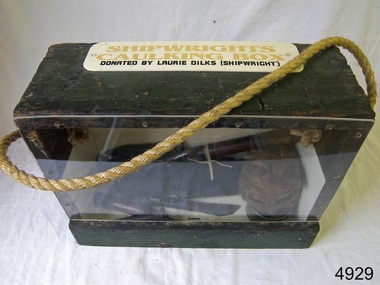
Equipment - Toolbox, Laurie Dilks, shipwright, Mid-to-late 20th century
... HMAS Warrnambool J202. The shipwright’s caulking box containing caulking tools is an example of the equipment used by shipwrights in the early to mid-20th centuries. This box is connected to the maritime history of Victoria through its past owner, user and donor, Laurie Dilks. Laurie began his career as a shipwright at Ports and Harbours in Melbourne ...Caulking is a process used by shipwrights and other tradespeople to seal the gaps and cracks in boats and ships, buildings and plumbing fittings. It prevents water, air and pests from entering the through the gaps. The shipwright’s caulking box and a display of shipwright's tools are connected to the maritime history of Victoria through their past owner, user and donor, Laurie Dilks. Laurie began his career as a shipwright in the mid-1900s, following in the wake of the skilled carpenters who have over many centuries used their craft to build and maintain marine vessels and their fittings. Laurie worked for Ports and Harbours, Melbourne, for over 50 years, beginning in the early 1960s. He and a fellow shipwright inscribed their names on a wheelhouse they built in 1965; the inscription was discovered many decades later during a repair of the plumbing. Many decades later Laurie worked on the Yarra River moving barges up and down the river and was fondly given the title ‘Riverboat Man’ His interest in maritime history led him to volunteer with the Maritime Trust of Australia’s project to restore and preserve the historic WWII 1942 Corvette, the minesweeper HMAS Castlemaine, which is a sister ship to the HMAS Warrnambool J202.The shipwright’s caulking box containing caulking tools is an example of the equipment used by shipwrights in the early to mid-20th centuries. This box is connected to the maritime history of Victoria through its past owner, user and donor, Laurie Dilks. Laurie began his career as a shipwright at Ports and Harbours in Melbourne in the mid-1900s, following in the wake of the skilled carpenters who have over many centuries used their craft to build and maintain marine vessels and their fittings.Shipwright's caulking box, green wooden exterior with green and cream interior. Box has a Perspex face. A rope handle, knotted on each end, extends from one side to the other. A white rectangular plaque with rounded corners is screwed to the top and has yellow and black printed text. The donor was shipwright Laurie Dilks.Printed on plaque "SHIPWRIGHTS / CAULKING BOX / DONATED BY LAURIE DILKS [SHIPWRIGHT]'"flagstaff hill, flagstaff hill maritime museum and village, warrnambool, maritime museum, maritime village, great ocean road, shipwreck coast, caulking tools, caulking equipment, caulking box, shipwright's tools, laurie kilks, ports and harbours -
 Waverley RSL Sub Branch
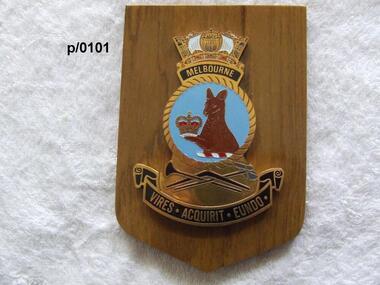
Plaque H.M.A.S. Melbourne
... HMAS Melbourne (1912), a Chatham class light cruiser launched in 1912 and broken up for scrap in 1929 HMAS Melbourne (R21), a Majestic class aircraft carrier acquired by the RAN in 1947. She was involved in two major collisions during her career...HMAS Melbourne (1912), a Chatham class light cruiser launched in 1912 and broken up for scrap in 1929 HMAS Melbourne (R21), a Majestic class aircraft carrier acquired by the RAN in 1947. She was involved in two major collisions during her career ...HMAS Melbourne (1912), a Chatham class light cruiser launched in 1912 and broken up for scrap in 1929 HMAS Melbourne (R21), a Majestic class aircraft carrier acquired by the RAN in 1947. She was involved in two major collisions during her career, and was sold for scrap in 1985. HMAS Melbourne (FFG 05), an Adelaide class guided missile frigate launched in 1989 and active as of 2012Wooden plaque with insignia of H.M.A.S. MelbourneH.M.A.S. Melbourneh.m.a.s. melbourne -
 Bendigo Military Museum
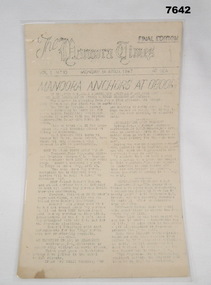
Document - THE MANOORA TIMES FINAL EDITION, c1947
... HMAS MANOORA Newsletter This is a single sheet of paper (foolscap size) dated No 10 Vol 1 14 April 1947. Text in black both sides. Side 1 - Headline - MANOORA ANCHORS AT 0800 HRS Sub Headlines - NO ELECTRIC TRAINS IN MELBOURNE, AUSTRALIA THE BEST COUNTRY, GENERATIONS TO CHANGE JAPAN. Side 2 - HEADLINE - CAPTAIN'S VARIED WAR CAREER ...Item in the collection re the BCOF Association Collection, refer Cat No 7625.This is a single sheet of paper (foolscap size) dated No 10 Vol 1 14 April 1947. Text in black both sides. Side 1 - Headline - MANOORA ANCHORS AT 0800 HRS Sub Headlines - NO ELECTRIC TRAINS IN MELBOURNE, AUSTRALIA THE BEST COUNTRY, GENERATIONS TO CHANGE JAPAN. Side 2 - HEADLINE - CAPTAIN'S VARIED WAR CAREER Sub Headlines - EARLY JAP TREATY REQUIRED, MELBOURNE MAY BE AN AIR TERMINAL, DISPLAY AIRCRAFT IN TROUBLE, NEW PLANE NAMED COBB, SHIP'S STAFF GOSSIP. bcof, hmas manoora, newsletter -
 Wangaratta RSL Sub Branch
Print - Framed print, HMAS Melbourne
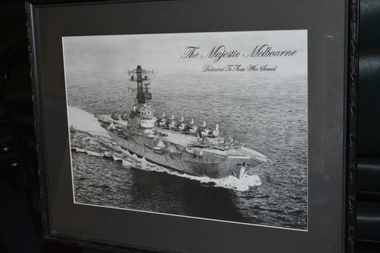
... HMAS Melbourne never fired a shot in anger during her career, having only peripheral, non-combat roles in relation to the Indonesia-Malaysia confrontation and the Vietnam War. ...HMAS Melbourne never fired a shot in anger during her career, having only peripheral, non-combat roles in relation to the Indonesia-Malaysia confrontation and the Vietnam War. ...HMAS Melbourne never fired a shot in anger during her career, having only peripheral, non-combat roles in relation to the Indonesia-Malaysia confrontation and the Vietnam War. She was, however, involved in two major collisions with allied vessels; though Melbourne was found not to be the primary cause of either incident. The first occurred on the evening of 10 February 1964, in which Melbourne rammed and sank the RAN destroyer HMAS Voyager when the latter altered course across her bow. Eighty-two of Voyager's personnel were killed, and two Royal Commissions were held to investigate the incident. The second collision occurred in the early morning of 3 June 1969, when Melbourne also rammed the United States Navy (USN) destroyer USS Frank E. Evans in similar circumstances. Seventy-four American personnel died, and a joint USN–RAN Board of Inquiry was held. These incidents, along with several minor collisions, shipboard accidents, and aircraft losses, led to the reputation that Melbourne was jinxed. HMAS Melbourne was a Majestic-class light aircraft carrier of the Royal Australian Navy (RAN). Operating from 1955 until 1982, she was the third and final conventional aircraft carrier to serve in the RAN. Melbourne was the only Commonwealth naval vessel to sink two friendly warships in peacetime collisionsMoulded patterned black plastic frame and mount containing black and white print of hand drawn ship at seaThe Majestic Melbourne Dedicated to those who servedhmas melbourne, ran, aircraft carrier -
 Wangaratta RSL Sub Branch
Print - Framed print, HMAS Sydney, 2008
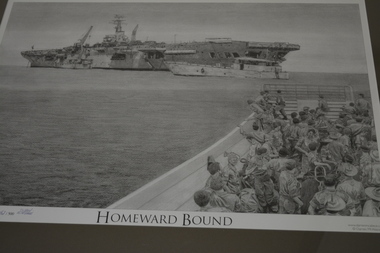
... career. From late 1951 to early 1952, she operated off the coast of Korea during the Korean War, making her the first carrier owned by a Commonwealth Dominion, and the only carrier in the RAN, to see wartime service. Retasked as a training vessel following the 1955 arrival of her modernised sister ship, HMAS Melbourne...career. From late 1951 to early 1952, she operated off the coast of Korea during the Korean War, making her the first carrier owned by a Commonwealth Dominion, and the only carrier in the RAN, to see wartime service. Retasked as a training vessel following the 1955 arrival of her modernised sister ship, HMAS Melbourne ...Depicting the boarding of Australian Troops from Vung Tau, Vietnam for return to Australia following active service in Vietnam. HMAS Sydney was a Majestic-class light aircraft carrier operated by the Royal Australian Navy (RAN). She was built for the Royal Navy and launched as HMS Terrible (93) in 1944, but was not completed before the end of World War II. The carrier was sold to Australia in 1947, completed, and commissioned into the RAN as Sydney in 1948. Sydney was the first of three conventional aircraft carriers to serve in the RAN, and operated as the navy's flagship during the early part of her career. From late 1951 to early 1952, she operated off the coast of Korea during the Korean War, making her the first carrier owned by a Commonwealth Dominion, and the only carrier in the RAN, to see wartime service. Retasked as a training vessel following the 1955 arrival of her modernised sister ship, HMAS Melbourne, Sydney remained in service until 1958, when she was placed in reserve as surplus to requirements. The need for a sealift capability saw the ship modified for service as a fast troop transport, and recommissioned in 1962. Sydney was initially used for training and a single supply run in support of Malaysia's defence policy against Indonesia, but in 1965, she sailed on the first voyage to Vũng Tàu, transporting soldiers and equipment to serve in the Vietnam War. 25 voyages to Vietnam were made between 1965 and 1972, earning the ship the nickname "Vung Tau Ferry". Sydney was decommissioned in 1973, and was not replaced. Despite several plans to preserve all or part of the ship as a maritime museum, tourist attraction, or car park, the carrier was sold to a South Korean steel mill for scrapping in 1975A pictorial image of troops returning to Australia from Vietnam.Timber frame with mount containing print of ship at sea and soldiers in a barge in foreground.Homeward Boundhmas sydney, ran -
 Wangaratta RSL Sub Branch
Poster - Framed poster, HMAS Sydney in Korean waters 1951-1952
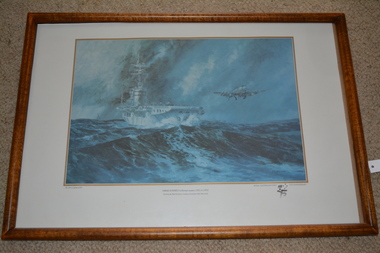
... HMAS Sydney was the first of three conventional aircraft carriers to serve in the RAN, and operated as the navy's flagship during the early part of her career. Retasked as a training vessel following the 1955 arrival of her modernised sister ship, HMAS Melbourne, Sydney remained in service until 1958, when she was placed in reserve as surplus to requirements. ...Reproduction print of HMAS Sydney in Korean waters launching Hawker Sea Fury fighters. Sydney was a Majestic-class light aircraft carrier operated by the Royal Australian Navy (RAN). She was built for the Royal Navy but was not completed before the end of World War II. The carrier was sold to Australia in 1947, completed and commissioned into the RAN in 1948. From late 1951 to early 1952, she operated off the coast of Korea during the Korean War, making her the first carrier in the RAN, to see wartime service. The Donor, Errol DREHER served with the RAN on board HMAS Sydney during the Korean War.HMAS Sydney was the first of three conventional aircraft carriers to serve in the RAN, and operated as the navy's flagship during the early part of her career. Retasked as a training vessel following the 1955 arrival of her modernised sister ship, HMAS Melbourne, Sydney remained in service until 1958, when she was placed in reserve as surplus to requirements. The need for a sealift capability saw the ship modified for service as a fast troop transport, and recommissioned in 1962. In 1965, she sailed on the first voyage to Vũng Tàu, transporting soldiers and equipment to serve in the Vietnam War. 25 voyages to Vietnam were made between 1965 and 1972, earning the ship the nickname "Vung Tau Ferry". Sydney was decommissioned in 1973, and was not replaced. Brown timber frame containing blue poster with image of ship and plane at seaHMAS Sydney in Korean waters 1951-1952 Painting by Roy Honisett, courtesy Australian War Memorial Royal Australian Navy 75th Anniversaryhmas sydney, korea, royal australian navy
