
Showing 5 items matching "the collapse of russia"
-
 Lara RSL Sub Branch
Book, The Great World War Volume VII, 1919
... ...The collapse of russia...Historical timeline of events from 1915 - 1917, Formal record of the Great War Eve of Russian revolution The fall of Tsardom in russia The entry of America minor naval operations british battles on the hindenburg line italy's double offensive the last russian effort Battle of Messines Passchandaele The collapse of russia The Great World War Volume VII Dark green hardcover and spine. ...Historical timeline of events from 1915 - 1917, Formal record of the Great WarThe Great World War Volume VII Dark green hardcover and spine. Faded gold text on spine. Maps, illustrations photographseve of russian revolution, the fall of tsardom in russia, the entry of america, minor naval operations, british battles on the hindenburg line, italy's double offensive, the last russian effort, battle of messines, passchandaele, the collapse of russia -
Emerald Museum & Nobelius Heritage Park
Award - British War Medal 1914-20, Royal Mint, 1919-1920
... In that year the 33rd Battalion engaged in a number of significant battles as the Germans launched their ‘Spring Offensive’ – a final push for victory following the revolution and collapse of the Russian army in late 1917. Some of the notable engagements include the Battle of Mont St Quentin, the Battle of Amiens and the Battle of Villers Bretonneux. ...In that year the 33rd Battalion engaged in a number of significant battles as the Germans launched their ‘Spring Offensive’ – a final push for victory following the revolution and collapse of the Russian army in late 1917. Some of the notable engagements include the Battle of Mont St Quentin, the Battle of Amiens and the Battle of Villers Bretonneux. ...James Beashel enlisted for the Australian Imperial Force (AIF) on 1 June 1917. He served with the 33rd Battalion and was marched out to the front in France in February 1918. In that year the 33rd Battalion engaged in a number of significant battles as the Germans launched their ‘Spring Offensive’ – a final push for victory following the revolution and collapse of the Russian army in late 1917. Some of the notable engagements include the Battle of Mont St Quentin, the Battle of Amiens and the Battle of Villers Bretonneux. The British War Medal 1914-20 was instituted by King George V in 1919 to mark the end of the First World War. It was awarded to members of British and Imperial forces who had served for a prescribed period during the course of the war, or who had died in active service. Beashel was not the most disciplined of soldiers throughout his time with the AIF. He was regularly disciplined for offences such as neglecting to obey orders, drunkenness, going AWOL and missing marching parades. He was discharged from the AIF at the conclusion of the First World War and returned home to New South Wales. Later in life he relocated to Victoria and died in 1965. For his service he received the Victory Medal, the British War Medal 1914-20, and the 1914-15 Star.This item is historically significant as it represents the service of an Australian in one of the most significant events of the twentieth century, and indeed in human history. 416,809 Australians enlisted for service, of which more than 60,000 were killed and more than 150,000 were wounded, gassed, or taken prisoner. The First World War remains a significant event in Australia's history. The landings at Gallipoli on April 25, 1915 is remembered as ANZAC Day, and is still commemorated to this day, over 100 years later.Silver, circular medallion. The profile of King George V is impressed on the obverse, along with the words 'GEORGIVS V BRITT: OMN: REX ET IND: IMP:' The reverse has an impression of St George on horseback, along with '1914' and '1918'. The ribbon is a thick orange band, flanked on both sides by thinner blue, black and white bands.Obverse: GEORGIVS V BRITT: OMN: REX ET IND: IMP: / Reverse: 1914 1918 //medal, commemorative medals, military, first world war, world war one, world war i, world war 1, wwi, ww1 -
Emerald Museum & Nobelius Heritage Park
Award - War Medals - World War I, Royal Mint, 1919-1920
... In that year the 33rd Battalion engaged in a number of significant battles as the Germans launched their ‘Spring Offensive’ – a final push for victory following the revolution and collapse of the Russian army in late 1917. Some of the notable engagements include the Battle of Mont St Quentin, the Battle of Amiens and the Battle of Villers Bretonneux. ...In that year the 33rd Battalion engaged in a number of significant battles as the Germans launched their ‘Spring Offensive’ – a final push for victory following the revolution and collapse of the Russian army in late 1917. Some of the notable engagements include the Battle of Mont St Quentin, the Battle of Amiens and the Battle of Villers Bretonneux. ...James Beashel enlisted for the Australian Imperial Force (AIF) on 1 June 1917. He served with the 33rd Battalion and was marched out to the front in France in February 1918. In that year the 33rd Battalion engaged in a number of significant battles as the Germans launched their ‘Spring Offensive’ – a final push for victory following the revolution and collapse of the Russian army in late 1917. Some of the notable engagements include the Battle of Mont St Quentin, the Battle of Amiens and the Battle of Villers Bretonneux. Beashel was not the most disciplined of soldiers throughout his time with the AIF. He was regularly disciplined for offences such as neglecting to obey orders, drunkenness, going AWOL and missing marching parades. He was discharged from the AIF at the conclusion of the First World War and returned home to New South Wales. Later in life he relocated to Victoria and died in 1965. For his service he received the Victory Medal, the British War Medal 1914-20, and the 1914-15 Star. The 1914-15 Star was awarded to those who served with the British and Imperial Forces between 5 August 1914 and 31 December 1915 The British War Medal 1914-20 was instituted by King George V in 1919 to mark the end of the First World War. It was awarded to members of British and Imperial forces who had served for a prescribed period during the course of the war, or who had died in active service. The Victory Medal was awarded to those who served with the armed forces of the British and Imperial Forces or with certain voluntary organisations between 5 August 1914 and 11 November 1918.This item is historically significant as it represents the service of an Australian in one of the most significant events of the twentieth century, and indeed in human history. 416,809 Australians enlisted for service, of which more than 60,000 were killed and more than 150,000 were wounded, gassed, or taken prisoner. The First World War remains a significant event in Australia's history. The landings at Gallipoli on April 25, 1915 is remembered as ANZAC Day, and is still commemorated to this day, over 100 years later.Four medals. One is a bronze four-pointed star medallion, ensigned with a crown. The obverse has two crossed swords overlaid with a wreath and a scroll that reads '1914-15'. Below is the royal cypher of King George V - GV. The ribbon is a thick white band flanked by a thinner blue band on one side and a red band on the other. Two of the medals are the same. Silver, circular medallions. The profile of King George V is impressed on the obverse, along with the words 'GEORGIVS V BRITT: OMN: REX ET IND: IMP:' The reverse has an impression of St George on horseback, along with '1914' and '1918'. The ribbon is a thick orange band, flanked on both sides by thinner blue, black and white bands. One is a circular, bronze medallion, impressed on the obverse with a winged, female figure holding a palm branch in her right hand. The reverse reads 'THE GREAT WAR FOR CIVILISATION 1914 - 1919', surrounded by a laurel wreath. The ribbon is rainbow coloured.Medal 1: Obverse: 1914-15 / Medals 2 and 4: Obverse: GEORGIVS V BRITT: OMN: REX ET IND: IMP: / Reverse: 1914 1918 / Medal 3: Reverse: THE GREAT / WAR FOR / CIVILISATION / 1914 - 1919 /medal, commemorative medals, military, first world war, world war one, world war i, world war 1, wwi, ww1 -
 Monbulk RSL Sub Branch
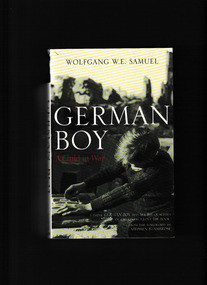
Book, Hodder and Stoughton, German boy : a refugee's story, 2002
... Russian army. They have no inkling of the chaos ahead. The boy and his mother must prevail over hunger and despair, or die." "In Strasburg, a small town north of Berlin where they find refuge, Wolfgang begins to comprehend the evils the Nazi regime has brought to Germany. As the Reich collapses ...In the Third Reich young Wolfgang Samuel and his family are content but alone. The father, a Luftwaffe officer, is away fighting the Allies in the West. In 1945 as Berlin and nearby communities crumble, young Wolfgang, his mother Hedy, and his little sister Ingrid flee the advancing Russian army. They have no inkling of the chaos ahead. The boy and his mother must prevail over hunger and despair, or die." "In Strasburg, a small town north of Berlin where they find refuge, Wolfgang begins to comprehend the evils the Nazi regime has brought to Germany. As the Reich collapses, mother, son, and little sister flee again just ahead of the Russian charge.Ill, p.357.non-fictionIn the Third Reich young Wolfgang Samuel and his family are content but alone. The father, a Luftwaffe officer, is away fighting the Allies in the West. In 1945 as Berlin and nearby communities crumble, young Wolfgang, his mother Hedy, and his little sister Ingrid flee the advancing Russian army. They have no inkling of the chaos ahead. The boy and his mother must prevail over hunger and despair, or die." "In Strasburg, a small town north of Berlin where they find refuge, Wolfgang begins to comprehend the evils the Nazi regime has brought to Germany. As the Reich collapses, mother, son, and little sister flee again just ahead of the Russian charge.world war 1939-1945 - refugees, wolfgang samuel - biography -
 Bendigo Historical Society Inc.
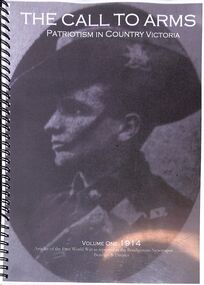
Book - "The Call to Arms. Patriotism in Country Victoria. Volume 1.", 2011
... Russia signed an armistice with the Central Powers in December, followed by a separate peace in March 1918. That month, Germany launched a spring offensive in the west, which despite initial successes left the German Army exhausted and demoralised. The Allied Hundred Days Offensive, beginning in August 1918, caused a collapse...Russia signed an armistice with the Central Powers in December, followed by a separate peace in March 1918. That month, Germany launched a spring offensive in the west, which despite initial successes left the German Army exhausted and demoralised. The Allied Hundred Days Offensive, beginning in August 1918, caused a collapse ...World War one began in 1914, and ended in 1918. World War I or the First World War (28 July 1914 – 11 November 1918), also known as the Great War, was a global conflict between two coalitions: the Allies (or Entente) and the Central Powers. One of the deadliest conflicts in history, World War I resulted in an estimated 15 to 22 million deaths, including those in war crimes and genocides. The war also helped spread the Spanish flu pandemic. The conflict saw important developments in weaponry, including the first large-scale use of machine guns, artillery, aircraft, chemical weapons, and tanks. The causes of World War I included the rise of the German Empire, which disturbed the long-standing balance of power in Europe, and the exacerbation of imperial rivalries, as reflected in new alliances and an arms race between the great powers. Tensions in the Balkans reached a breaking point on 28 June 1914 when Gavrilo Princip, a Bosnian Serb, assassinated Franz Ferdinand, the heir to the Austro-Hungarian throne. Austria-Hungary blamed Serbia and declared war on 28 July, upon which the Russian Empire mobilised in Serbia's defence. In early August, Germany declared war on Russia and France; the United Kingdom entered the war after Germany invaded Belgium. Germany's strategy in 1914 was to quickly defeat France, but its advance was halted in September, and the Western Front solidified into a near-continuous line of fortified trenches from the English Channel to Switzerland. The Eastern Front was more dynamic, but neither side gained a decisive advantage, despite costly offensives. The Ottoman Empire joined the Central Powers in November, which was followed by a failed Allied campaign at Gallipoli. Japan and Italy also joined the Allies. Major battles, including those at Verdun, the Somme, and Passchendaele, failed to break the stalemate on the Western Front. In April 1917, the United States joined the Allies after Germany resumed unrestricted submarine warfare against Atlantic shipping. Later that year, the Bolsheviks seized power in Russia in the October Revolution; Soviet Russia signed an armistice with the Central Powers in December, followed by a separate peace in March 1918. That month, Germany launched a spring offensive in the west, which despite initial successes left the German Army exhausted and demoralised. The Allied Hundred Days Offensive, beginning in August 1918, caused a collapse of the German front line. By early November, the Allies had signed armistices with the Ottomans and with Austria-Hungary, leaving Germany isolated. Facing a revolution at home, Kaiser Wilhelm II abdicated on 9 November, and the war ended with the Armistice of 11 November 1918. Metal spiral bound book. Plastic clear cover, and black cardboard back cover. Soft cover. Cover has an image of a black and white image of the bust of a soldier looking to the left. Titles in white. 121 pages. Contains articles of the First World War as reported in the 'Bendigonian Newspaper'. Contains a timeline of significant events during WW1. Has index. Transcribed by Pamela Houston. Printed by Bendigo Copy Centre, Bendigo. Volume one deals with 1914.world war one, soldiers, bendigonian newspapaper
