
Showing 4 items matching "the common frog"
-
 Flagstaff Hill Maritime Museum and Village
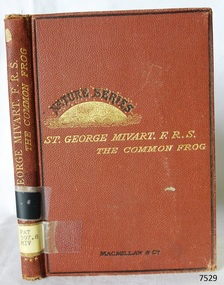
Book, The Common Frog - Nature Series:
... The Common Frog - Nature Series: ......The Common Frog... The Common Frog - Nature Series: Author: St George Mivart Publisher: MacMillan & Co Date: 1874...Warrnambool Shipwrecked-coast Flagstaff-Hill Flagstaff-Hill-Maritime-Museum Maritime-Museum Shipwreck-coast Flagstaff-Hill-Maritime-Village Shipwrecked-artefact Book Warrnambool Mechanics’ Institute Pattison Collection Warrnambool Library Ralph Eric Pattison Warrnambool City Librarian Mechanics’ Institute Library Victorian Library Board Warrnambool books and records Warrnambool Children’s Library The Common Frog - Nature Series: The Common Frog Nature Series St George Mivart Label on spine cover with typed text PAT 597.8 MIV Pastedown front endpaper has sticker from Warrnambool Mechanics Institute and Free Library Front loose endpaper has a sticker from Corangamite Regional Library Service The Common Frog - Nature Series: Author: St George Mivart Publisher: MacMillan & Co Date: 1874 The Common Frog - Nature Series: Book ...This item is from the ‘Pattison Collection’, a collection of books and records that was originally owned by the Warrnambool Mechanics’ Institute, which was founded in Warrnambool in 1853. By 1886 the Warrnambool Mechanics’ Institute (WMI) had grown to have a Library, Museum and Fine Arts Gallery, with a collection of “… choice productions of art, and valuable specimens in almost every branch and many wonderful national curiosities are now to be seen there, including historic relics of the town and district.” It later included a School of Design. Although it was very well patronised, the lack of financial support led the WMI in 1911 to ask the City Council to take it over. In 1935 Ralph Pattison was appointed as City Librarian to establish and organise the Warrnambool Library as it was then called. When the WMI building was pulled down in 1963 a new civic building was erected on the site and the new Warrnambool Library, on behalf of the City Council, took over all the holdings of the WMI. At this time some of the items were separated and identified as the ‘Pattison Collection’, named after Ralph Pattison. Eventually the components of the WMI were distributed from the Warrnambool Library to various places, including the Art Gallery, Historical Society and Flagstaff Hill. Later some were even distributed to other regional branches of Corangamite Regional Library and passed to and fro. It is difficult now to trace just where all of the items have ended up. The books at Flagstaff Hill Maritime Village generally display stamps and markings from Pattison as well as a variety of other institutions including the Mechanics’ Institute itself. RALPH ERIC PATTISON Ralph Eric Pattison was born in Rockhampton, Queensland, in 1891. He married Maude Swan from Warrnambool in 1920 and they set up home in Warrnambool. In 1935 Pattison accepted a position as City Librarian for the Warrnambool City Council. His huge challenge was to make a functional library within two rooms of the Mechanics’ Institute. He tirelessly cleaned, cleared and sorted a disarrayed collection of old books, jars of preserved specimens and other items reserved for exhibition in the city’s museum. He developed and updated the library with a wide variety of books for all tastes, including reference books for students; a difficult task to fulfil during the years following the Depression. He converted all of the lower area of the building into a library, reference room and reading room for members and the public. The books were sorted and stored using a cataloguing and card index system that he had developed himself. He also prepared the upper floor of the building and established the Art Gallery and later the Museum, a place to exhibit the many old relics that had been stored for years for this purpose. One of the treasures he found was a beautiful ancient clock, which he repaired, restored and enjoyed using in his office during the years of his service there. Ralph Pattison was described as “a meticulous gentleman whose punctuality, floorless courtesy and distinctive neat dress were hallmarks of his character, and ‘his’ clock controlled his daily routine, and his opening and closing of the library’s large heavy doors to the minute.” Pattison took leave during 1942 to 1942 to serve in the Royal Australian Navy, Volunteer Reserve as Lieutenant. A few years later he converted one of the Museum’s rooms into a Children’s Library, stocking it with suitable books for the younger generation. This was an instant success. In the 1950’s he had the honour of being appointed to the Victorian Library Board and received more inspiration from the monthly conferences in Melbourne. He was sadly retired in 1959 after over 23 years of service, due to the fact that he had gone over the working age of council officers. However he continued to take a very keen interest in the continual development of the Library until his death in 1969. The Pattison Collection, along with other items at Flagstaff Hill Maritime Village, was originally part of the Warrnambool Mechanics' Institute’s collection. The Warrnambool Mechanics’ Institute Collection is primarily significant in its totality, rather than for the individual objects it contains. Its contents are highly representative of the development of Mechanics' Institute libraries across Australia, particularly Victoria. A diversity of publications and themes has been amassed, and these provide clues to our understanding of the nature of and changes in the reading habits of Victorians from the 1850s to the middle of the 20th century. The collection also highlights the Warrnambool community’s commitment to the Mechanics’ Institute, reading, literacy and learning in the regions, and proves that access to knowledge was not impeded by distance. These items help to provide a more complete picture of our community’s ideals and aspirations. The Warrnambool Mechanics Institute book collection has historical and social significance for its strong association with the Mechanics Institute movement and the important role it played in the intellectual, cultural and social development of people throughout the latter part of the nineteenth century and the early twentieth century. The collection of books is a rare example of an early lending library and its significance is enhanced by the survival of an original collection of many volumes. The Warrnambool Mechanics' Institute’s publication collection is of both local and state significance. The Common Frog - Nature Series: Author: St George Mivart Publisher: MacMillan & Co Date: 1874Label on spine cover with typed text PAT 597.8 MIV Pastedown front endpaper has sticker from Warrnambool Mechanics Institute and Free Library Front loose endpaper has a sticker from Corangamite Regional Library Service warrnambool, shipwrecked-coast, flagstaff-hill, flagstaff-hill-maritime-museum, maritime-museum, shipwreck-coast, flagstaff-hill-maritime-village, shipwrecked-artefact, book, warrnambool mechanics’ institute, pattison collection, warrnambool library, ralph eric pattison, warrnambool city librarian, mechanics’ institute library, victorian library board, warrnambool books and records, warrnambool children’s library, the common frog - nature series:, the common frog, nature series, st george mivart -
 National Wool Museum
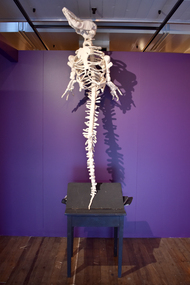
Sculpture - The Wreck of Hope, Michele Beevors, 2014
... Common Dolphin skeleton, Delphinus delphis) featured as part of the exhibition Anatomy Lessons, shown at the National Wool Museum in 2024. The exhibition featured meticulously-sculpted, life size skeletons, making visitors question their place in this web of the living and the dead. From a towering giraffe stretching 4.4 metres in height, to an army of over 50 delicately rendered frogs...Common Dolphin skeleton, Delphinus delphis) featured as part of the exhibition Anatomy Lessons, shown at the National Wool Museum in 2024. The exhibition featured meticulously-sculpted, life size skeletons, making visitors question their place in this web of the living and the dead. From a towering giraffe stretching 4.4 metres in height, to an army of over 50 delicately rendered frogs ...The Wreck of Hope (Long-nosed Common Dolphin skeleton, Delphinus delphis) featured as part of the exhibition Anatomy Lessons, shown at the National Wool Museum in 2024. The exhibition featured meticulously-sculpted, life size skeletons, making visitors question their place in this web of the living and the dead. From a towering giraffe stretching 4.4 metres in height, to an army of over 50 delicately rendered frogs, this exhibition was enthralling in scale. Each sculpture is an accurate portrayal of a real animal and is carefully measured, drawn, and moulded from steel, wire, and foam. The frame is then intricately knitted over to create these thought-provoking pieces. Each sculpture tells a story, one of the collection of animals by museums and collectors, of Western safari hunters, of human encroachment, and of the often-sad role of the animals in our lives. These underlying concepts are explored and reflected by the materials used. Wool, that speaks of warmth, of comfort, of care, meets the size, grace, and sheer breathtaking beauty of the pieces, clashing with the hard and complex stories beneath. This knitted dolphin skeleton was the start of Beevor's interest in comparative anatomy. Beevors recalls viewing a dolphin, one of many skeletons alongside a mouse and a lion in the Australian Museum's collection during a school visit in the 1970s. At the time, school children watched TV reruns of 'Flipper', which portrayed dolphins as intelligent and noble animals. Elsewhere, the conservation movement was growing, and appeals to protect marine mammals were gaining momentum through the 'Save the Whales' campaign. The fascination with live dolphin shows had grown throughout the 1960s and 1970s and the ethics began to be questioned. Some believe they played an important role in raising public awareness of cetaceans and their welfare. Others argued the performances glorified the dominance of heroic trainers over the subordinate dolphin, and offered little education about the dolphins' natural characteristics nor prioritised their welfare. Many of these facilities are now closed and all dolphin species are protected by international accords aimed at conserving wild populations. Despite this dolphins are still at risk of swallowing plastic waste, mercury toxicity, toxoplasmosis, boat impacts and being bycatch in commercial fishing operations. Originally from Australia, Michele Beevors has been practicing in New Zealand for the last 20 years. She is Head of Sculpture at Dunedin School of Art, Otago Polytechnic, New Zealand’s oldest, and one of its most prestigious, art schools. Beevors has exhibited in galleries, museums, and exhibition spaces in across New Zealand, Australia and Vienna with art that is defiant, unconventional, and moving.Life sized knitted skeleton of a dolphin, with white wool and internal steel, foam and wire frame. The dolphin is mounted on a wooden base, made from a desk, with books placed under the desk lid. The books and desk are painted black.knitting, art, dolphin, conservation, sculpture, skeletons, anatomy lessons, michele beevors -
 Sunshine and District Historical Society Incorporated
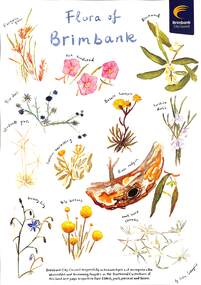
Poster - Brimbank City Council Flora and Fauna Posters
... Flora of Brimbank Poster - Kangaroo Grass, Blue Devil, Windmill Grass, Blubeberry Lily, Pink indweed, Common Everlasting, Bily Button, Basalt Podelepis, Rier, Redgum, Small Leaved Clematis, Blackwood & Sunshine Diurs| Fauna of Brimbank Poster - Tawny Frog Month, Eastern Brown Snake, Superb Fairy Wren, Growling Grass Frog, Blue Banded Bee, Wedge Tailed Eagle, Swamp Wallaby, Green Grass Dart, Short Beaked Echidna, Easter Long Necked Turtle, Striped legless lizard & White Faced Heron...City of Brimbank Flora of Brimbank Poster - Kangaroo Grass, Blue Devil, Windmill Grass, Blubeberry Lily, Pink indweed, Common Everlasting, Bily Button, Basalt Podelepis, Rier, Redgum, Small Leaved Clematis, Blackwood & Sunshine Diurs| Fauna of Brimbank Poster - Tawny Frog Month, Eastern Brown Snake, Superb Fairy Wren, Growling Grass Frog, Blue Banded Bee, Wedge Tailed Eagle, Swamp Wallaby, Green Grass Dart, Short Beaked Echidna, Easter Long Necked Turtle, Striped legless lizard & White Faced Heron 2 coloured posters featuring flora and fauna of the City of Brimbank Poster Brimbank City Council Flora and Fauna Posters Sofia Sabbagh ...Flora of Brimbank Poster - Kangaroo Grass, Blue Devil, Windmill Grass, Blubeberry Lily, Pink indweed, Common Everlasting, Bily Button, Basalt Podelepis, Rier, Redgum, Small Leaved Clematis, Blackwood & Sunshine Diurs| Fauna of Brimbank Poster - Tawny Frog Month, Eastern Brown Snake, Superb Fairy Wren, Growling Grass Frog, Blue Banded Bee, Wedge Tailed Eagle, Swamp Wallaby, Green Grass Dart, Short Beaked Echidna, Easter Long Necked Turtle, Striped legless lizard & White Faced Heroncity of brimbank -
 Wangaratta RSL Sub Branch
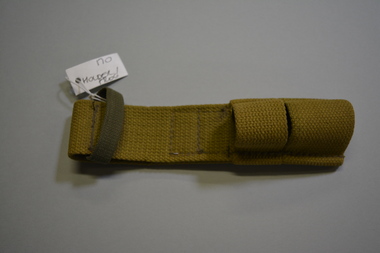
Equipment - Bayonet Holder/Frog
... A bayonet frog is a sheath holder—typically made of leather or webbing—designed to attach a bayonet scabbard to a soldier's belt. Common...A bayonet frog is a sheath holder—typically made of leather or webbing—designed to attach a bayonet scabbard to a soldier's belt. Common ...A bayonet frog is a sheath holder—typically made of leather or webbing—designed to attach a bayonet scabbard to a soldier's belt. Common in military kits, they often feature a loop for the belt and a stud or strap to secure the scabbardPale khaki canvas type material bayonet holder, also known as a Frog. Has a large darker khaki loop at the top and two smaller canvas loops at the bottom.There is writing on the back that is faded and cannot be read.frog, bayonet holder, scabbard holder
