
Showing 12 items matching "the faces of reality"
-
 Moorabbin Air Museum
Book - RAF in World War II, Years of Command A Personal Story of The Second War in the Air
... The faces of reality...RAF in World War II The faces of reality The slow awakening On borrowed time Base security Fighter command From defence to offence Broadening fronts Increasing pressures At low ebb Test of patience Biography of Sholto Douglas , former Commander in Chief of RAF, circa 1966 Years of Command A Personal Story of The Second War in the Air Book RAF in World War II ...Biography of Sholto Douglas , former Commander in Chief of RAF, circa 1966non-fictionBiography of Sholto Douglas , former Commander in Chief of RAF, circa 1966the faces of reality, the slow awakening, on borrowed time, base security, fighter command, from defence to offence, broadening fronts, increasing pressures, at low ebb, test of patience -
 Eltham District Historical Society Inc
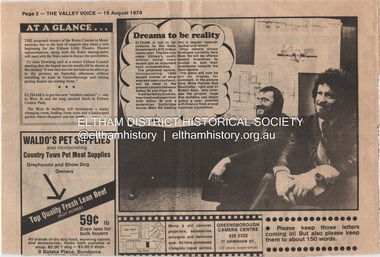
Document - Property Binder, Eltham Town Square, Commercial Place, Eltham
... reality, The Valley Voice, 15 August 1979, p2 - announcement of proposed town square of 1800 square metres of shop area and open courtyard to be sited in the carpark between Arthur Street and Pryor street. The plans also included tree-lined walkways from both Arthur Street and a pededstrian footbridge across Main Road leading to aregular open-air market and tavern. Shop owners facing Main Road were to be encouraged to turn their businesses towards the square. On reverse side - 'General' Marshall and his troops; Valley votes in five new faces...reality, The Valley Voice, 15 August 1979, p2 - announcement of proposed town square of 1800 square metres of shop area and open courtyard to be sited in the carpark between Arthur Street and Pryor street. The plans also included tree-lined walkways from both Arthur Street and a pededstrian footbridge across Main Road leading to aregular open-air market and tavern. Shop owners facing Main Road were to be encouraged to turn their businesses towards the square. On reverse side - 'General' Marshall and his troops; Valley votes in five new faces ...1. Dreams to be reality, The Valley Voice, 15 August 1979, p2 - announcement of proposed town square of 1800 square metres of shop area and open courtyard to be sited in the carpark between Arthur Street and Pryor street. The plans also included tree-lined walkways from both Arthur Street and a pededstrian footbridge across Main Road leading to aregular open-air market and tavern. Shop owners facing Main Road were to be encouraged to turn their businesses towards the square. On reverse side - 'General' Marshall and his troops; Valley votes in five new faces, The Valley Voice, 15 August 1979, p1 - picture showing newly elected Cr Robert Marshall 2. Square plan on display, Diamond Valley News, Tuesday, June 23, 1981, p1 - Council's prefered proposal on display to the public. On same page a story about the son of Cr Bob Manuell being attacked on the train from the city. On reverse side - Helping people - here and abroad by Marguerite Marshall, Diamond Valley News, Tuesday, June 23, 1981, p2 - about Keith Ryall of Zig Zag Road, the Apex international councillor for Australia 3. Plan: Eltham Town Centre property Acquisition, Shire of Eltham March 1994businesses, arthur street, bible street, commercial place, dudley street, eltham, franklins supermarket, luck street, main road, map, mcewans, pryor street, safeway supermarket, apex club, bronwyn ryall, keith ryall, zig zag road, cr bob manuell, cr robert allen, det sgt noel murphy, eltham chamber of commerce, eltham police, eltham shire council, eltham town square, lorraine manuell, pauline toner mp, robert manuell, rodney roscholler, shire planner, vicrail, elections, h&j white general store, hurstbridge, leslie bowker, main street, mrs marshall, pam lawson, robert marshall, rosemary tovey, central park, comfort station, eltham little theatre, montmorency, public toilets, rotex cinema, were street -
 Monbulk RSL Sub Branch
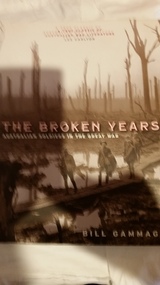
Book, Melbourne University Publishing, The broken years, 2010
... Those who have returned from war will recognise immediately the raw realities faced by the 'diggers', the growing disillusionment, and the hopes for the future. ...Before the First World War most Australians shared the emotions and traditions of the British Empire. Proud of their British heritage, anxious to raise the Imperial status of Australia, they were eager to fight and, if need be, to die in defence of their race and country. But the horror and tragedy of the conflict brought fundamental changes in outlook. Many of the pre-war enthusiasms persisted, but the days of unquestioning allegiance to Empire were beginning to come to an end, to be replaced by the bittersweet tradition of Anzac. Dr Gammage shows how and why these changes took place. Using the diaries and letters of one thousand front-line soldiers of the First Australian Imperial Force, most of them now part of a unique collection housed in the Australian War Memorial in Canberra, he reconstructs the motives and expectations with which these men volunteered and the experiences they encountered. He highlights and examines the new attitudes to war and to the homeland that developed and foreshadows the important effects in Australia of the changed outlook brought home by the survivors. Those who have returned from war will recognise immediately the raw realities faced by the 'diggers', the growing disillusionment, and the hopes for the future. Those with fathers, husbands, or brothers who served, and all those concerned with what happens to men at war, cannot fail to be moved by the simple dignity of the men{u2019}s accounts, or by the understated courage with which they wrote to their families of the miseries they endured. This book, written with sensitivity and scholarly care, must be read if we are to understand war and its impact on the ethos of a nation.Index, bib, ill, notes, p.288.non-fictionBefore the First World War most Australians shared the emotions and traditions of the British Empire. Proud of their British heritage, anxious to raise the Imperial status of Australia, they were eager to fight and, if need be, to die in defence of their race and country. But the horror and tragedy of the conflict brought fundamental changes in outlook. Many of the pre-war enthusiasms persisted, but the days of unquestioning allegiance to Empire were beginning to come to an end, to be replaced by the bittersweet tradition of Anzac. Dr Gammage shows how and why these changes took place. Using the diaries and letters of one thousand front-line soldiers of the First Australian Imperial Force, most of them now part of a unique collection housed in the Australian War Memorial in Canberra, he reconstructs the motives and expectations with which these men volunteered and the experiences they encountered. He highlights and examines the new attitudes to war and to the homeland that developed and foreshadows the important effects in Australia of the changed outlook brought home by the survivors. Those who have returned from war will recognise immediately the raw realities faced by the 'diggers', the growing disillusionment, and the hopes for the future. Those with fathers, husbands, or brothers who served, and all those concerned with what happens to men at war, cannot fail to be moved by the simple dignity of the men{u2019}s accounts, or by the understated courage with which they wrote to their families of the miseries they endured. This book, written with sensitivity and scholarly care, must be read if we are to understand war and its impact on the ethos of a nation. world war 1914-1918 - personal correspondence, world war 1914-1918 - social conditions -
 Monbulk RSL Sub Branch
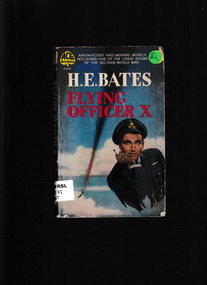
Book, Harborough Publishing, Flying Officer X, 1958
... Bates in his unprecedented role as an official war writer with the R.A.F. during WWII, where he animates the realities faced by pilots tasked with protecting the skies from enemy aircraft. p.189. ...The Flying Officer X stories were written by H.E. Bates in his unprecedented role as an official war writer with the R.A.F. during WWII, where he animates the realities faced by pilots tasked with protecting the skies from enemy aircraft.p.189.fictionThe Flying Officer X stories were written by H.E. Bates in his unprecedented role as an official war writer with the R.A.F. during WWII, where he animates the realities faced by pilots tasked with protecting the skies from enemy aircraft. air warfare - fiction, world war 1939-1945 - aerial operations - britain -
 Alfred Hospital Nurses League - Nursing History Collection
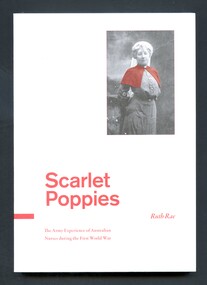
Book - Illustrated book, Ruth Rae 1957, Scarlet Poppies: the army experience of Australian nurses during the First World War, 2015
... realities of war from the nurses' perspective. World War 1914-1918 Military nursing-Australia Nurses Australia Army-Nurses Scarlet Poppies analyses the impact the military paradigm had upon the challenges faced by the 2,468 civilian trained nurses who joine the Australian Army Nursing Service (AANS). ...Scarlet Poppies analyses the impact the military paradigm had upon the challenges faced by the 2,468 civilian trained nurses who joine the Australian Army Nursing Service (AANS). The complex relationship between the male dominated military model and the female dominated Nightingale system of nursing training by the First World War nurses is examined in detail.Illustrated book with white front and back covers and red spine. The front cover has a red, black and white photograph of a nurse: Matron Adelaide (Maud) Kellett. Title and author's name are printed in red below this photo. Abbreviated title and author's name printed in white on the spine. Back cover has abbreviated title printed in red and a summary of the book printed in black.non-fictionScarlet Poppies analyses the impact the military paradigm had upon the challenges faced by the 2,468 civilian trained nurses who joine the Australian Army Nursing Service (AANS). The complex relationship between the male dominated military model and the female dominated Nightingale system of nursing training by the First World War nurses is examined in detail.world war 1914-1918, military nursing-australia, nurses, australia army-nurses -
 National Vietnam Veterans Museum (NVVM)
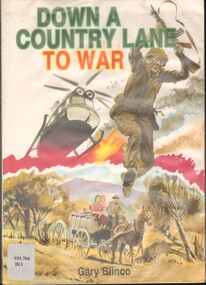
Book, Blinco, Gary, Down A Country Lane To War
... Soldiers - Australia - Biography Vietnamese Conflict 1961-1975 - Personal narratives Australian This novel will encourage anyone who has been forced to face life from a position of handicap, to believe in themselves, and to imprint images of success into their subconscious minds that will eventually overwhelm their seemingly hopeless current reality. ...This novel will encourage anyone who has been forced to face life from a position of handicap, to believe in themselves, and to imprint images of success into their subconscious minds that will eventually overwhelm their seemingly hopeless current reality.This novel will encourage anyone who has been forced to face life from a position of handicap, to believe in themselves, and to imprint images of success into their subconscious minds that will eventually overwhelm their seemingly hopeless current reality.soldiers - australia - biography, vietnamese conflict, 1961-1975 - personal narratives, australian -
 Uniting Church Archives - Synod of Victoria
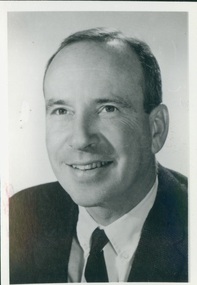
BW photo, Undated
... face conversation. The meeting lasted five hours, and three months later and with a $10,000 gift from a Pittsburgh businessman, FCA became a reality, chartered in Oklahoma on Nov. 10, 1954. ...face conversation. The meeting lasted five hours, and three months later and with a $10,000 gift from a Pittsburgh businessman, FCA became a reality, chartered in Oklahoma on Nov. 10, 1954. ...Don McClanen, who founded the Fellowship of Christian Athletes (FCA) in 1954, has died at the age of 91. “Don’s unwavering commitment and vision truly enabled FCA to grow to where it is today, encouraging millions of coaches and athletes to lead lives that are dedicated to Christ,” said Les Steckel, FCA president and CEO, in a statement. “Sixty-two years later, that vision is alive and well through FCA, influencing lives for Christ across the globe—an amazing legacy.” McClanen was born on February 3, 1925, in Trenton, New Jersey. He served in the Navy during World War II, then attended Oklahoma State University. After graduation, McClanen coached high school basketball before becoming the athletic director and men’s basketball coach at Eastern Oklahoma University. McClanen’s dreams of using sports to influence young people began after a speaker at a physical education conference he attended warned the audience that they could either lead youth “up a mountain or down a drain.” From FCA’s statement: McClanen was challenged to be a better model of his Christian life and told the Lord he would surrender to His will. Inspired by the conference, he began saving newspaper and magazine articles about Christian athletes and coaches. After reading that 30 million American youth had no religious training, McClanen began posting his articles in the locker room and praying before games. Soon, he was dreaming of a way for well-known Christian athletes to advertise their faith on television and in magazines the way they advertised other household products. McClanen’s relationship with Louis H. Evans, who later became the pastor at First Presbyterian Church in Hollywood and the leader of the Presbyterian Board of National Mission, helped spark what later became FCA. From FCA: Evans...encouraged McClanen to write to Christian athletes who were strong in their faith—greats like football stars Doak Walker and Otto Graham; baseball players Carl Erskine, Robin Roberts and Alvin Dark; Olympians Bob Mathias and Bob Richards; coaching and front office legends Amos Alonzo Stagg, Bud Wilkinson and Clarence “Biggie” Munn; and even broadcasters Tom Harmon and Red Barber. Fourteen of those 19 men told McClanen they were interested. But [Branch] Rickey, the then-Pittsburgh Pirates general manager who had signed Jackie Robinson when he led the Brooklyn Dodgers, didn’t answer the letter. McClanen, however, pressed on for a meeting with him. He promised to drive to Pittsburgh to meet with Rickey on his own dime for a five-minute face-to-face conversation. The meeting lasted five hours, and three months later and with a $10,000 gift from a Pittsburgh businessman, FCA became a reality, chartered in Oklahoma on Nov. 10, 1954. Died February 2016.Don McClanen, head & shoulders portrait.Don McClanendon mcclanen; fellowship of christian athletes 1954 -
Harcourt Valley Heritage & Tourist Centre
Book, Harcourt Speaks, 2009
... Provides a cross-section of the working adults of a rural community as they faced the grim reality of extended drought with attendant restrictions on the use of irrigation water and the consequent near disastrous impact on horticulture in this famed horticultural valley. ...'Harcourt Speaks' represents the collaboration of a group of local orchardists, farmers, growers and local community who worked together to gather photos and stories of strength, cohesion and innovation around the impact of relentless drought and changing climatic conditions. This was a drought assistance project supported by the Mount Alexander Shire Council and the Victorian Government Dept of Community Planning and Development.Project Facilitator was Phillippa Gregory and Photography Community Development was provided by Deanna Neville.Provides a cross-section of the working adults of a rural community as they faced the grim reality of extended drought with attendant restrictions on the use of irrigation water and the consequent near disastrous impact on horticulture in this famed horticultural valley. Each photo has a brief story attached. The captions tell how this community responded by acceptance and innovation, using words like "we adapted' 'we were innovative' 'new directions chosen' 'resilience' 'optimistic'.This project is significant in that it depicts a community that, faced with real adversity, was not weakly submissive, nor crushed, but made the best of it.It has significance as an example of a creative response to a prolonged negative situationSixteen page, spiral bound, A4 'landscape'book with coloured title page, with 31 coloured photographs.Harcourt Speaks -
 Federation University Art Collection
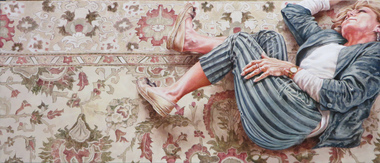
Painting - Artwork, Trudi Harley, 'Fallen' by Trudi Harley, 2009
... reality. I can also recall at the time reflecting on the adage ‘walk a mile in my shoes’ and the pressures we all face in life. ...reality. I can also recall at the time reflecting on the adage ‘walk a mile in my shoes’ and the pressures we all face in life. ...Trudi HARLEY Born Korumburra, Victoria Born in country Victoria Trudi Harley graduated with a Bachelor of Education (Art and Craft) at Victoria College, Burwood. After teaching for 10 years in both Government and Independent schools in Melbourne she worked as a Sales Executive and Art Educator for Cavalier Art Supplies for 16 years. Recently Trudi Harley completed a Bachelor of Arts (Visual Arts) (Honours) with Distinction between 2008 – 2009, and a Master of Arts (Research), Visual Art between 2010 – 2012 at the University of Ballarat (now Federation University). Maintaining an artistic practice while in a business partnership Trudi Harley owns and runs Atelier Art Supplies in Williamstown, Victoria, which is a major supporter of the arts in the western suburbs of Melbourne/ This item is part of the Federation University Art Collection. The Art Collection features over 2000 works and was listed as a 'Ballarat Treasure' in 2007.Artist's Statement: As an artist am continually drawn to ‘what makes us who we are’ and as a result the work, whatever it may be, is a reflection on what makes me who I am. In this I refer to perception, experience and memory as aspects that contribute to our sense of reality. By using these references I intend to engage the audience and develop a sense of connection and community through the visual image. ‘Fallen’ was not necessarily a reflection on my own life but of life in general as I recall at the time I had a family member who was struggling to cope with their own reality. I can also recall at the time reflecting on the adage ‘walk a mile in my shoes’ and the pressures we all face in life. Added to this were my own influences of upbringing, I have always been particularly drawn to fabrics and patterns as my mother was/is (getting a little old now) a seamstress and my father was a bit of a ‘perfectionist’. During my honours study I came across the term ‘Esperpento’ which included such visual elements as exaggeration and unusual viewpoints. Fallen was a comment on the psychology associated with expectations in life, or more importantly those expectations placed on offspring by their parents. This painting reflected the consequences of not living up to those expectations. It is unfortunate that in life, by the time you get to the point of realising that you have the opportunity to set your own standards, that you’ve probably embodied a great many set of values by osmosis and that you’ve now claimed them as your own. The view is from above to dramatize the subject, the figure placed compositionally in the top right hand corner to open up the picture plane and allow for the narrative to continue outside the visual area of the canvas. It was also in this painting that I rubbed back some of the darker oil paint to allow the lighter underpainting to show through.art, artwork, trudi harley, harley, carpet, portrait, self-portrait, alumni -
 Melbourne Tram Museum
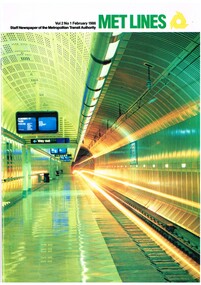
Magazine, Metropolitan Transit Authority (MTA), "Met Lines", 1986
... Tramway and bus names only listed, not railway. .1 - Vol 2 No. 1 - Feb. 1986 - front cover - Flagstaff station, St Kilda/Port Melbourne light rail system announced, police at Hawthorn learning about trams, Chinese delegation looking at Melbourne's trams, Elwood depot article with photos by Lloyd Rogers at time of Elwood depot coming part of The Met, promotional posters for tramcars, Tram cards, tram power supply upgraded (photo of Z129) - Brown Boveri equipment to Kew and Ascot Vale, memoirs of a tram conductress Nancy Scutt, item with photo of Conductor Jeff Harvey, employment notes, Preston Workshops Christmas party and presentation to Essendon depot tramway soccer champs by Norm Maddock. .2 - Vol 2, No. 2 - March 1986 - Jolimont workshops, modal interchange at Bundoora, Transport Information Centre, memoirs of a tram conductress continued, tram cricket matches, tramway bowls - photos and players listed, Harris trains to be phased out. .3 - Vol 2, No. 3 - April 1986 - front cover of a Met Tram overhead maintenance, linesmen training, new super scheme (old gratuity scheme), visit from ATMOEA NSW visit, Elwood bus depot 12 months with The Met, flying flags on trams, tramway bowls, cricket. .4 - Vol 2, No. 4, May 1986 - 20 pages - Met Information Centre - "Dreams of trams become a reality - driver Peter Gamble", tram tour for American visitors to the zoo, Harris trains, article and photos on Camberwell depot, pantographs on trams, face lift for trams (758) and new buses (182). .5 - Vol 2, No. 5, June/July 1986 - 40 pages - Clock shop, materials testing, lost property, chemical analysis - Preston Workshops, Bus Driving School, Munitions bus 301 at Hawthorn, AVM on trams (223), tram track repairs, relaying Preston workshops entrance for LRV's, new type of safety zones (967 and 871), Preston Workshops redevelopment for LRV's, tram shelters, transporting arts - new series, Michael Leunig, mentions Clifton Pugh tram 504, federal funding for trams, fitting air conditioners to trams. .6 - Vol 2, No. 6, August 1986 - 20 pages - front cover - rotary converter at Carlton, Doncaster bus depot celebrates 25 years, the day the rains came - Ray Marsh - 1972 floods, substations power tram network, Carlton, tram art of a different kind, launch of Leunig's tram. ...Tramway and bus names only listed, not railway. .1 - Vol 2 No. 1 - Feb. 1986 - front cover - Flagstaff station, St Kilda/Port Melbourne light rail system announced, police at Hawthorn learning about trams, Chinese delegation looking at Melbourne's trams, Elwood depot article with photos by Lloyd Rogers at time of Elwood depot coming part of The Met, promotional posters for tramcars, Tram cards, tram power supply upgraded (photo of Z129) - Brown Boveri equipment to Kew and Ascot Vale, memoirs of a tram conductress Nancy Scutt, item with photo of Conductor Jeff Harvey, employment notes, Preston Workshops Christmas party and presentation to Essendon depot tramway soccer champs by Norm Maddock. .2 - Vol 2, No. 2 - March 1986 - Jolimont workshops, modal interchange at Bundoora, Transport Information Centre, memoirs of a tram conductress continued, tram cricket matches, tramway bowls - photos and players listed, Harris trains to be phased out. .3 - Vol 2, No. 3 - April 1986 - front cover of a Met Tram overhead maintenance, linesmen training, new super scheme (old gratuity scheme), visit from ATMOEA NSW visit, Elwood bus depot 12 months with The Met, flying flags on trams, tramway bowls, cricket. .4 - Vol 2, No. 4, May 1986 - 20 pages - Met Information Centre - "Dreams of trams become a reality - driver Peter Gamble", tram tour for American visitors to the zoo, Harris trains, article and photos on Camberwell depot, pantographs on trams, face lift for trams (758) and new buses (182). .5 - Vol 2, No. 5, June/July 1986 - 40 pages - Clock shop, materials testing, lost property, chemical analysis - Preston Workshops, Bus Driving School, Munitions bus 301 at Hawthorn, AVM on trams (223), tram track repairs, relaying Preston workshops entrance for LRV's, new type of safety zones (967 and 871), Preston Workshops redevelopment for LRV's, tram shelters, transporting arts - new series, Michael Leunig, mentions Clifton Pugh tram 504, federal funding for trams, fitting air conditioners to trams. .6 - Vol 2, No. 6, August 1986 - 20 pages - front cover - rotary converter at Carlton, Doncaster bus depot celebrates 25 years, the day the rains came - Ray Marsh - 1972 floods, substations power tram network, Carlton, tram art of a different kind, launch of Leunig's tram. ...Magazine, published by the Metropolitan Transit Authority of Victoria "Met Lines" (Metlines) - A4, printed on white gloss paper, with the MTA logo or symbol. Issued under the name of Kevin Shea as Chairman. References to Minister Tom Roper. Continues from Reg Item 1059 "Met Lines" - printed in an A4 version. Major tram and bus items listed. Tramway and bus names only listed, not railway. .1 - Vol 2 No. 1 - Feb. 1986 - front cover - Flagstaff station, St Kilda/Port Melbourne light rail system announced, police at Hawthorn learning about trams, Chinese delegation looking at Melbourne's trams, Elwood depot article with photos by Lloyd Rogers at time of Elwood depot coming part of The Met, promotional posters for tramcars, Tram cards, tram power supply upgraded (photo of Z129) - Brown Boveri equipment to Kew and Ascot Vale, memoirs of a tram conductress Nancy Scutt, item with photo of Conductor Jeff Harvey, employment notes, Preston Workshops Christmas party and presentation to Essendon depot tramway soccer champs by Norm Maddock. .2 - Vol 2, No. 2 - March 1986 - Jolimont workshops, modal interchange at Bundoora, Transport Information Centre, memoirs of a tram conductress continued, tram cricket matches, tramway bowls - photos and players listed, Harris trains to be phased out. .3 - Vol 2, No. 3 - April 1986 - front cover of a Met Tram overhead maintenance, linesmen training, new super scheme (old gratuity scheme), visit from ATMOEA NSW visit, Elwood bus depot 12 months with The Met, flying flags on trams, tramway bowls, cricket. .4 - Vol 2, No. 4, May 1986 - 20 pages - Met Information Centre - "Dreams of trams become a reality - driver Peter Gamble", tram tour for American visitors to the zoo, Harris trains, article and photos on Camberwell depot, pantographs on trams, face lift for trams (758) and new buses (182). .5 - Vol 2, No. 5, June/July 1986 - 40 pages - Clock shop, materials testing, lost property, chemical analysis - Preston Workshops, Bus Driving School, Munitions bus 301 at Hawthorn, AVM on trams (223), tram track repairs, relaying Preston workshops entrance for LRV's, new type of safety zones (967 and 871), Preston Workshops redevelopment for LRV's, tram shelters, transporting arts - new series, Michael Leunig, mentions Clifton Pugh tram 504, federal funding for trams, fitting air conditioners to trams. .6 - Vol 2, No. 6, August 1986 - 20 pages - front cover - rotary converter at Carlton, Doncaster bus depot celebrates 25 years, the day the rains came - Ray Marsh - 1972 floods, substations power tram network, Carlton, tram art of a different kind, launch of Leunig's tram. Doncaster party. .7 - Vol 2, No. 7, October 1986, 20 pages, artic buses start rolling (articulated), vandals, Robert Jacks tram launched, Peace tram 829,. .8 - Vol 2, No. 8, November 1986, 20 pages, MTA Annual report, Debbie Bateman Conductor thanked by passengers, Papal tour planning, MTA Ball, Frankston Neighbourhood launched, Essendon depot Soccer report. .9 - Vol. 2, No. 9, December 1986, 20 pages, Christmas issue, (has a $1.50 sticker on it), Met Lines year in review, Federal funding for more A class trams, Bundoora - La Trobe Uni bus interchanged opened, Domain Interchange opened, For next year 1987 - see Reg Item 1141 - Announced in December issue, Met Lines quarterly next year.trams, tramways, mta, the met, elwood depot, light rail, posters, power supply, kew, ascot vale, conductresses, sports, essendon depot, bundoora, jolimont workshops, tower truck, overhead, superannuation, flags, camberwell depot, drivers, trolley poles, pantographs, clocks, buses, avm, automatic vehicle monitoring, shelters, flooding, substation, carlton, transporting art, federal funding, a class, domain interchange, tram 2001, tram 129, tram 234, tram 50, tram 504, tram 871, tram 967, tram 223, tram 758 -
 Merri-bek City Council
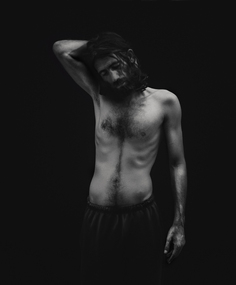
Archival pigment print, Hoda Afshar, Behrouz Boochani – Manus Island No.2, 2018
... realities described—the emotional impact of the work is intensified. It creates a simultaneous sense of beauty and horror. The photographic portraits of the same individuals are equally compelling. Positioned prominently against a dark backdrop, these subjects assert their presence, emphasizing their right to be seen. The deliberate simplicity of these portraits serves as a powerful political statement, countering the invisibility imposed by the act of detention. Afshar metaphorically acknowledges the struggles faced...realities described—the emotional impact of the work is intensified. It creates a simultaneous sense of beauty and horror. The photographic portraits of the same individuals are equally compelling. Positioned prominently against a dark backdrop, these subjects assert their presence, emphasizing their right to be seen. The deliberate simplicity of these portraits serves as a powerful political statement, countering the invisibility imposed by the act of detention. Afshar metaphorically acknowledges the struggles faced ...Hoda Afshar's 2018 body of work, "Remain," offers a forthright and unapologetic political commentary on Australia's border protection policy, shedding light on its impact on human rights. This collection comprises a film and a series of photographic portraits that chronicle the stories of stateless men who chose to stay on Manus Island, Papua New Guinea, even after the closure of the immigration detention centre in October 2017. In the accompanying film, the experiences of these men are conveyed through episodic fragments, narrated with a mix of lyrical and brutal voiceovers. Some express themselves through poetry, others through song, while some recall the riots and suicides. Set against the backdrop of a picturesque landscape featuring lush foliage and crystal-clear water—a stark contrast to the harsh realities described—the emotional impact of the work is intensified. It creates a simultaneous sense of beauty and horror. The photographic portraits of the same individuals are equally compelling. Positioned prominently against a dark backdrop, these subjects assert their presence, emphasizing their right to be seen. The deliberate simplicity of these portraits serves as a powerful political statement, countering the invisibility imposed by the act of detention. Afshar metaphorically acknowledges the struggles faced by these men, depicting them contending with the elements—fire, water, and earth—yet never questioning their inherent humanity. Here we see Behrouz Boochani, the Kurdish Iranian writer whose memoir ‘No Friend but the Mountains: Writing from the Manus Prison’ won the Victorian Premier’s Prize for Literature and the Prize for Non-Fiction in 2019. Boochani was held in detention on Manus Island from 2013 until the centre’s closure in 2017 and was forced to remain on the island in a stateless condition. -
 Returned Nurses RSL Sub-branch
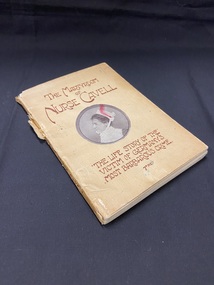
Book - Paperback book, William Thomson Hill, The Martyrdom of Nurse Cavell : the life story of the victim of Germany's most barbarous crime, 1915
... face of unimaginable adversity. Cavell's story has resonated deeply for generations, solidifying her place as a martyr and a symbol of humanitarianism amidst the brutal realities of war. ..."The Martyrdom of Nurse Cavell: The Life Story of the Victim of Germany's Most Barbarous Crime" recounts the tragic and inspiring story of Edith Cavell, a British nurse whose unwavering dedication during World War I led to her execution. William Thomson Hill meticulously chronicles Cavell's life and service in Belgium, where she aided wounded soldiers from all sides of the conflict. This historical biography explores the circumstances surrounding Cavell's arrest and trial, painting a vivid picture of wartime Belgium and the moral complexities faced by those caught in the crossfire. More than just a biography, this book serves as a powerful testament to courage, compassion, and self-sacrifice in the face of unimaginable adversity. Cavell's story has resonated deeply for generations, solidifying her place as a martyr and a symbol of humanitarianism amidst the brutal realities of war. It is a timeless and important account of a life lived in service to others. - from BiblioSmall, worn paperback book with a faded and discoloured cream cover that is torn along the spine. There is a portrait of Nurse Cavell in a round template in the centre of the cover and the title and sub-title are rinted above and below the image in brown print.non-fiction"The Martyrdom of Nurse Cavell: The Life Story of the Victim of Germany's Most Barbarous Crime" recounts the tragic and inspiring story of Edith Cavell, a British nurse whose unwavering dedication during World War I led to her execution. William Thomson Hill meticulously chronicles Cavell's life and service in Belgium, where she aided wounded soldiers from all sides of the conflict. This historical biography explores the circumstances surrounding Cavell's arrest and trial, painting a vivid picture of wartime Belgium and the moral complexities faced by those caught in the crossfire. More than just a biography, this book serves as a powerful testament to courage, compassion, and self-sacrifice in the face of unimaginable adversity. Cavell's story has resonated deeply for generations, solidifying her place as a martyr and a symbol of humanitarianism amidst the brutal realities of war. It is a timeless and important account of a life lived in service to others. - from Biblio edith cavell, nurses biograohy, world war 1914-1918 german atrocities, german occupation of belgium
