
Showing 2 items matching "the girl with a brogue"
-
 Thompson's Foundry Band Inc. (Castlemaine)
Work on paper - Sheet Music, Shipley Douglas et al, The Arcadians
... ...The Girl with a Brogue...Selected and arranged by Shipley Douglas includes: Opening Chorus, Chorus of Waitresses, Back your fancy, The girl with a brogue, the joy of life, my Motter, Bring ma a rose, Charming Weather, Fickle Fortune and Arcady is every young. ...Chorus of Waitresses, Back your fancy, The girl with a brogue, Opening Chorus Act II, The Joy of Life, My Motter, Bring me a rose, Charming Weather, Fickle Fortune and Arcady is ever young. ...Chorus of Waitresses, Back your fancy, The girl with a brogue, Opening Chorus Act II, The Joy of Life, My Motter, Bring me a rose, Charming Weather, Fickle Fortune and Arcady is ever young. ...20 parts for Brass band. This piece is a selection of pieces from the 1909 Edwardian style musical comedy - the Arcadians. Selected and arranged by Shipley Douglas includes: Opening Chorus, Chorus of Waitresses, Back your fancy, The girl with a brogue, the joy of life, my Motter, Bring ma a rose, Charming Weather, Fickle Fortune and Arcady is every young.20 parts for Brass band. This piece is a selection of pieces from the 1909 Edwardian style musical comedy - the Arcadians. Selected and arranged by Shipley Douglas includes: Opening Chorus, Chorus of Waitresses, Back your fancy, The girl with a brogue, the joy of life, my Motter, Bring ma a rose, Charming Weather, Fickle Fortune and Arcady is every young. Parts: E♭ soprano cornet Solo cornet in B♭ Repiano cornet in B♭ 2nd cornet in B♭ 3rd cornet in B♭ Flugel horn in B♭ 1st horn in E♭ 2nd horn in E♭ 3rd horn in E♭ 4th horn in E♭ 1st baritone in B♭ 2nd baritone in B♭ 1st euphonium 2nd euphonium 1st tenor trombone 2nd tenor trombone Bass trombone B♭ bass (2 copies) E♭ bass (2 copies) Drums.fiction20 parts for Brass band. This piece is a selection of pieces from the 1909 Edwardian style musical comedy - the Arcadians. Selected and arranged by Shipley Douglas includes: Opening Chorus, Chorus of Waitresses, Back your fancy, The girl with a brogue, the joy of life, my Motter, Bring ma a rose, Charming Weather, Fickle Fortune and Arcady is every young. edwardian musical, musical, shipley douglas, lionel monkton, howard talbot, chorus of waitresses, back your fancy, the girl with a brogue, the joy of life, my motter, bring me a rose, charming weather, fickle fortune, arcady is ever young, chappel & co, chappell's bras and reed journal -
 National Wool Museum
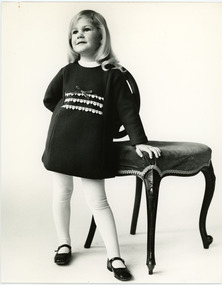
Photograph, c.1960
... Black and white photograph printed on photographic paper depicting a young blonde girl wearing white tights, shiny black mary janes with broguing and a short black long-sleeved dress. ...Business Business history Manufacturing Knitting Machine Fashion Textile Production Business Archives Manufacturing Documents Textile Industry - history Wool Marketing Wool Marketing Fashion Textile Industry Children's Knitwear Children's clothing Knitwear Marketing Black and white photograph printed on photographic paper depicting a young blonde girl wearing white tights, shiny black mary janes with broguing and a short black long-sleeved dress. ...Kathryn Knitwear, founded by Robert Blake, manufactured high quality children’s knitwear in Melbourne from the 1940s – 1980s. Robert Blake began manufacturing children’s knitwear in his bedroom in Strathmore using a hand powered machine in the late 1940s. The operation moved to Ascot Vale and Essendon, before eventually establishing a factory in Moonee Ponds in the early 1950s. The business continued to expand, necessitating a move to a new factory in Broadmeadows. By 1962, the Broadmeadows factory was producing an average of 20,000 garments per month, which increased to 24,000 by 1964. Robert Blake’s Son, Brendan recalls that “The Kathryn brand was famous around Australia, anywhere children needed to keep warm and dress smartly. It also won a number of wool fashion awards”, including the 1969 Wool Awards, which was held by the Australian Wool Bureau and published in Women’s Weekly. The Kathryn range was designed for durability, comfort and care, without sacrificing style. They used patterning techniques that increase stretchiness, comfort and fit, as well as integrating decorative elements into the fabric to prevent them from being bulky, uncomfortable or tight. Making longevity of style a priority, Brendan Blake remembers that “there was one particular garment that was in the range for at least thirty years”. He also recalls “In the past, when women have found out that I was associated with Kathryn Knitwear, they would often relate to me the story of a garment they had purchased or received as a gift and, when their child had grown out of it, they would hand it on to another child. Several ladies have told me of purchasing garments for their daughters’ glory box, or saving a particular garment after their daughter had grown out of it. Brendan Blake: “At the peak of their operation they employed approximately two hundred people, mainly women and girls. A family would often seek to send their daughter to work in this company because they knew they would be looked after and safe. One lady wrote to me telling me that working at the Moonee Ponds Factory prior to getting married was the happiest time of her life.” In 1963, workers at the Kathryn factory earned £13 per week, which was 8 shillings and 8 pence higher than the minimum weekly wage for female workers in the textile manufacturing industry (£12 11s 4d). By 1970, the Kathryn Knitwear brand expanded from children’s knitwear into womenswear under the brand name ‘Lady Kathryn’, and for boys and men under ‘Robert Blake’. Continuing to diversify their distribution, they also began exporting ‘Kathryn’ garments to New Zealand, the Pacific Islands, and Japan. ‘Kathryn Knitwear’ was well-known for their early adoption of modern materials and techniques that had broad appeal to their customer base. This is shown in their early use of the acrylic fibre ‘Orlon’ in the 50s and 60s and ‘Superwash’ wool in the 1970s. Many of Kathryn Knitwear’s styles, particularly those that were long running staples of the brand, were available in both wool and Orlon to suit the consumer’s preference. Far from the humble origins of one man in his bedroom with a hand-cranked machine; at its closure in 1980, the Broadmeadows factory of ‘Kathryn’ housed more than 100 machines, including 53 sewing machines and 45 knitting machines. Robert Blake was “a passionate advocate for wool and Australian Made” throughout his whole life. A strong thread that ties through the lifespan of Robert Blake and Kathryn Knitwear is a balance between adopting new innovations without sacrificing the core values of durability, comfort, care and style that had made the brand so well known. Their legacy forms an integral part of both Australian social and manufacturing history.Black and white photograph printed on photographic paper depicting a young blonde girl wearing white tights, shiny black mary janes with broguing and a short black long-sleeved dress. The dress has three horizontal rows of white lace trim and a velvet ribbon that ties in a bow across the front panel. She has one arm behind her back and is resting her other arm and leaning against an ornate dining chair with velvet upholstery. From a promotional shoot for Kathryn Knitwearbusiness, business history, manufacturing, knitting machine, fashion textile production, business archives, manufacturing documents, textile industry - history wool marketing, wool marketing fashion textile industry, children's knitwear, children's clothing, knitwear marketing
