
Showing 286 items matching "the great depression"
-
 Bendigo Historical Society Inc.
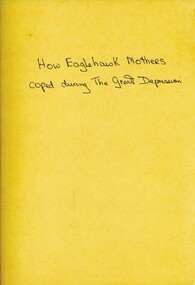
Book - HOW EAGLEHAWK MOTHERS COPED DURING THE GREAT DEPRESSION, 1983
... HOW EAGLEHAWK MOTHERS COPED DURING THE GREAT DEPRESSION...How Eaglehawk Mothers Coped during the Great Depression....How Eaglehawk Mothers Coped during the Great Depression. Book HOW EAGLEHAWK MOTHERS COPED DURING THE GREAT DEPRESSION ...How Eaglehawk Mothers Coped during the Great Depression.Annette McHugh.eaglehawk, history, women during the depression. -
 Bendigo Historical Society Inc.
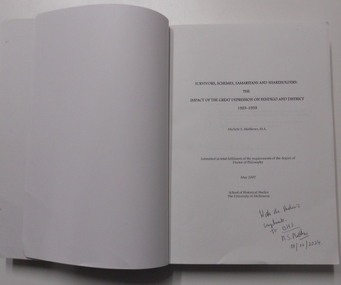
Book - Michele Matthews Collection - Thesis, Survivors, Schemes, Samaritans and Shareholders: The Impact of the Great Depression on Bendigo and District 1925-1935, May 2007
... Survivors, Schemes, Samaritans and Shareholders: The Impact of the Great Depression on Bendigo and District 1925-1935...The Great Depression...The Great Depression Bendigo & District Handwritten in ink on title page "With the Author's compliments to BHS. ...237 pp black covered manuscript being the Thesis by Michele Matthews M.A. Submitted in total fulfilment of the requirements of the degree of Doctor of Philosophy. The School of Historical Studies, The University of Melbourne - May 2007 Table of contents includes Abstract, List of Tables, List of Illustrations, Abbreviations, Acknowledgements and Bibliography. Access for research purposes only.Handwritten in ink on title page "With the Author's compliments to BHS. M.S. Matthews 04/06/2024"the great depression, bendigo & district -
 Tarnagulla History Archive
Account of The Great Depression, by Don Clark, 1990
... Account of The Great Depression, by Don Clark...A handwritten account of life in Irishtown, near Tarnagulla, during The Great Depression of 1929-37 as remembered by Donald Clark. ...Account of The Great Depression, by Don Clark ...Donald Clark Collection.A handwritten account of life in Irishtown, near Tarnagulla, during The Great Depression of 1929-37 as remembered by Donald Clark. Written for a school student's history project in 1990. -
 City of Moorabbin Historical Society (Operating the Box Cottage Museum)
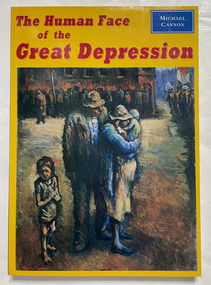
Book, Cannon, Michael, The human face of the great depression, 1996
... The human face of the great depression...The human face of the great depression Book Cannon, Michael Cannon, Michael ...315 p. : ill., facsims., ports. ; Ill. on end papers. Includes bibliography and index.non-fictiondepressions, poverty, australia, politics, economic conditions -
Whitehorse Historical Society Inc.
Article, The Great Depression, 19/04/1981
... The Great Depression...Article was written in January 1974 and published in April 1981. The Great Depression Article Article ...Photocopy of an article in the National Times by Ruth Park on the experiences of people during the 1929 depression.Photocopy of an article in the National Times by Ruth Park on the experiences of people during the 1929 depression. Article was written in January 1974 and published in April 1981.Photocopy of an article in the National Times by Ruth Park on the experiences of people during the 1929 depression.depression 1929 - 1939, ruth park -
Unions Ballarat
Weevils in the flour : an oral record of the 1930s depression in Australia, Lowenstein, Wendy, 1978
... ...the great depression...An oral history relating to the Great Depression and the personal hardships that were suffered by families. ...An oral history relating to the Great Depression and the personal hardships that were suffered by families. ...An oral history relating to the Great Depression and the personal hardships that were suffered by families. Relevant to Australian social and workplace history, especially during the period of the Great Depression of the 1930s.Paper; book. Front cover: black background; artistic impression of working class people, including a banner that reads "work not dole"'; red, yellow and white lettering. Front cover: title and author's name.btlc, ballarat trades hall, ballarat trades and labour council, the great depression, work for the dole, oral histories, wages, economic conditions, social history, history, australian history, economics, employment, unemployment -
Unions Ballarat
Collingwood Coke, Freeman, Harry, 1984
... ...the great depression...Set in the Great Depression. About unemployed people living in Collingwood and the role of the Methodist mission in caring for poor people in the area....Set in the Great Depression. About unemployed people living in Collingwood and the role of the Methodist mission in caring for poor people in the area. ...Set in the Great Depression. About unemployed people living in Collingwood and the role of the Methodist mission in caring for poor people in the area.Relevant to Australian history in the Great Depression, particularly in Collingwood.Paper; book. Front cover: brown theme/background; picture of houses and a cobblestone street; brown lettering.Front cover: author's name and title.btlc, ballarat trades hall, ballarat trades and labor council, collingwood, the great depression, unemployment, methodist mission, methodist church, city missions, missionaries, history, social history -
Unions Ballarat
Minutes of meetings - Mothers' Social Club Ballarat/Unemployed Mothers Club. Includes minutes of Ballarat Unemployed Association Committee meetings, 4 October 1933-20 February 1935
... ...The Great Depression...Mothers' Social Club, Ballarat/Unemployed Mothers' Club was formed during The Great Depression in Ballarat. The minutes also include minutes of the Ballarat Unemployed Association Committee meetings. ...Mothers' Social Club, Ballarat/Unemployed Mothers' Club was formed during The Great Depression in Ballarat. The minutes also include minutes of the Ballarat Unemployed Association Committee meetings. ...Mothers' Social Club, Ballarat/Unemployed Mothers' Club was formed during The Great Depression in Ballarat. The minutes also include minutes of the Ballarat Unemployed Association Committee meetings. It is assumed that the two groups had some parallel interests and that they met under the auspices of Ballarat Trades Hall.Of significance to matters of women's rights, collective action, employment and social equity in the Ballarat region.Paper, binding - 1 volume.mothers' social club, ballarat, unemployed mothers' club, the great depression, minutes, ballarat unemployed association committee, ballarat trades hall, btlc, ballarat trades and labour council, women, unemployment, employment, equity -
 Bendigo Historical Society Inc.
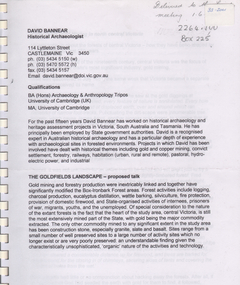
Booklet - The Goldfields Landscape, David Bannear, 2001
... 1931 - 1940: The Great Depression...Subjects covered in the presentation include: Early 1850's Gold Mining in north central Victoria Botanising diggers Quartz mining Deep lead mining, The state of the forests at the end of the nineteenth century State of the Central Victoria forests Settlement Charcoal production Wattle bark industry The railways Eucalyptus production State nurseries and plantations Thinning of forests Royalty system Creswick School of Forestry and Forestry Commission 1919: Pines and unemployed schemes 1931 - 1940: The Great Depression 1939: Black Friday 1939-45: Alien or interment forestry camps 1939- 45: Second World War charcoal production 1944-45 Prisoner of War Camps 1949-51: Migrant or refugee camps ...Early 1850's Gold Mining in north central Victoria Botanising diggers Quartz mining Deep lead mining The state of the forests at the end of the nineteenth century State of the Central Victoria forests Settlement Charcoal production Wattle bark industry The railways Eucalyptus production State nurseries and plantations Thinning of forests Royalty system Creswick School of Forestry and Forestry Commission 1919: Pines and unemployed schemes 1931 - 1940: The Great Depression 1939: Black Friday 1939-45: Alien or interment forestry camps 1939- 45: Second World War charcoal production 1944-45 Prisoner of War Camps 1949-51: Migrant or refugee camps David Bannear Eleven page typed booklet with clear plastic cover and white plastic ring binding. ...Eleven page typed booklet with clear plastic cover and white plastic ring binding. Booklet contains a presentation delivered to the Bendigo Historical Society on 1st June 2001, by David Bannear, BA, MA (University of Cambridge) Historical Archaeologist. Subjects covered in the presentation include: Early 1850's Gold Mining in north central Victoria Botanising diggers Quartz mining Deep lead mining, The state of the forests at the end of the nineteenth century State of the Central Victoria forests Settlement Charcoal production Wattle bark industry The railways Eucalyptus production State nurseries and plantations Thinning of forests Royalty system Creswick School of Forestry and Forestry Commission 1919: Pines and unemployed schemes 1931 - 1940: The Great Depression 1939: Black Friday 1939-45: Alien or interment forestry camps 1939- 45: Second World War charcoal production 1944-45 Prisoner of War Camps 1949-51: Migrant or refugee camps early 1850's gold mining in north central victoria, botanising diggers, quartz mining, deep lead mining, the state of the forests at the end of the nineteenth century, state of the central victoria forests, settlement, charcoal production, wattle bark industry, the railways, eucalyptus production, state nurseries and plantations, thinning of forests, royalty system, creswick school of forestry and forestry commission, 1919: pines and unemployed schemes, 1931 - 1940: the great depression, 1939: black friday, 1939-45: alien or interment forestry camps, 1939- 45: second world war charcoal production, 1944-45 prisoner of war camps, 1949-51: migrant or refugee camps, david bannear -
Koorie Heritage Trust
Document - Printed Sheets, Beveridge, Peter, Of the Aborigines inhabiting the Great Lacustrine and Riverine Depression of the Lower Murray, Lower Murrumbidgee, Lower Lachlan, and Lower Darling, 1883
... Of the Aborigines inhabiting the Great Lacustrine and Riverine Depression of the Lower Murray, Lower Murrumbidgee, Lower Lachlan, and Lower Darling...Of the Aborigines inhabiting the Great Lacustrine and Riverine Depression of the Lower Murray, Lower Murrumbidgee, Lower Lachlan, and Lower Darling Document Printed Sheets Beveridge, Peter Unknown ...19-74 p. ; 23 cm.aborigines-lower murray - boora boora, baraba baraba, watty watty, waiky waiky, latchy latchy, darty darty, yairy yairy, law-games, punishment, dogs, spirituality, tribal, death, sickness, food, canoes, cordage, hunting, see also: watti watti; dadi dadi; latchi latchi; -
 The Beechworth Burke Museum
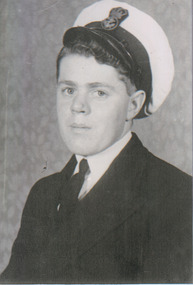
Audio - Oral History, Jennifer Williams, Mr Ray Stone, 8th June 2000
... ...The Great Depression...While the township of Beechworth is known for its history as a gold rush town, these accounts provide a unique insight into the day-to-day life of the town's residents during the 20th century, many of which will have now been lost if they had not been preserved. listen to what they say beechworth oral history burke museum stone ray stone tannery tanneries finch street navy The Great Depression poverty wheelbarrow race cars gift footrace marriage travel Mr Ray Stone / This is a digital copy of a recording that was originally captured on a cassette tape. ...Ray Stone was born in 1927, growing up in Beechworth as the oldest of eight children, but spent much of his life travelling, which he recalls in this oral history. Although he started working at the Beechworth Tannery with his father, he joined the Navy before he was of age in 1944 to support the war effort, and upon returning to Beechworth gave up on the Tannery after half a day to continue working jobs across Victoria instead. He talks extensively about watching Beechworth's famous Wheelbarrow race, where Tony Evans bet Tom Parkinson that the latter would not be able to push the former in a wheelbarrow from the Beechworth Post Office to Mt Buffalo in eight days. Calling himself a "helper all [his] life", he discusses the way many towns he worked in would come together to support struggling families, especially widows. In comparison, he suggests that the Beechworth of 2000 is much less community-orientated. He also discusses the economic changes he's witnessed around Beechworth, from the difficulties during the Depression while he was a child, to business improvements at the Tannery and Brewery, to the tourism boom. This oral history recording was part of a project conducted by Jennifer Williams in the year 2000 to capture the everyday life and struggles in Beechworth during the twentieth century. This project involved recording seventy oral histories on cassette tapes of local Beechworth residents which were then published in a book titled: Listen to what they say: voices of twentieth century Beechworth. These cassette tapes were digitised in July 2021 with funds made available by the Friends of the Burke.Ray Stone's account of his life is historically and socially significant to the region of Beechworth for the way it describes changes in the town over the twentieth century. It covers themes including community relationships, business development, and cultural life. It makes this commentary in comparison to nearby regions such as the Snowy Mountains. This oral history account is socially and historically significant as it is a part of a broader collection of interviews conducted by Jennifer Williams which were published in the book 'Listen to what they say: voices of twentieth-century Beechworth.' While the township of Beechworth is known for its history as a gold rush town, these accounts provide a unique insight into the day-to-day life of the town's residents during the 20th century, many of which will have now been lost if they had not been preserved.This is a digital copy of a recording that was originally captured on a cassette tape. The cassette tape is black with a horizontal white strip and is currently stored in a clear flat plastic rectangular container. It holds up 40 minutes of recordings on each side.Mr Ray Stone /listen to what they say, beechworth, oral history, burke museum, stone, ray stone, tannery, tanneries, finch street, navy, the great depression, poverty, wheelbarrow race, cars, gift footrace, marriage, travel -
The Beechworth Burke Museum
Audio - Oral History, Mrs May Harris, July 2000
... ...the great depression...She discusses community events, highlighting both the social aspects and the fundraising aspects. listen to what they say beechworth oral history burke museum illness asthma farming farm work rural life stanley stanley athenaeum sinclair's sawmill sawmill the great depression housework australian tea fundraising This is a digital copy of a recording that was originally captured on a cassette tape. ...This oral history interview was conducted with Mrs May Harris (née Peach), who grew up in the farming town of Stanley, about 9km southeast of Beechworth. Mrs Harris moved to Melbourne and got work cleaning houses before getting married. Her husband worked on farms, and the couple eventually found their way back to Stanley. She describes experiences of illness, particularly her husband and children's experience with asthma and the impact that had on their lives and careers. Mrs Harris talks about local fundraising events in Stanley, particularly what she calls 'Australian Teas', as well as some of the dances and picnics that were major sources of entertainment when she was young. This oral history recording was part of a project conducted by Jennifer Williams in the year 2000 to capture the everyday life and struggles in Beechworth during the twentieth century. This project involved recording seventy oral histories on cassette tapes of local Beechworth residents which were then published in a book titled: Listen to what they say: voices of twentieth century Beechworth. These cassette tapes were digitised in July 2021 with funds made available by the Friends of the Burke.Mrs May Harris' statement explores life in a small farming community alongside some of her life in the city, which might provide an interesting comparison. She discusses the difficulties of facing illnesses in these rural communities, noting the lack of available resources and need to travel to Beechworth. She discusses community events, highlighting both the social aspects and the fundraising aspects.This is a digital copy of a recording that was originally captured on a cassette tape. The cassette tape is black with a horizontal white strip and is currently stored in a clear flat plastic rectangular container. It holds up 40 minutes of recordings on each side.listen to what they say, beechworth, oral history, burke museum, illness, asthma, farming, farm work, rural life, stanley, stanley athenaeum, sinclair's sawmill, sawmill, the great depression, housework, australian tea, fundraising -
 Greensborough Historical Society
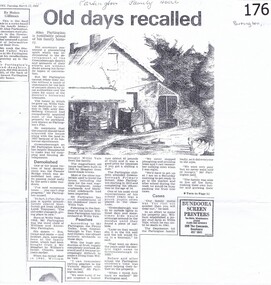
Article - Newspaper Clipping, Diamond Valley Leader, Old Days Recalled: by Helen Gillman, 13/03/1984
... ...the great depression...Originally the Meaghers (Maygars) lived there and later the Partingtons. partington willis vale greensborough orchards wood cutting the great depression A 2 page photocopy of an article in the Diamond Valley News dated March 13 1984. ...Details some of the Partington family's time at Willis Vale. Part 3 in a series of articles written by Helen Gillman from interviews with Alan Partington.Willis Vale was built in 1839 from locally sourced hand made bricks. Originally the Meaghers (Maygars) lived there and later the Partingtons.A 2 page photocopy of an article in the Diamond Valley News dated March 13 1984.partington, willis vale, greensborough, orchards, wood cutting, the great depression -
 Bendigo Historical Society Inc.
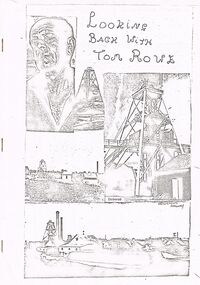
Document - PRINTED REMINISCENCE: LOOKING BACK WITH TOM ROWE
... ...The Great Depression...BENDIGO History autobiography Tom Rowe The Great Depression Mr T Rowe World War 2 Central Deborah Gold Mine. ...Printed reminiscence ''Looking Back with Tom Rowe'' with Appendices. 27 stapled pages and 28 - 42 loose sheets of Appendix. Loose sheets (7) of Select Bibliography and (poor quality) copies of photos including portraits of un-name male and un-named female; also picnic gathering of approx 20 hatted/suited men in rural setting. No author, no date of authorship.bendigo, history, autobiography tom rowe, the great depression, mr t rowe, world war 2, central deborah gold mine. mr charles robert searle rowe, new chum railway company, north old chum syndicate, list of mine managers, golden square school, big hills gold mine, henry gibs, new chum synline, school of mines, cr. g d garvin, central deborah mine, golden square fire station, the fife shire hotel, the rose of australia hotel, hicks spurs, red white and blue mine -
![Sustenance workers, Susso Drive [Yarra Boulevard], 1930s](/media/collectors/550653872162f11fb04854aa/items/58cf0689d0ce9809d870b7dd/item-media/58cf5a5cd0ce6633142774c9/item-fit-380x285.jpg?cb=6) Kew Historical Society Inc
Kew Historical Society IncPhotograph, Herald Sun, Sustenance workers, Susso Drive [Yarra Boulevard], 1930s
... ...the great depression (kew)...The Yarra Boulevard was a major depression era public works project. yarra boulevard susso drive road construction 1930s the great depression (kew) Attached green postit: "In Herald Sun. ...The Yarra Boulevard was a major depression era public works project.Sustenance workers, Susso Drive [Yarra Boulevard], 1930s. Attached green postit: "In Herald Sun. Richmond section not Kew. Check with Richmond Historical Society.yarra boulevard, susso drive, road construction 1930s, the great depression (kew) -
 Unions Ballarat
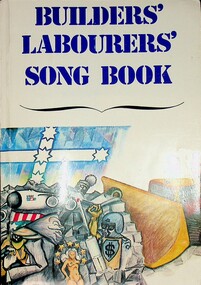
Builders' Labourers' Song Book, Australian Building Construction Employees' and Builders' Labourers' Federation, 1975
... ...The Great Depression...Yankee go home Union songs and campaigns. btlc Ballarat Trades and Labour Council Unions Ballarat BLF Builders Labourers Federation Unions Anthems/songs Australia -- republic Eureka Stockade The Great Depression Constitutional Crisis -- the Dismissal Book; paperback. ...Contents page: 1. Black resistance 2. Convict revolt 3. Eureka uprising 4. Rebellion in the bush--the small farmers 5. The working class develops 6. Women, we were there 7. Same enemy, same fight--people of the world units! 8. Yankee go homeUnion songs and campaigns.Book; paperback.btlc, ballarat trades and labour council, unions ballarat, blf, builders labourers federation, unions, anthems/songs, australia -- republic, eureka stockade, the great depression, constitutional crisis -- the dismissal -
Unions Ballarat
Ballarat Sustenance and Relief Workers' Union Constitution and Rules, n.d
... ...The great depression...Ballarat Sustenance and Relief Workers' Union BTLC Ballarat Trades and Labour Council Ballarat Trades Hall unemployment The great depression constitution rules unions Paper (1 item) Ballarat Sustenance and Relief Workers' Union Constitution and Rules ...A Trades Hall Council-sponsored organisation co-ordinating the self help activities of the Ballarat unemployed during the 1930s depression. (1935-1940) Significant to history and operations of Ballarat Sustenance and Relief Workers' Union.Paper (1 item)ballarat sustenance and relief workers' union, btlc, ballarat trades and labour council, ballarat trades hall, unemployment, the great depression, constitution, rules, unions -
Unions Ballarat
Minutes of general and special meetings - Ballarat Sustenance and Relief Workers' Union, 16 October 1935-13 September 1939
... ...the great depression...Ballarat Sustenance and Relief Workers' Union BTLC Ballarat Trades and Labour Council unions unemployment the great depression ballarat trades hall minutes 6 bound volumes Minutes of general and special meetings - Ballarat Sustenance and Relief Workers' Union ...A Trades Hall Council-sponsored organisation co-ordinating the self help activities of the Ballarat unemployed during the 1930s depression. (1935-1940)The minutes are significant to the history and operations of Ballarat Sustenance and Relief Workers' Union.6 bound volumesballarat sustenance and relief workers' union, btlc, ballarat trades and labour council, unions, unemployment, the great depression, ballarat trades hall, minutes -
Unions Ballarat
Correspondence concerning relief work - Ballarat Sustenance and Relief Workers' Union, 24 September 1935-20 February 1940
... ...The great depression...BTLC Ballarat Trades Hall Ballarat Trades and Labour Council Unemployment The great depression employment relief work Paper in folder. ...A Trades Hall Council-sponsored organisation co-ordinating the self help activities of the Ballarat unemployed during the 1930s depression. (1935-1940)The correspondence is significant to the history and operations of Ballarat Sustenance and Relief Workers' Union.Paper in folder.ballarat sustenance and relief workers' union., btlc, ballarat trades hall, ballarat trades and labour council, unemployment, the great depression, employment, relief work -
Unions Ballarat
Correspondence with the Central Unemployed Committee, Melbourne. Ballarat Sustenance and Relief Workers' Union, April-October 1939
... ...The Great Depression...The file forms part of the history of "unemployed unions" during The Great Depression. It also highlights attempts by previous Australian governments to impose "work for the dole" on to unemployed persons in exchange for unemployment benefits. unemployment dole Central Unemployed Committee Victorian Trades Hall Council BTLC Ballarat Trades Hall Ballarat Trades and Labour Council work for the dole Ballarat Sustenance and Relief Workers' Union The Great Depression Paper in folder. ...Ballarat Sustenance and Relief Workers' Union was a Trades Hall Council-sponsored organisation co-ordinating the self help activities of the Ballarat unemployed during the 1930s depression. (1935-1940) Central Unemployed Committee was established in Melbourne by Victorian Trades Hall Council in 1933. The Committee was known to actively lobby against work for the dole schemes.The file forms part of the history of "unemployed unions" during The Great Depression. It also highlights attempts by previous Australian governments to impose "work for the dole" on to unemployed persons in exchange for unemployment benefits. Paper in folder.unemployment, dole, central unemployed committee, victorian trades hall council, btlc, ballarat trades hall, ballarat trades and labour council, work for the dole, ballarat sustenance and relief workers' union, the great depression -
Unions Ballarat
Union ticket - Ballarat Sustenance and Relief Workers' Union, 1940
... ...The Great Depression...Ballarat Sustenance and Relief Workers' Union was a Trades Hall Council-sponsored organisation co-ordinating the self help activities of the Ballarat unemployed during the 1930s depression. (1935-1940) Union tickets were important as evidence of proving financial union membership. unions BTLC Ballarat Trades and Labour Council Ballarat Sustenance and Relief Workers' Union union ticket pence cards Ballarat Trades Hall unemployment The Great Depression Paper - union ticket. Union ticket - Ballarat Sustenance and Relief Workers' Union ...Ballarat Sustenance and Relief Workers' Union was a Trades Hall Council-sponsored organisation co-ordinating the self help activities of the Ballarat unemployed during the 1930s depression. (1935-1940)Union tickets were important as evidence of proving financial union membership.Paper - union ticket.unions, btlc, ballarat trades and labour council, ballarat sustenance and relief workers' union, union ticket, pence cards, ballarat trades hall, unemployment, the great depression -
Unions Ballarat
Minutes of Meetings - Unemployed Strike Committee, Ballarat, 5 May 1937-30 July 1937
... ...The Great Depression...Unemployed strike actions are also part of the history of The Great Depression and the beginning of a state-funded welfare system for unemployed persons. ...Several unemployed strike actions took place in the thirties to improve relief assistance to unemployed persons. Assistance could be in the form of food rations, money or nothing at all. State governments paid very small amounts of unemployment relief that were funded by state taxes. More information about unemployed strike actions and unemployed unions can be found at Solidarity Online: http://www.solidarity.net.au/highlights/organising-the-unemployed-dole-strikes-and-the-1930s-depression/ Ballarat Sustenance and Relief Workers' Union was a Trades Hall Council-sponsored organisation co-ordinating the self help activities of the Ballarat unemployed during the 1930s depression.Unemployed strikes in the 1930s showed the power of collective action and are a strong part of the history of Ballarat and other Trades Halls. Unemployed strike actions are also part of the history of The Great Depression and the beginning of a state-funded welfare system for unemployed persons.Paper, one bound volume.unemployed strike committee, minutes, btlc, ballarat trades and labour council, the great depression, strikes, susso, dole, unemployment, unemployment benefits, victorian trades hall council, vthc, rationing, rationing, unemployed workers movement, uwm, ballarat sustenance and relief workers' union, ballarat trades hall -
Unions Ballarat
Journal of Australasian mining history 2003, Davies, Mel, 2003
... ...the great depression...Relevant to Australian and New Zealand history, particularly around miners and mining. mining history archaeology btlc ballarat trades hall ballarat trades and labour council the great depression miners work welfare class maoris mining - copper mining - gold Front cover: Name of journal, date and volume number; publisher's name. ...Relates to mining work and history in Kalgoorlie, Northern Territory, South Australia, New Zealand, New South Wales and Queensland.Relevant to Australian and New Zealand history, particularly around miners and mining.Paperbook book. Front cover: Name of journal, date and volume number; publisher's name. A drawing of "stamping batteries", Port Phillip Gold Mining Company, Clunes from Illustrated Australian News. Cover includes the words: "Embracing all aspects of mining history, mining archaeology and heritage." Back cover: Blank.mining, history, archaeology, btlc, ballarat trades hall, ballarat trades and labour council, the great depression, miners, work, welfare, class, maoris, mining - copper, mining - gold -
 Wodonga & District Historical Society Inc
Decorative object - Bead and Snake bone necklace, Fred Walker, c1930
... ...The Great Depression...These beads demonstrate enterprising activities carried out by Australian people in order to survive during the Great Depression of the 1930s. snake jewellery The Great Depression Survival during the Depression A necklace made from black beads and treated snake bones. ...These beads were made by Fred Walker, then of Wodonga, during the Depression. He created them to make additional income when work was scarce. They were sold for 3 shillings per necklace. The snakes he caught were boiled to separate the flesh from the bones. After saturating the market in Wodonga, Fred and a friend took to the road. At one stage they travelled with live snakes which had been de-fanged and kept them alive with frogs until more necklaces were needed. He travelled much of the east coast of Australia until the economic conditions improved, when he settled in Melbourne. After the death of his wife in the mid 1970s, Fred took to the road again, resurrecting the making of snake jewellery as he travelled the countryside. These beads were purchased by Mrs. Lilian Black of Kergunyah, Victoria when Fred Walker visited her family farm in the 1930s.These beads demonstrate enterprising activities carried out by Australian people in order to survive during the Great Depression of the 1930s.A necklace made from black beads and treated snake bones. There are 5 coloured beads in the middle of the necklace.snake jewellery, the great depression, survival during the depression -
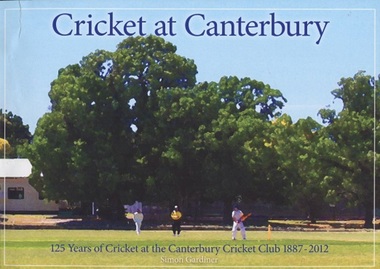 Surrey Hills Historical Society Collection
Book, Canterbury Cricket Club : 125 years of cricket at the Canterbury Cricket Club 1887-2012, 2017
... The Canterbury Cricket Club has survived world wars, the great depression, uncertain world politics and major social changes to the way we work and to our leisure time options. ...The Canterbury Cricket Club has survived world wars, the great depression, uncertain world politics and major social changes to the way we work and to our leisure time options. ...The Canterbury Cricket Club has survived world wars, the great depression, uncertain world politics and major social changes to the way we work and to our leisure time options. ...In 1887 Melbourne was a little more that 50 years old and the game of cricket barely established in the colony. The Canterbury Cricket Club has survived world wars, the great depression, uncertain world politics and major social changes to the way we work and to our leisure time options. This is the story of 125 years of Canterbury Cricket Club.In 1887 Melbourne was a little more that 50 years old and the game of cricket barely established in the colony. The Canterbury Cricket Club has survived world wars, the great depression, uncertain world politics and major social changes to the way we work and to our leisure time options. This is the story of 125 years of Canterbury Cricket Club.Front page : signed by the author : Sam Gardinercanterbury cricket club, cricket, (mr) simon gardiner -
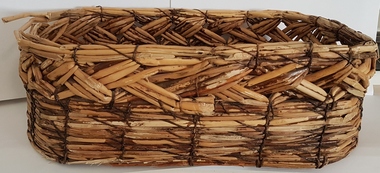 Linton and District Historical Society Inc
Basket, Reed Basket, Linton
... ... Great Depression 1930s...Rectangular woven basket hand-made at Linton during the Great Depression (1930s). Reeds used to make it came from the old Linton Reservoir on Mortchup Road....Baskets Handcrafts Great Depression 1930s Rectangular woven basket hand-made at Linton during the Great Depression (1930s). ...Rectangular woven basket hand-made at Linton during the Great Depression (1930s). Reeds used to make it came from the old Linton Reservoir on Mortchup Road.baskets, handcrafts, great depression 1930s -
Kew Historical Society Inc
Archive (Sub-series) - Subject File, Depression, 1930s, 1958
... great depression -- kew (vic.)...Archive file containing a anonymous, undated article (single page) on the Great Depression in Kew. It might be from Vaughan’s history (1960). ...Typically files will contain primary and secondary sources. great depression -- kew (vic.) kew -- history -- 1930s yarra boulevard Archive file containing a anonymous, undated article (single page) on the Great Depression in Kew. ...Various partiesReference, Research, InformationSecondary Values (KHS Imposed Order)Subject file containing a anonymous, undated article (single page) on the Great Depression in Kew. It might be from Vaughan’s history (1960). It covers Council support and the creation of the Yarra Boulevardgreat depression -- kew (vic.), kew -- history -- 1930s, yarra boulevardgreat depression -- kew (vic.), kew -- history -- 1930s, yarra boulevard -
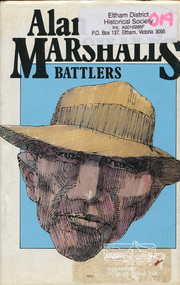 Eltham District Historical Society Inc
Book, Alan Marshall (1902-1984), Alan Marshall's battlers / compiled by Gwen Hardisty, 1983
... great depression...Stories of people battling to survive in Melbourne during the great Depression....Stories of people battling to survive in Melbourne during the great Depression. great depression alan marshall stories ISBN 0908090587 Hardback with dust jacket; 169 p. ; 22 cm. ...Stories of people battling to survive in Melbourne during the great Depression.Hardback with dust jacket; 169 p. ; 22 cm.ISBN 0908090587great depression, alan marshall, stories -
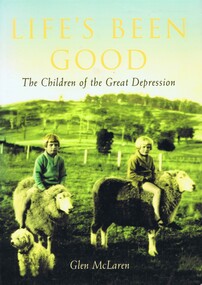 Greensborough Historical Society
Book, Glen McLaren, Life's been good; children of the depression, 1999
... THe people interviewed in this book tell their personal stories of life during the great depression....THe people interviewed in this book tell their personal stories of life during the great depression. Australia - depression 1929 australia - social conditions A collection of interviews with Australians 268p., illus. ...A collection of interviews with Australians268p., illus.non-fictionA collection of interviews with Australiansaustralia - depression 1929, australia - social conditions -
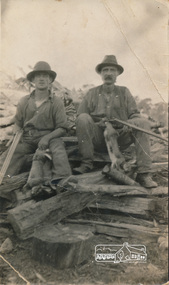 Eltham District Historical Society Inc
Photograph, Arthur Frederick Castledine (right) sitting on a wood pile towards the rear of their property, Araluen (southern end), Old Eltham Road, Lower Plenty, c.1930, 1930c
... Shows the men with rifles sitting on a wood pile out hunting for rabbits around the time of the Great Depression...Shows the men with rifles sitting on a wood pile out hunting for rabbits around the time of the Great Depression araluen, arthur frederick castledine, lower plenty, old eltham road, rabbits Digital image of original held in private collection of Joan Castledine, daughter of Sid and Polly (nee Arrowsmith) Castledine, granddaughter of Arthur Frederick Castledine. ...Shows the men with rifles sitting on a wood pile out hunting for rabbits around the time of the Great DepressionDigital image of original held in private collection of Joan Castledine, daughter of Sid and Polly (nee Arrowsmith) Castledine, granddaughter of Arthur Frederick Castledine.araluen, arthur frederick castledine, lower plenty, old eltham road, rabbits
