
Showing 8 items matching "the great petition"
-
 Women's Art Register
Book - Exhibition Catalogue, Caroline Phillips, The f Word: Contemporary feminist art in Australia, 2012-2014
... ...The Great Petition...It built a sustained three year dialogue across geographic and conceptual divides, capturing and strengthening the re-invigoration of feminist art discourses in Australia. feminism feminist art Melbourne The Dinner Party Australia Judy Chicago West Space Latrobe Visual Art Institute Bendigo Gippsland Art Gallery Sale Victoria Ararat Regional Art Gallery Ararat Technopia Tours Kim Donaldson Catherine Bell Penny Byrne Filomena Coppola Kate Just Jill Orr Clare Rae Elvis Richardson Kate Beynon Karen Buczynski-Lee Destiny Deacon Laurene Dietrich Eliza-Jane Gilchrist Janice Gobey Georgia MacGuire Robyn Massey Caroline Phillips Louise Saxton Inez de Vega Lyndal Walker Justine Makdessi The Great Petition Natalie Thomas Laura Castagnini Lyndal Jones Vicki Kinai Dot Ket Virginia Fraser Juliette Peers Louise Burchill Carolyn Barnes Melbourne Social Equity Institute Ebony Gulliver Kalinda Vary Kate Robertson Stephanie Alexander Kate MacNeill Victoria Duckett Hana Assafiri Victoria Bennett Anne Marsh Catherine Deveny Danni Zuvela Jon Dale Marcia Jane Catherine Evans Publication accompanying the project, The f Word: Contemporary feminist art in Australia. ...Publication accompanying the project, The f Word: Contemporary feminist art in Australia. Curated by Caroline Phillips, this project included multiple components: A Dinner Party: Setting the table; the Regional Feminist Art Forum, the Technopia Tours Feminist Art Bus, and two exhibitions.Publication accompanying the project, The f Word: Contemporary feminist art in Australia. Curated by Caroline Phillips, this project included multiple components: A Dinner Party: Setting the table; the Regional Feminist Art Forum, the Technopia Tours Feminist Art Bus, and two exhibitions.feminism, feminist art, melbourne, the dinner party, australia, judy chicago, west space, latrobe visual art institute, bendigo, gippsland art gallery, sale, victoria, ararat regional art gallery, ararat, technopia tours, kim donaldson, catherine bell, penny byrne, filomena coppola, kate just, jill orr, clare rae, elvis richardson, kate beynon, karen buczynski-lee, destiny deacon, laurene dietrich, eliza-jane gilchrist, janice gobey, georgia macguire, robyn massey, caroline phillips, louise saxton, inez de vega, lyndal walker, justine makdessi, the great petition, natalie thomas, laura castagnini, lyndal jones, vicki kinai, dot ket, virginia fraser, juliette peers, louise burchill, carolyn barnes, melbourne social equity institute, ebony gulliver, kalinda vary, kate robertson, stephanie alexander, kate macneill, victoria duckett, hana assafiri, victoria bennett, anne marsh, catherine deveny, danni zuvela, jon dale, marcia jane, catherine evans -
 Federation University Historical Collection
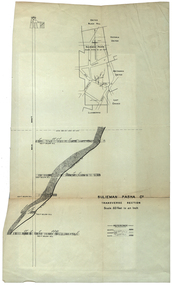
Plan, Sulieman Pasha Co Plan Transverse Section
... petition to the local council and government authorities. They stated the shaft contravened the mining statutes, which stating no mining could take place within 150 yards of a public building or church. A speech by a resident stated 'mining always comes with glorious pictures of the great...petition to the local council and government authorities. They stated the shaft contravened the mining statutes, which stating no mining could take place within 150 yards of a public building or church. A speech by a resident stated 'mining always comes with glorious pictures of the great ...The Sulieman Pasha is possibly named after the most important Sultan of the Ottoman Empire, Suleiman One, or Suleiman the Magnificent, when the Ottoman Empire was at its peak. Or potentially a number of Ottoman governors, statesmen and military commanders with the same name after, however the spelling is slightly different to the mine name. No Turkish connection was found relating to the formation of the company, and remains unconfirmed. The mine operated from two shafts; No. 1 near the corner of Humffray and Mair streets, and also near where the Welcome Nugget (2217 ounces) was found years earlier; and the controversial No. 2 shaft several blocks south bordering the northern side of the main highway through Ballarat. The company produced 62 666 ounces of gold, the twelfth highest quartz reef gold production for any mine on the Ballarat goldfield. Some crushing figure examples are January-June 1881: 3674 tonnes 1085 ounces; January-June 1885: 2949 tonnes 1281 ounces; July-December 1885: 4459 tonnes 1119 ounces; January-June 1887: 1869 tonnes 730 ounces; July-December 1892: 1450 tonnes 771 ounces; July-December 1896: 4365 tonnes 1372 ounces. Like many mines in the area, gold grades were low. John Watson was noted as mine manager in the 1880s, and John Williams 1890s. The company was re-organised twice increasing the number of shares from 4000 to 24 000, and increasing the capital available. The Sulieman Pasha Company was formed in 1878. David Fitzpatrick was given the honour of turning the first sod of both the No.1 and later No. 2 shafts. The first dividend was given to shareholders in July 1881. The company obtained a prospecting vote (government grant) to start, and was very proud to be the first Victorian gold mining company to pay the funds back to the government. The event was marked by a lavish banquet laid out for ministers and government officials by the company. Leases were purchased to the south in 1885 to the Llanberris Mine boundary, after poor results began accumulating from the small No. 1 shaft. To take advantage of this new land the company planned to sink a second shaft. Initially this was to take place on government land, but the uproar from nearby residents caused the company to purchase land along the Main Road (now Western Highway), and the old Yarrowee Hotel which had occupied the site since the alluvial digger days of the 1850's was demolished. The area had since those days become heavily occupied with a number of shops, houses, a post office, church and two schools in the immediate area. The thought of an underground mine next door drew considerable opposition. The company (before the days of public relations departments) wrote 'most people would have thought that progress as vital as mining would be supported by tradesmen whose business rely on the mining industry. It seems when it comes to mining they are bereft of their senses, and considering the low ebb of mining in Ballarat East, the action of our opponents are unaccountable. (Sarcastically) There are certain engineering difficulties in moving the quartz reefs to a new location, but if we could to appease our opponents we would'. The company also wanted to take over 4 acres of the St Paul's school oval for machinery, but accused the St Paul's Church of wanting extortionate amounts of money upfront, and on a yearly basis for the privilege. It stated the church could not be opposed to mining when several years earlier it had formed its own company to mine the land, only for shareholders to lose their money. In 1886, the company approached the Minister for Mines, and attended heated public meetings on the matter. The local residents, shop owners, and church submitted a 60 person petition to the local council and government authorities. They stated the shaft contravened the mining statutes, which stating no mining could take place within 150 yards of a public building or church. A speech by a resident stated 'mining always comes with glorious pictures of the great benefits which would accrue all parties concerned if their request is granted, but if property is destroyed or depreciated in value, no-one then comes forward and compensates them'. The No. 2 shaft was approved including taking over part of the school oval. In 1888, workers at the company's No. 2 shaft went on strike to try and bring their wages in line with other mines in the district (the No. 1 shaft was operated by tributers). William Madden (26) was killed from a fall of earth underground the same year, while a year later his father John Madden (70) was similarly killed in the Madame Berry Mine elsewhere in the district. In 1897 as the amount of gold being found fell away, it came to light part of the deal to purchase the Yarrowee Hotel site was a 5% royalty on gold found. Shareholders could not understand why they were paying a royalty to the former owners of the property. The mine closed in 1898 due to a lack of gold. In 1902 a boy (age unknown) called Charles Lee was killed from a fractured skull while working to dismantle the Sulieman Pasha plant. The fuss over the No. 2 shaft had a sequel. On the company winding up, the land was purchased by J.S. Trethowan who built a house next to the shaft. In 1907, the shaft caved-in creating a sinkhole immediately at the back of the house. A Mr Chamberlain heard a deep rumbling sound at 5am, and looked out the window to see his fowl house and thirteen chickens disappear down an expanding hole. He then went back to bed, and called the police later in the day. The shaft was 1050 feet deep, and the hole at the surface that developed was 20 feet by 17 feet across, and 20 feet depth. In 1930 it is reported a syndicate had been formed to clean out the old shaft, and re-open the mine. It is assumed this was the No. 1 shaft but no more was found. (https://www.mindat.org/loc-304239.html, accessed 07/08/2019) A transverse section plan of the Sulieman Pasha Mine.sulieman pasha company, plan, mining, united black hill mine, victoria united mine, victoria street, britannia united mine, last chance mine, llanberris mine, ottoman empire, john watson, john williams, david fitzpatrick -
 Mission to Seafarers Victoria
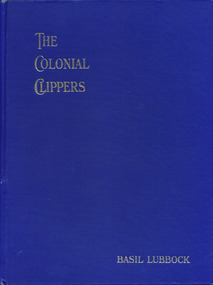
Book, Basil Lubbock, The Colonial Clippers, 1948
... The book gives details about merchant ships sailing into Hobson's Bay notable the Loch ships choses captais signed the petition. clippers basil lubbock loch vennachar loch gary loch ryan loch sloy ship hobsons bay mermerus From the Preface: "In this book I have attempted to give some account of the beautiful sailing ships which played so great a part in the development of the great British Dominions under the Southern Cross. ...From the Preface: "In this book I have attempted to give some account of the beautiful sailing ships which played so great a part in the development of the great British Dominions under the Southern Cross. It is written specially for the officers and seamen of our Mercantile Marine, and I have endeavoured to avoid such a criticism as the following:—“Heaps about other ships, but my old barkey was one of the fastest and best known of them all and he dismisses her with a line or two.” I have made rather a point of giving passage records, as they are an everlasting theme of interest when seamen get together and yarn about old ships. The memory is notoriously unreliable where sailing records are concerned, so I have been most careful to check these from logbooks and Captains’ reports. Even Lloyd’s I have found to be out by a day or two on occasions. A great deal of my material has been gathered bit by bit through the past 25 or 30 years. Alas! many of the old timers, who so kindly lent me abstract logs and wrote me interesting letters, have now passed away. The illustrations, I hope, will be appreciated, for these,viii whether they are old lithographs or more modern photographs, are more and more difficult to unearth, and a time will soon come when they will be unprocurable. Indeed, if there is any value in this book it is because it records and illustrates a period in our sea history, the memory of which is already fast fading into the misty realms of the past. To preserve this memory, before it becomes impossible, is one of the main objects, if not the main object, of my work."430 pp. on art paper. approx 60 illustrations, photos, sketches, all B&W. Extensive appendices according to the trades the ships engaged in. Long index, examples of log entries, mapsnon-fictionFrom the Preface: "In this book I have attempted to give some account of the beautiful sailing ships which played so great a part in the development of the great British Dominions under the Southern Cross. It is written specially for the officers and seamen of our Mercantile Marine, and I have endeavoured to avoid such a criticism as the following:—“Heaps about other ships, but my old barkey was one of the fastest and best known of them all and he dismisses her with a line or two.” I have made rather a point of giving passage records, as they are an everlasting theme of interest when seamen get together and yarn about old ships. The memory is notoriously unreliable where sailing records are concerned, so I have been most careful to check these from logbooks and Captains’ reports. Even Lloyd’s I have found to be out by a day or two on occasions. A great deal of my material has been gathered bit by bit through the past 25 or 30 years. Alas! many of the old timers, who so kindly lent me abstract logs and wrote me interesting letters, have now passed away. The illustrations, I hope, will be appreciated, for these,viii whether they are old lithographs or more modern photographs, are more and more difficult to unearth, and a time will soon come when they will be unprocurable. Indeed, if there is any value in this book it is because it records and illustrates a period in our sea history, the memory of which is already fast fading into the misty realms of the past. To preserve this memory, before it becomes impossible, is one of the main objects, if not the main object, of my work."clippers, basil lubbock, loch vennachar, loch gary, loch ryan, loch sloy ship, hobsons bay, mermerus -
 Eltham District Historical Society Inc
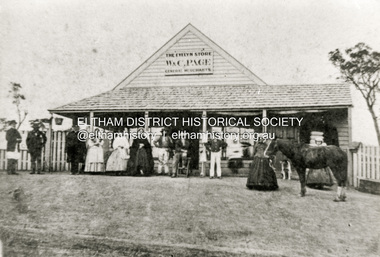
Photograph - Copy of photograph, The Evelyn Store, W. & C. Page, General Merchants, Little Eltham, located on northeast corner of Main Road and John Street, c.1865
... Page along with John Pearson, Richard Warren (owner of the Eltham Hotel), James Kiddle and Thomas Marland petitioned the Licensing Magistrates of the District of Heidelberg, seeking for better police protection for the district. They pointed out that Eltham had two hotels, a local population of about a thousand persons, a great number of them strangers employed on the public roads. ...Page along with John Pearson, Richard Warren (owner of the Eltham Hotel), James Kiddle and Thomas Marland petitioned the Licensing Magistrates of the District of Heidelberg, seeking for better police protection for the district. They pointed out that Eltham had two hotels, a local population of about a thousand persons, a great number of them strangers employed on the public roads. ...W. and C. Page’s Evelyn Store was in the centre of the Eltham township in the 1860s. It was situated on the eastern side of Maria Street (Main Road) on what was Lot 355 of Josiah Holloway’s Plan of Subdivision of Little Eltham The property is described as having a frontage of one hundred and fifty one feet six inches to Maria-street by a depth of one hundred and thirty two feet with John Street on the south side. That property is now known as 816 Main Road and is occupied by Goodstart Early Learning Eltham. William Austin Page and Charlotte Moyses were married in the last quarter of 1840 in Wisbech, Cambridgeshire, England. Records of their arrival in Australia have not been found. The first record of W.A and C. Page, General Merchants is an advertisement placed in The Argus newspaper in February 1854 for The White Flag Store in Wellington Street, Collingwood. William Austin Page is next recorded in the 1856 Electoral Roll for Evelyn as a storekeeper of Little Eltham. The nature of his qualification being a dwelling house in Little Eltham. There is no C. Page recorded so it is likely that this is William’s wife. It is not known when the store was built, possibly at the direction of W. and C. Page but most likely circa 1855-1856. The Page’s previous business in 1854 being The White Flag Store in Wellington Street, Collingwood. On 21 April 1857, W.A. Page along with John Pearson, Richard Warren (owner of the Eltham Hotel), James Kiddle and Thomas Marland petitioned the Licensing Magistrates of the District of Heidelberg, seeking for better police protection for the district. They pointed out that Eltham had two hotels, a local population of about a thousand persons, a great number of them strangers employed on the public roads. The Bourke District police inspector investigated and recommended that the application be approved; and he advised the Chief Commissioner of the availability of a cottage (not very good) and a two-stalled stable with a fenced paddock of four acres, for the sum of ten shillings a week. This was William Jarrold' s cottage, on the west side of Main Road which became Eltham's first police station - with Constable George Reid in charge. In 1858 the newly established Eltham Road District Board implemented a rate charge. For the year ending October 14, 1858, William A. Page of Little Eltham was listed as the owner and occupier of a shop in Little Eltham, assessed 10 shillings based on building rate of 6d per £, the store valued at £20. The same was assessed for 1859 through 1861. The business was advertised for sale with four years remaining on the then present lease in October 1860. Apparently, there was a lack of interest as they attempted to sell the business again in September 1861 with three years remaining on the lease. Again, to no avail. No record of W.A. Page or the store appears in the 1862 rates assessment however in 1863 the store was valued at £25, owned by T. Hunniford and occupied by W.A. Page. Presumably Thomas Hunniford, purchased the property in 1862 and it may have been unoccupied for a period of time or the owner/occupier entries could have been transposed incorrectly in the rates book. In April 1863, William Austin Page, storekeeper of Little Eltham advertised his intention to have Lot 345 (sic) of Josiah Holloway’s Plan of Subdivision brought under the provisions of the Real Property Act. The property is described as having a frontage of one hundred and fifty one feet six inches to Maria-street by a depth of one hundred and thirty two feet with John Street on the south side. The actual lot described is Lot 355 and this is most likely the location of Page’s Evelyn Store. This action suggests the Pages remained owners of the property and this move was to facilitate a future sale. By September 1867 the Pages had been appointed official agents for The Leader newspaper. In January 1868 the business was once again put up for sale, the owners having been in business 12 years and desirous to return to England. Once more it did not sell and was offered again for sale in March and October of that year. Presumably businesses must have been difficult to sell in those times. No further evidence has been located so far of the Pages having sold their business, but an advertisement was placed in December 1870 offering the store and dwelling house for sale, presently occupied by the Pages. The property was finally sold January 28, 1871, by auction for £150. Whether the Pages ever did return to England, at least for a visit also has not been established but death records show William Austin Page died 12 April 1884 and his wife Charlotte died 4 August 1896. Both are buried in St Kilda Cemetery. - Research by Peter Pidgeon, EDHS, June 2026Black and white copy of photographeltham, evelyn store, general merchants, general store, shops, w. & c. page, william austin page, charlotte page (nee moyses), little eltham -
 Bendigo Historical Society Inc.
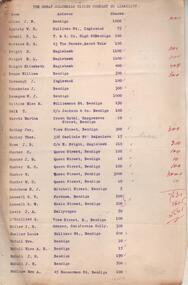
Administrative record - Great Columbian Mining Company Minute Book 1904-1911, 1906
... Great Columbian Mining Company No Liability' Minutes entered date from 30th March 1904 to 6th September 1911. Minutes signed by James Hedley. Documents inserted in minute book, additional to minute content: 1. List of unpresented cheques (no date on list) 2. Petition...Great Columbian Mining Company No Liability' Minutes entered date from 30th March 1904 to 6th September 1911. Minutes signed by James Hedley. Documents inserted in minute book, additional to minute content: 1. List of unpresented cheques (no date on list) 2. Petition ...Dark green hardcover register, buff binding on spine and corners, two hundred and seventy pages. 'Minute Book' written in gold print on spine of book. Written in blue pen on inside front page: ' The Great Columbian Mining Company No Liability' Minutes entered date from 30th March 1904 to 6th September 1911. Minutes signed by James Hedley. Documents inserted in minute book, additional to minute content: 1. List of unpresented cheques (no date on list) 2. Petition by John William Allen, Manager, Bank of Victoria, View Street, Bendigo to 'wind up' the Great Columbian Mining Co. Dated 18th September, 1911. 3. From Great Columbian Mining Co., Inglewood, Butler and Sons account 4. List of Great Columbian Mining Company N.L. shareholders 5. Mine Manager's Report half year ending 6th September 1911 6. Directors' Report, 6th September 1911 7. Two letters from Fred. Douglas Jones, Barrister and Solicitor, Albion Chambers, Bendigo regarding cheques 'being returned unpaid' by Bank 8. Judgement from County Court Bendigo, 19th September, 1911, against the Great Columbian Mining Company, defendant. Plaintiffs, George Victor Lansell; George Wooten Lansell and Richard Hartley Smith Abbott 9. McColl and Rankin, Legal Managers, Accountants, invoice to Great Columbian Mining Co., 31st December 1911. 10. Letter, J. Stagg, Inglewood to McColl and Rankin, re settling up of accounts for the Great Columbian Mining Co., Inglewood 11. Great Columbian liquidation, Ingleoowd, Feb 19th. 1912 to R.A. Rankin Esq., re sale catalogue articles. Enclosed Mr. Butters charge for hire of horse and dray ((not in book) Signed J. Cavanaugh 12. Invoice from McColl and Rankin to the Great Columbian Co., for cash advances, 31st December 1912 13. Great Columbian Mining Co., statement of having received 'one receiver and mountings in good condition' signed McCulloch Carrying co., L. Lee, 5/2/12 14. Account Richard Linton, Manufacturers Agent, Queen Bridge Square, Melbourne to Great Columbian Mining Co., Inglewoodbendigo, mccoll and rankin, margaret roberts, great columbian mining company, inglewood, -
 Bendigo Historical Society Inc.
Map - Sandhurst Goldfield 1873, 1873
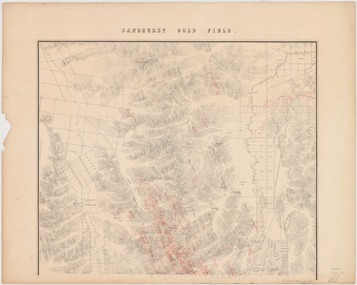
... great power, including the dubious dismissal of John Green, general inspector of Aborigines in 1861-75 with whom he had earlier collaborated. Smyth's compilation, The Aborigines of Victoria … (1878), arose from his efforts to gather information and artefacts of Victorian Aboriginal cultures at a time when their vestiges were fast disappearing. The work, still valuable though long since superseded, relied heavily upon others such as L. Fison, G. B. Halford, A. Howitt and J. Milligan. Press reports and a petition...great power, including the dubious dismissal of John Green, general inspector of Aborigines in 1861-75 with whom he had earlier collaborated. Smyth's compilation, The Aborigines of Victoria … (1878), arose from his efforts to gather information and artefacts of Victorian Aboriginal cultures at a time when their vestiges were fast disappearing. The work, still valuable though long since superseded, relied heavily upon others such as L. Fison, G. B. Halford, A. Howitt and J. Milligan. Press reports and a petition ...Robert Brough Smyth (1830-1889), civil servant and mining engineer, was born on 18 February 1830 near Wallsend, Northumberland, England, son of Edward Smith, mining engineer, and his wife Elizabeth, née Brough. On 14 November 1852 Smyth arrived in Melbourne and went to the gold diggings, where he worked as a carter on the construction of roads at Sawpit Gully. Back in Melbourne, on 7 November 1853 he became a draftsman under the surveyor-general, Andrew Clarke, and soon was acting chief draftsman. Smyth compiled numerous reports and wrote catalogues for exhibitions of minerals and fossils. In November 1869 he superintended the establishment of a museum of economic geology, mineralogy and mining and published in Melbourne The Gold Fields and Mineral Districts of Victoria … Covertly involved in the controversy that led to the disbanding of the Geological Survey in 1869, he became its director on its reinstatement in 1871; he increased its part in the search for and proving of economic mineral and coal deposits. In 1875 he became chief inspector of mines and published the geological reports on John Forrest's Western Australian exploration. On 19 June 1860 Smyth had become honorary secretary to the Board for the Protection of Aborigines and in 1863 became a voting member. Zealous and determined, he assumed the role of chairman, which belonged ex officio to the chief secretary, and wielded great power, including the dubious dismissal of John Green, general inspector of Aborigines in 1861-75 with whom he had earlier collaborated. Smyth's compilation, The Aborigines of Victoria … (1878), arose from his efforts to gather information and artefacts of Victorian Aboriginal cultures at a time when their vestiges were fast disappearing. The work, still valuable though long since superseded, relied heavily upon others such as L. Fison, G. B. Halford, A. Howitt and J. Milligan. Press reports and a petition from officers in the Mining Department accused Smyth of 'tyrannical and overbearing conduct', and in February 1876 a board of inquiry was constituted and heard evidence until April. McCoy defended 'one of the best heads of department he had ever known' but the board found the charges of 'excessive severity … in the main substantiated', and reported that Smyth had been irritable, lacking self-control and over-fastidious, but acknowledged his 'unremitting energy and zealous labours in the public service'. On 4 May Smyth resigned all public offices except his membership of the Aborigines' board. Source: Australian Dictionary of Biography. https://adb.anu.edu.au/biography/smyth-robert-brough-4621Original map printed on paper on canvas; copy of map with original. Title: Sandhurst gold field [cartographic material] / surveyed and compiled under the direction of R. Brough Smyth and Thos. Couchman, Angus Mackay ; additions made to the survey under the same direction by Regd. A.F. Murray, April 1873. "Lithd. by R. Shepherd" Topographic map of Sandhurst gold field, with relief shown by hachures. Shows roads, railways and public buildings. "Note - blocks held under leasing regulations are outlined and numbered in red" Map is also available on State Library Victoria: https://find.slv.vic.gov.au/discovery/fulldisplay?vid=61SLV_INST:SLV&search_scope=slv_local&tab=searchProfile&context=L&docid=alma994975393607636 sandhurst, goldfield, lease holdings, gullies, brough smyth, state library of victoria -
 Bendigo Historical Society Inc.
Poster - RED RIBBON COLLECTION: RED RIBBON REBELLION POSTER
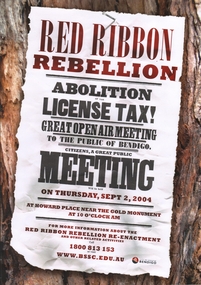
... petition to Governor LaTrobe to no avail. A protest gathering in Pall Mall marched to the Government camp on Camp Hill but this was a peaceful event again to no real avail. BENDIGO Gold mining Red Ribbon Rebellion Poster produced the Bendigo Historical Society, supported by Bendigo Senior Seconday College, advertising the re-enactment of the Red Ribbon Rebellion (also referred to as the Red Ribbon Agitation) 'Abolition of the license tax, great open air meeting to the public of Bendigo' Held on Thursday September 2, 2004. ...In 1853, Bendigo Miners protested against the 30 shilling miners licence the had to pay the government. They wore red ribbons to show their protest and shopkeepers hung red ribbons outside their premises in support. Thousands of miners signed a petition to Governor LaTrobe to no avail. A protest gathering in Pall Mall marched to the Government camp on Camp Hill but this was a peaceful event again to no real avail.Poster produced the Bendigo Historical Society, supported by Bendigo Senior Seconday College, advertising the re-enactment of the Red Ribbon Rebellion (also referred to as the Red Ribbon Agitation) 'Abolition of the license tax, great open air meeting to the public of Bendigo' Held on Thursday September 2, 2004. Poster printed in maroon and black.bendigo, gold mining, red ribbon rebellion -
 City of Melbourne Libraries
Photograph, Bull, Hugh Jones, 1897-1993, Vice-regal visit to zoo: Lord Huntingfield meets an emu
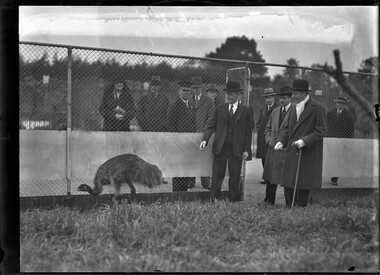
... Great Depression, but the settlers also had to contend with plummeting wheat and wool prices, crippling drought and rabbit infestation. The Scullin Government (Oct 1929-Jan 1932) had promised subsidies to the Western Australian farmers if they increased their wheat crops but were unable to pass the legislation in the Senate. The new Lyons Government (Jan 1932-April 1939) abandoned the legislation and the subsidies were never paid, bringing calls from Western Australia of secession from Australia. In October 1932, a deputation of soldier settlers from the Campion wheatbelt region in Western Australia, petitioned...Great Depression, but the settlers also had to contend with plummeting wheat and wool prices, crippling drought and rabbit infestation. The Scullin Government (Oct 1929-Jan 1932) had promised subsidies to the Western Australian farmers if they increased their wheat crops but were unable to pass the legislation in the Senate. The new Lyons Government (Jan 1932-April 1939) abandoned the legislation and the subsidies were never paid, bringing calls from Western Australia of secession from Australia. In October 1932, a deputation of soldier settlers from the Campion wheatbelt region in Western Australia, petitioned ...Photographer notations on slide: "Vice Regal visit to Zoo B42" Not published. Description: A group of men and one woman all dressed in hats and overcoats stand by a wire fence while watching an emu. Research by project volunteer, Fiona Collyer: On 25 June 1934, new Victorian Governor, His Excellency Lord Huntingfield and his wife Lady Huntingfield made an official visit to the Melbourne Zoological Gardens in order to grant his patronage to the Royal Zoological and Acclimatisation Society. During the visit, zoo director Mr. Andrew Wilkie introduced them to some of the zoo’s inhabitants, including an emu. After the First World War, many returned soldiers took up the Government’s offer of land in the Soldier Settlement Scheme. Most of the veterans had little or no farming experience and much of the land offered was of poor quality, with blocks often too small to be viable. Many of the settlers had ongoing physical and mental injuries from the war. The Western Australian government allocated land to 5000 former soldiers but by 1929, one quarter of the men had already abandoned their land, unable to make a living. Not only was the world economy struggling with the Great Depression, but the settlers also had to contend with plummeting wheat and wool prices, crippling drought and rabbit infestation. The Scullin Government (Oct 1929-Jan 1932) had promised subsidies to the Western Australian farmers if they increased their wheat crops but were unable to pass the legislation in the Senate. The new Lyons Government (Jan 1932-April 1939) abandoned the legislation and the subsidies were never paid, bringing calls from Western Australia of secession from Australia. In October 1932, a deputation of soldier settlers from the Campion wheatbelt region in Western Australia, petitioned Commonwealth Minister for Defence, Western Australian Senator Sir George Pearce, for assistance. A mob of 20,000 emus were migrating to the coast after breeding and were gathering along the eastern side of the Number 1 Rabbit Proof Fence, attracted to the ripening crops and the dams the farmers had built. They were heading towards Campion, 303 kilometres east of Perth, eating and trampling the wheat, destroying the fences and letting the rabbits in. Having witnessed firsthand the effectiveness of machine guns in killing people in war, the former soldiers thought the guns would be ideal for killing emus. Sir George, wanting to demonstrate that his government was sympathetic to the settlers and hoping to quell Western Australian succession talk, agreed. However, he stipulated that no expense would be incurred by the Commonwealth Government and only active military personnel could use the machine guns. The farmers had to pay for the ammunition, food and accommodation for the military for the length of the operation. The cost for the ammunition was £50 for 10,000 rounds. Sir George also felt the operation would provide excellent target practice for the soldiers! The operation was headed by Major Gwynydd Purves Wynn-Aubrey Meredith, 1887-1975, of the Seventh Heavy Battery of the Royal Australian Artillery, and assisted by Sergeant S. McMurray and Gunner J. O'Halloran. They were equipped with two American-designed Lewis light machine guns and 10,000 rounds. Each magazine held 47 rounds of ammunition and the gun was capable of firing 500 to 600 rounds per minute with effective firing range of 800 metres. A cinematographer from British Movietone News accompanied the soldiers in order to record what was expected to be not only an easy victory but also useful propaganda for both the military and the Lyons Government. Emu (Dromaius novaehollandiae, meaning New Holland Racer) is a species of long-necked flightless bird endemic to Australia. The Tasmanian and the dwarf King and Kangaroo Island subspecies were hunted to extinction after the European settlement of Australia. It is the second largest bird in the world after the ostrich, standing up to 1.9 metres tall and weighing up to 50 kilograms. The Emu has long, powerful legs with three forward facing toes and is the only bird with calf muscles. It is able to jump 2.1 metres into the air and run 50 kilometres per hour. It communicates by drumming and booming through an inflatable neck sac which can be heard up to two kilometres away. Along with its tough hide and a body more feathers than flesh, the emu can be a tricky target. Emus had been a protected native species until 1922, when the government changed their status to “vermin” in response to the emus breaking down fences and destroying crops. Major Meredith told the press that Colonel Oswald V. Hoad of the 1st Cavalry Division NSW had especially requested he send 100 emu skins to replenish the plumage on his Light Horsemen’s hat tops. On the first day of the Emu War, 2 November 1932, Major Meredith spotted a mob of emus out of range of the guns, so he asked the farmers to use their vehicles to drive the emus towards the fence and the guns. The panicked birds split into small groups, kicking up the dust and scattering every which way. Only six were killed, though some were wounded. After that, the emus became very wary of humans. On 4 November, Major Meredith staged a dawn ambush at a dam. As 1000 emus approached to drink, the soldiers opened fire, killing 12 emus. After reloading, the gun jammed and the emus dispersed in all directions, and were not sighted again that day. The West Australian newspaper reported on 4 November 1932 that, “The emus have proved that they are not so stupid as they are usually considered to be. Each mob has its leader, always an enormous black-plumed bird standing fully six-feet high, who keeps watch while his fellows busy themselves with the wheat. At the first suspicious sign, he gives the signal, and dozens of heads stretch up out of the crop. A few birds will take fright, starting a headlong stampede for the scrub, the leader always remaining until his followers have reached safety.” In a later attempt, they mounted a gun onto the bed of a truck in order to chase and mow down the birds. However the truck couldn’t drive fast enough over the rough terrain and it was too bumpy to fire the gun accurately. The birds easily outran the truck except for one hapless emu who faltered while being chased and fell under the truck, its body wedging in the steering gear, causing the driver to crash the truck, and bringing down half a chain of the rabbit proof fence. RSPCA inspector Mr. Arthur Austin arrived with a rifle and knife in order to finish the work of the Lewis guns and dispatch injured emus. He said that while his society was sympathetic to the stricken settlers, he was anxious that wounded birds should not be left to suffer. Major Meredith told the inspector, “What speed can you run? You have to be better than Peter Pan if you want to catch wounded emus that make for the scrub.” (Racehorse “Peter Pan” had won the 1932 Melbourne Cup a few weeks earlier.) The commentator of the British Movietime newsreel uses a jocular tone to optimistically proclaim, “The scouts [emus] of the advancing army have keen eyesight, and in order to get close to the main body, our lads have to do some real stalking, with the enemy watching events through their periscopes raised up over the heads of corn... Instead of the birds ruining the farmers, tables are turned, there will be no more damage down here for many a day to come once the enemy is eliminated.” Emus proved tougher adversaries than expected, barely breaking stride even when badly injured from machine gun bullets, and the suspicious emus soon learnt to stay out of range of the men and their guns. Meanwhile, in the eastern states concern was being expressed about the cruelty of machine-gunning the native birds. Senator James Guthrie UAP of Victoria suggested that there must be “more humane, if less spectacular methods” of coping with the pests. People wrote letters to the newspapers to express their dismay at the inhumane methods used. R.F. Bellchambers from Humbug Scrub, 25 November 1932, lamented that, “At the present rate of extinctions, it will shortly be necessary to go to the Museum to see the remains of our fauna.” The Murchison Times published a letter on 16 November 1932 from “Clay Pan Joe”: “War on Emus. Slaughter of innocent birds would be more appropriate... The birds may be a nuisance and it may be necessary to destroy them, but why cause so much suffering amongst these innocent birds.” E.S. Playford of Norton’s Summit wrote to The Advertiser, 22 November 1932, that “...habitation on the earth would be impossible without bird life. Therefore, it is unwise to say that any bird is useless. Is sentiment dying? Are we so keen on personal gain that our lovely and unique birds have to be ruthlessly slaughtered in thousands and their bodies left rotting in the sun?” In Sydney, picture palace patrons expressed “considerable concern” after viewing the Movietone News newsreel of emus fleeing from the barrage of machine-guns, and wounded emus in the fields in Campion. The press had a field day, dubbing it the “The Emu War” and joking that the “Chicago method” was being used against the feathered foe. The Daily News newspaper published a cartoon depicting the emus outrunning and outsmarting the soldiers. In Parliament NSW Senator James Dunn called Sir George the “Minister for the Emu War”. Labor member Mr. Rosevear, midst great laughter, asked if the minister would consider declaring an armistice and withdrawing his troops from the Western Front. Prime Minister Joe Lyons was asked if medals would be struck for those taking part in the war. Labor parliamentarian Mr. A.E. Green declared any medals should go to the emus who had “won every round so far”. With the embarrassing press coverage and poor results, Sir George ordered a stop to the project on 9 November, and Major Meredith and the soldiers departed for Perth. The WA Premier Sir James Mitchell and the Campion farmers demanded they return, citing the continued destruction of crops and fences by the emus. Major Meredith and his two gunners were allowed to return on 13 November and seemingly having learnt from their previous experiences, had slightly more success this time killing emus. The operation finally finished on 10 December with Major Meredith reporting “definite kills” of 986 emus for 9860 rounds of ammunition, coincidentally and conveniently exactly 10% of the number of rounds used. A further 2500 birds were said to have died from their injuries and although this is a disputed figure, even if accurate, the ratio of rounds expended to emu casualties was thought too high to justify continuing. The operation barely caused a dint in the marauding mob of 20,000 emus. “There’s only one way to kill an emu”, one of the party bitterly remarked: “Shoot him through the back of the head when his mouth is closed or through the front of his mouth when his mouth is open. That’s how hard it is.” Australian ornithologist Dominic L. Serventy noted that “The machine-gunners’ dreams of point blank fire into serried masses of Emus were soon dissipated. The Emu command had evidently ordered guerrilla tactics, and its unwieldy army soon split up into innumerable small units that made use of the military equipment uneconomic. A crestfallen field force therefore withdrew from the combat area after about a month.” Major Meredith expressed the greatest of respect for the enemy. He said, “If we had a military division with the bullet-carrying capacity of these birds, it would face any army in the world. They could face machine guns with the invulnerability of tanks. They are like Zulus, whom even dum dum bullets would not stop." The Major’s official report stated that there were no human casualties in “The Emu War.” Emus are considered the victors of “The Great Emu War.” Western Australian farmers requested military assistance in 1934, 1943 and 1948, including using bombs, but the government refused. The bounty system instigated in 1923 continued, with farmers using rifles against their fleet-footed foe, with 57,034 bounties for dead emus claimed in six months in 1934 in Western Australia alone. 284,704 emus were killed in Western Australia between 1945 and 1960. The other most effective defence against the emus was the construction of a robust, vermin proof fence spanning over a long distance. Emus were formally protected in 1999 by the Environment Protection and Biodiversity Conservation Act. It’s estimated there are between 625,000 to 725,000 wild emus in Australia in 2024. An emu and a kangaroo feature on Australia’s coat of arms, holding up a shield illustrated with symbols of the six states. The animals symbolise the nation moving forward as neither animal can walk backwards. Campion is now a ghost town. A book about the operation, “Letters from the Emu War” by J.A. Bryden was published in 2023 by Playtime Books. In 2024, an Australian film called “The Emu War” was released, starring Damian Callinan and Luke McGregor. Andrew Arthur Wellesley Wilkie, 1853-1948, was Director of the Melbourne Zoo from 1923 to 1936 and was associated with the zoo for 70 years. He first worked as a horticultural assistant to Government botanist Baron Ferdinand von Mueller at the Botanical Gardens at the age of 13, along with his older brother David. One of Andrew’s jobs was to capture moths for the National Herbarium. In 1857, a group of prominent Melburnians assembled at St. Patrick’s Hall to form the Zoological Society of Victoria, with the aim of introducing animals and plants from overseas. It was conceived, “For the purposes of science and for that of affording the public the advantages of studying the habits of the animal creation in properly arranged zoological gardens.” The Victorian Government granted 32 acres (13 hectares) of land to the Zoological Society at the southern end of Richmond Paddock on the opposite bank to the Botanical Gardens. (This is where AAMI Stadium and Collingwood Football Club now stand.) In 1861, the Zoological Society of Victoria was renamed The Acclimatisation Society of Victoria. Unfortunately the Yarra River frontage was damp, swampy and subject to flooding, so the animals were briefly housed at the Botanical Gardens until in 1862, the City of Melbourne donated 55 acres (22 hectares) of land at Royal Park for the fledgling zoo. Baron von Mueller secured employment at Royal Park for Andrew and David and they helped to lay out the gardens, plant trees and take care of a collection of deer, pheasants, hares and partridges. Initially the zoo was used for the acclimatisation of animals recovering from the long voyage to Australia and for breeding them for sport. In 1872, the zoo bought two lions, a leopard and a cheetah that had been seized from circus showmen Keith and Phillips when they were unable to pay the bill of butcher Mr T K Bennet of Bourke Street. The first zoo director, Mr. Albert Le Souef, negotiated with captains of ships to buy animals at overseas ports they visited and soon a multitude of exotic species arrived, including a ten-year-old Indian elephant in 1878. In 1923, after being head keeper for some years, Andrew was appointed director of the zoo. By 1933, the zoo had 110 different species of animals, 200 species of birds and 72 species of reptiles under Andrew’s care. He had personally planted all but six trees and laid out the garden beds. As director he lobbied authorities for funds to build more humane enclosures for the animals. In June 1928, Table Talk magazine wrote of Andrew Wilkie: “Up at the Zoo there is a humble gentleman who is a lion among the lions, who knows the proper specific to employ when the boa constrictor has chilblains, and who is a friend and confidant of Queenie the elephant. His fount of zoological lore has never been plumbed. It is bottomless, like his good fellowship and geniality. Every day he may be seen somewhere in the grounds of that growing sanctuary for the strange and arresting fauna and creeping things of the world, and I assure you as one who is privy to his passion that that area and its inhabitants are rarely out of his thoughts.” Andrew retired from the zoo in 1936 at the age of 83 and in 1948 died at his home in Brunswick aged 94. He and his wife Josephine had six children. The Victorian Acclimatisation Society was founded in 1861 by Edward Wilson, 1813-1878, then owner and editor of The Argus newspaper. He said that Australian indigenous animals were practically useless, providing only “a little sport and an occasional meal”. The Society believed that Australia’s plants and animals were vastly inferior to those in Europe. They wanted to introduce and acclimatise to Victoria “all innoxious animals, birds, fishes, insects and vegetables, whether useful or ornamental” for sport and for the table, and to spread indigenous animals and plants from the colony around the world. Their motto was “if it lives, we want it”. The Society was primarily responsible for introducing sparrows, starlings, sambar and hog deer, ostriches, brown trout, blackberries, and carp to the Murray River. They released the European songbirds, thrush and blackbird to quell the homesickness of British settlers. The Society also sent Australian animals like platypus, echidnas, kangaroos and koalas to Europe for scientific and novelty purposes. Thomas Austin, a wealthy sheep farmer of Barwon Park, Winchelsea (property now owned by the National Trust) was a member and in 1859 he introduced hares, blackbirds, thrushes and partridges onto his property. He is probably best known for introducing 24 breeding rabbits onto his estate as game for shooting parties. Thomas quipped, “The introduction of a few rabbits could do little harm and might provide a touch of home, in addition to a spot of hunting." In 2022, genomic data confirmed that Australia’s feral rabbit population is entirely descended from these rabbits. Biological control has brought the rabbit population down from an estimated high of 10 billion rabbits in the 1920s to approximately 200 million today, inhabiting 70% of Australian landmass (5.3 million square kilometres). In 1872, the Acclimatisation Society was renamed The Zoological and Acclimatisation Society of Victoria and they focused on importing exotic animals for display purposes to the zoo. In 1937, the Royal Acclimatisation Society of Victoria was recreated as the Zoological Board of Victoria with a focus on research of native animals threatened with extinction. In an editorial for The Argus newspaper, 16 March 1856, Edward Wilson lamented: "...this country has been shamelessly stolen from the blacks. Had they been like the New Zealanders or the North American Indians, we should have bought their land, and supplied them with the means of living when we took it... In less than twenty years we have nearly swept them off the face of the earth. We have shot them down like dogs. In the guise of friendship we have issued corrosion sublimate in their damper, and consigned whole tribes to the agonies of an excruciating death. We have made them drunkards, and infected them with disease which has rotted the bones of their adults, and made such few children as are born amongst them a sorrow and a torture from the very instant of their birth. We have made them outcasts on their own land, and are rapidly consigning them to entire annihilation. There are but a few of them left, comparatively. This is what we would do for that few. We would feed and clothe every one of them.” [Note: this last sentence is italicized in the original newspaper article text]. Lord Huntingfield, (William Charles Arcedeckne Vanneck) 1883-1969, Governor of Victoria 1934-1939, was a British Conservative Party politician and the first ever Australian-born Governor of an Australian state (although he was always considered British). He was patron of the Royal Zoological and Acclimatisation Society of Victoria and was acting Governor-General for six months during the absence of Lord Gowie in 1938. Lady Huntingfield (née Margaret Eleanor Crosby) 1884-1943, his American-born wife showed great interest in social welfare and the advancement of women and children. She was president of the City Newsboys Society and Patroness of the Girls Friendly Society. In 1937, rose breeder Alister Clark named a yellow hybrid tea rose for her. In 1940, the City of Melbourne opened the Lady Huntingfield Free Kindergarten in North Melbourne, now the Lady Huntingfield Early Learning and Family Services Centre. Lady Huntingfield died in London in 1943 after her house was bombed during a German airstrike. The Lady Huntingfield Memorial Scholarship was established after the City of Melbourne raised £1000 in a public appeal conducted in her memory for students undertaking a Social Work degree at the University of Melbourne. It is awarded annually to this day. The Queen Victoria Hospital named a bed in her honour. References: VICE-ROYALTY GREETS THE KING OF BEASTS AT THE ZOO. (1934, June 26). The Age (Melbourne, Vic. : 1854 - 1954), p. 11. Retrieved August 23, 2024, from http://nla.gov.au/nla.news-article204818472 Prominent Personalities ANDREW WILKIE (1928, June 7). Table Talk (Melbourne, Vic. : 1885 - 1939), p. 15. Retrieved August 29, 2024, from http://nla.gov.au/nla.news-article146562949 'Edward Wilson (journalist)', Wikipedia, https://en.wikipedia.org/wiki/Edward_Wilson_(journalist) 'Thomas Austin (pastoralist)', Wikipedia, https://en.wikipedia.org/wiki/Thomas_Austin_(pastoralist) 'The Acclimatisation Society was driven by misguided ideals about 'fixing nature' in Australia', ABC News, https://www.abc.net.au/news/2022-11-04/acclimatisation-society-introduced-species-history-listen/101588262?utm_campaign=abc_news_web&utm_content=link&utm_medium=content_shared&utm_source=abc_news_web THE ABORIGINES. (1856, March 16). The Argus (Melbourne, Vic. : 1848 - 1957), p. 5. Retrieved September 28, 2024, from http://nla.gov.au/nla.news-article4833244 WAR ON EMUS. (1932, November 4). The West Australian (Perth, WA : 1879 - 1954), p. 12. Retrieved September 29, 2024, from http://nla.gov.au/nla.news-article32588972 'The Great Emu War: how it started and who won', ABC Australia, https://www.youtube.com/watch?v=Y1wA0PKeJqc Advertising (1932, November 25). The West Australian (Perth, WA : 1879 - 1954), p. 2. Retrieved October 26, 2024, from http://nla.gov.au/nla.news-article32584578 Emu Chasers Must Outstrip Peter Pan (1932, November 9). The Labor Daily (Sydney, NSW : 1924 - 1938), p. 5. Retrieved October 10, 2024, from http://nla.gov.au/nla.news-article237042749 WAR ON EMUS (1932, November 22). The Advertiser (Adelaide, SA : 1931 - 1954), p. 18. Retrieved October 15, 2024, from http://nla.gov.au/nla.news-article73997254 WAR ON EMUS. (1932, October 28). The Labor Daily (Sydney, NSW : 1924 - 1938), p. 6. Retrieved October 24, 2024, from http://nla.gov.au/nla.news-article237046601 EMU WAR (1932, December 3). Mirror (Perth, WA : 1921 - 1956), p. 7. Retrieved October 24, 2024, from http://nla.gov.au/nla.news-article75626301 Machine Gun Offensive Against Emus. (1932, November 10). Western Mail (Perth, WA : 1885 - 1954), p. 3 (PICTORIAL SECTION). Retrieved October 24, 2024, from http://nla.gov.au/nla.news-article37766670 A THOUSAND BIRDS IN LUCK. (1932, November 10). Western Mail (Perth, WA : 1885 - 1954), p. 28. Retrieved October 11, 2024, from http://nla.gov.au/nla.news-article37766849 New Strategy In A War On The Emu (1953, July 5). The Sunday Herald (Sydney, NSW : 1949 - 1953), p. 13. Retrieved October 11, 2024, from http://nla.gov.au/nla.news-article18516559 This is a nice emu-that was! (1932, November 5). The Daily News (Perth, WA : 1882 - 1955), p. 9 (HOME EDITION). Retrieved September 30, 2024, from http://nla.gov.au/nla.news-article82878309 LOCAL AND GENERAL (1932, November 16). The Murchison Times (Cue, WA : 1924 - 1937), p. 2. Retrieved October 14, 2024, from http://nla.gov.au/nla.news-article257500260 Taking Him for a Ride! (1932, October 13). The Daily News (Perth, WA : 1882 - 1955), p. 6 (HOME EDITION). Retrieved September 30, 2024, from http://nla.gov.au/nla.news-article83717338 'The Emu War', History Nuggets, https://historynuggets.squarespace.com/nuggets/2018/4/21/the-emu-war New Strategy In A War On The Emu (1953, July 5). The Sunday Herald (Sydney, NSW : 1949 - 1953), p. 13. Retrieved October 23, 2024, from http://nla.gov.au/nla.news-article18516559 'This is the story of how Australia went to war with emus and lost', First Dog on the Moon, https://www.theguardian.com/commentisfree/2018/jul/26/this-is-the-story-of-how-australia-went-to-war-with-emus-and-lost Photographer notations on slide: "Vice Regal visit to Zoo B42"emu wars, governors, melbourne zoo, city of melbourne, 1930-1939, hunting, lord huntingfield, lady huntingfield, royal park, animals, wildlife
