
Showing 4 items matching "the greek-english lexicon"
-
 Flagstaff Hill Maritime Museum and Village
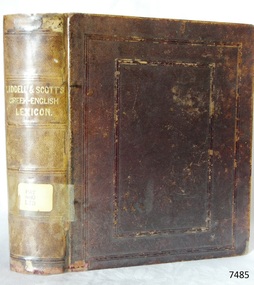
Book, The Greek-English Lexicon
... The Greek-English Lexicon......The Greek-English Lexicon...The Greek-English Lexicon Author: H G Liddell Publisher: Oxford University Press Date: 1852...Warrnambool Shipwrecked-coast Flagstaff-Hill Flagstaff-Hill-Maritime-Museum Maritime-Museum Shipwreck-coast Flagstaff-Hill-Maritime-Village Shipwrecked-artefact Book Warrnambool Mechanics’ Institute Pattison Collection Warrnambool Library Ralph Eric Pattison Warrnambool City Librarian Mechanics’ Institute Library Victorian Library Board Warrnambool books and records Warrnambool Children’s Library The Greek-English Lexicon H G Liddell Label on spine cover with typed text PAT 480 LID Pastedown end page has sticker from Warrnambool Mechanics Institute and Free Library covered by a sticker from Corangamite Regional Library Service The Greek-English Lexicon Author: H G Liddell Publisher: Oxford University Press Date: 1852 The Greek-English Lexicon Book ...This item is from the ‘Pattison Collection’, a collection of books and records that was originally owned by the Warrnambool Mechanics’ Institute, which was founded in Warrnambool in 1853. By 1886 the Warrnambool Mechanics’ Institute (WMI) had grown to have a Library, Museum and Fine Arts Gallery, with a collection of “… choice productions of art, and valuable specimens in almost every branch and many wonderful national curiosities are now to be seen there, including historic relics of the town and district.” It later included a School of Design. Although it was very well patronised, the lack of financial support led the WMI in 1911 to ask the City Council to take it over. In 1935 Ralph Pattison was appointed as City Librarian to establish and organise the Warrnambool Library as it was then called. When the WMI building was pulled down in 1963 a new civic building was erected on the site and the new Warrnambool Library, on behalf of the City Council, took over all the holdings of the WMI. At this time some of the items were separated and identified as the ‘Pattison Collection’, named after Ralph Pattison. Eventually the components of the WMI were distributed from the Warrnambool Library to various places, including the Art Gallery, Historical Society and Flagstaff Hill. Later some were even distributed to other regional branches of Corangamite Regional Library and passed to and fro. It is difficult now to trace just where all of the items have ended up. The books at Flagstaff Hill Maritime Village generally display stamps and markings from Pattison as well as a variety of other institutions including the Mechanics’ Institute itself. RALPH ERIC PATTISON Ralph Eric Pattison was born in Rockhampton, Queensland, in 1891. He married Maude Swan from Warrnambool in 1920 and they set up home in Warrnambool. In 1935 Pattison accepted a position as City Librarian for the Warrnambool City Council. His huge challenge was to make a functional library within two rooms of the Mechanics’ Institute. He tirelessly cleaned, cleared and sorted a disarrayed collection of old books, jars of preserved specimens and other items reserved for exhibition in the city’s museum. He developed and updated the library with a wide variety of books for all tastes, including reference books for students; a difficult task to fulfil during the years following the Depression. He converted all of the lower area of the building into a library, reference room and reading room for members and the public. The books were sorted and stored using a cataloguing and card index system that he had developed himself. He also prepared the upper floor of the building and established the Art Gallery and later the Museum, a place to exhibit the many old relics that had been stored for years for this purpose. One of the treasures he found was a beautiful ancient clock, which he repaired, restored and enjoyed using in his office during the years of his service there. Ralph Pattison was described as “a meticulous gentleman whose punctuality, floorless courtesy and distinctive neat dress were hallmarks of his character, and ‘his’ clock controlled his daily routine, and his opening and closing of the library’s large heavy doors to the minute.” Pattison took leave during 1942 to 1942 to serve in the Royal Australian Navy, Volunteer Reserve as Lieutenant. A few years later he converted one of the Museum’s rooms into a Children’s Library, stocking it with suitable books for the younger generation. This was an instant success. In the 1950’s he had the honour of being appointed to the Victorian Library Board and received more inspiration from the monthly conferences in Melbourne. He was sadly retired in 1959 after over 23 years of service, due to the fact that he had gone over the working age of council officers. However he continued to take a very keen interest in the continual development of the Library until his death in 1969. The Pattison Collection, along with other items at Flagstaff Hill Maritime Village, was originally part of the Warrnambool Mechanics' Institute’s collection. The Warrnambool Mechanics’ Institute Collection is primarily significant in its totality, rather than for the individual objects it contains. Its contents are highly representative of the development of Mechanics' Institute libraries across Australia, particularly Victoria. A diversity of publications and themes has been amassed, and these provide clues to our understanding of the nature of and changes in the reading habits of Victorians from the 1850s to the middle of the 20th century. The collection also highlights the Warrnambool community’s commitment to the Mechanics’ Institute, reading, literacy and learning in the regions, and proves that access to knowledge was not impeded by distance. These items help to provide a more complete picture of our community’s ideals and aspirations. The Warrnambool Mechanics Institute book collection has historical and social significance for its strong association with the Mechanics Institute movement and the important role it played in the intellectual, cultural and social development of people throughout the latter part of the nineteenth century and the early twentieth century. The collection of books is a rare example of an early lending library and its significance is enhanced by the survival of an original collection of many volumes. The Warrnambool Mechanics' Institute’s publication collection is of both local and state significance. The Greek-English Lexicon Author: H G Liddell Publisher: Oxford University Press Date: 1852Label on spine cover with typed text PAT 480 LID Pastedown end page has sticker from Warrnambool Mechanics Institute and Free Library covered by a sticker from Corangamite Regional Library Servicewarrnambool, shipwrecked-coast, flagstaff-hill, flagstaff-hill-maritime-museum, maritime-museum, shipwreck-coast, flagstaff-hill-maritime-village, shipwrecked-artefact, book, warrnambool mechanics’ institute, pattison collection, warrnambool library, ralph eric pattison, warrnambool city librarian, mechanics’ institute library, victorian library board, warrnambool books and records, warrnambool children’s library, the greek-english lexicon, h g liddell -
 Flagstaff Hill Maritime Museum and Village
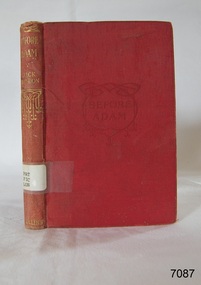
Book - A Fictional Story, Jack London, Before Adam, 1910s–1920s
... William Collins had been a millworker before establishing the printing and publishing business, which went on to produce pamphlets, sermons, hymn books, prayer books and a wide range of office products, and by 1824 had produced the firm's first dictionary, the Greek and English Lexicon. By 1841 the company was established as a printer of Bibles, and in 1846 William Collins retired, with his son Sir William Collins taking over the business. ...William Collins had been a millworker before establishing the printing and publishing business, which went on to produce pamphlets, sermons, hymn books, prayer books and a wide range of office products, and by 1824 had produced the firm's first dictionary, the Greek and English Lexicon. By 1841 the company was established as a printer of Bibles, and in 1846 William Collins retired, with his son Sir William Collins taking over the business. ...Before Adam (1906–07) is one of Jack London's more unusual novels. It's narrated by a modern man who is a "freak of heredity" through recurring, vivid dreams, he relives the memories of a prehistoric ancestor he calls "Big-Tooth." The story was first serialised in Everybody's Magazine before being published as a book, and tells of a man who dreams he lives the life of an early hominid. Most of the narrative unfolds through the eyes of Big-Tooth, one of the more primitive "Cave People," set against the more advanced "Fire People" and the animal-like "Tree People." Supporting characters include the hominid's father, a love interest, and Red-Eye, a savage "atavism" who terrorises the Cave People, with a sabre-toothed cat also playing a role.Hard cover book. Before Adam Author: Jack London Publisher: Collins Clear-Type Press Date: 1910s–1920s Further Information: A plain volume bound in red cloth, with a stuck-on library classification label ("PAT FIC LON") on the spine and no visible date, edition statement, or printer's imprint on the pages shown the copyright/date page. Gilt decoration and lettering to spine, no illustrated boards, and no dust jacket. fictionBefore Adam (1906–07) is one of Jack London's more unusual novels. It's narrated by a modern man who is a "freak of heredity" through recurring, vivid dreams, he relives the memories of a prehistoric ancestor he calls "Big-Tooth." The story was first serialised in Everybody's Magazine before being published as a book, and tells of a man who dreams he lives the life of an early hominid. Most of the narrative unfolds through the eyes of Big-Tooth, one of the more primitive "Cave People," set against the more advanced "Fire People" and the animal-like "Tree People." Supporting characters include the hominid's father, a love interest, and Red-Eye, a savage "atavism" who terrorises the Cave People, with a sabre-toothed cat also playing a role.shipwrecked-coast, flagstaff-hill, flagstaff-hill-maritime-museum, warrnambool, maritime-museum, shipwreck-coast, flagstaff-hill-maritime-village, shipwrecked-artefact, book, pattison collection, warrnambool library, warrnambool mechanics’ institute, ralph eric pattison, corangamite regional library service, warrnambool city librarian, mechanics’ institute library, victorian library board, warrnambool books and records, warrnambool children’s library, before adam, jack london -
 Flagstaff Hill Maritime Museum and Village
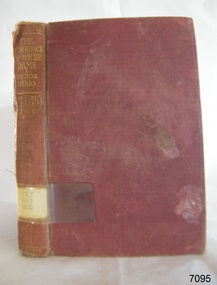
Book - A Fictional Story, Collins Clear Type Press et al, The Hunchback of Notre Dame, 1910-1925
... William Collins had been a millworker before establishing the printing and publishing business, which went on to produce pamphlets, sermons, hymn books, prayer books and a wide range of office products, and by 1824 had produced the firm's first dictionary, the Greek and English Lexicon. By 1841 the company was established as a printer of Bibles, and in 1846 William Collins retired, with his son Sir William Collins taking over the business. ...William Collins had been a millworker before establishing the printing and publishing business, which went on to produce pamphlets, sermons, hymn books, prayer books and a wide range of office products, and by 1824 had produced the firm's first dictionary, the Greek and English Lexicon. By 1841 the company was established as a printer of Bibles, and in 1846 William Collins retired, with his son Sir William Collins taking over the business. ...The Hunchback of Notre-Dame is Victor Hugo's 1831 historical novel set in fifteenth-century Paris. It follows Quasimodo, the deformed bell-ringer of Notre-Dame Cathedral; Esmeralda, a beautiful Romani street dancer; Claude Frollo, the tormented archdeacon obsessed with her; and Captain Phoebus, the soldier she loves. The novel is as much a portrait of the cathedral itself and medieval Paris as it is a story of its characters. Hugo used the book partly as a plea for the preservation of Gothic architecture, which was being neglected and demolished in his own era. The novel's success is credited with sparking renewed public interest in Notre-Dame and Gothic buildings generally, which contributed to the eventual restoration campaign led by Eugène Viollet-le-Duc in the 1840s.Hard cover book. The Hunchback of Notre Dame Author: Victor Hugo Illustrator: Arthur A Dixon Publisher: Collins Clear-Type Press Date: 1910-1925 Further Information: Red Cloth plain hardcover with lettering and patterning to spine in gilt. The spine has a Library label with an inscription.fictionThe Hunchback of Notre-Dame is Victor Hugo's 1831 historical novel set in fifteenth-century Paris. It follows Quasimodo, the deformed bell-ringer of Notre-Dame Cathedral; Esmeralda, a beautiful Romani street dancer; Claude Frollo, the tormented archdeacon obsessed with her; and Captain Phoebus, the soldier she loves. The novel is as much a portrait of the cathedral itself and medieval Paris as it is a story of its characters. Hugo used the book partly as a plea for the preservation of Gothic architecture, which was being neglected and demolished in his own era. The novel's success is credited with sparking renewed public interest in Notre-Dame and Gothic buildings generally, which contributed to the eventual restoration campaign led by Eugène Viollet-le-Duc in the 1840s.warrnambool, shipwrecked-coast, flagstaff-hill, flagstaff-hill-maritime-museum, maritime-museum, shipwreck-coast, flagstaff-hill-maritime-village, shipwrecked-artefact, book, the hunchback of notre dame, victor hugo -
 Flagstaff Hill Maritime Museum and Village
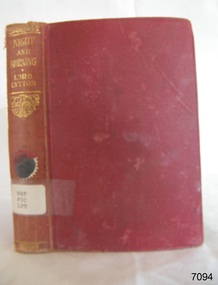
Book - A Fictional Story, Victor Prout (Illustrator) et al, Night And Morning, 1905 or 1913
... William Collins had been a millworker before establishing the printing and publishing business, which went on to produce pamphlets, sermons, hymn books, prayer books and a wide range of office products, and by 1824 had produced the firm's first dictionary, the Greek and English Lexicon. By 1841 the company was established as a printer of Bibles, and in 1846 William Collins retired, with his son Sir William Collins taking over the business. ...William Collins had been a millworker before establishing the printing and publishing business, which went on to produce pamphlets, sermons, hymn books, prayer books and a wide range of office products, and by 1824 had produced the firm's first dictionary, the Greek and English Lexicon. By 1841 the company was established as a printer of Bibles, and in 1846 William Collins retired, with his son Sir William Collins taking over the business. ...Night and Morning is a novel by Edward Bulwer-Lytton (later Lord Lytton), originally published in three volumes in 1841, although the preface reproduced in most later editions, including the subject volume, is dated 1845 and refers to a revised edition. The story centres on two orphaned siblings, Philip and Sidney, who are separated by misfortune and a scheming relative after their father's death, and who endure hardship and social injustice as they fight to reclaim their family's name and honour. The novel explores social justice, moral dilemmas and class distinctions, opening in a small Welsh village where Reverend Caleb Price grapples with his own failures, before a mysterious stranger arrives revealing plans for a secret marriage he wants kept quiet because of his wealthy uncle's likely disapproval. The plot turns heavily on inheritance law and the legitimacy of the brothers' birth; Lytton reportedly consulted a real lawyer on the legal plot points to get the details right in his novel.Hard cover book. Night and Morning Author: Lord Lytton Illustrator: Victor Prout Publisher: Collins Clear-Type Press Date: 1890s–1910s Further Information: Red Cloth plain hardcover with lettering and patterning to spine in gilt. The spine has a Library label with an inscription.fictionNight and Morning is a novel by Edward Bulwer-Lytton (later Lord Lytton), originally published in three volumes in 1841, although the preface reproduced in most later editions, including the subject volume, is dated 1845 and refers to a revised edition. The story centres on two orphaned siblings, Philip and Sidney, who are separated by misfortune and a scheming relative after their father's death, and who endure hardship and social injustice as they fight to reclaim their family's name and honour. The novel explores social justice, moral dilemmas and class distinctions, opening in a small Welsh village where Reverend Caleb Price grapples with his own failures, before a mysterious stranger arrives revealing plans for a secret marriage he wants kept quiet because of his wealthy uncle's likely disapproval. The plot turns heavily on inheritance law and the legitimacy of the brothers' birth; Lytton reportedly consulted a real lawyer on the legal plot points to get the details right in his novel.warrnambool, shipwrecked-coast, flagstaff-hill, flagstaff-hill-maritime-museum, maritime-museum, shipwreck-coast, flagstaff-hill-maritime-village, shipwrecked-artefact, book, night and morning, lord lytton, victor william prout, edward george earle bulwer-lytton
