
Showing 4 items matching "the last days of pompeii"
-
 Flagstaff Hill Maritime Museum and Village
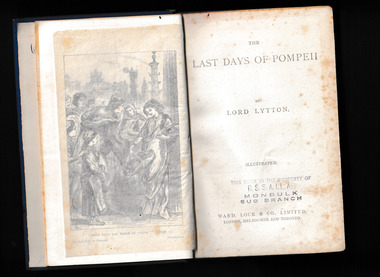
Book - Historical Fictional Story, Edward George Earle Bulwer-Lytton, The Last Days of Pompeii, 1911
... The Last Days of Pompeii......the last days of pompeii...He reached the height of his popularity with Godolphin (1833), The Pilgrims of the Rhine (1834), The Last Days of Pompeii (1834), Rienzi (1835) and Harold, the Last of the Saxons (1848). ...Hard cover book. The Last Days of Pompeii Author: Lord Lytton Publisher: Ward Lock & Co Date: 1911 Further Information: Green Cloth embossed pattern hardcover with lettering and patterning to spine in gilt. ...He reached the height of his popularity with Godolphin (1833), The Pilgrims of the Rhine (1834), The Last Days of Pompeii (1834), Rienzi (1835) and Harold, the Last of the Saxons (1848). ...This is a novel by Edward Bulwer-Lytton, first published in 1834 and inspired by Karl Briullov's painting The Last Day of Pompeii, which he saw in Milan. It was one of the most popular English historical novels of the nineteenth century. The story is set in Pompeii in AD 79 and ends with the eruption of Vesuvius. The central characters are Glaucus, a wealthy young Athenian in love with Ione. Ione is the beautiful ward of the Egyptian priest Arbaces. Orphaned in childhood, she becomes the target of Arbaces' attempts at seduction. Arbaces is the villain, a sinister Egyptian sorcerer-priest who wants Ione for himself. There is also Nydia, a blind flower-girl who loves Glaucus. Arbaces schemes against Glaucus, and a murder leaves Glaucus condemned to the arena. The eruption interrupts the games and destroys the city, while the virtuous escape. The Getty reads the eruption in the novel as a Last Judgment that destroys the sinners and spares the virtuous.Hard cover book. The Last Days of Pompeii Author: Lord Lytton Publisher: Ward Lock & Co Date: 1911 Further Information: Green Cloth embossed pattern hardcover with lettering and patterning to spine in gilt. The spine has a Library label with an inscription. fiction This is a novel by Edward Bulwer-Lytton, first published in 1834 and inspired by Karl Briullov's painting The Last Day of Pompeii, which he saw in Milan. It was one of the most popular English historical novels of the nineteenth century. The story is set in Pompeii in AD 79 and ends with the eruption of Vesuvius. The central characters are Glaucus, a wealthy young Athenian in love with Ione. Ione is the beautiful ward of the Egyptian priest Arbaces. Orphaned in childhood, she becomes the target of Arbaces' attempts at seduction. Arbaces is the villain, a sinister Egyptian sorcerer-priest who wants Ione for himself. There is also Nydia, a blind flower-girl who loves Glaucus. Arbaces schemes against Glaucus, and a murder leaves Glaucus condemned to the arena. The eruption interrupts the games and destroys the city, while the virtuous escape. The Getty reads the eruption in the novel as a Last Judgment that destroys the sinners and spares the virtuous. shipwrecked-coast, flagstaff-hill, flagstaff-hill-maritime-museum, warrnambool, maritime-museum, shipwreck-coast, flagstaff-hill-maritime-village, shipwrecked-artefact, book, pattison collection, warrnambool library, warrnambool mechanics’ institute, ralph eric pattison, corangamite regional library service, warrnambool city librarian, mechanics’ institute library, victorian library board, warrnambool books and records, warrnambool children’s library, great ocean road, the last days of pompeii, lord lytton -
 Mrs Aeneas Gunn Memorial Library
Book, Ward Lock and Co, The last days of Pompeii, [1850]
... The last days of Pompeii....Notes, ill, p.393. The last days of Pompeii. Book Ward Lock and Co Lord Lytton ...In ancient Pompeii an evil magician attempts to prevent a young woman from marrying the young man she loves. They escape as the volcano destroys Pompeii.Notes, ill, p.393. In ancient Pompeii an evil magician attempts to prevent a young woman from marrying the young man she loves. They escape as the volcano destroys Pompeii. pompeii - destruction, pompeii - fiction -
 Flagstaff Hill Maritime Museum and Village
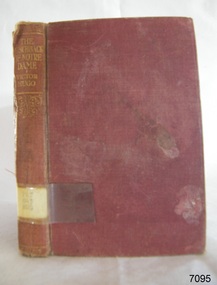
Book - A Fictional Story, Collins Clear Type Press et al, The Hunchback of Notre Dame, 1910-1925
... His work for Collins' Clear-Type Press alone included Thackeray's Henry Esmond (1903), Hawthorne's The House of the Seven Gables (1903), Lytton's The Last Days of Pompeii (1905), Gaskell's North and South (1905), Dumas' The Black Tulip and The Count of Monte-Cristo, Kingsley's Hereward the Wake, Hugo's The Hunchback of Notre-Dame and Les Misérables, and Dickens' Our Mutual Friend all issued without dates but datable to the 1910s. ...His work for Collins' Clear-Type Press alone included Thackeray's Henry Esmond (1903), Hawthorne's The House of the Seven Gables (1903), Lytton's The Last Days of Pompeii (1905), Gaskell's North and South (1905), Dumas' The Black Tulip and The Count of Monte-Cristo, Kingsley's Hereward the Wake, Hugo's The Hunchback of Notre-Dame and Les Misérables, and Dickens' Our Mutual Friend all issued without dates but datable to the 1910s. ...The Hunchback of Notre-Dame is Victor Hugo's 1831 historical novel set in fifteenth-century Paris. It follows Quasimodo, the deformed bell-ringer of Notre-Dame Cathedral; Esmeralda, a beautiful Romani street dancer; Claude Frollo, the tormented archdeacon obsessed with her; and Captain Phoebus, the soldier she loves. The novel is as much a portrait of the cathedral itself and medieval Paris as it is a story of its characters. Hugo used the book partly as a plea for the preservation of Gothic architecture, which was being neglected and demolished in his own era. The novel's success is credited with sparking renewed public interest in Notre-Dame and Gothic buildings generally, which contributed to the eventual restoration campaign led by Eugène Viollet-le-Duc in the 1840s.Hard cover book. The Hunchback of Notre Dame Author: Victor Hugo Illustrator: Arthur A Dixon Publisher: Collins Clear-Type Press Date: 1910-1925 Further Information: Red Cloth plain hardcover with lettering and patterning to spine in gilt. The spine has a Library label with an inscription. fiction The Hunchback of Notre-Dame is Victor Hugo's 1831 historical novel set in fifteenth-century Paris. It follows Quasimodo, the deformed bell-ringer of Notre-Dame Cathedral; Esmeralda, a beautiful Romani street dancer; Claude Frollo, the tormented archdeacon obsessed with her; and Captain Phoebus, the soldier she loves. The novel is as much a portrait of the cathedral itself and medieval Paris as it is a story of its characters. Hugo used the book partly as a plea for the preservation of Gothic architecture, which was being neglected and demolished in his own era. The novel's success is credited with sparking renewed public interest in Notre-Dame and Gothic buildings generally, which contributed to the eventual restoration campaign led by Eugène Viollet-le-Duc in the 1840s. warrnambool, shipwrecked-coast, flagstaff-hill, flagstaff-hill-maritime-museum, maritime-museum, shipwreck-coast, flagstaff-hill-maritime-village, shipwrecked-artefact, book, the hunchback of notre dame, victor hugo -
 Flagstaff Hill Maritime Museum and Village
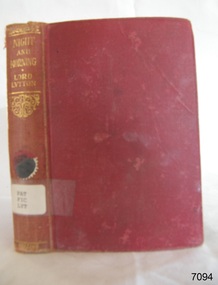
Book - A Fictional Story, Victor Prout (Illustrator) et al, Night And Morning, 1905 or 1913
... His 1828 novel Pelham brought him both income and critical reputation, and he reached the height of his popularity with Godolphin (1833), The Pilgrims of the Rhine (1834), The Last Days of Pompeii (1834), Rienzi (1835) and Harold, the Last of the Saxons (1848). ...His 1828 novel Pelham brought him both income and critical reputation, and he reached the height of his popularity with Godolphin (1833), The Pilgrims of the Rhine (1834), The Last Days of Pompeii (1834), Rienzi (1835) and Harold, the Last of the Saxons (1848). ...Night and Morning is a novel by Edward Bulwer-Lytton (later Lord Lytton), originally published in three volumes in 1841, although the preface reproduced in most later editions, including the subject volume, is dated 1845 and refers to a revised edition. The story centres on two orphaned siblings, Philip and Sidney, who are separated by misfortune and a scheming relative after their father's death, and who endure hardship and social injustice as they fight to reclaim their family's name and honour. The novel explores social justice, moral dilemmas and class distinctions, opening in a small Welsh village where Reverend Caleb Price grapples with his own failures, before a mysterious stranger arrives revealing plans for a secret marriage he wants kept quiet because of his wealthy uncle's likely disapproval. The plot turns heavily on inheritance law and the legitimacy of the brothers' birth; Lytton reportedly consulted a real lawyer on the legal plot points to get the details right in his novel.Hard cover book. Night and Morning Author: Lord Lytton Illustrator: Victor Prout Publisher: Collins Clear-Type Press Date: 1890s–1910s Further Information: Red Cloth plain hardcover with lettering and patterning to spine in gilt. The spine has a Library label with an inscription. fiction Night and Morning is a novel by Edward Bulwer-Lytton (later Lord Lytton), originally published in three volumes in 1841, although the preface reproduced in most later editions, including the subject volume, is dated 1845 and refers to a revised edition. The story centres on two orphaned siblings, Philip and Sidney, who are separated by misfortune and a scheming relative after their father's death, and who endure hardship and social injustice as they fight to reclaim their family's name and honour. The novel explores social justice, moral dilemmas and class distinctions, opening in a small Welsh village where Reverend Caleb Price grapples with his own failures, before a mysterious stranger arrives revealing plans for a secret marriage he wants kept quiet because of his wealthy uncle's likely disapproval. The plot turns heavily on inheritance law and the legitimacy of the brothers' birth; Lytton reportedly consulted a real lawyer on the legal plot points to get the details right in his novel. warrnambool, shipwrecked-coast, flagstaff-hill, flagstaff-hill-maritime-museum, maritime-museum, shipwreck-coast, flagstaff-hill-maritime-village, shipwrecked-artefact, book, night and morning, lord lytton, victor william prout, edward george earle bulwer-lytton
