
Showing 5 items matching "the leftovers"
-
 Clunes Museum
Newspaper - ARTICLE, BALLARAT COURIER PTY. LTD, HOLLYWOOD HITS CLUNES
... THE LEFTOVERS...ARTICLE BY OLIVIA SHYING ABOUT HBO TV SERIES "THE LEFTOVERS" IN CLUNES...THE LEFTOVERS TV SERIES LIV TYLER 2016 HOLLYWOOD HITS CLUNES, PHOTO OF LIV TYLER BALLARAT COURIER 2 SEPT, 2016, P 2. ...BALLARAT COURIER 2 SEPT, 2016, P 2. ARTICLE BY OLIVIA SHYING ABOUT HBO TV SERIES "THE LEFTOVERS" IN CLUNESHOLLYWOOD HITS CLUNES, PHOTO OF LIV TYLERthe leftovers, tv series, liv tyler, 2016 -
Clunes Museum
Memorabilia - DVD, VARIOUS
... ...the leftovers...DVD: .1 DVD TOMORROW WHEN THE WAR BEGAN, SERIES, PARTLY FILMED IN CLUNES 2016 .2 DVD MAD MAX, MOVIE, PARTLY FILMED IN CLUNES IN 1979 .3 DVD THE LEFTOVERS, THIRD AND FINAL SEASON, PARTLY FILMED IN CLUNES 2017 .4 DVD NED KELLY, MOVIE, FILMED IN CLUNES ...FILM PRODUCTIONS FILMED IN AND AROUND CLUNES VICTORIA films ned kelly mad max the leftovers tomorrow when the war began NIL DVD: .1 DVD TOMORROW WHEN THE WAR BEGAN, SERIES, PARTLY FILMED IN CLUNES 2016 .2 DVD MAD MAX, MOVIE, PARTLY FILMED IN CLUNES IN 1979 .3 DVD THE LEFTOVERS, THIRD AND FINAL SEASON, PARTLY FILMED IN CLUNES 2017 .4 DVD NED KELLY, MOVIE, FILMED IN CLUNES VARIOUS Memorabilia DVD ...FILM PRODUCTIONS FILMED IN AND AROUND CLUNES VICTORIADVD: .1 DVD TOMORROW WHEN THE WAR BEGAN, SERIES, PARTLY FILMED IN CLUNES 2016 .2 DVD MAD MAX, MOVIE, PARTLY FILMED IN CLUNES IN 1979 .3 DVD THE LEFTOVERS, THIRD AND FINAL SEASON, PARTLY FILMED IN CLUNES 2017 .4 DVD NED KELLY, MOVIE, FILMED IN CLUNES NILfilms, ned kelly, mad max, the leftovers, tomorrow when the war began -
 National Wool Museum
Textile - Wagga, Gwenyth Fletcher, c.1950s
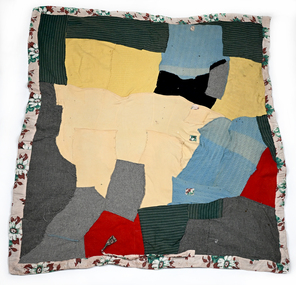
... The Wagga was probably made during the time at Ernabella from children's knits and other leftovers. John had to camp out from the home a lot in order to muster sheep and the desert nights are cold. ...The Wagga was probably made during the time at Ernabella from children's knits and other leftovers. John had to camp out from the home a lot in order to muster sheep and the desert nights are cold. ...Gwenyth Fletcher (nee Thompson) was born in 1922 in Burwood. At six months of age her family moved to Blackheath where she lived until her marriage to John Fletcher. When Gwenyth was four years old, her grandfather was the mayor of Blackheath and as such, he had to welcome the Duke and Duchess of Kent to the town. Gwenyth presented the future King George VI and his wife Elizabeth with a posy of flowers as part of the welcoming ceremony. John and Gwenyth were married in 1951 and in 1952 they moved to Canowindra. John was working for the Presbyterian Church and they needed an assistant sheep worker at Ernabella (now Pukatja), a remote First Nations community, in the far North West of South Australia and he had worked there prior to his marriage. The work involved sheep, vehicles and general handy man work, and trips to Finke (railway 200 miles east). After marriage John was again asked to work at Ernabella. He and Gwenyth left for Ernabella in 1953 and returned in November. They then bought a property in Canowindra and the family stayed for four years before returning to Ernabella. Two children were born whilst they were in Canowindra. The family stayed for eight years at Ernabella from 1958 to April 1966. During the time at Ernabella and Fregon, three more children were born. In May 1966, the family returned to the farm in Canowindra. John and Gwenyth retired from the farm in 1985 and moved to South Canowindra. The Wagga was probably made during the time at Ernabella from children's knits and other leftovers. John had to camp out from the home a lot in order to muster sheep and the desert nights are cold. There is evidence (ties) that Gwenyth made the wagga into a swag-like product that John could easily carry. There were few resources available to her in the remote region, so she used what she had. Gwenyth was known for her reuse of everything – she never threw anything out. Everything was repurposed or recycled. Gwenyth Fletcher was my mother-in-law. Because I was interested in quilts/quilting and patchwork she gave me the blanket instead of throwing it out. She gave it to me during the 1990s. - Donor, November 2025Wagga blanket with base made from two different beige/light khaki blankets. One of the blankets is lightly striped. The top is made up of random, non-geometrical pieces of cardigans and jumpers and other blankets that are machine stitched to the bottom blankets. The cardigans are different colours - light blue, red, navy, yellow and light yellow and are knitted with different patterns. The top blanket pieces are different greys. The cardigan pieces include a pocket, button holes and one of the blanket patches has some of a blanket stitched border. The top also has some green striped material patches. The whole blanket/quilt is bordered by a wide brown patterned material. Some of this material is also used as smaller patches on holes in the cardigans. There are also some hand stitched repairs.wagga, remote community, gwenyth fletcher, king george vi, canowindra, ernabella, pukatja, swag, blanket, sheep, rural life -
 Melton City Libraries
Photograph, Mrs Knox and Beryl Gillespie at the First Hundred Years Celebration of Melton State School 430, 1970
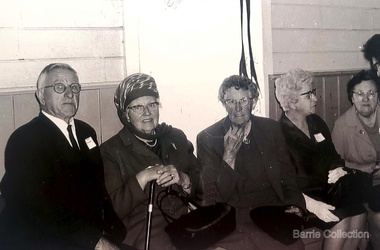
... It didn’t matter which team played the supporters were treated to a cup of tea and leftovers from their afternoon tea. In 1978 were the first residents to move into the Jennings Estate Kurunjang and lived there 31 years and retired 4 years ago into Unit. ...It didn’t matter which team played the supporters were treated to a cup of tea and leftovers from their afternoon tea. In 1978 were the first residents to move into the Jennings Estate Kurunjang and lived there 31 years and retired 4 years ago into Unit. ...Beryl Knox speaking about early life in Melton. Page 1 1949 – 64 years ago. We began our married life at Melton Sth. The house on the corner of the Exford Rd and Staughton St-- dusty gravel roads, box thorns and noxious weeds everywhere and a sprinkling of houses and vacant land. It was a friendly community consisting of old family names. McDonalds, Blacks, Dodemaide, Cahill, Coopers, Minns, Tinklers, Nesbitts, Cochranes, Wickhams, Exells. Mavis Butler. The home owned by Mr. Robinson and Miss Robinson had been shifted in two parts transported from Diggers Rest and it is still standing 2013. Bruce’s father purchased the house and two adjoining blocks, the Conways built on one and the Rawlinson family on the other block. Eileen still resides there, she was only a baby in a pram and the family had not long arrived from England. The railway line was close to the house and the contents would rattle when heavy steams trains went through, and on a clear frosty night the 1am paper train would echo roar through very loudly when labouring towards the Exford Bridge. Then the two carriage motor train was introduced, this was great for the workers and schoolies who travelled to Melbourne. The train pulled up at the crossing or riding to pick up or drop off. Melva Gillespie (nee Hirt) Bill Cahill delivered the milk by the billy and then in bottles. Len Kennedy (Paul Kennedy’s father, Norma Murrays son) delivered Jongebloeds bread, he always had a sweep going for the Melbourne Cup and raffles for the footy club. Mr. Woodgate owned an old bus and pick up point was the Post Office when there was a Saturday film on a Melton. There were no doctors or dentists in the district. If we need a Doctor we had to travel to Bacchus Marsh or discuss problems over the phone. In later years a Bacchus Marsh Doctor rented the Bluestone building in McKenzie St a couple of days a week. If we needed the Dentist we had to travel to West Footscray or Footscray. We did our banking at “State Savings” then the Miss Minns had the agency and then Bardsleys Store. We travelled to Bacchus Marsh to the National and Commercial banks. Station Rd to Western Highway, now (High Street) was a narrow stretch of bitumen and gravel farmland either side and a couple of farm houses and large gum trees on the properties. Page 2 North of the Railway line Mrs Bessie Jones, mother of Chas and Betty Jones managed the Post Office, next door to her Chas and Betty had the Shell Centre, and later moved the business to Melton. Hughie Nesbitt and mother owned the grocery and hardware store, and I bought my first set of saucepans there. On the opposite side of Station road Mr Coombe owned the fruit shop, and also provided soft drinks and lollies for children. The Chaff Mill was on the corner of Station Rd and Brooklyn Rd. Mr Lumsden was manager and later years Bernie Trethowan and Jack Butler were partners. It finally burnt down and is a Service Station now. Along Brooklyn Rd there were a few houses and Victoria Hall, not a very big hall, but catered for lots of functions, Balls, Fancy Dress, Bazaars, Square Dancing and meetings. The Bacchus Marsh Baptists held Sunday School in the hall. A group of shops were built south of the railway line Molly and Len Skinner managed the Post Office and handled a few essential groceries. Tom McDonald and Ron Lunsberg were the butchers. Mary and Syd Cooper lived next door to us and often in turn would run out of something when we had a baking spree we would borrow or exchange, sugar flour etc over the fence. Mavis and Jack Butler lived there before the Coopers. Bernie and Iris Trethowan lived two doors up. Neighbours were invited into their home to view the first black and white television in Melton Sth. Bill Exell was one of the first Melton Sth farmers to sell his land to developers, the land was idle for years before housing developed. I joined the Melton Valley Golf Club in 1960. The Gun Club as our Club House, an old tin shed consisting a water tank, trestle table and forms and dirt floor. It was a 9 hole course with sand scraps and landscape putting before greens. The Common or parkland was part of the Golf Course. It was open for every ones recreation. Roy Norton an old identity trained his trotters on the Common and wouldn’t clear the track for the golfers. The golfers had to avoid him to continue to play. We had to keep clear when the young youths came in their paddock cars and motorbikes. Over the years the Toolern Creek flooded its banks, water and debri covered the course on one year our first Club house was flooded out. It took several working bees to clean it up. We lived at Melton Sth for 15 years and moved to Melton on the farm “Croxton Park.” The Nixon family farm “Mowbray” adjoined the farm. Bruce worked the land cropping the farm when Mrs Nixon died. Page 3 (page 4 on the handwritten script) Bruce had the first offer to buy, in those days it wasn’t easy to get good bank loans. Part of the land is the Golf Course now and Mr O’Shea purchased the bulk. Moving to Melton was totally different – I became involved with Committees, Scouts, Guides, Mothers Clubs, CWA, Church Op shop (8 years). Melton Amateurs players produced and tutored by Mabel Rogers exerts from Pyjama Game, South Pacific, Carousel - later years a group of ladies did gentle water exercise at Essendon and Station Road swimming pool. I was 20 or so years in Probus. The local followed the football, there was always a Gymkhana on the long weekend in June. The tennis always created a lot of interest during the finals. It didn’t matter which team played the supporters were treated to a cup of tea and leftovers from their afternoon tea. In 1978 were the first residents to move into the Jennings Estate Kurunjang and lived there 31 years and retired 4 years ago into Unit. The amazing changes I have experienced. Merrimu supplied our water, after depending on tanks. The landscape changed completely when developers came in, no more dusty plains \ typed web Sept 2013 McFarlane, Mrs Knox and Beryl Gillespie at the First Hundred Years Celebration of Melton State School 430. The event was held at Mechanics Hall, Melton.local identities, local significant events, education -
 Whitehorse Historical Society Inc.
Machine - Portable Typewriter
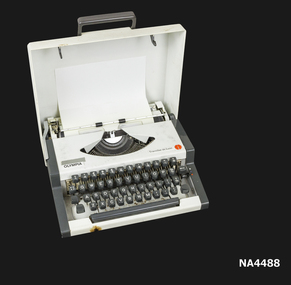
... In WWII the factory was destroyed. 'Leftovers' in Erfurt (East-Germany) became OPTIMA BUEROMASCHINEWERKE a GDR-run business - Former employees founded in Wilhemshaven (West-Germany) the new OLYMPIA WERKE under AEG share-holding. ...Was purchased in 1974 at Eastern Office Supplies and was used by the donor for many years.OLYMPIA==> see also BRUMSVIGA + MONROE|The company started after the invention of the 'Pointing Typewriter' MIGNON by Friedrich v.Hefner-Alteneck, engineer of AEG (=ALLGEMEINE ELEKTRIZITAETSGESELLSCHAFT) in Berlin: In 1903 a company was founded to produce the >>MIGNON<<, the UNION SCHREIBMASCHINENGESELLSCHAFT. In 1923 the company moved to Erfurt and was renamed AEG DEUTSCHE WERKE. In 1930 it was renamed EUROPA SCHREIBMASCHINEN. Until the end of production in 1933, there were 49 different Font-Cylinders available. Their new typewriters were very successful under the name >>OLYMPIA<<, and in 1936 the company was renamed again OLYMPIA BUEROMASCHINEWERKE. In WWII the factory was destroyed. 'Leftovers' in Erfurt (East-Germany) became OPTIMA BUEROMASCHINEWERKE a GDR-run business - Former employees founded in Wilhemshaven (West-Germany) the new OLYMPIA WERKE under AEG share-holding. OLYMPIA's peak was in the 1970s when it was the largest producer of office machines in Germany. The rise of small-computers organization of Daimler-Benz/AEG/Olympia, the OLYMPIA branch was sold and the new owner in Asia formed the OLYMPIA INTERNATIONAL HOLDING LTD.Traveller De Luxe Portable Typewriter. Olympia (1973) Wilhemshaven Germany. German Qwerty Keyboard; pica 10cpi; 83cp; Black/White/Red ribbon; plastic case; Weight 11lbs/5kg.Purchased from Eastern Office Supplies, Railway Road, Blackburn.Olympia 1973commerce, office equipment / stationery
