
Showing 8 items matching "the melbourne eucharistic congress 1934"
-
 St Vincent's Hospital Melbourne Archives
Photograph - Mount St Evins Hospital Melbourne, venue for National Eucharistic Congress in 1934
... The Melbourne Eucharistic Congress 1934...1934. There are many priests, nuns, dignitaries, altar servers, Children of Mary, and public members. The hospital balcony is adorned with stage curtains and floral arrangements. The theme of the congress was "Catholic Action "and it coincided with the Centenary of Melbourne. The Melbourne Eucharistic ...Image of Religious Notables on Mount St Evin's balcony, led by Archbishop Mannix, overseeing a large gathering on Victoria Parade Fitzroy on December 10, 1934. There are many priests, nuns, dignitaries, altar servers, Children of Mary, and public members. The hospital balcony is adorned with stage curtains and floral arrangements. The theme of the congress was "Catholic Action "and it coincided with the Centenary of Melbourne. 'Agnes McLean, December 1934"the melbourne eucharistic congress 1934, mount st evin's private hospital melbourne, archbishop mannix -
 City of Melbourne Libraries
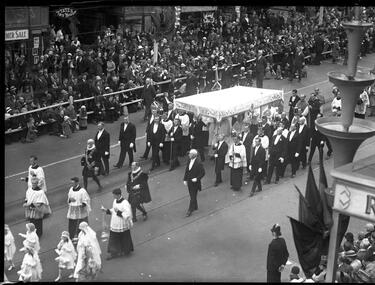
Photograph, Bull, Hugh Jones, 1897-1993, Eucharistic Congress Procession, Collins Street, Melbourne
... Retrieved January 23, 2024, from http://nla.gov.au/nla.news-article104371824 'The year of the Melbourne Eucharistic Congress: 1934.' The Campion Society, https://campion.australiancardijninstitute.org/ch-7-the-year-of-the-melbourne-eucharistic-congress-1934/ 'Melbourne Eucharistic Congress 1934.' ...Retrieved January 23, 2024, from http://nla.gov.au/nla.news-article104371824 'The year of the Melbourne Eucharistic Congress: 1934.' The Campion Society, https://campion.australiancardijninstitute.org/ch-7-the-year-of-the-melbourne-eucharistic-congress-1934/ 'Melbourne Eucharistic Congress 1934.' ...Published: The Age 10 December 1934 Published title: RELIGIOUS PAGEANTRY AND FERVOR MARKED CLOSE OF EUCHARISTIC CONGRESS. Published caption: Thousands of men and women marched in the Eucharistic procession yesterday which brought the Congress to a close. The picture above shows the procession headed by the Children of Mary in Bourke-street and turning into Spring-street, in front of Parlia ment House. Right (top) — The procession leaving the starting point at St. Patrick's Cathedral and below, the Papal Legate carrying the Host under a canopy borne by a guard of laymen and preceded by white-clad girls scattering rose leaves, incense bearers and the Papal Chamberlains in their Spanish uniforms. The end of the procession in front of Mount St. Evin’s Hospital from which the final benediction was given by Cardi nal MacRory from an altar on the bal cony. The Papal Legate carrying the Host is passing through the assemblage of surpliced priests. On the left is an aerial picture taken just as the Children of Mary at the head of the procession are taking up their places for the final assembling. In the left top corner of the picture is St Patrick's Cathedral, from which the procession started, and in the right lower corner is Mount St. Evin’s Hospital. The space immediately in front of the hospital was reserved for the processionists while on either side is the crowd that assembled to take part in the final service. Trove article identifier: http://nla.gov.au/nla.news-article205067634 Religious pageantry and fervour The National Eucharistic Congress took place from Sunday 2 to Sunday 9 December 1934. An initiative of the Roman Catholic Church, it was their contribution to Melbourne’s Centenary Celebrations. 200,000 Catholics resided in Melbourne at this time – one quarter of the city’s population. While the Congress was aimed at Catholics, and acted as an opportunity to reinforce their living faith and homage, it contained a variety of events of splendour, solemnity and significance designed to appeal to Melbournians, and would additionally provide incentive for people to travel to Victoria, thereby creating an economic benefit to the state. The Procession of the Blessed Sacrament concluded the week-long Congress. Commencing at St Patrick’s Cathedral, it covered a two-mile route via Gisborne, Collins, Elizabeth and Bourke streets, then to Victoria Parade, where a final benediction was pronounced by Cardinal MacRory from the balcony of Mount St. Evin’s Hospital (today the site of St Vincent’s Private Hospital). An estimated 100,000 took part. Onlookers line Swanston Street, some standing at the entrance to Tate’s Tea House – a well-known Melbourne landmark located in the basement of the Manchester Unity Building. The white-veiled Children of Mary Sodalists strew rose petals in the path of the canopy, covering the jewelled Monstrance containing the Blessed Sacrament of consecrated Host (bread) and carried by the Cardinal. Church hierarchy in scarlet robes walk alongside, followed by incense bearers, the Papal Chamberlains in their Spanish uniforms, and a guard of honour of laymen of the city and country parishes. In the foreground is a tiered pole. This is one of 800 “Venetian Lights” specifically installed for the Centenary along all principal thoroughfares. “The poles are painted white, the superstructure resembling three trumpet lilies are made of durable fibro-cement, and their colour scheme deepens from clear yellow on the top cone to orange on the lowest, with slender rims of vermilion and white. Each cone is flooded with light externally from three lamps concealed in the one below it. There is also a painted coat of arms from which spring a trophy of flags.” – Australian Home Beautiful Featured in "Newsworthy: Melbourne in photographs 1933-1936" exhibition at East Melbourne Library, October to December 2023. Exhibition caption by project volunteer, Louise McKenzie. Research by project volunteer, Louise McKenzie: This photo was taken on Sunday 9 December 1934, looking from the Melbourne Town Hall (corner of Swanston and Collins streets) across the road to the Manchester Unity Building. This is the afternoon procession concluding the Catholic Church’s National Eucharistic Congress in Melbourne - a procession of the Blessed Eucharist through the Melbourne city. It commenced at St Patrick’s Cathedral, and covered a two mile route via Gisborne, Collins, Elizabeth and Bourke streets, then to Victoria Parade where a final benediction was pronounced by the Cardinal from the balcony of Mount St. Evin’s Hospital (present day St Vincent’s Private Hospital). An estimated 100,000 took part in the march. The people lining the streets a men in suits and hats, women in coats and hats, and children in their “Sunday best”, kneeling beside the road, many with their hands clasped in front of them. The small girls ahead of the canopy covering the Host are pale-blue clad, white veiled Children of Mary Sodalists, who strew rose petals to pave the way of the Cardinal carrying the jewelled Monstrance (Blessed Sacrament of consecrated Host (bread)), together with church heirarchy wearing scarlet robes. Behind came incense bearers and the Papal Chamberlains in their Spanish uniforms, followed by a guard of honour of laymen of the city and country parishes. The Children of Mary Sodalities was a religious body which aimed at fostering in its members an ardent devotion, reverence, and filial love towards the Blessed Virgin Mary, initially embracing the pupils and orphans of the schools and institutions of the Sisters of Charity of St Vincent de Paul. In 1847, Blessed Pius IX affiliated them to the Jesuit Roman Sodality. They were distinguished by a medal suspended from a blue ribbon, and once a fully-fledged a Child of Mary wore a distinctive blue cape. On the extreme right foreground of the photo can be seen an intriguing piece of artistic design – a tiered pole. This is one of the 800 “Venetian Lights” specifically installed for Melbourne’s Centenary along all principal thoroughfares. “The poles are painted white, the superstructure resembling three trumpet lilies are made of durable fibro-cement, and their colour scheme deepens from clear yellow on the top cone to orange on the lowest, with slender rims of vermilion and white. Each cone is flooded with light externally from three lamps concealed in the one below it. There is also a painted coat of arms from which spring a trophy of flags.” Note the sign for Tates Tea House - a well-known Melbourne landmark, located in the basement of the Manchester Unity Building. References: RELIGIOUS PAGEANTRY AND FERVOR MARKED CLOSE OF EUCHARISTIC CONGRESS. (1934, December 10). The Age (Melbourne, Vic. : 1854 - 1954), p. 11. Retrieved September 14, 2023, from http://nla.gov.au/nla.news-article205067634 Eucharistic Congress (1934, December 1). The Argus (Melbourne, Vic. : 1848 - 1957), p. 11. Retrieved January 23, 2024, from http://nla.gov.au/nla.news-article10997817 National Eucharistic Congress, Melbourne. (1934, December 6). The Catholic Press (Sydney, NSW : 1895 - 1942), p. 28. Retrieved January 23, 2024, from http://nla.gov.au/nla.news-article104371824 'The year of the Melbourne Eucharistic Congress: 1934.' The Campion Society, https://campion.australiancardijninstitute.org/ch-7-the-year-of-the-melbourne-eucharistic-congress-1934/ 'Melbourne Eucharistic Congress 1934.' Panoramic photograph, https://emhs.org.au/catalogue/emdf0123 The National Eucharistic Congress, Melbourne, Australia December 2nd-9th, 1934. Edited by Rev. J.M. Murphy and Rev. F. Moynihan, The Advocate Press, Melbourne. 'Children of Mary Sodalists', Wikipedia, https://en.wikipedia.org/wiki/Sodality_of_Our_Lady 'Dressing Melbourne for the Duke' (1934, October 1). The Australian home beautiful : a journal for the home builder, p. 21, 58. Retrieved September 14, 2023, from http://nla.gov.au/nla.obj-2950922209 Photographer notations on slide: "Eucharistic Congress Procession on Swanston St B61" [sic - actually Collins Street].events, religion, parades, catholic church -
St Vincent's Hospital Melbourne Archives
Photograph - Agnes McLean photographs at St Vincents Hospital Melbourne, Circa 1928-1934
... Melbourne including laying the foundation stone, St Evins, the Eucharistic Congress. St Vincent's Hospital Melbourne Mount St Evin's Private Hospital Melbourne Eucharistic Congress 1928 Agnes McLean Sister Alphonsus Mary Devine Mary Rawson Mother Dorothea Ida and Marion O'Doherty Gert O'Toole Cardinal Cerrutti Ciss Farrell Theatre Nurse Uniform 1928 Photograph Agnes McLean photographs at St Vincents Hospital Melbourne, Circa 1928-1934 ...Nurses in uniform photographed at events at St Vincent's Hospital Melbourne including laying the foundation stone, St Evins, the Eucharistic Congress.st vincent's hospital melbourne, mount st evin's private hospital melbourne, eucharistic congress 1928, agnes mclean, sister alphonsus, mary devine, mary rawson, mother dorothea, ida and marion o'doherty, gert o'toole, cardinal cerrutti, ciss farrell, theatre nurse uniform 1928 -
 Melbourne Tram Museum
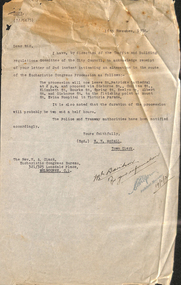
Document - Memorandum, Melbourne & Metropolitan Tramways Board (MMTB), Eucharist Congress and Procession, 1934
... Eucharistic Congress and Procession, Sunday 9 December, 1934. 6 - Arrival and departure times of country trains on Sunday 9 December, 1934, replacing previous timetable. 7 - Memo from Assistant Manager to Dist Traffic Supts NS & SS. Other similar memos relating the the event. 8 - Letter from WV McCall, to Secretary, MMTB, advising of Eucharistic Procession, Sunday 9 December, 1934. Handwritten note to "Mr Davidson, for your information, 7/12/34". 263H x 206W, poor condition, torn edges and folds Eucharist Congress and Procession Document Memorandum Melbourne ...Memorandums and table card for tram scheduling for Eucharist Congress and Procession: 1 - Newspaper clipping: "Papal Legate on Cathay - Due in Melbourne November 26, Papal Legate, Cardinal MacRory will visit for the National Catholic Congress in Melbourne December 2 to 9. 230H x 55W, poor condition 2 - Letter from WV McCall, Town Clerk, to Rev NA Clack, Eucharistic Congress Bureau, advising of receipt of letter advising of changes to Eucharist Congress Procession. Handwritten note to "Mr Davidson, for your information, 19/11/34". 335H x 210W, poor condition, torn edges and folds 3 - Set of 3 table cards for Eucharistic Congress Show Grounds "Men's Night". Thursday 6/12/34 "Down Loading at City Rd. Camberwell Glen Iris, South Melb Toorak, Elsternwick St Kilda Beach, 223H x 76W 4 - Set of 4 memos from DJ Davidson to depots regarding tram scheduling for Eucharistic Congress Show Grounds "Men's Night". Note pinned to front, handwritten in red pencil, Eucharistic Congress Mens Night - Thurs 6/12/34. 127H x 204W, 265H x 208W, good condition 5 - Set of 13 pages of memos relating to the the Eucharistic Congress and Procession, Sunday 9 December, 1934. 6 - Arrival and departure times of country trains on Sunday 9 December, 1934, replacing previous timetable. 7 - Memo from Assistant Manager to Dist Traffic Supts NS & SS. Other similar memos relating the the event. 8 - Letter from WV McCall, to Secretary, MMTB, advising of Eucharistic Procession, Sunday 9 December, 1934. Handwritten note to "Mr Davidson, for your information, 7/12/34". 263H x 206W, poor condition, torn edges and foldstrams, tramways, instructions, events, eucharistic congress, showgrounds -
 Hymettus Cottage & Garden Ballarat
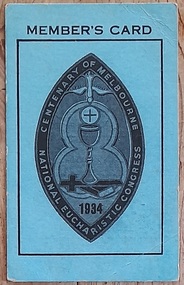
Card - Ticket, Membership Card
... Melbourne in 1924 included many and varied celebrations and commemorative events. One of the biggest events was the Centenary Eucharistic Congress conducted by the Catholic Church and driven by the charasmatic Archbishop Daniel Mannix. Melbourne Centenary of Melbourne 1934 ...melbourne, centenary of melbourne, 1934, eucharistic congress, mermbership card -
 City of Melbourne Libraries
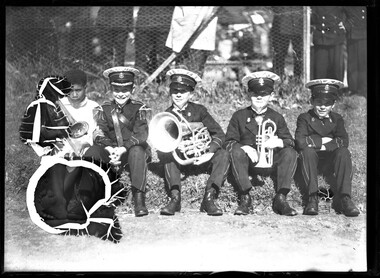
Photograph, Bull, Hugh Jones, 1897-1993, Boy bandsmen
... Melbourne. The reason for the event – a garden party – was held as part of the National Eucharistic Congress which took place in Melbourne from Sunday 2 – Sunday 9 December 1934. ...Melbourne. The reason for the event – a garden party – was held as part of the National Eucharistic Congress which took place in Melbourne from Sunday 2 – Sunday 9 December 1934. ...Published: 7 Dec 1934 Published title: A FIJIAN TROMBONIST. Published caption: Although the young Fijian here for the Eucharistic Congress had no uniform, he did not feel out of it with the members of St. Vincent de Paul’s Band at the Sacre Coeur, East Malvern, this week. Trove article identifier: http://nla.gov.au/nla.news-article205071643 Description: A young Fijian boy sits with young members of the St Vincent de Paul’s Band, all seated on the grass in sunshine. The three young band members are jauntily dressed in braided hats, long pants and smart dark jackets, white shirts, dark bow tie, and dark long trousers and boots. One holds a French horn, one a trumpet. In contrast, the young Fijian boy is shoeless, hatless, and dressed in white – a white shirt, and possibly a white “skirt” as observed to be worn by Fijian policemen in their home country at that time. He carries a trombone, which perhaps belongs to the young band member sitting beside him. Research by project volunteer, Louise McKenzie: A photo in the Argus on the previous day shows “two Papuans, Aloysius and Bernard, … talking to Archbishop O’Shea of Wellington (N.Z.).” In a turn of phrase which would be far from acceptable today, the caption notes that the juxtaposition of the dark skinned boys and the white skinned Archbishop makes “A picturesque Contrast”. The photo is also staged in a way that has the two dark skinned boys (wearing white shirts and white “skirts”, and no hats), standing, looking down on the Archbishop in his elaborate clothing and headcovering. The Age caption advises that they are at Sacre Coeur, East Melbourne. The reason for the event – a garden party – was held as part of the National Eucharistic Congress which took place in Melbourne from Sunday 2 – Sunday 9 December 1934. An initiative of the Roman Catholic Church, it was their contribution to Melbourne’s Centenary Celebrations. At this garden party the Papal Legate, Cardinal MacRory, accompanied by dignatories including the Papal Chamberlain, met Old Girls of Sacre Coeur Convent. The Cardinal’s sister was at one time Mother Superior of this Convent. The featuring of Fijian and Papuan boys in these articles reflected the diverse nature of Catholic Church representatives worldwide who attended the Eucharistic Congress which featured as part of Melbourne’s Centenary celebrations. Notable visitors to the Congress included the Papal Legate, His Excellence Cardinal MacRory, several Monsignors from Rome, the Archbishop of Liverpool representing England, Scotland and Wales, together with representatives from New Zealand, China, South Africa, Ireland, the Islands of the Pacific, India, Malta, USA, and of course from across Australia. St Vincent de Paul “Our History” advises that the Society was founded in France in 1833 by a group of dedicated Catholics who put their faith into action to support the poor in their community. The “Vinnies” website “1854 onwards” sets out milestones of the Society’s close involvement with Melbourne from its infancy in March 1854 up to today. A well researched blog by Jeremy de Korte dated February 28, 2024 – Band Blasts from the Past – Anecdotes, Stories and Personalities, notes: Orphanage bands in Australia were a copy of practices in England where the teaching of music in boys’ institutions was commonplace (Sheldon, 2009). There was, however, a major difference to the outcomes of this musical education between the two countries. Boys who were trained as musicians in English institutions readily found themselves recruited into the bands of the British Army and Navy (Sheldon, 2009). Whereas the musicians that graduated from the Orphanage bands in Australia found themselves positions in the wider band movement. … We know that Orphanage bands in Australia have had a long and distinguished history, as well as enviable reputations. The St. Augustine’s Band from Geelong is probably the most famous of them all, and it is mentioned that by 1898 they were already putting the call out for a new set of instruments (“ST. AUGUSTINE’S ORPHANAGE BAND.,” 1898). St. Augustine’s went on to win many competitions at South Street in Ballarat and toured extensively – in one instance, in 1906 they won the A Grade Championships at South Street (Royal South Street Society, 1906). The band at St. Vincent’s de Paul in Melbourne was no less famous than their counterpart in Geelong and in 1921 they gained the services of Mr. Leslie Hoffman, a graduate of the St. Augustine’s Band, as their conductor (“St. Vincent’s Bandmaster,” 1921). This slide is quite badly damaged, reminding us of the fragility of this photographic form. The colour is washed out across most of the slide, and the left of the slide is badly degraded as if the photographic solution hasn’t quite taken. But the culprits are most likely time and mode of storage. References: A FIJIAN TROMBONIST--SUITE FOR DOLL'S HOUSE--LUNCH TIME AT THE SPORTS--A FULL SLIDE. (1934, December 7). The Age (Melbourne, Vic. : 1854 - 1954), p. 3. Retrieved April 9, 2024, from http://nla.gov.au/nla.news-article205071643 "INTERSTATE TENNIS -- EUCHARISTIC GARDEN PARTY" The Argus (Melbourne, Vic. : 1848 - 1957) 6 December 1934: 9. Web. 9 Apr 2024 Photographer notations on slide: "Boy bandsmen B61".1930-1939, bands, catholic church -
 City of Melbourne Libraries
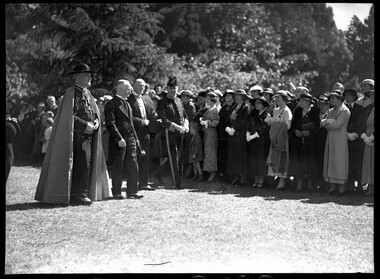
Photograph, Bull, Hugh Jones, 1897-1993, Cardinal MacRory meets "old girls" of Sacre Coeur Convent
... 1934, December 6). The Age (Melbourne, Vic. : 1854 - 1954), p. 6. Retrieved January 23, 2024, from http://nla.gov.au/nla.news-article205082619 . Description: The photograph shows Cardinal MacRory in full regalia accompanied by diginaries walking beside a crowd of mostly women in an open garden setting. This event was one of the many that took place during the National Eucharistic Congress...1934, December 6). The Age (Melbourne, Vic. : 1854 - 1954), p. 6. Retrieved January 23, 2024, from http://nla.gov.au/nla.news-article205082619 . Description: The photograph shows Cardinal MacRory in full regalia accompanied by diginaries walking beside a crowd of mostly women in an open garden setting. This event was one of the many that took place during the National Eucharistic Congress ...Photographer notations on slide: Cardinal MacRory meets "old girls" of Sacre Coeur Convent Age Dec 6 34 B61 Published: The Age, 6 Dec 1934 Published title and caption: CARDINAL MACRORY MEETS OLD GIRLS OF SACRE COEUR CONVENT. The Papal Legate, Cardinal MacRory, accompanied by Mr. E. L. Kiernan, M.L.C., Mr. T. Gaffney and the Papal Chamberlain, Mr. E. Hollingdale, at the garden party at the Sacre Coeur Convent yesterday. The Cardinal’s sister was at one time Mother Superior of this Convent, and many of the girls she had taught were presented to him. Reference: WOMAN'S INTERESTS (1934, December 6). The Age (Melbourne, Vic. : 1854 - 1954), p. 6. Retrieved January 23, 2024, from http://nla.gov.au/nla.news-article205082619 . Description: The photograph shows Cardinal MacRory in full regalia accompanied by diginaries walking beside a crowd of mostly women in an open garden setting. This event was one of the many that took place during the National Eucharistic Congress which took place from Sunday 2 to Sunday 9 December 1934. An initiative of the Roman Catholic Church, it was their contribution to Melbourne’s Centenary Celebrations. 200,000 Catholics resided in Melbourne at this time – one quarter of the city’s population. While the Congress was aimed at Catholics, and acted as an opportunity to reinforce their living faith and homage, it contained a variety of events of splendour, solemnity and significance designed to appeal to Melbournians, and would additionally provide incentive for people to travel to Victoria, thereby creating an economic benefit to the state. Photographer notations on slide: "Cardinal MacRory meets "old girls" of Sacre Coeur Convent Age Dec 6 34 B61".catholic church, centenaries, 1930-1939, schools, clothing and dress, religious festivals -
 City of Melbourne Libraries
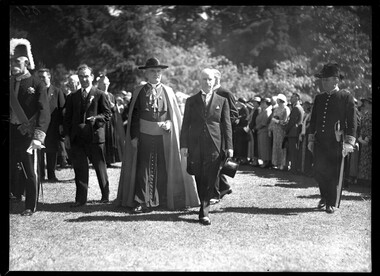
Photograph, Bull, Hugh Jones, 1897-1993, Cardinal MacRory at Convent of Sacre Coeur
... This event was one of the many that took place during the National Eucharistic Congress which took place from Sunday 2 to Sunday 9 December 1934. An initiative of the Roman Catholic Church, it was their contribution to Melbourne’s Centenary Celebrations. 200,000 Catholics resided in Melbourne at this time – one quarter of the city’s population. ...This event was one of the many that took place during the National Eucharistic Congress which took place from Sunday 2 to Sunday 9 December 1934. An initiative of the Roman Catholic Church, it was their contribution to Melbourne’s Centenary Celebrations. 200,000 Catholics resided in Melbourne at this time – one quarter of the city’s population. ...The photograph shows Cardinal MacRory in full regalia accompanied by diginitaries walking beside a crowd of mostly women in an open garden setting. This event was one of the many that took place during the National Eucharistic Congress which took place from Sunday 2 to Sunday 9 December 1934. An initiative of the Roman Catholic Church, it was their contribution to Melbourne’s Centenary Celebrations. 200,000 Catholics resided in Melbourne at this time – one quarter of the city’s population. While the Congress was aimed at Catholics, and acted as an opportunity to reinforce their living faith and homage, it contained a variety of events of splendour, solemnity and significance designed to appeal to Melbournians, and would additionally provide incentive for people to travel to Victoria, thereby creating an economic benefit to the state.Photographer notations on slide: Cardinal MacRory at Convent of Sacre Coeur B61catholic church, catholic schools, religious events, 1930-1939, centenaries, clothing and dress
