
Showing 219 items matching "the pioneer period"
-
 Moorabbin Air Museum
Book - Aviation history, Aircraft and Airports
... The pioneer period...Aviation history The pioneer period Development - two world wars Modern aviation History of aircraft & airports with drawings & technical specifications, Aircraft and Airports Book Aviation history ...History of aircraft & airports with drawings & technical specifications,non-fictionHistory of aircraft & airports with drawings & technical specifications,the pioneer period, development - two world wars, modern aviation -
![Administrative record - Compact disc, Tasmania Pioneer index: [1803-1999]](/media/collectors/4f729f5697f83e03086015b8/items/6576a8f8862c6a3a2a56c5dd/item-media/6576a958862c6a3a2a56c88f/item-fit-380x285.jpg?cb=6) Greensborough Historical Society
Greensborough Historical SocietyAdministrative record - Compact disc, Tasmania Pioneer index: [1803-1999]
... This disc contains records for Tasmania, births, deaths and marriages for the pioneer period 1803-1899....This disc contains records for Tasmania, births, deaths and marriages for the pioneer period 1803-1899. A database of vital records (births, deaths, marriages) from Tasmania. genealogy resources family history registers of births deaths marriages tasmania Contents listed on CD 1 compact disc in plastic case Tasmania Pioneer index: [1803-1999] Administrative record Compact disc ...Tasmania Pioneer index: [1803-1999] (B.D.M.) This disc contains records for Tasmania, births, deaths and marriages for the pioneer period 1803-1899.A database of vital records (births, deaths, marriages) from Tasmania.1 compact disc in plastic caseContents listed on CDgenealogy resources, family history, registers of births deaths marriages, tasmania -
 Bendigo Historical Society Inc.
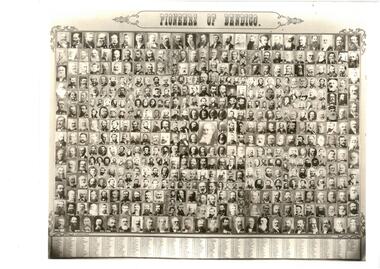
Photograph - PIONEERS OF BENDIGO
... Many hundreds of other pioneers during this period are not included in the picture....Many hundreds of other pioneers during this period are not included in the picture. ...BHS CollectionPhoto of Pioneers of Bendigo (copy or original). Men's photos are numbered with corresponding name on bottom of image. A large photograph was issued from the studio of Mr. H. Hanson, of McCrae street, to the order of Mr. R. Walker of Melbourne. The original Photograph is owned by Sandhurst Trustees Bendigo. It has six additional photographs attached. There are 472 photographs of pioneers of Bendigo. The earliest of these arrived in 1851 and most of them by 1860. The great majority, however, were pioneers from 1851 to 1856. Many hundreds of other pioneers during this period are not included in the picture.bendigo, history, pioneers of bendigo -
 Federation University Historical Collection
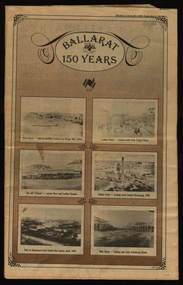
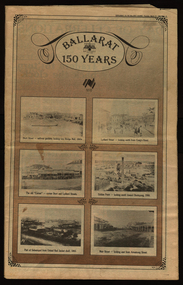
Newspaper, Ballarat 150 Years: Supplement to the Ballarat Courier, 1988, 17/03/1988
... Articles include: 1838-the pastoral period begins; First White Settlers arrive (Anderson, Winter, Yuille, Kirkland, Learmonth); Learmonths - Pioneer Settlers; The Rush to Ballarat; Last of the Aborigines; Eureka Affair Gains New Importance; Mining-After the rush; SMB - First Technical School; Clubs Play their Part; Ballarat Yuilles had Wealthy Ancestors; Town, Country Share a Close Relationship; Many Sides to Metals Industry; True Victorian City; Five Severe Recessions; Financiers to the Fore; Ready for War; City Rich in Sport Facilities; Visitors to most exciting place; No Place for a Nervous Lady; Theatres Provide Welcome Diversion for Mines; Might Achievers Among famous Citizens; Life Seemed Different After the War; Ballarat School of Mines Eastern Station Hotel; Memorial (Her Majesty's) Last of Many Theatres; Art Gallery at its Best; Pilgrimage to Yuille Cairn at Sebastopol Images include: Jelbart tractor; Sunshine Harvester; Bailey's Mansion; Pennyweight Hotel; Bridge Mall; Blue Riband Mine, Black Hill, Burrumbeet Shooting party; A wendouree rowing club; Motor Cycle Racing; Women bowlers, Queen Elizabeth; Gong Gong Methodist Church; Arbour day at Waterloo Farm, Smythes Rd; Gold panners (1890s); Ballarat Cricket Team (1902); William Peart; D'Angri's store; Sturt St Advertisements include: Rehfisch and Co.; UFS Dispensaries; Deutscher Mower Sales and Service; Haymes Paint; Cincotta's; Abraham's Sportscene; McK's; McKay Macleod; St John of God Hospital; Benjamins Real Estate; Ballarat Water Board; Cornell's Pharmacy; Laminex Industries; Coltman Mitre 10; Lal Lal Iron Mine; Heinz Bros; Crockers; Frank ford travel; S.J. ...Articles include: 1838-the pastoral period begins; First White Settlers arrive (Anderson, Winter, Yuille, Kirkland, Learmonth); Learmonths - Pioneer Settlers; The Rush to Ballarat; Last of the Aborigines; Eureka Affair Gains New Importance; Mining-After the rush; SMB - First Technical School; Clubs Play their Part; Ballarat Yuilles had Wealthy Ancestors; Town, Country Share a Close Relationship; Many Sides to Metals Industry; True Victorian City; Five Severe Recessions; Financiers to the Fore; Ready for War; City Rich in Sport Facilities; Visitors to most exciting place; No Place for a Nervous Lady; Theatres Provide Welcome Diversion for Mines; Might Achievers Among famous Citizens; Life Seemed Different After the War; Ballarat School of Mines Eastern Station Hotel; Memorial (Her Majesty's) Last of Many Theatres; Art Gallery at its Best; Pilgrimage to Yuille Cairn at Sebastopol Images include: Jelbart tractor; Sunshine Harvester; Bailey's Mansion; Pennyweight Hotel; Bridge Mall; Blue Riband Mine, Black Hill, Burrumbeet Shooting party; A wendouree rowing club; Motor Cycle Racing; Women bowlers, Queen Elizabeth; Gong Gong Methodist Church; Arbour day at Waterloo Farm, Smythes Rd; Gold panners (1890s); Ballarat Cricket Team (1902); William Peart; D'Angri's store; Sturt St Advertisements include: Rehfisch and Co.; UFS Dispensaries; Deutscher Mower Sales and Service; Haymes Paint; Cincotta's; Abraham's Sportscene; McK's; McKay Macleod; St John of God Hospital; Benjamins Real Estate; Ballarat Water Board; Cornell's Pharmacy; Laminex Industries; Coltman Mitre 10; Lal Lal Iron Mine; Heinz Bros; Crockers; Frank ford travel; S.J. ...A supplement to celebrate 150 since the establishment of the Port Phillip Colony (Victoria).40 page newspaper published to celebrate the Sesquicentenary of Ballarat. Articles include: 1838-the pastoral period begins; First White Settlers arrive (Anderson, Winter, Yuille, Kirkland, Learmonth); Learmonths - Pioneer Settlers; The Rush to Ballarat; Last of the Aborigines; Eureka Affair Gains New Importance; Mining-After the rush; SMB - First Technical School; Clubs Play their Part; Ballarat Yuilles had Wealthy Ancestors; Town, Country Share a Close Relationship; Many Sides to Metals Industry; True Victorian City; Five Severe Recessions; Financiers to the Fore; Ready for War; City Rich in Sport Facilities; Visitors to most exciting place; No Place for a Nervous Lady; Theatres Provide Welcome Diversion for Mines; Might Achievers Among famous Citizens; Life Seemed Different After the War; Ballarat School of Mines Eastern Station Hotel; Memorial (Her Majesty's) Last of Many Theatres; Art Gallery at its Best; Pilgrimage to Yuille Cairn at Sebastopol Images include: Jelbart tractor; Sunshine Harvester; Bailey's Mansion; Pennyweight Hotel; Bridge Mall; Blue Riband Mine, Black Hill, Burrumbeet Shooting party; A wendouree rowing club; Motor Cycle Racing; Women bowlers, Queen Elizabeth; Gong Gong Methodist Church; Arbour day at Waterloo Farm, Smythes Rd; Gold panners (1890s); Ballarat Cricket Team (1902); William Peart; D'Angri's store; Sturt St Advertisements include: Rehfisch and Co.; UFS Dispensaries; Deutscher Mower Sales and Service; Haymes Paint; Cincotta's; Abraham's Sportscene; McK's; McKay Macleod; St John of God Hospital; Benjamins Real Estate; Ballarat Water Board; Cornell's Pharmacy; Laminex Industries; Coltman Mitre 10; Lal Lal Iron Mine; Heinz Bros; Crockers; Frank ford travel; S.J. Weir; Ludbrook Plumbing Service; Mars; Robert Sim Building Supplies, Frank Day; Sectrol Systems; Thornton Richardsballarat, anniversary, sydney abraham, cincotta, eureka, ballarat school of mines, mining, ballarat club, lal lal iron mine, ballarat rangers, victorian rifles, 3rd battalion victorian rifles, ballarat militia, white flat, celia scott, adelphi theatre, victoria theatre, montezuma theatre, charlie napier, juliamatthews, royal theatre, dick richards, henry sutton, eleanor lucus, martin hosking, newington estate, saleyards, g. gay & co, ballarat books, old benev' alleviated distress on goldfields -
The Beechworth Burke Museum
Audio - Oral History, Jennifer Williams, Mrs Vanessa McDonald, 9 November 2000
... period of general economic decline. On the east side of the Dingle Range, Mrs. McDonald's father, William Henry Collins, felled timber and the family were pioneer apple orchardists. ...Mrs. Vanessa McDonald was born in Beechworth in 1917. Christened, Agnes Bertha Collins, Vanessa changed her name in 1960. Mrs. McDonald's family's connection with gold mining in the district reach back to the first of Beechworth's gold rushes, when her great grandfather, a Dutchman who adopted the name Charles Collins, arrived in 1851-1852. Mrs. McDonald spent her childhood in the isolated hamlet of Stanley, in the area known as 'Little Scotland', where she recalls helping her mother to raise younger siblings, picking apples and walnuts on the family farm, and roaming the hills for wildflowers. As a young woman Mrs. McDonald attended religious and social gatherings in the local community. In 1940 she went to Melbourne to work as a mothercraft nurse during the Second World War. She met her husband at a Beechworth football match and was married at the Stanley Methodist Church in 1941. The gold diggings known as the 'Nine Mile' became the hamlet of Stanley, after the British Prime Minister, Lord Stanley, in 1858. By the late 1850s, Stanley boasted schools, an athenaeum, a church, a weekly newspaper and several hotels and other civic infrastructure to cater for a growing population. The area attracted large numbers of Chinese miners, whose presence was frequently resisted. Like other early Victorian mining settlements, Stanley was a hotbed of political and racial tensions during the gold rush. One side of the Nine Mile Creek was known as 'Little Scotland’, the other, 'Little Ireland'. A number of Christian denominations built congregations and churches in Stanley, including the Church of England, Methodist Church, the Catholic Church, and Presbyterian Church. Stanley became part of the United Shire of Beechworth in 1871. By 1880 timber was being cut and two sawmills were established by 1887. River-dredged gold mining consumed vast amounts of timber from the forests in the area, and in 1931 the first of several softwood plantations began. This oral history recording was part of a project conducted by Jennifer Williams in the year 2000 to capture the everyday life and struggles in Beechworth during the twentieth century. This project involved recording seventy oral histories on cassette tapes of local Beechworth residents which were then published in a book titled: 'Listen to what they say: voices of twentieth century Beechworth'. These cassette tapes were digitised in July 2021 with funds made available by the Friends of the Burke.Following the decline in the mining and associated industries during the early-mid-twentieth century, the Beechworth district experienced a period of general economic decline. On the east side of the Dingle Range, Mrs. McDonald's father, William Henry Collins, felled timber and the family were pioneer apple orchardists. The establishment of apple orchards in Stanley reflects changes to how land was used and contributes to our understanding of the historical development of rural communities following the gold rush. Mrs. McDonald's recollections are significant for understanding family and social life in a small rural town in years leading up to the Great Depression and prior to the Second World War. This oral history recording may be compared with other oral histories and items in the Burke Museum's collection. This oral history account is socially and historically significant as it is a part of a broader collection of interviews conducted by Jennifer Williams which were published in the book 'Listen to what they say: voices of twentieth-century Beechworth.' While the township of Beechworth is known for its history as a gold rush town, these accounts provide a unique insight into the day-to-day life of the town's residents during the 20th century, many of which will have now been lost if they had not been preserved.This is a digital copy of a recording that was originally captured on a cassette tape. The cassette tape is black with a horizontal white strip and is currently stored in a clear flat plastic rectangular container. It holds up 40 minutes of recordings on each side.Mrs Vanessa McDonald /listen to what they say, beechworth, oral history, burke museum, emigration, gold rush immigration, victorian gold rush, mining families, apple orchard, forestry, forest plantation, little scotland, stanley, twentieth century history, regional australia, rural australia, farming, harvest festival, great depression, dingle range, the nine mile, australian wildflowers, high country wildflowers, mothercraft nurse, rural and regional women, social history, collins, mrs. vanessa mcdonald, building community life, shaping cultural and creative life, fruit growers, family history, changes to land use in regional victoria -
 Australian Jazz Museum
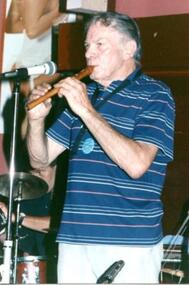
Musical Instrument, Mid to late 20th centurry
... Ade Monsbourgh (1917-2006) was one of Australia's pioneering jazz musicians especially in the period following World War 2 when he played in Graeme Bell's band. ...Used on Ade Monsbourgh's Recorder in Ragtime album of 1956 described by Bruce Johnson as "a unique exercise in jazz on recorder."The significance of this recorder lies in it being both an early example of recorder making in Australia and its connection with internationally recognised Australian jazz musician Ade Monsbourgh. The Pan company was the first to produce recorders in Australia. It was established by jazz musicians Ade Monsbourgh and Don Roberts in the Melbourne suburb of Hawthorn, Victoria in 1951. The company manufactured affordable wooden recorders for school students. Instruments such as this were made using local timbers and featured an innovative section of the mouthpiece (the block unit or windway) which was removable and made of plastic, possibly to allow easier cleaning to occur for the sake of hygiene. It is unknown in what numbers these instruments were made. Ade Monsbourgh (1917-2006) was one of Australia's pioneering jazz musicians especially in the period following World War 2 when he played in Graeme Bell's band. As a talented and influential saxophonist he toured several countries, as well as playing with other leading Australian musicians including Bob and Len Barnard. He was awarded an Order of Australia for his services to music in 1992. Don 'Pixie' Roberts (b.1917) was also an early figure in the Australian jazz scene from the 1930s and, in particular, the Australian Jazz Convention of 1946. He also played with Graeme Bell's band. Alto Recorder belonging to Ade Monsbourghade monsbourgh, alto recorder -
 The Beechworth Burke Museum
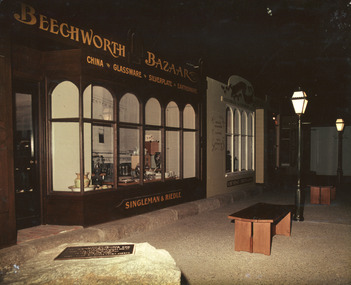
Photograph, 1990s -- estimated
... period in museology.' This photograph evokes the historic shopfronts of Beechworth Bazaar and George Gammon's Chemist and Druggist from the Street of Shops, which were established during the mid-1850s on the back of gold mining wealth. The expansion of banks within Beechworth also stimulated the local economy. Burke Museum Beechworth Beechworth Bazaar 19th-century Victorian history beechworth historic shops Burke Museum Promoting settlement Marketing and retailing Living in country towns Making regional centres Preserving traditions and commemorating Victorian gold rush towns Beechworth pioneers 1850s Beechworth Obverse: BEECHWORTH BAZAAR est. 1855/ CHINA GLASSWARE SILVERPLATE EARTHENWARE/ ? ...Taken in the 1990s, this photograph depicts a line of historically restored shopfronts on Ford Street, Beechworth, with Beechworth Bazaar in the foreground and George Gammon's Chemist and Druggist adjacent to it.This photograph is of social significance to the Beechworth community in depicting the Street of Shops, the creation of curator, Roy Harvey, which opened in 1979 at Burke Museum. According to the Indigo Shire Council webpage for Burke Museum, this addition 'began a new period of collecting with Roy Harvey calling to the community for donations. The response resulted in an influx of material adding to the town history/ development and local identities collections. The Shops and their contents reflect another period in museology.' This photograph evokes the historic shopfronts of Beechworth Bazaar and George Gammon's Chemist and Druggist from the Street of Shops, which were established during the mid-1850s on the back of gold mining wealth. The expansion of banks within Beechworth also stimulated the local economy.Colour rectangular photograph printed on gloss photographic paper.Obverse: BEECHWORTH BAZAAR est. 1855/ CHINA GLASSWARE SILVERPLATE EARTHENWARE/ ?ESTER HO?E/ R.?ALL. ? LT.LITTLEWOO?/ SINGLEMAN & RIEDLE GEORGE GAMMON/ MEDICAL GALVANISM/ CUPPING/ TEETH EXTRACTED/ CHEMIST & DRUGGIST Reverse: 3. 3055 burke museum, beechworth, beechworth bazaar, 19th-century victorian history, beechworth historic shops, burke museum, promoting settlement, marketing and retailing, living in country towns, making regional centres, preserving traditions and commemorating, victorian gold rush towns, beechworth pioneers, 1850s beechworth -
 Federation University Historical Collection
Newspaper, Ballarat Courier, Ballarat 150 years: Supplement to the Ballarat Courier, 1988, 17 March 1988
... Collection of photographs and articles telling the history of Ballarat from the 1800s 1838 pastoral period first settlers anderson family ballarat pioneers aborigines goldfields eureka school of mines technical school ballarat clubs victorian city Newspaper - tabloid Ballarat 150 years: Supplement to the Ballarat Courier, 1988 Newspaper Ballarat Courier ...Collection of photographs and articles telling the history of Ballarat from the 1800sNewspaper - tabloid1838 pastoral period, first settlers, anderson family, ballarat pioneers, aborigines, goldfields, eureka, school of mines, technical school, ballarat clubs, victorian city -
 Flagstaff Hill Maritime Museum and Village
Clothing - Evening Outfit, before April 1874
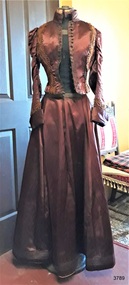
... Beyond their representation of period fashion, the outfit and mannequin are significant due to their association with colonial pioneer families from Australia, specifically Victoria and Warrnambool. ...This amber satin evening outfit was worn by Mrs Isabella Mitchell (nee Russell, 1840 – 1929) at the wedding of her brother Alexander (c.1846–1938) and Eliza (nee Moore, c.1854–1939). The jacket and skirt attach at the waist by joining the metal rings around the base of the jacket, and the metal hooks on the waistband of the skirt. The outfit was donated with its own mannequin and fits it perfectly. In the colonial days, outer clothing was rarely, if ever, washed, due to the expense of fabrics and the difficulty in careful laundering. Clever methods were employed to reduce the occurrence of soiling. The mannequin included with the donation would also help keep the outfit in good shape and ensure a flattering fit. FAMILIES’ HISTORY The families connected with this wedding, where the outfit was worn, are from Warrnambool’s colonial days. Isabella and Alexander’s parents, Robert Russell and Elizabeth (nee Mitchell), were born in 1808 and married about 1830. They were from farming families in Northern Ireland, where they raised their seven children before migrating to Australia in the early colonial days, around 1857. Their graves are in the Tower Hill Cemetery. Alexander’s wife, Eliza (nee Moore, born in 1854), was also from Northern Ireland and migrated to Australia in 1858 with her parents, Thomas and Nancy Moore, in the last voyage of the sailing ship “Chance”. Isabella (Bella) talked with her granddaughter Ruby Akers about her memories of Alexander and Eliza’s wedding and other events in her life. Ruby recorded these memories in a letter. She says, “They were married in the Warrnambool Congregational Church by a pioneer minister, the Reverend Uriah Coombs. The bride wore a pale blue silk wedding gown, which she made herself. Bella was Matron of Honora, and Ian McCasker was best man. In those days, the transport to the church was usually a carriage – similar to a cab – and a pair of white ponies. They would have the reception at home, go for a drive afterwards, and at night there would be a dance. They did all the catering themselves … Eliza carried on farming in the Dennington, Yarpturk and Purnim districts until they moved to Camperdown around 1905…” Ruby’s letter later mentions “[Isabella] could recall seeing a blackfellows’ corroboree being performed near where the Dennington Bridge now stands. It was rather a terrifying experience; they seemed to be in a warlike mood, and one never knew what they would do next. One lubra came running to Granny, crying, Hide me, bad man kill me. She was bleeding from a wound in the head: probably the result of a blow from a waddy. My mother [Margaret Jane McLaughlan nee Mitchell], coming home from school in the 1800s, often met blackfellows walking ahead with spears and boomerang, the two lubras – they usually had two – following in the rear, carrying the children or any burdens they had.“ Margaret was probably in primary school at the time she saw these things. Alexander and Eliza had ten children. One of their daughters, Margaret Jane, was born in Warrnambool in 1879. She married William McCullagh, and they had eleven children. Margaret made headlines in the Warrnambool newspapers for celebrating her 100th birthday. She had lived in the district for 60 years before moving to Melbourne. Alexander passed away at the age of 92, and Eliza passed away six months later, aged 85. Their graves are in the Colac cemetery. Isabella married Ralph Mitchell, and their daughter Margaret Jane married John McLauchlan in 1891. Margaret and John’s daughter, Ruby Elizabeth Jane, married Fredrick Akers in 1938. Fredrick, born in England, was a Boer War veteran and served in the British Army. He migrated to Queensland, Australia, in 1913, and joined the Australian Army to fight in World War I. In 1935, he moved to Warrnambool, where he served in the Volunteer Defence Corps from 1938 to 1945. Both Ruby and Fredrick are buried in the Tower Hill Cemetery.The evening outfit and its accompanying mannequin serve as notable examples of female fashion from the mid to late 1900s. These items reflect the styles and trends that were prevalent during this period, offering insight into the clothing choices and cultural influences that shaped women's attire. Beyond their representation of period fashion, the outfit and mannequin are significant due to their association with colonial pioneer families from Australia, specifically Victoria and Warrnambool. These families played an important role in the development and history of the region, and the items are linked to their legacy. The evening outfit and mannequin are also notable for their connection to a wedding that united two colonial families originating from Northern Ireland. These families immigrated to Australia in the mid-1850s and became influential figures within the Warrnambool district. The wedding marked a significant event, symbolising the merging of two prominent family lineages. Furthermore, the significance of the evening outfit and mannequin extends to their connection with the colonial families’ contact with the indigenous culture of the district. These items represent a period of interaction between the native and European peoples, highlighting the cultural exchanges that occurred within the region. This lady’s evening outfit is made from amber coloured satin fabric. It comprises a short-waisted, long-sleeved jacket and a long skirt, and it has its own neck-to-floor wooden mannequin on a pedestal. The outfit was worn by Mrs Isabella Mitchell (nee Russell) as the Matron of Honour at the wedding of her brother Alexander Russell and his fiancée Eliza Moore in Warrnambool, 29th April 1874.flagstaff hill, warrnambool, shipwrecked coast, flagstaff hill maritime museum, maritime museum, shipwreck coast, flagstaff hill maritime village, great ocean road, evening outfit, wedding outfit, bridesmaid’ outfit, matron of honour outfit, clothing female, clothing late 19th century, clothing wedding late 19th century, clothing bridesmaid late 19th century, clothing antique, clothing ladies, women’s clothing, women’s fashion, alexander russell, eliza russell, eliza moore, isabella mitchell, bella mitchell, bella russell, isabella russell, ralph russell, ian mccusker, ruby akers, fredrick william akers, ruby mclauchlan, margaret jane mclaughlan nee mitchell, margaret jane mclaughlan centenarian, william mclaughlan, robert russell, elizabeth russell nee mitchell, irish immigrants, warrnambool volunteer defence corps 1938-1945, antique satin outfit, warrnambool wedding 1874, congregational church warrnambool, reverend uriah coombs, dennington farmer, yarpturk farmer, purnim district farmer, camperdown resident 1905, dennington bridge, indigenous corroboree in dennington, corroboree in warrnambool, 1880s corroboree in warrnambool, lubra and baby, indigenous corroboree in warrnambool, mccullagh family -
 Flagstaff Hill Maritime Museum and Village
Container - Wooden Box, 1930s
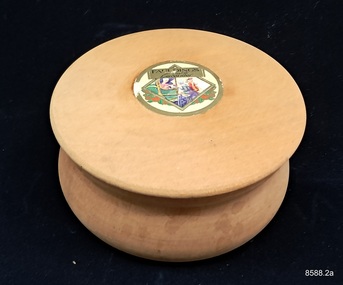
... pioneer in the use of X-rays and in ocular surgery. Flagstaff Hill Maritime Museum and Village Great Ocean Road Shipwreck Coast Warrnambool Shipwtreck Coast Dr W R Angus Faulding's Lavender Powder Cosmetic Faulding's Old English Lavender, and picture of old English men and women in period costume. ...One pharmaceutical enterprise which put greater emphasis on the manufacturing side of its business and whose successors strengthened this emphasis was Faulding's. A pharmacist, Francis H. Faulding, started his shop in Adelaide in 1841 and formed a partnership with an English physician, L. Scammel, in 1861. From its beginnings the firm showed a flare for innovation. After Simpson's discovery of the anaesthetic properties of chloroform in 1847, Francis Faulding was the first to import chloroform; in 1858 he distributed cocaine preparations; in 1864 he produced the first olive oil from South Australian olives and, after J. Lister's reports in Lancet on the reduction of mortality after surgery with the use of phenol, Faulding began production of antiseptics ('Solyptol') in 1867. Faulding was also the first to utilize the medicinal and antiseptic properties of eucalyptus oil which was obtained from distilleries on Kangaroo Island The Second World War in Europe disrupted the supply of cod liver oil, an important source of Vitamin A. Faulding chemists found an alternative source in white schnapper shark, which sustained supplies in Australia as well as generated exports to the UK . When supplies of I.G. Farben's newly discovered sulpha drugs ran out, Faulding became involved in the national program organised by the Medical Equipment Control Committee (MECC) and, jointly with universities, synthesised sulphanilamide. Following the transfer of American knowhow. Faulding's was also the first private enterprise to produce yet another life saving drug of military importance, penicillin. After the war basic synthesis of antibiotics became difficult to sustain by private enterprise because of the gigantic scale advantages of competing US producers, and competition in the synthesis of new drugs demanded huge investment in R & D; Fauldings maintained their business by a combination of marketing, wholesaling and producing consumer and medical products. In the 1970s, however, Fauldings set a remarkable precedent in research strategy and achievement in the Australian pharmaceutical business. They decided to concentrate their research on drugs which had proven efficacy, but which also suffered from certain shortcomings restricting their clinical usefulness, and to seek advances overcoming these shortcomings. This was an imaginative new strategy, a way of grafting Australian knowhow on to major products, in keeping with local resources and yet offering opportunities for sophisticated skill. At the same time it promised to open internatiSurgeon and onal markets, since the major producers of the basic drugs could hardly ignore significant advances. https://www.samhs.org.au/Virtual%20Museum/Medicine/drugs_nonsurg/Fauldings_drug/Fauldings_drugs.html This decorative gift box once containing Faulding’s Old English Lavender soap or powder belonged to Dr. Angus' wife, Gladys. It was donated to Flagstaff Hill Maritime Village by his daughter, Bernice McDade. It is part of the “W.R. Angus Collection” that includes historical medical equipment, surgical instruments and material once belonging to Dr Edward Ryan and Dr Thomas Francis Ryan, (both of Nhill, Victoria) as well as Dr Angus’ own belongings. The Collection’s history spans the medical practices of the two Doctors Ryan, from 1885-1926 plus that of Dr Angus, up until 1969. Powder or soap in boxes such as this was perfumed and used as part of a women’s personal grooming in the early to mid 20th century. Faulding’s Company began in Adelaide, Australia, in 1845 and made a wide range of cosmetic and perfume products as well as pharmaceuticals. The company is still in operation today. ABOUT THE “W.R.ANGUS COLLECTION” Doctor William Roy Angus M.B., B.S., Adel., 1923, F.R.C.S. Edin.,1928 (also known as Dr Roy Angus) was born in Murrumbeena, Victoria in 1901 and lived until 1970. He qualified as a doctor in 1923 at University of Adelaide, was Resident Medical Officer at the Royal Adelaide Hospital in 1924 and for a period was house surgeon to Sir (then Mr.) Henry Simpson Newland. Dr Angus was briefly an Assistant to Dr Riddell of Kapunda, then commenced private practice at Curramulka, Yorke Peninsula, SA, where he was physician, surgeon and chemist. In 1926, he was appointed as new Medical Assistant to Dr Thomas Francis Ryan (T.F. Ryan, or Tom), in Nhill, Victoria, where his experiences included radiology and pharmacy. In 1927 he was Acting House Surgeon in Dr Tom Ryan’s absence. Dr Angus had become engaged to Gladys Forsyth and they decided he further his studies overseas in the UK in 1927. He studied at London University College Hospital and at Edinburgh Royal Infirmary and in 1928, was awarded FRCS (Fellow from the Royal College of Surgeons), Edinburgh. He worked his passage back to Australia as a Ship’s Surgeon on the on the Australian Commonwealth Line’s T.S.S. Largs Bay. Dr Angus married Gladys in 1929, in Ballarat. (They went on to have one son (Graham 1932, born in SA) and two daughters (Helen (died 12/07/1996) and Berenice (Berry), both born at Mira, Nhill ) According to Berry, her mother Gladys made a lot of their clothes. She was very talented and did some lovely embroidery including lingerie for her trousseau and beautifully handmade baby clothes. Dr Angus was a ‘flying doctor’ for the A.I.M. (Australian Inland Ministry) Aerial Medical Service in 1928 . Its first station was in the remote town of Oodnadatta, where Dr Angus was stationed. He was locum tenens there on North-South Railway at 21 Mile Camp. He took up this ‘flying doctor’ position in response to a call from Dr John Flynn; the organisation was later known as the Flying Doctor Service, then the Royal Flying Doctor Service. A lot of his work during this time involved dental surgery also. Between 1928-1932 he was surgeon at the Curramulka Hospital, Yorke Peninsula, South Australia. In 1933 Dr Angus returned to Nhill and purchased a share of the Nelson Street practice and Mira hospital (a 2 bed ward at the Nelson Street Practice) from Dr Les Middleton one of the Middleton Brothers, the current owners of what previously once Dr Tom Ryan’s practice. Dr Tom and his brother had worked as surgeons included eye surgery. Dr Tom Ryan performed many of his operations in the Mira private hospital on his premises. He had been House Surgeon at the Nhill Hospital 1902-1926. Dr Tom Ryan had one of the only two pieces of radiology equipment in Victoria during his practicing years – The Royal Melbourne Hospital had the other one. Over the years Dr Tom Ryan had gradually set up what was effectively a training school for country general-practitioner-surgeons. Each patient was carefully examined, including using the X-ray machine, and any surgery was discussed and planned with Dr Ryan’s assistants several days in advance. Dr Angus gained experience in using the X-ray machine there during his time as assistant to Dr Ryan. When Dr Angus bought into the Nelson Street premises in Nhill he was also appointed as the Nhill Hospital’s Honorary House Surgeon 1933-1938. His practitioner’s plate from his Nhill surgery is now mounted on the doorway to the Port Medical Office at Flagstaff Hill Maritime Village, Warrnambool. When Dr Angus took up practice in the Dr Edward and Dr Tom Ryan’s old premises he obtained their extensive collection of historical medical equipment and materials spanning 1884-1926. A large part of this collection is now on display at the Port Medical Office at Flagstaff Hill Maritime Village in Warrnambool. In 1939 Dr Angus and his family moved to Warrnambool where he purchased “Birchwood,” the 1852 home and medical practice of Dr John Hunter Henderson, at 214 Koroit Street. (This property was sold in1965 to the State Government and is now the site of the Warrnambool Police Station. and an ALDI sore is on the land that was once their tennis court). The Angus family was able to afford gardeners, cooks and maids; their home was a popular place for visiting dignitaries to stay whilst visiting Warrnambool. Dr Angus had his own silk worm farm at home in a Mulberry tree. His young daughter used his centrifuge for spinning the silk. Dr Angus was appointed on a part-time basis as Port Medical Officer (Health Officer) in Warrnambool and held this position until the 1940’s when the government no longer required the service of a Port Medical Officer in Warrnambool; he was thus Warrnambool’s last serving Port Medical Officer. (Masters of immigrant ships arriving in port reported incidents of diseases, illness and death and the Port Medical Officer made a decision on whether the ship required Quarantine and for how long, in this way preventing contagious illness from spreading from new immigrants to the residents already in the colony.) Dr Angus was a member of the Australian Medical Association, for 35 years and surgeon at the Warrnambool Base Hospital 1939-1942, He served as a Surgeon Captain during WWII1942-45, in Ballarat, Victoria, and in Bonegilla, N.S.W., completing his service just before the end of the war due to suffering from a heart attack. During his convalescence he carved an intricate and ‘most artistic’ chess set from the material that dentures were made from. He then studied ophthalmology at the Royal Melbourne Eye and Ear Hospital and created cosmetically superior artificial eyes by pioneering using the intrascleral cartilage. Angus received accolades from the Ophthalmological Society of Australasia for this work. He returned to Warrnambool to commence practice as an ophthalmologist, pioneering in artificial eye improvements. He was Honorary Consultant Ophthalmologist to Warrnambool Base Hospital for 31 years. He made monthly visits to Portland as a visiting surgeon, to perform eye surgery. He represented the Victorian South-West subdivision of the Australian Medical Association as its secretary between 1949 and 1956 and as chairman from 1956 to 1958. In 1968 Dr Angus was elected member of Spain’s Barraquer Institute of Barcelona after his research work in Intrasclearal cartilage grafting, becoming one of the few Australian ophthalmologists to receive this honour, and in the following year presented his final paper on Living Intrasclearal Cartilage Implants at the Inaugural Meeting of the Australian College of Ophthalmologists in Melbourne In his personal life Dr Angus was a Presbyterian and treated Sunday as a Sabbath, a day of rest. He would visit 3 or 4 country patients on a Sunday, taking his children along ‘for the ride’ and to visit with him. Sunday evenings he would play the pianola and sing Scottish songs to his family. One of Dr Angus’ patients was Margaret MacKenzie, author of a book on local shipwrecks that she’d seen as an eye witness from the late 1880’s in Peterborough, Victoria. In the early 1950’s Dr Angus, painted a picture of a shipwreck for the cover jacket of Margaret’s book, Shipwrecks and More Shipwrecks. She was blind in later life and her daughter wrote the actual book for her. Dr Angus and his wife Gladys were very involved in Warrnambool’s society with a strong interest in civic affairs. He had an interest in people and the community They were both involved in the creation of Flagstaff Hill, including the layout of the gardens. After his death (28th March 1970) his family requested his practitioner’s plate, medical instruments and some personal belongings be displayed in the Port Medical Office surgery at Flagstaff Hill Maritime Village, and be called the “W. R. Angus Collection”.Fauldings Company is a very historical Australian company, still in operating today. The powder box is an example of fashion and grooming in the 1930's in Australia. The W.R. Angus Collection is significant for still being located at the site it is connected with, Doctor Angus being the last Port Medical Officer in Warrnambool. The collection of medical instruments and other equipment is culturally significant, being an historical example of medicine from late 19th to mid-20th century. Dr Angus assisted Dr Tom Ryan, a pioneer in the use of X-rays and in ocular surgery.Container, wooden powder box with separate lid. Round box is made from light coloured timber and was sold containing Faulding’s Old English Lavender cosmetic powder. The wooden bowl is light in colour and the lid has a decal with text and images of two ladies facing each other, a gentleman looking over his shoulder at them, and red roses. From the W.R. Angus Collection.Faulding's Old English Lavender, and picture of old English men and women in period costume.flagstaff hill maritime museum and village, great ocean road, shipwreck coast, warrnambool, shipwtreck coast, dr w r angus, faulding's, lavender, powder, cosmetic -
 Flagstaff Hill Maritime Museum and Village
Equipment - Forceps, 20th century
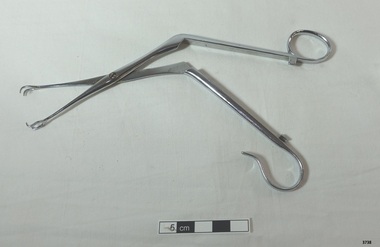
... period of advancement in surgical instruments, including forceps. The famous French Surgeon Jean-Louis Petit introduced forceps with curved tips, making them more suitable for specific procedures. John Hunter, a Scottish surgeon, designed forceps with fine tips, allowing for more delicate and precise manipulation during surgeries. Joseph Lister, a pioneer...period of advancement in surgical instruments, including forceps. The famous French Surgeon Jean-Louis Petit introduced forceps with curved tips, making them more suitable for specific procedures. John Hunter, a Scottish surgeon, designed forceps with fine tips, allowing for more delicate and precise manipulation during surgeries. Joseph Lister, a pioneer ...Surgical forceps have been used in various forms from ancient times and have evolved into a indispensable instrument for modern surgeries. Forceps are surgical instruments for the practice of medicine which are used for grasping, holding, and manipulating tissues and objects during surgical procedures. Ancient Origins Surgical instruments, including forceps, have been use since man first started working with tools. Ancient civilizations, like Egypt, Greece, and Rome, had physicians who used rudimentary forceps made of bronze or iron. The forceps of the ancient world were often simple in design, with two arms that could be squeezed together to grasp objects. They were primarily used for tasks like extracting foreign bodies or handling tissues. Middle Ages and Renaissance During the Middle Ages, medical knowledge and surgical techniques experienced a decline in Europe. While the Roman empire enjoyed remarkably advanced medical care and practices, its collapse left a vacuum that led to a loss of a centralized medical knowledge and a disruption of education and trade. At the same time, religious superstitions suppressed medical inquiry. With many of the medical texts of Hippocrates and Galen and others lost, the medical practice experienced a decline. However, surgical forceps continued to be used in various forms, albeit with limited advancements. With the Renaissance period came a revival in medical knowledge and innovation. Ambroise Paré, a French surgeon of the 16th century, is credited with introducing improvements to the forceps design, making them more versatile and effective. 18th and 19th Centuries Innovators The 18th and 19th centuries marked a significant period of advancement in surgical instruments, including forceps. The famous French Surgeon Jean-Louis Petit introduced forceps with curved tips, making them more suitable for specific procedures. John Hunter, a Scottish surgeon, designed forceps with fine tips, allowing for more delicate and precise manipulation during surgeries. Joseph Lister, a pioneer of antiseptic surgery, emphasized the importance of cleanliness and sterile instruments during surgical procedures. This led to advancements in forceps sterilization techniques, which greatly improved patient outcomes. Modern Era The late 19th and early 20th centuries saw the development of a wide variety of specialized forceps for different surgical procedures. Advances in metallurgy and manufacturing techniques allowed for more intricate and delicate designs. As surgery became more specialized, forceps were tailored to suit specific procedures, such as neurosurgery, ophthalmology, and gynecology. Contemporary Advances In recent decades, surgical technology evolves continuously. Many surgical procedures are now performed using minimally invasive techniques, which require specialized instruments. Modern surgical forceps are typically made of high-quality stainless steel, stainless steel alloy, or titanium. They come in various shapes, sizes, and designs, each suited to specific surgical tasks. Some forceps have serrated jaws for a better grip, while others have delicate tips for fine tissue manipulation. Modern Forceps The history of surgical forceps is a story of innovation, adaptation, and continuous refinement. From ancient origins to the modern era, these instruments have evolved alongside medical knowledge and surgical techniques, playing a crucial role in improving patient outcomes and advancing the field of surgery. https://www.wpiinc.com/blog/post/history-evolution-of-forceps These forceps were donated to Flagstaff Hill Maritime Village by the family of Doctor William Roy Angus, Surgeon and Oculist. It is part of the “W.R. Angus Collection” that includes historical medical equipment, surgical instruments and material once belonging to Dr Edward Ryan and Dr Thomas Francis Ryan, (both of Nhill, Victoria) as well as Dr Angus’ own belongings. The Collection’s history spans the medical practices of the two Doctors Ryan, from 1885-1926 plus that of Dr Angus, up until 1969. ABOUT THE “W.R.ANGUS COLLECTION” Doctor William Roy Angus M.B., B.S., Adel., 1923, F.R.C.S. Edin.,1928 (also known as Dr Roy Angus) was born in Murrumbeena, Victoria in 1901 and lived until 1970. He qualified as a doctor in 1923 at University of Adelaide, was Resident Medical Officer at the Royal Adelaide Hospital in 1924 and for a period was house surgeon to Sir (then Mr.) Henry Simpson Newland. Dr Angus was briefly an Assistant to Dr Riddell of Kapunda, then commenced private practice at Curramulka, Yorke Peninsula, SA, where he was physician, surgeon and chemist. In 1926, he was appointed as new Medical Assistant to Dr Thomas Francis Ryan (T.F. Ryan, or Tom), in Nhill, Victoria, where his experiences included radiology and pharmacy. In 1927 he was Acting House Surgeon in Dr Tom Ryan’s absence. Dr Angus had become engaged to Gladys Forsyth and they decided he further his studies overseas in the UK in 1927. He studied at London University College Hospital and at Edinburgh Royal Infirmary and in 1928, was awarded FRCS (Fellow from the Royal College of Surgeons), Edinburgh. He worked his passage back to Australia as a Ship’s Surgeon on the on the Australian Commonwealth Line’s T.S.S. Largs Bay. Dr Angus married Gladys in 1929, in Ballarat. (They went on to have one son (Graham 1932, born in SA) and two daughters (Helen (died 12/07/1996) and Berenice (Berry), both born at Mira, Nhill According to Berry, her mother Gladys made a lot of their clothes. She was very talented and did some lovely embroidery including lingerie for her trousseau and beautifully handmade baby clothes. Dr Angus was a ‘flying doctor’ for the A.I.M. (Australian Inland Ministry) Aerial Medical Service in 1928. Its first station was in the remote town of Oodnadatta, where Dr Angus was stationed. He was locum tenens there on North-South Railway at 21 Mile Camp. He took up this ‘flying doctor’ position in response to a call from Dr John Flynn; the organisation was later known as the Flying Doctor Service, then the Royal Flying Doctor Service. A lot of his work during this time involved dental surgery also. Between 1928-1932 he was surgeon at the Curramulka Hospital, Yorke Peninsula, South Australia. In 1933 Dr Angus returned to Nhill and purchased a share of the Nelson Street practice and Mira hospital (a 2 bed ward at the Nelson Street Practice) from Dr Les Middleton one of the Middleton Brothers, the current owners of what previously once Dr Tom Ryan’s practice. Dr Tom and his brother had worked as surgeons included eye surgery. Dr Tom Ryan performed many of his operations in the Mira private hospital on his premises. He had been House Surgeon at the Nhill Hospital 1902-1926. Dr Tom Ryan had one of the only two pieces of radiology equipment in Victoria during his practicing years – The Royal Melbourne Hospital had the other one. Over the years Dr Tom Ryan had gradually set up what was effectively a training school for country general-practitioner-surgeons. Each patient was carefully examined, including using the X-ray machine, and any surgery was discussed and planned with Dr Ryan’s assistants several days in advance. Dr Angus gained experience in using the X-ray machine there during his time as assistant to Dr Ryan. When Dr Angus bought into the Nelson Street premises in Nhill he was also appointed as the Nhill Hospital’s Honorary House Surgeon 1933-1938. His practitioner’s plate from his Nhill surgery is now mounted on the doorway to the Port Medical Office at Flagstaff Hill Maritime Village, Warrnambool. When Dr Angus took up practice in the Dr Edward and Dr Tom Ryan’s old premises he obtained their extensive collection of historical medical equipment and materials spanning 1884-1926. A large part of this collection is now on display at the Port Medical Office at Flagstaff Hill Maritime Village in Warrnambool. In 1939 Dr Angus and his family moved to Warrnambool where he purchased “Birchwood,” the 1852 home and medical practice of Dr John Hunter Henderson, at 214 Koroit Street. (This property was sold in1965 to the State Government and is now the site of the Warrnambool Police Station and an ALDI sore is on the land that was once their tennis court). The Angus family was able to afford gardeners, cooks and maids; their home was a popular place for visiting dignitaries to stay whilst visiting Warrnambool. Dr Angus had his own silk worm farm at home in a Mulberry tree. His young daughter used his centrifuge for spinning the silk. Dr Angus was appointed on a part-time basis as Port Medical Officer (Health Officer) in Warrnambool and held this position until the 1940’s when the government no longer required the service of a Port Medical Officer in Warrnambool; he was thus Warrnambool’s last serving Port Medical Officer. (Masters of immigrant ships arriving in port reported incidents of diseases, illness and death and the Port Medical Officer made a decision on whether the ship required Quarantine and for how long, in this way preventing contagious illness from spreading from new immigrants to the residents already in the colony.) Dr Angus was a member of the Australian Medical Association, for 35 years and surgeon at the Warrnambool Base Hospital 1939-1942, He served with the Australian Department of Defence as a Surgeon Captain during WWII 1942-45, in Ballarat, Victoria, and in Bonegilla, N.S.W., completing his service just before the end of the war due to suffering from a heart attack. During his convalescence he carved an intricate and ‘most artistic’ chess set from the material that dentures were made from. He then studied ophthalmology at the Royal Melbourne Eye and Ear Hospital and created cosmetically superior artificial eyes by pioneering using the intrascleral cartilage. Angus received accolades from the Ophthalmological Society of Australasia for this work. He returned to Warrnambool to commence practice as an ophthalmologist, pioneering in artificial eye improvements. He was Honorary Consultant Ophthalmologist to Warrnambool Base Hospital for 31 years. He made monthly visits to Portland as a visiting surgeon, to perform eye surgery. He represented the Victorian South-West subdivision of the Australian Medical Association as its secretary between 1949 and 1956 and as chairman from 1956 to 1958. In 1968 Dr Angus was elected member of Spain’s Barraquer Institute of Barcelona after his research work in Intrasclearal cartilage grafting, becoming one of the few Australian ophthalmologists to receive this honour, and in the following year presented his final paper on Living Intrasclearal Cartilage Implants at the Inaugural Meeting of the Australian College of Ophthalmologists in Melbourne In his personal life Dr Angus was a Presbyterian and treated Sunday as a Sabbath, a day of rest. He would visit 3 or 4 country patients on a Sunday, taking his children along ‘for the ride’ and to visit with him. Sunday evenings he would play the pianola and sing Scottish songs to his family. One of Dr Angus’ patients was Margaret MacKenzie, author of a book on local shipwrecks that she’d seen as an eye witness from the late 1880’s in Peterborough, Victoria. In the early 1950’s Dr Angus, painted a picture of a shipwreck for the cover jacket of Margaret’s book, Shipwrecks and More Shipwrecks. She was blind in later life and her daughter wrote the actual book for her. Dr Angus and his wife Gladys were very involved in Warrnambool’s society with a strong interest in civic affairs. He had an interest in people and the community. They were both involved in the creation of Flagstaff Hill, including the layout of the gardens. After his death (28th March 1970) his family requested his practitioner’s plate, medical instruments and some personal belongings be displayed in the Port Medical Office surgery at Flagstaff Hill Maritime Village, and be called the “W. R. Angus Collection”. The W.R. Angus Collection is significant for still being located at the site it is connected with, Doctor Angus being the last Port Medical Officer in Warrnambool. The collection of medical instruments and other equipment is culturally significant, being an historical example of medicine, administration, household equipment and clothing from late 19th to mid-20th century. Dr Angus assisted Dr Tom Ryan, a pioneer in the use of X-rays and in ocular surgery. Forceps from W.R. Angus Collection. Stainless steel, elbow shape in middle, hollow claw shape ends, one handle is open circle, handles clip together. flagstaff hill, warrnambool, shipwrecked coast, flagstaff hill maritime museum, maritime museum, shipwreck coast, flagstaff hill maritime village, great ocean road, dr w r angus, dr ryan, surgical instrument, t.s.s. largs bay, warrnambool base hospital, nhill base hospital, mira hospital, flying doctor, department of defence australia, australian army, army uniform, medical treatment, medical history, medical education, forceps, surgery -
 Flagstaff Hill Maritime Museum and Village
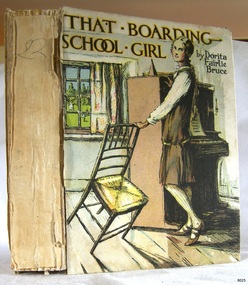
Book - Fiction, Oxford University Press, That Boarding School Girl, 1926
... period. The book is important as a connection to the early township of Dennington, a community distinguished by its established school and church. This association reflects the values the community placed on education and religious instruction. The book’s significance is further enhanced by its relationship with colonial pioneer ...Sylvia Jean Veronica McCullagh Barr (1914–1998) was a student at the Presbyterian Sabbath School in Dennington, near Warrnambool. In December 1930, she received a book as an award from F. Jones, the Sabbath School Superintendent, recognising her involvement and achievements at the school. Sylvia was the granddaughter of James McCullagh (1831–1911) and Elizabeth Eccles (1831–1909), a pioneering couple in the region. Married in 1856, James and Elizabeth settled at Oak Grove, Yangery, Illowa from 1859, where they lived until their deaths. One of James and Elizabeth’s sons, William McCullagh (1873–1940), married Margaret Jane Russell (1879–1981). William and Margaret also made their home at Oak Grove and raised eleven children there, including Sylvia.The book, “That Boarding School Girl” by Dorita Fairlie Bruce, represents an example of literature accessible to older girls during the early 20th century. It was specifically selected as an end-of-year award, recognising consistent attendance at Sabbath School. Such choices highlight the role of books in supporting the educational and moral development of young women during this period. The book is important as a connection to the early township of Dennington, a community distinguished by its established school and church. This association reflects the values the community placed on education and religious instruction. The book’s significance is further enhanced by its relationship with colonial pioneer families in Australia, particularly those from Victoria and the Warrnambool district in southwest Victoria. It is a tangible link to the history and legacy of these early settlers, who were instrumental in shaping the regional development. That Boarding School Girl Author: Dorita Fairlie Bruce Publisher: Oxford University Press Date: 1926 The front cover and the page opposite the fly page have drawn and coloured illustrations. The cloth-covered, hardcover book includes black and white illustrations and coloured illustrations on the front cover and frontispiece. The front cover illustration shows a teenage irl in a school tunic, standing beside a piano with one hand on the backrest of a tilted chair. Inscriptions are printed on the front loose endpaper and handwritten on the fly page. The book belonged to Sylvia McCullagh. It was awarded to her as a prize in 1930.Handwritten on the top of the fly page: "Sylvia McCullagh Den" [ Den - abbreviation for Dennington] " Presbyterian Sabbath School, Dennington. Prize Awarded to: Sylvia McCullagh. December 1930." "F. Jones, Superintendent"flagstaff hill, flagstaff hill maritime museum and village, warrnambool, maritime museum, maritime village, great ocean road, shipwreck coast, book, warrnambool library, warrnambool mechanics’ institute, mechanics’ institute library, victorian library board, warrnambool books and records, warrnambool children’s library, warrnambool public library, that boarding school girl, dorita fairlie bruce, sylvia mccullagh, sylvia jean veronica mccullagh, sylvia barr, james mccullagh, elizabeth eccles mccullagh, william mccullagh, margaret jane russell mccullagh, oak grove, yangery, illowa, dennington, presbyterian sabbath school, presbyterian sunday school, dennington presbyterian church, book award, book prize, book presentation, f. jones, sabbath school superintendent, 1930 -
 Flagstaff Hill Maritime Museum and Village
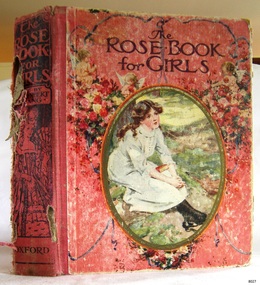
Book - Fiction, Mrs Herbert Strang, editor, The Rose Book for Girls, 1916
... period. The book is important as a connection to the early township of Dennington, a community distinguished by its established school and church. This association reflects the values the community placed on education and religious instruction. The book’s significance is further enhanced by its relationship with colonial pioneer ...Alma McCullagh was a student at the Presbyterian Sabbath School located in Dennington, near Warrnambool. In January, around 1928, she received a book as an award from R. Conn, her Sabbath School teacher, in recognition of her involvement and achievements at the school. The exact year of this award is based on available records: in January 1928, Alma was presented with a prize by R. Conn, whereas by 1930, the role of awarding prizes had passed to F. Jones. Alma was probably the granddaughter of James McCullagh (1831–1911) and Elizabeth Eccles (1831–1909), who were pioneering settlers in the region. James and Elizabeth married in 1856 and established their home at Oak Grove, Yangery, Illowa from 1859, residing there until their deaths. One of their sons, William McCullagh (1873–1940), married Margaret Jane Russell (1879–1981). William and Margaret continued the family tradition, making their home at Oak Grove as well. They raised eleven children, with Alma likely being among the youngest of their children.The book, “The Rose Book for Girls”, edited by Mrs Herbert Strang, represents an example of literature accessible to older girls during the early 20th century. It was specifically selected as an end-of-year award, recognising consistent attendance at Sabbath School. Such choices highlight the role of books in supporting the educational and moral development of young women during this period. The book is important as a connection to the early township of Dennington, a community distinguished by its established school and church. This association reflects the values the community placed on education and religious instruction. The book’s significance is further enhanced by its relationship with colonial pioneer families in Australia, particularly those from Victoria and the Warrnambool district in southwest Victoria. It is a tangible link to the history and legacy of these early settlers, who were instrumental in shaping the regional development. In addition, the book is notable for its connection to the McCullagh family, a prominent farming family whose contributions supported the social and economic growth of the local district. This historical association enriches its value, situating the book within the broader narrative of community progress and pioneer achievement in the area, and highlighting its place within a tradition of religious life and community building.The Rose Book for Girls A collection of short stories by various authors Edited by Mrs Herbert Strang Publisher: Henry Frowde, Hodder & Stoughton, London Printer: Morrison & Gibb Ltd., Tanfield, Edinburgh, Scotland, UK Date: 1916 Hardcover book. Deep pink front and back covers, decorated with garlands of pink and white flowers, cupids and blue ribbons. The front has a cameo with a seated girl in white, with a book in her lap. Details on the spine: title, author, publisher and a sketched female in 19th-century dress holding a fan. The fly page shows details of the book and has a black and red sketch of two seated girls, one reading, the other stitching. Twenty-five books are listed on the Contents page, as well as the printer's details. Within the book are several colourful sketches. Inscriptions include the name of the book's previous owner, Alma McCullagh.Front loose-end paper: "Presbyterian Sabbath School, Dennington. Prize Awarded to: Alma McCullagh. January. (year is unreadable, circa 1928) R. Conn, Teacher"flagstaff hill, flagstaff hill maritime museum and village, warrnambool, maritime museum, maritime village, great ocean road, shipwreck coast, book, the rose book for girls, mrs herbert strang, short stories, henry frowde, hodder & stoughton, london, morrison & gibb ltd, 1916, alma mccullagh, james mccullagh, elizabeth eccles mccullagh, ca. 1928, dennington, southwest victoria, warrnambool district, presbyterian sabbath school, presbyterian sunday school, dennington presbyterian church, book award, book prize, book presentation, r. conn, sabbath school superintendent -
 Flagstaff Hill Maritime Museum and Village
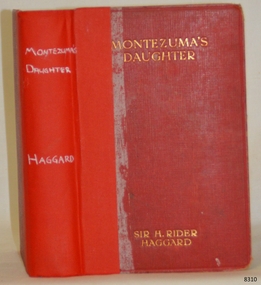
Book - Fictional Novel, H Rider Haggard, author, Montezumas Daughter, 1893
... pioneered the "Lost World" literary genre. Born in Norfolk, he spent his formative early adulthood in South Africa as a government official, a period that deeply inspired his most famous works, such as King Solomon’s Mines (1885) and She (1887). ...pioneered the "Lost World" literary genre. Born in Norfolk, he spent his formative early adulthood in South Africa as a government official, a period that deeply inspired his most famous works, such as King Solomon’s Mines (1885) and She (1887). ...Montezuma’s Daughter (1893) is an epic Victorian adventure and historical fiction novel set during the sixteenth-century Spanish conquest of the Aztec Empire. The story is narrated in the first person by an elderly Englishman, Thomas Wingfield, reflecting on the tumultuous journey of his youth. After his Spanish mother is murdered by his malicious cousin, Juan de Garcia, Thomas embarks on a quest for vengeance. His pursuit takes him across Europe, through a brush with the Spanish Inquisition, and onto a ship bound for the New World. Following a shipwreck and capture, Thomas finds himself in Mexico, where he is initially slated for Aztec human sacrifice. He is ultimately spared, rises to high status among the Aztecs, and marries Princess Otomie, the daughter of Emperor Montezuma. The narrative reaches its emotional and historical peak as Thomas fights alongside the Aztecs against Hernán Cortés during the brutal siege and fall of Tenochtitlan. Prior to its book release, the novel was serialised in the British weekly newspaper The Graphic between July and November of 1893. Longmans, Green, and Co. published the official first book edition in London on November 13, 1893, printing an initial run of 10,000 copies.Montezumas Daughter Author: H Rider Haggard Publisher: Longmans Green Date: 1893 A novel in a red, hard covered book with a reinforced spine with a handwritten title, front cover has gold embossed title. Inscriptions include stickers and a stamp. It is part of the Pattison Collection.fictionMontezuma’s Daughter (1893) is an epic Victorian adventure and historical fiction novel set during the sixteenth-century Spanish conquest of the Aztec Empire. The story is narrated in the first person by an elderly Englishman, Thomas Wingfield, reflecting on the tumultuous journey of his youth. After his Spanish mother is murdered by his malicious cousin, Juan de Garcia, Thomas embarks on a quest for vengeance. His pursuit takes him across Europe, through a brush with the Spanish Inquisition, and onto a ship bound for the New World. Following a shipwreck and capture, Thomas finds himself in Mexico, where he is initially slated for Aztec human sacrifice. He is ultimately spared, rises to high status among the Aztecs, and marries Princess Otomie, the daughter of Emperor Montezuma. The narrative reaches its emotional and historical peak as Thomas fights alongside the Aztecs against Hernán Cortés during the brutal siege and fall of Tenochtitlan. Prior to its book release, the novel was serialised in the British weekly newspaper The Graphic between July and November of 1893. Longmans, Green, and Co. published the official first book edition in London on November 13, 1893, printing an initial run of 10,000 copies.flagstaff hill, warrnambool, shipwrecked coast, flagstaff hill maritime museum, maritime museum, shipwreck coast, flagstaff hill maritime village, great ocean road, book, pattison collection, warrnambool library, warrnambool mechanics’ institute, ralph eric pattison, corangamite regional library service, warrnambool city librarian, mechanics’ institute library, victorian library board, warrnambool books and records, warrnambool children’s library, montezumas daughter, h rider haggard, longmans green and co., thomas longman, paternoster row london, free library -
 Flagstaff Hill Maritime Museum and Village
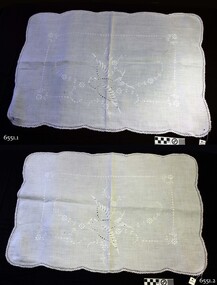
Textile - Pillow Shams, Daisy Dale, 1844-1900
... period of three generations from Sarah (nee Chamberlain) Lees, Ann (nee Lees) Dale, and Daisy Elvena (nee Dale) Welsh. All three were accomplished needlewomen, both Sarah Lees (born 1844) and her daughter, Ann (1865) these women crocheted a wide variety of articles for use in their homes. Today we have a few surviving examples of their skill that has survived the years. This item and others in the collection donated by Betty Stone are significant for their association with the early Warrnambool pioneering ...The two embroidered pillow shams were made by Betty Stones's mother Daisy (nee Dale) Welsh. A number of crocheted and embroidered articles were donated to Flagstaff Hill Museum by Betty Stone who advised that they cover a period of three generations from Sarah (nee Chamberlain) Lees, Ann (nee Lees) Dale, and Daisy Elvena (nee Dale) Welsh. All three were accomplished needlewomen, both Sarah Lees (born 1844) and her daughter, Ann (1865) these women crocheted a wide variety of articles for use in their homes. Today we have a few surviving examples of their skill that has survived the years.This item and others in the collection donated by Betty Stone are significant for their association with the early Warrnambool pioneering families of Chamberlain, Dale and Lees. These families are listed in the "Pioneers' Register" for Warrnambool Township and Shire, 1835-1900, and published by A.I.G.S. Warrnambool Branch. The item is a fine example of early 20th-century needlework and handmade domestic items.A pair of white pillow shams, rectangular in shape with a shallow scalloped crochet edge. The embroidered central design includes a bird motif. Made by Daisy Walsh (nee Dale). Part of the Chamberlain Dale Lees Collection.flagstaff hill, warrnambool, flagstaff hill maritime museum and village, great ocean road, chamberlain family, dale family, lees family, betty stone, warrnambool pioneer, warrnambool genealogy, wangoom, chamberlain dale lees collection, glory box, handmade, craft, manchester, linen, haberdashery, needlework, crochet, pillow shams, bed linen, pillow covers, daisy dale, daisy welsh, betty stone's mother -
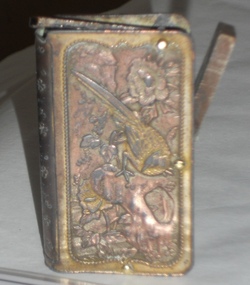 City of Moorabbin Historical Society (Operating the Box Cottage Museum)
Domestic object - Personal Effects, Vesta case tin, c1860
... period, almost everyone carried strike anywhere matches, so they could light stoves, lanterns and other devices. Early matches were unreliable and prone to ignite from rubbing on one another or spontaneously. Accordingly, most people carried a match safe / box to house their matches. Wealthy people had match safes made of gold or silver, while common folk had ones made of tin or brass. jewellery personal effects craftwork vesta case lights candles safety matches moorabbin brighton bentleigh cheltenham early settlers pioneers Embossed with a Japanese type bird design on the front and back . c1860 A small tin Japanesque vesta case, with a roughened strike plate, to hold matches for lighting fires, lamps, cigarettes or pipes. ...A Vesta case is a small, portable box / safe to carry matches and came into use around the 1830s and were produced extensively between 1890 and 1920. During this period, almost everyone carried strike anywhere matches, so they could light stoves, lanterns and other devices. Early matches were unreliable and prone to ignite from rubbing on one another or spontaneously. Accordingly, most people carried a match safe / box to house their matches. Wealthy people had match safes made of gold or silver, while common folk had ones made of tin or brass.c1860 A small tin Japanesque vesta case, with a roughened strike plate, to hold matches for lighting fires, lamps, cigarettes or pipes. The tin case has been embossed with a Japanese type bird design on the front and back and then coated with copper and brass to decorate and highlight different parts of the design.Embossed with a Japanese type bird design on the front and back . jewellery, personal effects, craftwork, vesta case, lights, candles, safety matches, moorabbin, brighton, bentleigh, cheltenham, early settlers, pioneers -
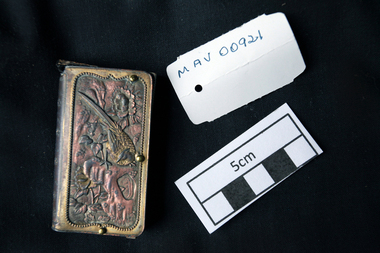 City of Moorabbin Historical Society (Operating the Box Cottage Museum)
Personal Effects, vesta case silver, c1900
... period, almost everyone carried strike-anywhere matches, so they could light stoves, lanterns and other devices. Early matches were unreliable and prone to ignite from rubbing on one another or spontaneously. Accordingly, most people carried a match safe / box to house their matches. Wealthy people had match safes made of gold or silver, while common folk had ones made of tin or brass. jewellery personal effects craftwork vesta case lights candles safety matches moorabbin brighton bentleigh cheltenham early settlers pioneers Embossed with bird and floral design on the front and back . ...A Vesta case is a small, portable box / safe to carry matches that came into use around the 1830s and was produced extensively between 1890 and 1920. During this period, almost everyone carried strike-anywhere matches, so they could light stoves, lanterns and other devices. Early matches were unreliable and prone to ignite from rubbing on one another or spontaneously. Accordingly, most people carried a match safe / box to house their matches. Wealthy people had match safes made of gold or silver, while common folk had ones made of tin or brass.C 1900 A small silver vesta case, with a roughened strike plate, to hold matches for lighting fires, lamps, cigarettes or pipes. The tin case has been embossed with a bird and floral design on the front and back Embossed with bird and floral design on the front and back .jewellery, personal effects, craftwork, vesta case, lights, candles, safety matches, moorabbin, brighton, bentleigh, cheltenham, early settlers, pioneers -
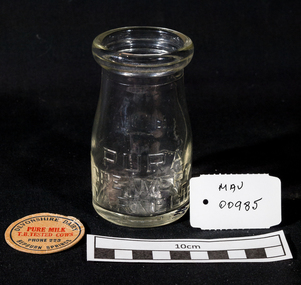 City of Moorabbin Historical Society (Operating the Box Cottage Museum)
Manufactured Glass, bottle PURA Cream 4oz, 20thC
... The former glassworks was established in 1890 and originally made bottles for pharmacists Felton Grimwade before it was sold to the state government by US multinational, OI glass manufacturers melbourne glass bottle works, spotswood melbourne, milk, dairy, dairy produce, dairy farmers, market gardeners, pioneers, early settlers, moorabbin, cheltenham, pasteur louis, pasteurization, pura creamery carnegie devonshire dairy hepburn springs waxed paper milk bottle lids felton grimwade co ltd, Bottle : PURA / CREAMERY / CARNEGIE / CONTENTS 4 OZS Base : 120 Lid circumference : DEVONSHIRE DAIRY HEPBURN SPRINGS:/ Lid centre: PURE MILK/ T.B. TESTED COWS / PHONE 223 A clear glass 4 oz bottle for PURA Creamery Carnegie. . A waxed cardboard disc lid from Devonshire Dairy Hepburn Springs is not related to this bottle but is an example of the typical lid used during this period ...There are two distinct types of milk consumption: a natural source of nutrition for all infant mammals and a food product for humans of all ages that is derived from other animals. Milk is a key contributor to improving nutrition and food security particularly in developing countries. Improvements in livestock and dairy technology offer significant promise in reducing poverty and malnutrition in the world. Pasteurization is used to kill harmful micro-organisms by heating the milk for a short time and then immediately cooling it. In the past, milk was always packaged in glass milk bottles The first glass bottle packaging for milk was used in the 1870s. The first company to do so may have been the New York Dairy Company in 1877 with a small glass lid and a tin clip. Lewis P. Whiteman holds the first patent for a glass milk bottle c1884,which was sealed with a waxed paper disk. The Express Dairy Company in England began glass bottle production in 1880. Melbourne Glass Bottle Works Spotswood 1880 - 1990. Milk cartons first came to Australia in 1958, when the Model Dairy in Melbourne began packaging milk in 150 ml and 500 ml cartons. At the time, 160,000 new glass bottles were needed in Melbourne alone every week to keep up the delivery of 1.3 million bottles of milk a day. n 1970, the blow-moulded disposable plastic milk bottle was introduced. In 1987, only about 2% of milk was still being sold in glass bottles. Glass milk bottles are now rare .Melbourne Glass Bottle Works Co Pty Ltd (1903 - 1915) Registered in Victoria in 1903 the company amalgamated with the Waterloo Glass Bottle Works Ltd in 1915 to form Australian Glass Manufacturers Company, Limited. Melbourne Glass bottle works Spotswood 1872- 1915 The Melbourne Glass Bottle Works (former), comprising a complex of buildings constructed between 1880 and 1940, at Booker Street, Douglas Parade, 2-38 Hudson Road, Raleigh Street and Simcock Avenue, Spotswood. The former glassworks was established in 1890 and originally made bottles for pharmacists Felton Grimwade before it was sold to the state government by US multinational, OI glass manufacturers A clear glass 4 oz bottle for PURA Creamery Carnegie. . A waxed cardboard disc lid from Devonshire Dairy Hepburn Springs is not related to this bottle but is an example of the typical lid used during this period Bottle : PURA / CREAMERY / CARNEGIE / CONTENTS 4 OZS Base : 120 Lid circumference : DEVONSHIRE DAIRY HEPBURN SPRINGS:/ Lid centre: PURE MILK/ T.B. TESTED COWS / PHONE 223 melbourne glass bottle works, spotswood melbourne, milk, dairy, dairy produce, dairy farmers, market gardeners, pioneers, early settlers, moorabbin, cheltenham, pasteur louis, pasteurization, pura creamery carnegie, devonshire dairy, hepburn springs, waxed paper milk bottle lids, felton grimwade co ltd, -
Glenelg Shire Council Cultural Collection
Programme - Programme - Pioneer Week 1983, n.d
... Pioneer Week, 11-20 NOV 1983. These events were a prelude to the 150th celebrations to be held in November 1984. Programme typed on pink paper, burgundy border, heading 'Victoria's 150th Anniversary', man and woman in period dress bottom left....Pioneer Week, 11-20 NOV 1983. These events were a prelude to the 150th celebrations to be held in November 1984. Programme typed on pink paper, burgundy border, heading 'Victoria's 150th Anniversary', man and woman in period dress bottom left. ...Pioneer Week 1983Programme of events for Pioneer Week, 11-20 NOV 1983. These events were a prelude to the 150th celebrations to be held in November 1984. Programme typed on pink paper, burgundy border, heading 'Victoria's 150th Anniversary', man and woman in period dress bottom left. -
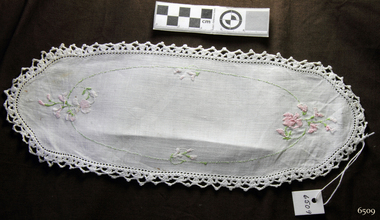 Flagstaff Hill Maritime Museum and Village
Textile - Doily, c. 1910
... period of three generations- ie. Sarah (nee Chamberlain) Lees, Ann (nee Lees) Dale, and Daisy Elvena (nee Dale) Welsh. All three were accomplished needlewomen; also, both Sarah Lees (born 1844) and her daughter, Ann (b 1865) crocheted a wide variety of articles for use in their homes. A few examples of these items have survived the years.” (NOTE: For additional information please refer to my book Pioneer...period of three generations- ie. Sarah (nee Chamberlain) Lees, Ann (nee Lees) Dale, and Daisy Elvena (nee Dale) Welsh. All three were accomplished needlewomen; also, both Sarah Lees (born 1844) and her daughter, Ann (b 1865) crocheted a wide variety of articles for use in their homes. A few examples of these items have survived the years.” (NOTE: For additional information please refer to my book Pioneer ...This doily is typical of items of household linen in popular use in the 19th and early-to-mid 20th centuries. It was a tradition for brides to have a 'glory box' containing linen and embroidered and crocheted articles to take to their new home. In the Words of donor, Betty Stone, … “These crocheted and embroidered articles cover a period of three generations- ie. Sarah (nee Chamberlain) Lees, Ann (nee Lees) Dale, and Daisy Elvena (nee Dale) Welsh. All three were accomplished needlewomen; also, both Sarah Lees (born 1844) and her daughter, Ann (b 1865) crocheted a wide variety of articles for use in their homes. A few examples of these items have survived the years.” (NOTE: For additional information please refer to my book Pioneer and Places- A History of Three Warrnambool Pioneering Families ie. Chamberlain, Dale and Lees families)This item is associated with the Warrnambool pioneer families of Chamberlain, Dale and Lees. These families are listed in the Pioneers' Register for Warrnambool Township and Shire, 1835-1900, published by A.I.G.S. Warrnambool Branch. The item is a fine example of early 20th-century needlework.Doily; white rectangular shape, pointed on short sides. Embroidered with pink flowers and green stems, and embellished with a lace frill. Part of the Chamberlain Dale Lees Collection.flagstaff hill, warrnambool, flagstaff hill maritime museum and village, great ocean road, chamberlain family, dale family, lees family, betty stone, warrnambool pioneer, warrnambool genealogy, wangoom, chamberlain dale lees collection, glory box, doily, embroidery, needlework, crochet, handmade, craft, manchester -
 Flagstaff Hill Maritime Museum and Village
Textile - Doily, c. 1910
... period of three generations- ie. Sarah (nee Chamberlain) Lees, Ann (nee Lees) Dale, and Daisy Elvena (nee Dale) Welsh. All three were accomplished needlewomen; also, both Sarah Lees (born 1844) and her daughter, Ann (b 1865) crocheted a wide variety of articles for use in their homes. A few examples of these items have survived the years.” (NOTE: For additional information please refer to my book Pioneer...period of three generations- ie. Sarah (nee Chamberlain) Lees, Ann (nee Lees) Dale, and Daisy Elvena (nee Dale) Welsh. All three were accomplished needlewomen; also, both Sarah Lees (born 1844) and her daughter, Ann (b 1865) crocheted a wide variety of articles for use in their homes. A few examples of these items have survived the years.” (NOTE: For additional information please refer to my book Pioneer ...This doily is typical of items of household linen in popular use in the 19th and early-to-mid 20th centuries. It was a tradition for brides to have a 'glory box' containing linen and embroidered and crocheted articles to take to their new home. In the Words of donor, Betty Stone, … “These crocheted and embroidered articles cover a period of three generations- ie. Sarah (nee Chamberlain) Lees, Ann (nee Lees) Dale, and Daisy Elvena (nee Dale) Welsh. All three were accomplished needlewomen; also, both Sarah Lees (born 1844) and her daughter, Ann (b 1865) crocheted a wide variety of articles for use in their homes. A few examples of these items have survived the years.” (NOTE: For additional information please refer to my book Pioneer and Places- A History of Three Warrnambool Pioneering Families ie. Chamberlain, Dale and Lees families)This item is associated with the Warrnambool pioneer families of Chamberlain, Dale and Lees. These families are listed in the Pioneers' Register for Warrnambool Township and Shire, 1835-1900, published by A.I.G.S. Warrnambool Branch. The item is a fine example of early 20th-century needlework.Doily, Ovate in shape. White fabric embroidered with a brown bowl with blue and pink flowers and trimmed with crocheted edge. Part of the 'Chamberlain Dale Lees Collection. flagstaff hill, warrnambool, flagstaff hill maritime museum and village, great ocean road, chamberlain family, dale family, lees family, betty stone, warrnambool pioneer, warrnambool genealogy, wangoom, chamberlain dale lees collection, glory box, doily, embroidery, needlework, crochet, handmade, craft, manchester, linen -
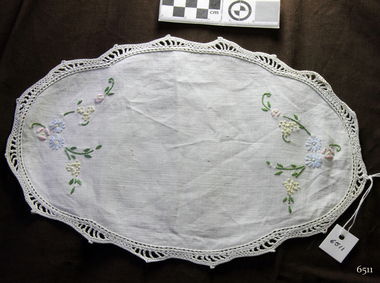 Flagstaff Hill Maritime Museum and Village
Textile - Doily, c. 1910
... period of three generations- ie. Sarah (nee Chamberlain) Lees, Ann (nee Lees) Dale, and Daisy Elvena (nee Dale) Welsh. All three were accomplished needlewomen; also, both Sarah Lees (born 1844) and her daughter, Ann (b 1865) crocheted a wide variety of articles for use in their homes. A few examples of these items have survived the years.” (NOTE: For additional information please refer to my book Pioneer...period of three generations- ie. Sarah (nee Chamberlain) Lees, Ann (nee Lees) Dale, and Daisy Elvena (nee Dale) Welsh. All three were accomplished needlewomen; also, both Sarah Lees (born 1844) and her daughter, Ann (b 1865) crocheted a wide variety of articles for use in their homes. A few examples of these items have survived the years.” (NOTE: For additional information please refer to my book Pioneer ...This doily is typical of items of household linen in popular use in the 19th and early-to-mid 20th centuries. It was a tradition for brides to have a 'glory box' containing linen and embroidered and crocheted articles to take to their new home. In the Words of donor, Betty Stone, … “These crocheted and embroidered articles cover a period of three generations- ie. Sarah (nee Chamberlain) Lees, Ann (nee Lees) Dale, and Daisy Elvena (nee Dale) Welsh. All three were accomplished needlewomen; also, both Sarah Lees (born 1844) and her daughter, Ann (b 1865) crocheted a wide variety of articles for use in their homes. A few examples of these items have survived the years.” (NOTE: For additional information please refer to my book Pioneer and Places- A History of Three Warrnambool Pioneering Families ie. Chamberlain, Dale and Lees families)This item is associated with the Warrnambool pioneer families of Chamberlain, Dale and Lees. These families are listed in the Pioneers' Register for Warrnambool Township and Shire, 1835-1900, published by A.I.G.S. Warrnambool Branch. The item is a fine example of early 20th-century needlework.Doily, Oblong white linen embroidered with pink, blue and yellow flowers and green stems. Finished with crocheted edging. Part of the Chamberlain Dale Lees Collectionflagstaff hill, warrnambool, flagstaff hill maritime museum and village, great ocean road, chamberlain family, dale family, lees family, betty stone, warrnambool pioneer, warrnambool genealogy, wangoom, chamberlain dale lees collection, glory box, doily, embroidery, needlework, crochet, handmade, craft, manchester, linen, haberdashery -
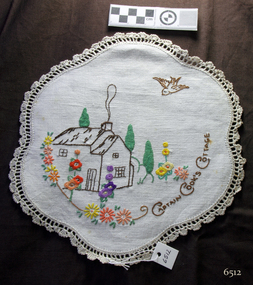 Flagstaff Hill Maritime Museum and Village
Textile - Doily, Captain Cook's Cottage, c. 1934
... period of three generations- ie. Sarah (nee Chamberlain) Lees, Ann (nee Lees) Dale, and Daisy Elvena (nee Dale) Welsh. All three were accomplished needlewomen; also, both Sarah Lees (born 1844) and her daughter, Ann (b 1865) crocheted a wide variety of articles for use in their homes. A few examples of these items have survived the years.” (NOTE: For additional information please refer to my book Pioneer...period of three generations- ie. Sarah (nee Chamberlain) Lees, Ann (nee Lees) Dale, and Daisy Elvena (nee Dale) Welsh. All three were accomplished needlewomen; also, both Sarah Lees (born 1844) and her daughter, Ann (b 1865) crocheted a wide variety of articles for use in their homes. A few examples of these items have survived the years.” (NOTE: For additional information please refer to my book Pioneer ...This doily is typical of items of household linen in popular use in the 19th and early-to-mid 20th centuries. It was a tradition for brides to have a 'glory box' containing linen and embroidered and crocheted articles to take to their new home. The featured image of Captain Cook's Cottage suggests that the doily was embroidered around the time of the transfer of the cottage in Melbourne. The cottage was constructed in 1755 in England and was brought to Australia in 1934 and installed in the Fitzroy Gardens, Melbourne. In the Words of donor, Betty Stone, … “These crocheted and embroidered articles cover a period of three generations- ie. Sarah (nee Chamberlain) Lees, Ann (nee Lees) Dale, and Daisy Elvena (nee Dale) Welsh. All three were accomplished needlewomen; also, both Sarah Lees (born 1844) and her daughter, Ann (b 1865) crocheted a wide variety of articles for use in their homes. A few examples of these items have survived the years.” (NOTE: For additional information please refer to my book Pioneer and Places- A History of Three Warrnambool Pioneering Families ie. Chamberlain, Dale and Lees families)This item is associated with the Warrnambool pioneer families of Chamberlain, Dale and Lees. These families are listed in the Pioneers' Register for Warrnambool Township and Shire, 1835-1900, published by A.I.G.S. Warrnambool Branch. The item is a fine example of 1930's needlework.Doily, ovate in shape. White cotton embroidered with a cottage scene and named "Captain Cook's Cottage"; the image includes flowers, trees and a bird. The edge is crocheted. Part of the Chamberlain Dale Lees Collection. Embroidered on doily "Captain Cook's Cottage"flagstaff hill, warrnambool, flagstaff hill maritime museum and village, great ocean road, chamberlain family, dale family, lees family, betty stone, warrnambool pioneer, warrnambool genealogy, wangoom, chamberlain dale lees collection, glory box, doily, embroidery, needlework, crochet, handmade, craft, manchester, linen, haberdashery, captain cook's cottage -
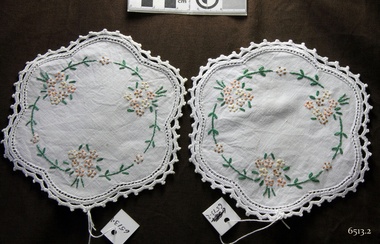 Flagstaff Hill Maritime Museum and Village
Textile - Doily, c. 1910
... period of three generations- ie. Sarah (nee Chamberlain) Lees, Ann (nee Lees) Dale, and Daisy Elvena (nee Dale) Welsh. All three were accomplished needlewomen; also, both Sarah Lees (born 1844) and her daughter, Ann (b 1865) crocheted a wide variety of articles for use in their homes. A few examples of these items have survived the years.” (NOTE: For additional information please refer to my book Pioneer...period of three generations- ie. Sarah (nee Chamberlain) Lees, Ann (nee Lees) Dale, and Daisy Elvena (nee Dale) Welsh. All three were accomplished needlewomen; also, both Sarah Lees (born 1844) and her daughter, Ann (b 1865) crocheted a wide variety of articles for use in their homes. A few examples of these items have survived the years.” (NOTE: For additional information please refer to my book Pioneer ...This pair of diolies is typical of items of household linen in popular use in the 19th and early-to-mid 20th centuries. It was a tradition for brides to have a 'glory box' containing linen and embroidered and crocheted articles to take to their new home. In the Words of donor, Betty Stone, … “These crocheted and embroidered articles cover a period of three generations- ie. Sarah (nee Chamberlain) Lees, Ann (nee Lees) Dale, and Daisy Elvena (nee Dale) Welsh. All three were accomplished needlewomen; also, both Sarah Lees (born 1844) and her daughter, Ann (b 1865) crocheted a wide variety of articles for use in their homes. A few examples of these items have survived the years.” (NOTE: For additional information please refer to my book Pioneer and Places- A History of Three Warrnambool Pioneering Families ie. Chamberlain, Dale and Lees families)This item is associated with the Warrnambool pioneer families of Chamberlain, Dale and Lees. These families are listed in the Pioneers' Register for Warrnambool Township and Shire, 1835-1900, published by A.I.G.S. Warrnambool Branch. The item is a fine example of early 20th-century needlework.Doily; Pair of two (2), each doily is round with scalloped edges with crochet trim. The white cloth is embroidered with orange, yellow and brown flowers with green stems and lace fringe. They are part of the Chamberlain, Dale, Lees Collection.flagstaff hill, warrnambool, flagstaff hill maritime museum and village, great ocean road, chamberlain family, dale family, lees family, betty stone, warrnambool pioneer, warrnambool genealogy, wangoom, chamberlain dale lees collection, glory box, doily, embroidery, needlework, crochet, handmade, craft, manchester, linen, haberdashery -
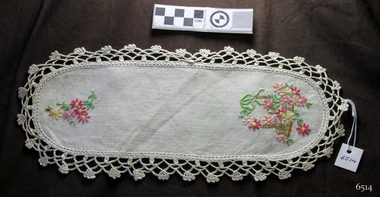 Flagstaff Hill Maritime Museum and Village
Textile - Doily, c. 1910
... period of three generations- ie. Sarah (nee Chamberlain) Lees, Ann (nee Lees) Dale, and Daisy Elvena (nee Dale) Welsh. All three were accomplished needlewomen; also, both Sarah Lees (born 1844) and her daughter, Ann (b 1865) crocheted a wide variety of articles for use in their homes. A few examples of these items have survived the years.” (NOTE: For additional information please refer to my book Pioneer...period of three generations- ie. Sarah (nee Chamberlain) Lees, Ann (nee Lees) Dale, and Daisy Elvena (nee Dale) Welsh. All three were accomplished needlewomen; also, both Sarah Lees (born 1844) and her daughter, Ann (b 1865) crocheted a wide variety of articles for use in their homes. A few examples of these items have survived the years.” (NOTE: For additional information please refer to my book Pioneer ...This doily is typical of items of household linen in popular use in the 19th and early-to-mid 20th centuries. It was a tradition for brides to have a 'glory box' containing linen and embroidered and crocheted articles to take to their new home. In the Words of donor, Betty Stone, … “These crocheted and embroidered articles cover a period of three generations- ie. Sarah (nee Chamberlain) Lees, Ann (nee Lees) Dale, and Daisy Elvena (nee Dale) Welsh. All three were accomplished needlewomen; also, both Sarah Lees (born 1844) and her daughter, Ann (b 1865) crocheted a wide variety of articles for use in their homes. A few examples of these items have survived the years.” (NOTE: For additional information please refer to my book Pioneer and Places- A History of Three Warrnambool Pioneering Families ie. Chamberlain, Dale and Lees families)This item is associated with the Warrnambool pioneer families of Chamberlain, Dale and Lees. These families are listed in the Pioneers' Register for Warrnambool Township and Shire, 1835-1900, published by A.I.G.S. Warrnambool Branch. The item is a fine example of early 20th-century needlework.Doily. oblong, with embroidered pink and yellow flowers in a brown basket at one end and red, pink and yellow flowers with green stems at the other end, with crocheted trim around the edges. From the Chamberlain Dale Lees Collection,flagstaff hill, warrnambool, flagstaff hill maritime museum and village, great ocean road, chamberlain family, dale family, lees family, betty stone, warrnambool pioneer, warrnambool genealogy, wangoom, chamberlain dale lees collection, glory box, doily, embroidery, needlework, crochet, handmade, craft, manchester, linen, haberdashery -
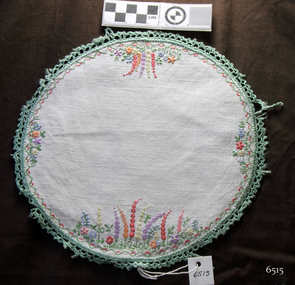 Flagstaff Hill Maritime Museum and Village
Textile - Doily, c. 1910
... period of three generations- ie. Sarah (nee Chamberlain) Lees, Ann (nee Lees) Dale, and Daisy Elvena (nee Dale) Welsh. All three were accomplished needlewomen; also, both Sarah Lees (born 1844) and her daughter, Ann (b 1865) crocheted a wide variety of articles for use in their homes. A few examples of these items have survived the years.” (NOTE: For additional information please refer to my book Pioneer...period of three generations- ie. Sarah (nee Chamberlain) Lees, Ann (nee Lees) Dale, and Daisy Elvena (nee Dale) Welsh. All three were accomplished needlewomen; also, both Sarah Lees (born 1844) and her daughter, Ann (b 1865) crocheted a wide variety of articles for use in their homes. A few examples of these items have survived the years.” (NOTE: For additional information please refer to my book Pioneer ...This doily is typical of items of household linen in popular use in the 19th and early-to-mid 20th centuries. It was a tradition for brides to have a 'glory box' containing linen and embroidered and crocheted articles to take to their new home. In the Words of donor, Betty Stone, … “These crocheted and embroidered articles cover a period of three generations- ie. Sarah (nee Chamberlain) Lees, Ann (nee Lees) Dale, and Daisy Elvena (nee Dale) Welsh. All three were accomplished needlewomen; also, both Sarah Lees (born 1844) and her daughter, Ann (b 1865) crocheted a wide variety of articles for use in their homes. A few examples of these items have survived the years.” (NOTE: For additional information please refer to my book Pioneer and Places- A History of Three Warrnambool Pioneering Families ie. Chamberlain, Dale and Lees families)This item is associated with the Warrnambool pioneer families of Chamberlain, Dale and Lees. These families are listed in the Pioneers' Register for Warrnambool Township and Shire, 1835-1900, published by A.I.G.S. Warrnambool Branch. The item is a fine example of early 20th-century needlework. Doily, round white cotton with embroidered fox gloves and other flowers of orange, red, yellow, purple and blue flowers with greenery and green crocheted edging. From the Chamberlain Dale Lees Collectionflagstaff hill, warrnambool, flagstaff hill maritime museum and village, great ocean road, chamberlain family, dale family, lees family, betty stone, warrnambool pioneer, warrnambool genealogy, wangoom, chamberlain dale lees collection, glory box, doily, embroidery, needlework, crochet, handmade, craft, manchester, linen, haberdashery -
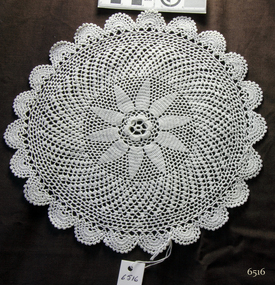 Flagstaff Hill Maritime Museum and Village
Textile - Doily, c. 1910
... period of three generations- ie. Sarah (nee Chamberlain) Lees, Ann (nee Lees) Dale, and Daisy Elvena (nee Dale) Welsh. All three were accomplished needlewomen; also, both Sarah Lees (born 1844) and her daughter, Ann (b 1865) crocheted a wide variety of articles for use in their homes. A few examples of these items have survived the years.” (NOTE: For additional information please refer to my book Pioneer...period of three generations- ie. Sarah (nee Chamberlain) Lees, Ann (nee Lees) Dale, and Daisy Elvena (nee Dale) Welsh. All three were accomplished needlewomen; also, both Sarah Lees (born 1844) and her daughter, Ann (b 1865) crocheted a wide variety of articles for use in their homes. A few examples of these items have survived the years.” (NOTE: For additional information please refer to my book Pioneer ...This doily is typical of items of household linen in popular use in the 19th and early-to-mid 20th centuries. It was a tradition for brides to have a 'glory box' containing linen and embroidered and crocheted articles to take to their new home. In the Words of donor, Betty Stone, … “These crocheted and embroidered articles cover a period of three generations- ie. Sarah (nee Chamberlain) Lees, Ann (nee Lees) Dale, and Daisy Elvena (nee Dale) Welsh. All three were accomplished needlewomen; also, both Sarah Lees (born 1844) and her daughter, Ann (b 1865) crocheted a wide variety of articles for use in their homes. A few examples of these items have survived the years.” (NOTE: For additional information please refer to my book Pioneer and Places- A History of Three Warrnambool Pioneering Families ie. Chamberlain, Dale and Lees families)This item is associated with the Warrnambool pioneer families of Chamberlain, Dale and Lees. These families are listed in the Pioneers' Register for Warrnambool Township and Shire, 1835-1900, published by A.I.G.S. Warrnambool Branch. The item is a fine example of early 20th-century needlework.Doily, white round crocheted work with flower motif in centre and scalloped edge. From the Chamberlain Dale Lees Collection. flagstaff hill, warrnambool, flagstaff hill maritime museum and village, great ocean road, chamberlain family, dale family, lees family, betty stone, warrnambool pioneer, warrnambool genealogy, wangoom, chamberlain dale lees collection, glory box, doily, needlework, crochet, handmade, craft, manchester, linen, haberdashery -
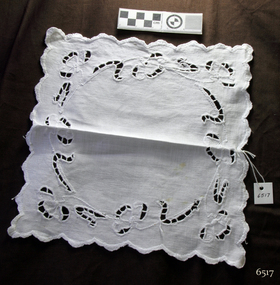 Flagstaff Hill Maritime Museum and Village
Textile - Doily, C. 1910
... period of three generations- ie. Sarah (nee Chamberlain) Lees, Ann (nee Lees) Dale, and Daisy Elvena (nee Dale) Welsh. All three were accomplished needlewomen; also, both Sarah Lees (born 1844) and her daughter, Ann (b 1865) crocheted a wide variety of articles for use in their homes. A few examples of these items have survived the years.” (NOTE: For additional information please refer to my book Pioneer...period of three generations- ie. Sarah (nee Chamberlain) Lees, Ann (nee Lees) Dale, and Daisy Elvena (nee Dale) Welsh. All three were accomplished needlewomen; also, both Sarah Lees (born 1844) and her daughter, Ann (b 1865) crocheted a wide variety of articles for use in their homes. A few examples of these items have survived the years.” (NOTE: For additional information please refer to my book Pioneer ...This doily is typical of items of household linen in popular use in the 19th and early-to-mid 20th centuries. It was a tradition for brides to have a 'glory box' containing linen and embroidered and crocheted articles to take to their new home. In the Words of donor, Betty Stone, … “These crocheted and embroidered articles cover a period of three generations- ie. Sarah (nee Chamberlain) Lees, Ann (nee Lees) Dale, and Daisy Elvena (nee Dale) Welsh. All three were accomplished needlewomen; also, both Sarah Lees (born 1844) and her daughter, Ann (b 1865) crocheted a wide variety of articles for use in their homes. A few examples of these items have survived the years.” (NOTE: For additional information please refer to my book Pioneer and Places- A History of Three Warrnambool Pioneering Families ie. Chamberlain, Dale and Lees families) This item is associated with the Warrnambool pioneer families of Chamberlain, Dale and Lees. These families are listed in the Pioneers' Register for Warrnambool Township and Shire, 1835-1900, published by A.I.G.S. Warrnambool Branch. The item is a fine example of early 20th-century needlework.Doily, square white cotton with floral cutwork pattern, embroidery and scalloped edges. From the Chamberlain Dale Lees Collection, flagstaff hill, warrnambool, flagstaff hill maritime museum and village, great ocean road, chamberlain family, dale family, lees family, betty stone, warrnambool pioneer, warrnambool genealogy, wangoom, chamberlain dale lees collection, glory box, doily, embroidery, needlework, handmade, craft, manchester, linen, haberdashery, cutwork -
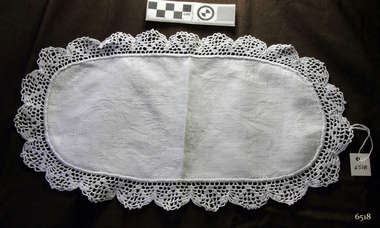 Flagstaff Hill Maritime Museum and Village
Textile - Doily, c. 1910
... period of three generations- ie. Sarah (nee Chamberlain) Lees, Ann (nee Lees) Dale, and Daisy Elvena (nee Dale) Welsh. All three were accomplished needlewomen; also, both Sarah Lees (born 1844) and her daughter, Ann (b 1865) crocheted a wide variety of articles for use in their homes. A few examples of these items have survived the years.” (NOTE: For additional information please refer to my book Pioneer...period of three generations- ie. Sarah (nee Chamberlain) Lees, Ann (nee Lees) Dale, and Daisy Elvena (nee Dale) Welsh. All three were accomplished needlewomen; also, both Sarah Lees (born 1844) and her daughter, Ann (b 1865) crocheted a wide variety of articles for use in their homes. A few examples of these items have survived the years.” (NOTE: For additional information please refer to my book Pioneer ...CONTEXT Embroidered and Crocheted Items This doily is typical of items of household linen in popular use in the 19th and early-to-mid 20th centuries. It was a tradition for brides to have a 'glory box' containing linen and embroidered and crocheted articles to take to their new home. In the Words of donor, Betty Stone, … “These crocheted and embroidered articles cover a period of three generations- ie. Sarah (nee Chamberlain) Lees, Ann (nee Lees) Dale, and Daisy Elvena (nee Dale) Welsh. All three were accomplished needlewomen; also, both Sarah Lees (born 1844) and her daughter, Ann (b 1865) crocheted a wide variety of articles for use in their homes. A few examples of these items have survived the years.” (NOTE: For additional information please refer to my book Pioneer and Places- A History of Three Warrnambool Pioneering Families ie. Chamberlain, Dale and Lees families)This item is associated with the Warrnambool pioneer families of Chamberlain, Dale and Lees. These families are listed in the Pioneers' Register for Warrnambool Township and Shire, 1835-1900, published by A.I.G.S. Warrnambool Branch. The item is a fine example of early 20th-century needlework.Doily, oblong white floral pattern weave fabric with crocheted edging. From the Chamberlain Dale Lees Collection.flagstaff hill, warrnambool, flagstaff hill maritime museum and village, great ocean road, chamberlain family, dale family, lees family, betty stone, warrnambool pioneer, warrnambool genealogy, wangoom, chamberlain dale lees collection, glory box, doily, needlework, crochet, handmade, craft, manchester, linen, haberdashery -
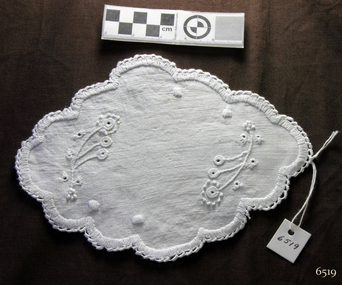 Flagstaff Hill Maritime Museum and Village
Textile - Doily, c. 1910
... period of three generations- ie. Sarah (nee Chamberlain) Lees, Ann (nee Lees) Dale, and Daisy Elvena (nee Dale) Welsh. All three were accomplished needlewomen; also, both Sarah Lees (born 1844) and her daughter, Ann (b 1865) crocheted a wide variety of articles for use in their homes. A few examples of these items have survived the years.” (NOTE: For additional information please refer to my book Pioneer...period of three generations- ie. Sarah (nee Chamberlain) Lees, Ann (nee Lees) Dale, and Daisy Elvena (nee Dale) Welsh. All three were accomplished needlewomen; also, both Sarah Lees (born 1844) and her daughter, Ann (b 1865) crocheted a wide variety of articles for use in their homes. A few examples of these items have survived the years.” (NOTE: For additional information please refer to my book Pioneer ...This doily is typical of items of household linen in popular use in the 19th and early-to-mid 20th centuries. It was a tradition for brides to have a 'glory box' containing linen and embroidered and crocheted articles to take to their new home. In the Words of donor, Betty Stone, … “These crocheted and embroidered articles cover a period of three generations- ie. Sarah (nee Chamberlain) Lees, Ann (nee Lees) Dale, and Daisy Elvena (nee Dale) Welsh. All three were accomplished needlewomen; also, both Sarah Lees (born 1844) and her daughter, Ann (b 1865) crocheted a wide variety of articles for use in their homes. A few examples of these items have survived the years.” (NOTE: For additional information please refer to my book Pioneer and Places- A History of Three Warrnambool Pioneering Families ie. Chamberlain, Dale and Lees families) This item is associated with the Warrnambool pioneer families of Chamberlain, Dale and Lees. These families are listed in the Pioneers' Register for Warrnambool Township and Shire, 1835-1900, published by A.I.G.S. Warrnambool Branch. The item is a fine example of early 20th-century needlework. Doily, lozenge shape with floral embroidery and crocheted scalloped edge. From the Chamberlain Dale Lees Collectionflagstaff hill, warrnambool, flagstaff hill maritime museum and village, great ocean road, chamberlain family, dale family, lees family, betty stone, warrnambool pioneer, warrnambool genealogy, wangoom, chamberlain dale lees collection, glory box, doily, embroidery, needlework, crochet, handmade, craft, manchester, linen, haberdashery
