
Showing 253 items matching "the royal studio"
-
 Narre Warren and District Family History Group
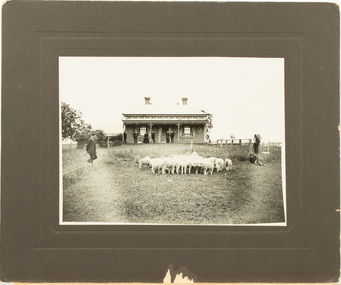
Photograph - Charles Weist's farm
... ...The Royal Studio...On the back is written, "Charles Weist's house, Gladstone Road Dandenong." Also "The Royal Studio, 179 Johnston Street, Fitzroy. G. ...Also "The Royal Studio, 179 Johnston Street, Fitzroy. G. ...Photograph of house mounted on dark cardboard. The house is a single fronted brick residence with two chimneys. It has windows either side of the front door. Their are six people standing on the front verandah. At the front of the house is a paddock with sheep. There is a man standing on the left hand side of the paddock dressed in a suit. On the right hand side of the paddock are two people, one lying down and a dog. On the back is written, "Charles Weist's house, Gladstone Road Dandenong." Also "The Royal Studio, 179 Johnston Street, Fitzroy. G. Doig - proprietor."weist family, charles weist, police paddocks, gladstone road dandenong, the royal studio -
 Stawell Historical Society Inc
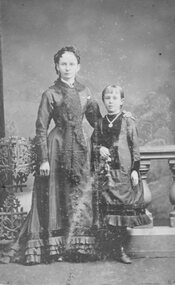
Photograph, Carte-de-Visite photograph of woman and girl posing in studio Portrait c1870
... C.B. HERBERT Royal Studio Stawell Main Street...Portraits C.B. HERBERT Royal Studio Stawell Main Street Carte-de-Visite photo of woman and girl posing in studio Portrait Carte-de-Visite photograph of woman and girl posing in studio Portrait c1870 Photograph ...Cragg/Wearmouth Family collection. People unknown. Carte-de-Visite photo of woman and girl posing in studio Portrait C.B. HERBERT Royal Studio Stawell Main Streetportraits -
 Stawell Historical Society Inc
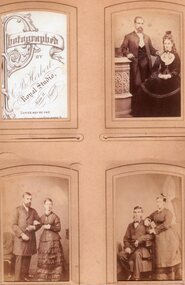
Photograph, Three Studio Portraits of and women
... C B Herbert Royal Studio Main Street Stawell...Johnson Family Album Stawell C B Herbert Royal Studio Main Street Stawell Three Studio Portraits of and women Photograph ...Johnson Family AlbumC B Herbert Royal Studio Main Street Stawellstawell -
 Bendigo Historical Society Inc.
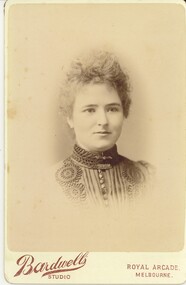
Photograph - HARRIS COLLECTION: FEMALE PHOTO, ninteenth century
... Young woman head & neck, Bardwells Studio Royal Arcade Melbourne printed on front. ...Bardwells Studio, Royal Arcade Melbourne...PHOTOGRAPH Person female Bardwells Studio, Royal Arcade Melbourne Black & White 16.5 cmx10.5cm photograph. ...Black & White 16.5 cmx10.5cm photograph. Young woman head & neck, Bardwells Studio Royal Arcade Melbourne printed on front. Embroidered dress top with close fitting neck collar. Two brooches at neck. Vertical row of small buttons fastening dress top.Bardwells Studio, Royal Arcade Melbournephotograph, person, female -
 Malmsbury Historical Society
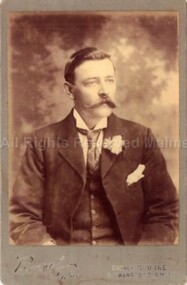
Photograph (Item), B/W Portrait Of Tom Sandford C1900, Malmsbury c1900
... People - "Sandford, Tom" Associated with - Royal Studios (Photo)...People - "Sandford, Tom" Associated with - Royal Studios (Photo) B/W Portrait Of Tom Sandford C1900, Malmsbury c1900 Photograph Photograph ...People - "Sandford, Tom" Associated with - Royal Studios (Photo) -
 Bendigo Historical Society Inc.
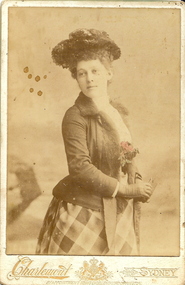
Photograph - FEMALE PORTRAIT, approx 1890's
... Charlemont & Co., Grosvenor Studioes, Royal Arcade, Sydney...PERSON Individual female portrait Charlemont & Co., Grosvenor Studioes, Royal Arcade, Sydney sepia studio study with some hand tinting shows upper body of young female adult. ...sepia studio study with some hand tinting shows upper body of young female adult. Plaid skirt, leather gloves, purse ? Floral spray, tinted. Pale buttoned blouse, hip length fur. Collared long sleeved jacket, floral decorated stgraw hat atop curled hair. Image is mounted on stiff card with commercial details theron. In gold lettering on lower front, coat of arms, ' Charlemont, Sydney, by appointment to his excellency, Lord Carrington.Charlemont & Co., Grosvenor Studioes, Royal Arcade, Sydneyperson, individual, female portrait -
 Bendigo Historical Society Inc.
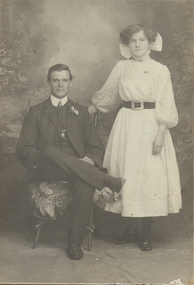
Photograph - HUSBAND AND WIFE, early 1900's
... Printed at angle BL corner 'Edgar Evans/Royal Studio/Eaglehawk' On back in lead pencil 'Mr'...Printed at angle BL corner 'Edgar Evans/Royal Studio/Eaglehawk' On back in lead pencil 'Mr' Photograph HUSBAND AND WIFE ...black and white photograph, mounted on brown board. Young man seated, young woman standing. Young man wearing 3 piece suit, chain and albert. Young woman wearing mid calf length pale dress with dark belt and buckle, dark stockings and boots. Very large bow at back of hair. Printed at angle BL corner 'Edgar Evans/Royal Studio/Eaglehawk' On back in lead pencil 'Mr''Edgar Evans'person, family, husband and wife -
 Stawell Historical Society Inc
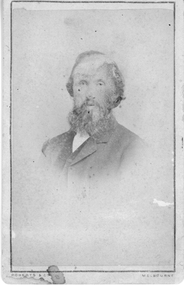
Photograph, Rev Thos Evans first Minister at the Baptist Church
... The Duke of Edinburgh and his Excellency the Governor Royal Studio Corner of Bourke & Elizabeth St. opposite the post office Melbourne. ...The Duke of Edinburgh and his Excellency the Governor Royal Studio Corner of Bourke & Elizabeth St. opposite the post office Melbourne. ...Portrait photograph of Rev Thos Evans First Minister at Stawell Baptist Church,Rev. Thos Evans who was the first Minister at Baptist Church. Portrait was once coloured as faint evidence can still be seen on image.ROBERTS & Co. by Special Application Photographers H.R.H. The Duke of Edinburgh and his Excellency the Governor Royal Studio Corner of Bourke & Elizabeth St. opposite the post office Melbourne. This or any other Portrait can be Enlarged up to Life Size. Copies may be had by sending name & N? " handwritten" Rev. Thos Evans who was first Minister of Church.stawell -
 Bendigo Historical Society Inc.
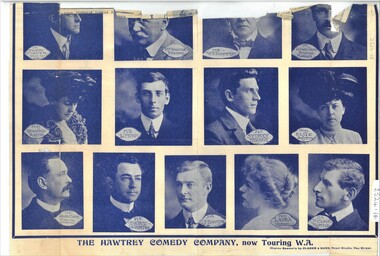
Document - HAMILTON COLLECTION: PHOTOS OF PERFORMERS, Early 1900s
... ''Photos specially by CLARKE and SONS, Royal Studio, Hay Street''. Page has been torn in half. ...''Photos specially by CLARKE and SONS, Royal Studio, Hay Street''. Page has been torn in half. ...Document. Half sheet of newspaper page with portrait photos of members of the ''Hawtrey Comedy Company, now touring W.A.''. ''Photos specially by CLARKE and SONS, Royal Studio, Hay Street''. Page has been torn in half. Four photos have top half missig. Printed in blue ink. Nine complete photos are named as: Miss Winifred Austin. Mr L. Monk. Mr Sydney Redgrave. Miss Elsie Austin. Mr David Cope - Musical Director. Mr Bert Leighton. Mr C P Hammond. Miss Laura Nicholls. Mr St. Clair Bayfield.performing arts, elocution, photos of performers. -
 Bendigo Military Museum
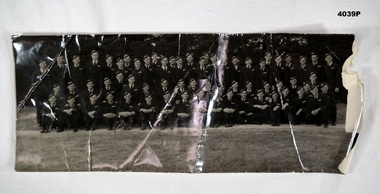
Photograph - PHOTOGRAPH, RAAF, Leonard Snowden Studios
... Stamped on back in blue ink "Leonard Snowden Studios By Royal Appointment, V7672" "Studios. No1 E.S. ...No. 3536P for his service record. photography raaf Stamped on back in blue ink "Leonard Snowden Studios By Royal Appointment, V7672" "Studios. No1 E.S. ...Fred Davey is in the middle row, 11th from the left. Part of Frederick Gardner Davey DFC No.410533 RAAF Collection. See Cat. No. 3536P for his service record.Photo, black & white of a group of men in RAAF uniform. Group is arranged in rows against a background of trees.Stamped on back in blue ink "Leonard Snowden Studios By Royal Appointment, V7672" "Studios. No1 E.S. Melbourne. All R.A.A.F & W.A.A.F Stations Priv. Res. 101 Glenferrie Rd. Malvern".photography, raaf -
 Tarnagulla History Archive
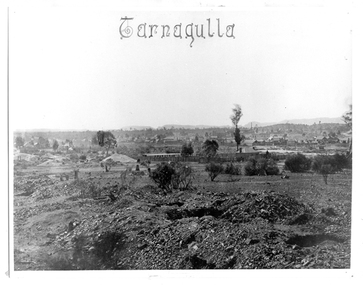
Photograph: View of Tarnagulla, June 1866
... By the following year he had settled in Portland, where he opened the Royal Photographic Studio in Gawler Street. From his base in Portland he toured surrounding districts, offering portrait and view services. ...By the following year he had settled in Portland, where he opened the Royal Photographic Studio in Gawler Street. From his base in Portland he toured surrounding districts, offering portrait and view services. ...Murray Comrie Collection. In June 1866, Aimé Marchand (1846-1910) made a series of fourteen photographs which were submitted to the 1866-67 Melbourne Intercolonial Exhibition, where they earned a 1st Class Honorable Mention. This is one of those fourteen images. Of French or Belgian origin and possibly formerly an assayer in California, Marchand appears to have begun his practice of photography in Tarnagulla around 1865 as an assistant to A.B. Clay. By the following year he had settled in Portland, where he opened the Royal Photographic Studio in Gawler Street. From his base in Portland he toured surrounding districts, offering portrait and view services. Little else is known about his life. He appears to have left Australia in 1878. A misprint of his name in a local directory as Annie Marchand created the misconception that he was one of only a few named women photographers in the colonies. Monochrome photograph depicting a view across Tarnagulla in June 1866.tarnagulla, views, mining, aimé marchand, photographers -
 Tarnagulla History Archive
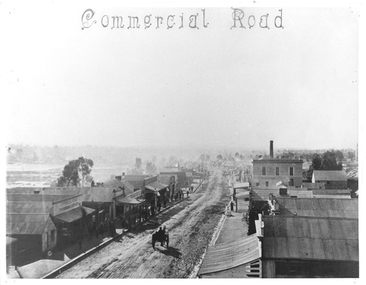
Photograph of Commercial Road, Tarnagulla, June 1866
... By the following year he had settled in Portland, where he opened the Royal Photographic Studio in Gawler Street. From his base in Portland he toured surrounding districts, offering portrait and view services. ...By the following year he had settled in Portland, where he opened the Royal Photographic Studio in Gawler Street. From his base in Portland he toured surrounding districts, offering portrait and view services. ...Murray Comrie Collection. Copy of an 1866 photograph by Aimé Marchand. In June 1866, Aimé Marchand (1846-1910) made a series of fourteen photographs which were submitted to the 1866-67 Melbourne Intercolonial Exhibition, where they earned a 1st Class Honorable Mention. This is one of those fourteen images. Of French or Belgian origin and possibly formerly an assayer in California, Marchand appears to have begun his practice of photography in Tarnagulla around 1865 as an assistant to A.B. Clay. By the following year he had settled in Portland, where he opened the Royal Photographic Studio in Gawler Street. From his base in Portland he toured surrounding districts, offering portrait and view services. Little else is known about his life. He appears to have left Australia in 1878. A misprint of his name in a local directory as Annie Marchand created the misconception that he was one of only a few named women photographers in the colonies. Monochrome photograph looking north down Commercial Road, Tarnagulla from the roof of the Council Chambers. tarnagulla, views, burstall hall, council chambers, local government, commercial road, local people, residents, aimé marchand, photographers -
 Tarnagulla History Archive
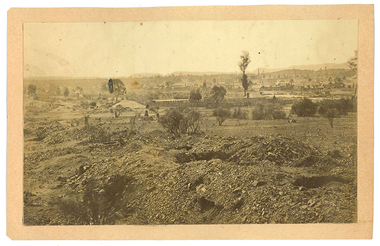
Photograph: Alluvial workings between Gladstone St and Commercial Road, Tarnagulla, June 1866
... By the following year he had settled in Portland, where he opened the Royal Photographic Studio in Gawler Street. From his base in Portland he toured surrounding districts, offering portrait and view services. ...By the following year he had settled in Portland, where he opened the Royal Photographic Studio in Gawler Street. From his base in Portland he toured surrounding districts, offering portrait and view services. ...David Gordon Collection. This image was created by Aime Marchand in June 1866. Marchand (1846-1910) made a series of fourteen photographs which were submitted to the 1866-67 Melbourne Intercolonial Exhibition, where they earned a 1st Class Honourable Mention. This is one of those fourteen images. Of French or Belgian origin and possibly formerly an assayer in California, Marchand appears to have begun his practice of photography in Tarnagulla around 1865 as an assistant to A.B. Clay. By the following year he had settled in Portland, where he opened the Royal Photographic Studio in Gawler Street. From his base in Portland he toured surrounding districts, offering portrait and view services. Little else is known about his life. He appears to have left Australia in 1878. A misprint of his name in a local directory as Annie Marchand created the misconception that he was one of only a few named women photographers in the colonies. -
 Tarnagulla History Archive
Negative: Copy of Marchand image of Tarnagulla Courthouse, Court House, June 1866 (original image)
... By the following year he had settled in Portland, where he opened the Royal Photographic Studio in Gawler Street. From his base in Portland he toured surrounding districts, offering portrait and view services. ...By the following year he had settled in Portland, where he opened the Royal Photographic Studio in Gawler Street. From his base in Portland he toured surrounding districts, offering portrait and view services. ...Murray Comrie Collection. This photograph is a reasonable copy created from an older original. In June 1866, Aimé Marchand (1846-1910) made a series of fourteen photographs which were submitted to the 1866-67 Melbourne Intercolonial Exhibition, where they earned a 1st Class Honorable Mention. This is one of those fourteen images. Of French or Belgian origin and possibly formerly an assayer in California, Marchand appears to have begun his practice of photography in Tarnagulla around 1865 as an assistant to A.B. Clay. By the following year he had settled in Portland, where he opened the Royal Photographic Studio in Gawler Street. From his base in Portland he toured surrounding districts, offering portrait and view services. Little else is known about his life. He appears to have left Australia in 1878. A misprint of his name in a local directory as Annie Marchand created the misconception that he was one of only a few named women photographers in the colonies.A black and white negative image depicting the Court House in Tarnagulla. Copy of the photogrpah made by Aime Marchand.tarnagulla, courthouse, justice, policing, law, buildings, views, victoria street -
 Tarnagulla History Archive
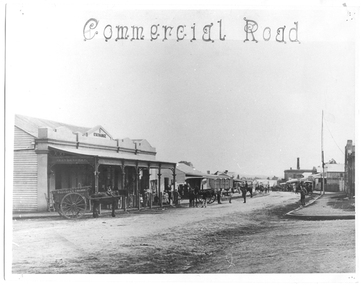
Photograph of Commercial Road, Tarnagulla, June 1866
... By the following year he had settled in Portland, where he opened the Royal Photographic Studio in Gawler Street. From his base in Portland he toured surrounding districts, offering portrait and view services. ...By the following year he had settled in Portland, where he opened the Royal Photographic Studio in Gawler Street. From his base in Portland he toured surrounding districts, offering portrait and view services. ...Murray Comrie Collection. Copy of an 1866 photograph by Aimé Marchand. Thomas Comrie's Exchange Store was at south end of Commercial Road, it has since been destroyed. In June 1866, Aimé Marchand (1846-1910) made a series of fourteen photographs which were submitted to the 1866-67 Melbourne Intercolonial Exhibition, where they earned a 1st Class Honorable Mention. This is one of those fourteen images. Of French or Belgian origin and possibly formerly an assayer in California, Marchand appears to have begun his practice of photography in Tarnagulla around 1865 as an assistant to A.B. Clay. By the following year he had settled in Portland, where he opened the Royal Photographic Studio in Gawler Street. From his base in Portland he toured surrounding districts, offering portrait and view services. Little else is known about his life. He appears to have left Australia in 1878. A misprint of his name in a local directory as Annie Marchand created the misconception that he was one of only a few named women photographers in the colonies. Monochrome photograph looking north down Commercial Road, Tarnagulla from the Wayman Street corner, opposite Thomson and Comrie's Exchange Store (at south end of Commercial Road).tarnagulla, views, thomas comrie, comrie exchange store, commercial road, local people, residents, aimé marchand, photographers -
 Tarnagulla History Archive
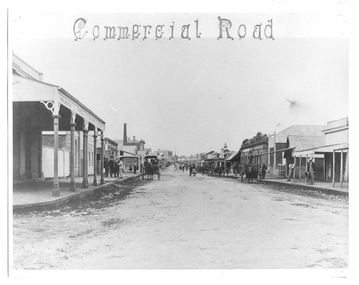
Photograph of Commercial Road, Tarnagulla, June 1866
... By the following year he had settled in Portland, where he opened the Royal Photographic Studio in Gawler Street. From his base in Portland he toured surrounding districts, offering portrait and view services. ...By the following year he had settled in Portland, where he opened the Royal Photographic Studio in Gawler Street. From his base in Portland he toured surrounding districts, offering portrait and view services. ...Murray Comrie Collection. Copy of an 1866 photograph by Aimé Marchand. Victoria Hotel and Theatre is the stone building at centre right. On the immediate left is Pierce's Southern Cross Store, later to be incorporated into the flour mill complex. The gentleman in the white hat in the group on the left is George Thomson. In June 1866, Aimé Marchand (1846-1910) made a series of fourteen photographs which were submitted to the 1866-67 Melbourne Intercolonial Exhibition, where they earned a 1st Class Honorable Mention. This is one of those fourteen images. Of French or Belgian origin and possibly formerly an assayer in California, Marchand appears to have begun his practice of photography in Tarnagulla around 1865 as an assistant to A.B. Clay. By the following year he had settled in Portland, where he opened the Royal Photographic Studio in Gawler Street. From his base in Portland he toured surrounding districts, offering portrait and view services. Little else is known about his life. He appears to have left Australia in 1878. A misprint of his name in a local directory as Annie Marchand created the misconception that he was one of only a few named women photographers in the colonies. Monochrome photograph looking south down Commercial Road, Tarnagulla from near the Victoria Hotel and Theatre, at northern end of Commercial Road.tarnagulla, views, victoria hotel and theatre, commercial road, local people, residents, aimé marchand, photographers -
 Tarnagulla History Archive
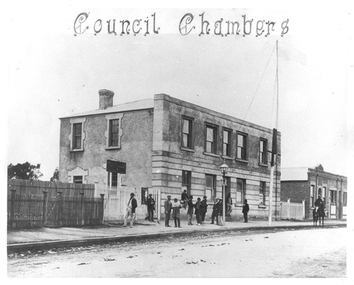
Photograph of Tarnagulla Council Chambers, June 1866
... By the following year he had settled in Portland, where he opened the Royal Photographic Studio in Gawler Street. From his base in Portland he toured surrounding districts, offering portrait and view services. ...By the following year he had settled in Portland, where he opened the Royal Photographic Studio in Gawler Street. From his base in Portland he toured surrounding districts, offering portrait and view services. ...Murray Comrie Collection. Copy of an 1866 photograph by Aimé Marchand. The building was originally Company's Hotel, then used as temporary premises by the Colonial Bank during construction of the bank's own premises, then Borough of Tarnagulla Council Chambers and Mechanics Institute. Also known locally as Burstall Hall from c1960 following a donation of maintenance funding from the Estate of the late RH Burstall. In June 1866, Aimé Marchand (1846-1910) made a series of fourteen photographs which were submitted to the 1866-67 Melbourne Intercolonial Exhibition, where they earned a 1st Class Honorable Mention. This is one of those fourteen images. Of French or Belgian origin and possibly formerly an assayer in California, Marchand appears to have begun his practice of photography in Tarnagulla around 1865 as an assistant to A.B. Clay. By the following year he had settled in Portland, where he opened the Royal Photographic Studio in Gawler Street. From his base in Portland he toured surrounding districts, offering portrait and view services. Little else is known about his life. He appears to have left Australia in 1878. A misprint of his name in a local directory as Annie Marchand created the misconception that he was one of only a few named women photographers in the colonies. Monochrome photograph the Tarnagulla Council Chambers in June 1866. tarnagulla, views, burstall hall, council chambers, local government, commercial road, local people, residents, aimé marchand, photographers -
 Tarnagulla History Archive
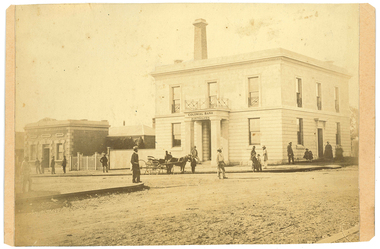
Photograph: Colonial Bank of Australasia (later Union Bank) in Tarnagulla, June 1866
... By the following year he had settled in Portland, where he opened the Royal Photographic Studio in Gawler Street. From his base in Portland he toured surrounding districts, offering portrait and view services. ...By the following year he had settled in Portland, where he opened the Royal Photographic Studio in Gawler Street. From his base in Portland he toured surrounding districts, offering portrait and view services. ...David Gordon Collection. There were four banks in Tarnagulla at one stage, but two - the National Bank and the Bank of Australasia - were open for a short period only. The single-storey brick building at far left was built in 1859 and used by the Union Bank until 1888, and was later renamed 'Lochcarron' and used as premises by doctors and dentists. The two-storey building (right) was built in 1866 by the Colonial Bank of Australasia. Before this, the site had been occupied by Foo's shop. Whilst it was being built, the Colonial Bank operated from Company's Hotel (later known as Burstall Hall and the Council Chambers). The double-storey building in this image was used by the Colonial Bank from 1866 until 21st February, 1888. The premises were sold to the Union Bank for £2500. The Union Bank moved in and commenced operations on 6th June 1888, continuing until 1942. The building was later used as a general store until the 1990s. Both buildings are now private residences. This image was created by Aime Marchand in June 1866. Marchand (1846-1910) made a series of fourteen photographs which were submitted to the 1866-67 Melbourne Intercolonial Exhibition, where they earned a 1st Class Honourable Mention. This is one of those fourteen images. Of French or Belgian origin and possibly formerly an assayer in California, Marchand appears to have begun his practice of photography in Tarnagulla around 1865 as an assistant to A.B. Clay. By the following year he had settled in Portland, where he opened the Royal Photographic Studio in Gawler Street. From his base in Portland he toured surrounding districts, offering portrait and view services. Little else is known about his life. He appears to have left Australia in 1878. A misprint of his name in a local directory as Annie Marchand created the misconception that he was one of only a few named women photographers in the colonies. -
 Flagstaff Hill Maritime Museum and Village
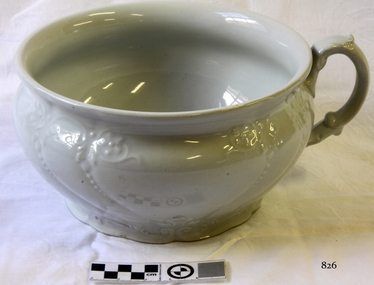
Ceramic - Chamber Pot, 1912
... ‘Sol’ (c.1912-1963), ‘Studio’ (1953 on) and ‘Royal Staffordshire’ (post 1968) were important J. & G. ...‘Sol’ (c.1912-1963), ‘Studio’ (1953 on) and ‘Royal Staffordshire’ (post 1968) were important J. & G. ...In the 19th and early 20th centuries, J. & G. Meakin were important, large-scale producers of good quality, ironstone tableware (‘White Granite’ ware) that met a ready market in the United States, South America, Australia, and other traditional British markets. By the 1890s the company was one of the world’s largest earthenware manufacturers. Although export teaware and tableware was the factory’s staple commodity, Meakin also manufactured toilet ware, kitchen ware and a wide range of fancy earthenware. The company was amongst the first British pottery firms to experiment with modernist designs associated with the art deco period. The Moderne' range was introduced in 1929 consisting of an angular shape decorated design with geometric patterns and often highlighted with silver or gold. This range remained in production through the 1930s. Post 1945 the company introduced the streamlined Studio shape (1953) and Horizon shape (1955) both heavily influenced by the Russell Wright ‘American Modern’ tableware. In 1964 a new Studio shape was released with tall streamlined coffee pots used as the background for many contemporary patterns now associated with the 1950s and 1960s. Designs by Jessie Tate and Eve Midwinter, some originally found on Midwinter shapes, also appear on 1970s Studio ware. The Studio range was one of Meakin’s most successful and continued in production until the late-1970s. The enormous range of floral, geometric, and abstract designs make Studio Ware collectible in its own right. In the 1970s and 1980s as part of the Wedgwood Group Meakin produced contemporary products under the ‘Bull in a China Shop’ and ‘Creative Tableware’ names. ‘Sol’ (c.1912-1963), ‘Studio’ (1953 on) and ‘Royal Staffordshire’ (post 1968) were important J. & G. Meakin Ltd trade names. Meakin marks are numerous, but all include the J. & G. Meakin name. The significance of this item and pottery generally is that often earthenware is portrayed as being a landmark in the evolution of humanity. This is because these items are the few things from the past that have survived in a tangible form. Pottery is an important functional part of society and it has a critical role to play as it helps archaeologists to date other artefacts of the same time period. Also, the decorations on pottery have told much about the beliefs, lifestyles and lives of the people who bought them and used them. In other words it gives us today a snapshot of society from the past and how people used these items in their daily lives, their likes as well as societal and design trends. Earthenware white glazed ironstoneJ & G Meakin Hanley England stamped to base, with white flora designwarrnambool, flagstaff-hill, flagstaff-hill-maritime-museum, shipwreck-coast, flagstaff-hill-maritime-village, pottery, earthenware, iron stone, alfred meakin, james meakin, george meakin, earthenware manufactures, chamber pot -
 Federation University Historical Collection
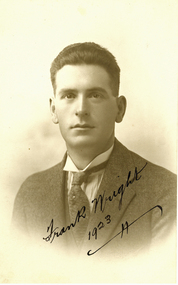
Photograph - Black and White, Frank Wright, 1923, 1923
... The Frank Wright Medal at the Royal South Street competition is awarded to an individual recognized as making an outstanding contribution to brass music in Australia. frank wright cornet conductor Written in pen on back - Frank Wright (21) taken at Easter 1923, at Brisbane Queensland, while competing in the Q. band championship. Easter 1923 Written in pen on front - Frank Wright, 1923 Studio ...Frank Wright was a renown resident of Smeaton, where he was born on 2 August 1901. He lived at Laura Villa, and attended Smeaton State School. His father William was a gold miner and his mother's name was Sarah. Their family won many singing and instrumental awards. Frank was tutored by Percy Code and was awarded a gold medal for the highest marks in the ALCM examinations in the British Colonies at the age of seventeen years. He became the Australian Open Cornet Champion by the age of eighteen. A year later, Frank conducted the City of Ballarat Band, and later the Ballarat Soldiers’ Memorial Band. He formed the Frank Wright Frisco Band and Frank Wright and his Coliseum Orchestra. These bands won many South Street awards, and Frank as conductor won many awards in the Australian Band Championship contest. In 1933 Frank Wright sailed to England to conduct the famous St Hilda’s Band and was later appointed Musical Director of the London County Council, where he organized many amazing concerts in parks, in and around the London district. He was made Professor of Brass and Military Band Scoring and conducted at the Guildhall of Music and Drama. Frank was often invited to adjudicate Brass Band Championships around Europe, in Australia, including South Street and in New Zealand. The Frank Wright Medal at the Royal South Street competition is awarded to an individual recognized as making an outstanding contribution to brass music in Australia.Studio portrait of the bust of a man dressed in a jacket, striped shirt with a stand up collar and tie. The man is Frank Wright.Written in pen on back - Frank Wright (21) taken at Easter 1923, at Brisbane Queensland, while competing in the Q. band championship. Easter 1923 Written in pen on front - Frank Wright, 1923frank wright, cornet, conductor -
 Federation University Historical Collection
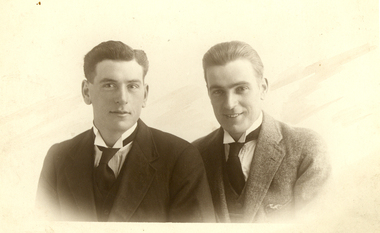
Photograph - Black and White, Frank Wright and Alex Wright, 1921, 12 March 1921
... The Frank Wright Medal at the Royal South Street competition is awarded to an individual recognized as making an outstanding contribution to brass music in Australia. Photograph of Frank Wright and his brother Alex Wright alex wright frank wright 1921 printed on back , Post Card, Mendelssohn Studios 80 Swanston St, Melbourne, written on back Frank Wright (aged 19 years ) Alex Wright 12th March 1921 Black and white photograph with 2 men in 3 piece suits one of the men is Frank Wright aged 19 years and the other is Alex Wright Frank Wright and Alex Wright, 1921 Photograph - Black and White Mendelssohn Studios ...Frank Wright was a renown resident of Smeaton, where he was born. He lived at Laura Villa, and attended Smeaton State School. His father William was a gold miner and his mother's name was Sarah. Their family won many singing and instrumental awards. Frank was tutored by Percy Code and was awarded a gold medal for the highest marks in the ALCM examinations in the British Colonies at the age of seventeen years. He became the Australian Open Cornet Champion by the age of eighteen. A year later, Frank conducted the City of Ballarat Band, and later the Ballarat Soldiers’ Memorial Band. He formed the Frank Wright Frisco Band and Frank Wright and his Coliseum Orchestra. These bands won many South Street awards, and Frank as conductor won many awards in the Australian Band Championship contest. In 1933 Frank Wright sailed to England to conduct the famous St Hilda’s Band and was later appointed Musical Director of the London County Council, where he organized many amazing concerts in parks, in and around the London district. He was made Professor of Brass and Military Band Scoring and conducted at the Guildhall of Music and Drama. Frank was often invited to adjudicate Brass Band Championships around Europe, in Australia, including South Street and in New Zealand. The Frank Wright Medal at the Royal South Street competition is awarded to an individual recognized as making an outstanding contribution to brass music in Australia.Photograph of Frank Wright and his brother Alex WrightBlack and white photograph with 2 men in 3 piece suits one of the men is Frank Wright aged 19 years and the other is Alex Wrightprinted on back , Post Card, Mendelssohn Studios 80 Swanston St, Melbourne, written on back Frank Wright (aged 19 years ) Alex Wright 12th March 1921alex wright frank wright 1921 -
 Federation University Historical Collection
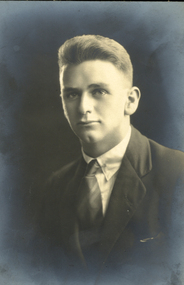
Photograph - Black and White, Vernon Holt, 1910s-1920s
... The Frank Wright Medal at the Royal South Street competition is awarded to an individual recognized as making an outstanding contribution to brass music in Australia. vernon holt frank wright brass band Black and white studio photograph of the torso of a young man dressed in a suit. ...Vernon Holt was a friend of Frank Wright. Frank was a renown resident of Smeaton, where he was born on 2 August 1901. He lived at Laura Villa, and attended Smeaton State School. His father William was a gold miner and his mother's name was Sarah. Their family won many singing and instrumental awards. Frank was tutored by Percy Code and was awarded a gold medal for the highest marks in the ALCM examinations in the British Colonies at the age of seventeen years. He became the Australian Open Cornet Champion by the age of eighteen. A year later, Frank conducted the City of Ballarat Band, and later the Ballarat Soldiers’ Memorial Band. He formed the Frank Wright Frisco Band and Frank Wright and his Coliseum Orchestra. These bands won many South Street awards, and Frank as conductor won many awards in the Australian Band Championship contest. In 1933 Frank Wright sailed to England to conduct the famous St Hilda’s Band and was later appointed Musical Director of the London County Council, where he organized many amazing concerts in parks, in and around the London district. He was made Professor of Brass and Military Band Scoring and conducted at the Guildhall of Music and Drama. Frank was often invited to adjudicate Brass Band Championships around Europe, in Australia, including South Street and in New Zealand. The Frank Wright Medal at the Royal South Street competition is awarded to an individual recognized as making an outstanding contribution to brass music in Australia.Black and white studio photograph of the torso of a young man dressed in a suit. The man is Vernon Holt.vernon holt, frank wright, brass band -
 Federation University Historical Collection
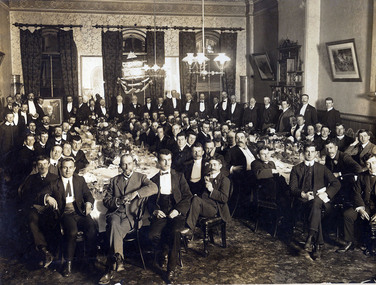
Photograph - Photograph (Black & White), Victa Studios, Presentation to Professor Alfred Mica Smith of the Ballarat School of Mines at Craig's Royal Hotel, c1924, c1924
... The painting was presented to the Ballarat Fine Art Gallery Presentation to Professor Alfred Mica Smith of the Ballarat School of Mines at Craig's Royal Hotel, c1924 Photograph Photograph (Black & White) Victa Studios ...This photo is thought to have been taken at the time of Alfred Mica Smith's retirement from the Ballarat School of Mines. It is most probably also the unveiling of the Max Meldrum portrait of Smith. Alfred Mica Smith retired from the Ballarat School of Mines in 1922 after an association of 41 years and aged 78 years. At the August meeting of the Ballarat School of Mines Council in 1881 it was resolved that 'Alfred Mica Smith Esq., B.Sc., be appointed Professor in Chemistry and Metallurgy and be Superintendent of the Laboratories, for the period of twelve months at a stipend of five hundred pounds per annum, and to commence duty as soon as possible'. (signed: James Oddie, Vice-President) Smith played a major role in the years of 1887-1893 when SMB was affiliated with Melbourne University. In 1912 he became Professor of Metallurgy and received an annual salary of 250 pounds. Alfred Mica Smith presented many scholarly papers, gave evidence at government enquiries into the safety of mines and became an authority on mine safety and ventilation. He was on the Mines Ventilation Board. Professor Smith was the public analyst for the City of Ballarat and Town of Ballarat East, as well as to a number of other boroughs and shires. He was also Chief juror to the Adelaide International Exhibition, chemical section. He provided information to the Royal Commission on gold mining (1889, 1891), and was President to the chemistry section of Australian Association for the Advancement of Science, Associate of American and Australasian Institute of Mining Engineering, Member of the Science Faculty Melbourne University, and Hon. Life Member of the Miner Managers' Association of Australia. He also was involved in many educational and community affairs such as President of the SMB Students' Association, President of the Ballarat Science Society, first President of the Ballarat Camera Club, Vice President of the Field Naturalists' Club, and he presented Ballaarat Fine Art Gallery with his collection of paintings and porcelain ware. His legacies include the mutual regard between him and his students, the many tributes by former students, the Mica Smith scholarship (established in 1923) and now known as the Corbould-Mica Smith Travelling Scholarship, his portrait in oils by noted artist Max Meldrum, and the marble bust of Smith sculptured by Paul Montford. Money for a scholarship in sanitary science at the University of Manchester in the name of his uncle R. A. Smith was left being set up in 1928. Smith died of cancer on 14 May 1926 and his remains, cremated at Springvale, were interred in the Ballaarat New Cemetery. See http://guerin.ballarat.edu.au/curator/honour-roll/honourroll_Smith,%20Alfred%20Mica.shtml Black and white mounted photograph showing a number of men sitting around two dining tables at Craig's Royal Hotel in Ballarat. Professor Alfred Mica Smith of the Ballarat School of Mines is standing 15 from the left, and is the subject of the painting on an easel to the left. The painting was presented to the Ballarat Fine Art GalleryLower right of mount 'Victa Studios Ballarat' Verso (typed and glued on): Presentation to professor Mica Smith, Craig's Hotelballarat school of mines, craig's hotel, craig's royal hotel, alfred mica smith, art gallery of ballarat, ballarat fine art gallery, portrait, frederick martell, daniel walker -
 Federation University Historical Collection
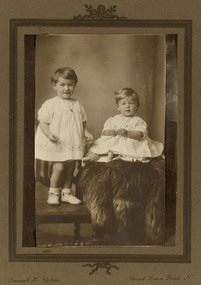
Photograph, Frank Wright (left) and his brother, Alex, c 1903 - 1904
... The Frank Wright Medal at the Royal South Street competition is awarded to an individual recognized as making an outstanding contribution to brass music in Australia. frank wright alex wright young children Printed on the front of the mount - Percival K. Upton. Stroud Green Road, N. A mounted, studio ...Frank Wright was a renown resident of Smeaton, where he was born. He lived at Laura Villa, and attended Smeaton State School. His father William was a gold miner and his mother's name was Sarah. Their family won many singing and instrumental awards. Frank was tutored by Percy Code and became the Australian Open Cornet Champion by the age of eighteen. A year later, Frank conducted the City of Ballarat Band, and later the Ballarat Soldiers’ Memorial Band. He formed the Frank Wright Frisco Band and Frank Wright and his Coliseum Orchestra. These bands won many South Street awards, and Frank as conductor won many awards in the Australian Band Championship contest. In 1933 Frank Wright sailed to England to conduct the famous St Hilda’s Band and was later appointed Musical Director of the London County Council, where he organized many amazing concerts in parks, in and around the London district. He was made Professor of Brass and Military Band Scoring and conducted at the Guildhall of Music and Drama. Frank was often invited to adjudicate Brass Band Championships around Europe, in Australia, including South Street and in New Zealand. The Frank Wright Medal at the Royal South Street competition is awarded to an individual recognized as making an outstanding contribution to brass music in Australia.A mounted, studio sepia photograph of two children. The younger child is sitting on an animal fur rug beside the older child who is standing on a chair.Both children are in dresses, with the older child wearing shoes and socks. The children are Frank Wright and his brother Alex. It appears that the photograph has been pasted over another photograph and the information printed on the mount refers to that underneath.Printed on the front of the mount - Percival K. Upton. Stroud Green Road, N.frank wright, alex wright, young children -
 Federation University Historical Collection
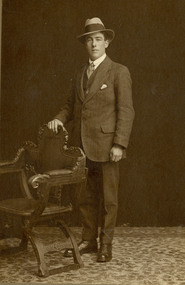
Photograph, Tesla Studios, Maurice Wright, 11/1919
... The Frank Wright Medal at the Royal South Street competition is awarded to an individual recognized as making an outstanding contribution to brass music in Australia. maurice wright frank wright new zealand Hand written on back - With best wishes from Maurice Nov. 1919 Printed on back - The 'Tesla Studios', Wanganui, N.Z. ...Maurice Wright was the brother of Frank Wright. Frank Wright was a renown resident of Smeaton, where he was born. He lived at Laura Villa, and attended Smeaton State School. His father William was a gold miner and his mother's name was Sarah. Their family won many singing and instrumental awards. Frank was tutored by Percy Code and became the Australian Open Cornet Champion by the age of eighteen. A year later, Frank conducted the City of Ballarat Band, and later the Ballarat Soldiers’ Memorial Band. He formed the Frank Wright Frisco Band and Frank Wright and his Coliseum Orchestra. These bands won many South Street awards, and Frank as conductor won many awards in the Australian Band Championship contest. In 1933 Frank Wright sailed to England to conduct the famous St Hilda’s Band and was later appointed Musical Director of the London County Council, where he organized many amazing concerts in parks, in and around the London district. He was made Professor of Brass and Military Band Scoring and conducted at the Guildhall of Music and Drama. Frank was often invited to adjudicate Brass Band Championships around Europe, in Australia, including South Street and in New Zealand. The Frank Wright Medal at the Royal South Street competition is awarded to an individual recognized as making an outstanding contribution to brass music in Australia.Black and white photograph of a man standing in a formal pose holding the back of an ornate chair. The backdrop is a dark curtain and the man is standing on a floral carpet. The man is wearing a suit and light coloured hat with a dark hat band. The man is Maurice Wright.Hand written on back - With best wishes from Maurice Nov. 1919 Printed on back - The 'Tesla Studios', Wanganui, N.Z.maurice wright, frank wright, new zealand -
 Federation University Historical Collection
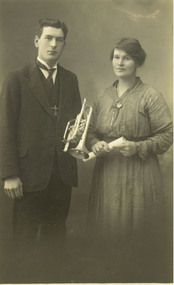
Photograph, Eden Studio, Frank Wright and his sister Laura, 30/6/1920
... The Frank Wright Medal at the Royal South Street competition is awarded to an individual recognized as making an outstanding contribution to brass music in Australia. frank wright laura wright cornet player brass band Frank Wright (18), Laura Wright (24) 30/6/1020. Eden Studio ...Frank Wright was a renown resident of Smeaton, where he was born. He lived at Laura Villa, and attended Smeaton State School. His father William was a gold miner and his mother's name was Sarah. Their family won many singing and instrumental awards. Frank was tutored by Percy Code and became the Australian Open Cornet Champion by the age of eighteen. A year later, Frank conducted the City of Ballarat Band, and later the Ballarat Soldiers’ Memorial Band. He formed the Frank Wright Frisco Band and Frank Wright and his Coliseum Orchestra. These bands won many South Street awards, and Frank as conductor won many awards in the Australian Band Championship contest. In 1933 Frank Wright sailed to England to conduct the famous St Hilda’s Band and was later appointed Musical Director of the London County Council, where he organized many amazing concerts in parks, in and around the London district. He was made Professor of Brass and Military Band Scoring and conducted at the Guildhall of Music and Drama. Frank was often invited to adjudicate Brass Band Championships around Europe, in Australia, including South Street and in New Zealand. The Frank Wright Medal at the Royal South Street competition is awarded to an individual recognized as making an outstanding contribution to brass music in Australia.A black and white photograph showing a man holding a cornet and a woman holding a scroll of paper. The man is Frank Wright and the woman is Laura Wright his sister.Frank Wright (18), Laura Wright (24) 30/6/1020. Eden Studio, Sturt St., Ballarat. Post Cardfrank wright, laura wright, cornet player, brass band -
 Federation University Historical Collection
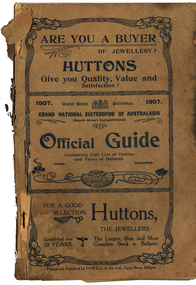
Book - Programme, South Street Eisteddfod Official Guide, 1907, 1907
... Studio; D. Lem Chinese Medical Practitioner, Bosisto's Eucalyptus Oil, Ronaldson Bros & Tippett, Unicorn HOtel, Mrs F. Allen Caterer, Coles & Pullum, J.C. Dillon & Co., Surrey Tannery, Coulthard's Ballarat Business College, George Farmer, MrBride's Boots, L.J. Austin, Dyason's, Ballarat Brewing Company, Phoenix Brewery, Royal...Studio; D. Lem Chinese Medical Practitioner, Bosisto's Eucalyptus Oil, Ronaldson Bros & Tippett, Unicorn HOtel, Mrs F. Allen Caterer, Coles & Pullum, J.C. Dillon & Co., Surrey Tannery, Coulthard's Ballarat Business College, George Farmer, MrBride's Boots, L.J. Austin, Dyason's, Ballarat Brewing Company, Phoenix Brewery, Royal ...South Street competitions have been held in Ballarat since 1991.Official guide to the 1907 South Street competitions. Images include: Prince of Wales, Lord Northcote, W.D. Thomas, South Street Competition Executive Committee (W.H. Pearson, W.H. Chandler, A. Prichard, W.H. Richards, W.D. Hill, Col. Williams, W.D. Thomas, F. Besemeres, F.J. Martell, J.T. Morris. F.J. Williams, R. Maddern, R.J. Gribble), Sir John Madden, Lord Tennyson, W.D. Hill, Frederick Bevan, Ballarat (Sturt Street), Lake Wendouree (Yachts), J.W. Beswick, Lawrence Campbell, City of Ballarat Mayor and Councillor (Mayor Brawn, E. Williams, E. Morey. Cr Brokenshire, J. Whykes, J.M. Barker, G. Crocker, W.D. Hill, R. Pearse, T. Hollway), Ballarat East Mayor and Councillors (J. Gent, Cr Glendenning, J.N. Dunn, I. Pearce, C. Bunting, A. Levy, J. Ritchie, J. McNeil, A. McKenzie, Cr Penhalluriak), Sturt Street Looking West, Old Curiosity House, Entrance to the Ballarat Fine Art Gallery, Interior of the Ballarat Fine Art Gallery, Ballarat East Town Hall and Gardens, Lake Wendouree Ferry, W.E. Swenson, S.B. Swenson, J.G.M. Swenson, Rev. T. Flynn, Edwards' Pyrites, Lestor's Hotel, Sunshine Sheild, W to W Shield, Frank Herman, W.F. Coultman, Marks' Trophy, Lighthouse Port Fairy, R. Correll Music Seller, James Smith, Isaac Pitman, Arthur Brumfield, Hugh Leschen, John Robson, St Augustine's Band Geelong, Moorabool Falls, Kirks Dam, Ballarat Choral Society, Alfred Deakin, James Long, Hugh McKay Advertisements include: Huttons the Jewellers, Sam Jamieson, Sun Foundry, City Saw Mills, Blomeley Bros Iron and Brass Founders, G. Bongiorno- Railway Fruit Palace, Henry Brind & Co., Andrew Cant, Harrison's Foundry, Umbrella and Sunshade Emporium, Ballarat City Baths, Ballarat Coffee Palace, Irwin's Provincial Hotel, Victa Studio; D. Lem Chinese Medical Practitioner, Bosisto's Eucalyptus Oil, Ronaldson Bros & Tippett, Unicorn HOtel, Mrs F. Allen Caterer, Coles & Pullum, J.C. Dillon & Co., Surrey Tannery, Coulthard's Ballarat Business College, George Farmer, MrBride's Boots, L.J. Austin, Dyason's, Ballarat Brewing Company, Phoenix Brewery, Royal Standard Brewery, Edwards' Pyrites, Lestor's Hotel, Robson's College of Music, James A. Gear, Williams Shoemen, Tekardo Brothers, Powell & Co.south street competitions, eisteddfod, chinese herbalist, south street, r.b. lemmon, g. bongiorno, w.d. thomas, john madden, lord tennyson, w.d. hill, frederick bevan, j.w. beswick, lawrence campbell, boer war memorial, queen victoria statue, curiosity shop, m.b. john foundry, ballarat east town hall and gardens, sunshine shield, hugh victor mckay, w to w shield, w.j. coltman, frank herman, j. hutton-jones, t. downer, j. marks, hutton and co trophy, marks trophy, hugh leschen, john robson, st augustine's band, geelong, downer trophy, trekardo brothers, moorabool falls, kirks dam, ballarat choral society, alfred deakin, challenge cup, james long, grand national eisteddfod of australasia, ballarat east gardens, ballarat east town hall -
 Federation University Historical Collection
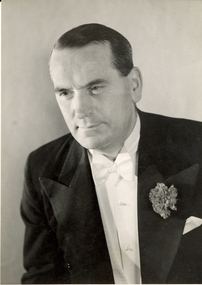
Photograph - black and white, Cyril Arnold, Frank Wright, mid 1900s
... The Frank Wright Medal at the Royal South Street competition is awarded to an individual recognized as making an outstanding contribution to brass music in Australia. frank wright conductor brass band Printed on back - Photo by:- Cyril Arnold, 15 Grape St., London, W.C.2, Phone--Temple Bar 0573 Written in pen on back - 1779/c Black and white studio photograph of the torso of a man dressed in a dinner suit with a carnation in the buttonhole. ...Frank Wright was a renown resident of Smeaton, where he was born on 2 August 1901. He lived at Laura Villa, and attended Smeaton State School. His father William was a gold miner and his mother's name was Sarah. Their family won many singing and instrumental awards. Frank was tutored by Percy Code and was awarded a gold medal for the highest marks in the ALCM examinations in the British Colonies at the age of seventeen years. He became the Australian Open Cornet Champion by the age of eighteen. A year later, Frank conducted the City of Ballarat Band, and later the Ballarat Soldiers’ Memorial Band. He formed the Frank Wright Frisco Band and Frank Wright and his Coliseum Orchestra. These bands won many South Street awards, and Frank as conductor won many awards in the Australian Band Championship contest. In 1933 Frank Wright sailed to England to conduct the famous St Hilda’s Band and was later appointed Musical Director of the London County Council, where he organized many amazing concerts in parks, in and around the London district. He was made Professor of Brass and Military Band Scoring and conducted at the Guildhall of Music and Drama. Frank was often invited to adjudicate Brass Band Championships around Europe, in Australia, including South Street and in New Zealand. The Frank Wright Medal at the Royal South Street competition is awarded to an individual recognized as making an outstanding contribution to brass music in Australia.Black and white studio photograph of the torso of a man dressed in a dinner suit with a carnation in the buttonhole. The man is Frank Wright.Printed on back - Photo by:- Cyril Arnold, 15 Grape St., London, W.C.2, Phone--Temple Bar 0573 Written in pen on back - 1779/cfrank wright, conductor, brass band -
 Federation University Historical Collection
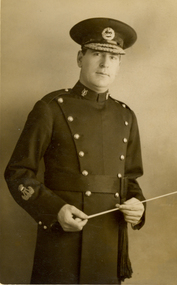
Photograph - Sepia, Frank Wright, Conductor of St Hilda's Band, London, 16/3/1934
... The Frank Wright Medal at the Royal South Street competition is awarded to an individual recognized as making an outstanding contribution to brass music in Australia. frank wright brass band st hilda's band conductor 16 MAR 1934, British made, Jerome Sepia studio photographs of a man in a band uniform. ...Frank Wright was a renown resident of Smeaton, where he was born on 2 August 1901. He lived at Laura Villa, and attended Smeaton State School. His father William was a gold miner and his mother's name was Sarah. Their family won many singing and instrumental awards. Frank was tutored by Percy Code and was awarded a gold medal for the highest marks in the ALCM examinations in the British Colonies at the age of seventeen years. He became the Australian Open Cornet Champion by the age of eighteen. A year later, Frank conducted the City of Ballarat Band, and later the Ballarat Soldiers’ Memorial Band. He formed the Frank Wright Frisco Band and Frank Wright and his Coliseum Orchestra. These bands won many South Street awards, and Frank as conductor won many awards in the Australian Band Championship contest. In 1933 Frank Wright sailed to England to conduct the famous St Hilda’s Band and was later appointed Musical Director of the London County Council, where he organized many amazing concerts in parks, in and around the London district. He was made Professor of Brass and Military Band Scoring and conducted at the Guildhall of Music and Drama. Frank was often invited to adjudicate Brass Band Championships around Europe, in Australia, including South Street and in New Zealand. The Frank Wright Medal at the Royal South Street competition is awarded to an individual recognized as making an outstanding contribution to brass music in Australia.Sepia studio photographs of a man in a band uniform. He is holding a baton in a different position in each photo. The man is Frank Wright and the band is St. Hilda' s Brass Band.16 MAR 1934, British made, Jeromefrank wright, brass band, st hilda's band, conductor -
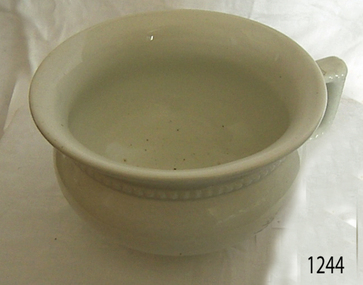 Flagstaff Hill Maritime Museum and Village
Ceramic - Chamber Pot, J & G Meakin, Early to mid 20th century
... 'Sol' (c.1912-1963), 'Studio' (1953 on) and 'Royal Staffordshire' (post-1968) were important J. & G. ...'Sol' (c.1912-1963), 'Studio' (1953 on) and 'Royal Staffordshire' (post-1968) were important J. & G. ...In the 19th and early 20th centuries, J. & G. Meakin were important, large-scale producers of good quality, ironstone tableware (‘White Granite’ ware) that met a ready market in the United States, South America, Australia, and other traditional British markets. By the 1890s the company was one of the world’s largest earthenware manufacturers. Although export teaware and tableware was the factory’s staple commodity, Meakin also manufactured toilet ware, kitchenware and a wide range of fancy earthenware. The company was amongst the first British pottery firms to experiment with modernist designs associated with the art deco period. The Moderne' range was introduced in 1929 consisting of an angular shape decorated design with geometric patterns and often highlighted with silver or gold. This range remained in production through the 1930s. Post 1945 the company introduced the streamlined Studio shape (1953) and Horizon shape (1955) both heavily influenced by the Russell Wright ‘American Modern’ tableware. In 1964 a new Studio shape was released with tall streamlined coffee pots used as the background for many contemporary patterns now associated with the 1950s and 1960s. Designs by Jessie Tate and Eve Midwinter, some originally found on Midwinter shapes, also appear on 1970s Studio ware. The Studio range was one of Meakin’s most successful and continued in production until the late-1970s. The enormous range of floral, geometric, and abstract designs make Studio Ware collectible in its own right. In the 1970s and 1980s as part of the Wedgwood Group Meakin produced contemporary products under the 'Bull in a China Shop' and 'Creative Tableware' names. 'Sol' (c.1912-1963), 'Studio' (1953 on) and 'Royal Staffordshire' (post-1968) were important J. & G. Meakin Ltd trade names. Meakin marks are numerous, but all include the J. & G. Meakin name. The significance of this item and pottery generally is that often earthenware is portrayed as being a landmark in the evolution of humanity. This is because these items are the few things from the past that have survived in a tangible form. Pottery is an important functional part of society and it has a critical role to play as it helps archaeologists to date other artefacts of the same time period. Also, the decorations on pottery have told much about the beliefs, lifestyles and lives of the people who bought them and used them. In other words it gives us today a snapshot of society from the past and how people used these items in their daily lives, their likes as well as societal and design trends. Chamber pot ceramic white with handle at side and decoration around top. Unclearwarrnambool, shipwrecked-coast, flagstaff-hill, flagstaff-hill-maritime-museum, shipwreck-coast, flagstaff-hill-maritime-village, champer pot, personal hygiene, personal item, ceramic pot, domestic object
